THERMAL COMFORT OF GURUSINA TRADITIONAL HOUSE (SA’O)
IN FLORES
Khotijah Lahji1, Agustin Lakawa2, M. Bambang Susetyarto3, Rita Walaretina4
Department of Architecture, Faculty of Civil Engineering and Planning Trisakti University, Jakarta [email protected]
ABSTRACT
Sa‘o traditional house in Gurusina, Flores is a house that was designed based on local wisdom, with regard to the concept of tropical architecture. Thermal factors (temperature, humidity, wind speed) and heat gain due to the design and to the building envelope materials are the important factors in determining the level of thermal comfort on a building. The purpose of this study was to determine the relationship among several aspects of the
design i.e. the shape, the orientation, and the sheath material against heat gain and thermal comfort of Sa‘o
traditional house. The research method was conducted through (1) direct measurement of thermal profile both
inside and outside of Sa‘o traditional house, (2) heat gain based on OTTV calculation (overall thermal transfer
value), (3) thermal sensation prediction of the occupants by using PMV analysis (predicted mean vote) and PPD (predicted percentage of dissatisfied). The OTTV analysis indicates that heat value inside the house especially at One and Teda One rooms is 25.54 watt/m² and RTTV is 8,1watt/m², the value that is recommended by SNI 6389-2011 in that it is less than 35 W/m2 which can be considered as environmentally friendly building. While, the analysis of thermal sensation through the PMV and PPD represents the sensation of comfort level of the
occupants in each room of Sa‘o traditional house (Wewa, Piro Sa'o, Lago Sa'o, Kolong, Wewa Teda, Teda One,
One). The results show that in the mornings all of the rooms are considered as comfortable, but in the afternoon Teda One and One room are considered as less comfortable due to the lack of wind flows in both rooms. Based on the results of this study, some sets of recommendations will be provided as a reference in improving thermal comfort of Gurusina traditional houses in Flores.
Keywords: Thermal comfort, traditional house of Sa‘o
1. INTRODUCTION
Sa’o traditional houses in the Gurusina, Flores are designed based on the concept of tropical architecture by considering local wisdom or local culture in terms of setting the orientation in a centralized pattern. The centre of orientation is a wide open space in the middle of the village (kisa loka) which can be used for various activites by all the indigenous villagers of Gurusina. This open space (kisa loka) facility encourages the movement of quite high windspeed i.e. 1 .6-3.3m/secas the potential of micro climate to achieve a thermal comfort at Sa’o traditional house. The construction of traditional house is a house on stilts as a response and protection to the micro environment by using local materials, such as fibers f or roof covering, woods and bamboos for walls and floors, wood coloumns and stone pedestal for foundation. Space
hierarcy of Sa‘o traditional house is composed from the outside into the inside which consists of several rooms i.e. Loka (yard), Wewa (link the outside and inside space), Teda Wewa (terrace), Teda One (living room), and One (private room). Tropical rules rare taken very much into consideration, among others by using large/high angle roof form to reduce the heat in the room. From the field observation, it is concluded that although Sa’o traditional house has been built to respond to the environment, yet there is still less comfortable space, especially at noon in the One room in which the occupants claimed as less comfortable warm. This less comfortable condition will be observed during this study.
room. From the analysis, One and Teda One rooms are the rooms that are recommended because the four sides of the rooms are oriented with the building envelope. However, rooms with only have roof covering without building envelope can not be analyzed by using OTTV and RTTV. In addition, more rooms will be analyzed by using PMV and PPD alone, in that the result will provide a comfort level qualitatively.
2. METHODOLOGY
To collect information and data on the topics being studied, there are several methods used, i.e. observation and interviews, field measurements by using some of the measurement instruments, such as: anomemeter, air quality measurement, and digital distance measurement/distance meter. As for the steps in conducting the study are as follows: (1)Direct measurement of thermal aspects inside and outside of Sa‘o traditional house, (2)OTTV and RTTV analysis resulted on the heat value inside the room especially at
One and Teda One in Sa‘o traditional house, (3)Prediction of thermal comfort sensation of its occupants by
usirng PMV and PPD analysis, in order to reach the level of thermal comfort sensation of the occupants, and (4) The results of the above analyses are expected to provide recommendations for architectural concept of Sa'o traditional house with green environmentally friendly in Flores based on Green Building Council Indonesia (2011).
3. LITERATURE REVIEW
3.1. OTTV (Overall Thermal Transfer Value)
OTTV pays special attention to a fairly passive design which has the role in achieving thermal comfort and as one of the criteria for energy savings and environmentally friendly building. The passive design is referred to as the building envelope consisting of a wall or a building facade and roof. The use of facade and roof materials determines the temperature in the room, because all the materials have the properties of transferring solar heat radiation into the room. The amount of solar heat radiation becomes the greatest external heat source that will contradict with the use of sunlight as a source of day lighting, which can lessen the energy lighting in the room. OTTV and RTTV analysis will be used to measure room heat caused by passive design or building envelope in order to calculate the sun orientation as the determinant fariable of room heat.The goal of OTTV and RTTV analysis is to explore in room acquisition of heat, which in turn is aimed at encouraging energy efficiency through building envelope design by using GBCI worksheet, which will calculate the amount of heat in the room such as the external heat through the building facade (OTTV Value) for walls and through the building roofs (RTTV value).
Step-by-step OTTV analyses based on SNI ISO 6389-2011 areto (1) determine the extent of building envelope materials, (2) determine the value of sun absorption from the use of materials and the surface color
of the building envelope (α), (3) determine the Uvalue (thermal transmission) of wall materials both massive and transparent sheath (U), (4) determine the shading coefficient penetration on the envelope design (SC), (5) determine the factors of solar radiation in watts/m² (SF) and the equivalent temperature difference (T deck), (6) calculate OTTV on the building envelope/wall. From the six steps, the OTTV value/heat gain through the wall would be found. The standard of green/sustainable building according to ISO standards and OTTV GBCI is when the value is less than 35 watts/m² as an early indicator of green/sustainable building. The formula of OTTV is as follows:
Description: OTTV (Overall Thermal Transfer Value), (α) absortant material value and color A1
massive/transparent of wall size (Tdek): the equivalent unit of temperature difference (K), (UW1 ... n): termal walltransmission and massive roof, (Uf) the transmission of thermal penetration, (SF): factor of solar
radiation, (ΔT): design temperature difference between outside and inside of the room. The coefficient supporting values of the above formula are as follows:
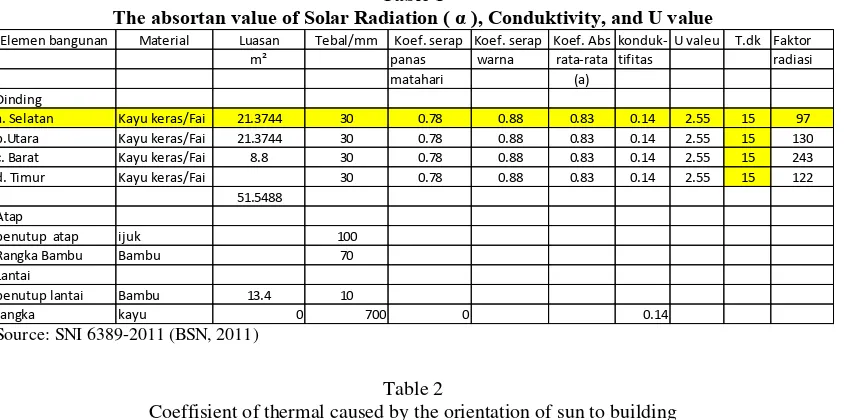
Table 1
The absortan value of Solar Radiation ( α ), Conduktivity, and U value
Elemen bangunan Material Luasan Tebal/mm Koef. serap Koef. serap Koef. Abs konduk- U valeu T.dk Faktor
m² panas warna rata-rata tifitas radiasi
matahari (a)
Dinding
a. Selatan Kayu keras/Fai 21.3744 30 0.78 0.88 0.83 0.14 2.55 15 97
b.Utara Kayu keras/Fai 21.3744 30 0.78 0.88 0.83 0.14 2.55 15 130
c. Barat Kayu keras/Fai 8.8 30 0.78 0.88 0.83 0.14 2.55 15 243
d. Timur Kayu keras/Fai 30 0.78 0.88 0.83 0.14 2.55 15 122
51.5488 Atap
penutup atap ijuk 100
Rangka Bambu Bambu 70
Lantai
penutup lantai Bambu 13.4 10
rangka kayu 0 700 0 0.14
Source: SNI 6389-2011 (BSN, 2011)
Table 2
Coeffisient of thermal caused by the orientation of sun to building
ORIENTASI U: Utara TL: Timur Laut T: Timur TGR; tenggaraS; Selatan BD: Barat daB: Barat BL Barat Laut
130 113 122 97 97 176 243 211
Source :SNI 6389-2011 (BSN, 2011)
3.2 RTTV (Roof Thermal Transfer Value)
Step-by-step RTTV analyses based on ISO 6389-2011 are(1) determining the size of roof construction and the suitable roof materials, (2) determining the sun absorption value from the use of materials and the color of
the roof surface (α), (3) determining the Uvalue (thermal transmission) of roofing materials (U), (5) determining the factors of solar radiation in watts/m² (SF) and equivalent temperature difference (T deck), (6) calculating the RTTV valueof the building envelope/wall. From the six steps, the OTTV/heat gain through the wall would be found. The standard of green/sustainable building according to ISO standards and RTTV GBCI is when the value is less than 35 watts/m² as an early indicator as the green/sustainable building. The RTTV formula is:
3.3 PMV (Predicted Mean Vote) and PPD (predicted Percentage of Dissatisfied) to the thermal sensation
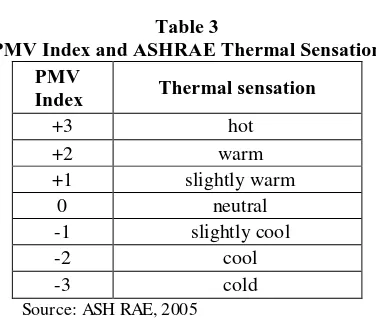
PMV according to SNI (BSN, 2001) as comfortable temperature is <27,1oC and> 20,5oC with a humidity of 40% -60%.Predicted Mean Vote (PMV) was first introduced by Fanger (1970), this method is used to indicate the perception of thermal comfort level in humans through the chill index values of up to a sense of warmth. PMV in the comfort range according to ASH RAE worth -0.5 <PMV <+0.5. PMV index on the ASHRAE reference scale and the thermal sensation can be seen in the following Table 3
:
Table 3
PMV Index and ASHRAE Thermal Sensation PMV
Index Thermal sensation
+3 hot
+2 warm
+1 slightly warm
0 neutral
-1 slightly cool
-2 cool
-3 cold
Source: ASH RAE, 2005
Variables used in the PMV calculation are six factors that affect thermal comfort that was issued by ASHRAE (1989), which are: (1) Air Temperature, (2) Mean Radiant Temperature, (3) Wind Speed, (4) Humidity, (5) Clothing insulation, (6) Metabolic Rate/PPD Activity is a percentage value that describes the prediction of dissatisfied occupants to environmental conditions. PPD percentage value is linked to the PMV, in general, the larger the percentage of PPD, the smaller the level of satisfaction with thermal comfort in the environment. Comfortable standart of PPD is less than 10% (ASHRAE). The PPD Value can be seen in the following Table 4:
Tabel 4
The Correlation of PMV Index, Thermal Sensation and PPD PMVIndex Thermal senstion PPD (%)
+3 hot 100
+2 warm 75
+1 slightly warm 25
0 neutral 5
-1 slightly cool 25
-2 cool 75
-3 cold 100
Source: ASHRAE, 2005
The calculation analysis of PMV and PPD is done by using the applica tion which can be downloaded through http://comfort.cbe.berkeley.edu/ as it is displayed on Figure 1 below.
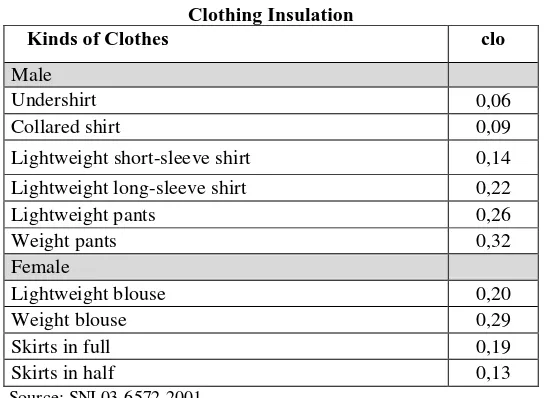
The amount of heat released by the body is affected by the type of clothing that is being worn at the time, particularly in regards to the size of thermal insulation of the clothing materials and its thickness as expressed in Table 5. Thermal insulation materials that worn expressed in clo, where: 1 clo = 0.155 m2.K/ Watt.
Table 5
Aktivities Btu/ (jam/m2) met
Break
Cleaning the house 37-63 2,0-3,4
Seating, heavy movements on limbs 41 2,2
Source: SNI 03-6572-200 (BSN, 2011)
4. DISCUSSION
4.1. Gurusina Climate
for the Gurusinaindigenous villagers.This open space facilitypromotes the high wind speed at 1.6-3.3 m/sec, as can be seen from the following Figure 2 about the condition of Gurusina settlement:
Figure 2. Gurusina site and building typology
4.2. Sa’o Traditional House
The hierarcy of Sa’o traditional house is composed from the inside room in which consists of One, Teda One, and Billi, the three rooms can be analysed by using OTTV and RTTF. Whilst other rooms i.e. WewaSao, Teda Wewa, and Lago Sao, Left Piro, Right Bheli, Vault are the rooms which can be used by the occupants. The
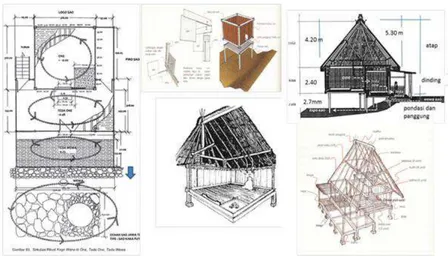
construction of Sa‘o traditional house is a stilt house as a response and protection to the microenvironment by
using local materials such as fibers for roof, woods and bamboos for walls and floors, woods and stone pedestal for foundation. The construction of Sa‘o traditional house can be seen in Figure 3 and Table 7 below.
Table 7
Thermal Aspect Condition (time, temperature, wind, humidity) Tempt
Piro Sa’o kiri 07.10-07.34 24.2 0.0 56.7
Piro Sa’o
Kanan 07.10-07.34 24.6 0.0 58.1
5. ANALYSIS AND RESULTS
a. OTTV and RTTV Analysis
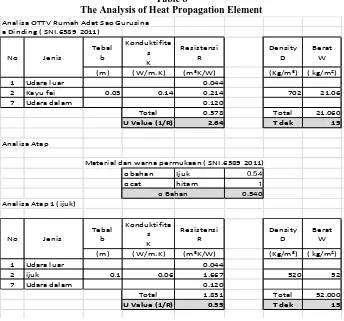
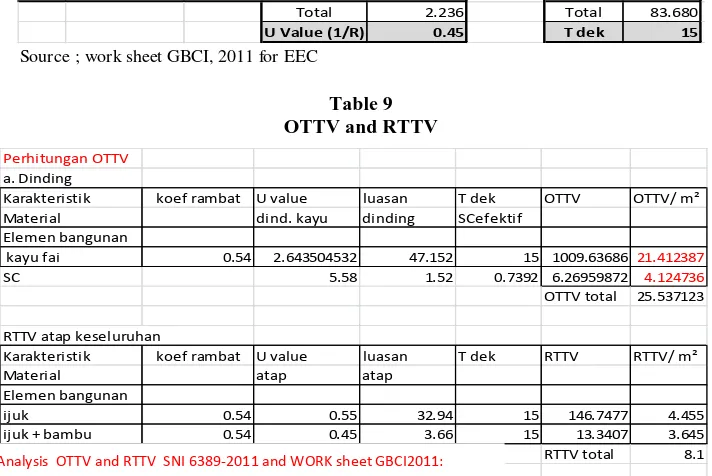
Analytical procedures of OTTV and RTTV were conducted to analyse the differences in temperature equivalent (Tdek), color and absorptant materials, thermal material transmission to heat, resistance and condusive as can be seen in Table 8 whilst Table 9 describes the value of heat propagation through the building envelope of Gurusina traditional house in Sa’o.
Table 8
The Analysis of Heat Propagation Element
Analisa OTTV Rumah Adat Sao Gurusina
2 Kayu fai 0.03 0.14 0.214 702 21.06
7 Udara dalam 0.120
Total 0.378 Total 21.060
U Value (1/R) 2.64 T dek 15
Analisa Atap
Material dan warna permukaan ( SNI.6389 2011)
Applying Local Knowledge
3 bambu 0.06 0.148 0.405 528 31.68
7 Udara dalam 0.120
design of wall sheathing of Sa‘o traditional house can be categorized as low; so that, this Sa‘o traditional
house from thermal aspects point of view through the building envelope design is considered as environment friendly aspect.
b. PMV and PPD Analysis
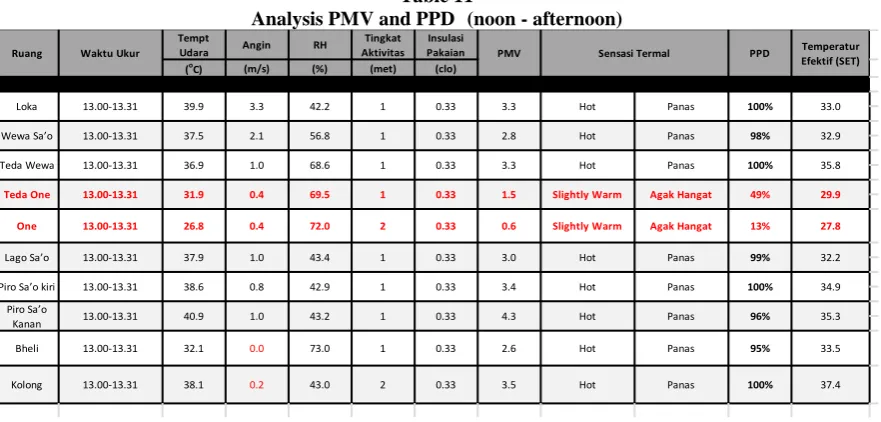
Analysis PMV is an analysis that predicts the level of thermal comfort of the occupants in a comfortable thermal room which is influenced by outdoor and indoor temperatures, the activities and clothing of residents. The data simulation measurement in the field i.e. the measurement of temperature and humidity and wind speed as well as interview of the occupants on thermal comfort perceived. The results obtained are described in Table 10 on PMV and PPD simulation in the morning from 07.00-10.00-12.00 WIT. Whereas Table 11 describes the results of the analysis of the PMV and PPD at noon and afternoon from 13.00.- 15:00 WIT.
Perhitungan OTTV a. Dinding
Karakteristik koef rambat U value luasan T dek OTTV OTTV/ m²
Material dind. kayu dinding SCefektif
Elemen bangunan
kayu fai 0.54 2.643504532 47.152 15 1009.63686 21.412387
SC 5.58 1.52 0.7392 6.26959872 4.124736
OTTV total 25.537123
RTTV atap keseluruhan
Karakteristik koef rambat U value luasan T dek RTTV RTTV/ m²
Material atap atap
Elemen bangunan
ijuk 0.54 0.55 32.94 15 146.7477 4.455
ijuk + bambu 0.54 0.45 3.66 15 13.3407 3.645
36.6 RTTV total 8.1
Table 10
Analysis PMV and PPD (morning – noon)
Based on the results of PMV and PPD analysisduring morning hours from 07:00 to 10:00 WIT, it can be concluded that, in the morning the whole room has a thermal sensation within the range of cold to cool. The most comfortable thermal sensation roomisOneroom with a value of PMV (-0.3).Other rooms are considered less comfortably cool whilst the room which is considered comfortably cool by PMV is between the value of -0.5 <PMV +0.5.
Table 11
Analysis PMV and PPD (noon - afternoon) Tempt
One 13.00-13.31 26.8 0.4 72.0 2 0.33 0.6 Slightly Warm Agak Hangat 13% 27.8
Bheli 13.00-13.31 32.1 0.0 73.0 1 0.33 2.6 Hot Panas 95% 33.5
Kolong 13.00-13.31 38.1 0.2 43.0 2 0.33 3.5 Hot Panas 100% 37.4
96%
1 0.33 4.3 Hot Panas
100% 34.9
Piro Sa’o
Kanan
13.00-13.31 38.6 0.8 42.9 1 0.33 3.4 Hot
35.3
1 0.33 1.5 Slightly Warm Agak Hangat
35.8
Teda One
13.00-13.31 36.9 1.0 68.6 1 0.33 3.3 Hot
Teda Wewa
13.00-13.31 39.9 3.3 42.2 1 0.33 3.3 Hot
Loka
32.9 13.00-13.31 37.5
Temperatur Efektif (SET)
Ruang Waktu Ukur PMV Sensasi Termal PPD
At noon all the rooms except Teda One and One havehigh PMV valueand the percentage value of PPD is above 90%, it is concluded that these rooms were considered uncomfortably hot., Based on the PMV and PPD value, the One and Teda Oneroomshave lowest among other rooms, though the thermal sensationgained is
One 07.10-07.34 23.0 0.4 72.0 1 0.33 -0.3 Neutral Netral 7% 23.5
Bheli 07.10-07.34 23.1 0.0 62.5 1 0.33 -1.6 Cool Sejuk 55% 20.8
Kolong 07.10-07.34 24.8 0.2 71.3 1 0.33 -1.0 Slightly Cool Agak Dingin 27% 22.1
Cool 85% 19.2
Loka 07.10-07.34 23.3 1.6 73.0 1 0.33 -3.6 Cold 100%
Temperatur
Teda Wewa 07.10-07.34 25.0 0.0 68.6 1 0.33 -0.7 Slightly Cool 13%
Wewa Sa’o 07.10-07.34
Piro Sa’o kiri 07.10-07.34 24.2 0.0 56.7 1 0.33 -1.1 Slightly Cool 31%
Slightly Cool 23% 22.4
Piro Sa’o
can be recycled within a relatively short duration(bamboo, palm fiber, wood).The method of building the traditional house was based on local knowledge without any cost of transportionin that there is minimal used of energy.
T he r e s ul t s o f P M V a nd P P V a na l ys i s , i n t he mo r n i n g t h e ho u s e i s c o n s i d e r e d comfortable/neutral, and during the noonthere are only two rooms i.e Teda One and One which can be considered almost comfortable/rather warm and other rooms are considered hot.
From the results of the analysis, there are several things to be concluded, i.e:
1. Based on the OTTV and RTTV aspects on building envelope, Teda One and One has metthe standard as a sustainable/environmentally friendly building but based on PMV and PPD analysis, the rooms do not fully meet ASHRAE standards.
2. Based on GBCI Rating, it is stated that the convenience/sensation of occupants in the building can be used as
the final evaluation to be considered whether or not it is a sustainable building. Therefore, Sa‘o traditional house requires a design recommendation to meet the criteria of green buildings.
3. Recommendations to meet thermal comfort are to:
a. Improve the micro-climate by planting vegetation to create shading on the surrounding environment,
so as reducing the outdoor temperature as well as reducing air pollutants if any.
b. Choose appropriate vegetation as recommended by Gurusina traditional community.
c. Use maximalwindto remove heat from outside temperature.
d. Synchronize building orientation to the potential of wind direction if there is no regulation of Gurusina
traditional house in Sa‘o.
e. Add openings at One and Teda One roomsto provide wind flow into the rooms maximally.
f. Evaluate the openings of the traditional house by using CFD software simulation depending on the consultation with Gurusina traditional community.
REFERENCES
1. ASHRAE Standard, 2007, Energi Sta nda rd for Building Except Low-r ise Residentia l Building, S!
Edition.
2. Badan Stadarisasi Nasional, 2011, Konservasi Energi Selubung Bangunan SN! 6389-2011, BSN ,Jakarta
3. Frick Heinz,Ardiyanto Antonius,Darmawan AMS, 2008, !lmu Fisika Bangunan, Penerbit Kanisius, U n
iversitas Soeg ijapranata, Semarang
4. Green Building Council Indonesia, 2014. Panduan Teknis Perangkat Penilaian Bangunan Hijau Versi 1.2.,
Greeship, Jakarta.
5. Lippsmeier, Georg, 1980, Bangunan Tropis, Erlangga, Jakarta
6. Susetyarto, Bambang, M, 2013, Arsitektur Vernakular Keberlanjutan Budaya di Kampung Bena Flores,