Bankrupt accountants and
lawyers
Transition in the rise of professionalism in
Victorian Scotland
Thomas A. Lee
University of Alabama, Tuscaloosa, Alabama, USA and
University of St Andrews, St Andrews, UK
Abstract
Purpose– The purpose of this paper is to study the incidence, impact, and consequences of accountant and lawyer bankruptcies in Victorian Scotland. The paper examines these bankruptcies in the context of an emerging profession separating from an established legal profession as part of the rise of professionalism in the Victorian Age.
Design/methodology/approach– The paper reports data describing 135 accountant and 361 lawyer bankruptcies declared between 1855 and 1904. It uses theories of the rise of professionalism, signals of movement to occupational ascendancy, and social attitudes to money to provide explanations of the incidence, impact, and consequences of these bankruptcies. The paper also examines bankruptcy and the early disciplinary codes of professional accountancy associations. Findings– Despite a trend of general decline in total, accountant, and lawyer bankruptcies in Scotland through the Victorian Age, there is no consistency over time between accountant and lawyer bankruptcies and economic conditions. Bankrupt accountants were typically unregulated as professionals in contrast with bankrupt lawyers who were usually regulated. Accountant and lawyer bankruptcies predominantly involved experienced practitioners, location in major cities, and administration by professional accountants. Bankruptcy was associated with criminal activity in a minority of cases in each profession. There was inconsistency in the post-bankruptcy disciplining of bankrupt accountants and lawyers, and post-bankruptcy loss of economic status in both professions. Practical implications– The paper contributes to the Victorian history of institutionalised professions such as accounting and law. It demonstrates the presence of marginal practitioners in emerging and established professions, the need to study professionalisation in social context, and the impact of bankruptcy on discipline in an emerging profession.
Originality/value– The paper represents the first contextualised study of bankruptcy among professionals generally and accountants and lawyers, particularly in the Victorian Age.
KeywordsBankruptcy, Disciplinary code, Fraud, Marginal practitioner, Money, Professionalism, Public accountancy, Occupational ascendancy, Accountants, Lawyers, Professions, Scotland Paper typeResearch paper
Introduction
This study examines cases of bankruptcy among Scottish accountants and lawyers between 1855 and 1904[1]. This period covers the first half-century of the history of professional accountancy following associational formations in 1853 and 1854, and coincides with much of the Victorian Age from 1837 to 1901. The purpose of the study is to consider the incidence, impact, and consequences of bankruptcy among accountants and lawyers in a period of professional transition following associational foundation. The transitional period has two dimensions – first, the emergence of accountancy as an organised profession separate from the established legal profession; The current issue and full text archive of this journal is available at
and, second, a more general evolution in professions away from largely unregulated systems of service towards regulated systems dependent on formal standards regulated by professional associations. Use is made of histories of the rise of professionalism by Corfield (1995) and Perkin (1989) to consider marginal practitioners in Victorian professions, Carnegie and Edwards’ (2001) concept of signals of movement to occupational ascendancy in a professional project to consider bankruptcy as a trigger for disciplinary codes in professional accountancy, and Herbert’s (2002) history of “filthy lucre” to comprehend Victorian attitudes to bankruptcy.
The study is longitudinal and contextual in nature. It examines the incidence, impact, and consequences of bankruptcy among accountants during much of the Victorian Age in the context of similar cases affecting lawyers[2]. More specifically, the study contrasts bankruptcy data in relation to time periods, other occupations, locations, occupational communities, completion times, practitioner experience, trustees in bankruptcy, criminal activities, post-bankruptcy disciplining, and post-bankruptcy economic status. The data are taken from records of the Accountant in Bankruptcy[3] in the National Archives of Scotland[4], and from The Edinburgh Gazette (1855-1911)[5]. The paper provides a perspective on the rise of professionalism in the Victorian Age, an explanation of the relationship between nineteenth century accountants and lawyers in Scotland, analyses of archival data relating to the characteristics of accountant and lawyer bankruptcies, and discussion of the main findings.
Social history of professions in Victorian Britain
Abbott (1988, p. 1) observes the history of what he terms “old” or established and “new” or emerging professions as follows:
The professions dominate our world. They heal our bodies, measure our profits, save our souls. Yet we are deeply ambivalent about them. For some, the rise of professions is a story of knowledge in triumphant practice. It is a story of Pasteur and Osler and Schweitzer, a thread that ties the lawyer in the country village to the justice on the Supreme Court bench. For others it is a sadder chronicle of monopoly and malfeasance, of unequal justice administered by servants of power, of Rockefeller medicine men.
In contrast, Perkin’s (1989) social history of professionalism is much less ambiguous than Abbott’s about the success of professions. He argues that nineteenth century hierarchies of professions cut across a long-established “vertical swathe” of functional interest and economic class ranging from landowner to agricultural labourer and from merchant to craftsman (Perkin, 1989, pp. 2-3). Perkin (1989, p. 25) further argues that Victorian professions permeated society sufficiently to supercede the dominance of the ruling classes of landowner and capitalist. His principal thesis is that professionalism was an organising principle that effectively and gradually replaced class over time. He characterises Victorian professionals as a “forgotten middle class” during the late nineteenth century when the social class structure was described typically as “the aristocracy, the trading classes, and the working classes” (Perkin, 1989, p. 362). The Victorian Age was also a period of change within the professional hierarchy, with established professions such as divinity, law, and medicine growing more slowly than emerging professions such as architecture and engineering (and accounting) (Perkin, 1989, pp. 79-80). More specifically, the fortunes of established professions declined as professions generally began to organise by means of incorporated associations (Perkin, 1989, pp. 84-6).
AAAJ
24,7
Millerson (1964, p. 6) describes the emergence of these associations in the context of Victorian perceptions of professionals:
Based on the first professions of the church, law and medicine, a traditional image of the professional evolved. He was a “gentleman,”’ an independent practitioner dispensing a necessary public service of a fiduciary nature. His competence was determined by examination and licence. His integrity was ensured by observance of a strict ethical code. Unprofessional conduct could lead to complete deprivation from further practice. His training and education was institutionalised. Here was the model for all professions.
Millerson (1969, pp. 6-7 and 16-21) questions the validity of this perspective because of the widespread lack of formal standards even in established professions prior to the middle of the nineteenth century and despite a long history for certain professional associations over several centuries. His questioning is consistent with that of Corfield (1995, pp. 223-32) who, in a study of the rise of British professions to 1850, argues that, although they offered social advancement in a world of increasing risk and competition, they had no safety net for unsuccessful practitioners. Corfield (1995, p. 13) characterises the pre-1850 history of professions as comprising traditional “gentlemanly” professionals such as clergymen, lawyers, and doctors who became the new “power-brokers” because of their specialist knowledge. She argues that this history is a “spectrum of social advancement” – a small number of cases of “dazzling success”, a “solid core of respectable achievement”, and a “long, professional tail” Corfield (1995, p. 237). In other words, professions by the middle of the nineteenth century provided a prospect of success that concealed a possibility of failure. Not all professional careers were outstanding and there were many cases of absolute failure or marginal survival. Unsurprisingly in these circumstances, status hierarchies developed in professions and “success or failure was subject to the vagaries of skill and reputation” (Corfield, 1995, p. 230). Earnings and living standards were variable and unstable, haggling over money due for services was deemed unworthy, and a professional lifestyle was hard to sustain for many practitioners who achieved only marginal success by relying on a variety of sources of earnings. Corfield (1995, p. 232) concludes that “a profession was thus not an automatic passport to affluence or security”.
This reality of mixed success among professionals persisted into the second half of the nineteenth century. For example, Perkin (1989, pp. 91-117) argues that, below the practitioner e´lite in each profession, economic wealth and lifestyle was substantially less than that of the e´lite. Indeed, there were persistent economic problems for non-e´lite members of a profession attempting to maintain an expected economic lifestyle and social appearances (e.g. a home in a reputable neighbourhood, employment of domestic servants, and children at fee-paying schools). There was also a sense of insecurity for professionals who were marginal practitioners because of the constant possibility of bankruptcy or loss of employment. This feeling was exacerbated by conflict between the ideal of public service that took the professional above and beyond economic matters, and the necessity that professional services provided sufficient economic reward for the practitioner to survive.
Millerson’s doubts about the formal standards of professionals in Victorian society, Corfield’s disclosure of a spectrum of professional success, survival, and failure, and Perkin’s recognition of marginal practitioners, suggest Victorian professions comprised e´lite occupational groups whose members enjoyed varying degrees of economic and social success when serving the public interest. Occupational e´litism was
Bankrupt
accountants and
lawyers
enhanced by the emergence in the middle to late nineteenth century of “qualifying” associations from which, by means of explicit standards of entry, examination, training, and disciplining, skilled occupations transitioned to organised (and regulated) professions (Millerson (1964), pp. 22-5)[6].
Most theories and histories of the rise of professionalism in the Victorian Age bend towards a story of success and achievement – , e.g. professionals superseding previously dominant social classes of landowners and capitalists. Even critical historians such as Larson (1977, p. 242) focus on success and achievement while recognising social inequality:
Education, intelligence, persistent effort, and social usefulness appear to grant professions dignity and the possibility of full human development. Professionals expect and demand deference in the nonpolitical circumstances of everyday life; they usually get it, most especially from working-class and lower-class clienteles. Is this because of their ability, because of their capacity to help a person in need, because of their credentials, or because of the symbols of their class and status position? It is impossible to say, and it does not really matter; the location of most professionals in middle- and upper-middle social strata infuses the lifestyle and the ethos of the dominant class with meritocratic and ethical legitimations. From the occupational and educational systems, the ideological effect spreads to the whole structure of social inequality.
It is therefore instructive to turn to Corfield’s (1995, p. 237) “long, professional tail” and Perkin’s (1989, p. 96) “marginal men” when presenting evidence that the social history of organised professions in the Victorian Age involved failure as well as success and that, paradoxically, failure positively influenced the professional project.
In this study of accountants and lawyers, failure is defined as the bankruptcy of a professional, a topic rarely commented on by historians of professions. The period of study is 1855 to 1904 and covers the first half-century of the modern history of professional accountancy in Britain following the initial organisational events of the middle of the nineteenth century in Scotland. This was a period of transition for Scottish professional accountants for two reasons. First, following several decades of service provision as a subset of the legal profession, Scottish accountants by the end of the nineteenth century emerged as a professional grouping separate from the legal profession and capable of providing a range of accounting, auditing, and court-related services (Kedslie, 1990, pp. 135-178). Second, within the context of a general change among professional communities in Britain, Scottish accountants transitioned from the professional model described by Corfield (1995) of gentlemanly service in the community devoid of significant disciplinary structures and processes, to that described by Millerson (1964) of qualifying associations with explicit standards of entry, training, regulation, and discipline.
This transition lies at the heart of Larson’s (1977) social history of professions as organised monopolies of competence within capital market structures. She argues that the nineteenth century phase of professionalisation was embedded in several pre-capitalist residues – first, a work ethic expressed as a notion of calling (i.e. professional services had intrinsic value beyond bourgeois means of capitalist accumulation); second, universal service protecting the social fabric within an unequal society (i.e. enhancing professional service as a duty to the community); and, third, the feudal notion of noblesse oblige (i.e. an ideological aversion to providing professional services solely for economic reward) (Larson, 1977, pp. 220-21). Larson (1997, pp. 212-13) further argues that the pre-capitalist phase of professionalisation was
AAAJ
24,7
gradually replaced by a market-orientated focus on objectifying the professional commodity with an exchange value by means of control of education and training by professional associations. She makes no mention, however, of professional failure or disciplinary codes and processes as part of this control.
Abbott (1988, p. 13) characterises Larson’s history of professions as a study of practitioner e´lites maximising personal rewards through collective social mobility. However, as Corfield (1995) and Perkin (1989) argue for the nineteenth century, not all professional e´lites comprised e´lite practitioners. The current study evidences this in the context of the Scottish accountancy and legal professions from 1855 to 1904.
Scottish accountants and lawyers
By the middle of the nineteenth century, Scottish accountants and lawyers co-existed in an occupational relationship very different from a more fractious counterpart in England[7]. Walker (1988, pp. 13-21) describes the Scottish relationship as a positive collaboration, in which accountants formed an important and publicly-recognised subset of the legal profession in the nineteenth century. This was particularly the case in the capital city of Edinburgh, which contained the national courts of law and the senior echelons of the legal profession. Heiton (1861, p. 6) describes the social hierarchy of the legal community in Edinburgh in mid-nineteenth century as follows:
The Aristocrats in family and land will with difficulty condescend to a Paper Lord. The Paper Lords fight shy; they are scarcely anywhere, being too big for the Advocates, and too small for the Honeycombs. The Advocates keep the Writers to the Signet at bay, except when these have a fee in their hands. The Writers to the Signet look askance at the Solicitors before the Supreme Courts, and also at the Accountants; who again will have nothing to do with the Solicitors-at-Law.
Heiton thus observed accountants as part of the hierarchy of the Scottish legal profession – i.e. in descending order of professional status, Lords or judges, Advocates, Writers to the Signet, Solicitors before the Supreme Courts, Accountants, and Solicitors-at-Law. This hierarchy is confirmed in annual listings of the time – , e.g. the legal section ofEdinburgh Gazette, The (1855)-1911)[8]. Heiton (1861, p. 176) characterises Edinburgh as “a huge manufactory of litigation” and “the great number of these law agents is merely an example of the principle of supply and demand” (Heiton, 1861, pp. 180-81). He further identifies accountants as bringing “order” to the “entangled affairs” of lawyers (Heiton, 1861, pp. 185-6).
Scottish lawyers were well established and organised in professional associations by mid-nineteenth century. Organisation started in the sixteenth century and, by 1855, there were three national associations, each located in Edinburgh (i.e. in order of seniority, the Faculty of Advocates, 1532, the Society of Writers to Her Majesty’s Signet, 1594, and the Society of Solicitors in the Supreme Courts, 1797). However, the legal profession was fragmented, with communities of lawyers in numerous cities and towns perpetuating a system of local monopoly of court services. For example, in Edinburgh by 1855 and in addition to the national bodies, there was the Society of Solicitors at Law (1780); in Glasgow, the Faculty of Procurators (1668); and elsewhere in Scotland, the Society of Advocates (Aberdeen) (1774), and the Faculty of Procurators and Solicitors (Dundee) (1820). The Procurators (Scotland) Act 1865 permitted local law associations to incorporate, establish formal entry standards, and preserve local monopolies of court services. As a result, between 1865 and 1888, several additional
Bankrupt
accountants and
lawyers
associations were formed – , e.g. nationally, the Incorporated Society of Law Agents in Scotland (1884); in Edinburgh, the Faculty of Procurators or Solicitors (Edinburgh) (1865); and elsewhere in Scotland, faculties or societies of solicitors or procurators in towns such as Ayr (1866), Greenock (1865), Inverness (1865), and Stirling (1870).
The task of these associations was to organise local communities of lawyers of varying size and little is known of their early standards. Walker (1996, p. 11), however, reports that the national associations had formal disciplinary procedures in place before 1855 – , e.g. the conduct of members of the Faculty of Advocates was examined by judges of the Court of Session who reprimanded, suspended or deposed members; the Society of Writers to the Signet appointed commissioners to investigate delinquent misconduct “for the good of the calling”; and the council of the Society of Solicitors in the Supreme Courts disciplined members “derogatory to the profession”. However, Walker (1996, p. 12) also note that the principal disciplinary approach of the Scottish law associations of the nineteenth century was an emphasis on the spirit or conventions of professional etiquette rather than compliance with codified rules – in other words, an approach consistent with Corfield’s (1995) and Perkin’s (1989) conclusions about the gentlemanly state of professions in the nineteenth century.
Consistent with the above descriptions, and for purposes of data analyses, bankrupt lawyers who were members of national or local law associations are described in this study as “regulated” in order to recognise their potential to be disciplined for unprofessional behaviour and their appearance in public lists as “certified” lawyers[9]. Other lawyers who were not members of law associations or publicly recorded as certified law agents at the time of their bankruptcy are described as “unregulated”.
Between 1855 and 1904, and in contrast to the legal profession, the accountancy profession in Scotland was largely unorganised and unregulated. However, Chartered Accountant members of the Society of Accountants in Edinburgh (SAE, 1853-1886) (chartered in 1854), the Institute of Accountants and Auditors in Glasgow (IAAG) (1854-1890), and the Society of Accountants in Aberdeen (SAA, 1867-1894) were organised with entry, examination, and disciplinary rules in place by 1904 (Kedslie, 1990, pp. 179-217; Shackleton, 1995). Bankrupt Chartered Accountants are categorised in this study as “regulated”. Of the other bankrupt accountants in the study, with the exception of a member of the Scottish Institute of Accountants (SIA), all are treated as “unregulated”[10].
Bankruptcy and disciplinary codes for Scottish accountants
The bankruptcy of Scottish accountants and lawyers has to be placed in social context. According to Hobsbawm (1968, pp. 154-5), Victorian society regarded bankruptcy as a penalty for inefficient business practice, something to be avoided because of the prospect of poverty, disgrace, and ostracism. Unsurprisingly, financial scandal (often including bankruptcy) in the Victorian Age damaged the careers of public figures (Taylor, 2005) despite the law being more tolerant to upper or middle class failure than working class failure ( Johnston, 1993). The fictional depiction of bankruptcy by Victorian authors such as Charles Dickens as a horrifying and tragic affair usefully portrays contemporary social attitudes to financial failure (Landon, 2001; see also Herbert, 2002). As Hunt (2001, p. 8) comments, “credit was virtuous, speculation corrupting, and debt sinful”.
Victorian attitudes to monetary matters are described in detail by Herbert (2002) in a cultural study of fictional and no-fictional writings of the Victorian Age. In particular,
AAAJ
24,7
by means of writings that contrast the sacred or divine and the unclean or dirty, Herbert (2002, pp. 186-190) describes money as the taboo subject for Victorians of “filthy lucre” in a “money-making age”, involving “ready-money” and the elevation of money to a “faith”. Victorians were also significantly influenced by a puritanical Christian faith founded on the paradox of unclean poverty and spiritual richness (Herbert, 2002, pp. 194-5). The taboo of money and monetary wealth was accompanied by inner fears of “bankruptcy, disgrace, beggary” (Herbert, 2002, p. 190). Victorian businessmen and professionals therefore sought wealth and success, but attempted to avoid failure and poverty in what Herbert (2002, p. 191) describes as “an ultimately irreconcilable incongruity between the value system of capitalist bourgeois society, on the one hand, and that of puritanical religion, on the other”.
In addition to this social context, it is also useful to review the effect that bankruptcy had on Scottish accountants within the specific context of professional organisation in the second part of the nineteenth century – in particular, whether the Victorian attitude to financial failure and bankruptcy initiated disciplinary processes to punish those accountants unable to pay their creditors in full. This is relevant with respect to the disciplining of SAE, IAAG, and SAA members in this study. These were the major professional associations in Scotland responsible for regulating Chartered Accountants identified as bankrupt in this study. Details of disciplinary rules were extracted from council and annual general meeting minutes of the SAE, IAAG, and SAA for the period 1855 to 1904. The relevant files in the National Archives of Scotland are SAE (1853-1886), IAAG (1854-1890), and SAA (1867-1894). In addition, a volume of SAE rules for 1853 to 1904 was used SAE (1904).
Looking first at the SAE, Section 8 of its predecessor Institute of Accountants in Edinburgh (IAE) membership rules of 1853 had a single disciplinary provision – i.e. if the annual subscription of an IAE member was two years in arrears and three months’ notice of the debt had been given, the member was named a “defaulter”. There is no explanation given regarding the meaning of “defaulter” or its disciplinary consequence. Amended SAE rules published in 1855, 1876, and 1881 had a single disciplinary provision in Section 40 stating membership was conditional on “complying with the bye-laws, rules and regulations”. This provision is ambiguous and bankruptcy and fraud were therefore not addressed directly by an explicit disciplinary SAE rule by 1881 despite the considerable publicity surrounding the fraud of a prominent SAE founder in 1873 (SAE, 1853-1886, p. 200)[11].
However, in 1883, a further fraud by an SAE founder resulted in the SAE council agreeing a bye-law providing for the expulsion of any member committing “a breach of trust, fraud, misdemeanour, or acts of similar kind” (SAE, 1853-1886, p. 318; see also Walker, 1996, p. 28). Following public exposure and debate of the fraud, the member was declared bankrupt and is a subject in this study[12]. The bye-law became part of the SAE disciplinary code as Section 49 of the published rules of 1888, 1892, 1897, and 1899 and states “in the event of a member being convicted in a competent court of falsehood, fraud, willful imposition, embezzlement, forgery, or other crime or misdemeanour, or fleeing to defraud creditors” the matter would be taken to the annual general meeting of members for their decision to expel (SAE, 1853-1886, p. 132). There were no further changes to the SAE disciplinary code until 1904 when an amendment stated that a court conviction of a member wouldipso factoresult in expulsion (SAE, 1904).
Bankrupt
accountants and
lawyers
The SAE does not appear to have been influenced by the prior disciplinary example of the IAAG. Although there are no surviving details of the earliest IAAG rules, its council in 1868 agreed a bye-law that any member becoming bankrupt wouldipso facto cease to be a member (IAAG, 1854-1890, p. 351). This decision followed bankruptcies involving seven of the 49 founders of the IAAG that culminated in the bankruptcy and suicide of a founder shortly after a very public scandal involving a family member (Lee, 2006, pp. 136-138). Subsequent disciplinary rules and regulations of the IAAG appear to have used ambiguous terms such as “unprofessional or unbecoming conduct” (IAAG, 1931, p. 28). In the case of the SAA in Aberdeen, its first bye-laws in 1867 introduced a provision entitled “Malfeasance of Members” in which it was stated that, should there be suspicion of a member being charged with any “flagrant misdemeanour or breach of duty”, the SAA council would inquire and, if there was a basis found, remit the case to the next annual general meeting for a vote of members to expel (SAA, 1867-1894, pp. 21-22). What this meant in practice is hard to determine. Kedslie (1990, p. 272) reports the case of the SAA president of 1883 who was bankrupted in 1883 and moved to practice in London without any disciplining. On return to Aberdeen in 1896, his poor financial condition remained and the SAA council offered to pay for his emigration. He refused the offer and was struck off, with the SAA repaying him several years of membership fees. There is no evidence in SAA council or annual general meeting minutes to suggest any major changes to the 1867 provision in the remainder of the period of this study.
From the above brief history to 1904, it can be concluded that the major professional accountancy associations in Scotland acted at different times and ways to establish disciplinary regulations covering events such as bankruptcy or criminal activities such as fraud. The SAE explicitly covered cases of fraud from 1883 but did not mention bankruptcy at any time. The IAAG dealt explicitly with bankruptcy from 1868 but did not mention fraud. The SAA mentioned neither bankruptcy nor fraud explicitly at any time during the period. For many years, SAE and SAA decisions about the continuing membership of defaulting members were left to the discretion of fellow members in annual meeting.
This early history of emerging disciplinary codes in Scottish accountancy bodies can be examined through the Carnegie and Edwards (2001, pp. 303-304) conceptual lens of signals of movement to occupational ascendancy in a professional project. As these researchers argue, the formation of a professional association is only one visible signal within the closure process of professionalisation to indicate occupational ascendancy, and other events and actions pre- and post-formation can be identified as further signals (e.g. obtaining a royal charter or arguing for legislation to create service monopolies). Thus, it is suggested here that the post-formation attempts at disciplinary codes were specific signals of movement to occupational ascendancy in the Scottish accountancy profession. However, this history between 1855 and 1904 reveals inconsistencies and ambiguities in the use of such signals, specifically as they relate to bankruptcy and fraud. Unsurprisingly, therefore, the following analyses reveal different experiences and outcomes for regulated accountants and lawyers in this study.
Data analyses
The following analyses of professional bankruptcies and related information use data from reports of the decennial censuses from 1851 to 1911 and bankruptcy files
AAAJ
24,7
maintained by the National Archives of Scotland. Details of these sources are given in individual tables where relevant.
Overall context
Table I provides a demographic background for this study.
Between 1851 and 1911, the Scottish population expanded by 64.7 per cent at an average annual rate of 1.1 per cent[13]. Within this general increase, professions increased by 109.5 per cent, accountants by 122.8 per cent, and lawyers by 94.0 per cent. Comparable increases for the specific later period of 1881 to 1911 are, respectively, 27.3 per cent, 57.7 per cent, 66.8 per cent, and 72.7 per cent. This is consistent with Perkin’s (1989) social history of the rise of professionalism from 1880. The increases for accountants particularly reflect a growing demand for accounting-related services in the Victorian Age (Kedslie, 1990, pp. 114-178) and the membership increases following the formation of the SAE, IAAG, and SAA (113 founding SAE and IAAG members in 1854 increased to 1,298 SAE, IAAG, and SAA members by 1911).
The period 1851 to 1911 contained significant economic changes for Scotland (Devine, 1999, pp. 249-272 and 448-467; Devine et al., 2005, pp. 56-70, 92-97 and 111-125); Knox, 1999, pp. 81-183; McCaffrey, 1998, pp. 55-106). Due to agricultural and industrial developments begun in the first half of the nineteenth century, the 1850s and 1860s featured rapid economic growth and a complete restructuring of the economy from predominantly rural-based agriculture to urban-based industry. Trade increasingly focused on exports in global markets and traditional industries were superceded by manufacturing processes using new technologies. There was considerable demand for skilled workers, average earnings increased, and population growth included inward and outward migrations of semi-skilled and unskilled workers. Thus, Scotland was transformed by the early 1900s into a “world economic power” (Devine, 1999, p. 257), with a prosperous and upwardly-mobile middle-class (Devine, 1999, p. 262) including professionals such as accountants and lawyers who offered a range of services associated with the industrial and commercial changes[14]. However, these changes also exposed the Scottish economy to global
Census totalsa 1851 1861 1871 1881 1891 1901 1911
Accountantsb 852 889 921 1,138 1,199 1,721 1,898
Lawyersc 2,174 2,205 2,125 2,442 3,111 3,970 4,218
Professionalsd 25,703 33,420 35,206 34,159 42,013 51,606 53,855
Total population
(millions) 2.89 3.06 3.36 3.74 4.03 4.47 4.76
Sources and definitions:aCensus (1854, 1864, 1874, 1884, 1893, 1903 and 1913);bIncluding public and commercial accountants, practicing actuaries, and auditors, but excluding apprentices, clerks, bookkeepers, and cashiers;cIncluding Advocates, Writers to the Signet, Solicitors in the Supreme Courts, and other solicitors and writers, but excluding court clerks and law clerks;dCensuses (1854,
1864, 1874 and 1884) are based on a definition of professionals as members of learned professions (i.e.inter alios, clergymen, lawyers, doctors, teachers, etc.), Civil Servants, local government officials, and military officers. Censuses (1893, 1903 and 1913) report the latter three categories separately and data from Censuses (1854, 1864, 1874 and 1884) have been restated to be consistent with Censuses (1893, 1903 and 1913)
Table I. Scottish professional communities and population 1851-1911
Bankrupt
accountants and
lawyers
competition and frequent international business cycles. Despite overall economic growth in agriculture, mining, and manufacturing between 1851 and 1911, there was general stagnation from the early 1870s to the late 1890s and specific slowdowns in the 1880s, early 1890s, and early 1900s. Expectations here are that the economic boom of the 1850s and 1860s led to a decline in business failure and bankruptcy, but stagnation and slowdowns in the 1870s onwards, had the opposite effect.
Scottish bankruptcies
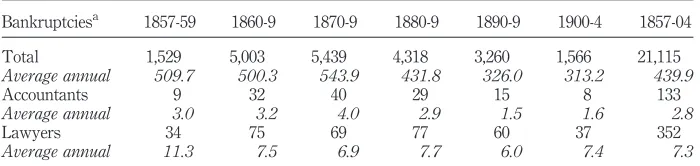
The data in Table II suggest the economic transformation of Scotland between 1855 and 1904 involved failure as well as success.
Table II summarises the bankruptcy cases recorded in Scotland between 1857 (the first year of reporting under the Bankruptcy (Scotland) Act 1856) and 1904 (the last year of this study). Data are those reported annually for the previous year to 31 October by the Accountant in Bankruptcy for Scotland. Total bankruptcies were 21,115 (annual average 439.9), with a high of 5,439 (annual average 543.9) in the 1870s, and a low of 3,260 (annual average 326.0) in the 1880s. Of every ten bankruptcies, seven started in the period 1860 to 1889 (i.e. 14,760 or 69.9 per cent of 21,115). Equivalent data for the accountant and lawyer bankruptcies are, respectively, total 133 (average 2.8), high 40 (average 4.0) in the 1870s, and low 15 (average 1.5) in the 1880s; and total 352 (average 7.3), high 77 (average 7.7) in the 1870s, and low 60 (average 6.0) in the 1880s. More than three-quarters of the accountant bankruptcies were initiated between 1860 and 1889 (i.e. 101 or 75.9 per cent of 133) and more than six of every ten lawyer bankruptcies also started in the same period (i.e. 221 of 352 or 62.8 per cent).
In terms of annual averages, the overall trend from 1857 to 1904 is one of decline – i.e. from a total of 509.7 to 313.2, 3.0 to 1.6 accountants, and 11.3 to 7.4 lawyers. In terms of specific decades, total bankruptcies declined in the 1860s, 1880s, and 1890s, and increased in the 1870s and early 1900s. Accountant bankruptcies increased in the 1860s and 1870s and declined in the 1880s and 1890s. Lawyer bankruptcies increased in the 1880s and early 1900s and declined in the 1860s, 1870s, and 1890s. In other words, assuming the general expectations stated at the end of the previous section, there is no consistent pattern in these data. Increases and decreases are not always consistent with the economic boom of the 1850s and 1860s or the stagnation and specific slowdowns that started in the early 1870s and remained throughout most of the remainder of the period to 1904.
Bankruptciesa 1857-59 1860-9 1870-9 1880-9 1890-9 1900-4 1857-04
Total 1,529 5,003 5,439 4,318 3,260 1,566 21,115
Average annual 509.7 500.3 543.9 431.8 326.0 313.2 439.9
Accountants 9 32 40 29 15 8 133
Average annual 3.0 3.2 4.0 2.9 1.5 1.6 2.8
Lawyers 34 75 69 77 60 37 352
Average annual 11.3 7.5 6.9 7.7 6.0 7.4 7.3
Note:aAdministered under the Bankruptcy (Scotland) Act 1856; 11 bankruptcies (two accountants
and nine lawyers) in 1855 and 1856 were administered under the Bankruptcy Act 1838 and are excluded from the analysis
Sources: NAS (1857-1905); NAS (1856-1905), NAS (1857-1905), NAS (1911) and The Edinburgh Gazette(1855-1911)
Table II.
Scottish bankruptcies: 1857-1904
AAAJ
24,7
The analysis becomes more puzzling in light of the overall decline in bankruptcies during the period of study (Table II) because this resulted in a similar decline in bankruptcy trusteeships for accountants (particularly) and lawyers (Table III and Kedslie, 1990, pp. 117-20). In an era of continuous professional expansion and consequential competition for accounting and legal services (Table I), it is reasonable to expect an increasing number of marginal practitioners generally and accountant and lawyer bankruptcies particularly. However, as demonstrated in Table II, the overall trend for accountant and lawyer bankruptcies is one of decline rather than increase. Economics therefore does not appear to provide an obvious explanation for this paradox and, instead, the answer may be sociological or cultural.
The overall increase in Scottish middle class economic prosperity between 1851 and 1911, as observed by historians such as Devine (1999), Knox (1999), and McCaffrey (1998), may have had a social or cultural effect that particularly impacted professionals such as accountants and lawyers despite increasing numbers and competition for services. More specifically, Herbert’s (2002) thesis of “filthy lucre” and the general Victorian aversion to monetary failure and attendant social disgrace may have imbued in accountants and lawyers an increased desire and commitment to avoid these outcomes, particularly as members of organised professions explicitly committed to serving the public interest and, as reviewed by Millerson (1964), subject to increasingly formal regulation by their professional associations. This desire may have been particularly strong in the emerging profession of accountancy in Scotland that spent much of the later decades of the nineteenth century establishing and defending the reputation of its professional project (Walker, 1991).
Accountant and lawyer bankruptcies
A more detailed analysis of accountant and lawyer bankruptcies between 1855 and 1904 is given in Table IV.
Including two accountant and nine lawyer cases under the Bankruptcy Act 1838, 496 accountant and lawyer bankruptcies were recorded in Scotland between 1855 and 1904 – i.e. 135 (27.2 per cent) accountants and 361 (72.8 per cent) lawyers. Of the accountants, 22 (16.3 per cent) of 135 were Chartered Accountants (i.e. SAE seven, IAAG 14, and SAA one). Allowing for an SIA member categorised as regulated, 112 (83.0 per cent) of 135 bankrupt accountants were unregulated in the period. Of the bankrupt lawyers, 79 (21.9 per cent) of 361 were members of three national associations and 259 (71.7 per cent) of 361 were publicly reported as certified practitioners. This means that 102 (28.3 per cent) of 361 lawyers were uncertified and presumably
Bankrupts/trustees
Regulated accountants 17 5 1 23
Unregulated accountants 47 32 9 9 7 104
Regulated lawyers 139 37 46 9 17 248
Unregulated lawyers 42 17 16 9 13 97
Total bankruptcies 245 91 72 27 37 472
Sources:NAS (1857-1905) andThe Edinburgh Gazette (1855-1911); excluding 24 deeds of arrangement with no trustee appointed (eight for accountants and 16 for lawyers)
unregulated. Using definitions by Abbott (1988, p. 1) and Perkin (1989, pp. 79-80), these differences reflect the emerging nature of the “new” accountancy profession as compared to the established state of the “old” legal profession.
As with the general analysis of bankruptcies in Table II, there are inconsistencies in the data in Table IV. For example, Chartered Accountancy bankruptcies peaked at 9 in the 1880s but other accountants peaked at 37 in the 1870s. Advocates and Writers to the Signet had peaks of 3 and 7, respectively, in the 1860s but Solicitors in the Supreme Courts had 15 in each of the 1880s and 1890s, other certified lawyers had 42 in the 1870s, and uncertified lawyers had 24 in the 1860s. These differences confirm the earlier conclusion from Table II that accountant and lawyer bankruptcies do not readily match the general pattern of economic activity in Scotland through the period of study. Instead, they are more compatible with Corfield’s (1995, p. 237) “long, professional tail” or Perkin’s (1989, p. 96) “marginal men” – i.e. in an age of competitive professional services and increasing practitioner numbers, each profession had practitioners who were at the margin of survival or failure. When that margin was breached and bankruptcy ensued was a matter of individual circumstances and events rather than general economic conditions (although the latter may have been a contributing factor from case to case).
Other occupations of bankrupt professionals
Nineteenth century accounting and legal practices in Scotland were not always restricted to a narrow range of defined accounting or legal services[15]. For example, by the middle of the nineteenth century, several Edinburgh accountants had trained as lawyers, were dual qualified, and offered legal as well as accounting services (e.g. Lee, 2006, pp. 73, 110, 133, 173 302 and 333). Other Edinburgh accountants were involved in insurance management and agency, banking, and property management in addition to public accountancy (e.g. Lee, 2006, pp. 84, 107, 118, 158, 175, 212, 225 ad 339), and many Glasgow accountants worked as stockbrokers and property managers (e.g. Lee, 2006, pp. 50, 53, 86, 115, 116, 140, 186, 205 and 232). Aberdeen and Dundee accountants provided insurance and stock-broking services as well as banking and railway management expertise (Kedslie, 1990, p. 74).
Bankruptcies* 1855-9 1860-9 1870-9 1880-9 1890-9 1900-4 Total
Chartered accountants 2 5 3 9 1 2 22
Other accountants 9 27 37 20 14 6 113
Total accountants 11 32 40 29 15 8 135
Faculty of Advocates 1 3 1 2 1 8
Writers to Signet 1 7 2 4 1 2 17
Solicitors in Supreme Courts 3 9 5 15 15 7 54
Certified other advocates, procurators,
solicitors and writers 16 32 42 41 33 16 180
Uncertified solicitors and writers 22 24 19 15 10 12 102
Total lawyers 43 75 69 77 60 37 361 Total bankruptcies 54 107 109 106 75 45 496
Sources: NAS (1839-1879), NAS (1856-1905), NAS (1857-1905), NAS (1911) andThe Edinburgh Gazette(1855-1911)
Table IV.
Accountant and lawyer bankruptcies: 1855-1904
AAAJ
24,7
In these circumstances, it is unsurprising to find 120 bankrupt accountants and lawyers recorded in their bankruptcy reports with occupations additional to their main profession (data taken from NAS, 1839-1879, NAS, 1856-1905, NAS, 1857-1905, NAS, 1911, andThe Edinburgh Gazette, 1855-1911). Although this does mean they did not provide other services in practice, 376 (75.8 per cent) of 496 bankrupts were recorded with a single occupation. In contrast, ten (43.5 per cent) of 23 regulated accountants, 51 (45.5 per cent) of 112 unregulated accountants, 41 (15.8 per cent) of 259 regulated lawyers, and 18 (17.6 per cent) of 102 unregulated lawyers were recorded by the Accountant in Bankruptcy as having more than one occupation. These data confirm more multi-occupation bankruptcies in accountancy compared with law. As Kedslie (1990, pp. 15-49 and 135-178) reports, by mid-nineteenth century, multiple service provision was a familiar feature of accountancy practices and during the second half of the century this became more necessary due to a decline in court-related appointments (Tables II and IV) and the increasing size of the accountant community (Table I).
Of the 120 cases of multiple occupations, 66 (55.0 per cent) were concerned with commercial or property management, 28 (23.3 per cent) with related professions such as accountancy or law, and 26 (21.7 per cent) with broker services (particularly stock-broking). These findings are consistent with the general comment by Corfield (1995, p. 230) of a “long, professional tail” prior to the 1850s involving marginal practitioners forced to offer a variety of services other than their main vocation in order to survive financially. On the basis of the above data, this “tail” appears to have persisted throughout the nineteenth century and, in these circumstances, it is reasonable to question whether the designated other occupations, if risky or highly competitive in nature, contributed to the marginality of the professional concerned. These data can also be related to Herbert’s (2002) thesis about the Victorian aversion to economic failure – i.e. the marginality of the main occupation may have resulted in other, perhaps more risky, services being offered.
Bankruptcies and professional communities
Table V relates the accountant and lawyer bankrupts to their relevant occupational communities. Bankruptcy data are taken from Table IV to compute regulated and unregulated categories for accountants and lawyers, and community data are averages of the totals reported in relevant Census returns (i.e. approximating each complete
Accountants and lawyers 1860-9 1870-9 1880-9 1890-9
Accountant bankruptcies 32 40 29 15
Accountant community 905 1,030 1,169 1,460
% 3.54 3.88 2.48 1.03
Lawyer bankruptcies 75 69 77 60
Lawyer community 2,165 2,284 2,777 3,541
% 3.46 3.02 2.77 1.69
Total bankruptcies 107 109 106 75
Total communities 3,070 3,314 3,946 5,001
% 3.49 3.29 2.69 1.50
Sources:NAS (1839-1879), NAS (1856-1905), NAS (1857-1905), NAS (1911);The Edinburgh Gazette
(1855-1911); Census (1854, 1864, 1874, 1884, 1893, 1903, 1913)
Table V. Accountant and lawyer bankruptcies and communities: 1860-1899
Bankrupt
accountants and
lawyers
decade of bankruptcies, e.g. the average for Censuses 1861 and 1871 gives an approximate community size for the 1860s). Computations are not reported for the partial periods in the 1850s and 1900s. The incidence of bankruptcy in each professional community in each complete decade is expressed as a percentage of the average community size for each decade.
In the 1860s, shortly after the founding of the SAE and IAAG, the average incidence of bankruptcy in the accountant community was 3.54 per cent. In the 1870s, this rate increased marginally to 3.88 per cent. However, in the 1880s and 1890s, it decreased more markedly to 2.48 per cent and then 1.03 per cent – coinciding with the efforts of the SAE, IAAG, and SAA to defend their professional designation and reputation (Walker, 1991). For the lawyer community, the rates are similar in relative terms although the decline is more continuous – i.e. from 3.46 per cent in the 1860s to 1.69 per cent in the 1890s. Overall, when combining both occupations, the rate declined by more than one-half to 1.5 per cent between the 1860s and the 1890s. The incidence of bankruptcy in the accountant and lawyer communities by the 1890s was therefore very small and smallest for the emerging profession of accountant. The rates for regulated accountants, however, are somewhat higher than for the occupational group as a whole. The 22 bankrupt SAE, IAAG, and SAA members represent 4.29 per cent of the average combined membership of 513 for these bodies between 1855 and 1904 – with the IAAG rate of 14 (5.69 per cent) of 246 materially in excess of that of seven (2.94 per cent) of 238 for the SAE and one (3.45 per cent) of 29 for the SAA[16].
These results confirm earlier data in Tables II and IV reporting a general decline in total and average bankruptcy cases for accountants and lawyers between 1855 and 1904 and again invite use of Herbert’s (2002) thesis concerning the Victorian attitude to financial failure and social disgrace. The differences between the two professions, however, are somewhat counter-intuitive. Compared to the accountancy profession, lower bankruptcy rates for the established legal profession, arguably because of its greater organisational experience and regulation, is confirmed between 1860 and 1879 but not confirmed between 1880 and 1899. This may be due to the much larger legal profession having relatively more of Corfield’s (1995) or Perkin’s (1989) marginal practitioners in the early decades compared to the accountancy profession. In addition, consistent with Herbert (2002) and in light of frequent challenges to the professionalism of Chartered Accountants (Walker, 1991), accountants may have been individually and collectively more aware by the later decades of the need to avoid failure in order to maintain professional credibility and reputation. Interestingly, the higher rates of bankruptcy for regulated accountants compared to unregulated accountants appear inconsistent with the explicit efforts of the SAE founders to exclude a majority of Edinburgh accounting practitioners from the SAE[17].
Location of bankrupts
The locations of bankrupt accountants and lawyers in this study reflect where demand for their professional services was greatest or least. The majority of each grouping was situated in either Edinburgh as the major Scottish centre for financial and legal services or Glasgow as one of the world’s largest commercial and industrial centres of the period. A total of 22 (95.7 per cent) of 23 regulated accountants and 83 (74.1 per cent) of 112 unregulated accountants were found in these cities. This compares with 130 (50.2 per cent) of 259 regulated lawyers and 51 (50.0 per cent) of 102 unregulated lawyers. Eight
AAAJ
24,7
(5.9 per cent) of 135 accountants and 30 (8.3 per cent) of 361 lawyers were located in either of the two other major cities, Aberdeen and Dundee. The remaining 22 (16.3 per cent) of 135 accountant locations and 150 (41.6 per cent) of 361 lawyer locations involved 128 towns throughout Scotland. The presence of such a large proportion of lawyers outside the two main legal and commercial centres is unsurprising given an established history since the sixteenth century of that profession in providing services in various provincial courts in Scotland, including those specifically related to landownership (Brown, 2001, p. 214; see also Donaldson, 1976). So, too, is the concentration of accountants in major cities in which accounting-related services were most required (Kedslie, 1990, pp. 43-44). It would take many decades before the accountancy profession was sufficiently established in the smaller business and financial communities of Scotland to warrant a widespread provision of services outside the four main cities.
Experience of bankrupts
Due to lack of relevant archival resources, and other than members of specific professional associations (e.g. the SAE, IAAG, SAA, Faculty of Advocates, and Society of Writers to the Signet), it is difficult to determine the professional experience of individual bankrupts at the time of their bankruptcy. However, by accessing birth, marriage, and death records held at the General Record Office of Scotland (BM&D, n.d.), it is possible to determine the age of each accountant and lawyer when declared bankrupt and use this as a proxy for experience. From BM&D, it was found that 16 (69.6 per cent) of 23 regulated accountants, 72 (64.3 per cent) of 112 unregulated accountants, 180 (69.5 per cent) of 259 regulated lawyers, and 61 (59.8 per cent) of 102 unregulated lawyers were aged between 40 and 59 years when sequestrated. The average age for regulated and unregulated accountants is, respectively, 46.7 and 46.6 years, and of regulated and unregulated lawyers 48.0 and 44.7 years. These findings reveal only small differences between the designated categories and that between six and seven of every ten professionals were reasonably experienced when declared bankrupt. This suggests that Corfield’s (1995) and Perkin’s (1989) marginal practitioner in both the accounting and legal professions post-1850 was reasonably experienced and may therefore have failed because of matters such as decreasing court appointments and increasing competition in markets for professional services.
Bankruptcy trustees
Table III summarises the bankruptcy trusteeships associated with bankrupt accountants and lawyers between 1855 and 1904, and specifically accentuates the importance of these court appointments for professional accountants.
Bankruptcy trustees in Scotland were court-appointed officers administering the bankruptcy process and reporting to the Accountant in Bankruptcy. The process required business, managerial, legal, and accounting skills. Although anyone could be appointed trustee, in practice the position was typically filled by either an accountant or a lawyer. Kedslie (1990, pp. 124-127) reports the dominant position of accountants generally and Chartered Accountants particularly in the four major Scottish cities between 1857 and 1902. Lawyers predominated in locations other than these cities (Kedslie, 1990, p. 129). The importance of bankruptcy trusteeships to accountants was a major reason for the associational foundations in mid-nineteenth century (Walker, 1995).
Bankrupt
accountants and
lawyers
Overall, 336 (71.2 per cent) of 472 relevant bankruptcies in this study had an accountant as trustee. A total of 245 (72.9 per cent) of 336 were Chartered Accountants, consistent with the general evidence of Kedslie (1990). Lawyers held 99 (21.0 per cent) of 472 appointments (with 72 of 99 or 72.7 per cent being regulated lawyers). The remaining 37 (7.8 per cent) of 472 trustees were either local bankers, merchants, or other businessmen. With respect to the bankruptcies of accountants, 101 (79.5 per cent) of 127 were administered by professional accountants. The comparable statistic for the bankruptcy of lawyers by lawyers was 80 (23.2 per cent) of 345. A total of 17 (73.9 per cent) of 23 regulated accountants were administered by regulated accountants, and 46 (18.5 per cent) of 248 regulated lawyers were dealt with by regulated lawyers. These findings raise questions about the appearance of independence of the trustee in bankruptcy in situations where he was a member of the same or related profession or professional association as the bankrupt professional (e.g. a Chartered Accountant administering the estate of a Chartered Accountant). These concerns are heightened when the trustee and the bankrupt professional practiced in the same city or town[18]. For example, 91 (71.7 per cent) of 127 bankrupt accountants had an accountant trustee in the same city. The comparable statistic for bankrupt lawyers is 69 (20.0 per cent) of 345. These findings are somehow unsurprising and inevitable given the role of accountants as part of the Scottish legal community prior to the 1850s and the observation by Heiton (1861, pp. 185-186) regarding the dependence of lawyers on the orderly services of accountants. Bankruptcy was a service involving a combination of accountancy and legal skills and, as Kedslie (1990, p. 40) concludes, given the complexity of accounting in many cases of bankruptcy administration, it was expected that the services of professional accountants would be required.
Events associated with bankruptcy
Previous analyses focus on the incidence and specific characteristics of Scottish accountant and lawyer bankruptcies between 1855 and 1904. In contrast, the remaining analyses examine relevant events associated with these bankruptcies – i.e. criminal activity by bankrupted accountants and lawyers, post-bankruptcy disciplining of bankrupted accountants and lawyers, and the post-bankruptcy economic status of bankrupted accountants and lawyers.
Criminal activity
By examining public court records for the period of study (NAS, 1550-1905), a small proportion of accountant and lawyer bankruptcies (27 or 5.4 per cent of 496) were found to be associated with fraud, embezzlement, money laundering, theft, and similar offences. In all but one of these cases, the defendant was found guilty, with 13 individuals imprisoned and 13 outlawed because they fled prior to trial. These cases involved one (4.3 per cent) of 23 regulated accountants, four (3.6 per cent) of 112 unregulated accountants, 17 (6.6 per cent) of 259 regulated lawyers, and five (4.9 per cent) of 102 unregulated lawyers. Thus, although relatively minor in relation to the bankruptcy totals, the incidence of criminal activity was greatest in the regulated communities of accountant and lawyer. There is no obvious reason for this finding. Although it is consistent with a general Victorian belief in negative aspects of monetary matters, it is contrary to the Victorian ethos of avoiding social disgrace as a result of non-Christian behaviour (Herbert, 2002).
AAAJ
24,7
Post-bankruptcy disciplining
In response to the issue of whether, when relevant, professional bankruptcy led to the formal disciplining of practitioners by their professional associations, Table VI provides a post-bankruptcy overview of the apparent impact of disciplinary processes within each group of bankrupt professionals.
Of 496 bankrupts, 86 (17.3 per cent) died before their bankruptcy was declared (i.e. 19 accountants and 67 lawyers). A further 95 (19.2 per cent) of 496 could not be traced in Britain following bankruptcy (i.e. 33 accountants and 62 lawyers), presumably because they had fled overseas[19]. None were regulated accountants but seven were regulated lawyers who also disappeared from their association’s membership list. The remaining 315 (63.5 per cent) of 496 bankrupt professionals were traced post-bankruptcy. By examining membership lists and certified lawyer lists inThe Edinburgh Gazetteand the Index Juridicus(n.d.), eight (61.5 per cent) of 13 regulated accountants and 115 (57.8 per cent) of 199 regulated lawyers were found to have been removed from associational membership. This means five (38.5 per cent) of 13 regulated accountants and 84 (42.2 per cent) of 199 regulated lawyers continued in membership and practiced post-bankruptcy. For unregulated accountants post-bankruptcy, a minority (i.e. 26 or 37.1 per cent of 70) continued to practice. The remaining 44 (62.9 per cent) of 70 unregulated accountants were found to be in employment, typically as accounting clerks. For unregulated lawyers, 28 (84.8 per cent) of 33 continued to practice and the remaining five (15.2 per cent) were employed as law clerks.
These data reveal that the majority of bankrupt accountants and lawyers alive after bankruptcy did not continue to practice as members of professional associations or as certified practitioners. However, more than one-third of post-bankruptcy survivors in each profession continued to practice on completion of bankruptcy proceedings. Thus, post-bankruptcy disciplining for surviving regulated professionals was an inconsistent process during the period of study, although both regulated groupings had similar proportions of individuals removed from membership (i.e. approximately six of every ten survivors). The disciplinary inconsistencies are more understandable in the case of the emerging profession of accountant (in which disciplinary codes affecting bankruptcy and fraud were incomplete and inconsistent between associations). It is less understandable in the case of the established legal profession, which had a longer history of disciplinary processes in place. In all cases, and particularly for the emerging profession of regulated accountants, inconsistency in the disciplinary process did not provide an unambiguous signal of movement to occupational ascendancy in the sense
Bankruptcies
Regulated accountants 10 8 5 23
Unregulated accountants 9 26 44 33 112
Regulated lawyers 53 115 84 7 259
Unregulated lawyers 14 28 5 55 102
Total bankruptcies 86 123 143 49 95 496
Sources:The Edinburgh GazetteandIndex Juridicus(1855-1905)
given by Carnegie and Edwards (2001). In other words, certain surviving accountants and lawyers appear to have been treated more favourably than others by their professional associations following bankruptcy.
Economic status
The post-bankruptcy economic status of bankrupt accountants and lawyers was examined in this study in order to provide a perspective on the financial impact of bankruptcy on these professionals. The analysis uses a version of the 1881 Census (1999), which has a searchable database. Accountants and lawyers bankrupted before 1881 were identified in the Census to determine whether they employed domestic servants post-bankruptcy. Servants are used here as a proxy indicator of economic status in the Victorian Age. It was found that 106 (36.6 per cent) of 290 pre-1881 bankrupt accountants and lawyers died before the Census and a further 53 (18.3 per cent) of 290 could not be traced in Britain. Of the remaining 131 bankrupts, 17 (13.0 per cent) resided in lodgings in 1881 (four accountants and 13 lawyers), 57 (43.5 per cent) had no servants (18 accountants and 39 lawyers), and 57 (43.5 per cent) had one or more servants resident at the Census. In other words, nine (29.0 per cent) of 31 formerly bankrupt accountants and 48 (48.0 per cent) of 100 formerly bankrupt lawyers employed servants in 1881. These data suggest bankruptcy had a significant and negative financial effect on a majority of traceable bankrupts. The effect appears to have been hardest for accountants compared to lawyers. These finding are compatible with the perspectives given in Herbert (2002) regarding the negativity of monetary matters in Victorian society and by Corfield (1995) regarding the difficulty for marginal practitioners of maintaining social appearances.
Summary and conclusions
The purpose of this study is to use archival material to consider the incidence, impact, and consequences of bankruptcy among professional accountants and lawyers in Scotland during a 50-year period following associational formations in accountancy. It identifies and provides evidence of and possible reasons for similarities and differences in the bankruptcy of members of an emerging profession (accountant) compared to an established profession (lawyer) in a period of change for professions generally. The historical context, archival analyses, and explanations given in the study are related to Perkin’s (1989) rise in professionalism, Corfield (1995) and Millerson’s (1964) marginal professional, Herbert’s (2002) Victorian aversion to money, and Carnegie and Edwards’ (2001) signals of movement towards occupational ascendancy. The study specifically explores whether the bankruptcy of accountants influenced formal disciplinary processes by professional accountancy associations in Scotland.
Summary
The Scottish accountancy profession during the Victorian Age increased at a rate approximately double that of its sister legal profession and the Scottish population. In contrast, the trend of regulated and unregulated accountant bankruptcies in Scotland was one of decline through the period in line with that of regulated and unregulated lawyers and bankruptcies generally. Regulated accountants formed a minority of total accountant bankruptcies while regulated lawyers formed a majority of total lawyer bankruptcies.
There is little evidence in this study to suggest economic activity was associated directly with the incidence of bankruptcy in either profession. There was economic
AAAJ
24,7
stagnation and slowdown for much of the later decades of the period when total, accountant, and lawyer bankruptcies declined substantially in Scotland. For this reason, the incidence of accountant and lawyer bankruptcy was assessed in social terms using Herbert’s (2002) essay on how the Victorians coped with the contradictions of capitalism and Christianity. The findings of the study include the possibility that Scottish accountants and lawyers strove more than ever before to remain solvent and avoid the poverty and disgrace that Herbert (2002, p. 190) characterises as the “panicky, superstitious shadow over the moneymaking, ready-money age”.
A minority of accountant and lawyer bankrupts had occupations in addition to their main professional vocation. These other occupations were typically in commerce and finance and, consistent with Corfield (1995) and Millerson (1964), were possibly in place to sustain a marginal practice. They also suggest possible additional explanations for the bankruptcies. Involvement in areas such as property management, stock-broking, and commercial agency exposed an accountancy practitioner to risks additional to the risks of an increasingly competitive market for accounting services[20].
Bankrupt accountants and lawyers formed a small subset of their professional communities and, as with the trend in bankruptcy cases, these proportions declined over the period in both professions. The rate of decline was greatest in the emerging accountancy profession and is therefore counterintuitive given the established nature of the legal profession. However, it resonates with Heiton’s (1861) observation of the disordered state of Scottish law practices in the 1850s and 1860s and their dependence on the orderliness of accountants, and is more generally consistent with Herbert’s (2002) thesis about Victorian society and its dual focus on capitalism and Christianity while avoiding economic poverty and social disgrace. It is possible that accountants as members of an emerging profession with newly-formed associations were particularly anxious to establish and maintain their professional status by striving harder than the more-established lawyers to avoid the pitfalls described by Herbert.
Unsurprisingly, a majority of bankrupt accountants and lawyers were located in the major financial and commercial centres of Scotland. Bankrupt lawyers were more geographically dispersed than bankrupt accountants, reflecting the established nature of the legal profession, demand for legal services outside the major cities, and the city-based nature of the accountancy profession in its early history. The majority of regulated and unregulated accountants and regulated and unregulated lawyers were reasonably experienced as, using average age as a proxy for experience, there was little difference between the four main categories of bankrupt professional. This is contrary to a reasonable expectation that, compared to an established profession, bankruptcy would affect proportionally more of the younger and less experienced practitioners in an emerging profession. Again, Herbert’s (2002) observation of the general Victorian societal attitude to monetary matters and the avoidance of poverty and disgrace may have been at work in both professions.
Consistent with earlier studies such as Kedslie (1990), this study revealed that accountants generally and Chartered Accountants particularly dominated trusteeships in bankruptcy. In contrast, lawyers had a minority of these appointments. In the case of bankrupt accountants, a large majority were administered by accountants from the same city, raising an issue about the appearance of independence with respect to such services. A small minority of bankrupt accountants and bankrupt lawyers were associated with criminal activities. This is consistent with research of the late nineteenth century
Bankrupt
accountants and
lawyers
in England and Wales (Chandleret al., 2007). Allowing for practitioners who were dead when declared bankrupt or fled Scotland post-bankruptcy, a majority of regulated accountants and regulated lawyers were excluded from membership of their professional associations. Disciplinary codes in each profession existed throughout much of the period, although there were inconsistencies between the initiation and implementation of specific rules by accountancy and legal associations. However, the existence and application of disciplinary codes by the SAE, IAAG, and SAA is consistent with Carnegie and Edwards’ (2001) general concept of signals of movement to occupational ascendancy. There is indirect evidence from both professions of inconsistency regarding decisions to continue membership and the right to practice because not all regulated accountants and regulated lawyers ceased membership and practice post-bankruptcy[21]. In the case of regulated accountants, this may have been due to brevity and vagueness in their disciplinary code or sympathetic decisions made by fellow members in annual meetings. Overall, therefore inconsistencies in the application of their disciplinary codes by accountancy associations provide a mixed signal of movement to occupational ascendancy.
Based on a sizeable subset of accountant and lawyer bankruptcies pre-1881, the available evidence reveals a small minority in each case employed domestic servants post-bankruptcy, thus appearing to maintain a reasonable lifestyle despite previous bankruptcy. Bankrupt accountants seemed less able to employ servants compared to bankrupt lawyers. These findings can be related to Herbert’s (2002) message about the fears of Victorians regarding monetary failure, reduced lifestyle, and social appearances.
Conclusions
With respect to bankruptcy as a signal of failure, the post-foundation transitional phase of the nineteenth century professional project of Scottish accountancy suggests that the emerging profession of accountant should have fared worse than the established profession of lawyer. However, according to the findings of this study, differences between the two professions in the form of the temporal, absolute, and relative incidence of bankruptcy, and disciplinary consequences in the form of exclusions from associational membership and continuation in practice are sufficiently small to suggest that the emerging profession was not markedly different in these matters from the established profession of lawyer – despite accountants being in a period of major transition from a largely unregulated to a mainly regulated profession. In part, this may be due to the Scottish accountancy profession beginning the period as a recognised subset of the legal profession and being influenced by the customs, habits, and regulations of lawyers. In other part, it may be due to accountants and their associations being part of a Victorian society coping with the incongruity of pursuing the capitalism within a puritanical Christian context and avoiding poverty, disgrace, and loss of reputation in a competitive era at all costs. This conclusion is strengthened by the relatively small incidence of criminal activity associated with the bankruptcies of accountants that, in the context of a Victorian aversion to such behaviour, nevertheless appears to have encouraged the SAE, IAAG, and SAA from time to time to specify explicit disciplinary rules and implement them as signals of movement towards occupational ascendancy. From this perspective, the negative nature of bankruptcy events among accountants can be argued to have had a positive outcome.