• Tidak ada hasil yang ditemukan

IMPACT OF INDONESIAN DECENTRALIZATION ON POVERTY ALLEVIATION

N/A
N/A
Protected

Academic year: 2019

Membagikan "IMPACT OF INDONESIAN DECENTRALIZATION ON POVERTY ALLEVIATION"

Copied!
9
0
0

Teks penuh

(1)

IMPACT OF INDONESIAN DECENTRALIZATION ON

POVERTY ALLEVIATION

Sutiyo

Bappeda Kabupaten Purbalingga. Jl. Jambukarang No. 8, Purbalingga, Jawa Tengah, 53311, Indonesia

Email: [email protected]

Abstract: Impact of Indonesian Decentralization on Poverty Alleviation. This study aims to analyze the impact of decentralization on poverty alleviation. To understand how decentralized programs have impact on various dimensions of poverty, this study uses a case study in Serang, Kedarpan and Sumilir villages in Purbalingga district, Central Java province. The study popula-tion was household. Samples taken were 10% of households randomly from each study village. Data are collected through observation, interview, questionnaire and documentary study. Positive impacts of decentralization are found more in terms of access to public service and infrastructure improvement, but less in income generation and social protection. Among various decentralized poverty alleviation programs, geographically targeted program like National Program for Com-munity Empowerment is more successful compared to individually targeted program like Raskin, Askeskin, Poor House Renovation Program, and Program of Woman Saving Group.

Keywords:decentralization, poverty alleviation, impacts, households

Abstrak: Dampak Desentralisasi Indonesia pada Pengentasan Kemiskinan. Penelitian ini bertujuan untuk menganalisis dampak desentralisasi terhadap pengentasan kemiskinan. Untuk memahami bagaimana program desentralisasi berdampak pada berbagai dimensi kemiskinan, penelitian ini menggunakan studi kasus di Serang, Kedarpan dan Sumilir desa di kabupaten Pur-balingga, Jawa Tengah. Populasi penelitian adalah rumah tangga. Sampel yang diambil 10% dari rumah tangga secara acak dari masing-masing desa. Data dikumpulkan melalui observasi, wawancara, angket dan studi dokumentasi. Dampak positif desentralisasi ditemukan lebih dalam hal akses ke pelayanan publik dan peningkatan infrastruktur, tetapi kurang dalam peningkatan pendapatan dan perlindungan sosial. Di antara berbagai program pengentasan kemiskinan yang terdesentralisasi, program yang ditargetkan secara geografis seperti Program Nasional Pember -dayaan Masyarakat lebih sukses dibandingkan dengan program individu seperti Raskin, Ask-eskin, Program Renovasi Rumah Miskin, dan Program Simpan Pinjam Perempuan.

Kata kunci: desentralisasi, pengentasan kemiskinan, dampak, rumah tangga

INTRODUCTION

In 2001, the government of Indone-sia launched decentralization policy. Pow-er, budget and human resources to deliver public service were since then transferred to local governments. Conceptually, it aims to improve community development and pub-lic service delivery. It is expected that trans-fer of power and resources to local govern-ment will accelerate poverty alleviation.

The implementation of decentraliza-tion implied to the change in poverty al-leviation strategy. The government gradu-ally moved from vast price subsidy to the programs directly targeting the poor. These included social protection programs, infra-structure development and establishment of microfinance in poor localities. Various decentralized schema are applied in poverty alleviation programs. Social protection pro-grams are usually decentralized in term of

(2)

identification of beneficiaries and distribu -tion of programs. Infrastructure improve-ment programs are usually decentralized in term of planing, execution and financing.

Several studies on poverty allevia-tion have been produced. Hastuti at al. (2008), Guggenheim (2006), McLaughlin, at al. (2007) are among the studies analyz-ing implementation and impact of the pro-grams. However, because the studies were separately conducted for each program, they could not comparatively discuss how vari-ous dimensions of poverty were alleviated. Sumarto and Widyanti (2008), Suryahadi, at al. (2010) and Sutiyo and Maharjan (2011) have comparatively reviewed various pov-erty alleviation programs. However, their analyses mostly focused on national level data, somehow not able to present grass-roots realities deeply.

Poverty is broadly defined as lack of basic necessities to maintain sufficient standard of living (Haughton & Khandker, 2009). This definition underlines poverty as a multidimensional issue, thus a simplified measure based only on income will not able to understand its nature comprehensively. Various studies to measure the multidimen-sionality of poverty have been proposed, yet, many of them have both conceptual and methodological limitations. Generally, the studies underline the importance of educa-tion, health, access to public service, asset and income itself. In Indonesia, the poor are identified based on fourteen indicators, which include: The education of household head is elementary or less; The floor area is less than 8 m2 per capita; The floor is dirt; The wall is bamboo, poor wood or un-ce-mented brick; Having no private toilet; Hav-ing no electricity; HavHav-ing no clean water fa-cilities; Cooking fuel is wood or kerosene; Not able to pay medical cost; Only able to consume meat or milk once a week; Only able to take meal twice a day; Only able to buy clothes once a year; Having no as-set worth more than IDR 500,000; Having income less than IDR 600,000 per month (BPS, 2011). These indicators present an

in-creasing acknowledge to see poverty as not only problem of income but also education, health, dwelling, asset and access to public service. It is relatively better to measure the multidimensionality of poverty rather than identifying the poor only from income.

While decentralization theoretically improves poverty alleviation, several stud-ies present different facts. Most of them find that social protection in Indonesia is suffered from trouble in targeting (Hastuti et al., 2008; Sumarto & Widyanti, 2008; Suryahadi at al. 2010). The biggest leak-age was on Raskin Program, which reached the figure of 70%. In program of Askeskin, about 21% of the cards were allocated to the 20% of richest households in rural com-munity (Suryahadi et al., 2010). Programs of infrastructure improvement in poor loca-tion were also not free from problems. Local elites intervened decision making (Sumarto & Widyanti, 2008), and program outputs more benefited the non-poor rather than the poor (McLaughlin et al., 2007).

This study aims to analyze the im-pact of various decentralized programs in the context of Indonesian decentralization. To do so, it will analyze the change in some sectoral indicators related to public service at district, village and household level, and connect them with the existing poverty al-leviation programs. It will be a before-after analysis, in which various indicators before decentralization are compared to those of af-ter decentralization.

METHODS

(3)

catego-rized based on location, gender and relative economic status and about 10% of them were randomly selected. 232 people consist-ing of 113 in Serang, 61 in Kedarpan and 58 in Sumilir were selected.

Data of this study include both pri-mary and secondary. Fieldworks were con-ducted three times, which were in February to March 2011 for initial data collection, in January to February 2012 for questionnaire distribution, interview and observation, and in January to February 2013 for addi-tional data collection. Data will be analyzed through qualitative and descriptive statistic technique.

FINDINGS

Description of Research Location and Re-spondent

Purbalingga district was located at longitude of 7010’ - 7029’ South and latitude of 101011’ - 109035’ East. It covered 777.6 km2 of land with population in 2012 was

881,831 people. It is typically an agricul-ture area. 43% of household heads worked in agriculture, followed by trading (20%), industry (17%), service (10%), construc-tion (6%) and other (6%) (BPS Purbalingga, 2013). Further, village of Serang, Kedarpan and Sumilir covered an area of 13.1 km2, 2.3 km2 and 2.3 km2, respectively. By 2013, there were 1,256 households in Serang, 598 households in Kedarpan, and 564 household in Sumilir. 77% of household heads in Se-rang, 46% in Kedarpan, and 52% in Sumilir work in farming. The average landholding per household was 0.6 ha in Serang, 0.23 ha in Kedarpan and 0.39 ha in Sumilir.

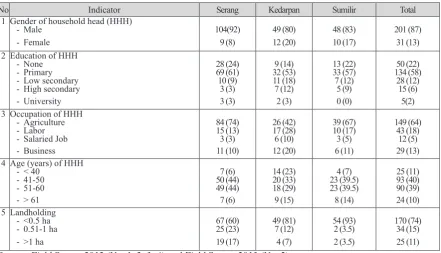
Majority of respondents were male, graduating from primary education, work-ing in agriculture sector with landholdwork-ing less than 0.5 ha, and aging between 41 and 60 year old. Among the study villages, re-spondents in Kedarpan averagely had high-est education and most diverse occupations. Averagely, the largest landholding was in Serang (Table 1).

Table 1.Profile of the Respondents

No Indicator Serang Kedarpan Sumilir Total 1 Gender of household head (HHH)

- Male 104(92) 49 (80) 48 (83) 201 (87) - Female 9 (8) 12 (20) 10 (17) 31 (13) 2 Education of HHH

- None 28 (24) 9 (14) 13 (22) 50 (22) - Primary 69 (61) 32 (53) 33 (57) 134 (58) - Low secondary 10 (9) 11 (18) 7 (12) 28 (12) - High secondary 3 (3) 7 (12) 5 (9) 15 (6) - University 3 (3) 2 (3) 0 (0) 5(2) 3 Occupation of HHH

- Agriculture 84 (74) 26 (42) 39 (67) 149 (64)

(4)

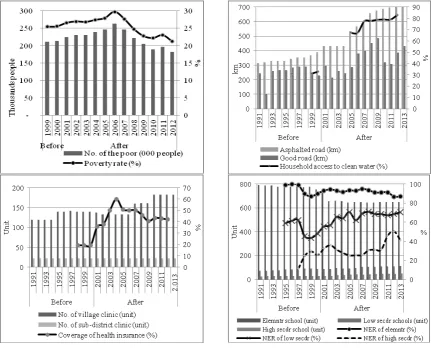
Changes in Some Sectors at District Level During decentralization, the pov-erty rate in Purbalingga was decreased by 5.32%, from 26.51% in 2001 to 21.19% in 2012. The unavailability of data before decentralization makes impossible for this

study to compare with before decentraliza-tion. Compared to national achievement in poverty alleviation, the performance of Pur-balingga district was lower. In the same pe-riod, national poverty rate was decreased by 6.75 %, from 18.41% to 11.66 % (Figure 1).

Figure 1. Changes in some sectoral data in purbalingga, 1991-2013

Source: (BPS Purbalingga, 1992, 1993, 1994, 1995, 1996, 1997, 1998, 1999, 2000, 2001, 2002, 2003, 2004, 2005, 2006, 2007, 2008, 2009, 2010, 2011, 2012, 2013; District Government of Purbalingga, 2014; Purbal-ingga Local Planning Agency, 2006)

In education sector, from 2001 to 2013, the district government built 22 new lower secondary schools and 46 new upper secondary schools. There was no increase in the number of elementary schools, as they were already provided in each village since 1990. Further, Net Enrolment Ratio (NER) of elementary level was decreased, and NER of lower secondary and higher

second-ary was increased. This means that positive impact of decentralization existed only in low and high secondary level.

(5)

from 2001 to 2013, the district government built about 21 new village policlinics. These indicators present that decentralization had positive impact on health sector.

In infrastructure sector, among 710 km of total district road, 95% were asphalt-ed by 2013, comparasphalt-ed to only 52% in 2000. This was obviously a good achievement that the district built quite long new roads. Yet, by 2013, only 65% of them were in good condition. Further, up to 2012, about 80% of households had access to clean water, compared to that of 31% in 2000. Most of increases were due to small clean water facilities funded by NPCE. Further, there was a locally initiated program named Poor House Renovation Program (PPHR), which distributed stimulant fund for the poor to repair their home. This program has been implemented since 2003 to cover averagely five houses per villages per year. So far, up to 2013 the district government had repaired about 13,923 houses. These indicators pres-ent that decpres-entralization had positive impact in infrastructure sector.

Changes in Some Indicators at Village Level

In 2000, prior to the decentralized sys-tem, all study villages suffered from poor in-frastructure. The main roads were still dirt, and the villages had no policlinic and kin-dergarten. Microfinance, as an alternative of loan source, did not existed.

During decentralization, various pro-grams were executed to improve infrastruc-ture. Among other were National Program for Community Empowerment (NPCE) and Program of Village Allocation Fund (PVAF), Water and Sanitation for Local Corporation (WSLC). Serang, Kedarpan and Sumilir vil-lages received IDR 276 million, 164 million and 185 million in 2013, respectively. The largest portion of grants was used for road improvement, followed by clean water fa-cilities and school building.

As the impact of these programs, in-frastructures were improved. Asphalt road, kindergarten, clean water facilities and ir-rigation were built. Decentralization also improved villager’s access to loan. Each village had women saving groups, thanks to the program of NPCE (Table 2).

Table 2. Change in village infrastructure

No Infrastructure Serang Kedarpan Sumilir

2000 2013 2000 2013 2000 2013

1 Passable road (asphalt: total km) 7:36 26: 36 0.5:7 5:7.5 1.3: 6.9 4.8: 6.9

2 Clean water supply (unites) 0 3 2 5 0 0

Source: Field survey, 2013

Changes in Poverty Indicators at House-hold Level

With regard to access to public servic-es, by 2012, 60% and 31% respondents had

(6)

indicators, it can be said that NPCE has significant impact in improving respondent’s access to infrastructures (Table 3).

Table 3. Respondent access to clean water and electricity

Poverty indicator Village No. of Respondent Change P value

2000 2012

No access to clean water

Serang 113 101 12 (11) 0.000***

Kedarpan 56 38 18 (32) 0.000***

Sumilir 58 45 13 (22) 0.000***

No access to electricity

Serang 54 36 18 (33) 0.000***

Kedarpan 18 14 4 (22) 0.219

Sumilir 34 23 11 (32) 0.001***

Source: Field Survey (2012) Note:

1. Mc Nemar Test is applied, and *, **, *** means significant at 10%, 5% and 1%, respectively.

2. Figure in parenthesis is percentage to total respondents in 2000.

Program of Raskin, Askeskin, PPHR and PWSG were implemented in each study villages. Program of Raskin had the highest coverage while PPHR had the lowest cover-age (Table 4). Leakcover-age of Raskin program was found, where the rice was distributed to almost all the villagers, somehow making

the amount received was less than what it should be. Another leakage was also found in PWSG, where many of the non-poor became the clients. Further, Askeskin and PPHR suffered from under coverage, where many of poor households did not received the programs.

Table 4. Beneficiaries of poverty alleviation programs, 2012

Program

Number of beneficiaries

Serang Kedarpan Sumilir Total

Raskin 102 (90) 58 (95) 57 (98) 217 (94)

Askeskin 44 (39) 24 (39) 25 (43) 93 (40)

PPHR 18 (16) 12 (20) 6 (10) 36 (16)

PWSG 106 (94) 50 (82) 58 (100) 214 (92)

Source: Field Survey, 2012

Note: Figure in parenthesis is percentage to total respondents

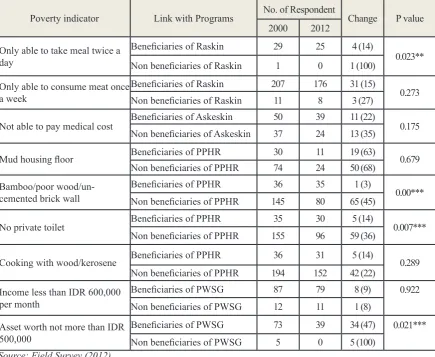
By 2012, there were 11% respondents not able to take meal twice a day, and 79% re-spondents not able to consume meat more than once a week. With regard to access to health service, 27% respondents were not able to pay medical cost when getting sick. With regard to dwelling condition, 15% re-spondents used mud or rudimentary floor,

(7)

Table 5. Change in some selected poverty indicators, 2000-2012

Poverty indicator Link with Programs No. of Respondent Change P value

2000 2012

Only able to take meal twice a day

Beneficiaries of Raskin 29 25 4 (14)

0.023** Non beneficiaries of Raskin 1 0 1 (100)

Only able to consume meat once a week

Beneficiaries of Raskin 207 176 31 (15)

0.273 Non beneficiaries of Raskin 11 8 3 (27)

Not able to pay medical cost Beneficiaries of Askeskin 50 39 11 (22) 0.175

Non beneficiaries of Askeskin 37 24 13 (35)

Mud housing floor Beneficiaries of PPHR 30 11 19 (63) 0.679

Non beneficiaries of PPHR 74 24 50 (68)

Bamboo/poor wood/un-cemented brick wall

Beneficiaries of PPHR 36 35 1 (3)

0.00*** Non beneficiaries of PPHR 145 80 65 (45)

No private toilet Beneficiaries of PPHR 35 30 5 (14) 0.007***

Non beneficiaries of PPHR 155 96 59 (36)

Cooking with wood/kerosene Beneficiaries of PPHR 36 31 5 (14) 0.289

Non beneficiaries of PPHR 194 152 42 (22)

Income less than IDR 600,000 per month

Beneficiaries of PWSG 87 79 8 (9) 0.922

Non beneficiaries of PWSG 12 11 1 (8)

Asset worth not more than IDR 500,000

Beneficiaries of PWSG 73 39 34 (47) 0.021***

Non beneficiaries of PWSG 5 0 5 (100)

Source: Field Survey (2012) Note:

1. Chi square Test is used*, **, *** means significant at 10%, 5% and 1%, respectively.

2. Figure in parenthesis is percentage to number of respondents in 2000.

3. Indicator of income and asset in 2000 were counted by considering inflation rate

The improvements from 2000 to 2012 were significant in frequency of meal, house wall, sanitary and asset. Although frequency of meat consumption, ability to pay medical cost, house floor, cooking fuel and income were improved, the changes were statistical-ly not significant. These indicators present that program of Raskin, Askeskin, PPHR and PWSG were not completely successful.

DISCUSSION

This study has analyzed the changes in various dimensions of poverty, and finds mixed impacts of decentralization on pover-ty alleviation. Positive impact of decentral-ization is mostly identified in term of access to public service like clean water, electricity,

asphalted, policlinic, kindergarten, second-ary school, health insurance. In addition, frequency of taking meal, house wall, sani-tary and asset of the poor were significantly improved during decentralization. In con-trary, frequency of meat consumption, abil-ity to pay medical cost, house floor, cooking fuel and income of the poor were not signifi -cantly improved.

(8)

Findings of this study complement the earlier studies conducted by Hastuti et al. (2008), Sumarto and Widyanti (2008) and Suryahadi et al. (2010) which find the prob -lem of leakage in program of Raskin and Askeskin, and study by McLaughlin et al. (2007) about NPCE program. With regard to PWSG, while Edstrom (2002) reports that that the program significantly provide an alternative loan for the poor, this study finds that the borrowed money still cannot improve income. Thus, PWSG only prevent the clients to become poorer, but do not help them escape out from poverty.

This study underlines that decentral-ization is more likely to be successful in geographically targeted programs rather than individually targeted programs. If lo-cal governments are given grants, they are more likely use the money more on infra-structure benefitting all villagers rather than only the poor. Even if the decision-making is decentralized, the poor have no voice to influence decision-making and bargain with most member of community. Thus, social protection and microfinance, that are strong -ly needed by the poor, get limited funding. In addition, using decentralized schema, so-cial protection and microfinance are proven very prone to leakage, where the programs are distributed to almost all villagers, even if they are not poor.

CONCLUSION

Positive impact of decentralization is found mostly in term of access to public service and infrastructure improvement, but less in income generation and social protec-tion. NPCE is quite successful in poverty alleviation, in contrary to PWSG, Raskin, Askeskin and PPHR. Most of poverty al-leviation programs suffer from leakage and under coverage due to insufficient funding.

To ensure that the poor are benefit -ted from decentralization, the government should guarantee the rights of the poor in lo-cal budget decision making. It is equally im-portant to monitor the distribution of Raskin

and PWSG, and to improve the funding of PPHR. To ensure that the poorest groups are benefitted from decentralization, the gov -ernment should improve the targeting mech-anism in poverty alleviation, especially so-cial protection and microfinance clusters. As Indonesia is a diverse country, the govern-ment should not strictly impose any national standard to identify the eligible household. It may be worth if the government involve community in identifying the program ben-eficiaries, as it will provide an opportunity to develop a local flexibility in defining the poor households

REFERENCES

BPS. 2011. Pendataan Program Layanan So-sial (PPLS) 2011 (Survey of social in-surance program 2011). Jakarta: BPS. Guggenheim, S. 2006. Crises and

Contra-dictions: Understanding the Origins of Community Development Project in Indonesia,. In e. a. A. J. Bebington (Ed.), The Search of Empowerment: Social Capital as Idea and Practice at the World Bank: 111-144. USA: Ku-marian Press.

Hastuti, Mawardi, S., Sulaksono, B., Akhmadi, Devina, S., & Artha, R. P. 2008. The Effectiveness of the Raskin Program. Jakarta: The SMERU Re-search Institute.

Haughton, J., & Khandker, S. R. 2009. Handbook on Poverty and Inequality. Washington D. C.: World Bank.

McLaughlin, K., Satu, A., & Hoppe, M. 2007. Kecamatan Development Pro-gram Qualitative Impact Evaluation. Washington DC: World Bank.

(9)

Suryahadi, A., Yumna, A., Raya, U. R., & Marbun, D. 2010. Review of Govern-ment’s Poverty Reduction: Strategies, Policies and Programs in Indonesia. Jakarta: The SMERU Research Insti-tute.

Gambar

Table 1. Profile of the Respondents
Figure 1. Changes in some sectoral data in purbalingga, 1991-2013
Table 2. Change in village infrastructure
Table 3. Respondent access to clean water and electricity
+2

Referensi

Dokumen terkait

It is diffi cult to mitigate poverty in Indonesia: the amount needed for poverty alleviation, as a percentage of GDP, decreases as the GDP per capita increases and amount

Jurnal The Role Of Poverty Alleviation In Bojonegoro Flood Wellmaintain.

• So, in principle, the poverty alleviation program (especially Cluster 1 programs) is effectively Indonesian Social Protection

The deduction made in this regard is that most participants in rural poverty alleviation projects do not have grade 12, which is a problem as the management of sustainable poverty

Livelihood Security, Poverty Alleviation, Women Empowerment under Mahatma Gandhi National Rural Employment Guarantee Act in West Bengal Abstract Livelihood Security of people, in

1, 2021, E-ISSN: 2 2 2 2 -6990 © 2021 HRMARS 596 The Impact of The Rural Culture and Cultural Attractions on Poverty Alleviation: The Moderating Effect of Tourism Resources

Shortcomings of South African Economic Growth on Poverty Alleviation and Job Creation ML Msiza University of South Africa, South Africa Abstract: The paper analyses shortcomings of

QARD-AL-HASSAN AS A TOOL FOR POVERTY ALLEVIATION: A CASE STUDY OF THE FAEL KHAIR WAQF PROGRAM IN BANGLADESH Farah Muneer1 and Foyasal Khan2 1 Institute for Inclusive Finance and