67
FORUM Ejournal 10 (June 2011): 67-77
© 2011 by Newcastle University. All rights reserved.
1354-5019-2009-01
The Future of Sustainable Development in Bali
Ciptadi Trimarianto School of Architecture, Faculty of Engineering, University of Udayana, Bali, Indonesia
Steven Dudek School of Architecture Planning and Landscape, Newcastle University, England, UK
Abstract This paper aims to develop a framework of sustainable development for the construction industry in Bali, Indonesia. The main objective of this framework is to adopt guidelines from traditional Balinese design philosophy for designing low energy building and reducing energy consumption at domestic level. Original Balinese compound dwellings followed Hindu religious customs and practices and were in balance with the natural environment. However, the current building codes in Bali are aimed at preserving the visual heritage of the island while ignoring the issue of sustainability. This paper also recognises the current local constraints to fully adopt such traditional design guidelines; and hence, proposes an integrated framework combining low energy building and use of renewable energy resources.
Keywords Bali, sustainable development, low energy building, traditional dwelling, building material
Introduction
Bali is an attraction in Indonesia for people from other regions of the Indonesian archipelago, and visitors from all over the world. Their impacts on Bali are social, economic and environmental. Indonesians come to this region, as the tourist industry can generate higher incomes from them than elsewhere. This
influx adds to the problem of
urbanisation and increases the demand for public services and accommodation. This development needs to reflect the architectural background of Balinese dwellings, whilst considering culture, sustainability, land availability, climate and environment. The contemporary construction industry needs to learn
lessons from Bali’s traditional dwelling
pattern, where cultural, economic,
environmental, and natural resources were in harmony.
Based on the building code in Bali, building materials, like limestone and clay brick in particular, have been extensively used for their visual architectural performances. The use of such materials has grown rapidly and is becoming difficult to manage, as extraction of such materials is affecting the environment.
To achieve sustainability in these
developments, careful material
The Future of Sustainable Development in Bali
68
http://research.ncl.ac.uk/forum
Building material
Masonry and especially limestone are important building materials in the construction industry in Bali and both are most commonly used for visual elements of architectural buildings. Limestone is a natural sedimentary rock, a key ingredient for quicklime, mortar, cement, concrete, and is also used as a building material.
Bali, like most of the islands of the Indonesian archipelago, has abundant layers of limestone and clay for masonry use. With an emphasis on sustainable development, in the last decade, the building code in Bali has prompted the use of traditional building materials applied to government offices, private
residential estates, and tourism
accommodations. Many such
developments are designed by famous architects, with attractive landscapes; tropical gardens designed with ponds and pools, and are reminiscent of a classic Balinese village featuring extensive use of lime stone and masonry materials. Similarly, the estate villas are designed,
decorated, and ornamented by
combination of limestone and masonry. But the primary concern has been with capturing the visual appeal of the traditional Balinese dwellings. These building codes have not addressed the wider issues of sustainability to ensure the visual Balinese design can be continued.
Thermal Comfort Design
Overheating and high humidity in the warm humid climate of Bali have significant impact on indoor climate. Indigenously, passive natural ventilation was ecologically adequate and had the
ability to eliminate overheating and
humidity problems. However, the
contemporary construction industry has moved away from such abovementioned
traditional design techniques. For
instance, the cooling technique in modern buildings moved away from natural ventilation, and comfort was achieved by installing air conditioning. New developments now depend on active cooling, which consumes more
energy, is more expensive and
environmentally contributes towards
global warming. In these circumstances,
designing low-energy building is
paramount as part of the sustainable development in Bali.
In order to achieve sustainable
development by reducing energy
consumption, a combination of natural ventilation and air conditioning should be integrated with traditional pattern dwelling design. Such compact design would be an intelligent respond to the
thermal comfort performance of
dwelling.
Architectural design should be
considered before an engineering
solution. The reasons are, the former is more robust, has a long duration of
applicability and environmentally
Trimarianto & Dudek
69
FORUM Ejournal
Traditional Balinese House
The mainstream of the population in Bali is Hindu, and this religion influences all part of Balinese life in their daily activities, which is also reflected on the architectural design of their dwellings. Historically, the urban villages followed a similar pattern of development across the rest of Bali. Due to the recent rapid urbanisation problem in Bali, although the religion and philosophy aspects are still present, the influence is regrettably getting less significant, resulting in a different pattern of housing, a modern contemporary compact accommodation.
According to Budiharjo (1986) and Dumarcy (1987), the traditional houses in Bali were built following the design concept of Tri Angga, the hierarchy of space, Sanga Mandala, the cosmological orientation, Manik Ring Cucupu, the balance cosmology, Sikut tapak, human scale of proportion ratio, Natah, the courtyard pattern, and the use of natural
landscape and locally available building materials.
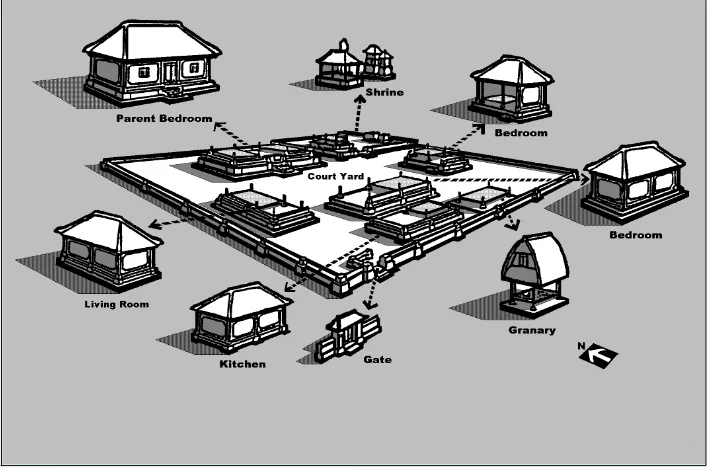
These abovementioned design concepts, in turn, influences the site plan; and has been reflected in the spatial arrangement of the typical Balinese compound. The traditional house pattern had specific zones dedicated for specific uses. Sanggah
as the shrine, the most sacred space for worship, is located at the North-Eastern part of the site, oriented towards Mount Agung, the highest mountain in Bali.
Angkul-angkul, the entrance gate, and the most public zone in the house, is located to the South-Western site. Paon, the kitchen is normally located nearby and closely to lumbung, the granary, which is crops storage. The bales, pavilions, are for daily activities. Sleeping places are consist of the bale daja, the parent bedroom designed as close private room for the Balinese parent at the North of the site,
following by the semi open rooms of where the bale dangin, children bedroom at the East, the bale delod, other children
The Future of Sustainable Development in Bali
70
http://research.ncl.ac.uk/forum
bedroom at the South and the bale dauh,
living room at the West. All of these rooms exist on the site around the natah. Natah is a courtyard, an open space located at the centre of the building, designed as an attractive beautiful tropical garden of the island. Any activity inside the dwellings cannot be seen from outside of the house due to the high outer wall or fence around the dwellings.
Extension of one’s living to the outside of the building envelop was recognised as a paramount character of the traditional Balinese house design where occupants would develop a tropical landscape as part of the exterior garden between the pavilions that formed the home (Figure 1).
Therefore, as Rapoport (1981) pointed out, the traditional Bali design guidelines
could provide a framework for
environmental sustainable development; by improving the comfort level around the site and dwelling, and also considering socio-cultural vitality of the Balinese people.
Sustainable Development
Following the most popular definition of sustainability adopted from the United Nation Conference, 1987, used by the Brundtland Commission Report of the World Commission on Environment and Development (WECD) (Smith and Rees, 1998), this study defines sustainable development as development that meets the needs of the present without compromising the ability of future generations to meet their own needs (WECD, 1987).
Framework for sustainable
development in Bali
Following the principle of Robert Gillman’s golden rule of sustainability (Mahaffy, 1999), the framework for sustainable development in Bali should broadly focus on three dimensions: environmental social, and economic (refer Figure 2). More specifically, for the construction industry, it might be useful to adopt a framework that encourages use of construction methods, systems and materials that respect use of natural resources (Rosenbaum, 1993 as cited in unknown, 2002b); and recognise the sites’
natural environment while also
considering social and economic factors.
This section of the study aims to investigate how the traditional design guidelines in Bali proposes a framework of sustainable development for the construction industry with
environment-friendly guidelines throughout a
building's life-cycle, starting from design to assemble, construction, operation, and maintenance. However, it is recognised that there are local constraints to completely adopt such guidelines, mainly due to recent rapid urbanisation and modernisation problem. Such constraints will be discussed in the next section in
Trimarianto & Dudek
71
FORUM Ejournal
order to propose an acceptable
framework suitable in the recent context.
The framework of sustainability first needs a design philosophy focussing on efficient use of energy and building materials, at an optimally reduced construction cost. During its life cycle, the development should have minimal negative impact on Balinese natural resources. However, focus should be given to improve comfort level during operation and maintenance of the building. This should be achieved through better layout, design, and
construction technique. Traditional
Balinese design guidelines are based on such a philosophy.
The traditional design philosophy in Bali is known to strike a balance between the
microcosms, people with everyday activities and cultures, and the macrocosms, places, dwellings, buildings, built environment, and also the natural environments. Hence, this philosophy should potentially provide guidelines on how to maintain balance between peoples’ daily activities and built environment, even in the contemporary context. This philosophy is also known to operate within the balance of nature, with a goal of protecting and conserving those elements as parts of the ecosystem that nurture the environment. Therefore, it is also expected that such guidelines will maintain a balance between the built environment and the nature. The traditional design guidelines recognise the evolved order of building systems through years of adaptations to climate,
social circumstances, environment,
available materials and conventional technologies. Such design guidelines are
not only useful for achieving
environmental sustainability but also
recognises cultural values in order to achieve sustainable development.
On the basis of these three components, i.e., microcosms, macrocosms, and nature, as Shu-Yang et al (2004) says, this framework of sustainability can also be
adopted in construction industries
elsewhere as a response to the international concern over environmental sustainability issues.
Design
Site planning
The first objective of this framework is to seek guidelines for designing low energy building. Predicted by the International Energy Agency in the future (Hebden, 2006), low energy building could reduce one third of the world's energy needs as
40% of the world’s energy is used in
buildings (WBCSD, 2009). Designing a low energy building should involve efficient use of energy through proper site planning, both in terms of orientations of building and adopting design features inside and outside a building with an aim to maximise the use of daylight, minimise the transmission of heat inside buildings and improve insulation of building. The traditional design guidelines used to orient building to benefit from environment and natural resources.
The Future of Sustainable Development in Bali
72
http://research.ncl.ac.uk/forum
small scale courtyard-pavilions building to improve thermal comfort.
Such guidelines also refer to human scale that encourages cluster site planning, and compound building oriented to open space patterns, based on anthropometric dimensions of Balinese people. Travel
distances by foot and dwelling
compounds were linked by pathways, and surrounded by tropical landscape of the island.
Buildings and open spaces were designed on the basis of human scale; courtyard pavilions and landscape were used as buffers to eliminate undesirable climate; by mixing open spaces and built environments sensibly; and by using anthropometric proportions and natural building materials. Such guidelines also used to maintain a proportionate balance between the height of buildings and open
spaces considering human scale
interaction. Thus, the proposed
framework for sustainable development can potentially adopt such guidelines from traditional design philosophy to apply in contemporary built environment.
Design features
Traditional design guidelines offer a number of design features to improve the thermal insulation of a building. Such features reduce the energy consumption of the building during its life-cycle to improve the thermal comfort from the hot-humid climate by mechanical devices. In contrast to this, they offer natural cooling.
Locating the living space at the end of natural landscape and views in a traditional dwelling is one of such important features. Natural environment was respected in the design of built
environment, assuring that buildings have major access of sight lines toward environmental assets. On one hand, as such design features improved peoples’ visual connection with nature; on the other hand, such adjacent natural landscape improved the thermal comfort of the house by cooling down the temperature.
Semi open Balinese pavilion is another significant feature of traditional Balinese house. Such pavilions maximise the input of natural light through skylights; on other hand, they maximise the cooling of environment through garden of the island which are an effective natural cooling system. Preventing excess heat gain by means of roof overhang and natural vegetations shading devices are also recognised as important features and known as means of effective cooling. moderated wind through the compound dwellings. In urban warm humid climates areas of Bali, the buildings cooling systems should be the primary focus of design, since they are typically one of the largest energy consumers in buildings. In this hot-humid climate, where cooling is a primary concern, passive building designs can be very effective in conserving energy in Bali.
Social sustainability
The traditional design guidelines
recognise the conviviality and hospitality of Balinese people, which is essential to
achieve social sustainability. The
Trimarianto & Dudek
solace, companionship, domesticity,
neighbourliness, community and public life, which called banjar adat through its
design. Vibrant societies can be
interactive; socially engaging and offer people numerous opportunities for gathering and meeting one another. This had been achieved through design of the built-environment and that society operates within hierarchies of social status and relations which occupy specific place in cluster and compound design as per bale banjar building. The traditional design guidelines have addressed all these issues and provide a robust framework to achieve social sustainability.
Designing: material
In addition, traditional design guidelines also provides framework for designing use of specific building material in heat impact throughout the day.
A low energy building should adopt such design features, especially in the warm humid climate of Bali. This will allow the building to use less mechanical energy to cool down the temperature and improve comfort.
Assemble/ producing building
material
Traditional building materials in Bali were typically considered to be sustainable, as taken from locally available natural
materials such as sand, stone, limestone, clay bricks and roof tiles, recyclable materials such as coconut timber, bamboo, wild grass and straw. These
building materials were both
environment friendly and affordable as locally available. In addition, to make it technologically simple, such building materials have been extracted from nature and processed locally before transporting to the construction site.
Construction industry can potentially adopt such guidelines from the traditional
construction methods, encouraging
building materials being processed off-site, close to the raw material extraction site, allowing minimal wastage of raw material due to transportation.
Construction industry is increasingly using artificial limestone produced from recycled waste materials in order to meet
peoples’ affordability and also meeting
environmental sustainability. However, such practice of using artificial limestone is not highly appreciated in the industry. The main rationale for such rejection is based on the aesthetic look of the material though. Organic limestone is more visually appealing than the artificial one. However, since extraction of natural limestone leaves a negative impact on the environment, new guidelines should be formulated keeping a balance between aesthetic and environmental issues though.
Construction
The Balinese tradition of passive energy building design allows buildings to
exploit the natural environment
The Future of Sustainable Development in Bali
74
http://research.ncl.ac.uk/forum
passive dwelling designs incorporate building materials with natural thermal mass, well insulated, that prevents heat gain and works to prevent loss of comfort conditions.
From the design point of view, a low energy building should include measures to reduce effective energy use by increasing the efficiency of the building
envelope, as a barrier between
conditioned and unconditioned space. For instance, installing insulation in walls, ceilings, and floors, making use of the natural landscape and air movement can be borrowed from traditional design.
Operation and maintenance
Abovementioned site planning
guidelines, design features and
construction techniques should provide a framework for designing low energy
building that would not require
substantial mechanical energy
consumption to improve the thermal and living comfort during its operation. However, such guidelines of low energy building should be integrated with other active cooling systems if required. An
integrated passive-active combined
cooling system will increase energy efficiency when the buildings are well insulated, positioned to employ the natural environment, excessive heat gains eliminated with a low electrical energy load.
More specifically to avoid heating in the warm humid climate, the most important and cost effective element is to provide
an efficient ventilating, and air
conditioning (VAC) dwellings system in a well insulated building, and to decide on proper orientation of the buildings with extensive use of sun shading, water ponds, and barrier of tropical landscape
against direct heat of the sun. An energy-efficient building design requires heat dissipation and ventilation capacity to improve the indoor thermal comfort.
Significant amount of energy is
consumed in buildings is because of poor management of the air conditioning air flows. However, proper planning and building orientation will have greater positive impact on a building's VAC efficiency.
An integrated approach
In the current situation, especially in urban area, there are local constraints such as restricted availability of land, and hence, higher land value, mainly due to rapid urbanisation. It will be complicated to apply the design philosophy of traditional architecture in such a scenario.
Whereas dependency on modern
technology will be obvious, the
framework will be based on a
combination between sustainable
guidelines reflected by indigenous design and modern technology. However, such technologies to control indoor climate should depend on renewable energy to reduce negative impacts on environment.
Energy efficiency and renewable energy have been understood as twin pillars of sustainable energy guidelines (Prindle and
Eldridge, 2007). The proposed
framework can combine guidelines both from traditional practices for designing
low energy building and from
contemporary research on using
renewable resources in order to develop sustainable practice in the construction industry.
Trimarianto & Dudek
75
FORUM Ejournal
International Institute for Asian Studies (IIAS) has highlighted socially sustainable jatropha production, called jarak in Indonesia (IIAS, 2009). This can be used as a clean non-fossil diesel fuel, and economically provided new income sources in most of marginal areas. Biodiesel was produced from renewable resources, and contains almost no sulphur; only 15 parts per million (ppm) are found in the emissions of vehicles using this fuel. The lowest levels of sulphur content in Indonesian fossil fuels average about 500 ppm while more dirty fuels can produce up to 3,000 ppm. However, the total cost of the production
of Jatropha’s biodiesel needs to be taken into account in order to understand its economical affordability and socially viability.
However, while considering the
comprehensive energy strategy of
demand and supply; the cost-benefit analysis should be done comprehensively considering local, national, regional, or global scale as the overall framework contributes towards global sustainability. The process couples with energy awareness, energy conservation, and energy efficiency with the use of primary renewable energy resources (Dorf, 1981).
Conclusion
Construction industry in Bali has recently experienced accelerated development.
The traditional architecture has
disappeared under the stream of the new
contemporary technologies and
sophisticated building with high reliance on mechanical systems. These new technologies do not consider the natural insulation property of building materials
used in envelop and the design of
envelop itself. Specifications are
concerned with mere visual aspects of building by using limestone and Balinese brick.
The proposed framework hopes to incorporate design of building envelop drawing guidelines from traditional design and satisfy visual aspect in an
energy-efficient manner. Such a
framework will help the construction industry to significantly contribute towards sustainable development.
Bali, being a renowned emerald paradise island with lush bright green rice fields, tropical architectures, luxury resorts, hotels, villas, and golf courses, with golden sand beaches of the island, should adopt a robust framework like this for sustainable development that strike a balance between built environment and natural environment.
Efficient use of energy will be crucial in
the framework with minimal
environmental impact. As there will be dependency on energy sources, different forms of renewable energy, such as biomass, solar, wind, hydro, and geothermal, should be explored, with due consideration to the availability of resources and local conditions. However, sustainable management of natural resources should be prioritised.
As it was admired world-wide, with the
name of Sustainable Hinduism
The Future of Sustainable Development in Bali
76
http://research.ncl.ac.uk/forum
family life values and highest flexibility, within a tropical buildings system that was a masterpiece of simplicity and elegance, the traditional of Balinese architecture. The ability of Balinese to absorb, adopt, and adapt to the
environment is a lesson to the rest of the world. Learning from its history, the contemporary construction industry in Bali can adopt this framework to continue its development in a sustainable way.
References
Adams, W.M. (2006). The Future of Sustainability: Re-thinking Environment and Development in the Twenty-first Century. Report of the IUCN Renowned Thinkers Meeting, 29–31
January 2006. Retrieved on 16-02-2009 from
http://cmsdata.iucn.org/downloads/iucn_future_of_sustanability.pdf
Budiharjo, E. (1986). Architecture Conservation in Bali. Yogyakarta, Gadjah Mada University Press.
Dorf, R.C. (1981). The Energy Factbook, McGraw-Hill.
Dumarcey, J. (1987). The House in Suth-East Asia. Oxford: Oxford University Press.
Gilpin, A. (2000). Dictionary of Environmental Law. [Online], Retrieved on 03-02-2010 from
http://www.eionet.europa.eu/gemet/concept?ns=1&cp=2944
Hebden, S. (2006). Invest in clean technology says IEA report, 22 June 2006 | EN. [Online], Retrieved on 03-02-2010 from http://www.scidev.net/en/news/invest-in-clean-technology-says-iea-report.html
Hopkins, R. (2002). A Natural Way of Building. Transition Culture. [Online], Retrieved on 12-01-2010 from http://transitionculture.org/essential-info/articles/a-natural-way-of-building-2002/
IIAS, International Institute for Asian Studies. (2009). Jatropha (JARAK), Research and
Knowledge network. [Online], Retrieved on 09-02-2010 from
http://www.iias.nl/research/jatropha-research-and-knowledge-network-jarak
James, S. (2003). "Eco-municipalities: Sweden and the United States: A Systems Approach
to Creating Communities". Retrieved on 16-03-2009 from
http://www.instituteforecomunicipalities.org/Eco-municipalities.html.
Levin, H. (2009). Indoor climate and global climate change: Exploring connections, Building Ecology Research Group, Santa Cruz, California USA. [Online], Retrieved on 08-12-2009
from
Trimarianto & Dudek
77
FORUM Ejournal
Mahaffy, M. (1999), Computer Systems Professional, School of Architecture, Washington
State University, [Online], Retrieved on 20-01-2010 from
http://www.arch.wsu.edu/09%20publications/sustain/defnsust.htm
McLennan, J.F. (2004), The Philosophy of Sustainable Design. [Online], Retrieved on 09-02-2010 from http://bloggingathesis.wordpress.com/2011/05/10/the-philosophy-of-sustainable-design/
Prindle, B. and Eldridge, M. (2007). The Twin Pillars of Sustainable Energy: Synergies between Energy Efficiency and Renewable Energy Technology and Policy. American Council for an Energy-Efficient Economy, [Online], Retrieved on 03-02-2010 from
http://aceee.org/store/proddetail.cfm?CFID=2957330&CFTOKEN=50269931 &ItemID=432&CategoryID=7
Rapoport, A. (1981). Environmental Quality, Metropolitan Areas and Traditional Settlement, Proceeding of the First International Congress of Planning of Major Cities, Mexico City. Great Britain.
Smith, C. and Rees, G. (1998). Economic Development, 2nd edition. Basingstoke: Macmillan. Shu-Yang, F., Freedman, B. and Cote, R. (2004). Principles and practice of ecological
design. Environmental Reviews. 12: 97–112.
Unknown. (2002). Sustainable Hinduism. Hello Bali Magazine, June 2002.
Unknown. (2002). Sustainability Is .... Oregon State University. [Online], retrieved on
08-02-2010 from
http://polyland.calpoly.edu/topics/stewardship/stewardshipx330/definition.htm l
WBCSD, World Business Council for Sustainable Development. (2009). Manifesto for Energy
Efficiency in Buildings. [Online], Retrieved on 12-01-2010 from
http://www.wbcsd.org/DocRoot/fsn7uYGeAOl2VKHZPB8J/EEBManifesto.p df.
WECD, World Commission on Environment and Development. (1987). Our common future;