ABSTRACT INTRODUCTION MATERIAL AND METHODS RESULTS AND DISCUSSION
CONCLUSION ACKNOWLEDGEMENT
REFERENCES
IMPACT OF LAND USE PRACTICES ON POORNESS AT MINANGKABAU COMMUNITIES IN INDONESIA
Authors:
Yuzirwan Rasyid and Retno Dewi
Institute for Public Services Andalas University, Indonesia Phone/Feax: +62 751 72650, E-mail: [email protected]
ABSTRACT
Intention of this research is identify, to classification, evaluate poorness that happened in the minangkabau communities. Arround the Pesisir Selatan district occupying ranking highest in West Sumatera Province that is 40,35%. This poorness shouldn't happened because many potential farms which is not tilled for farm of effort agriculture on household as community unit. Approach done with method Partisipatory Rural Appraisal (PRA) and Rapid Rural Appraisal (RRA) to decompose the root problem of poorness with custom figure, moslem scholar figure, governmental nagari, deliberation body nagari, young man, and group of is effort society. Society given opportunity to tell the opinion concerning the factor and poorness cause the happening of poorness, their opinion of vital importance because they who deal with the the problem is everyday. So also their assessment to productivity nagari in the case of to the number of the sleep farms not yet been tilled, farm is the clan customary right for land ground in terms in nagari, nagari is the unit region of Minangkabau communities base.
Its result indicate that family tipologies distinguishable impecunious to the; impecunious almost, impecunious and very impecunious : (1) very impecunious family is having land use practices < 0,5 ha right of property the ; Very narrow; tight house ( wide < 21 m2, dance soil / wood, roof rumbia-seng, wall bambu/papan compile); Sanitasi ugly (there no WC & Goth, source of water sungai-sumur dig no concrete); Member household > 7 person; Ugly health ( less nutrient - skin disease - disease in); Ugly education ( don't go to school - finish basic school); Source of Energi ( firewood - kerosene); work temporary farmer; Earnings < Rp 500.000 / month. (2) impecunious
family is having the farm land use practices 0,5 - < 1 ha right of property the ; Simple
disease in); Ugly education ( don't go to school - finish basic school); Source of Energi ( firewood - kerosene); work temporary farmer; Earnings Rp 500.000 - < Rp 1.000.000/ month. (3) impecunious almost family is have land use practicec 0,5 - 1 ha right of property the ; House very simple ( wide 21 - 36 m2, concrete floor cor, zinc roof, plaster brick wall); Sanitasi ugly (there no WC & Goth, source of water is surface water or sumur dig no concrete); Member of houseshold 5 - 7 person ; Ugly health ( less nutrient, skin disease - disease in); Ugly education ( don't go to school - finish basic school – medium school); Source of Energi ( firewood - kerosene); work temporary farmer; Earnings Rp 1000.000 - < Rp 1.500.000/ month;
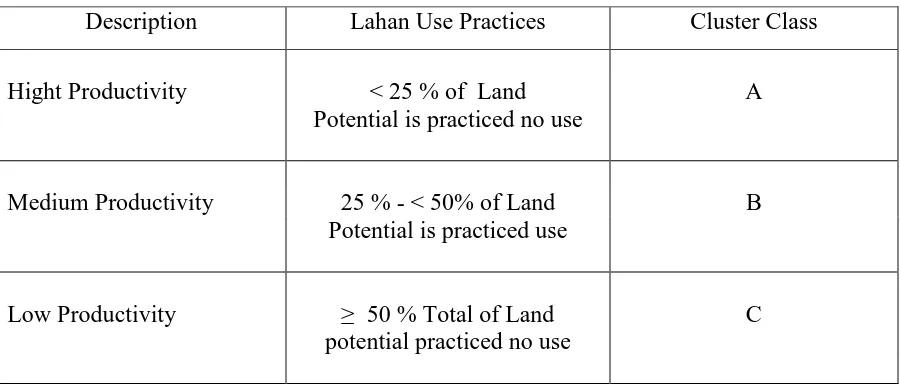
Produktivities of nagari, place the nagari in to 3 klaster, that is klaster A is nagari where < 25% totalizing wide potential farm [of] him not yet been tilled ; klaster B is nagari where 25% - <50% from totalizing wide productive farm [of] him not yet been tilled; and klaster C is nagari where ≥ 50% totalizing wide potential farm [of] him not yet been tilled. Pengentasan poorness is must be done konprehensifly by moving houseshold impecunious become houseshold productive with approach of rights land consolidation, fair customary right for land ground andly proporsional.
INTRODUCTION
Poorness is an condition where family as entitas human community in an area unable to fulfill minimum clauses to be able to live normally and fair caused by his limitation to obtain; get sufficiency of requirement of base ( food and clothing, board), obtain; get the service education of base, health, and also obtain; get the infrastructure facility of base ( drinking water and sanitasion). Vision of poorness is visible in so many aspect and form, be like ; hunger and nutrient ugly with various his impact aspect to health, situated behind then, stupidity, unemployment, low earnings, behavior and attitude retreating, badness of environment and sanitation family, etc.
Poorness impact of its influence to growth of region is veri big because interconnected sliver with productivity resources, ethos and human. It implication is to security and orderliness of society and continuity resources, environment and forest. Area where his society is impecunious will sensitive to trouble mass and convulsing and also forest resources will threatened destroy because rampant wild hewing. According to world bank study ( 2006), there is three uppermost characteristic of poorness in Indonesia ; first, poorness related to lowering of of earnings of family ; both, poorness related to him lowering access the family to obtain;get sufficiency of food, clothing, and board, sufficiency of education service, sufficiency of health service, and also sufficiency of availability of elementary infrastructure ( clean water source, and sanitasi environmental); third, poorness related to limitation of ability of sub-province area / town in all Indonesia to develop;build the base infrastructure, provide the education service, health, and also create growth of employment and economics.
rural and 78 % in the urban have access the clean water source and sanitasi environmental.
In cultured West Sumatra of custom Minangkabau, poorness is an ignominy, in consequence become the responsibility the family sole to eradication of poornee this done. Suggest the people to be productive human, assiduous, and diligent is custom teaching, but since custom shall no longger become domain governance region hence existence fungtionary custom in arranging the governance nagari to to pull over. Therefore eradication of poorness shall base on to nagari by giving the space for fungtionary custom cooperative with government, then potential customary right for land ground not yet use must be use productive expecting him to and for the clan a few wide his farm can wear with right of property or sharing holder of the clan wide his land ground. How impact of land use practices or land ground on poorness at minangkabau communities ?, is that is what studied in this research.
MATERIAL AND METHODS
Custom Minangkabau in principle arrange the societal life manners and have interaction to with its environment to be human can reach the secure and prosperous life degree full of feeling brotherhood and feeling the responsibility so that natural resourcer (timberland, river, lake, sea) becoming the custom society good and chattel can be exploited and managed on an on going basis under leadership the leader custom lead the wise and wise clan able to give the security to his society ( LKAAM, 1999). Pursuant to adagium this custom can be made by the X the hypothetical model of poorness be like following ; poorness is unabless custom society to manage natural resources make everlastingly to reach sufficiency of requirement of food materials, clothing, board, and also reach sufficiency of earnings to defray education of family, look after health of family, and also obtain; get the security, orderly, peaceful, and balmy below/under leadership custom leaders as authoritative leader , the hypothetical model formulated be like following;
Y = f (X1, X2, X3, X4, X5, X6, X7)
Where Y, is making an index to ability of society to manage the farm of effort ( rice field. farm, garden, forest, sea), measured from wide ratio of the farm laboured by per year broadly potential farm which mastered. X1 is ratio [among/between] food materials expenses per year by totalizing the earnings per year, X2 is ratio [among/between] suiting expenses per year by totalizing the earnings per year, X3 is ratio [among/between] expenses rehabilitation house per year by totalizing the earnings per year, X4 is ratio [among/between] expenses of effort per year by totalizing the earnings per year, X5 is ratio [among/between] expenses education of child per year by totalizing the earnings per year, X6 is ratio [among/between] expenses health of family per year by totalizing the earnings per year, X7 is ratio [among/between] security expenses / recreation per year by totalizing the earnings per year.
effort to be farm productivity of effort impecunious family become maximally, hypothetical model can formulated be like following ;
P = f (Y, M, S, I)
Where P, is farm productivity of effort that is ratio [among/between] benefit and farmer operating cost ( B/C Ratio) where P will in determining by ; value Y that is index ability of society to manage the farm of effort, measured from laboured farm ratio per year with the farm mastered by 1 hoeshold, assess M is productivity manajerial society to manage the farm of effort that is measured from ratio of amount of productive energies with family member in 1 housKK, assess S is membership or skill society to create the efficiency, measured from wide hold of farm practised per 1 people day work broadly money farm laboured per year, hereinafter assess I is economic added value which obtained by theX the input effect the by theX the farm be like manure, measured from added value ratio of result of after given by theX the input compared to before in input berry.
RESULTS AND DISCUSSION
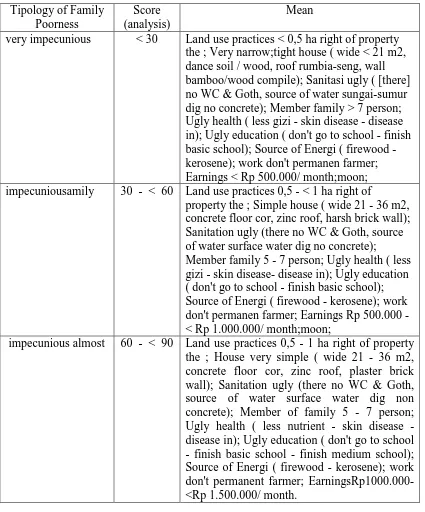
Poorness tipoloy in Pesisir Selatan district differentiated to the family impecunious almost, family impecunious, and family very impecunious. Is while Klaster nagari consist of cluster A, cluster B, and cluster C. Family very impecunious is they having the farm garapan < 0,5 ha right of property the ; Very narrow;tight house ( wide < 21 m2, dance soil / wood, roof rumbia-seng, wall bamboo/wood compile); Sanitation ugly (there no WC & Goth, source of water sungai-sumur dig no concrete); Member of family > 7 person, Ugly health ( less nutrient - skin disease - disease in); Ugly education ( don't go to school - finish basic school); Source of Energi ( firewood - kerosene); work don't permanent farmer; Earnings < Rp 500.000/ month;moon; Is while family impecunious is having the farm land practices 0,5 - < 1 ha right of property the ; Simple house ( wide 21 - 36 m2, concrete floor cor, zinc roof, harsh brick wall); Sanitation ugly (there no WC & Goth, source of water sungai-sumur dig no concrete); Member of family 5 - 7 person; Ugly health ( less nutrient - skin disease- disease in); Ugly education ( don't go to school - finish basic school); Source of Energi ( firewood - kerosene); work don't permanen farmer; Earnings Rp 500.000 - < Rp 1.000.000/ month;moon; And family impecunious almost are they having the farm land practices 0,5 - 1 ha right of property the ; House very simple ( wide 21 - 36 m2, concrete floor cor, zinc roof, plaster brick wall); Sanitation ugly (there no WC & Goth, source of water surface water or ground water dig no concrete); Member of family 5 - 7 person; Ugly health ( less nutrient - skin disease - disease in); Ugly education ( don't go to school - finish basic school - finish medium schol); Source of Energi ( firewood - kerosene); work don't permanent farmer; Earnings Rp 1000.000 - < Rp 1.500.000 per month.
not yet been tilled. Eradication of poorness is must be done konprehensifly by moving family impecunious become family productive with approach of rights consolidation to practiced fair customary right for land ground andly proporsional. Nagari-Nagari with tipology poorness and cluster class A, B, and C the is be like Tabel following (table 1, 2);
Table 1
Tipologi Family Poorness and Cluster Class of Nagari as Custom Minangkabau Region at Pesisir Selatan district, West Sumatera Province, Indonesia
Tipology of Family Poorness
Score (analysis)
Mean
very impecunious < 30 Land use practices < 0,5 ha right of property the ; Very narrow;tight house ( wide < 21 m2, dance soil / wood, roof rumbia-seng, wall bamboo/wood compile); Sanitasi ugly ( [there] no WC & Goth, source of water sungai-sumur dig no concrete); Member family > 7 person; Ugly health ( less gizi - skin disease - disease in); Ugly education ( don't go to school - finish basic school); Source of Energi ( firewood - kerosene); work don't permanen farmer; Earnings < Rp 500.000/ month;moon; impecuniousamily 30 - < 60 Land use practices 0,5 - < 1 ha right of
property the ; Simple house ( wide 21 - 36 m2, concrete floor cor, zinc roof, harsh brick wall); Sanitation ugly (there no WC & Goth, source of water surface water dig no concrete);
Member family 5 - 7 person; Ugly health ( less gizi - skin disease- disease in); Ugly education ( don't go to school - finish basic school); Source of Energi ( firewood - kerosene); work don't permanen farmer; Earnings Rp 500.000 - < Rp 1.000.000/ month;moon;
Table 2
Cluster Class of Nagari as Custom Minangkabau Region and Productivity at Pesisir Selatan district, West Sumatera Province, Indonesia
Description Lahan Use Practices Cluster Class
Hight Productivity < 25 % of Land A
Potential is practiced no use
Medium Productivity 25 % - < 50% of Land B
Potential is practiced use
Low Productivity ≥ 50 % Total of Land C
potential practiced no use
CONCLUSION
1. Land Use practices on influented to created family porness at Minangkabau communities in Indonesia.
2. Family poorness distributed on nagari and influent the produvtivity, who present 3 cluster class ; hight, medium, and low productivity.
3. Eradication of poorness base on nagari and customary right for land ground potency in principle is way to improve the index ability of society to manage the farm of effort to be farm productivity of effort impecunious family become maximally
ACKNOWLEDGEMENT
REFERENCES
Bappeda Kabupaten Pesisir Selatan, 2006., Pesisir Selatan Development Plan, Year 2005 – 2010., West Sumatera Province.
World bank, 2006., New era in Eradication Of Family Poorness in Indonesia. The Word Bank Office, Jakarta.
Bureau of Statistical Board, 2006., Family Poorness Survey in Indonesia. Biro Pusat Statistik, Jakarta.