(Pengaruh Pemberian Biji Kapas sebagai Suplemen pada Ternak Domba yang Diberi Ransum basal Hay terhadap Kecernaan Pakan dan Fermentasi Rumen)
Ismartoyo
Faculty of Animal Science, Hasanuddin University, Makassar, 90245. Email:[email protected]
ABSTRACT
This experiment was conducted in vivo to investigate the effects of feeding WCS as a supplement for sheep fed GH on the apparent feed digestibility, and the rumen fermentation. Four different diets (T1-T4) were used, GH alone, or GH plus 150, 300 or 500 g WCS d-1 (fresh basis). The main objectives of the in vivo experiment was to examine digestibility and rumen characteristics (pH, ammonia and VFA concentration) of sheep fed the four diets. The results of this experiment indicated that supplementation of GH with WCS at level of 500 g d-1 (0.37 of the diet) reduced DM, ADF and NDF digestibility. There was no statistically signiicant effect on total rumen VFA, but the molar proportions of acetate, propionate and butyrate were altered by the highest rate of inclusion of WCS. These results suggested that WCS might have reduced the numbers or activities of cellulolytic rumen microorganisms.
Key words : Whole cottonseed, Gossypol, Feed digestibility, and Rumen characteristics.
ABSTRAK
Penelitian ini dilakukan untuk menguji pengaruh beberapa level supplemen biji kapas terhadap daya cerna bahan kering, ADF dan NDF ransum, dan fermentasi dalam rumen domba jantan dewasa yang diberi pakan basal hay. Dengan menggunakan rancangan percobaan Latin Square (4x4) domba dialokasikan pada 4 perlakuan ransum T1, T2, T3, and T4. Ke 4 ransum tersebut adalah T1 = hay, T2 = hay + 150 g biji kapas, T3 = hay + 300 g biji kapas, dan T4 = hay + 500 g biji kapas. Hasil penelitian ini menunjukkan bahwa suplementasi biji kapas 500 g/hari menurunkan daya cerna bahan kering, ADF dan NDF ransum. Biji kapas yang digunakan dalam penelitian ini mengandung gossypol 1.93 g/kg. Pemberian suplemen biji kapas tidak berpengaruh terhadap karakteristik rumen (pH, ammonia, total konsentrasi VFA), tetapi berpengaruh terhadap proporsi molar asam asetat, asam propionat, dan asam butirat. Suplementasi biji kapas meningkatkan proporsi molar asam butirat yang menyarankan bahwa suplementasi biji kapas menurunkan aktivitas selulolysis dari mikroba rumen.
Kata kunci : Biji kapas, gossypol, daya cerna pakan, karakteristik rumen.
INTRODUCTION
In Indonesia and other tropical countries wherever cotton is grown whole cottonseed (WCS) has been utilised by farmers as feed supplement for ruminants (Preston and Leng, 1987: Ely and Guthrie, 2012). Coppock et al.,
(1987) reported that WCS is rich in energy, protein and crude ibre content which is similar to that of peanut kernels with skins and hulls. It was suggested that inclusion of WCS up to 25% in the diets of dairy cows increased net energy for lactation and milk fat percentage.
However other studies in vivo indicated that inclusion of WCS in the diets of steers (Moore
al, 1993). The fermentation of GH by rumen protozoa (Ismartoyo et al, 1994), and attachment to and degradation of cellulose by rumen fungi in culture (Ismartoyo et al, 1995a) were reduced in the presence of gossypol. Feeding studies
in vivo with whole cottonseed (Ismartoyo et al, 1995b) showed that supplementation of whole cottonseed (WCS) up to 500 g d-1 (0.37 of the diet) for sheep fed GH resulted in a signiicant reduction in the numbers of protozoa and fungi in the sheep rumen.
In the present study, an experiment was conducted in vivo to examine the effects of feeding WCS as a supplement for sheep fed GH on the apparent feed digestibility, and the rumen fermentation. Four different diets (T1-T4) were used, GH alone, or GH plus 150, 300 or 500 g WCS d-1 (fresh basis). The main objectives of the in vivo experiment was to examine digestibility and rumen characteristics (pH, ammonia and VFA concentration) of sheep fed the four diets.
MATERIALS AND METHODS
Animals
Four male mature castrated sheep of average weight (80.7 + 4.6) kg, each itted with rumen canulae of 40 mm internal diameter, were used. The sheep were housed indoors in separate pens and were chosen from six animals on the basis of their ability to consume the WCS offered.
Diets management and experimental design
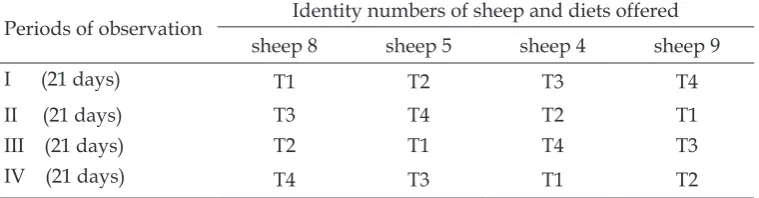
Four diets were offered to the sheep according to a 4 x 4 Latin square design (Table 1) with periods of four weeks. The diets consisted of grass hay (GH) alone, or 150, 300 or 500 g d-1 whole cottonseed (WCS) plus GH (diets T1-T4 respectively). The amount of GH offered was that which the animals would eat, leaving little
or no residue. This was achieved by adjusting the amount of GH offered during the irst 3 weeks of each period (adjustment stage), and a ixed amount as determined in the initial stage during the 4th week when observations were made. Each diet was offered as two equal meals at 08.00 and 16.00 h. The WCS was always offered irst, and the GH once the WCS had been consumed. Thus intake of hay was restricted, although the amount of hay consumed varied between sheep. The average intakes of feed eaten are given in Table 2.
Water was freely available to sheep throughout the experiment. WCS was offered in a separate small bucket so that intakes of GH and WCS could be measured.
Measurement of rumen characteristics
Rumen liquor samples were taken through the rumen istula 2 h after the morning feed for 2 days in each observation period for measurement of rumen characteristics (pH, NH3-N and VFA concentration). Rumen luid was immediately transferred to a beaker for pH measurement using a portable pH meter (Model M-80, Hanna Instruments Ltd., UK).
Rumen VFA
Samples of rumen luid for VFA analysis were collected at the same time as that for pH measurements. The rumen sample was immediately strained through a double layer of muslin and transferred to plastic bottles (100 ml) and frozen at -20oC. Volatile fatty acid (VFA) concentrations in the rumen samples were analysed by HPLC according to the method of Rooke et al. (1990).
Rumen NH3-N
Frozen rumen luid was thawed at room temperature overnight and the supernatant Tabel 1. Allocation of diets (T1-T4) and animals according to 4 x 4 Latin square
experimental design
Periods of observation Identity numbers of sheep and diets offered
sheep 8 sheep 5 sheep 4 sheep 9
I (21 days) T1 T2 T3 T4
II (21 days) T3 T4 T2 T1
III (21 days) T2 T1 T4 T3
IV (21 days) T4 T3 T1 T2
(1 ml) was transferred to a small vial to which was added 1 ml sulphuric acid (10%, v/v, 10 ml concentrated sulphuric acid in 100 ml distilled H2O). Rumen samples were centrifuged at 300*g for 5 min and the supernatant was transferred to tubes for NH3-N determination. NH3-N concentrations in the rumen luid was analysed using an autoanalyser (TechniconInstruments) by the Central Analytical Unit, SAC, Aberdeen, according to the methods of Weatherburn (1967) by complexing with salicylate in the presence of nitroprussidehypochloride (a source of chlorine), in a buffered alkaline solution at a pH of 12.8-13. The absorbance of the ammonia-salicylate complex was read spectrophotometrically at 660 nm.
RESULTS AND DISCUSSIONS
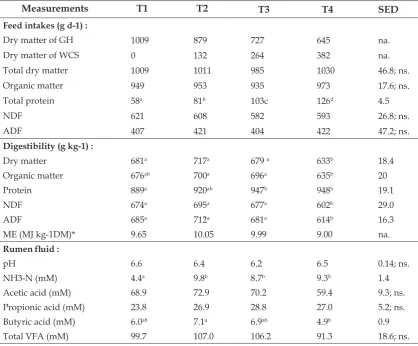
The feed intake and digestibility, and the rumen characteristics (pH, NH3-N and VFA concentrations) are shown in Table 2.
The data in Table 2 show the substitution of GH by WCS. The DM, NDF and ADF digestibility for supplemented diet T4 were signiicantly (p<0.01) reduced compared to T1, T2, and T3. There were no signiicant differences (p>0.05) in the total VFA concentrations between the diets. When the VFA concentrations were calculated as molar proportions of the total VFA, the molar proportion of propionic acids for T1, T2, T3 and T4 were 0.23, 0.25, 0.26, and 0.29 respectively (p<0.05, SED= 0.024) suggesting that supplementation with WCS at 500 g d-1 tended to increase the proportion of propionic acid. There were no signiicant (p>0.05) differences in the molar proportions of acetic and butyric acid between rumen liquor from sheep fed the different diets.
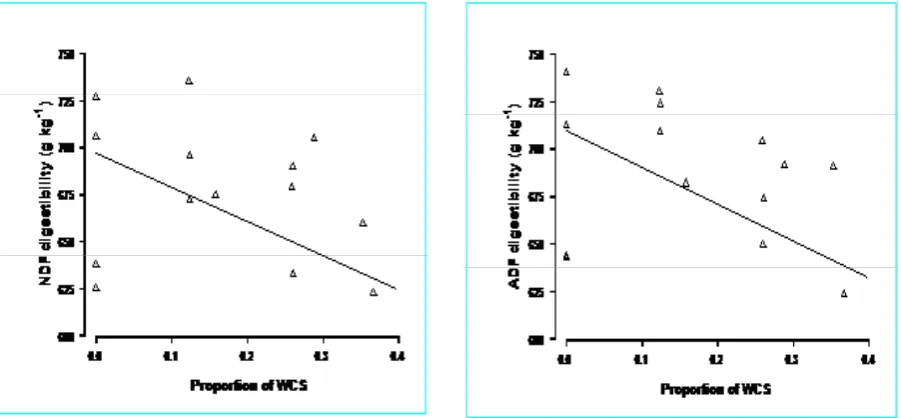
Figure 1 shows that the DM, NDF and ADF digestibility decreased as the the proportion of WCS in the diet increased. This was supported by the slopes of regressions between the feed digestibility against the proportion of WCS in Tabel 2. Intake, digestibility of feed and rumen characteristics of sheep fed diets T1-T4
Measurements T1 T2 T3 T4 SED
Feed intakes (g d-1) :
Dry matter of GH 1009 879 727 645 na.
Dry matter of WCS 0 132 264 382 na.
Total dry matter 1009 1011 985 1030 46.8; ns.
Organic matter 949 953 935 973 17.6; ns.
Total protein 58a 81b 103c 126d 4.5
NDF 621 608 582 593 26.8; ns.
ADF 407 421 404 422 47.2; ns.
Digestibility (g kg-1) :
Dry matter 681a 717a 679 a 633b 18.4
Organic matter 676ab 700a 696a 635b 20
Protein 889a 920ab 947b 948b 19.1
NDF 674a 695a 677a 602b 29.0
ADF 685a 712a 681a 614b 16.3
ME (MJ kg-1DM)* 9.65 10.05 9.99 9.00 na.
Rumen luid :
pH 6.6 6.4 6.2 6.5 0.14; ns.
NH3-N (mM) 4.4a 9.8b 8.7b 9.3b 1.4
Acetic acid (mM) 68.9 72.9 70.2 59.4 9.3; ns.
Propionic acid (mM) 23.8 26.9 28.8 27.0 5.2; ns.
Butyric acid (mM) 6.0ab 7.1a 6.9ab 4.9b 0.9
Total VFA (mM) 99.7 107.0 106.2 91.3 18.6; ns.
Means with different subscripts in the same rows are signiicantly different (p<0.05). T1 = GH alone, T2 = GH +
150 g WCS, T3 = GH + 300 g WCS and T4 = GH + 500 g WCS. * Estimated ME = -1.15 + 0.16 DOM (Menke and
Steingass, 1988), DOM = digestible organic matter, na. = no statistical analysis; ns. = not signiicant (p>0.05). WCS =
the diets (see Table 3). The reduced NDF and ADF digestibility of T4 indicated a possible depression of the activity or numbers of cellulolytic rumen microbes, and suggested that the microbial degradation of cellulose was affected by the presence of WCS.
The dietary lipid content of T4 of 79 g kg-1, is higher than the level of dietary lipid in other studies (Moore et al, 1986; Bird and Dicko, 1987) from which it was concluded that a lipid content of 66 g kg-1 (derived from an inclusion of WCS) in the diet of steers or an addition of 60 to 90 g kg-1 cottonseed oil in the diet of sheep decreased DM and ADF digestibility. It is unclear whether the oil content of WCS might be involved in the reduction of the DM and ibre digestibility in the rumen of sheep fed T4.
Gossypol content of WCS used in this study was 1.93 g kg-1 (Ismartoyo, 1999) and
the gossypol was analysed using methods of Botsoglou (1992). WCS is also known to contains other antinutrients compounds such as tannins (Bailey, 1948; Acamovic, 1994; Ismartoyo, 1999) and various pigments glands (Jones, 1969; Lyman
et al, 1963; Risco and Chase, 1997) which might contributed low rumen fermentation. The results from the earlier study in vitro (Ismartoyo et al, 1993) indicated that removal of oil from WCS did not increase its fermentability suggesting that the oil content might not the main factor causing the reduction of the DM and ibre digestibility. Other factors affecting the degradability and fermentation characteristics of WCS such as the degradability and fermentability of NDF and ADF, the presence of lignin and of the presence of antinutritional factors might contribute to the low DM and ibre digestibility(Nunung Akhirany, dkk, 2013; Rohmyatul Islamiyati,
Table 3. Regression equations of feed digestibility (g kg-1) vs the proportion of whole cottonseed in the diet of sheep fed grass hay (n = 16)
Feed digestibility Regression equations r2 (%)
DMD DMD = (705 + 15.21) - (145 + 63.6) WCS 27.1
OMD OMD = (695.9 + 17.8) - (102.5 + 74.3) WCS 11.9
NDFD NDFD = (697.4 + 19.5) - (181.5 + 81.5) WCS 26.1
ADFD ADFD = (708 + 18.8) - (189.6 + 78.7) WCS 29.4
WCS = the proportion whole cottonseed in the diet of sheep fed GH, GH = grass hay, DMD = dry matter
digest-ibility, OMD = organic matter digestdigest-ibility, NDFD = neutral-detergent ibre digestdigest-ibility, ADFD = acid-detergent ibre digestibility, r2 = coeficient of regression
dkk, 2013; Jamila, dkk, 2013), and probably the activity of the cellulolytic microbes in the rumen of sheep fed T4. The low nitrogen content of GH might also affect the NDF and ADF digestibility of GH basal diet. and NDF digestibility. There was no statistically signiicant effect on total rumen VFA, but the molar proportions of acetate, propionate and butyrate were altered by the highest rate of inclusion of WCS. These results suggested that WCS might have reduced the numbers or activities of cellulolytic rumen microorganisms.
REFERENCES
Acamovic, T.1994. The advantages and disadvantages of xenobiotics in plant foods and feeds. In: Development and ethical considerations in toxicology.(Ed. M.I.Weitzner) Royal Society of Chemistry. pp.129-138.
Bailey, A.E. 1948. Cottonseed. Interscholarstic Publishing Inc., New York, USA. p.522.
Bird, S.H. and M. Dicko. 1987. Cottonseed supplement for sheep. In: Recent advances in animal nutrition in Australia. (Ed. D.J. Farrel). Department of Biochemistry, Microbiology and Nutrition, University of New England, Armidale, Australia. pp.80-88.
Botsoglou, N.A.1992. Liquid chromatographic determination of unbound and aceton-soluble bound gossypol in cottonseed meals and mixed feeds. J. AOAC., 75: 815-822.
Coppock, C.E., J.K. Lanham and J.I. Horner. 1987. A Review of the nutritive value and utilisation of whole cottonseed, cottonseed meal and associated by-products by dairy cattle. Anim. Feed Sci. Technol., 18: 89-129.
Ely, L.O. and Guthrie, L.D., 2012. Feeding whole cottonseed to dairy cows and replacement. Univ of Georgia (UGA) extension Colleges of Agricultural and Environmental Science. www.extension.uga. edu/publication/detail.cfm?number=SB59. Ismartoyo, T. Acamovic, and C.S. Stewart.1993. The effect
of gossypol on the rumen microbial degradation of grass hay under consecutive batch culture (CBC). Anim. Prod., 56: (Suppl.1).462 (A.).
Ismartoyo and T. Acamovic. 1994. The effect of gossypol on animal cells in culture. InPlant-Associated Toxins; Agricultural, Phytochemical and Ecological Aspects. (Eds. S.M. Colegate and P.R. Dorling). CAB International, Wallingford, United Kingdom. pp. 201-206.
Ismartoyo, C. S. Stewart, W. J. Shand and T. Acamovic. 1994a. The effect of gossypol on the rumen protozoal degradation of grass hay (GH) in vitro. VIII International Symposium on ruminant Physiology. 25-30 September 1994, Willigen, Germany. p. 205.
Ismartoyo, C. S. Stewart, W. J. Shand and T. Acamovic. 1994b. In vitro rumen microbial degradation of a selection oilseeds and legume seeds under consecutive batch culture (CBC). Anim. Prod., 58: 453.
Ismartoyo, C. S. Stewart, T. Acamovic and A. J. Richardson. 1995a. The effect of gossypol on rumen fungal attachment to and degradation of cellulose in culture. British Society of Animal production, Proceedings of the Winter Meeting, Animal production, p. 153.
Ismartoyo, T. Acamovic, C. S. Stewart, A. J. Richardson, S. H. Duncan and W. J. Shand. 1995b. The effect of feeding WCS (whole cottonseed) as a supplement for sheep fed GH (grass hay) on the rumen fermentation and defaunation of rumen microorganism. Conference on the Evaluation of Tropical Forages for Ruminant Utilisation. Held in University of Zimbabwe, August 27 to September 1st, 1995.
Ismartoyo. 1999. Analysis of gossypol in whole cottonseed and rumen liquor of sheep fed a basal diet grass hay supplemented with whole cottonseed. Buletin Ilmu Peternakan dan Perikanan. 5(13): 11-31.
Mustabi, J., R. Ngitung, R. Islamiyati, N. Akhirany, A. Natsir, K. Jusoff, Ismartoyo, T. Kuswinanti and Rinduwati. 2013. Rice Straw Fermented with white rot fungi as an alternative to elephant grass in goat feeds. Global Veterinaria, 10(6): 697-701.
Jones, L.A. 1979. Gossypol and some other terpenoids, lavanoids, and phenols that affect quality of cottonseed protein. J. Am. Oil Chem. Soc., 56:727-730.
Jones, L. A. 1991. Deinition of gossypol and its prevalence in cottonseed products. In: Cattle Research with gossypol containing feeds: A collecting of papers addressing gossypol effects in Cattle. (Eds L. A. Jones, D. H. Kinard and J. S. Mills). Published by National Cottonseed Products Association, Memphis, Tennessee. pp.1-18.
Lyman, C. M., A. S. El-Nockrashy and J. W. Dollahite. 1963. Gossyverdurin: A newly isolated pigment from cottonseed pigment glands. J. Am. Oil Chem. Soc., 40: 571-575.
Martin, S. D. 1990. Gossypol effects in animal feeding can be controlled. Feedstuffs, 62 (33):14.
Nunung Akhirany, Ismartoyo, K. Jusoff, A. Natsir, and A. Ako. 2013. The digestibility, degradation and index value of four local feeds for goat. World Appl. Sci. J., 26: 60-66.
Risco, C. A. and C. C. Chase, Jamie Robertson. 1997. Gossypol. In: Plant and fungal toxicants. (Ed. J.P.F. D’Mello). CRC Press, Boca Raton, Florida. pp. 243-252.
Islamiyati, R., S. Rasjid, A. Natsir, and Ismartoyo. 2013. Crude protein and iber fraction of corn stover inoculated by fungi Trichoderma sp. And Phanerochaete Chrysosporium. Int. J. Sci. and Tech. Res., 2(8):149 – 152.
Islamiyati, R., S. Rasjid, A. Natsir, and Ismartoyo. 2013. Productivity of local goat fed corn stover treated with fungi Trichoderma sp. and supplemented Gliricidia. Int. J. Agric. Systems. 1(2): 128 – 134.
Rooke, J. A., A. J. Borman and D. G. Armstrong. 1990. The effect of inoculation with Lactobacillus plantarum on fermentation in laboratory silos of herbage low in water-soluble carbohydrate. Grass and Forage Sci., 45:143-152.