Presence of
Nitrosospira
cluster 2 bacteria corresponds
to N transformation rates in nine acid Scots pine forest soils
R.A. Nugroho
a,*, W.F.M. Ro¨ling
b, A.M. Laverman
c, H.R. Zoomer
a, H.A. Verhoef
aaInstitute of Ecological Science, Faculty of Earth and Life Sciences, Vrije Universiteit, De Boelelaan 1085, 1081 HV Amsterdam, The Netherlands bDepartment of Molecular Cell Physiology, Faculty of Earth and Life Sciences, Vrije Universiteit, De Boelelaan 1085,
1081 HV Amsterdam, The Netherlands
cDepartment of Geochemistry, Faculty of Earth Sciences, Universiteit Utrecht, Budapestlaan 4, 3584 CD Utrecht, The Netherlands
Received 7 October 2004; received in revised form 29 November 2004; accepted 7 February 2005
First published online 2 March 2005
Abstract
The relation between environmental factors and the presence of ammonia-oxidising bacteria (AOB), and its consequences for the N transformation rates were investigated in nine Scots pine (Pinus sylvestrisL.) forest soils. In general, the diversity in AOB appears to be strikingly low compared to other ecosystems.Nitrosospiracluster 2, as determined by temporal temperature gradient electro-phoresis and sequencing, was the only sequence cluster detected in the five soils with high nitrification rates. In the four soils with low nitrification rates, AOB-like sequences could not be detected. Differences in nitrification rates between the forest soils correlated to soil C/N ratio (or total N) and atmospheric N deposition.
2005 Federation of European Microbiological Societies. Published by Elsevier B.V. All rights reserved.
Keywords: Nitrification; Ammonia-oxidising bacteria; Acid Scots pine forests; Environmental factors
1. Introduction
Nitrification is carried out in most ecosystems by autotrophic bacteria and this process is often considered rate limited by the activities of ammonia-oxidising bac-teria (AOB). These bacbac-teria are responsible for the oxi-dation of ammonia to nitrite by the enzymes ammonia monooxygenase and hydroxylamine oxidoreductase
[1,2].
All known terrestrial AOB to date belong to a mono-phyletic assemblage ofNitrosospiraandNitrosomonasin theb-subdivisionProteobacteria [2,3]. This assemblage originally consists of seven 16S rRNA gene sequence clusters[3]. Koops et al.[4]have expanded the
subdivi-sion of AOB by including environmentally retrieved 16S rRNA gene sequences. Molecular analysis revealed that
Nitrosospira cluster 2 dominated in acid soils [3,5,6].
Nitrosospira cluster 3 and Nitrosomonas cluster 7 were major AOB in tilled and fertilised soils[7–9], while Nitr-osospiracluster 0 dominated under undisturbed and unf-ertilised grassland [9,10]. Generalisation regarding the relationship between clusters and environmental vari-ables cannot be made as other 16S rRNA gene (rDNA)-based studies showed that Nitrosomonas euro-paea cluster 7 can also be present in acid soils[11]and in unfertilised grasslands [9], and Nitrosospiracluster 3 in both fertilised and unfertilised grassland [9]. There-fore, it remains unclear how the composition of AOB communities varies due to different environmental factors.
Our aim is to improve the understanding on the rela-tion between the presence of AOB and environmental
0168-6496/$22.00 2005 Federation of European Microbiological Societies. Published by Elsevier B.V. All rights reserved. doi:10.1016/j.femsec.2005.02.002
* Corresponding author. Tel.: 31 20 598 7073; fax: 31 20 598 7123. E-mail address:[email protected](R.A. Nugroho).
factors in acid Scots pine forest soils and the conse-quences for the in situ N transformation process. We, therefore, (i) quantified the N transformation rates, i.e. net mineralisation, net nitrification and net ammonifica-tion rates in nine Scots pine forest soils with different NHþ4–N concentrations; (ii) established correlations
be-tween soil properties, i.e. total C, total N, C/N ratio, Ca content, pH, initial NO3–N and NHþ
4–N concentrations
and N transformation rates and (iii) tested the hypothe-sis that soils with different NHþ4–N concentrations con-tain different autotrophic AOB and that this difference correlates to N transformation rates.
A culture-independent method was used to examine the presence of AOB in nine acid Scots pine forest soils that have been subjected to different levels of N deposi-tion for many years. Molecular biological approaches have significant advantages for analysis of in situ AOB communities[12], as analysis can be carried out without enrichment and isolation of pure cultures.
2. Materials and methods
2.1. Field site and forest floor collection
Eight sites located in the Netherlands and one site in Finland (Table 1) were chosen to represent a large range in NHþ4–N concentrations. The forest floor
(fragmenta-tion (F) layer) of Scots pine (Pinus sylvestris L.) stand utilized in this study was collected in June 2002. At each site, ten samples (15·20 cm) of the F layer were
col-lected randomly from an area of approximately 5·5 m, then pooled in a clean plastic bag and returned
to the laboratory. Pooling was necessary to make the soil more homogeneous. The field-moist soils were immediately passed through a 4-mm sieve in the labora-tory and homogenized by hand. Sieving through 2-mm sieves has hardly any effect on mineralisation [13]. Sub-samples of 30 g of the sieved material were stored at 20C until molecular analysis (Section 2.4). The
remaining sieved material was kept at 5C, to minimise
changes in initial conditions across the soils, for less than a week until further analysis on soil characteristics (Section 2.2) and N transformation rates (Section 2.3). In this study, the F layer was chosen, as in this layer, compared to the litter (L) layer and mineral soil, less spatial variation was observed in mineralisation and nitrification rates and temporal variation in these rates was not significant[14]. In addition to that, denitrifying capacity was lowest in the F layer[6].
2.2. Soil characteristics analysis
Sub-samples of the sieved material were analysed for total N and total C on a Carlo Erba Strumentazione
ele-mental analyser (model 1106) and Ca content on AAS Table
(Perkin Elmer, model 1100B). Moisture contents of the soils were determined by drying fresh samples at 50C
for 3 days. Other sub-samples were extracted with 1 M KCl (15 g field-moist soil:100 ml of 1 M KCl) on a sha-ker at 200·gfor 1.5 h and filtered through filter paper
(Schleicher and Schuell, 595.5). Extractable NHþ4–N and
NO3–N concentrations were measured on an
autoanaly-ser (Skalar SA-40), and pH was measured using a Con-sort P907 pH meter.
2.3. N transformation rate determination
N transformation rates were determined using the method described by Laverman et al. [14]. Before the N transformations experiment, sub-samples for incuba-tion were brought to 65% moisture content by adding demineralised water. Two 250-ml screw-cap bottles were filled with 15 g fresh material each. One bottle was capped with a regular cap and the other with a sep-tum-contained cap. Acetylene 0.1% (vol/vol) was added to a septum-capped bottle and was present throughout the incubation time as acetylene was still detectable in the headspace at the end of the incubation (data not shown). Acetylene was purified by passage through 5 N H2SO4, 5 N NaOH, and water [15]. Both bottles
were incubated for three weeks at 25C in the dark. This
assay was done in triplicate for each soil. At the end of incubation, 1 M KCl-extractable NHþ4–N and NO3–N
concentrations, and pHKCl were determined. This
ap-proach was chosen to indicate the in situ N transforma-tion rates.
Concentrations of extractable NO3–N in soil at time zero and after three weeks were used to calculate net nitrification rate. The net ammonification rate and net N mineralization rate were calculated in the same man-ner; subtracting initial concentrations of NHþ4–N and
ðNHþ4 þNO3–NÞ, respectively, from those measured
at the end of the incubation. All N transformations were expressed on dry weight basis. The percent contribution of net ammonification and nitrification rates to net min-eralization rate were calculated as net ammonification and net nitrification rates divided by net mineralization rate, respectively.
2.4. DNA extraction from soil and nested PCR
DNA was extracted from approximately 0.3 g sub-samples of soil (at field moisture content) using the FastDNA SPIN Kit for Soil (FastPrep FP120 Cell Disrupter). The extracted DNA was cleaned three times with the Wizard DNA clean-up system (Promega, Mad-ison, WI, USA). Independent DNA extractions were done in triplicate. A nested PCR was then carried out for all samples. Universal bacterial-specific 16S rDNA directed primers pAf/pHr[16]were used in the primary
amplification. PCR products were amplified from each DNA preparation in 50ll reactions, 400 nM pAf/pHr, 0.2 mM dNTPs, 10lg BSA, Taq DNA polymerase (2.5 unit, Promega), the buffer conditions recommended by the manufacturer, and 5ll of each soil DNA extrac-tion as template source. Reacextrac-tions were carried out in a T3 thermocycler (Whatman Biometra). The PCR ther-mocycling regime was as follows: 3 min at 95C,
fol-lowed by 30 cycles consisting of 1 min at 95C, 1 min
at 55C, and 1 min at 72C and a final cycle consisting
of 10 min at 72C. The PCR products were diluted 100
times and used as template in the second amplification using AOB specific primers, CTO189f-GC/CTO654r
[12]. The secondary amplifications used the same reac-tion volume, reagent concentrareac-tions and buffer condi-tions as described for the primer set of pAf/pHr. The PCR amplifications were performed at 95C for 3 min
after which 30 cycles were performed at 95C for
1 min, 57C for 1 min, 72C for 1 min and a final cycle
consisting of 10 min at 72C. PCR products were
exam-ined by agarose gel electrophoresis.
2.5. TTGE analysis, cloning and sequencing
The PCR products were then profiled on TTGE using a Biorad Protein II Electrophoresis Unit (BIO-RAD Dcodee systems, Hercules, CA, USA) as described by Laverman et al.[6]. Gels (8% polyacrylamide, 1·TAE,
37.5:1 acrylamide:bisacrylamide, 8 M ureum) were run for 16 h at 60 V over temperature range 59.6–64.4C,
increasing at 0.3C h1. Laverman et al. [6]have
com-pared TTGE and DGGE profiling of AOB and found that TTGE banding patterns are similar to those pro-duced by DGGE. TTGE gels were stained with ethidium bromide, washed in distilled water and digitally re-corded using the Imagere system (Appligene, Inc., Ill-kirch, France). To optimise the sensitivity of DNA detection, we also stained TTGE gel using SYBR gold, one of the most sensitive dyes, and the results were iden-tical to those used ethidium bromide stain (data not shown). Independent DNA extractions and PCRs on the same soil sample revealed similar TTGE patterns (data not shown).
To determine the nucleotide sequence of TTGE bands, the centre of the band was cut out and incubated overnight in 50ll TE at 4C. This solution was used for
Biotech.) according to the manufacturerÕs instruction. These selected clones were tested for correspondence with the original TTGE bands to make sure that the se-quences were the target bands.
2.6. Data analysis
Non-parametric tests were used as homogeneity of variances of the data was not ensured. Mann–Whitney
Unon-parametric tests were used to analyse differences in environmental factors and N transformation rates be-tween two groups of sites, one group containing all sites that showed the presence of a particular 16S rRNA se-quence, the other group containing the sites that did not show this sequence. Correlations between net nitrifi-cation rate, net ammonifinitrifi-cation rate and environmental factors were determined using SpearmanÕs correlations. All statistical analyses were done using SPSS 11.5 for Windows.
Recovered 16S rDNA sequences were compared to se-quences deposited in the GenBank DNA database by using BLAST algorithm[17]. Sequence alignments were performed using ClustalW Multiple sequence alignment program version 1.8 (http://clustalw.genome.jp). Only nucleotide positions that were unambiguously aligned were used in the subsequent phylogenetic analysis. Distance analysis of 427 nucleotide positions of the alignment was performed with Treecon version 1.3b software[18]. Gaps were not taken into account in the analysis. The bootstrap analysis was based on 100 replicates.
2.7. Nucleotide sequence accession numbers
The nucleotide sequences have been deposited in GenBank under accession numbers AY683621–
AY683629.
3. Results
3.1. Study sites properties
Table 1 shows the soil characteristics of all study sites. The chosen sites show a large range in initial NHþ4–N, NO3–N and Ca concentrations, total C, total
N and pH. NHþ4–N was the predominant form of
inor-ganic-N, and NO3–N concentrations were very low in
Schoorl, Nastola, Bentveld and Appelscha, accounting for less than 6% of inorganic N. In the other sites NO3–N concentrations were much greater, accounting for 29–38% of inorganic N. Comparisons across all sites revealed that soil from Nastola has the lowest values of the initial NHþ4–N and NO3–N contents, total C and
to-tal N compared to other soils, while other sites have
shown no consistent trends concerning within site soil properties.
3.2. N transformation rates
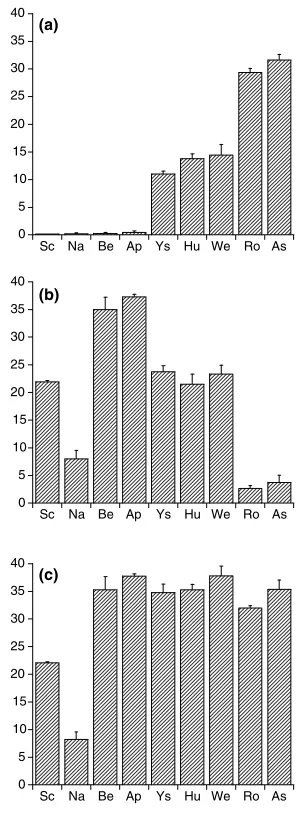
The N transformation rates in nine forest soils after 3 weeks of incubation are shown in Fig. 1. At all sites, acetylene treatment resulted in a complete inhibition of net nitrification rate, suggesting that autotrophic nitrifi-cation was the dominant process. Concerning the net nitrification rate (Fig. 1(a)), the rates in Schoorl, Nast-ola, Bentveld and Appelscha were relatively low, less than 0.5lg g1dry soil wk1. The rates in Ysselsteyn, Hulshorst and Wekerom were considerable higher at 11.0–14.4lg g1dry soil wk1. The highest rate
com-0 5 10 15 20 25 30 35 40
Sc Na Be Ap Ys Hu We Ro As
0 5 10 15 20 25 30 35 40
Sc Na Be Ap Ys Hu We Ro As
0 5 10 15 20 25 30 35 40
Sc Na Be Ap Ys Hu We Ro As
(a)
(b)
(c)
prises soils from Roggebotzand and Asbak (29.4– 31.6lg g1dry soil wk1).
Net ammonification rates differed between sites (Fig. 1(b)). The lowest net ammonification rates were in Rog-gebotzand and Asbak (2.6–3.7lg g1dry soil wk1). Nastola has a higher rate (8.0lg g1dry soil wk1) than Roggebotzand and Asbak, while Schoorl, Ysselsteyn, Hulshorst and Wekerom have higher (a factor three) rates than Nastola. The highest rates were found in Bentveld and Appelscha (35.0–37.3lg g1dry soil wk1).
Furthermore, net mineralization rates in all soils were comparable with the exception of soils from Schoorl and Nastola (Fig. 1(c)). The net mineralization rates in Schoorl and Nastola were lower than other in sites, 22.1 and 8.2lg g1dry soil wk1, respectively. More-over, the percent contribution of ammonification and nitrification to net mineralization rates in Schoorl, Nast-ola, Bentveld and Appelscha are around 99% and 1%, respectively. The percent contribution of these two pro-cesses to net mineralization rates in Ysselsteyn, Huls-horst and Wekerom are around 64% and 36%, respectively, and in Roggebotzand and Asbak around 9% and 91%, respectively.
3.3. Correlation between soil properties and N transformation rates
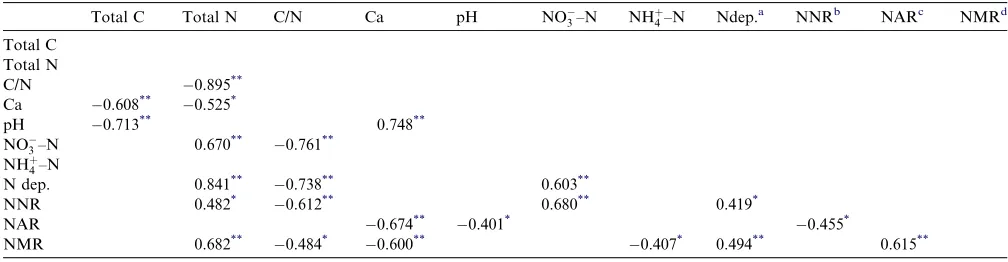
Table 2shows SpearmanÕs correlations between dif-ferent soil properties. Positive correlations were found between pH and Ca content, initial NO3–N
concentra-tion and total N, N deposiconcentra-tion rate and total N, and N deposition rate and initial NO3–N concentration.
Negative correlations were found between C/N ratio
and total N, Ca content and total C, Ca content and to-tal N, pH and toto-tal C, initial NO3–N concentration and
C/N ratio, and N deposition rate and C/N ratio. A weak negative correlation was observed between net ammonification rate and net nitrification rate. Net mineralisation was positively correlated to net ammonification rate. Moreover, these rates were also correlated to some soil properties (Table 2). Net nitri-fication rate was negatively correlated to C/N ratio, and positively correlated to total N, initial NO3–N concentration and N deposition rate. Net ammonifica-tion rate was negatively correlated to Ca content and pH. Net mineralisation rate was positively correlated to total N and N deposition rate, and negatively cor-related to C/N ratio, Ca content and initial NHþ4–N
concentration.
3.4.b-subdivision AOB-like 16S rDNA
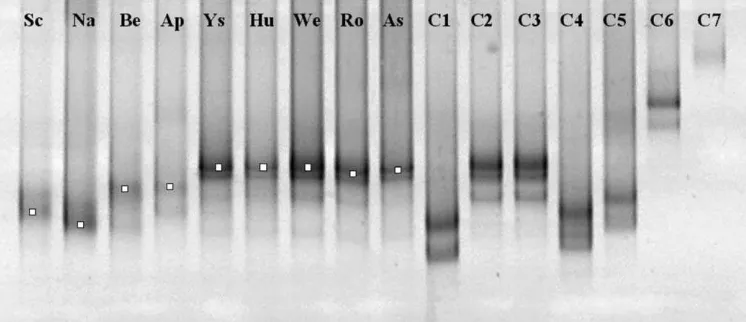
Fig. 2 shows that very similar AOB TTGE banding patterns were recovered for soil samples from Yssels-teyn, Hulshorst, Wekerom, Roggebotzand and Asbak (Fig. 2). These doublet bands co-migrated with products from cloned standards representingNitrosospiraclusters 2 and 3. The TTGE bands apparent for the Schoorl, Nastola, Bentveld and Appelscha samples did not clearly co-migrate with any of the cloned standards (Fig. 2). TTGE patterns of PCR products from indepen-dent PCRs on the same sample and from indepenindepen-dent DNA extractions showed no variation in the number of bands and migration position (results not shown). These findings confirmed the reproducibility of the PCR-TTGE method. In both reference clone and envi-ronmental TTGE patterns, bands often occurred in dou-blets, which is consistent with previous results which
Table 2
SpearmanÕs correlation coefficients between net nitrification, ammonification, and mineralisation rates and soil properties among sites (only significant correlations are shown)
Total C Total N C/N Ca pH NO3–N NH
þ
4–N Ndep. a
NNRb NARc NMRd
Total C Total N
C/N 0.895**
Ca 0.608** 0.525*
pH 0.713** 0.748**
NO3–N 0.670
**
0.761** NHþ4–N
N dep. 0.841**
0.738** 0.603**
NNR 0.482*
0.612** 0.680** 0.419*
NAR 0.674**
0.401*
0.455*
NMR 0.682**
0.484*
0.600**
0.407* 0.494** 0.615**
a Ndep., N deposition rate. b NNR, Net nitrification rate. c NAR, Net ammonification rate. d NMR, Net mineralisation rate. * P60.05.
showed that a single template sequence can give rise to multiple TTGE bands due to an ambiguous position in the CTO reverse primer[12].
Co-migration of bands from Nitrosospira clusters 2 and 3 and the lack of co-migration for bands from four samples with any of the standards prevented unambigu-ous identification of AOB clusters based on migration pattern alone. It was, therefore, necessary to excise and reamplify TTGE bands for cloning, sequencing and phylogenetic analysis.
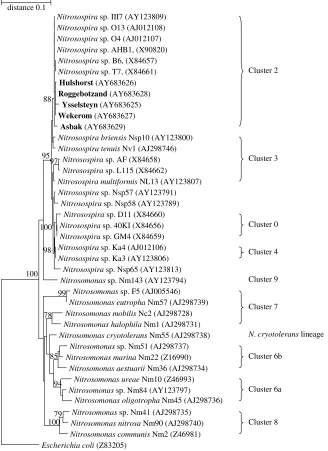
Phylogenetic analysis of the recovered sequences de-rived from Ysselsteyn, Hulshorst, Wekerom, Rogge-botzand and Asbak bands placed these sequences (GenBank Accession Nos. AY683625, AY683626,
AY683627, AY683628 and AY683629, respectively) in
Nitrosospira cluster 2 (Fig. 3), which is in agreement with the TTGE analysis. The similarity between these five sequences ranged from 98% to 100%. The sequences showed the closest affinity toNitrosospirasp. strains III7 and AHB1. The similarity to these knownb-subdivision AOB sequences ranged from 95% to 99%. Phylogenetic analysis of Schoorl, Nastola, Bentveld and Appelscha bands placed their recovered sequences (GenBank Accession Nos. AY683621, AY683622, AY683623, and AY683624, respectively) outside the Nitrosospira Nitrosomonasclade.
Statistical analysis based on non-parametric analysis of variance (Mann–Whitney U test) on soils with and without recoveredNitrosospiracluster 2-like 16S rDNA sequences revealed that soils with recoveredNitrosospira
cluster 2-like 16S rDNA sequences were significantly higher in total N, initial NO3–N concentration and atmospheric N deposition, while C/N ratio was lower in these soils. Net nitrification rate was higher in these soils, while net ammonification rate was lower in these soils.
4. Discussion
In this study, we found that environmental factors, such as C/N ratio of the F layer and atmospheric N deposition affect the presence of the AOB, which may explain the big differences in N transformation rates be-tween the different forest soils. The presence of AOB was determined by cultivation-independent, molecular methods. The different steps (DNA extraction, PCR, and profiling) in such a molecular approach have their pitfalls [19]. However, since all samples were treated similarly, these pitfalls can be considered the same for all samples, allowing between-sample comparisons.
In soils with high net nitrification rates, we detected only Nitrosospiracluster 2-like sequences. In soils with low net nitrification rates, we could not detect any AOB-like sequences even though a nested PCR ap-proach was used. We found only non-AOB sequences in these soils. The detection of non-AOB-like sequences using the CTO primers was not surprising, since these primers have a relatively low specificity[4,20]. Purkhold et al. [20] demonstrated that none of the primers and probes targeting the 16S rRNA or the 16S rRNA-encoding gene of AOB can cover all cultured species along with being 100% specific for these AOB. The pre-dominance of Nitrosospira cluster 2-like sequences de-tected in this study is not likely to be due to high selectivity of the CTO primers. Kowalchuk et al. [12]
tested the selectivity in the CTO primers by performing on DNA templates containing different ratios of clones pH4.2A/6 (Nitrosospiracluster 2) and pH4.2A/23 ( Nitr-osomonas cluster 6), followed by separation of these two clones in DGGE. The DGGE profiling revealed bands with relative intensities that were in good agree-ment with ratios between the two clones in the starting DNA template.
We also do not expect that the predominance of Nitr-osospira cluster 2-like sequences is due to a failure of FastDNA Spin Kit to extract DNA of several types of highly abundant AOB.Nitrosospira clusters 3[21] and 4[21,22]andNitrosospira multiformisandNitrosomonas europaea[23]could also be detected in soil systems using the FastDNA Spin Kit. Furthermore, Laverman et al.
[6] previously used a modified mechanistic cell disrup-tion method to extract DNA from two forest soils, Wek-erom and Roggebotzand, that were also addressed in this study and also detectedNitrosospiracluster 2, exclu-sively, based on 16S rRNA gene based analysis. More-over, Laverman et al. [6]confirmed the dominance by members ofNitrosospiracluster 2 by using a set of
prim-ers that target the ammonia monooxygenase (amoA) gene. They found that all AOB populations detected in Wekerom and Roggebotzand soils were closest related to a cultured representative of Nitrosospira cluster 2, strain Nitrosospirasp. AHB1.
Nevertheless, we have used only one non-quantitative analysis for the detection of AOB sequences. Since no single technique can be expected to provide a compre-hensive view of microbial populations in their environ-ment [2], we might have overlooked other AOB populations possibly present. Therefore, we cannot rule out that additional AOB populations will be found if a combination of different techniques and molecular markers would be applied on all samples.
Cluster 8 Cluster 6b
Cluster 6a Cluster 7 Cluster 9 Cluster 4 Cluster 0 Cluster 3 Cluster 2 distance 0.1
Escherichia coli(Z83205)
Nitrosomonas sp. Nm143 (AY123794) Asbak (AY683629)
Nitrosomonas cryotoleransNm55 (AJ298738) Nitrosospira sp. Nsp65 (AY123813) Hulshorst(AY683626)
Nitrosomonas communis Nm2 (Z46981) Nitrosomonas aestuarii Nm36 (AJ298734) Nitrosospira sp. D11 (X84660)
Nitrosomonas ureae Nm10 (Z46993) Nitrosospira multiformis NL13 (AY123807) Roggebotzand(AY683628)
Nitrosospirasp. III7 (AY123809) Nitrosospirasp. O13 (AJ012108) Nitrosospirasp. O4 (AJ012107) Nitrosospirasp. AHB1, (X90820)
Nitrosospirasp. B6, (X84657) Nitrosospirasp. T7, (X84661)
Ysselsteyn(AY683625) Wekerom (AY683627)
Nitrosospira briensis Nsp10 (AY123800) Nitrosospira tenuis Nv1 (AJ298746)
Nitrosospira sp. AF (X84658) Nitrosospira sp. L115 (X84662)
Nitrosospirasp. Nsp57 (AY123791) Nitrosospira sp. Nsp58 (AY123789)
Nitrosospirasp. Ka4 (AJ012106) Nitrosospirasp. Ka3 (AY123806)
Nitrosospirasp. 40KI (X84656) Nitrosospirasp. GM4 (X84659)
Nitrosomonas sp. F5 (AJ005546) Nitrosomonas eutrophaNm57 (AJ298739)
Nitrosomonassp. Nm41 (AJ298735) Nitrosomonas nitrosa Nm90 (AJ298740) Nitrosomonas mobilis Nc2 (AJ298728) Nitrosomonas halophila Nm1 (AJ298731)
Nitrosomonassp. Nm51 (AJ298737) Nitrosomonas marina Nm22 (Z16990)
Nitrosomonassp. Nm84 (AY123797) Nitrosomonas oligotrophaNm45 (AJ298736) 100
95
100 85
94 88
97
98 100
99
79 78
N. cryotolerans lineage
Soils with high nitrification rates are characterised by high initial NO3–N concentrations, low C/N ratios (or
high total N) and high atmospheric N deposition. According to the atmospheric N deposition map of The Netherlands[24], sites with high nitrification rates can be classified as sites with intermediate to high atmo-spheric N deposition. Thus, our observations are in agreement with earlier findings[25–29]. As the soils with high nitrification rates were all characterised by a pre-dominance of Nitrosospiracluster 2-like sequences, the C/N values and the high atmospheric N deposition of these sites are probably favourable for the presence of
Nitrosospira. In acid coniferous forest soil profiles with low N deposition (14.8 kg N ha1yr1) at a site in South Western Sweden, AOB-like sequences could not be detected either[30].
Net nitrification rates and the presence of Nitroso-spira cluster 2 were not correlated to soil pH. This may be due to the relatively small range of soil pH val-ues and small number of study sites, although it has been observed in acid forest soil thatNitrosospiracluster 2 is present regardless of soil pH[22].
Since we did not detect any other cluster types, this study suggests the dominance of a single 16S rDNA sequence type within natural AOB communities in geographically distant acid Scots pine forest soils. So far, similar little variation of AOB community compo-sition, with the exclusive detection of a single Nitroso-spira 16S rDNA sequence cluster, was found in a nitrogen-saturated coniferous forest soil [6]. These re-sults are in contrast with other molecular studies of AOB in soil habitats where larger 16S rDNA sequence diversity has been detected [e.g., 3,5,7,12,22]. Environ-mental factors in our study sites probably affect the activity and presence, but not the cluster type of AOB.
The AOB found in this study at Wekerom is similar to the AOB previously detected at this site by Laverman et al.[6]. They also found little variation between differ-ent organic layers and throughout the year in this site. We suggest that this high degree of spatio-temporal sta-bility of AOB in acid Scots pine forest soils is a general phenomenon.
In general, it appears that members of Nitrosospira
cluster 2 dominate in acidic soils with high nitrification rates [this study, 3,5,6]. However, Nitrosomonas euro-paea-like populations dominating in acidic Belgian for-est soils [11] show that this is not always the case. Which and how environmental factors select for certain sequence cluster(s) of AOB remains an enigma. The cor-relation of N transformation rates to C/N ratio (or total N), atmospheric N deposition and the presence of AOB suggests that N transformation rates are not simply the result of the effects of individual ecosystem properties, but are driven by the interactions between these properties.
Acknowledgements
The authors thank Paul L.E. Bodelier and Manuela Coci for providing reference clones of the AOB. Heikki M. Seta¨la¨ is acknowledged for providing soil from Nast-ola, Finland and George A. Kowalchuk for his useful comments on a previous draft.
References
[1] de Boer, W. and Kowalchuk, G.A. (2001) Nitrification in acid soils: micro-organisms and mechanisms. Soil Biol. Biochem. 33, 853–866.
[2] Kowalchuk, G.A. and Stephen, J.R. (2001) Ammonia-oxidizing bacteria: a model for molecular microbial ecological research. Annu. Rev. Microbiol. 55, 485–529.
[3] Stephen, J.R., McCaig, A.E., Smith, Z., Prosser, J.I. and Embley, T.M. (1996) Molecular diversity of soil and marine 16S rRNA gene sequences related to beta-subgroup ammonia-oxidizing bacteria. Appl. Environ. Microbiol. 62, 4147–4154.
[4] Koops, H.-P., Purkhold, U., Pommerening-Roser, A., Timmer-mann, G. and Wagner, M. (2003) The lithoautotrophic ammonia-oxidizing bacteria In: The Prokaryotes: An Evolving Electronic Resource for the Microbiological Community (Dworkin, M., et al., Eds.), third ed. Springer–Verlag, New York.
[5] Kowalchuk, G.A., Stienstra, A.W., Heilig, G.H., Stephen, J.R. and Woldendorp, J.W. (2000) Molecular analysis of ammonia-oxidising bacteria in soil of successional grasslands of the Drentsche A (The Netherlands). FEMS Microbiol. Ecol. 31, 207–215.
[6] Laverman, A.M., Speksnijder, A.G.C.L., Braster, M., Kowal-chuk, G.A., Verhoef, H.A. and van Verseveld, H.W. (2001) Spatiotemporal stability on an ammonia-oxidizing community in a nitrogen-saturated forest soil. Microbial. Ecol. 42, 35–45. [7] Bruns, M.A., Stephen, J.R., Kowalchuk, G.A., Prosser, J.I. and
Paul, E.A. (1999) Comparative diversity of ammonia oxidizer 16S rRNA gene sequences in native, tilled, and successional soils. Appl. Environ. Microbiol. 65, 2994–3000.
[8] Phillips, C.J., Harris, D., Dollhopf, S.L., Gross, K.L., Prosser, J.I. and Paul, E.A. (2000) Effects of agronomic treatments on structure and function of ammonia-oxidizing communities. Appl. Environ. Microbiol. 66, 5410–5418.
[9] Webster, G., Embley, T.M. and Prosser, J.I. (2002) Grassland management regimens reduce small-scale heterogeneity and spe-cies diversity of beta-proteobacterial ammonia oxidizer popula-tions. Appl. Environ. Microbiol. 60, 20–30.
[10] Kowalchuk, G.A., Stienstra, A.W., Heilig, G.H., Stephen, J.R. and Woldendorp, J.W. (2000) Changes in the community struc-ture of ammonia-oxidizing bacteria during secondary succession of calcareous grasslands. Environ. Microbiol. 2, 99–110. [11] Carnol, M., Kowalchuk, G.A. and de Boer, W. (2002)
Nitroso-monas europaea-like bacteria detected as the dominantb-subclass Proteobacteria ammonia oxidisers in reference and limed acid forest soils. Soil Biol. Biochem. 34, 1047–1050.
[12] Kowalchuk, G.A., Stephen, J.R., de Boer, W., Prosser, J.I., Embley, T.M. and Woldendorp, J.W. (1997) Analysis of ammonia-oxidizing bacteria of the beta subdivision of the class Proteobacteria in coastal sand dunes by denaturing gradient gel electrophoresis and sequencing of PCR-amplified 16S ribosomal DNA fragments. Appl. Environ. Microbiol. 63, 1489–1497.
[14] Laverman, A.M., Zoomer, H.R., van Verseveld, H.W. and Verhoef, H.A. (2000) Temporal and spatial variation of nitrogen transformations in a coniferous forest soil. Soil Biol. Biochem. 32, 1661–1670.
[15] Hyman, M.R. and Arp, D.J. (1987) Quantification and removal of some contaminating gases from acetylene used to study gas-utilizing enzymes and microorganisms. Appl. Environ. Microbiol. 53, 298–303.
[16] Edwards, U., Rogall, T., Blo¨cker, H., Emde, M. and Bo¨ttger, E.C. (1989) Isolation and direct complete nucleotide determination of entire genes. Characterisation of a gene coding for 16S ribosomal RNA. Nucleic Acids Res. 17, 7843–7853.
[17] Altschul, S.F., Madden, T.L., Scha¨ffer, A.A., Zhang, J., Zhang, Z., Miller, W. and Lipman, D.J. (1997) Gapped BLAST and PSI-BLAST: a new generation of protein database search programs. Nucleic Acids Res. 25, 3389–3402.
[18] van de Peer, Y. and de Wachter, R. (1994) TREECON for Windows: a software package for the construction and drawing of evolutionary trees for the Microsoft Windows environment. Comput. Appl. Biosci. 10, 569–570.
[19] von Wintzingerode, F., Go¨bel, U.B. and Stackebrandt, E. (1997) Determination of microbial diversity in environmental samples: pitfalls of PCR-based rRNA analysis. FEMS Microbiol. Rev. 21, 213–229.
[20] Purkhold, U., Pommerening-Ro¨ser, A., Juretschko, S., Schmid, M.C., Koops, H.-P. and Wagner, M. (2000) Phylogeny of all recognized species of ammonia oxidizers based on comparative 16S rRNA and amoA sequence analysis: implications for molec-ular diversity surveys. Appl. Environ. Microbiol. 66, 5368–5382. [21] Mintie, A.T., Heichen, R.S., Cromack Jr., K., Myrold, D.D. and
Bottomley, P.J. (2003) Ammonia-oxidizing bacteria along mea-dow-to-forest transects in the Oregon Cascade Mountains. Appl. Environ. Microbiol. 69, 3129–3136.
[22] Ba¨ckman, J.S.K., Klemedtsson, A˚ .K., Klemedtsson, L. and Lindgren, P.-E. (2004) Clear-cutting affects the
ammonia-oxidis-ing community differently in limed and non-limed coniferous forest soils. Biol. Fert. Soils. 40, 260–267.
[23] Briones, A.M., Okabe, S., Umemiya, Y., Ramsing, N.-B., Reichardt, W. and Okuyama, H. (2002) Influence of Different Cultivars on Populations of Ammonia-Oxidizing Bacteria in the Root Environment of Rice. Appl. Environ. Microbiol. 68, 3067– 3075.
[24] RIVM, (2001) Jaaroverzicht luchtkwaliteit 2001. RIVM rapport 725301009. Rijksinstituut voor Volksgezondheid en Milieu, Bil-thoven, The Netherlands.
[25] Laverman, A.M., Borgers, P. and Verhoef, H.A. (2002) Spatial variation in net nitrate production in a N-saturated coniferous forest soil. Forest Ecol. Manag. 161, 123–132.
[26] Bengtsson, G., Bengtson, P. and Ma˚nsson, K.F. (2003) Gross nitrogen mineralization-, immobilization-, and nitrification rates as a function of soil C/N ratio and microbial activity. Soil Biol. Biochem. 35, 143–154.
[27] Gundersen, P., Callesen, I. and de-Vreis, W. (1998) Nitrate leaching in forest ecosystems is related to forest floor C/N ratios. Environ. Pollut. 102, 403–407.
[28] Persson, T., Rudebeck, J.H., Jussy, J.H., Colin-Belgrand, M., Prieme´, A., Dambrine, E., Karlsson, P.S. and Sjo¨berg, R.M. (2000) Soil nitrogen turnover–mineralisation, nitrification and denitrification in European forest soils In: Ecological Studies – Carbon and Nitrogen Cycling in European Forest Ecosystems (Schulze, E.-D., Ed.), pp. 295–331. Springer, Berlin.
[29] Gundersen, P., Emmert, B.A., Kjonaas, O.J., Koopmans, C.J. and Tietema, A. (1998) Impact of nitrogen deposition on nitrogen cycling in forests: a synthesis of NITREX data. Forest Ecol. Manag. 101, 37–55.