P R O G R A M H A N D BO O K
Overview, Processes, Compet ences and Rules
Western Indian Ocean – Certiication of Marine Protected Areas Professionals.
PROGRAM HANDBOOK: Overview, Processes, Competences and Rules
Copyright: © 2012. Coastal Resources Center and Western Indian Ocean Marine Science Association
WIO-COMPAS is licensed under a Creative Commons Attribution-Non Commercial-Share Alike 3.0 Unported License.
For more information: http://creativecommons.org/licenses/
Coastal Resources Center University of Rhode Island 220 South Ferry Road Narragansett, RI 02882 USA
Western Indian Ocean Marine Science Association Mizingani Street, House No. 13644/10
Zanzibar Town Zanzibar P. O. Box 3298
United Republic of Tanzania
ISBN: 9987-651-02X
Citation: Coastal Resources Center and WIOMSA. 2012. Western Indian Ocean – Certiication
of Marine Protected Areas Professionals Program Handbook: Overview, Processes,
Competences and Rules. v + 34p.
Cover photos: De Hoop Patrol Boat in action © P. Chadwick, WWF SA.
(Clockwise) Corporal Ranger Mwanapili Hamisi with Curio Traders at Mombasa Marine Park © M. Hamisi, Kenya Wildlife Service.
Coral Garden, Mombasa Marine Park © M. Hamisi, Kenya Wildife Service
P R O G R A M H A N D BO O K
Overview, Processes, Compet ences and Rules
www.wio-compas.org
or
www.wiomsa.net/wiocompas
Endorsed by:
Funded by:
Table of Contents
Acknowledgements ...v
1. Overview of the WIO-COMPAS Program ...1
1.1 Background ...4
1.2 Status of WIO-COMPAS Events and MPA PROs ...4
1.3 Purpose of the Certiication Program ...5
1.4 Professional Development ...5
1.5 MPA PRO Networking ...6
1.6 Code of Ethics and Leadership ...6
2. The Certiication Program ...7
2.1 Levels of Certiication ...7
2.2 Competences of MPA Professionals ...9
2.3 Entry Requirements to the Program ...9
2.4 Certiication Process ...9
2.5 Overview of the Assessment Process ...10
2.6 Scoring System for Certiication ... 11
3. Policies and Procedures ...13
3.1 Governance Structure ...13
3.2 Fees and Scholarships ...14
3.3 Application Process ...14
3.4 Appealing Decision and Re-Entering the Program ...15
3.5 Certiication Renewal ...16
3.6 Forgery and Cheating ...16
3.7 Code of Ethics and Leadership Violations ...16
3.8 Qualiications for Assessors ...16
4. Level 1 ~ Marine Field Operations Certiication ...18
4.1 Process ...18
4.2 Competences ...18
4.3 Assessment Instruments ...18
5. Level 2 ~ Site Management Certiication ...19
5.1 Process ...19
5.2 Competences ...20
5.3 Assessment Instruments ...20
6. Level 3 ~ Strategy, Policy and Planning Certiication ...21
6.1 Process ...21
6.2 Competences ...21
Appendices ...23
Appendix A. Bibliography ...23
Appendix B. WIO-COMPAS Code of Ethics and Leadership ...24
Appendix C. Level 1 – Marine Field Operations Competences ...27
Appendix D. Level 2 – Site Management Competences ...29
Acknowledgements
The WIO-COMPAS program is a result of discussions and hard decisions between numerous partners across the WIO region, at the CRC/URI and USAID Washington. First and foremost, special thanks to Dr Richard Volk, who believed in the idea and committed funds to support the development of the WIO-COMPAS Program in 2006. We are indebted to USAID, Sida and ReCoMaP who have provided core funding for the program, and to other partners like WWF South Africa and WWF Tanzania, Kenya Wildlife Service, Cape Nature, South Africa National Parks, Ezemvelo KZN Wildlife and Marine Parks and Reserve Units, Tanzania
for on-kind and material support for the various certiication assessment events.
The WIOMSA Board of Trustees has played a leadership role in building support and promoting the young program. The management agencies in each country have provided guidance, in-kind contributions and their staff. We recognize the following leaders who have supported WIO-COMPAS over the years: Dr. Nyawira Muthiga, Dr. Nirmal Shah, Dr. Salomao Bandeira, Dr. Margareth Kyewalyanga, Dr. Pascale Chabanet, Prof. Rudy van der Elst, Prof. Nils Kautsky, Prof. Micheni Ntiba, Indu Hewawasam, Prof Ron Johnstone, Ali Kaka and Cedric Coetzee. They have provided a lot of useful feedback and inputs that have been incorporated into this manual.
Another equally exceptional group of people who have contributed to the development of this handbook either through participation in assessment events as Assessors or in evaluation meetings as experts are Glenn Ricci, Lesley Squillante, Julius Francis, Lawrence Sisitka, Lilian Omolo, Peter Chadwick and Arthur Tuda. We thank this group for their contribution and commitment.
We appreciate the management authorities in each country for their guidance to the programme, in-kind contribution and for their approval of their staff to participate in the programme. We are also grateful organizations that took the initiative to endorse WIO-COMPAS from the beginning – IUCN WCPA Marine, International Ranger Federation, Game Ranger Association of Africa and WWF South Africa.
1. Overview of the WIO-COMPAS Program
This handbook provides a detailed description of the Western Indian Ocean Certiication of Marine Protected
Area Professionals (WIO-COMPAS) Program elements, processes, rules and policies. It is a resource to help marine protected area (MPA) professionals, MPA management authorities, donors and potential applicants understand how the Program is structured and how to engage in this unique offering. It is also a guide to assessors and members of the certifying bodies to ensure transparency and accountability to rules.
Section one provides a brief overview of the WIO-COMPAS Program and its history. Section two provides
further details on the levels of certiication, competences and assessment processes. Section three highlights the organizational structure, policies, procedures and the fee structure. Sections four, ive and six outline the three levels of certiication that are offered. The Program’s supporting documents—the Code of Ethics and Leadership as well as the detailed competences—are included as appendices.
This publication complements the WIO-COMPAS website (www.wio-compas.org or www.wiomsa.net/ wiocompas). A list of our certiied MPA PROs, their case studies, applications with the competences and
other valuable information is maintained online at the WIO-COMPAS website.
WIO-COMPAS assesses and certiies MPA professionals in the WIO Region based on recognized standards of excellence. It promotes competence, professional growth, leadership, innovation &
ethical conduct.
Three Levels of Certiication are offered:
• Level 1~ Marine Field Operations: professionals performing the daily duties of an MPA
ranger or other marine ield operators, conducting
maintenance and habitat management activities, engaging communities and enforcing laws
• Level 2~ Site Management: professionals at a site with supervisory responsibilities, similar to MPA manager, warden or section leaders
• Level 3~Strategy, Policy & Planning: professionals involved in higher-level management, strategy, planning and policy development, beyond the boundaries of individual MPAs, and often across international boundaries
Core Competence Areas of the Program
The Program has identiied seven core areas of competences needed by a range of individuals working at
different levels within an MPA. The competences and standards vary for each Level.
Seven Core Competence Areas
• MPA Governance
• Marine Conservation: MPAs and other approaches • Communication and Stakeholder Engagement
• Human and Financial Resources Mobilization and Management • Management Implementation and Effectiveness
This irst-in-the-world certiication Program for MPA professionals has been developed by the Western Indian
Ocean Marine Science Association (WIOMSA) and the Coastal Resources Center at the University of Rhode Island (CRC/URI) in partnership with regional organizations and national governments. The Program is
endorsed by several key organisations including the International Union for the Conservation of Nature’s World
Commission on Protected Areas-Marine, World Wildlife Fund South Africa, International Ranger Federation and Game Ranger Association of Africa. The United States Agency for International Development (USAID) and the Swedish International Development Cooperation Agency (Sida) have provided initial funding for the Program. The European Union-funded ReCoMap project (Regional Coastal Management Program) managed
by the Indian Ocean Commission, has also provided additional inancial support.
The overall goal of the Western Indian Ocean Certiication of Marine Protected Area Professionals
(WIO-COMPAS) Program is to establish a professional association that provides a framework to promote competence, professionalism, leadership, innovation and ethical conduct in Marine Protected Area (MPA) management. WIO-COMPAS recognizes those individuals working in MPAs whose knowledge and skills currently meet a
clearly deined professional standard. The Program then further enhances individuals’ knowledge and skills
through dialogue and networking with other professionals as a way to share new ideas and thinking about MPA management and coastal governance.
This is accomplished through a process that:
• Assesses performance based on professional standards in core competence areas • Provides professional development opportunities
• Catalyzes regional networking amongst MPA staff More speciically, the Program:
• Deines for the irst time the full spectrum of core competences required to perform a range of functions— at three professional levels— associated with the effective management of MPAs
• Establishes standards within each of these competence areas that “set the bar” for what all MPA sites should
be expecting from their professionals
• Raises understanding of the profession—across geographic boundaries (i.e., it matters little if the profession
is being conducted in Western Indian Ocean region, or East Asia, or elsewhere)
• Supports (does certainly not necessarily eliminate) the need for on-the-job training and provides speciic
guidance as to what is required
• Provides employers with a valuable staff motivation and retention tool • Creates a career path for practitioners/professionals
• Ensures employers/donors that they are hiring appropriately qualiied individuals
• Reassures communities that they have a professional committed to carrying out his/her work in an ethical
manner, which includes consideration of client/stakeholder needs
The WIO-COMPAS Program is structured around the four “E” components of Experience, Examination,
Education, and Ethics. While the Program is NOT a training course, it does provide candidates during
certiication assessment events with professional development sessions on emerging issues. Applicants wishing to become candidates for certiication are initially assessed on their education and training background,
their work experience, and their current roles and responsibilities. Successful applicants are then invited, as candidates, to a rigorous assessment event at which multiple assessment instruments are used to score
candidate’s professional workplace competences in seven areas (see below). A code of ethics binds together those individuals who become certiied—known as MPA PROs—to uphold the high standards of the Program
and the profession of MPA management (Figure 1).
signals that an individual has demonstrated certain standards of
through a course of study/training, but through practical experience, application, and
testing. It also signals that the individual has agreed to adhere to a set of professional
standards of conduct or code of ethics.
WIO-COMPAS may refer individuals who are interested in but who lack the requisite
meet the performance standards necessary to gain enrollment into the Program.
1.1 Background
A large number of coastal countries have already developed or are in the process of developing national coastal management programs. Even in those that do not have a formal program, coastal management and coastal ecosystem governance activities are underway as communities and government recognize the value of coastal resources in providing food, livelihoods, and recreation. They also recognize the magnitude and impacts
of the growing degradation—and in some cases even permanent loss—of those resources. Universally, this
degradation is the result of many forces at play such as climate change, and destructive and uninformed human behavior driven by basic needs for food and income. MPAs are one effective tool/approach for helping protect and maintain the long-term physical and economic health of the marine resources upon which so many local communities in developing countries depend.
MPAs also provide a mechanism for contracting parties to meet their commitments under international
agreements such as the Convention on Biological Diversity (CBD). In fact, The Jakarta Mandate—the coastal and marine biodiversity program of action of the CBD—highlights MPAs as one of ive thematic areas
necessary for implementation of the CBD. In the Western Indian Ocean they are critical for meeting the obligations of signatory states to the Nairobi Convention.
Too often, however, management of these MPAs is less than effective. Many meetings, reports and assessments have issued a call to rectify this and have recommended that regional and national training courses for MPA staff become a high priority. In response, there have been important capacity development initiatives for MPA managers undertaken globally. This includes in the Western Indian Ocean region, where WIOMSA and its partners have conducted regional training courses in MPA management. South Africa has also developed a complementary course. These two courses are now strongly aligned with each other and with the
WIO-COMPAS Level 2 competences. Three important tools for MPA managers have also been produced—Training Manual for MPA Managers; Toolkit for Managing Marine Protected Areas in the Western Indian Ocean; and Assessing Management Effectiveness of Marine Protected Areas: A Workbook for the Western Indian Ocean.
Collectively these and other capacity-building efforts and publications have helped to highlight the competences and practices that are essential to effective management of MPAs. The next step in helping MPA management evolve from a practice to a profession was to: 1) categorize these core competences and establish standards for each against which to assess the performance and experience of professionals working in MPAs; and 2) establish a set of ethics by which those working in the profession agree to abide. The WIO-COMPAS Program
represents this “next” step and offers the irst-of-its-kind certiication of MPA professionals.
1.2 Status of WIO-COMPAS Events and MPA PROs
Since the start of WIO-COMPAS there have been seven assessment events with applications from 111 MPA professionals resulting in 37 of them achieving
the title of MPA PRO certiication. Events have been
hosted in four of the WIO region countries. To make this all possible and maintain a rigorous and respected program we have recruited and trained over 12 assessors from the WIO region to moderate the entire assessment process. WIO-COMPAS was designed to recognize the leaders and proven professionals of MPAs in the region. These results represent
quality over quantity of certiied professionals. A irm foundation has been established for long-term
development of WIO-COMPAS.
Table 1. List of Assessment Events, Applicants and Certiied Professionals as of June 2012.
1.3 Purpose of the Certiication Program
Involving Regional Experts in the Development
Development of the WIO-COMPAS Program began in 2006, led by WIOMSA and CRC-URI. It has been a
collaborative process — engaging leaders and practitioners from within and outside the region at every step.
Steps in the process have included:
• Conducting need and demand surveys of potential clients—both the potential candidates for the Program
and those who would fund/support their participation
• Holding regional experts workshops to solicit input, ideas, and develop and agree the
WIO-COMPAS model ( Kenya 2007 and Tanzania 2008) and revisions to the Program based on evaluations (Tanzania 2008)
• Hiring as part of the team, regional experts with both marine/coastal ield experience and expertise in education (including certiication programs), curriculum design, professional development, and
learning assessments
• Developing the Program Framework, Operational Structure, and Business/Marketing Plan to include a
strategy for long-term funding of the Program
• Establishing the WIO-COMPAS Advisors Committee
• Securing endorsement by the IUCN (World Conservation Union) World Commission on Protected Areas
and national and regional organizations within the WIO region
• Developing a cadre of Assessors from the region to expand their leadership opportunities • Evaluation meetings conducted after the irst Assessment Events for Level 1 and 2.
In addition to being the irst certiication for MPA professionals in the world, WIO-COMPAS offers several
innovative features that serve the needs of MPA professionals in the WIO region.
• Independent Assessors. WIO-COMPAS uses a system of independent assessors to review participant credentials and competences. This helps ensure quality and rigor of the certiication process. Being awarded the title “MPA PRO” signals to the world that the recipient has been certiied by a reputable
group of experts, that they possess the necessary skills and experience, and commits to the professional
code of ethics. MPA-PRO identiies them as a competent MPA professional.
• Focused on WIO Region–the Program caters to the unique context of WIO through the diversity of
languages and decentralized strategy for sustainability. You will be assessed on the skills and standards that are tuned to realities of the region. We speak your language!
• Assessments focus on what candidates have done in the past. Professional development sessions provide
candidates with the latest tools and experience for acting in the future.
1.4 Professional Development
In addition to assessing a candidate’s proven competence based on previous on-the-job performance, WIO-COMPAS is committed to providing professional development. All certiication levels include Assessment
Events that provide presentation and discussion sessions targeting emerging issues of concern to MPA management. Events also include sessions focused on professional skills building as a way to strengthen
candidates’ competences. These sessions are not, however, part of the scoring process. Assessors also provide individualized career guidance to candidates to help them improve their competence gaps and gain certiication at the next level—as one step to advancing their career development.
Guest speakers invited to the Assessment Event summarize the latest advances on topics relevant to MPA
management and review international practices and lead speciic skills building exercises to help candidates
1.5 MPA PRO Networking
There is more to the WIO-COMPAS Program after the assessments are conducted. MPA PROs—the title given to certiied MPA professionals—can continue to beneit by participating in and becoming an active
member of the WIO-COMPAS network of MPA professionals in the region. The WIO-COMPAS website (www.wio-compas.org or http://www.wiomsa.net/wiocompas/) highlights the achievements and experience of its MPA PROs including sharing case studies written by MPA PROs. As this library of experience and case
studies grows, it becomes a valued resource for capturing ield experience in MPA management for the WIO region. The website includes proiles of the WIO-COMPAS MPA PROs. Making these proiles available also
helps in the goal of networking.
MPA PROs with each other and with other MPA professionals throughout the region. Additional services and
beneits will be provided based on needs and demands of MPA PROs.
MPA PROs with the appropriate skills, experience and enthusiasm are invited to become assessors for future
certiication offerings. This is part of the overarching WIO-COMPAS strategy to decentralize the Program and
provide opportunities for MPA PROs to expand their leadership roles.
1.6 Code of Ethics
and Leadership
Equally important as setting the technical and management standards by which an MPA professional is judged, the Program has established ethical rules and good practices that underpin effective MPA management. At the end of the assessment event, the candidates discuss the ethical challenges in conducting their jobs and share practical solutions to overcoming the issues. Candidates jointly sign the Code of Ethics and Leadership with their fellow candidates at the closing ceremony. See Appendix B for the Code of Ethics and Leadership as well as Section 3.7 for the rules related to ethical violations of MPA PROs.
© C. Hicks
Marina on the South Coast, Kenya. • Ecological networks of MPAs
• Coastal adaptation to climate change • Linking MPAs to wider ICM Programs • Guidelines for MPA management
• Management of people and leadership • Conlict management
2. The Certiication Program
2.1 Levels of Certiication
WIO-COMPAS offers three levels of certiication for MPA professionals based on their work experience and
proven performance capabilities. Each level addresses a unique set of skills that contribute to the effective
management of MPAs. Professionals can be certiied at multiple levels to relect their diverse areas of expertise
and performance.
Level 1~ Marine Field Operations
Level 1 is designed for the professional who performs practical functions and has responsibility for the day-to-day management of an MPA such as engaging communities and enforcing laws, and who has basic administrative responsibilities.
Ideal candidate: equivalent of an MPA Ranger, Oficer or Marine Field Operator, operating within an MPA Examples of experience could include:
• Providing input to development of site workplans and implementing aspects of those and management plans • Active involvement in compliance and enforcement activities, practical habitat management/conservation,
monitoring, budget management of tasks or workplan elements
• Direct interaction/communication with local residents, resource users, visitors, staff, volunteers, contractors,
and local media
• Supervising and providing on the job skill building through guidance, mentoring and support to junior
personnel, volunteers and contractors
• Producing routine reports and local media articles
Level 2~ Site Management
Level 2 is designed for the professional who is performing management, supervisory and administrative functions and responsibilities, principally at the site level, but may also cover a number of adjacent MPAs.
Ideal candidate: an MPA Manager, Assistant Manager, Site Manager, Senior Warden or Section Ranger
Examples of experience could include:
• Developing management plans and supervising their implementation • Providing input into organizational policy
• Engaging in management planning and review, supervising practical management/conservation activities,
monitoring and evaluation, negotiating with partners and contractors etc., fundraising from local/national sources, developing and managing budgets
• Directly interacting/communicating with local community and resource user groups, researchers/
institutions, local partner and co-management organizations (including local and national non-governmental organizations/NGOs, local municipalities and government departments), staff, volunteers, contractors, and local/national media
• Training/mentoring staff
• Producing plans, reports, media articles, funding proposals
Level 3~ Strategy, Policy and Planning
Level 3 is designed for the professional performing high-level management, planning, strategy and policy development, and administrative functions and responsibilities.
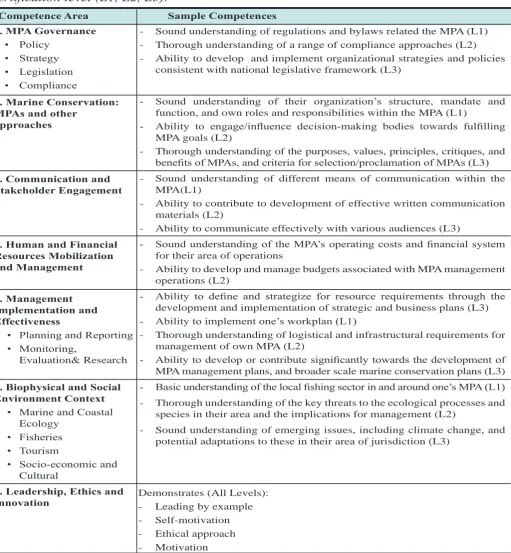
1. MPA Governance
- Sound understanding of regulations and bylaws related the MPA (L1) - Thorough understanding of a range of compliance approaches (L2) - Ability to develop and implement organizational strategies and policies
consistent with national legislative framework (L3)
- Sound understanding of their organization’s structure, mandate and
function, and own roles and responsibilities within the MPA (L1)
- Ability to engage/inluence decision-making bodies towards fulilling
MPA goals (L2)
- Thorough understanding of the purposes, values, principles, critiques, and
beneits of MPAs, and criteria for selection/proclamation of MPAs (L3)
- Sound understanding of different means of communication within the MPA(L1)
- Ability to contribute to development of effective written communication materials (L2)
- Ability to communicate effectively with various audiences (L3)
- Sound understanding of the MPA’s operating costs and inancial system
for their area of operations
- Ability to develop and manage budgets associated with MPA management operations (L2)
- Ability to deine and strategize for resource requirements through the
development and implementation of strategic and business plans (L3)
- Ability to implement one’s workplan (L1)
- Thorough understanding of logistical and infrastructural requirements for management of own MPA (L2)
- Ability to develop or contribute signiicantly towards the development of
MPA management plans, and broader scale marine conservation plans (L3)
- Basic understanding of the local ishing sector in and around one’s MPA (L1)
- Thorough understanding of the key threats to the ecological processes and species in their area and the implications for management (L2)
- Sound understanding of emerging issues, including climate change, and potential adaptations to these in their area of jurisdiction (L3)
Demonstrates (All Levels):
Table 2. Summary of the seven competence areas with sample competences from each certiication level (L1, L2, L3).
Examples of responsibilities include:
• Developing and/or reviewing organizational strategies and policies and supporting development of
management plans consistent with these
• Providing input to national (and international) policy development
• Being actively involved in policy development and review; supervising development of management plans
and policy; negotiating with national and international partners; fundraising from national/international sources; developing and managing organizational level budgets
• Directly interacting/communicating with national and international partners including government
departments, UN agencies, international NGOs, and national and international media
• Involvement in broad-scale marine and coastal management Programs such as Integrated Coastal Zone
Management and Large Marine Ecosystem initiatives.
2.2 Competences of MPA Professionals
The WIO-COMPAS Program used input from regional MPA leaders and international experts to establish the set of competences (levels of understanding and abilities) required for a professional standard of performance in management of MPAs. There are seven competence areas and within each, the professional must
demonstrate a level of technical and management understanding and ability in order to become certiied. For
each competence there are detailed standards which identify the level that a candidate must achieve to receive
certiication. The number and degree of competences vary between the three levels of certiication offered.
The WIO-COMPAS competences complement other international assessment Programs such as the WIO MPA Management Effectiveness and World Bank MPA Scorecard. Detailed lists, by Level, of the competences and their associated standards are included in Appendices C through E.
Each of the irst six core areas has detailed competences and standards (levels of understanding and ability).
The seventh competence area is Leadership, Ethics and Innovation. It serves to integrate across all the competences and to assess the intangible skills and performance of a professional. This competence is scored differently and contributes up to 15% of the overall assessment score.
2.3 Entry Requirements to the Program
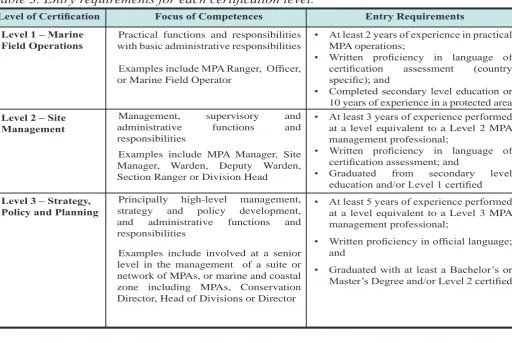
Entry requirements for the WIO-COMPAS Program are unique for each level of certiication. All levels are based on years of experience working in MPAs, language ability and academic achievement. Certiication at
a lower level can substitute for academic achievement if necessary.
2.4 Certiication Process
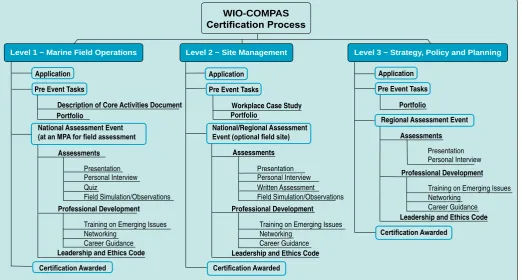
The certiication process starts with the application phase and ends with a multi-day assessment event where assessors formally evaluate candidates’ competences. Candidates must complete several activities prior to attending the assessment event. The speciics of these activities, their timeline and the assessment instruments
used vary between the Levels (Figure 2). For example, Levels 2 and 3 must attend an assessment event that is either national or regional, while Level 1 assessment events are national or sub-national, and are held at an MPA site when possible.
Practical functions and responsibilities with basic administrative responsibilities
Examples include MPA Ranger, Oficer,
or Marine Field Operator
Management, supervisory and administrative functions and responsibilities
Examples include MPA Manager, Site Manager, Warden, Deputy Warden, Section Ranger or Division Head
Principally high-level management, strategy and policy development, and administrative functions and responsibilities
Examples include involved at a senior level in the management of a suite or network of MPAs, or marine and coastal zone including MPAs, Conservation Director, Head of Divisions or Director
Level of Certiication Focus of Competences Entry Requirements
Table 3. Entry requirements for each certiication level.
• At least 2 years of experience in practical
MPA operations;
• Written proiciency in language of certiication assessment (country speciic); and
• Completed secondary level education or
10 years of experience in a protected area
• At least 3 years of experience performed
at a level equivalent to a Level 2 MPA • At least 5 years of experience performed
at a level equivalent to a Level 3 MPA management professional;
• Written proiciency in oficial language;
and
Level 1 ~ Marine Field Operations Level 2 ~ Site Management Level 3 ~ Strategy, Policy and Planning WIO-COMPAS
Application Pre Event Tasks
National Assessment Event National/Regional Assessment Regional Assessment Event Application
Leadership and Ethics Code Leadership and Ethics Code
Leadership and Ethics Code
Figure 2. Comparison of the Process for Certiication between Levels
2.5 Overview of the Assessment Process
A suite of assessment instruments are used by assessors to assess a candidate’s competences. Competences
are WHAT a candidate must be able to do. The assessment instruments are HOW a candidate demonstrates their skills and knowledge. Candidates are scored on the evidence they present as part of the assessment process. Assessment instruments provide the candidate with different opportunities to provide evidence of
their experience and abilities. Each certiication level uses a different combination of assessment instruments to accurately and fairly assess candidates’ competences. Sections 4, 5 and 6 of this Handbook provide detailed
overviews of the assessment instruments for each Level.
• Application—provides a broad view of the applicant’s background and experience for initial assessment as to suitability for the acceptance into the offered Certiication. Gives indications of areas of experience/
inexperience in relation to competence areas. May highlight areas of potential weakness, linked to gaps in experience. Does not provide evidence of actual competence or quality of work/outputs.
It is only after the application review that a decision is made to accept or decline the applicant into the Program
to which they have applied. Once accepted, an applicant is referred to as a ‘candidate’ for WIO-COMPAS Certiication and the actual scoring process begins. Applicants not accepted onto the Program are given the
reasons for this and offered professional development guidance to strengthen apparently weak areas in order to support them in reapplying at a later stage.
• Workplace Case-study or Core Activities Document — These instruments provide candidates with the
opportunity to demonstrate a number of work-related competences, especially in areas for which there may otherwise be limited evidence available. Level 1 candidates produce a Core Activities Document that highlights their daily work routine. Level 2 candidates produce a Workplace Case-Study which describes a recent management issue with analysis and lessons. Candidates produce a short written report and a presentation that is delivered during the Assessment Event. Level 3 candidates develop a presentation on their key activities over the previous 3 years, which they present to their peers and the assessors at the assessment event.
• Portfolio — provides documentary proof of work-related activities and outputs, and includes documents
• Quiz or Written Assessment —Level 1 candidates undertake a simple quiz, based on images of critical
marine species. Level 2 candidates undertake a 2 hour written test which provides evidence in those areas
dificult to assess by other means, for example when trying to assess technical understanding or knowledge
(e.g., of legislation or ecology). It also helps validate evidence from other sources.
• Patrols and Possible Simulations —The Assessment Event may require candidates to demonstrate particular competences—e.g., conducting patrols. Level 1 candidates conduct short beach and/or boat patrols on which they report their observations and any interactions they have with ishers or tourists. In some events
they may be required to conduct activities simulating real-life interactions with stakeholders in the MPA.
• Face-to-face Interview — probes more deeply into those areas of evidence that appear less certain, and provides validation of evidence from other sources, such as the portfolio. The interview can provide both irm evidence of a range of competences; particularly those concerned with ‘understanding’ and ‘knowledge’,
and corroborate other evidence. A two-person interview panel conducts each interview at Levels 1 and 2 to ensure consistency and transparency.
• Panel Interviews – these are solely for Level 3, and candidates are questioned in depth by a panel of marine and MPA specialists, and an assessment expert.
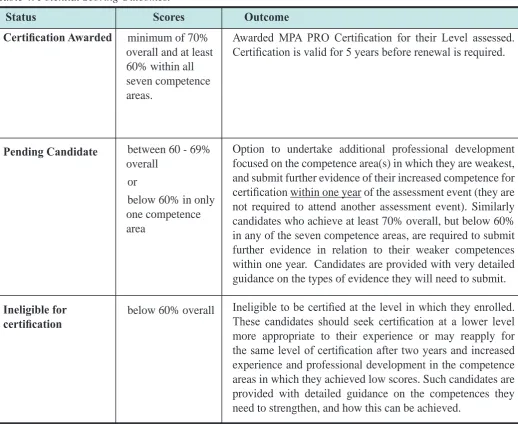
2.6 Scoring System for Certiication
Candidates for certiication are assessed based on their cumulative experience across the seven competence
areas. Candidates must provide some evidence that they have already performed the majority of competences
to the standards required, though they don’t need to have experience in every individual competence – only
enough within each competence area overall.
Certiication Awarded Certiication is valid for 5 years before renewal is required.
Option to undertake additional professional development focused on the competence area(s) in which they are weakest, and submit further evidence of their increased competence for
certiication within one year of the assessment event (they are not required to attend another assessment event). Similarly candidates who achieve at least 70% overall, but below 60% in any of the seven competence areas, are required to submit further evidence in relation to their weaker competences within one year. Candidates are provided with very detailed guidance on the types of evidence they will need to submit.
Ineligible to be certiied at the level in which they enrolled. These candidates should seek certiication at a lower level
more appropriate to their experience or may reapply for
the same level of certiication after two years and increased
Candidates must attend the entire Assessment Event as well as participate in all of the assessment instruments
– such as portfolios, written assessments and interviews as required by each Certiication Level. Candidates
do not receive scores for these instruments, only the individual competences receive scores, according to
the evidence revealed by the use of each instrument. In other words, it doesn’t matter if you prove your
competence through the portfolio or the interview. The scoring is on evidence provided for the competences through all the instruments.
Each competence is usually allocated a weighting of either 2 or 4 points to relect overall importance in the
full assessment scheme. The exception is for the four main competences under CA7 (Leadership, Ethics and
Innovation), which at Levels 2 and 3 are weighted at 8 each to relect the particular importance of these at
these levels. Competences assigned a weight of 4, can be scored from 0-4(including ½ points) while those assigned a weight of 2, can be scored from 0-2. The competences given a weighting of 8 can be scored from
0-8. Again, candidates do not need experience in every competence. The candidate’s overall score is based on
the tally of all competence scores.
To receive certiication, candidates must score a minimum of 70% overall and at least 60%within each of the
seven competence areas.
© WIOMSA
3. Policies and Procedures
3.1 Governance Structure
Five groups share in different governance aspects of the WIO-COMPAS Program.
Certiication Bodies. The WIOMSA Board serves as the legal entity to the WIO-COMPAS Program. The WIOMSA Board and the Coastal Resources Center at the University of Rhode Island (CRC/URI) serve as
the co-certiication bodies. The Board also provides technical oversight, guidance, credibility, promotion and
fundraising for the Program as a whole.
Advisors — Partner organisations provide guidance and feedback to the certifying bodies on how to maintain rigor, decentralize the Program and identify opportunities for certiication offerings. The committee is
comprised of regional and international capacity-building institutions.
Program Secretariat — WIOMSA has dedicated staff who serve as the Secretariat for WIO-COMPAS. Their
role is to provide coordination and day-to-day operations and act as a hub for assessors. The Secretariat
(and local partners) manages all logistics and marketing of the certiication offerings. CRC/URI assists the Secretariat in developing their capacity and procedures through back ofice support, Program development
and delivery, as well as providing technical support to the Program as a whole.
Assessors — Assessors acting as independent experts, are responsible for evaluating each candidate’s
competences through a process that includes application interviews, mentoring candidates through their portfolio and reports, conducting the assessment event and providing recommendations to the Board for
certiication of successful candidates. Assessors conduct the assessment activities only.
MPA management organizations — The MPA management organizations, both government and
non-governmental, play a key role in promoting the Program, encouraging staff to apply, endorsing the application
of individual candidates, conirming validity of application materials, facilitating the case study process,
verifying portfolios and most importantly supporting MPA PROs upon their return to work. Representatives are invited as members of the Advisory Committee.
3.2 Fees and Scholarships
There are no application fees for the WIO-COMPAS Program. Only after an applicant is accepted into a
certiication offering and becomes an oficial candidate is a fee due. Payment of the certiication fee reserves a space in a speciic certiication offering. A limited number of scholarships are sometimes available.
Certiication
• Certiication Fee – amount will depend on the extent the core costs have been covered by funds raised. Mode of payment will be communicated by the Secretariat upon admitted into the Program.
• Renewal Fee – USD $25 The certiication fee covers:
• Administrative costs associated with reviewing applications and enrolment
• Assessment costs including resource materials, professional development programs and a personal assessor
for Levels 1 and 2, and the assessment panel for Level 3
• Accommodation and board for the Assessment Event • Certiication awards and transcripts
Fees do NOT include costs associated with:
• Communicating with the Secretariat and/or assessors (via phone, internet or postal carrier) • Personal time and resources to conduct the assessment activities
• Candidate’s travel to and from the assessment event • Personal expenses or daily subsistence allowance
• Visa costs and other travel related costs to the Assessment Event venue Scholarships
A limited number of partial scholarships are sometimes available for a select number of candidates and are
based on inancial need. Contact the WIO-COMPAS Secretariat for details and scholarship application forms.
The amount of scholarship funding available and the rules related to awarding that funding will vary based on the donors that have provided the funding.
3.3 Application Process
The application process is thorough and extensive for two reasons. One is to accurately conirm an applicant’s education, employment and professional experience related to the level of certiication requested. The other is to achieve eficiency in guiding MPA professionals to the appropriate level of certiication before entering the Program.
The Secretariat serves as gatekeeper to the Program. They send out applications, and they provide WIO-COMPAS information to MPA institutions and professionals to assist them in understanding the Program levels, competences and process. The application review process is as follows:
1. Secretariat screens applications for completeness and entry requirements
2. If approved, a personal assessor is assigned to the applicant to conirm the appropriate type and level of
experience related to the competences
3. Assessors may contact the individual to conduct a telephone conversation to clarify issues arising from the application
4. Assessors submit their acceptance recommendations onto the Program to the Secretariat
5. If the number of qualiied applications exceeds the number of spaces available for the certiication offering
a. Completeness of application (Secretariat screens for entry requirements) and all supporting documentation/evidence
b. Appropriateness of professional experience c. Number of years of work experience in MPAs
d. Level of active involvement in management of the MPA e. Equitable country representative (i.e. seeking regional balance)
f. Likelihood of applicant to stay employed at MPA/commitment to future career in MPAs (must
commit/plan to staying at least two years after being certiied)
g. Gender balance (when possible)
h. Ability to pay certiication fees or only require minimal scholarship assistance
i. Secretariat provides the Board with the list of recommended candidates. The WIO-COMPAS
Board reserves the authority to deny an applicant if they have speciic information that counters the applicant’s evidence
6. Board approves candidates and acceptance letters are forwarded to candidates for enrolment.
Guidance for Applicants Not Accepted
For those applicants who do not meet the entry requirements for the level of certiication to which they have
applied, or whose array of competences are short of the competence standards, WIO-COMPAS provides a
detailed summary of their performance “gaps” as they relate to the Program’s competence areas. The review also advises the applicant of training courses that might increase the applicant’s competence and their chances
of being accepting into the Program at a later date. The review may also recommend that the applicant applies
for a lower level of certiication than the one for which they originally applied.
For details of the Certiication Processes and Events at all 3 levels see sections 4, 5 and 6.
3.4 Appealing Decision and Re-Entering the Program
Applicants not accepted to the Program and candidates not awarded certiication may appeal the Secretariat’s decisions and re-enter the certiication process at a level appropriate to their skills and experience.
Appealing the Entry Decision
• Applicants who wish to appeal the decision on their application should write to the Secretariat requesting an explanation of how their qualiications did not meet the entry requirements
• The primary assessor for the applicant can also write a defense of their recommendation for rejecting the
application
• Other assessors will review the evidence materials, appeal and defense statement to offer their opinion on the decision given. In cases of a split vote, the decision goes to the WIOMSA Board, which makes the inal
determination; all communications regarding an appeal are made through email or telephone only
• Applicants are offered recommendations for how to improve their competences or apply for entry to another
level of the WIO-COMPAS Program.
Appealing the Certiication Scores
• Candidates can appeal their competences scores in a written statement
• Other assessors will review the materials and statement to offer their judgment of the decision (with the
option to raise this to the Board sub-committee if necessary)
• If a candidate did not complete the case study, they are given another 30 days to resubmit
3.5 Certiication Renewal
MPA PROs must renew their certiication every ive years by:
• Showing evidence of continued employment related to MPAs for most of the past ive years
• Successfully completing at least one continuing education course and/or training activity linked to improving their professional performance at MPAs. These are “refresher” courses meant to keep professionals current
on the coastal management and marine protected area management profession and its practice, with topics
shaped by myriad inluences such as the state of global warming, international conventions, new tools and
techniques being used in the practice, and new experiences learned from the ongoing practice of integrated coastal management (ICM) in coastal countries around the world
• Submitting an updated CV highlighting employment changes and job responsibilities, training, awards,
contact information
• Re-signing of the Code of Ethics and Leadership
• Participating in at least one online discussion forum with fellow MPA PROs.
By renewing their certiication, the individual earns the right to continue using the MPA PRO title, logos and website resources. This identiies the individual as a professional who has stayed current in the knowledge,
skills, and practice required of an effective MPA professional.
3.6 Forgery and Cheating
If assessors suspect a candidate is cheating by submitting forged documents or documents authored by others, or lying about their experience, the assessor must report this in writing to the Secretariat/Board for their follow-up. The candidate may be asked by the lead assessor to suspend their participation in the Assessment
Event. Should the charges be veriied, a candidate may drop out of the Program and avoid further action. However, the charges will be noted in the candidate’s records.
3.7 Code of Ethics and Leadership Violations
Candidates must sign their agreement to abide by the WIO-COMPAS Program Code of Code of Ethics and
Leadership. The WIO-COMPAS Board is authorized to revoke certiication if presented with evidence of wrong-doing by the individual holding the certiication. All accusations of wrong doing must be submitted
in writing to the WIO-COMPAS Board. The MPA PRO is given a copy of the accusation and offered an
opportunity to submit their defense or explanation of the issue. If certiication is revoked, an individual can
no longer use the MPA-PRO designation or WIO-COMPAS logo. MPA PROs found guilty of violating the
Code of Ethics will not be eligible for certiication renewal. They also must wait at least eight years before reapplying for certiication (starting the process from the beginning) and must submit a written statement
explaining why they should be given another opportunity.
3.8 Qualiications for Assessors
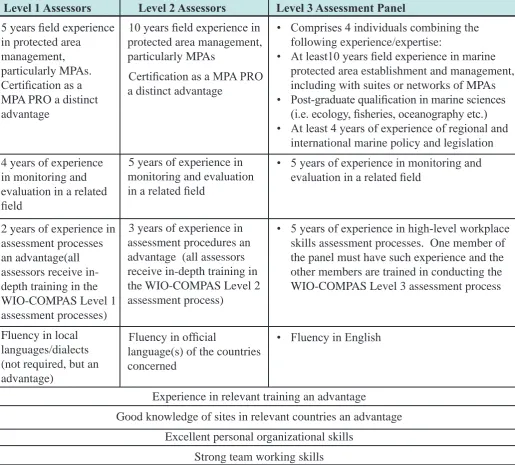
WIO-COMPAS has an open selection process for assessors. As a decentralized region-based certiication Program, assessors from each of the WIO region countries are recruited and trained. Qualiications for
assessors vary by Program Levels (see Table 5 below). Assessors participate in a comprehensive training and apprenticeship regimen before they are approved to conduct candidate assessments. This ensures that assessors maintain the WIO-COMPAS focus on assessment credibility and that they commit to upholding
Experience in relevant training an advantage
Good knowledge of sites in relevant countries an advantage Excellent personal organizational skills
2 years of experience in assessment processes
10 years ield experience in
protected area management, particularly MPAs
Certiication as a MPA PRO
a distinct advantage
5 years of experience in monitoring and evaluation
in a related ield
3 years of experience in assessment procedures an
• Comprises 4 individuals combining the
following experience/expertise:
• At least10 years ield experience in marine
protected area establishment and management, including with suites or networks of MPAs
• Post-graduate qualiication in marine sciences (i.e. ecology, isheries, oceanography etc.) • At least 4 years of experience of regional and
international marine policy and legislation
• 5 years of experience in monitoring and evaluation in a related ield
• 5 years of experience in high-level workplace
skills assessment processes. One member of the panel must have such experience and the other members are trained in conducting the WIO-COMPAS Level 3 assessment process
• Fluency in English Level 1 Assessors Level 2 Assessors Level 3 Assessment Panel Table 5. Qualiications for Assessors.
© WIOMSA
4. Level 1 ~ Marine Field Operations Certiication
Level 1 Certiication focuses on the practical tasks of everyday MPA ield operations. This is usually associated with the work of rangers and community oficers. A detailed description of the type of MPA professionals eligible for Level 1 certiication is summarized in Section 1. Level 1 Certiications are offered on a national or sub-national basis to relect language and travel cost issues.
4.1 Process
The process of being certiied at Level 1 should take less than six months from application to certiication. Those enrolled in a certiication offering will invest
approximately two-three weeks of dedicated time overall. Figure 4 outlines the
steps in the Level 1 certiication process.
1. Application - Signiicant attention and time is dedicated to the
application phase. This is to ensure that the applicant has the depth of experience related to the competences. Applicants must get their
supervisors to sign the application to conirm the accuracy of the
applicants experience and the support of the MPA for the applicant to participate in the Assessment Event and be granted time off from work.
2. Pre Event Tasks - Candidates must produce their Core Activities Document, a related presentation and portfolio before attending the four-day Assessment Event.
3. Assessment Event (4 days) - Most of the assessment scoring is done at the Assessment Event. In addition to assessing candidates, the WIO-COMPAS mission is to provide professional development, opportunities for networking and a commitment to ethical standards. These sessions are not part of the scoring process. Local guest speakers are invited to the Assessment Event to discuss emerging issues related
to MPAs or improved practices related to speciic competences.
4.2 Competences
Level 1 Certiication has 41competences and standards across the seven core competence areas. This number of competences relects the broad
skills necessary to be an MPA professional. The competence focus
is on practical ield operations. There is some overlap with Level 2
competences though the standards for Level 1 are often at a more basic level of understanding or ability.
Candidates are expected to have competence across all seven core competence areas, though not necessarily every competence and standard. Refer to the scoring method in Section 2 for details. The full list of competences and standards are in appendix C.
4.3 Assessment Instruments
A set of seven assessment instruments are used in Level 1: 1. Application
2. Description of Core Activities Document 3. Presentation of one Core Activity
4. Portfolio 5. Quiz
6. Beach and (where possible) boat patrols. Possibly simulations
7. Face-to-Face Interview
Figure 4. Process for Level 1 Certiication.
5. Level 2 ~ Site Management Certiication
A description of the type of MPA professional eligible for Level 2 certiication is summarized in Section 1.
Level 2 is focused on site management and supervisory skills.
5.1 Process
The process of being certiied at Level 2 should take less than six months from application to certiication. Those enrolled in a certiication offering will invest approximately three
weeks of time overall. Figure 5 outlines the steps in the Level
2 certiication process.
1. Application - Signiicant attention and time is dedicated to
the application phase. This is to ensure that the applicant has the depth of experience related to the competences. Most of the assessment scoring is done at the Assessment Event.
2. Pre-event Tasks - Candidates must produce a case study report and portfolio before attending the Assessment Event.
3. Assessment Event (4 days) - A full four days of Program time is necessary to accomplish the objectives of the Event. The Assessment Event provides a valuable means for:
• assessing candidate’s competences and provide career
guidance exploring new areas of knowledge on topics of current global interest related to MPAs through guest speakers
• enabling regional networking of professionals
• providing a venue for relection of the practice of
MPA management in its current state and the future challenges it must address.
• committing to the WIO-COMPAS Code of Ethics and
Leadership
• In addition to assessing candidates, the WIO-COMPAS
mission is to provide professional development, opportunities for networking and a commitment to ethical standards. These sessions are not part of the scoring process. Local guest speakers are invited to the Assessment Event to discuss emerging issues related
to MPAs or improved practices related to speciic
competences.
5.2 Competences
Level 2 Certiication has 69 competences and standards across the seven core competence areas. This number of competences relects the broad skills necessary to be an MPA professional. The competence focus is on
supervisory skills.
Candidates are expected to have competence across all seven core competence areas, though not necessarily every competence and standard. Refer to the scoring method in Section 2 for details. The full list of competences and standards are in appendix D.
5.3 Assessment Instruments
A set of ive assessment instruments are used in Level 2:
1. Application (with telephone conversation) 2. Workplace Case Study Report & Presentation 3. Portfolio
4. Written Assessment 5. Face-to-Face Interview
© WIOMSA
6. Level 3 ~ Strategy, Policy and Planning Certiication
A description of the type of MPA professional eligible for Level 3 certiication is summarized in Section
1. Level 3 is focused on strategy, policy and planning skills. Since there are relatively few professionals
performing at this level in the region, certiication offerings will be regionally based. Professionals operating
at this level often work internationally and must learn from experiences in other countries, thus the language of assessment will be English.
6.1 Process
The process of being certiied should take less than three months from application to certiication. Those enrolled in a certiication
offering will invest approximately two weeks of time overall.
Figure 6 outlines the steps in the Level 3 certiication process. 1. Application - Signiicant attention and time is dedicated to the
application phase. This is to ensure that the applicant has the depth of experience related to the competences. Most of the assessment scoring is done at the Assessment Event.
2. Pre-event Tasks - Candidates must produce a presentation and portfolio before attending the Assessment Event.
3. Assessment Event (4 days) – A full four days of Program time is necessary to accomplish the objectives of the Event. The Assessment Event provides a valuable means for:
• assessing candidate’s competences, provide career guidance and if interested in Level 3 certiication
• exploring new areas of knowledge on topics of current
global interest related to MPAs through guest speakers
• enabling regional networking of professionals
• providing a venue for relection of the practice of MPA
management in its current state and the future challenges it must address.
• committing to the WIO-COMPAS Code of Ethics and
Leadership
In addition to assessing candidates, the WIO-COMPAS mission is to provide professional development, opportunities for networking and a commitment to ethical standards. These sessions are not part of the scoring process. Local guest speakers are invited to the Assessment Event to discuss emerging issues
related to MPAs or improved practices related to speciic
competences.
6.2 Competences
Level 3 Certiication has 56 competences and standards across the seven core competence areas. This number of competences relects the broad skills necessary to be an MPA professional. The competence focus is on
strategy, policy and planning skills.
Candidates are expected to have competence across all seven core competence areas, though not necessarily every competence and standard. Refer to the scoring method in Section 2 for details. The full list of competences and standards are in appendix E.
6.3 Assessment Instruments
A set of four assessment instruments are used in Level 3: 1. Application (with telephone conversation)
2. Portfolio 3. Presentation 4. Panel Interview
© P. Chadwick
APPENDICES
Appendix A. Bibliography
WIO-COMPAS has produced numerous documents to capture the experience and share the model for others to replicate. Below are the key documents available.
Squillante, L.J, Ricci, G., Francis, J. and L. Sisitka. 2010. Innovations in capacity building: Certiication of
marine protected area professionals. Coastal Management, v38 n3 (2010 05 01): 272-290.
Squillante, L.J, Ricci, G. and J. Francis. 2010. Innovations in Capacity Building: Certiication of Marine
Protected Area Professionals. Basins and Coasts v2. Issue 4: 36-43.
Ricci. G and J. Francis. 2008. Certiication Program Now Available For MPA Managers. MPA News
Newsletter v10. No.5.
WIO-COMPAS. 2011. Western Indian Ocean Certiication of Marine Protected Area Professionals. Online
www.wio-compas.org.
Appendix B. WIO-COMPAS Code of Ethics and Leadership
CODE OF ETHICS AND LEADERSHIP
Preamble
Professionals working in marine protected area (MPA) management are engaged in a professional situation that is uniquely varied and complex. They are involved with their discipline, their colleagues, their local communities, especially those immediately abutting the protected area, their sponsors. They also engage other vested organizations ranging from their own governments, to funding agencies, to nongovernmental organizations (NGOs) and their projects that are working in the area, to the private sector. They are addressing
the goal of protecting an area’s rich marine resources, while recognizing that these resources may also be of signiicant importance—both historically and today—in providing food and income to the communities that surround the protected area. Working in the ield of such complex involvements and sometimes competing interests—as usually is the case in marine protected areas—there may be frequent misunderstandings, conlicts, and the need to make choices among conlicting values. These generate ethical dilemmas and
demand practical leadership. It is a prime responsibility of professionals working in MPAs to anticipate these and to resolve them in a way that respects both the rights of the individuals and group stakeholders as well as the mandate of the protected area.
The Program
The Western Indian Ocean Certiication of Marine Protected Area Professionals (WIO-COMPAS) Program is structured around four “E” components of Education, Experience, Examination and Ethics. Most importantly,
it sets standards of performance and the levels of knowledge and applied skills and experience against which a
“certiied” individual is measured. WIO-COMPAS assesses the ability of individuals to apply critical thinking and decision-making to addressing the issues facing those working in MPAs—including such emerging issues as global climate change and linkages to a broader integrated coastal management context. The Program’s use of standards implies a performance expectation—i.e., it is not enough to simply complete coursework. Rather, it is necessary to be able to apply the knowledge and skills at a certain level (standard) of proiciency, and to provide irm evidence of this. The Program has identiied seven core areas of competence needed by
individuals working at different levels within an MPA:
• MPA Governance
• Marine Conservation: MPAs and other approaches • Communication and Stakeholder Engagement
• Human and Financial Resources Mobilization and Management • Management Implementation and Effectiveness
• Biophysical and Social Environment Context • Leadership, Ethics and Innovation
Equally important to setting the technical and management standards by which an MPA professional is judged, the Program has established ethical rules, a call for leadership, and good practices that underpin effective
Principles
COMMITMENT TO MPAS Core Principle
As an MPA Professional, I recognize that:
• MPAs are an important management strategy for biodiversity conservation (including protection of
endemic, rare and threatened species, restoration of natural ecosystem functioning, conservation of
habitats for vulnerable life stages) and sustainable use (isheries, recreation, tourism, education, research
and aesthetic reasons).
• MPAs are one of many effective strategies for protection of coastal and marine biodiversity as well as
contributing to the sustainable use of the coastal and marine resources.
• There is a diversity of MPAs based on their objectives and context. • All MPAs must be established by law or other recognized means.
• Management of MPAs is complex as it involves working with different stakeholders with competing interests and inluences; therefore observance of the ideals and principles as speciied in this Code of
Ethics is essential.
PROFESSIONAL RESPONSIBILITY Core Principle
As an MPA professional, I am responsible for adding value to the organizations I serve and the work I perform. I accept professional responsibility for my individual decisions and actions and serve as an advocate for the profession of MPA management by engaging in activities that enhance its credibility and value as a profession. I shall:
• Build respect, credibility and recognition for my profession within my organization, the communities in
which I work, my government, and the private sector.
• Assist the organizations I serve in achieving their objectives and goals.
• Inform and educate current and future practitioners, the organizations I serve, and the general public
about principles and practices that help the profession.
• Positively inluence workplace and staff.
• Encourage professional decision-making and responsibility. • Encourage social responsibility.
PROFESSIONAL DEVELOPMENT Core Principle
As an MPA professional, I must strive to meet the highest standards of competence and commit to strengthen our competencies on a continuous basis. I shall:
• Expand my knowledge of marine protected area management (MPA) and its relationship to the broader
area of coastal ecosystem governance.
• Contribute to the body of knowledge, the evolution of the profession and the growth of individuals
through on-the-job training, research and dissemination of knowledge.
• Keep current on the latest information, tools and techniques related to my profession through completion
of continuing education courses, reading of professional journals and attendance at key conferences on marine protected area management and its related issues such as global climate change, etc.
• Ensure the use of both the physical and social sciences in shaping and implementing my work.