46
The Use of Mother Tongue
in General English Program for Teenagers
in the Second and Fourth Levels
Bawono, K.O.1 and Rini, J.E. 2
1,2 English Department, Faculty of Letters, Petra Christian University,
Siwalankerto 121 – 131, Surabaya 60236, East Java, Indonesia E-mails: [email protected], [email protected]2
ABSTRACT:
This study reports the teacher’s use of mother tongue (Bahasa Indonesia) in English as Foreign Language (EFL) classroom in Indonesia. The study was conducted in an English language course for teenagers, and focused more in the second and fourth level. It was revealed that beside English language, Bahasa Indonesia was used by the teachers as the medium of instruction for some functions: conveying and checking the meaning of words/sentences, explaining grammar, organizing tasks, maintaining discipline, and gaining contact with individual student; and the teachers’ reason in using Bahasa Indonesia was to make sure that the students understand about what they delivered. In addition, some similarities and differences were found in the comparison of the second and fourth levels.
Key words: mother tongue, function, utterance, semi-structured interview.
INTRODUCTION
The use of mother tongue in EFL classroom is a debatable issue which is widely talked until present (Ahsan and Islam, 2011). It is debatable because this issue has not come to a conclusive outcome. On one hand, those who againts the use of mother tongue in EFL classroom stated that mother tongue can prevent students to the exposure of English (He, 2012). On the other hand, there are also those who encourage the use of mother tongue in EFL classroom. According to Zacharias (2002), students’ mother tongue is something that can connect teachers to their students to see their previous learning experience, interests, knowledge of the world, and culture.
The debatable issue of the use of mother tongue in EFL classroom is an essential topic that teachers and students should put more concern, especially in Indonesia where English is considered as a foreign language. It is because teachers’ knowledge about the use of mother tongue in EFL classroom may influence the teaching and learning process in the classroom. Therefore, the writer would like to investigate the functions and the reasons of teacher’s use of Bahasa Indonesia in the classroom. The writer would also like to find out the similarities and/or differences of teachers use of Bahasa Indonesia between the second and fourth levels of General English Program for Teenagers of Petra Language Center.
Mother Tongue
This study was done in Indonesian context in which the students’ mother tongue was Bahasa Indonesia. This was in line with Pokharel (2001, p. 201), that “mother tongue is the language spoken in the family and/or it is the language of the country where he or she is living”. According to Kohler and Mahnken (2010), Bahasa Indonesia is one of the highest number of speakers in the world because it is spoken by approximately 240 million people throughout the Indonesian archipelago, and Bahasa Indonesia is also the official language of government, education, business, and the media.
Positive Ways to Use Mother Tongue
47
12% 14%
3% 4%
29% 25%
5% 10% 2.5%
28%
0% 10% 20% 30% 40%
Conveying and checking meaning
Explaining grammar
Organizing tasks Maintaining discipline
Gaining contact
Second level Fourth level
organization of the class, which includes when teachers organize tasks, maintain discipline, give contact with individual students, and give test to their students.
Teacher’s Beliefs
Teacher’s beliefs are the cornerstones in the teaching practises (Charalambous, Philippou, & Kyriakides, 2002, p.1, as cited in King and Nash, 2011). Therefore, it is important for teachers to reflect their belief and philosophy in teaching. King and Nash (2011) also stated that teachers’ reflection about their ideology and how their belief systems can impact the interaction linguistically and can influence students’ academic success or failure. They also said that teacher’s beliefs which relate to bilingual education settings might be influenced by these factors: teacher education programs; prior experiences in schools, either as students or teachers; personal or life experiences, including growing up as a member of a parallel culture; and experiences as a bilingual or with bilinguals; world view; and family. Richardson (1996, p. 104) as cited in King and Nash (2011) suggested that “the perceived relationship between beliefs and actions is interactive. Beliefs are thought to drive actions.”
METHODS
This study was conducted in Petra Language Center. This language center provides general English program for children, teenagers, and adult. The materials taught are reading, listening, speaking, and structure/grammar. However, in this study, the writer only focused to the English program for teenagers in the second and fourth level.
The participants of the study were three teachers who would be interviewed and the students in classes 2B, 4A, and 4B who would be observed. The participants were chosen purposefully because the writer would like to compare the beginner level (second level) and the advanced level (fourth level). Besides, classes available to observe during that period were only 2B, 3A, 4A, and 4B.
The data were collected from the video recording of teachers’ talk during the classroom observation. The observations were conducted two times for each class. Then, the teachers got involved in the semi-structured interview and were recorded by using voice recording of mobile phone. The video recording of classroom observations were transcribed in detail transcription to cover the content and the way the narrative was conveyed. While, the interview results were transcribed in clean transcription, where the focus was only on the content of the interview. Then, the data were analyzed and interpreted.
FINDINGS AND DISCUSSION
The analysis showed that all teachers from both level used Bahasa Indonesia in the classroom because they want to make sure that the students understand what the teacher delivered to them. Furthermore, comparing the second and the fourth level, the writer found some similarities and differences regarding the use of Bahasa Indonesia in EFL classroom.
Functions Based on Cook’s Classification
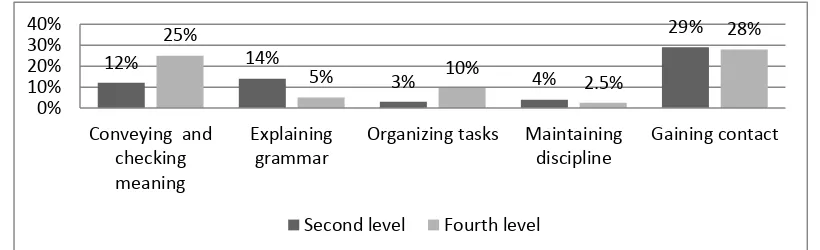
Figure 1 The comparison of frequency of the functions of using Bahasa Indonesia between the second and the fourth levels
48
frequency was various. First, teachers of both levels had the similar frequency in using Bahasa Indonesia to gain contact with individual student, that is 29% for second level teacher and 28% for fourth level teachers. It might be because all of them had the same way of teaching, that was asking students to do exercise and discussing the answer with them. Second, the amount using Bahasa Indonesia to convey meaning of words or sentences by second level teacher was 12%, while the amount using Bahasa Indonesia to convey meaning of words or sentences by fourth level teacher was 25%. As for it, the fourth level teachers had special time to ask whether their students had difficult vocabularies, while the second level teacher did not. Third, the teacher of second level used Bahasa Indonesia 14% of the class time to explain grammar, while the teachers of fourth level only spent 5% to explain grammar. It might be because the teacher of second level had to re-explain the students about the grammar concept to remind them. The second level students were considered as beginner students, who had to be oftenly reminded over and over again to make them understand well about the previous grammar concept, so that they did not repeat the same mistakes in doing exercises.
Below, the writer would discuss about the similarities and differences of teachers use of Bahasa Indonesia between second and fourth level regarding the functions based on Cook’s classification.
Similarities
The first similarity is that all teachers used Bahasa Indonesia to maintain discipline. It might be because the teenagers are active in the learning process and talkative, then the teachers have to maintain them to be more discipline.
T : ... Jadi kamu jangan terlalu banyak cerita... [So, you don’t talk too much...]
Figure 2 Maintaning discipline in the second level
The second similarity is that all teachers did not use Bahasa Indonesia to give test. From the interview with the teachers, she found that all the three teachers agree not to use Bahasa Indonesia both by the teachers to write the instruction and by the students to answer the questions because teachers would like to test their students’ comprehension about the material explained and to create differences between regular class and examination time.
Differences
The first difference is that the teacher of second level used Bahasa Indonesia to convey meaning of words or sentences, while fourth level teachers used Bahasa Indonesia to convey and check meaning of words or sentences.
T : Can itu kaleng. [Can means kaleng] Figure 2 Conveying meaning of words in the second level
Another example to convey meaning in Bahasa Indonesia through the sentences:
T : Huh? Which number? Where did Anna’s school trip go? Kemana, uh,
sekolah Anna. Kemana perjalanan sekolah Anna tersebut? Menuju
kemana perjalanan sekolah Anna tersebut? [Where is Anna’s school?
Where is Anna’s school trip? Where is Anna’s school trip go?] Figure 3 Conveying meaning of sentences in the fourth level
As stated before, that only the teachers from fourth level who used Bahasa Indonesia to check meaning of words or sentences.
V : Sejarah. [History] T : What is sejarah? An : History.
Figure 4 Checking meaning of word in the fourth level
During the writer’s observation, the teacher of second level did not check the meaning of words or sentences to the student. It might be because this level was considered as begining level in which the teacher did not expect the student to use English as much as those in the advanced levels.
49
T : No, no, no. Tapi ‘any’ itu dipakai dalam bentuk singular, sekalipun,
dia dipakai, kata kerjanya singular, sekalipun kata bendanya plural. Okay? [But ‘any’ is used in the singular form, although, it is used, the verb is singular, although the noun is plural.]
...
Figure 5 Re-explaining previous grammar concept in the second level
Another example to explain new grammar concept:
T : ... Jadi sekarang kita belajar, (writing ‘to be’ before all the adjective feeling at Langga’s sentence) bahwa, untuk kata-kata yang menggunakan adjective. Karena dia bukan kata kerja, dia tidak bisa langsung mengikuti subject. Harus ada verb ya. Ini (marking the words ‘to be’) bagian dari verb. Ini adalah verb. Ingat, uh, dalam tabel, uh apa namanya, past tense seperti itu, verb one,
verb two, dan sebagainya. Nah, ini verb two nya adalah? Am verb two nya adalah? [... So, now we learn that for adjective, since it is not verb, it cannot follow the subject. There should be verb. This is part of verb. This is verb. Remember, in the table, what is it, past tense, verb one, verb two, and so on.]
Figure 6 Explaining new grammar concept in the fourth level
The teacher of second level used Bahasa Indonesia to re-explain the previous grammar concept because the students’ level of proficiency was lower than the students of fourth level, so that the teacher should repeat the explanation, especially about grammar concept. Also, the teacher did not re-explain the previous grammar rules because it seemed that all students have understood already since they did not ask about the previous grammar, and the teacher did not discuss about the previous grammar.
The third difference is that the teacher of second level organized tasks by giving instruction based on the teacher herself, while the teachers of fourth level organized tasks by giving instruction based on both teachers and textbook.
T : ... Sekarang kamu ubah dia menjadi kata kerja ketiga. Itu kan kata kerja pertama tuh... [... Now, change it into past participle. That one is infinitive.]
Figure 7 Giving instruction based on herself in the second level
Below is another example of the fourth level teacher giving instruction, but based on the textbook. ...
T : Okay. Look at the column, and some words in the box. (reading the instruction) Complete the table with the verbs and verb phrases in the box. Okay. Kita bikin kira-kira mana-mana aja yang followed by gerund dan mana-mana aja yang followed by infinitive. Sekarang yang diikuti –ing selain ‘can’t stand’ kira-kira apa? [We make, which one is followed by gerund and which one is followed by infinitive. Now, followed by -ing beside can’t stand?]
...
Figure 8 Giving instruction based on textbook in the fourth level
The teacher of second level did not give the instruction based on the textbook because the instruction in the teaxtbook was considered as simple instructions that the students of second level could easily understand. In contrast to, in the fourth level, the instruction in the textbook could be more complicated that could make the students misunderstood.
The last difference is that the teacher of second level gained contact with individual student by correcting spoken and written tasks, while teachers of fourth level gained contact with individual student by correcting written tasks only.
T : Worked. (writing on the board) Bukan [not] worked (wrong spelling), worked (correct spelling).
50
T : (tapping on Angel) Ini nggak perlu diubah. Tetep aja dance and sing. Sing... [You don’t need to change this one.]
Figure 10 Correcting student’s written work in the second level
The fourth level teachers did not use Bahasa Indonesia to gain contact with individual student by correcting student’s spoken task because both teachers of fourth level focus only in the written task in the workbook. Yet, all teachers from both level did not use Bahasa Indonesia to gain contact with individual student by giving praise because the students would understand if the teachers praised them in English with these phrases: ‘good job’ or ‘excellent’.
Other Functions
If the writer found some other functions which cannot be classified into Cook’s classification, the writer classified it into the category of others. Then, she also divided the category of others into two smaller categories: others which influence the teaching and learning process and others which do not influence the teaching and learning process.
Similarities
The first similarity is that all the teachers used Bahasa Indonesia to check students’ comprehension. This function influences the teaching and learning process because by doing this, the teachers know how much the students understand the material delivered by the teacher. So, the teacher could also evaluate whether their way of teaching is effective for their students.
T : Contoh, kalimat nomor satu punya Vierri, kalau dia tambahkan ever or never, itu di bagian mana? [For example, Vierri’s sentence number one, if he adds the word ‘ever’ or ‘never’, where should he put it?] The dog... (looking at the board)
Figure 11 Checking students’ understanding in the second level
The second similarity is that all the teachers used Bahasa Indonesia to ask for clarification. This function influences the teaching and learning process because students might ask important questions which teachers do not realize or pay attention to. It is important also to ask clarification so that there is not any misunderstanding between the students and the teachers.
T : ... Okay, when you have finished correcting, uh, go to the next page. Let’s do the energy check for unit nine. (looking at Anne’s and Sheline’s textbook) We haven’t done it, have we?
A : (looking at the teacher)
T : Belum kan? [We haven’t done it, have we?] Figure 12 Asking for clarification in the fourth level
The example above shows that the teacher used Bahasa Indonesia to ask for clarification. The teacher asked for clarification to the students whether they have alerady done the ‘energy check’, a name of one of the exercise, for unit nine. Yet, the students did not answer, then the teacher asked again to clarify.
The third similarity is that all teachers used Bahasa Indonesia as filler. This function does not really influence the teaching learning process because it was only teacher’s habit in speaking.
T : (laughing softly and seeing Angel’s signature) Wait ya. (checking the papers)
Figure 13 Indonesian filler in the second level Differences
The first difference is that the teacher of second level clarified teacher’s mistake while teachers of fourth level did not. It might be because the teacher of second level had so many things to do at that meeting regarding that her students were going to have test on the next week, so that she had to finish everything before the test with the limited time. That pressure could make her less focused and concentrated. This function influences the teaching and learning process because it is important for the teachers to clarify their mistake in either explaining material or correcting student’s workbook. Every single thing that the teacher delivered to the students will be kept and processed by the students in their mind.
T : ... Irregular kan contoh, eh, regular, contohnya kayak ‘play’ ya. (menulis di papan) [... The example of irregular, eh, regular is play...]
51
The second difference is that teacher of second level explained important information to the students, while teachers of fourth level did not. It might be because on the next week, the students of second level were going to have test, so that the teacher explained the material for test in Bahasa Indonesia, so that the students would understand well about material which they had to study at home for the test. This function influences the teaching and learning process because the teacher is trying to deliver important information (beside grammar concept) which the students have to pay much attention to reduce the misunderstanding between them.
T : ... Yang pertama, yang pertama itu adalah yang akan keluar for sure will and going to. [... First, the first surely tested is fore sure, will and going to.] ... Trus countable uncountable.[Next, countable uncountable.] ... Yang terakhir adalah how much, how many, any, dan
some. [The last is how much, how many, any, and some.] Figure 15 Explaining important information in the second level
The third difference is that teacher of second level did not use Indonesian term, while the teachers of fourth level used Indonesian term in the classroom. It might be because students of fourth level were considered as advanced level, so that the material could be related to the students’ real life and could be discussed together. However, the material for second level students are not as complicated as those in the fourth level. This function influences the teaching and learning process because if the teacher changed those terms into English language, the students might not get the meaning since they get used to that terms in the school already.
T : Senior high school. Yeah. In my time, they divide between IPA
[science], IPS [social], and Bahasa [language]. (looking at Langga) How do they divide now? (wondering)
L : The same.
Figure 16 Using Indonesian terms in the fourth level
The fourth difference is that the teacher of second level teased the students in Bahasa Indonesia, while the teachers of fourth level did not tease. It did not influence the teaching and learning process because the teacher did it only to tease the student.
V : Not yet miss, masih ngrobek. [Not yet miss, I’m tearing the paper] An : Mesti miss ini nggak sabaran. [Miss, you are impatient.]
T : (smilling and going toward Vierri) Iih, lamabanget. [You are so slow] Figure 17 Teasing the students in the second level
The fifth difference is that the teacher of second level did not chat with the students in Bahasa Indonesia, while the teachers of fourth level chatted with the students in Bahasa Indonesia. It did not influence the teaching and learning process because the topic chatted was out of the lesson.
T : (opening the door)
S : (going in and looking for a seat on the back)
T : Saras, nggak duduk di depan sini aja? [Saras, do you want to sit here?] Figure 18 Chatting with the students in the fourth level
Percentage of Bahasa Indonesia Used
Table 1 The percentage of the use of Bahasa Indonesia in English classroom between second and fourth level
Utterance count (BahasaIndonesia)
Utterance count (total)
% of BahasaIndonesia
utterances
Second level 109 332 32.83%
Fourth level 124 605 20.49%
52
level have lower level of proficiency than students of the fourth level. So, the teacher had to used Bahasa Indonesia more often to make them understand about what teacher explained in the classroom. Yet, the fourth level students were considered as having higher level of proficiency, so that the teacher still used Bahasa Indonesia but they kept it as minimum as possible.
However, this finding shows a mismatch between the teachers’s belief with teacher’s practice in the classroom. From the interview result, it can be seen that the teacher of second level disagreed about the use of student’s mother tongue in English classroom because she believes that she has to make an environment where the students can practice English all the time, an environment which cannot be created at home, except in English course. So, the teacher of second level believes that the amount of Bahasa Indonesia used in English classroom should only be 20% of the class time and English should be 80% because, as she stated in the interview, if the students keep using Bahasa Indonesia, their English will not be improved. Yet, what the teachers do in the classroom is sometimes not in accordance with the teacher’s beliefs. It might be because the students faced some difficulties in understanding what the teacher explained when the teacher used English all the time. Besides, there are some external factors which can lead the teachers to use Bahasa Indonesia in English classroom: the composition of the class and each individual student, the amount of material which have to be delivered in one meeting, and the limited time for each meeting.
As stated before, the teachers of the fourth level also agreed to use English in the classroom, but if they really need to use Bahasa Indonesia, the amount of Bahasa Indonesia used in English classroom might be 50% of the class time since it is not conversation class and since there are many external factor influence the use of Bahasa Indonesia in the classroom. Yet, in its practice, they only used Bahasa Indonesia less than 25%. As being discussed before, level of proficiency of the students might be the main reason to this differences. When the students could understand the material in short time, then they would have more time to discuss about other things needed.
Reasons of Using Bahasa Indonesia
The data of the classroom observation shows that all teachers from two different levels taught with two languages. They used both English language and Bahasa Indonesia when they teach English Program for Teenagers. Furthermore, from the interview with them, the writer found out that their general reason of using Bahasa Indonesia in their classroom were similar for all functions, that was to make their students understand what they are saying, what they are delivering, and what they are explaining. The teacher of second level said that she even did not have any special ocassion to use Bahasa Indonesia in her classroom, but anytime she realized that her students seem like do not understand her, she suddenly switched the language into Bahasa Indonesia.
Talking about the use of medium of instruction in English classroom, all the teachers agreed that English should be used the most or even fully used in the classroom, but they had to consider the condition of the classroom also because teaching in a classroom is not only talking about the teacher, but also the students, especially when the students’ level of proficiency is not balanced one to another. So, they preferred to use the language which both of them (the teachers and the students) understood, which is Bahasa Indonesia, in order to make the teaching and learning process run well.
53 CONCLUSION AND SUGGESTIONS
This study is a language acquisition study in the scope of using Bahasa Indonesia in EFL classroom. In this study, the writer discussed about the function of teachers’ use of Bahasa Indonesia in the second and fourth level in General English Program for Teenagers as well as teachers’ reasons of using Bahasa Indonesia. Also, the writer provides the similarities and/or differences between the second and fourth level teachers.
In conclusion, mother tongue is useful to be used by teachers in EFL classroom, although it does not mean that teachers may spend all of the class time to use mother tongue. Students can get great benefits when teachers use mother tongue in the classroom. By using mother tongue, students are helped to understand what the teacher is trying to explain and say. Whenever the students look confused, teachers may directly switch to mother tongue to make sure that the students understand well about it. Furthermore, there is a possibility that even teachers can get greater benefits when they use mother tongue in the classroom. For example, when they have to explain complex material or when they have to attract students’ attention quicker. Therefore, mother tongue can be used positively by teachers in the right portion and functions; and the positive effects may be felt by both teachers and students in the classroom.
Besides, what teachers do in the classroom is sometimes not accordance with the teachers’ beliefs. In this study, beginning-level teacher used mother tongue more than advanced-level teachers, while beginning-level teacher hardly believes to limit the use of mother tongue more than advanced-level teachers. There might be some other factors which can influence this phenomenon. Factors such as students’ level of proficiency or students’ characteristic may be the challenge for teachers when applying their beliefs.
Further research could be conducted on a larger scale in which more respondents, such as both teachers and students, could be involved; or further research could be conducted to analyze whether teachers can get benefits of using mother tongue in EFL classroom or to see the similarities and differences of different classes in the same level.
REFERENCES
Ahsan, S., & Islam, M. J. (2011) Use of Bangla in EFL classes: the reaction of the secondary level students and the teachers in Bangladesh. ASA University Review, 5(2), 197 – 222.
Charalambous, C., Philippou, G.. & Kyriakides, L. (2002). Towards understanding teachers’ philosophical beliefs about mathematics. In Proceedings of the Annual Meeting of the International Group for the Psychology of Mathematics Education (Norwich, England). Cook, V. (2001). Using the first language in the classroom. The Canadian Modern Language
Review, 57(3), 402 – 423.
He, A. E. (2012). Systematic use of mother tongue as learning/teaching resources in target language instruction. Multilingual Education: A Springer Open Journal, 2(1), 1 – 15.
King, H., & Nash, C. P. (2011). Bilingual teacher beliefs and practice: do they line up? Gist Education and Learning Research Journal, 5, 66 – 83.
Kohler, M., & Mahnken, P. (2010). The current state of Indonesian language education in Australian schools. Australia: Education Services Australia Ltd.
Pokharel, B. R. (2001). Applied Linguistic. Kathmandu: Jupiter Publishers and Distributors. Richardson, V. (1996). The roles of attitudes and beliefs in learning to teach. In J. Sekula. (Ed.),
Handbook of research in teacher education (pp. 102 – 119). New York: Mcmillian. Tang, J. (2002). Using L1 in the English classroom. English Teaching Forum, 40(1), 36 – 43. Zacharia, H. (2002). Come on in, mother tongue: evaluating the role of mother tongue in English
language teaching in Indonesia. Retrieved April, 28th 2013 from