THE INFLUENCE OF POLITICS AND SOCIETAL CULTURE
TO SCHOOL AND CLASSROOM REFORM
Sopantini (Heyward)
Education Faculty, University of Tasmania, Hobart, Australia Email addresses: [email protected]
Abstract
This paper is informed by a case study conducted in the District of Kota Tidore Kepulauan, in North Maluku Province. The two questions that drive the investigation are: (1) How do teachers, principals, supervisors and local education administrators translate active learning that is embbeded in the national School-Based Curriculum policy in the classrooms and schools? and: (2) What obstacles do they face in implementation. In particular, the paper explores the impact of politics and culture on school reform. The findings suggest that surface-level change is the dominant feature of the reform efforts and outcome. The responses made by district and school actors to translate the national policy into local practices are marked with various limitations in which the role of politics and societal culture are critical.
Introduction
Since the fall of the New Order government of Suharto in 1998, Indonesia has embarked on an ambitious program of reform in the management, governance, curriculum and pedagogy practiced in these schools. The few recent studies of school and classroom reforms that have been conducted in Indonesia all highlight a lack of success in changing current practices (Bjork, 2003; Cannon, 2007; Malcolm, McLean, Tanuputra, & Harlen, 2001; Puskur, 2007; Utomo, 2005; Semiawan, 2001; Van Der Werf, Creemers, De Jong & Klaver, 2000). Reform in Indonesia is failing to achieve a deep-level change in the classroom. This reality has been repeated in the history of reform efforts in Indonesia over the last twenty or more years.
The common tendency to blame teachers for this failure is simplistic. More thoughtful and useful explanations are required if reform efforts are to succeed in the future. Teachers are the users of innovation and reform (Hall & Hord, 1987; Rogers, 1971). The users are critical for reform to succeed; they need to have the necessary skills and understanding to implement the change. However, this technical explanation is insufficient (Bjork 2003). An understanding of the political, socio-economic and cultural contexts is also critical.
The explanations given by scholars and practitioners alike for the repeated failure of reform efforts thus suggest a much simpler solution than is required for a deep-level change to occur. The question of culture, which is generally missing from the discourse and explanations of reform failure in Indonesia, is critical. Other critical aspects include: (1) the problematic process of policy making in Indonesia (Adams, Kee, & Lin, 2001; Elmore, 1980; Elmore, 1997; Klemperer, Theisens, Kaiser, 2001), and (2) technical, political and economic aspects of policy implementation in Indonesia. (Hall & Hord, 1984; Herbert, 2004; Hill, 2001; House, 1979; King, 1996; Nielsen, 1998; Windschitl, 2002).
This paper is informed by a case study conducted in the District of Kota Tidore Kepulauan, in North Maluku Province. This is a district in
eastern Indonesia that has received very minimal intervention due, among other factors, to its geographical position which is very far from both the capitals of the province and the nation (Puskur, 2007). The two questions that drive the investigation include how do teachers, principals, supervisors and local education administrators translate the national School-Based Curriculum policy into classroom and school reform, and what obstacles they face in implementation. In particular, this paper investigates the impact of culture and politics on school reform.
The paper argues that Indonesian cultural values and politics impact on the way local responses to national policy are made. These cultural values and the way politics is manifested in education reform must first be explored before a useful explanation to reform failure can be proposed. The aim of the paper is to explore the reform processes as they unfold in the district and schools, as observed in the case study. Particular attention is paid to identifying traditional Indonesian approaches to change and how powered is manifested in the education system in the districts. Once identified, the relevant cultural constructs and political manifestation provide a basis for an analysis of the experience and views of reform and its implementation held by teachers, principals, supervisors, and district personnel.
A conceptual framework: Three perspectives of change
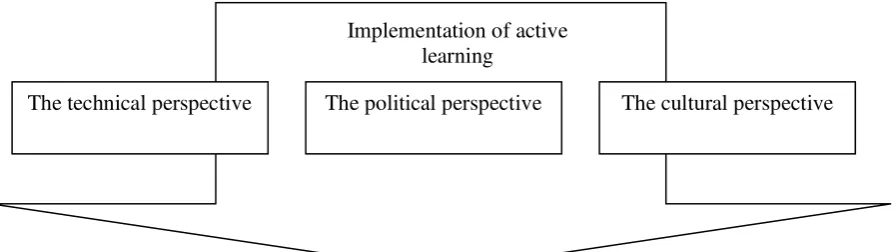
House (1979), and subsequently House and McQuillan (1998), proposed three perspectives for the analysis of education reform: (1) the technological perspective, (2) the political perspective, and (3) the cultural perspective.
chapter that the dominance of this perspective is, in part, a result of the policy borrowing process, whereby technical innovations are borrowed from the West and, with the support of international donors, are implemented in Indonesia – without the cultural context necessary for successful implementation. The design and subsequent evaluation of the pedagogical reform program in Indonesia, it will be argued, were driven by the political and economic agendas of international donors and their government partners, and not, as was the case when the innovations originally emerged in the West, by a range of context-specific cultural and political factors as well as technical. The original context for House and McQuillan‟s (1998) model was schools and districts in North America. This thesis thus further develops the theory by taking House and McQuillan‟s three perspectives, expanding the meaning to include higher level political perspectives and broader cultural perspectives, and applying this conceptual framework in a new setting, that of Indonesia, a developing nation.
This political perspective is necessary to offer an alternative explanation for many so-called „failed innovations‟. This perspective interprets innovation problems as primarily political, in which conflicts and compromises have to be made among what House called „factional groups‟; the curriculum developers, teachers, administrators, parents and government. Using this perspective to make sense of the unfolding events surrounding policy development and subsequent implementation in Indonesian primary schools may help explain the failure of reform programs.
The cultural perspective is an anthropological approach to studying educational innovation. It emphasizes the importance of the context of the innovation. The perspective captures the social-cultural milieu of the classroom, school, and community. It will be argued that culture is critical to an understanding of education and education reform in Indonesia – and particularly the differences between the cultures of the West, where active learning originated, and the traditional societal cultures of Indonesia along with the expression of these cultures in schools, government and the education system.
Building on this tri-parte framework, this thesis adopts a conceptual framework embodying three perspectives of change, which are somewhat broader than intended by House and McQuillan: (1) the technical perspective, which for the purposes of this study includes technical aspects of teacher professional development and classroom practice, (2) the political perspective, which for the purposes of this study includes the global politics of international aid and policy transfer, the national politics of policy (including curriculum) development and local politics involving the power relationships between school supervisors, principals, teachers, and (3) the cultural perspective, which for this study is taken to include societal culture as well as the subsets of organizational and educational culture. As is evident in the discussion below, each of the three perspectives is interrelated, thus political aspects appear in the discussion of the technical perspective and cultural perspectives and vice-versa.
The following figure illustrates this conceptual framework.
Figure 1. Conceptual framework
Indonesian school and classroom reforms – a repeated failure to affect deep-level change
This section provides a brief outline of the ongoing and added reform agenda as set out in the national policy and a brief report of how it is translated locally in the district school and schools studied. Primary evidence gathered in the case study revolved around teaching and learning and teachers professional development activities. Two
emerging themes were noted in response to the two questions asked in the case study: (1) the ongoing and current reforms have affected a surface-level change, and (2) the responses made by implementing actors are characterized by various political and cultural element which become obstacles to implementation of education reform.
Implementation of active
learning
The following list sets out the reform agenda which includes the ongoing reform in pedagogy starting with child-centred learning which was adopted in 1970s and including an expanded and ambitious agenda in the reform era, commencing with the end of the New Order government in the late 1990s. (Yasin, 1987, Depdikbud, 1994,
Permendiknas No. 41, 2007 Standar Proses). The additional reforms include:
(1) Decentralised education and school governance in which districts are given new responsibility in education management, including funding (UU Otda No. 22, 1999; PP Nomor 48/2008 Tentang Pendanaan Pendidikan; Law on Educational Funding; UU Pemerintah Daerah: The Regional Government Law 32/2004 and The Central-Regional Financial Balance Law 33/2004, UU Sisdiknas: Education Act No. 20/2003), (2) Eight National Education Standards (PP No.
19/2005 Standar Nasional Pendidikan) consisting of: (2.1) Content and (2.2) Graduate Competency Standards
(Permendiknas No, 22 & 23/2006: Standar Isi and Kompetensi Lulusan), (2.3) School Supervisor and (2.4) Principal Standards (Permendiknas No. 12 & 13/2007: Standar Pengawas dan Kepala Sekolah), (2.5) Facility Standards (Permendiknas No, 24/2007 :
Standar Sarana dan Prasarana), (2.6) Assessment and Evaluation Standards (Permendiknas No. 20/2007: Standar Penilaian Pendidikan), (2.7) Teaching and Learning or Process Standards (Permendiknas No. 41/2007: Standar Proses), and (2.8) Education Management Standards – one for central government
(Permendiknas no. 19 /2007: Standar Pengelolaan Pendidikan) and one for local government (Permendiknas No, 50/2007). (3) School-based curriculum development in
which the autonomy of schools and teachers is a central theme (Permendiknas No, 24 /2006).
Government laws or regulations in themselves are not a sufficient ingredient for the successful implementation of education policy aimed at effecting changes at a school level. However, many policymakers and practitioners in Indonesia seem to believe the contrary. Contrary to the international literature highlighting the ineffectiveness of government decrees or regulations to affect change at school level (Marsh & Morris, 1991), up until now the Indonesian government still takes this approach. It will likely be some time before a change of approach can occur. The approach in question, a top-down policy change approach, is defined in this context by the use of central government laws and regulations to affect the desired changes. This constitutes an externally driven school reform which ignores the many considerations, not only ideological but practical and cultural, which must be taken into account if reforms are to succeed. As has
been found in an earlier study of school reform, Indonesian teachers are constrained by many obstacles including lack of support and bureaucratic culture (Bjork, 2003).
It is tempting to conclude that the above reforms, borrowing Elmore‟s words, “…tinker around the edges of the core – fiddling with institutional arrangement and superficial structural features of the system – without ever influencing what kind of teaching and learning students are actually exposed to in the classroom and schools” (Elmore, 1997 p. 299). This is true. A more disquieting question is whether, given the centrality of the reforms to school improvement in Indonesia, the country can afford to continue approaching education reform in the way it has in the past.The section that follows will deal with the cultural and political obstacles as experienced by implementing actors at the district and school level.
Cultural and political constraints to reform The following sections are primarily concerned with the Tidore experience which can be better understood if it is placed, first of all, in the context of recent history. In 2006 new regulations governing the implementation of „decentralised management of school-based curriculum development and implementation‟ took effect. The sections below will provide a cultural and political explanation for the current practices observed which are not congruent with the policy. At this point it is important to note that a clash of both cultural and especialy political values as manifested in the power of school superintendent (pengawas) are evident. A clash between values embedded in the reform and those of the teachers, principals and the school superintendents as experienced in the field at the implementation stage.
As earlier stated, the few studies of school and classroom reforms conducted in recent years in Indonesia suggest a repeated pattern - a lack of success in efforts to change current practices. Analysis of reforms in Indonesia in particular and Asia in general is made complicated for two reasons; (1) the fact that many reforms are borrowed from developed nations (Hallinger, 2004), and (2) the different contexts, in particular the cultural values of the societies in which the imported reforms find themselves in the new countries. To make matter worse, study of reforms as they are implemented in countries different from their origins is very scarce.
Empirical literature on educational change in Indonesia and generally in Asia is sparse. In the Thailand study, the researchers bolstered the review with theoretical and empirical studies of Thai culture. The following section offers a review of Indonesian culture and relevant constructs.
Culture and politics as manifested in Indonesian education reform
The term „culture‟ in this paper refers to societal culture which underlies distinctive values of Indonesian society. The discourse on Indonesian values is closely related to a consideration of the political culture of The New Order government which governed the country for more than thirty years. It has been argued that Suharto‟s New Order government coopted deeply rooted cultural values of Java and Indonesia to strengthen its thirty-year grip on power, to reinforce a culture of compliance and to stifle dissent. This dynamic is most evident in the history of educational reform in Indonesia. The cultural aspects that will be discussed are those that have been identified in earlier literature as either contributing to or inhibiting reform (Bjork, 2003; Clarke, 2003).
In a study of reform in India, Clarke (2003) identified two cultural constructs conducive to reform and two cultural construct inhibiting reform. The two cultural constructs conducive to reform are „a shared holistic worldview‟ and a „conception of instruction as duty‟ whilst the two constructs that inhibit reform are described as „structural and qualitative hierarchy‟ and „knowledge as collectively accumulated‟. All of these four constructs, according to Clarke (2001), represent the broader meaning system underlying pedagogical practices in classrooms in India. The four constructs are extrapolated from anthropological and psychological research in India. The subsequent study considers the impact of these constructs on teachers‟ attempts at reforming instruction (Clarke, 2003). These four constructs are most pertinent to this study and are further described below.
First is the shared holistic worldview that supports the acceptance of regulation. This view also means that individuals are not autonomous but linked together in an interdependent system. Context and social relationships drive the individual. Individuals are governed by rules of interdependence, which are context specific and particularistic.
The second construct refers to the feeling of ease with which members of society accept regulating and being regulated. Duty-based cultures enshrine some blueprint for how people should live. According to the conception of instruction as duty, it is only natural to think an instruction from a superior as a duty that must be perform regardless of what one thinks or feel likes doing. It is not the thinking but the performing of duty that is important and regarded as desirable by the society.
The third cultural construct places teaching and teacher thinking within a social framework that
is defined by structural and qualitative hierarchy. Both these types of hierarchy apply to the teacher; structural hierarchy in terms of the establishment of authority in the organisation of the classroom and qualitative hierarchy in terms of the teacher being more knowledgeable than the student. Students‟ relationships to their teachers in the classroom display, at least superficially, the respect, esteem and even reverence demanded of a novice towards an expert. The relationship of the expert to the novice in both the structural and the qualitative hierarchy is nurturing, responsible and empathetic.
The fourth cultural construct that is relevant here is knowledge as collectively accumulated, attested and transferred. An individual‟s decisions and choices are often constructed by the choices made by the community rather than by individual experience and perception. In this process an individual constructing his or her knowledge becomes less significant.
Striking similarities to these four constructs can be found in Indonesian society – thanks in part to the New Order political machine which successfully manipulated traditional cultural values to promote obedience, a sense of duty, and unity over diversity (Dhakidae, 2003; Jatmiko, 2004; Mulder, 1994; Pradipto, 2007; Susena, 1997; and Vatikiotis, 1993). These values, when combined, constitute a world view of oneness. When tracked to its Javanese origin this worldview also gives birth to some additional constructs, including manut lan miturut which mean obedience, and ewuh pekewuh
to refer to the discomfort one should feel in relation to controversy or conflict and which discourages one to bring up sensitive issues in the open (Dardjowidjoyo, 2001).
These two particular constructs play a critical role in much social interaction including that in schools. This view of oneness is also about social order which was favourable to the New Order regime which governed the country for almost 32 years. This world view originally had a spiritual tone in its Javanese origin but, in Mulder‟s words, had shifted into a view about social order emphasising unity over diversity (1994 p. 35).
Suseno (1997) describes the following three basic principles as the most relevant in the Javanese worldview: (1) the principle of conflict avoidance, (2) the principle of respect, and (3) the ethics of social harmony. All of these principles manifest in various cultural constructs that govern the life of both individuals and the group. One instance is the concept of rukun as a manifestation of the conflict avoidance principle. Rukun refers to the common desire to live in peace with each other or to use Suseno‟s words, to feel oneself to be in a state of harmony (Suseno, 1997 p. 42). Rukun is commonly expressed in the willingness to compromise, which is often taken to mean accommodation to the point of conformity, being cooperative, mutual acceptance, and maintaining calm (Mulder, 1994).
desirable and lends itself to a view which prioritises the maintenance of harmony – a value which was also successfully promoted by the New Order government as a view about the nation.
As a nation, Indonesia is seen as a family
(kekeluargaan) or at least guided by the principles of family life. Relevant concepts under which fit this rubric include sharing a burden (gotong royong) and consensus, subordination of the individual to the common unanimous decision (mufakat).
It is worth noting here that although the Javanese are just one of many distinct ethnic groups in Indonesia, the Javanese culture may be said to dominate both government and education in Indonesia, particularly during the highly centralized period of the New Order. Many of these constructs are now also found in the worldview of other ethnic groups in Indonesia. The Javanese make up the largest ethnic group in Indonesian society (over 45% of the population). Many leadership positions during the New Order regime were filled by Javanese and consequently many cultural constructs originating from Javanese have arguably become mainstream especially in the bureaucracy (Vatikiotis, 1993).
Through its political and bureaucratic machinery, of which education formed a part, the New Order Regime was successful in instilling many of the above values across the nation. The adoption of Pendidikan Moral Pancasila in the curriculum which forms citizenship education and is taught from primary to university levels is an evidence of this effective mechanism (Bjork, 2003; Dhakidae, 2003; Jatmiko, 2004; Kalijernih, 2005; and Leigh, 1999). An example of how some of the above constructs have become entrenched in a way that the impact is noticeably in education has been outlined in the work of Dardjowidjoyo (2001). His work analyses the cultural constraints emanating from Javanese worldview that give rise to three cultural constructs, two of which were described above:
1. Manut-lan- miturut or total obedience, 2. Ewuh-pekewuh; a feeling of discomfort and
unease when discussing controversial issues, holding different opinions, questioning the words of elders or disagreeing with them, and
3. Sabda Pendita Ratu which gives rise to an attitude where an elder or a leader must be obeyed and an acceptance that their behaviours reflect the truth and must not be challenged.
These deeply embedded cultural attitudes also reinforce the disturbing habit of being unwilling to admit any fault, mistake or wrongdoing (Dardjowidjoyo, 2001, p. 316).
It is important here to note that Dardjowidjoyo‟s analysis should be treated cautiously due to its methodological limitations; the bulk of the work is a conceptual analysis without any field or experiential study to support it. Dardjowidjoyo is a linguist from Java. The fact that
he has conducted a study identifying these cultural constraints emanating from the values he has himself grown up with shows a deep understanding and meta-cognitive ability to critically analyse these cultural factors. Nonetheless, it does provide a good basis for a study of relevant cultural constructs. This is particularly true given the Indonesian context where there is a real lack of a research basis in this area (Hallinger, 2001).
In his analysis, Dardjowidjoyo (2001 p. 317) goes further to argue that these cultural constructs have manifested in a debilitating situation which constrains the working relationships of people in educational institutions including schools and universities. In the higher education context for example, he asserts that it is an expectation, on the part of the superior - professors in this case, not to have their words challenged by their students. Similarly, on the part of the students – they are expected not to challenge their professors‟ words, ideas and so on and if they do it will constitute disrespect. Furthermore, this kind of expectation also extends to the level of the rector, whose words must not be challenged by deans, and so on down the ranks.
Another recent analysis pertinent to this cultural aspect is in the work of Hofstede & Hofstede (2005). Although Hofstede and Hofstede‟s (2005) notion of national culture as exemplified in somewhat limited in the Indonesian context given that Indonesia is a nation with diverse cultures and ethnic groups, nonetheless the notions of power distance and communal society as exemplified in this work are useful. Hofstede and Hofstede (2005) define power distance as the extent to which the less powerful members of institutions and organizations within a country expect and accept that power is distributed unequally. In a small-power-distance situation, such as may be observed in Australia, for example, subordinates and superiors consider each other as existentially equal; the hierarchical system is just an inequality of roles, established for convenience; and roles may be changed. Organizations are more decentralized. In the small-power-distance situation, teachers are supposed to treat the students as basic equals and expect to be treated as equals by their students. The educational process is student centred, with an emphasis on student initiative‟ students are expected to find their own intellectual paths. Students make uninvited interventions in class; they are expected to ask questions; they may argue with teachers and express disagreement and criticism in front of the teachers and show no particular respect to teachers outside school.
contradicted or criticised and are treated with deference even outside school.
The discussion above has described research and analysis into cultural constructs identified in India and Javanese society as relevant to a consideration of reform in education in Indonesia. From the outset, there are similarities of cultural constructs between Indonesian and Indian societies. The worldview found in Indonesian society that gives rise to the principle of conflict avoidance which is manifested in the cultural constructs described above find its similarity in the view of holism that underlies the way society is governed in India. The hierarchical nature of the society is also found in both Indian and Indonesian cultures although it is manifested in different forms; the caste system is more common in India than in Indonesia. (Note that the Balinese, a Hindu group, also maintain the vestiges of a caste system.) As asserted by Hofstede and Hofstede (2005), this hierarchy marks the difference between many Asian and western nations.
Since there have been very little research into aspects of societal culture such as these and how they might relate to education reform in Indonesia, the studies conducted in India and the analysis of Javanese culture provide a useful framework for examining whether these cultural constructs, along with other non-cultural aspects have the potential to inhibit or facilitate change in the Indonesian context. Given that similarities in cultural constructs between the two societies are striking, as discussed above, it is reasonable to argue that these cultural constructs could play critical role in education reform either as a facilitator or impediment. Furthermore, given the deep influence of the Javanese worldview on the Indonesian government and education system, and the commonality of many cultural constructs identified as Javanese to other cultures in Indonesia, this discussion will provide a basis for exploring the influence of culture on education reform in Indonesia, and particularly in the case study described later in this paper, located in Tidore and Ternate in eastern Indonesia.
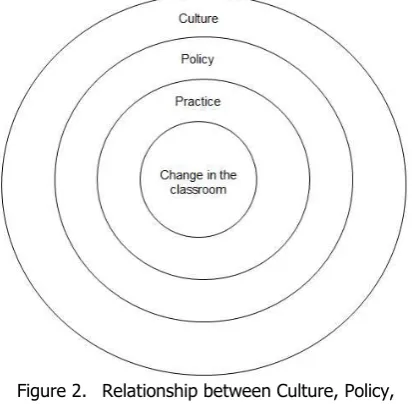
In summary, as illustrated in Figure 1, below, there is a strong relationship between societal culture, policy, practice and real change in the classroom. As described above, a number of cultural constructs have been identified in the literature which is relevant to a consideration of educational reform in Indonesia. These may be loosely grouped as follows:
1. Collectivist society, tendency to act and think in groups, acceptance of regulation 2. Teaching regarded as a duty
3. Hierarchical society, acceptance and reverence for authority, valuing of obedience; high power distance
4. Knowledge seen as collectively accumulated, attested and transferred 5. Conflict avoidance, valuing of harmony 6. Nation and institutions modelled on the
family
When central government policy advocates students to be active and critical thinkers, all of these cultural constraints reflected in the societal culture must be understood and negotiated. Policy makers and educational practitioners need to be aware of the constraints as well as the potentially supportive factors. The potential of the societal cultural constructs discussed above to hamper the interaction between teachers and students, teachers and principals, principals and school supervisors and others must be analysed if the policy is to take affect.
Figure 2. Relationship between Culture, Policy, Practice and Change
The sections that follow will deal with reform as it unfolds in the district and schools. The process and local responses made by various implementing actors will be analysed by focussing on the influence of cultural values on their behaviours of principals and supervisors which underlie reform decision making.
Method
A brief description of the research methods for the case study is presented in this section. I used a multisite case study to gather and analyse data on the school district‟s and schools‟ role in the implementation of child-centred learning and school-based curriculum development. This approach is well suited to in-depth analysis of complex
not considered in this paper. These teaching practices form the core of policy implementation of the nationally mandated School-Based Curriculum policy.
Autonomy versus Superordinate Command This section presents one exemplary story to illustrate the way in which one or more of the above cultural constructs can obstruct the implementation. It is also important to note the way politics is manifested in the form of power that was played out by the school superintendent (pengawas).
The story of an attempt to introduce competency-based curriculum in the school, Sekolah Jaya, illustrates clearly the effect that collectivism and high power distance can have on stifling innovation.
A clash of values between societal culture and the foreign or new culture embedded in the reform has been identified as an obstacle for change. Indonesian societies, although diverse in ethnicity demonstrate a strong sense of social harmony which manifest in cultural constructs such as the Javanese rukun, mufakat, and ewuh pekewuh which in Hofstede (2005) typology of national cultures is a feature of a collectivist society.
The values underlying the behaviour of various actors as local responses were made to central policy, as illustrated below, shows that there is a clash of values between culture and reform. The most relevant societal values referred to here are:
1. harmony and consensus in society as ultimate goals (Hofsted 2005), and 2. mufakat or subordination of the individual
to the common unanimous decision (Mulder, 1994)
The fact that similar topics was brought up by several different respondents during separate interviews provides good evidence for the veracity of the respondents„ accounts and accuracy of their perceptions. Furthermore, verification of the accounts with all actors involved shows that when combined, the different reports were consistent. Whilst on the surface, these various accounts illustrate technical and economic obstacles to reform, on closer examination, they highlight a set of deeper cultural constraints. They form a complete picture which highlights how strong values stemming from the cultural constructs outlined created an obstacle for change.
The illustration below also describes how hierarchy in society, also typical of collectivist society, plays a critical part in determining how long a reform initiative lives; in this account it lived for a very short time and was abruptly aborted. Central to the behaviours of all involved in these accounts is the notion of autonomy as exercised by a school principal when responding to central policy. The central policy in question refers to the Competency-Based Curriculum (KBK), a policy predecessor which forms the basis of the School-Based Curriculum
policy which followed and is the focus of this study (Permendiknas No. 24/2006 article 2.3).
KBK is an acronym for the term „Kurikulum Berbasis Kompetensi‟, literally. „Competency Based Curriculum‟. The draft national curriculum, developed by the national curriculum centre, and based heavily on the approach taken in the earlier national Australian curriculum (1994) was never formally adopted as policy for political than technical reasons. However the draft curriculum provided a basis for subsequent policies including the „School-Based Curriculum‟ policy and national standards, discussed above.
A revealing comment heard in the course of the case study was as follows:
Ya, otonomi tapi harus ada komando.Yes, autonomy but wait for instructions.
This account describes the experience of two principals and two supervisors as they were dealing with an initiative of the school, Sekolah Jaya, which decided to run a „trial‟ for the new curriculum.
Being aware that authority over the actual design and implementation of KBK is concentrated at the school level and supported by a seemingly competent colleague, the Principal of Sekolah Jaya
decided to adopt the 2004 KBK in the beginning of academic year of 2006/2007. Convinced that autonomy had been devolved to school and assisted by his colleague, an aspiring principal, to provide the needed training for his teachers, the Principal of
Sekolah Jaya embarked on a series of school-based programs focussing on curriculum development training activities to empower teachers and improve their capacity.
Whilst this training program was ongoing, teachers no longer used the old 1994 curriculum and instead referred their teaching programs to
KBK. It is worth noting that in practice the „trial‟ of
KBK involved the purchase of KBK-labelled textbooks by the schools and the usage of various
KBK teaching references. When other schools in the whole district continued to use the earlier 1994 curriculum, teachers in Sekolah Jaya abandoned it and began to use KBK instead.
In the local context, Sekolah Jaya is regarded as the most reputable school in the district. The parent population consisted mainly of public servants (87%) with the remainder a mix of farmers and members of the business community. Even the aspiring principal sent his two children to Sekolah Jaya. Some 50 percent of teachers had completed further study and earned teaching degrees – a feature believed by the community as an evidence of teachers‟ quality. A pass rate of 100% for the Grade Six national examinations over the past five years added to the list of pluses for the school‟s reputation.
trial, when the school examination was about to take place, a conflict with school supervisor emerged. This conflict ended the initiative of the school; an event which a year later was described as pelajaran berharga (an important lesson) for reform by one of the actors; the Principal of Sekolah Jaya.
On recalling the initial process of KBK trial in
Sekolah Jaya, Principal Sekolah Merdeka
commented as follows:
Saya dengan Pak A akrab dan sering berbincang tentang hal-hal baru termasuk KBK. Belum ada sekolah di Maluku yang mencoba KBK, kenapa Sekolah Jaya tidak mencoba. Saya sarankan dia untuk menerapkan KBK dan saya bilang saya siap bantu. Saya siap sosialisasi gimana KBK dilaksanakan di kelas, silabus dan sebagainya. I have good relationship with Pak A and we talk about new things including KBK. There is not yet any school in Maluku which has trialled KBK, why doesn‟t Sekolah Jaya try it? I suggested that he trialled KBK and I told him I was ready to give him support. I am ready to socialise the new curriculum, its enactment in class, the syllabus, and so on.
Interview with the Principal of Sekolah Jaya
verified and drew a consistent picture of the account:
Ya, bukankah dengan KBK sekolah punya otonomi. Saya putuskan untuk mencoba KBK karena mencoba kurikulum baru adalah hal yang baik untuk sekolah. Untuk kemajuan pendidikan di sekolah. KBK
entails school autonomy, does it not? I decided to trial KBK because this is a good initiative and it will be good for the school. For the improvement of the school.
Interview with the supervisor also drew a consistent picture:
Benar, waktu KBK dicoba oleh Sekolah Jaya, saya sebagai pengawas waktu itu. It is correct that I was the school supervisor when the initiative to trial KBK was conducted at Sekolah Jaya
On recalling the erupting conflict, and how principal and supervisors meeting was used by the supervisors to vent their anger over the initiative of the Principal of Sekolah Jaya, the Principal of
Sekolah Merdeka reported:
Di KBK guru punya hak untuk menyusun sendiri dan melaksanakan evaluasi pembelajaran. Jadi guru-guru sudah membuat soal-soal sendiri untuk dipakai. Pada saat tes evaluasi belajar di semester pertama, karena sekolah sudah membuat soal-soal sendiri, Sekolah Jaya tidak lagi mengambil soal-soal dari kecamatan. Pengawas marah. With KBK teachers have
the right to develop students‟ assessment. The teachers had developed their own test items for use. When the time came for the test to be administered, because they had already developed their own test, Sekolah Jaya no longer needed the test developed in the sub-district. The supervisor was angry.
Anger was apparent by the use of his increased tone when Principal Sekolah Jaya was interviewed to verify the account:
Tentang (percobaan) KBK itu, masak dijawab seenaknya. Seolah-olah saya tidak melakukan koordinasi. On the trail of KBK
in my school, their response [to my query about school autonomy] does not make any sense. They created the impression that I did it without coordinating with them.
In a separate interview the school inspector
(pengawas) explained his position:
Memang saya yang melarang. Otonomi itu bisa saja tetapi harus tetap menunggu komando. Indeed, it was me who prohibits [the continuation of the initiative]. It is OK to be autonomous but you have to wait for [superior] instruction.
The above illustration highlights how the newly gained power was exercised by the two principals, in particular the principal and teachers of Sekolah Jaya. They were developing a sense of autonomy as decision makers and curriculum developers.
Although it was not possible to assess just the extent of autonomy exercised by the principal and teachers in this school, the fact that they initiated the trial is worth noting. Suffice to say that this initiative was a form of experiential autonomy that was exercised in a context where external constraints are evident in various forms and in which the attitudes and behaviour of the school supervisory team form a part.
On the part of principal, his initiative to conduct the trial is something distinctive that only those with courage would do. As evident in the context: at the time, of 103 schools in the entire district, his was the only school which decided to conduct the trial. Although the reasons why other schools did not conduct the trial cannot be explained for certain, it is reasonable to assume that by not conducting the trial in their schools, these schools principals behaved according to the cultural expectations of a collectivist society; they would wait for their superior‟s instruction. In this local context, the instruction of school inspectors is normally based on the unanimous decision of the group (mufakat).
The fact that the Principal of Sekolah Jaya
conducted the trial comprised a great challenge of his authority in particular and the authority of the team of inspectors in general. The fact that the supervisory team decided to vent their anger in a public meeting to single out Sekolah Jaya principal confirms this.
A year later, the principal recalled the meeting and reported;
Ya, saya dituduh membangkang. Yes, they accused me of being rebellious.
From these accounts it is clear that autonomy as entailed in the new curriculum presents as a foreign idea and, as such, faces great cultural challenge when being exercised. These accounts also suggest that exceptions to these cultural rules are possible. In this case, an individual, the Sekolah Jaya Principal, chose to break the rules by behaving courageously enough and take an initiative and follow through regardless of how short-lived his effort to conduct the trial of the new curriculum in his school would be.
On this basis of exception, it is not unreasonable to expect that the reform has potential to be implemented successfully. What is important to bear in mind is the fact that for autonomy to be successfully adopted, there are cultural challenges that must be resolved. It is therefore important to study how individuals such as the principal of Sekolah Jaya managed to act individually in a collectivist culture such as that demonstrated by the supervisory team of the school community in the sub-district of Tidore.
Conclusion
In this paper, I have explored implementation of policy by examining the Indonesian societal culture and politics as they influence the responses made by implementing actors. This analysis, though limited in scope has nonetheless yielded insights into the two propositions long known in the literature on change and implementation of education innovation; (1) the complexity of implementation, and (2) that change is not an event but a process.
The key finding of this study is that the implementation of reforms in classroom practice has largely failed at the district and school levels due to, among other factors, the influence of cultural values and politics manifested in the power of school superintendents. A number of cultural constructs were identified as relevant to a consideration of educational reform in Indonesia. These include: (1) the tendency of members of a collectivist society to act and think in groups, acceptance of regulation, (2) teaching regarded as a duty, (3) the hierarchical nature society, acceptance and reverence for authority, valuing of obedience; high power distance, (4) a perception of knowledge as collectively accumulated, attested and transferred, (5) tendency to avoid direct conflict, valuing of
harmony, and (6) a view of nation and institutions as like a family.
These value sets can act to either support or constrain reform. In varying degrees they are all present in the case study reported from North Maluku. One exemplary story was provided to illustrate the way in which one or more of these cultural constructs can obstruct the implementation. The story of an attempt to introduce competency-based curriculum in the school, Sekolah Jaya,
illustrates clearly the effect that collectivism and high power distance can have on stifling innovation.
Notably this analysis has highlighted the extent to which Indonesian cultural norms have shaped the responses of teachers, principals, supervisors, and district officials to external change forces. Some insights to gain from this understanding can be framed in both implementation of innovation and change vocabularies. To look for the role of culture as an addition to blaming these implementing actors for failure would be a useful implementation perspective. Unless policy makers allow for the realities, including cultural realities, of implementers at the level of classroom, school and district, their reform policies are unlikely to be implemented and the pattern of failed reform in Indonesia‟s education system is likely to be repeated.
REFERENCES
Adams, D. K., G.H., & Lin, L. (2001). Linking research, policy and strategic planning to education development in Lao people's democratic republic. Comparative Education Review, 45(2), 220-241.
Ahmad, D., Mudjito, A.K., Tauhid. (1994). Pedoman pelaksanaan proses belajar mengajar di sekolah dasar: Departemen Pendidikan dan Kebudayaan Directorat Jenderal Pendidikan Dasar dan menengah Direktorat Pendidikan Dasar.
Australian national curriculum. (1994). Retrieved, from.
Bjork, C. (2003). Local responses to decentralization policy in Indonesia. Comparative Education Review Chicago, 47(2), 184-216.
Cannon, R., & Arlianti, R. (2008). Review of education development models for increasing access to quality basic educaton in Indonesia,
Jakarta: World Bank.
Clarke, P. (2001). Teaching and learning: The culture of pedagogy. New Delhi: Sage Publication.
Clarke, P. (2003). Culture and Classroom Reform.
Comparative Education, 39(1), 27-44.
Dhakidae, D. (2003). Cendikiawan dan kekuasaan (Scholar and power) (Vol. -). Jakarta: PT Gramedia Pustaka Utama.
Elmore, R. (1980). Backward mapping: Implementation research and policy decisions.
Political science quarterly, 94 (4).
Elmore, R. (1980). Backward mapping: Implementation research and policy decisions.
Political science quarterly, 94 (4).
Hall, G. E., & Hord, S. M. (1984). A framework for analysing what change facilitators do; The intervention taxonomy. Knowledge: Creation, Diffusion, Utilization, 5 (3), 275-307.
Hall, G. H., S. (1987). Change in schools: Facilitating the process. Albany, NY: State University of New York Press.
Hallinger, P. & Kantamara, P. (2001). Exploring the Cultural Context of School Improvement in Thailand. School Effectiveness and School Improvement, 12 (4), 385-408.
Hallinger, P. (2004). Making education reform happen: Is there an Asian way? Paper presented at the International Conference: Making change happen; learning from the Asian experience.
Hill, H. (2001). Technology and innovation in developing East Asia: An interpretive survey. Retrived November 24, 2009, from http://hdl.handle.net/1885/40355
Hofstede, G. H., G. J. (2005). Cultures and Organizations Software of the Mind. New York: McGraw-Hill.
House, E. R. (1979). Technology versus craft; A ten year perspective on innovation. Journal of Curriculum Studies, 11 (1), 1-16.
Jatmiko, Y. S. (2004). Pendidikan pemerdekaan: Catatan sejarah perjalanan SDK Eksperimen Mangunan YB Mangunwijaya: Dinamika Edukasi Dasar Misereor/KZE.
Kalijernih, F. (2005). The Indonesian Civic Ideal - Insider Perspectives.Unpublished manuscript.
King, D. Y. (1996). Bureaucracy and implementation of complex tasks in rapidly developing states: Evidence from Indonesia. Studies in Comparative International Development, 30
(No. 4), 78-92.
Laporan pelaksanaan bantuan pofesional tim pengembangan kurikulum (TPK) kabupaten/kota (Report on professional assistance for district curriculum development team). (2007). Jakarta: Pusat Kurikulum
(Curriculum Centre) Badan Penelitian dan Pengembangan Departemen Pendidikan Nasional
Leigh, B. (1999). Learning and Knowing Boundaries.
Sojourn, 14(No. 1), 34-56.
Malcolm, H., McLean, J., Tanuputra, G., Harlen, W. (2001). Active learning through professional support (ALPS) project, Indonesia 1988-1995: DFID.
Marsh, C. J., and Thomas, M. P. (1991). Curriculum development in East Asia. London: The Falmer Press.
Miles, M., and Huberman, M. (1984). Qualitative data analysis: A source book of new methods.
Beverly Hills, Calif.: Sage.
Mulder, N. (1994). Inside Indonesian society: An interpretation of cultural change in Java. Bangkok: Mr. Suk Soongwang.
Nielsen, H. D. (1998). Reforms to teacher education in Indonesia: Does more mean better? Asia Pacific Journal of Education, (18), 9-25.
Peraturan menteri pendidikan nasional Republik Indonesia nomer 12 tahun 2007 tentang standar pengawas sekolah/madrasah. (2007). Departemen Pendidikan Nasional.
Peraturan menteri pendidikan nasional Republik Indonesia nomer 13 tahun 2007 tentang standar kepala sekolah. (2007). Departemen Pendidikan Nasional.
Peraturan menteri pendidikan nasional Republik Indonesia nomer 19 tahun 2007 tentang standar pengelolaan pendidikan. (2007). Departemen Pendidikan Nasional.
Peraturan menteri pendidikan nasional Republik Indonesia nomer 19 tahun 2007 tentang standar pengelolaan pendidikan. (2007). Departemen Pendidikan Nasional.
Peraturan menteri pendidikan nasional Republik Indonesia nomer 20 tahun 2007 tentang standar penilaian pendidikan (2007). Departemen Pendidikan Nasional.
Peraturan menteri pendidikan nasional Republik Indonesia nomer 20 tahun 2007 tentang standar penilaian pendidikan (2007). Departemen Pendidikan Nasional.
Peraturan menteri pendidikan nasional Republik Indonesia nomer 22 tahun 2006 tentang standar isi (2006). Departemen Pendidikan Nasional.
Peraturan menteri pendidikan nasional Republik Indonesia nomer 23 tahun 2006 tentang standar kompetensi lulusan (2006). Departemen Pendidikan Nasional.
Peraturan menteri pendidikan nasional Republik Indonesia nomer 24 tahun 2007 tentang standar sarana dan prasarana (2007). Departemen Pendidikan Nasional.
Peraturan menteri pendidikan nasional Republik Indonesia nomer 24 tahun 2006 tentang pelaksanaan permendiknas nomer 22 & 23 tahun 2006. (2006).
Peraturan menteri pendidikan nasional Republik Indonesia nomer 41 tahun 2007 tentang standar proses. (2007). Departemen Pendidikan Nasional.
Peraturan menteri pendidikan nasional Republik Indonesia nomer 41 tahun 2007 tentang standar proses. (2007). Departemen Pendidikan Nasional.
Peraturan menteri pendidikan nasional Republik Indonesia nomer 41 tahun 2007 tentang standar proses. (2007). Departemen Pendidikan Nasional.
Peraturan pemerintah Republik Indonesia nomor 19 tahun 2005 tentang standar nasional pendidikan. (2005). Pemerintah Republik Indonesia.
Pradipto, Y. D. (2007). Belajar sejati vs kurikulum nasional:Kontestasi kekuasaan dalam pendidikan dasar. Yogyakarta: Kanisius.
Rogers, E. (1971). Diffusion of innovation. New York: Free Press.
Semiawan, C. (2001). Pendidikan, mutu pendidikan, dan peranan guru (Education, quality education, and the role of teachers). In D. Supriadi (Ed.), Guru di Indonesia. Jakarta:
Departemen Pendidikan Nasional, Dirjen Dik. Das. Men. Dit. Tenaga Kependidikan.
Stake, R.E. (1995). The art of case study research.Thousand Oaks, Calif.:Sage
Suseno, F. M. (1997). Javanese ethnics and world-view: The Javanese idea of good life. Jakarta: PT Gramedia Pustaka Utama.
Undang-undang Republik Indonesia nomer 19 tahun 1997 tentang otonomi daerah. (1999).
Undang-undang Republik Indonesia nomer 20 tahun 2003 tentang sistem pendidikan nasional. (2003).
Undang-undang Republik Indonesia nomer 32 tahun 2004 tentang perimbangan keuangan antar pusat dan daerah. (2004).
Van Der Werf, G., Creemers, B., De Jong, R. & Klaver, E. (2000). Evaluation of school improvement through an educational effectiveness model: The case of Indonesia's PEQIP project. Comparative Education Review, 44 (No.3), 329 - 355.
Vatikiotis, M. R. J. (1993). Indonesian Politics Under Suharto. London Routledge.
Windschitl, M. (2002). Framing constructivism in practices as the negotiation of dillema: An analysis of the conceptual, pedagogical, cultural, and political challenges facing teachers. Review of Educational Research, 72