ELECTROCHEMICAL OXIDATION OF ETHANOL USING
Ni-Co-PVC COMPOSITE ELECTRODE
Riyanto
1.*, Mohamed Rozali Othman
2, and Jumat Salimon
2 1Chemistry Study Program, Faculty of Mathematics and Natural Science, Universitas Islam Indonesia, Jl. Kaliurang KM 14.5 Yogyakarta 55584
2
Electrosynthesis Laboratory (Room B105), School of Chemical Sciences and Food Technology, Faculty of Science and Technology, Universiti Kebangsaan Malaysia,
43600 UKM, Bangi, Selangor Darul Ehsan, Malaysia
Received October 1, 2009; Accepted February 7, 2011
ABSTRACT
The morphological characteristics and electrochemical behavior of nickel metal foil (Ni), nickel-polyvinyl chloride (Ni-PVC) and nickel-cobalt-polyvinyl chloride (Ni-Co-PVC) electrodes in alkaline solution has been investigated. The morphological characteristics of the electrode surface were studied using SEM and EDS, while the electrochemical behavior of the electrodes was studied using cyclic voltammetry (CV). It was found that composite electrodes (Ni-PVC and Ni-Co-PVC) have a porous, irregular and rough surface. In situ studies using electrochemical technique using those three electrodes exhibited electrochemical activity for redox system, as well as selectivity in the electrooxidation of ethanol to acetic acid. The studies also found that an electrokinetics and electrocatalytic activity behaviors of the electrodes prepared were Ni metal foil<Ni-PVC<Ni-Co-PVC. Electrocatalysts involved in the electrooxidation process of ethanol in 1 M KOH using those electrodes involving the Ni(OH)2/NiOOH
and Co(OH)2/CoOOH catalysts which were determined by the XPS and cyclic voltammetry studies. A better
electrokinetics and electrocatalytic activity behaviors electrodes, gave a better results in the electrooxidation of ethanol in alkaline solution.
Keywords: Electrooxidation, ethanol, nickel-polyvinyl chloride (Ni-PVC) and nickel-cobalt-polyvinyl chloride
(Ni-Co-PVC); alkaline solution
INTRODUCTION
Electrooxidation of ethanol using nickel metal, nickel oxide, nickel alloy oxide for the purpose of fuel cell [1-2] and electrooxidation of ethanol in the electrosynthesis of acetic acid [3-7] have been done by many researchers. Nickel has been reported to be a good electrode for oxidation of various organic compounds in alkaline solution [8-13]. Electrooxidation of ethanol using nickel electrode in alkaline solution will produce acetic acid, acetaldehyde and ethyl acetate [1-7,14]. Acetic acid is an important component in the synthesis of many chemicals such as cellulose acetate, vinyl acetate, acetic acid esters, terephthalic acid, etc. [15].
Electrooxidation method is one of the alternative methods to yield acetic acid. Alkaline solution is the best medium in the electrooxidation of ethanol because it prevents corrosion and improves electrode stability [1,17,20-21]. The result of electrooxidation of ethanol is depending on the morphology or formation of electrode, porosity and electrode pore size. Electrocatalytic activity of these materials strongly depends on their morphology, surface area and structure, which in turn depend on the
preparation methods. One of the techniques of making the porous electrode is by incorporating polymer material like polyvinyl chloride (PVC) with the powder of respected metals [2,18,22-24]. The addition of certain percentage of Co powder into nickel composite electrode will enhance the electrode reactivity [4-5,19], increase the oxygen evolution reaction (OER) and is economically feasible for commercial use [16]. Cobalt and nickel, being transition elements, with their electronic layer d incomplete, have shown good electrocatalytic properties for the electrooxidation of ethanol in alkaline solution.
In this paper, a new technique of making the new electrode by mixing Co and Ni metals powder with PVC will be discussed. The existence of the two metal will cause synergistic effect [8,17-19], bifunctional oxygen electrode [25], and active bifunctional catalyst in alkaline solution and improve in acetic acid formation [2,4-5]. Because on the electrode surface there are compound which may act as electrocatalyst, oxide of Ni; NiO, Ni(OH)2 and NiOOH [2,6,8,26] and Co; CoO, Co(OH)2, CoOOH [26].
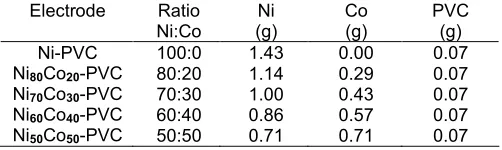
Table 1.Ratio and composition Ni and Co powder metal for Ni-Co-PVC electrodes preparation
Electrode Ratio
Ni-PVC 100:0 1.43 0.00 0.07
Ni80Co20-PVC 80:20 1.14 0.29 0.07
Ni70Co30-PVC 70:30 1.00 0.43 0.07
Ni60Co40-PVC 60:40 0.86 0.57 0.07
Ni50Co50-PVC 50:50 0.71 0.71 0.07
ethanol in alkaline solution, XPS was used [27-31, 33-35]. Analysis of acetic acid produced was performed using high performance liquid chromatography (HPLC) with C-18 column and a mixture of acetonitril:1% H3PO4 as mobile phase [2]. In addition, we also will report the percentage of acetic acid produced in the electrooxidation of ethanol using Ni metal foil, Ni-PVC and Ni-Co-PVC in alkaline solution. The surface morphology, electrochemical behaviors and electrokinetics parameters of the electrode prepared were studied using SEM and EDS, cyclic voltammetry and Tafel equation, respectively.
EXPERIMENTAL SECTION
Materials
KOH and ethanol (Merck, Germany) were prepared by dissolving their analytical grade reagent in deionised distilled water. Ni metal foils (99.98% purity, Aldrich Chemical Company), Ni powder (< 2 micron in size and 99.9% purity, Aldrich Chemical Company), PVC and tetrahydrofuran (THF) (Merck, Germany) were used as composite electrode. The acetonitrile (Merck, Germany) in 0.1% H3PO4 (Merck, Germany) were used as mobile phase throughout.
Instrumentation
The surface characterization of the electrode using SEM and EDS was performed on the JSM 5400 microscope equipped with a microprobe Voyager Noran system. The analysis sponge on electrode surface was performed using XPS Kratos Analytical, Digital 500, Ion pump system controller, Glassman High Voltage Inc. Minibeam Gun Control. Mg Kα (1253.6 eV) X-ray. Universal Pulsa Dynamic EIS, Voltammetry, Voltalab potentiostat (Model PGZ 402) was used for electrochemical behavior measurements, data acquisition was accomplished using the Voltamaster 4 software. Cyclic voltammetry experiments were performed in a three electrodes system using Ni, Ni-PVC or Ni-Co-PVC as a working electrode (anode), an Ag/AgCl (saturated KCl) or SCE as reference electrode and platinum wire as the counter electrode. All potentials given are with respect to the SCE reference electrode.
Analyses of the electrochemical oxidations products were carried out by High Performance Liquid Chromatography (HPLC) using equipments comprised of a pump (Waters 1515 Isocratic HPLC Pump), a column (C18) completed with and two detectors, UV-visible detector (Waters 2487, Dual Absorbance detector) and a differential refractometer set on line. Chromatograms were recorded and integrated by an integrator-calculator (Merck-Hitachi D-2500). All experiments were carried out at room temperature.
Procedure
Preparation of an nickel electrode
Ni metal foil was used to prepare Ni electrode. A 0.5 mm thick Ni foil was cut into approximately 1 cm x 1 cm piece and connected to silver wire with silver conducting paint prior covered with epoxy gum.
Preparation of a nickel-polyvinyl chloride electrode
The Ni-PVC electrode was prepared by mixing a weighed portion of Ni powder and PVC in 4 mL tetrahydrofuran (THF) solvent and swirled flatly to homogeneous followed by drying in an oven at 100 °C for 3 h. The mixture was placed in 1 cm diameter stainless steel mould and pressed at 10 ton/cm2. A typical pellet contained approximately 95% of Ni powder and 5% of PVC polymer. The total weighed of pellet obtained is approximately 1.5 g. The same treatments as Ni metal foil were later carried out for Ni-PVC electrode preparation.
Preparation of nickel-cobalt-polyvinyl chloride
electrodes
Four nickel-cobalt-polyvinyl chloride electrode was prepared by mixing a weighed portion of Co powder, Ni powder and PVC in 4 mL tetrahydrofuran (THF) solvent and swirled flatly to homogeneous followed by drying in an oven at 100 °C for 3 h. The mixture was placed in 1 cm diameter stainless steel mould and pressed at 10 ton/cm2. A typical pellet contained approximately different amount of Co and Ni powder, and approximately 5% of PVC polymer (Table 1). The total weighed of pellet obtained is approximately 1.5 g. The same treatments as Ni metal foil were later carried out for Ni-PVC and Ni-Co-PVC electrodes preparation.
Electrochemical of ethanol in alkaline solution
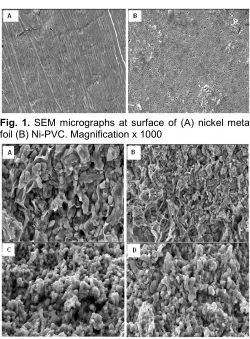
Fig. 1. SEM micrographs at surface of (A) nickel metal foil (B) Ni-PVC. Magnification x 1000
Fig. 2.SEM micrographs at cross section of (A) Ni-PVC (B) Ni80Co20-PVC (C) Ni70Co20-PVC and (D) Ni50Co50
-PVC. Magnification x 1000
Fig. 3.EDS spectra of Ni50Co50-PVC electrode
Nitrogen was used to deaerate the solutions and to keep an inert atmosphere over the reaction solution during the electrochemical oxidation process. Electrolysis products were analyzed using high performance liquid chromatography (HPLC).
RESULT AND DISCUSSION
Characterization of the electrodes surface using SEM and EDS
Fig. 1 showed the morphological study of freshly prepared Ni, Ni-PVC and Ni-Co-PVC electrodes by SEM. Almost a similar SEM micrograph were displayed by both Ni-PVC and Ni-Co-PVC. So in this paper only SEM micrograph almost gave as shown in electrodes surface [Fig. 1B] were very rough, irregular and having porous characteristic compared to Ni metal electrode surface (Fig. 1A). It has been reported that electrode prepared using powdered metal-PVC yielded electrode have surface which is very rough, irregular, and formed a lamellar orientated particles [23-24]. Ni-PVC composite material can be used an anode in alkaline solution and current collector for the NiCo2O4 [23]. The surface structure of Ni-PVC electrode shown the existence of porous surface compared to Ni metal electrode (Fig.1B). The picture shown in Fig. 2A-2D indicates that the surface morphology is highly heterogeneous and composed of aggregates of nickel particles separated by gaps of PVC and voids between aggregate of nickel. These morphological, structure and porosity characteristics enable the use of this Ni-PVC and Ni-Co-PVC composite electrodes as current collector for different catalysts with good adherence [23].
Analysis on Ni-PVC electrode using EDS showed the existence of Ni, C and of Cl peaks [Fig.3]. The existing C and Cl peaks show the existence of PVC on the surface of the electrode. The bonding between PVC and metal occurred through Cl atom from PVC and metal to form Ni-Cl bonding [36-37], which produced a good strength electrode. Using the same analytical tool, Fig.3 shows the existence of Co and together with Ni, C and Cl atoms in the Ni-Co-PVC electrode surface. Elemental analysis using EDS shows that the composition of both of metals on the surface of Ni-Co-PVC electrodes were Co 59.30% and Ni 38.4%; O 1.51% and Cl 1.14%, hence proving that by PVC was in very small amount. This unsimilar composition between Co and Ni metals on the surface of electrodes, which was Ni 50%, and Co 50% as prepared may due the covering of Ni atom by PVC.
Cyclic voltammetry studies
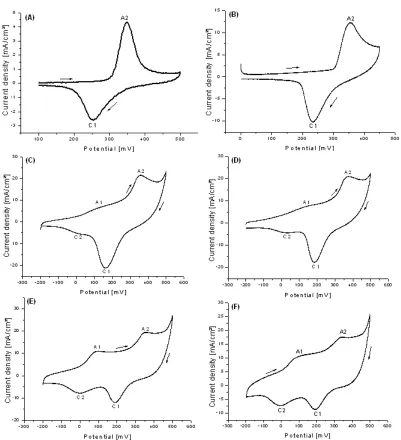
Fig. 4. Cyclic voltammograms of (A) Ni; (B) Ni-PVC; (C) Ni80Co20-PVC; (D) Ni70Co30-PVC (E) Ni60Co40-PVC; (F)
Ni50Co50-PVC; in 1 M KOH, first scan, scan rate 10 mV/sec.
between the cyclic voltammograms of Ni metal foil and of Ni-PVC electrodes is the level of current density. For Ni-PVC electrode higher current density was observed compared to Ni metal foil electrode, due higher surface area of earlier electrode compared to the latter electrode. Because Ni-PVC electrode was prepared using their powder form, while Ni metal foil electrode was prepared using its solid form. Hence, the molecular adsorption on the surface of the electrode with larger surface area was obtained. Powder electrodes are more economical and beneficial for the oxidation of materials compared to solid metal electrode due to higher current density; hence more oxidation process will occur.
Anodic peak (peak A2) in Fig. 4A and 4B represents to oxidation of Ni(II) to Ni(III) by the changing of Ni(OH)2 to NiOOH [10,19,27-28,39-45]. Oxidation of Ni(0) to Ni(II) occurred at more negative potential or hydroxide region (not shown in this cyclic voltammogram). The mechanism involved in the anodic peak (peak A2 in Fig. 4A and 4B) appearances representing Ni(III) region or oxyhydroxide region [39,44-45] is as follows:
-
-2
Ni + 2OH α-Ni(OH) + 2e at -0.8 up to -1.5V/SCE (1)
2 2
α-Ni(OH) β-Ni(OH) at -08 V up to 0 V/SCE (2)
-
-2 2
According to Casella et al. and Hahn et al. [27, 44-45], cathodic peak (peak C1) in Fig. 4A and 4B represents two forms of crystallographic from oxyhydroxideαand β. According to Medway et al. peak C1 in Fig 4A and 4B represents to reduction of Ni(III) to Ni(II) by the conversion of NiOOH to Ni(OH)2[2,24,39].
Nickel oxyhydroxide (NiOOH) is capable to oxidize a number of functional groups, for example primary alcohols may be oxidized to carboxylic acids [13]. Nickel has been reported to be a good electrode for the oxidation of various organic compounds. A redox couple of nickel, i.e., nickel hydroxide (Ni(OH)2) and nickel oxyhydroxide (NiOOH), was shown to be involved in the oxidation of alcohol at nickel electrodes in alkaline media [8]. The mechanism of electrooxidation process using nickel anode material was proposed as follows:
-e
According to Tarasevich et al. [1], the redox mechanism of the alcohol oxidation due to Ni(II)/Ni(III) pair is also acceptable, as the redox potential of this pair is at least 0.6 V more positive than the considered potential range. According to Kim and Park [8], reaction mechanism of electrocatalyst on the surface of Ni metal foil electrode is as follows:
-
-NiOOH + Intermediate 2 CH COOH + Ni(OH) (10) According to them, nickel oxyhydroxide (NiOOH) involved in the reaction that will oxidized ethanol to acetaldehyde and further oxidized to acetic acid. Most of acetaldehyde was oxidized to acetic acid because its oxidation rate is faster than ethanol. The reaction of organic compounds with the nickel oxides of higher valency is usually the rate of determination step.
Fig. 4C-4F show the available of new peak (A1) before nickel peak and may due the presence of Co as this peak may growing bigger with the increasing percentage of Co in the electrode prepared. The peak was not appeared at cyclic voltammogram at Fig. 4A and 4B. A1 peak at Fig. 4C-4F representing oxidation peak for Co (0) to form Co oxide compounds, Co(OH)2, Co3O4, Co2O3, CoHO2and CoOOH [27-28]. According to Wishvender and Toni [46], cobalt electrode surface in KOH supporting electrolyte will be in the form of Co(OH)2 film phase solid and oxidize to Co3O4, CoOOH and further oxidation to CoO2, which may representing by the following reaction:
Fig. 4C-4F showed that peak position for the oxidation of Co in cyclic voltammetry is similar as reported by Cataldi et al. [47], at potential between -0.05 up to +0.30 V vs Ag/AgCl. At this range, Co will be oxidised to its oxide according to the following reactions [47]: Refer to the Fig. 4C and 4F, reaction (15) occurred at a potential + 0.10 V versus Ag/AgCl (peak A1), while reactions (16), (17) and (18) could not be seen in the voltammograms in Fig. 4C–4F because their peaks were overlapped with A2 peak from nickel oxide peak which has a maximum at 350 mV vs Ag/AgCl as in Fig. 4A and 4B. From Fig. 4C–4F, redox couple occurred was A1/C2 and A2/C1. C2 peak showed the reformation of Co(II) species [27-28,35]. Similarly, nickel and cobalt oxide will play an important role in the oxidation of ethanol. According to Casella and Guascito [35], at higher potential, the electrooxidation process is attributed to the formation of CoOOH and/or Co(IV) species. While, according to Cataldi et al. [47], the final anodic transition which appeared prior to oxygen evolution reaction (OER) can be interpreted as being due to the oxidation of CoO(OH) to CoO2. Please to note that OER of the cobalt oxides was oxidized to Co(IV).
This potential representing the oxidation of carbohydrates and polyhydroxide compounds which may change Co(III) to Co(IV). This opinion may differ as reported by Ross et al. [26], that formation of cobalt oxide on the surface of electrode is cobalt (II) hydroxide, which undergoes a further transition to cobalt (III) oxide before oxygen evolution.
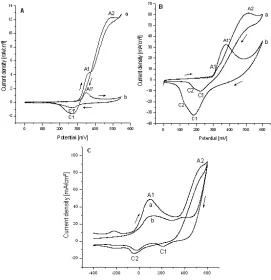
Fig. 5. Cyclic voltammograms of (a) 0.25 M ethanol; (b) without ethanol in 1 M KOH using (A) Ni metal foil; (B) Ni-PVC and (C) Ni50Co50-PVC electrodes. First scan and scan rate 10 mV/sec
Fig. 6.I-E characteristics recorded for 0.25 M ethanol. in 1 M KOH at 1 mV/sec for (a) Ni50Co50-PVC (b) Ni60Co40
-PVC (c) Ni70Co30-PVC (d) Ni80Co20-PVC (e) Ni-PVC and
(f) Ni metal foil electrodes
Co(II) to Co(III)
-
-2 2
Co(OH) + OH CoOOH + H O + e (19)
3 2 2
CoOOH + CH CH OH intermediate 1 + Co(OH) (20)
3 2
CoOOH + intermediate 1 CH CHO + Co(OH) (21)
3 2
CoOOH + CH CHO intermediate 2 + Co(OH) (22)
3 2
CoOOH + intermediate 2 CH COOH + Co(OH) (23)
Co(III) to Co(IV)
-
-2 2
CoOOH + OH CoO + H O + e (24)
2 3 2
CoO + CH CH OH intermediate 1 + CoOOH (25)
2 3
CoO + intermediate 1 CH CHO + CoOOH (26) 2 3
CoO + CH CHO intermediate 2 + CoOOH (27)
2 3
CoO + intermediate 2 CH COOH + CoOOH (28) Fig. 5A, 5B and 5C shows a cyclic voltammogram of 0.25 M ethanol in 1 M KOH using Ni metal foil, Ni-PVC and Ni-Co-PVC electrodes. For cyclic voltammogram of ethanol in KOH using Ni metal foil and Ni-PVC, sweeps from 0 mV 600 mV and return to the initial potential were used, while for Ni-Co-PVC electrode, sweeps from –400 to +600 mV and return was used (Fig. 5). Peaks A1 and A2 in Fig. 5A and 5B representing the anodic peaks. Peaks A1 and A1’ in Fig. 5A and 5B which have a relatively large anodic current is related to further oxide growth as well as the change in Ni oxidation state from Ni(II) to Ni(III) and possibly higher if overcharging occurs [39]. The oxidation of β-Ni(OH)2 to NiOOH occurs via the reaction (3) [15,44-45].
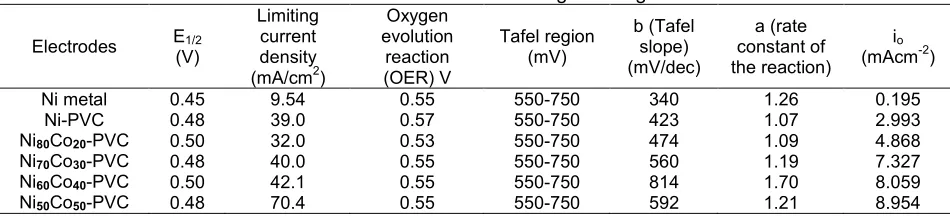
Table 2.Summarized the finding from Fig. 6.
Ni metal 0.45 9.54 0.55 550-750 340 1.26 0.195
Ni-PVC 0.48 39.0 0.57 550-750 423 1.07 2.993
Ni80Co20-PVC 0.50 32.0 0.53 550-750 474 1.09 4.868
Ni70Co30-PVC 0.48 40.0 0.55 550-750 560 1.19 7.327
Ni60Co40-PVC 0.50 42.1 0.55 550-750 814 1.70 8.059
Ni50Co50-PVC 0.48 70.4 0.55 550-750 592 1.21 8.954
Table 3.Electrooxidation product of 0.25 M ethanol in 1 M KOH at potential 1.05 V, electrolysis time 6 h
Type electrodes % Yield of acetic acid
Ni metal 74.95 182.30 47.75 3932.00
Ni-PVC 82.49 250.21 38.29 4904.00
Ni80Co20-PVC 83.36 245.12 39.50 4753.88
Ni70Co30-PVC 86.72 233.21 38.21 4914.53
Ni60Co40-PVC 92.55 212.98 39.57 4746.19
Ni50Co50-PVC 98.01 225.32 50.53 3716.62
C1 peak at Fig. 5A, 5B and 5C represent peaks for the formation of β-NiOOH, while peak C2 at Fig. 5B which do not appeared in Fig. 5A is explained by the existence
of crystallographic form γ-NiOOH. According to Casella
et al. [27], α-form is known to be unstable in alkaline solution and slowly converted and irreversible to the β -form, while on prolonged charging;β-NiOOH converts to
the γ-oxyhydroxide form. C1 peak at Fig. 5C is a
reduction peak for Ni(III) (in the form of NiOOH) to Ni(II) which is in the form of Ni(OH)2and C2 peak at Fig. 5C is a reduction peak for Co(III) in the form of CoOOH to Co(II) which is in the form of Co(OH)2.
This result obtained is agreeable with the result, which reported by Pereira et al. [2], where in 0.1 M KOH anodic peak appeared at 0.45 V representing the formation of Ni(III) and cathodic peak at 0.37 V representing the formation of Ni(II). A1 peak at Fig. 5A and B representing oxidation peak for Ni(II) to Ni(III), but with the existence of ethanol, overlapping with ethanol oxidation peak occurred. From the existing of ethanol oxidation peak, clearly that the oxidation of ethanol with Ni electrode can be done at a potential of 515 mV, where better electrocatalysts reaction would occurred at this potential due to the formation of NiOOH on the surface of electrode used.
Electrokinetic’s Parameter
Fig. 6 shows the I-E characteristics recorded for 0.25 M ethanol in 1 M KOH at scan rate 1 mV/sec for Ni metal foil, Ni-PVC and Ni-Co-PVC electrodes. In alkaline solution, a significantly differences in current density recorded between Ni metal foil, Ni-PVC and NiCo-PVC, in the sequence of Ni metal < Ni-PVC < NiCo-PVC.
Indicates, higher current density was recorded when the Co was added to Ni-PVC electrode.
Table 2 represents the limiting current density of electrode design with PVC. Addition of Co percentage to the electrode will improve limiting current density, hence a better ability for the oxidation of ethanol in alkaline medium. The OER potential was almost constant, 0.53–0.57 V. The I-E curve for nickel base electrodes in KOH electrolyte and the existing of ethanol always gave increase in current density at a potential of 0.3–0.45 V and potential above 0.5 V, because nickel base electrodes have two Tafel area, low and high Tafel region at 0.30–0.45 V and 0.55–0.75 V, respectively. Table 2 showed a kinetic parameter which taken at high Tafel region. Correlations between log io and potential fulfill the Tafel equation with R2 value about 1. The Tafel slope (b) represents the number of electron being transferred into the electrochemical or chemical reaction step [48].
The io (exchange current density) value can be used to compare the electrocatalytic ability for each electrode. As seen in Table 1, Ni metal electrode had a smallest io value compared to Ni-PVC and Ni-Co-PVC electrodes. Additions of Co metal into Ni-PVC electrode increase the electrode reactivity. The similar observation were reported by Xu et al. [17] using various composition of Pt/C and Pt-MgO electrodes, and Tarasevich et al. [1] using Ru-Ni electrode.
Electrooxidation product of ethanol
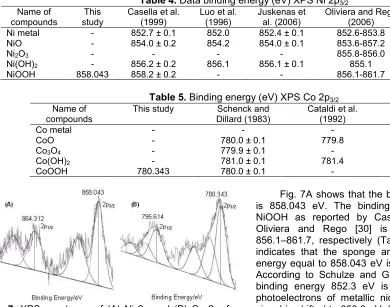
Table 4.Data binding energy (eV) XPS Ni 2p3/2
NiO - 854.0 ± 0.2 854.2 854.0 ± 0.1 853.6-857.2 853.5-854.3
Ni2O3 - - - - 855.8-856.0 857.3
Ni(OH)2 - 856.2 ± 0.2 856.1 856.1 ± 0.1 855.1 855.6
NiOOH 858.043 858.2 ± 0.2 - - 856.1-861.7
-Table 5.Binding energy (eV) XPS Co 2p3/2
Name of compounds
This study Schenck and Dillard (1983)
CoOOH 780.343 780.0 ± 0.1 - 780.0
Fig. 7. XPS spectrums of (A) Ni 2p and (B) Co 2p, for sponge formed on Ni and Co metal foil electrodes used in the electrolysis of 0.25 M ethanol in 1 M KOH. Electrolysis potential and time was 1.05 V versus SCE and 6 h, respectively
electrode (Table 3). An electrode that has higher current density may produce more acetic acid from the electrooxidation of ethanol at specific electrolysis time. There is a relation between the acetic acid yield with current efficiency and energy consumption. The greater the current density of the small energy consumption. Ni50Co50-PVC is the best electrode because it produces
the highest acetic acid and low energy consumption.
Determination of spongy at surface electrodes using XPS
A mixture of black and green (dominated by green color) sponge were formed on the surface of Ni-Co-PVC electrode used during the electrolysis process of 0.25 M ethanol in 1 M KOH for 6 h at a potential of 1.05 V. In order to determine the sponge substances, analysis of sponge formed on the surface of Ni and Co metal foil electrodes from the electrolysis of 0.25 M ethanol in 1 M KOH, respectively, were analyzed using XPS and the spectrum obtained were shown at Fig. 7.
Fig. 7A shows that the binding energy of Ni 2p3/2 is 858.043 eV. The binding energy of Ni 2p3/2 for NiOOH as reported by Casella et al. [27-28] and Oliviera and Rego [30] is 858.2 ± 0.2 eV and 856.1–861.7, respectively (Table 3). From their data, indicates that the sponge analyzed with the binding energy equal to 858.043 eV is belong Ni 2p3/2NiOOH. According to Schulze and Gulzoe [38], the signal at binding energy 852.3 eV is related to the Ni 2p3/2 photoelectrons of metallic nickel, where for NiO this signal is shifted to 853.3 eV. Suggested, the signals of Ni 2p3/2 photoelectron with higher binding energy are related to electrochemically formed nickel hydroxide, Ni(OH)2 and nickel oxyhydroxide, NiOOH. According to Luo et al. [31], the nickel oxide layer clearly has considerable hydroxide and this may be in the form of nickel α- or β-oxyhydroxide. The final oxide/hydroxide composition may be affected by alloying. There are small differences in XPS core data for such compounds, but the Ni 2p region is too complex to conclusively identify. The data of the binding energy for selected nickel compounds according to some authors are as summarized in Table 4.
Fig. 7B shows the binding energy for Co 2p3/2and Co 2p1/2was 780.343 eV and 795.614 eV, respectively. The data of binding energy obtained from various references, concluded that the two possible compound on the Co electrode surface was Co(OH)2and CoOOH (Table 5). Cataldi et al. [47] suggested that both of their binding energy and structure of satellite were taken into consideration to determine the compound of Co. If the satellite structure associated with the main peak, indicated the presence of Co(OH)2.
(Fig. 7B). Schenck and Dillard [34] support this opinion, because CoOOH do not exhibited any satellite peak. The possible mechanism occurred for the Co electrode during the electrooxidation of ethanol in KOH is the oxidation of Co(II) to Co(III). The data of the binding energy for selected cobalt compounds according to some authors are as summarized in Table 4. Because they have the same binding energy, hence their splitting energy (Co 2p3/2-Co 2p1/2) was considered. The splitting energy for the CoO and CoOOH are 15.9 eV and 15.0 eV, respectively [34]. According to Rashkova et al. [25] using XPS study, the elemental Co was not detected in the entire volume, which means that the whole amount of deposited Co is oxidized to Co2+.
According to the XPS result, the catalyst which play an important role in the electrooxidation of ethanol in 1 M KOH is relating to the redox couple of Ni(II)/Ni(III) and Co(II)/Co(III) or Ni(OH)2/NiOOH and Co(OH)2/CoOOH. Indicate, bifunctional mechanism and synergistic effect occurred from both catalysts. Proving, mechanism (6–10) for Ni and (19–23) for cobalt were occurred, where Ni(II) and Co(II) will be oxidized to Ni(III) and Co(III), respectively as suggested by Ross et al. [26] not to Co(IV) as suggested by Cataldie et al. [47].
CONCLUSION
The designed, Ni-PVC and Ni-Co-PVC electrodes has yielded the good electrodes in term of their electrokinetic’s and electrocatalytic’s behavior compared to metal nickel metal foil electrode. Ni-Co-PVC electrode, prepared by enhancing Ni-PVC electrode with Co metal be able to improve the ability of electrokinetic’s and electrocatalytic’s behavior. The equal percentage of Co and Ni (1:1) was found to be a better composition of Ni-Co-PVC electrodes for electrolysis of ethanol in alkaline solution. During the electrooxidation of ethanol, Ni-Co-PVC electrode in 1 M KOH will be in the form of electrocatalyst, Ni(OH)2/NiOOH and Co(OH)2/CoOOH which was determined by XPS and cyclic voltammogram study.
ACKNOWLEDGEMENT
Specially thank to Universitas Islam Indonesia (UII), Universiti Kebangsaan Malaysia (UKM) through Grant ST-005-2005 and Ministry of Higher Education through Grant UKM-ST-01-FRGS0043-2006 for their financial support.
REFERENCES
1. Tarasevich, M.R., Karichev, Z.R., Bogdanovskaya, V.A., Lubnin, E.N., and Kapustin, A.V., 2005,
Electrochem. Commun.,7, 2, 141–146.
2. Pereira, M.G., Jimenez, M.D., Elizalde, M.P., Robledo, A.M., and Vante, N.A., 2004,Electrochim. Acta, 49, 22-23, 3917–3925.
3. Kyriacou, D.K., 1981, Basics of Electroorganic Synthesis, John Wiley and Sons, New York, 1981, 110–115.
4. Cox, P., and Pletcher, D., 1990, J. Appl. Electrochem.,20, 4, 549–554.
5. Cox, P., and Pletcher, D., 1991, J. Appl. Electrochem., 21, 1, 11–13.
6. Kaulen, J., and Schafer, H.J., 1982, Electrochim. Acta, 38, 22, 3299–3308.
7. Vertes, G., Horanyi, G., and Nagy, F., 1972,
Tetrahedron, 28, 1, 37–42.
8. Kim, J.W., and Park, S.M., 1999, J. Electrochem. Soc.,146, 3, 1075–1080.
9. Fleischmann, M., Korinek, K., and Pletcher, D., 1971,J. Electroanal. Chem., 31, 1, 39–49.
10. Parpot, P., Pires, S.G., and Bettencourt, A.P., 2004,J. Electroanal. Chem., 566, 401–408.
11. Yeo, I.H., and Johnson, D.C., 2001,J. Electroanal. Chem., 495, 110–119.
12. Azar, M.H.P., and Nerbin, H.R., 2000, J. Electroanal. Chem., 488, 17-24.
13. Lund, H., and Hammerich, O., 2001, Organic Electrochemistry, Marcel Dekker Inc., New York, 243–250.
14. Belgsir, E.M., Bouhier, E., Essis-Yei, H., Kokoh, K.B., Beden, B., Huser, H., Leger, J.M., and Lamy, C., 1991,Electrochim. Acta, 36, 1157–1164. 15. Nomura, Y., Iwahara, M., and Hongo, M., 1988,
Appl. Environ. Microbiol., 54, 1, 137–141.
16. Armstrong, R.D., Briggs, G.W.D., and Charles, E.A., 1988,J. Appl. Electrochem.,8, 215–220. 17. Xu, C., Shen, P.K., Ji, X., Zeng, R., and Liu, Y.,
2005,Electrochem. Commun., 7, 12, 1305–1308. 18. Jimenez, M.M.D., Elizalde, M.P., Gonzalez, M.,
and Silva, R., 2000, Electrochim. Acta, 45, 25-26, 4187–4193.
19. Casella, I.G., and Gatta, M., 2002, J. Electroanal. Chem.,534, 31–38.
20. Shen, P.K., and Xu, C., 2006, Electrochem.
Commun.8, 1, 184–188.
21. Kibria, A.K.M., and Taradfar, S.A., 2002, Int. J. Hydrogen Energy, 27, 9, 879–884.
22. Davila, M.M., Elizalde, M.P., Mattusch, J., and Wennrich, R., 2001, Electrochim. Acta, 46, 20-21, 3189–3197.
23. Davila, M.M., Elizalde, M.P., Gonzalez, M., Perez, M.A., and Silva, R., 1998,Electrochim. Acta, 44, 8-9, 1307–1316.
24. Gonzalez, M., Elizalde, M.P., Banos, L., Poillerat, G., and Davila, M.M., 1999,Electrochim. Acta, 45, 4-5, 741–750.
26. Ross, S.D., Finkelstein, M., and Rudd, E.F., 1975,
Anodic Oxidation, Academic Press, New York, 216– 220.
27. Casella, I.G., Guascito, M.R., and Sannazzaro, M.G., 1999,J. Electroanal. Chem.,462, 2, 202–210. 28. Casella, I.G., and Gatta, M.J., 1999, J. Electroanal.
Chem.,476, 1, 54–63.
29. Juskenas, R., Valsiunas, I., Pakstas, V., Selskis, A., Jasulaitiene, V., Karpaviciene, V., and Kapocius, V., 2006,Appl. Surface Sci.,253, 3, 1435–1442.
30. Oliveira, M.C., and Rego, A.M.B., 2006, J. Alloys Comp.,425, 1-2, 64–68.
31. Luo, P.F., Kuwana, T., Paul, D.K., and Sherwood, P.M.A., 1996,Anal. Chem.,68, 19, 3330–3337. 32. Moulder, J.F., Stickle, W.F., Sobol, P.E., and
Bomben, K.D., 1992, Handbook of X-ray
Photoelectron Spectroscopy, Perkin-Elmer
Corporation, United States of America, 1–15.
33. Tavares, A.C., Cartaxo, M.A.M., Pereira, M.I.S., and Costa, F.M., 1999, J. Electroanal. Chem. 464, 2, 187–197.
34. Schenck, C.V., and Dillard, J.G., 1983, J. Colloid Interface Sci.,95, 2, 398–409.
35. Casella, I., and Guascito, M.R., 1999, Electrochim. Acta, 45, 7, 1113–1120.
36. Perry, C.C., Torres, J., Carlo, S.R., and Fairbrother, D.H.J., 2002,J. Vac. Sci. Technol., A, 20, 5, 1690– 1698.
37. Carlo, S.R., Perry, C.C., Torres, J., and Fairbrother, D.H.J., 2002,J. Vac. Sci. Technol., A, 20, 350–355.
38. Schulze, M., and Gulzow, E., 2004, J. Power Sources,127, 1-2, 252–263.
39. Medway, S.L., Lucas, C.A., Kowal, A., Nichols, R.J., and Johnson, D.J., 2006, Electroanal. Chem.
587, 1, 172–181.
40. Grden, M., and Klimek, K.J., 2005, Electroanal. Chem.,581, 1, 122–131.
41. Seghiouer, A., Chevalet, J., Barhoun, A., and Lantelme, F., 1998, Electroanal. Chem., 442, 1, 113–123.
42. de Souza, L.M.M., Kong, F.P., McLarnon, F.R., and Muller, R.H., 1997,Electrochim. Acta,42, 8, 1253– 1267.
43. Zoltwski, P., 1993, Electrochim. Acta, 38, 2119– 2133.
44. Hahn, F., Beden, B., Croissant, M.J., and Lamy, C., 1986,Electrochim. Acta,31, 3, 335–342.
45. Hahn, F., Floner, D., Beden, B., and Lamy, C., 1987,Electrochim. Acta,32, 1, 1631–1636.
46. Wishvender, K.B., and Toni, J.E., 1971, J. Electroanal. Chem. Interfacial Electrochem., 31, 1, 63–75.
47. Cataldi, T.R.I., Casella, I.G., Desimoni, E., and Rotunno, T., 1992,Anal. Chim. Acta. 270, 1, 161– 171.
48. Tapan, N.A., Mustain, W.E., and Prakash, J., 2005,
Proceedings International Hydrogen Energy