PREPARATION AND CHARACTERIZATION ION SELECTIVE ELECTRODE Cd(II)
BASED ON CHITOSAN IN PVC MEMBRANE
A. Sentosa Panggabean
Department of Chemistry, Faculty of Mathematics and Natural Sciences, University of Mulawarman, Samarinda-75119
Received August 15, 2011; Accepted October 10, 2011
ABSTRACT
Preparation of the chitosan membrane of ion-selective electrode for determination of cadmium ion has been conducted. Chitosan is a natural polymer containing nitrogen could coordinate with Cd2+to increase the membrane conductivity value. Chitosan is a principal material and mixed with polyvinylchloride (PVC) as matrix dissolved previously to solvent tetrahydrofuran (THF) and dioctylphenylphosphonate (DOPP) is added as plasticizer by proportion chitosan:PVC:DOPP (6:3:1). To obtain the dopant optimum concentration, membrane was dipped in Cd2+ for 7 days and its conductivity value was measured using the four-point probe method. From FT-IR spectrum the peaks of amine, acetylamide and hydroxy groups wavelength number was observed to assure that Cd2+ bound to the chitosan. The optimum concentration of Cd2+dopant was obtained at 1.00 M with conductivity value of 549.45 ohm-1m-1wich gave a Nernstian factor of 32.03 mV/decade with the detection limit of 2.512 x 10⁻⁵M. The electrodes work in the pH range 3 - 7. The life time of the electrode was 8 weeks. The ions of Ni2+, Fe3+, Pb2+, Cu2+, Zn2+, Cl -and SO4
2-toward concentration range 10-3M gave response did not interfere in the determine of Cd2+ion.
Keywords:Ion Selective Electrodes, Cadmium, PVC membrane, Chitosan
INTRODUCTION
In recent years there has been a growing need or desire for constructing chemical sensors for fast and economical monitoring of our environmental samples especially for heavy metal ions in real time [1]. One of the chemical sensors that concerns researchers these days is ion selective electrode (ISE) which is a very wide electrochemical sensor usage. This is because ISE can be controlled in a laboratory and used in the daily work [2]. Potentiometric detection based on ISE, as a simple method, offers several advantages such as speed and ease of preparation and procedures, simple instrumentation, relatively fast response, wide dynamic range, reasonable selectivity, and low cost. These characteristics have inevitably led to sensors for several ionic species, and the list of available electrodes has grown substantially over the last few years [3]. ISE was first made of membrane glass, for used to measure the pH of the solution, further developed for determining concentrations of various metals such as Na+, K+, NH4
+ , Ca2+and heavy metals such as Cu2+, Pb2+, and Cd2+[4].
Chitosan is the molecular poliglucosamine obtained from deacetylation of chitin derived from crab shells, shrimp, squid, crustaceans and other animals, have been used as an absorbent metal Cu, Cr, Pb and Zn [5]. Chitosan can also be formed into thin membranes [6] and has made ISE Fe3+ using PVC as the matrix [7]. This is possible because chitosan has a lone pair of the
amine and acetylamide groups which can form complexes with transition metals and post transition [8]. The conductivity of chitosan membranes can be improved by adding a certain amount of metals into the membrane. Metals added are referred to as a dopant metal. There are two ways to dope often performed by direct addition of dopants during the manufacture of membranes and with soaking in a solution of dopant. Doped by immersion will provide the membrane with a uniform conductivity in all parts of the surface so that the sensitivity increases and durable [9]. The optimum concentration for each metal were added to the membrane are specific, and can be distinguished from the other metals [10].
Weakness of the chitosan membrane electrode is easy to leak causing the solution may fall into the test solution. Chitosan membrane has a low tear resistance and to overcome them use PVC as a matrix by adding a little plasticizer [11].
Instrumentation
Equipment used in the manufacture of membrane is glass plate, glass equipment (E 'Merck), a digital multimeter to measure resistance, pH meter Orion model 420A to measure the electrical potential, to observe the shift in numbers wavelength of functional groups that can from complexes after membrane doped with Cd2+ used FT-IR spectroscopy (Prestige 21-Shimadzu).
Procedure
Membrane preparation
Chitosan was crushed to 400 mesh, 0.375 g PVC was dissolved in 20 mL of THF and added 1.0 mL DOPP, stirring with a magnetic stirrer, then the 0.750 g of chitosan was added gradually to the mixture and stirred for 2 h at room temperature. The mixture was poured into a glass plate and left until all the solvent evaporated and the obtained chitosan membranes. The same procedures are done also by comparison of the addition amount of chitosan, PVC and DOPP varied.
Membrane Doped
Chitosan membrane is cut into several circular with a diameter of 1.5 cm. Membranes dipped in a solution of Cd(NO3)2; 0.25, 0.5, 0.75, 1.0, 1.25 and 1.5 M for 5 days, removed and dried in oven at 40 °C for 30 min.
Membrane Conductivity measurements
Membranes that have been soaked in a solution of Cd(NO3)2 at various concentrations. Conductivity measurements carried out with four-point probe estimator’s method by passing a current at two electrodes and measuring the resulting voltage at the other two electrodes. From the measurement results of the highest conductivity can be determined optimum concentrations of dopants, which in turn will be used on the assembly of Cd2+ion selective electrode.
added 1M KNO3 as a ion strength adjusted buffer solution in the ratio 1:2.
Characterization of Cd2+Ion Selective electrode Characterization of Cd2+ ion selective electrode includes of the determination of the Nernstian factor, detection limit, pH measurement, response time, life time and the influence of interfere ion. The procedure works as follows: solution of 100 M Cd2+ is provided as stock standard solution. From the above solution was diluted to make a solution of Cd2+ were 10-1, 10-2, 10-3, 10-4, 10-5 and 10-6 M of each of 20 mL. In each of the above solution of Cd2+ added 2 mL of 1 M KNO3 as ionic strength adjusted buffer. Each solution was measured using the membrane electrode potential electrode Cd2+-chitosan as the working electrode using a pH meter while stirring with a magnetic stirrer. Potential E (mV) measured against log [Cd2+]. The Nernstian factors determined from the slope of the resulting curve. Detection limit values obtained from the extrapolation point of the curve log [Cd2+] against potential E (mV). The same procedures was done to determine the interval of pH measurement, response time, life time, and the influence of interfere ions; Zn2+, Fe3+, Ni2+, Cu2+, Pb2+, Cl-, and SO4
2-.
RESULT AND DISCUSSION
Optimum dopant concentration of Cd2+
Membrane Cd2+-chitosan has been conducted with a thickness membrane of 0.12 mm, with an
optimum composition proportion of
Fig 1. Membrane Conductivity at various dopant concentrations
Fig 2.FT-IR spectra Chitosan Membrane before doped with Cd2+
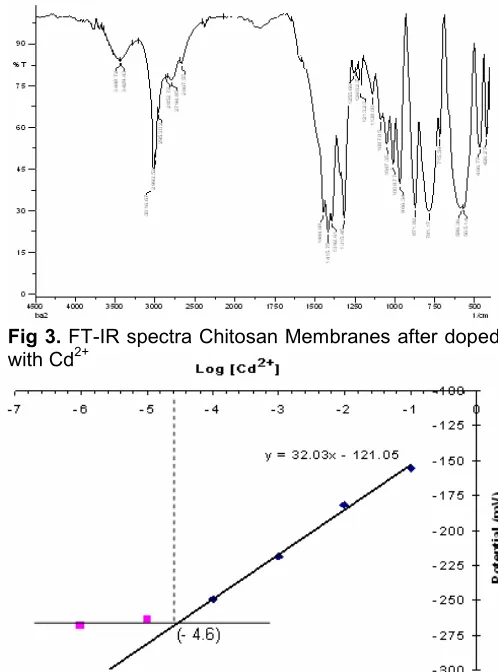
Fig 3.FT-IR spectra Chitosan Membranes after doped with Cd2+
Fig 4. Determination of Nernstian factor and Detection limit of ISE Cd2+
Immersion of metal ions to chitosan membrane can increase the conductivity value of membranes. The optimum dopant concentration is 1.0 M Cd2+ with the conductivity value is 549.45 ohm-1m-1. In this state the resistivity of the membrane decreased to the minimum value and increased membrane conductivity. The aim of conductivity measurement is to determine the optimum concentration of dopants, because the optimum concentration for each metal were added to the membrane are specific, and can be distinguished from the other metals [10].
Measurement of the Functional Groups Chitosan Membranes
There are two possibilities Cd2+ ion binds to the chitosan membrane is through the amine groups or amine and acetylamide groups or both [13]. Metal ion dopants provide special characteristics to form a complex with chitosan [8].
From FT-IR spectra in Fig. 2 prior to membrane before doped with Cd2+ showed that the N-H stretch of
secondary amine (acetylamide group) at the wavelength 1652.85 cm-1 and N-H stretch of the primary amine at the wavelength 1589.34 cm-1.
Fig. 3, the membrane after doped with Cd2+ showed peaks indicate the presence of N-H acetylamide and N-H stretch of primary amines group does not appear. While the peak of OH- group at wavelength number ~3400 cm-1 decrease in intensity. This is made possible that the N and O atoms are the amine ligands and hydroxide will form a complex compounds bond with Cd2+ ions which are electropositive, by donating its lone pairs electron, the N-H bond become weakness and its peak did not reappear. From FT-IR spectral data above is known that Cd2+ ions form a complex with chitosan through primary amine groups, acetylamide groups and hydroxy groups.
Nernstian Factor and Detection Limits
mV. In this research the detection limit is an extrapolation of the curve point log concentration (M) against potential (mV). From the curve extrapolated point value is -4.6, the detection limit value is -log -4.6 equal to 2.512 x 10⁻⁵M, as shown in Fig. 4.
Influence of pH
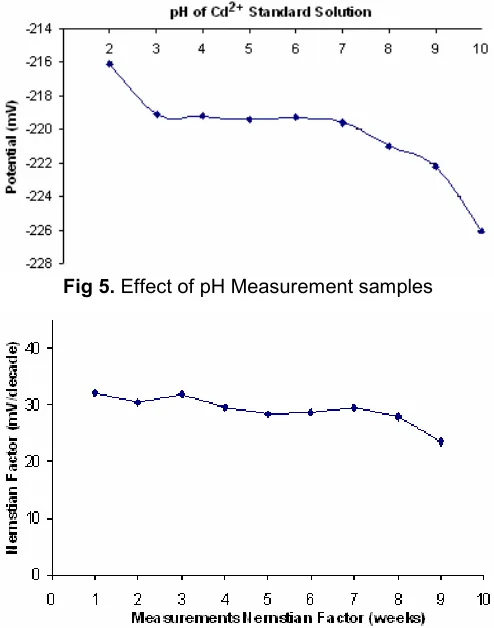
The effect of pH on the potentials of the proposed sensor was studied over pH range 2.0–10.0 at 1.0×10⁻³ M Cd2+ concentration after adjusting the pH of the solutions with HNO3 and NaOH. The measurement results are shown in Fig. 5.
In Fig. 5 shows, it is clear that the potential remained constant in the pH range 3.0–7.0, which can be taken as the working pH range of the proposed ISE. Above pH 7 and below pH 3, a sharp change in potential may be attributed to the hydrolysis of Cd2+ become Cd(OH)2 and disruption of H
+
ions from the test solution, respectively [14].
Response Time
The determination of the response time based on the provisions of international is the time required to reach 1 mV of final equilibrium potential after a sudden change in the primary ion activity [15]. The results were obtained response time measurement range 15-45 sec, the higher concentration of test solution the faster the response time. Agitation rate for each time the measurement should be constant. Different stirring speeds will give different response times, but the stirring speed is too high also interfering the measurement, because the magnetic stirrer hit the surface of the membrane.
Life Time
The life time of ESI Cd2+ is determined by measuring the Nernstian factor value changes for every week. Nernstian factor values are measured each week are shown in Fig. 6.
Fig 5.Effect of pH Measurement samples
Fig 6.Nernstian factor value changes from ESI Cd2+for every weeks
From Fig. 6, Nernstian factor value obtained at 8-week was 27.95 mV/decade, while at 9-8-week, the Nernstian factor value have dropped dramatically become 23.50 mV/decade, assumed ISE Cd2+ is no capable use for analysis. Electrode can be used only during the life time of 8-weeks. This is influenced by the aging process on the membrane resulted swelling both in the chitosan or the PVC as a matrix, and reduce the sensitivity of ISE showed by the decrease of the Nernstian factor value.
Effect of Ion Interfere
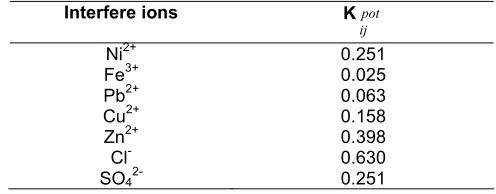
Table 1.The selectivity of coefficient value of ISE Cd2+ for interfere ions
Interfere ions Kpot
ij
For the interfere ion Ni2+ obtained the selectivity coefficient value ISE Cd2+ was 0.251. The value indicates the ISE Cd2+25.1 times more selective against the major ions Cd2+ compared with Ni2+ ion. The selectivity of coefficients value showed ESI Cd2+ which made did not interfere with presence Ni2+ion at 10-3M in the standard solution.
The same calculations done also for interfere ions Fe3+, Pb2+, Cu2+, Zn2+, Cl-, SO4
2-and obtained the selectivity of coefficient value as shown in Table 1.
Interfere ions Ni2+, Fe3+, Pb2+, Cu2+, Zn2+, Cl-and SO4
2-up to a concentration of 10-3 M did not provide responses that interfere with the measurement of Cd2+. ISE Cd2+- chitosan more selective than ISE from glass-CdS-AgI Sb2S3, this ESI is not selective for the ions Pb
2+
and Cu2+ions [17].
CONCLUSION
The optimum concentration of dopant solution Cd2+ on the membrane ISE Cd2+-chitosan with a composition ratio of chitosan:PVC:DOPP (6:3:1) was 1.0 M at conductivity value was 549.45 ohm-1 m-1. The measurement of the several parameters electrode characteristic very good, shown by the Nernstian factor value was 32.03 mV/decade, with a detection limit are 2.512 x 10⁻⁵M. The electrodes work in the pH range 3– 7. The life time of the electrode was 8 weeks. The ions of Ni2+, Fe3+, Pb2+, Cu2+, Zn2+, Cl-, and SO4
2-toward concentration range 10-3 M was not interfere in the determination of Cd2+ion.
REFERENCES
1. Moody, G.J., Saad, B.B., and Thomas, J.D.R., 1998,Sel. Electrode Rev., 10, 71–78.
2. Edmonds, T.E., 1988, Chemical Sensors. Blackie and Sons, New York.
3. Buhlmann, P., Pretsch, E., and Bakker, E., 1998, Chem. Rev., 98, 1593–1687.
4. Cobben, P.L., Egberink, J.G., Bomer, P., Bergveld, W., Verboom, D., and Reinhoudt, N., 1992, J. Am. Chem. Soc., 144, 10573–10582.
5. Kamisah, H.J.A., Sukiman, S., and Fauzi, A., 1989, Prosiding Simposium Kimia Analisis Kebangsaan Malaysia ke-3, Jilid I, 289–294.
6. Hassan, Z.A., Saime, W.N., and Sulaiman, A.G., 1996,Malays. J. Anal. Sci., 2, 1, 105–113.
7. Subban, R.H.Y., Yahya, A.H., and Arof, A.K., 1996, Malays. J. Anal. Sci., 2, 1, 123–128.
8. Muzzarelli, R.A.A., 1977, Chitin, Pergamon Press, Oxford.
9. Lozano, B.C., Comnelis, C.H., and Battisti, A., 1996,J. Appl. Electrochim., 26, 83–89.
10. Yang, X., Johnson, S., Shi, J., Holsinger, T., and Swanson, B., 1997,Sens. Actuators, B, 45, 87–92. 11. Florence, M.T., 1971, Ion-selective Electrodes,
Procceeding of electrochemistry the Royal Australia Chemical Institute, 261–269.
12. Panggabean, A.S., 2003, Jurnal Kimia Mulawarman, 1, 1, 27–30.
13. Ogawa, K., Oka, K., Miyanishi, T., and Hirano, S., 1984, X-ray Diffraction Study on Chitosan-metal Complex, Academic Press, New York.
14. Gupta, V.K., Jain, A.K., Kumar, P, Agarwal, S., and Maheshwari, G., 2006, Sens. Actuators, B, 113, 182–186.
15. Bailey, P.L., 1976, Analysis with Ion Selective Electrodes, Heyden and Sons, New York.
16. Zamani, H.A., Rajabzadeh, G., and Ganjali, M.R., 2006,Sens. Actuators, B, 119, 41–46.