THE POTENTIOMETRIC UREA BIOSENSOR USING CHITOSAN MEMBRANE
Ani Mulyasuryani
*, Anna Roosdiana, and Arie Srihardyastutie
Chemistry Department, Brawijaya University Jalan Veteran, MalangReceived February 22, 2010; Accepted May 25, 2010
ABSTRACT
Potentiometric urea biosensor development is based on urea hydrolysis by urease resulted CO2. The
biosensor is used chitosan membrane and the H3O +
electrode as a transducer. The research was studied of effecting pH and membrane thickness to the biosensor performance. The best biosensor performance resulted at pH 7.3 and membrane thickness of 0.2 mm. The biosensor has a Nerntian factor of 28.47 mV/decade; the concentration range is 0.1 up to 6.00 ppm; and the limit of detection is 0.073 ppm. The response time of this biosensor is 280 seconds, efficiency 32 samples and accuracy 94% up to 99%.
Keywords:biosensor, potentiometry, urea, chitosan membrane
INTRODUCTION
The detection of urea is of great interest in biomedical and clinical analysis application. Indeed, an interest of urea concentration in blood and a reduced level of urine is a strong indication of renal failure. The normal urea level in urine is between 12 up to 20 g/24 h [1]. The determination of urea is generally performed with enzyme-based biosensor. The biosensor is a device which is combining a sensor and a biochemical reaction. That constructed by three parts are bioactive, transducer, and detector. The bioactive is a molecule reacted specifically with analyze and resulted a compound or ion which is detected by transducers. Kind of electrochemical transducers are conductometry, amperometry and potentiometry [2]. Based on above explanation, the biosensor is a high selectivity device, so in this work were developed the construction of potentiometric urea biosensor.
The detection principle is based on hydrolysis of urea catalyzed by urease to product NH3and CO2[3].
urease
Generally, the potentiometric urea biosensor is developed using a NH3sensor as a transducer [4-6] and
urease immobilized on polycarbamolysulfonate [4-5], polycarbonate [7] and gelatin [8] which is NH3 selective
membranes. Based on urea hydrolysis, the construction of urea biosensor can be made using a CO2 selective
membrane and a H3O +
electrode as a transducer. It is possible, because the CO2 soluble in water to form
H2CO3which hydrolyzed to produce H3O +
and HCO3
-[9].
One of the CO2 selective membrane is chitosan,
because that has a –NH2 (amine) group, so that is
basic, moreover that easier interaction with an acid, like CO2 [10]. The chitosan membrane was used as an
enzyme immobilization media on development of biosensor potentiometric uric acid [11]. The kind of membrane is affecting to the biosensor performance, because that is affecting to urease activity. Chitosan can be made a porous membrane by adding glutaraldehyde that hoped the activity of immobilized enzyme would not change relatively [12]. Therefore, in this work we developed potentiometric biosensor urea using H3O
+
electrode as a transducer, and the chitosan membrane as urease immobilization material.
The potential cell of H3O +
electrode (were combined with external reference electrode) has a linear with the H3O
+
concentration that can see at this equation [13]:
+
cell 3
E = K + 0.0592 log H O
(5)
The CO2 from urea hydrolysis will be reacted with H2O
to form weak acid, H2CO3, and the concentration of
H3O +
is a square root of H2CO3concentration. Because
of that the equation (5) can be writing:
cell
E = K' + 0.0296 log urea (6)
chitosan membrane which effects the performance of potentiometric urea biosensor.
In these research, urease isolated from
Schizosaccharomyces pombe 3054, the free enzyme has Vm = 0.4046 μmol/min and KM = 0.2065 mM, at pH
8. The urease immobilized on chitosan membrane has Vm= 0.02μmol/min and KM= 15.94 mM, at pH 7.3. The
urea biosensor has its best performance at pH 7.3 and 0.21 mm thickness of membrane. That biosensor has a Nernstian factor of 28.40 mV/decade, range of urea concentration between 0.1 up to 6 ppm (1.7.10-6–10-4M) and limit of detection is 0.073 ppm (1.2.10-6 M). Response time of the urea biosensor is 280 sec, biosensor efficiency 32 samples and accuracy 94% up to 99%.
EXPERIMENTAL SECTION
Materials
All the chemicals were of analytical–reagent grade and all solutions were prepared with distilled water. Reagents were used from Merck, urea, chitosan, glutaraldehyde, acetic acid, phosphate buffer (7-8.5), and sodium hydroxide. Urease was isolated from
Schizosaccharomyces pombe3054 (7mg/mL).
Instrumentation
The instruments were used Schoot-Gerate pH-meter CG.820, H3O
+
glass electrode, magnetic stirrer, glass plates, and commonly glassware laboratory.
Procedure
Preparation of chitosan membranes [15]
The 0.10 g of chitosan powder is dissolved in 10 mL acetic acid 0.8% (v/v), stirred over night at room temperature. To the chitosan solution is added one drop of glutaraldehyde 1% (v/v), stirred up to 2 h. The chitosan cast on glass plates from a measured volume per surface area of 0.34 mL/cm2and dried for 1-2 h at 50 °C. The membranes were neutralized with a 1% (b/v) sodium hydroxide solution for 30 min and washed with water. The membranes were kept under water before use for enzyme immobilization.
Immobilization of Urease [11]
The membranes were dipped in a pH 4 acetic acid, washed with water and then left overnight at 4 °C, in contact with a 5 mL urease solution containing 7 mg/mL of enzyme in a pH 8.0 phosphate buffer. The next day, the membranes were washed with water kept in a pH 8.0 phosphate buffer until used.
Potential Measurement
The chitosan membranes with the immobilized urease were coated on the surface of a H3O
+
electrode. When not in use the biosensors were stored in a phosphate pH 8 buffer solution at 4 °C. The urea biosensors were immersed in phosphate buffer pH 7.3 and connected to the pH-meter (potentiometer), waited until the potentials were relatively constant. The biosensors were ready to use for potential measurement of 10-8M–10-1M urea solutions.
RESULT AND DISCUSSION
Effect of pH urea solutions
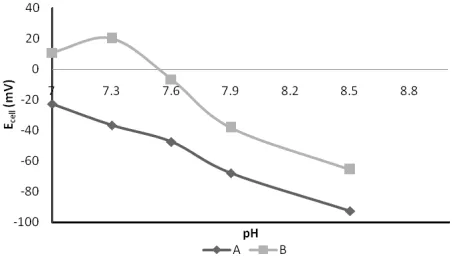
The urea biosensors were evaluated using 10-4M urea in buffer solution pH 7 up to 8.5. The cell potentials of the biosensor were compared with the cell potential of H3O
+
electrode. The cell potentials of biosensor are higher than H3O
+
electrode potential (Fig. 1). This indicates, that the produce of urea hydrolysis that are diffused to the transducer surface, is CO2. The
CO2is easier to diffuse than NH3, because the chitosan
membrane is basic. The NH3 from hydrolysis of urea
increases the diffusion of CO2 through the chitosan
membrane [10].
Fig 1. The cell potentials of H3O+ electrode (A) and
urea biosensor (B) at different pH for 10-4 M urea solution
Fig. 1 show the differences of cell potential at the pH 7–8.5, that is caused by the differences of enzyme activity. The highest potential difference is resulted at a pH 7.3, so that indicates the pH optimum, in that condition activity of urease immobilized is at maximum. The CO2 has highest solubility at pH 7 up to 8.5, so at
the pH 7.3 the CO2 from urea hydrolysis change
completely to form H3O +
and HCO3
-[16]. At the pH 7.3, also resulted a maximum Nernstian factor is 27.4 mV/decade (Fig. 2). Kinetically, the rate of urea hydrolysis is fastest at the pH 7.3 so the CO2production
is highest. The Nernstian factor is one of the parameter of potentiometric biosensor performance.
It can be concluded that the pH of urea solution affects the performance of urea biosensor. The maximum biosensor performance is resulted at pH 7.3. In that condition, the biosensor responds to an urea concentration between10-6M up to 10-4M (0.06–6.0 ppm), the limit of detection is 1.7.10-6M (0.1 ppm), the Nernstian factor is 27.4 mV/decade. Therefore the influence of chitosan membrane thickness to the performance of biosensor studied at pH 7.3.
Effect of chitosan membrane thickness
The results of this research show that the thickness of chitosan membrane affects the urea biosensor performance. Theoretically, the Nernstian factor has a linear correlation with the immobilized urease, however the Nernstian factors, presented in Table 1, are opposite with the theory. The best of Nernstian factor is obtained by the most thinness of membrane, 0.21 mm, with the minimum urease immobilized. The increase of enzyme density causes the decrease of the diffusion rate of CO2.
Since the CO2 reaches the transducer surface is
decreased, the biosensor sensitivity will also decrease. It can be concluded that the membrane thickness is one of the important factors to the biosensor sensitivity. The immobilized urease affects the reaction rate, but the product must be diffused to the transducer surface. The diffusion rate is opposite to the membrane thickness. The concentration of immobilized urease on the chitosan membrane is one of the significant factors in biosensor development. That can be controlled by adjusting the free enzyme concentration.
Character of Urea Biosensor
Response time is one of the important biosensor characteristic, determining the response time is obtained by 0.06; 0.1; 0.6; 1.0; and 6.0 ppm urea. The correlation of measurement time with biosensor potential is presented in Fig. 3 that show the response time depends on the concentration of urea. The response time at lower urea concentration is longer than at higher concentration.
Table1.The data correlation of the chitosan membrane thickness, the immobilized urease and the Nernstian factors.
Fig 3. The biosensor responses versus measurement time at different urea concentrations
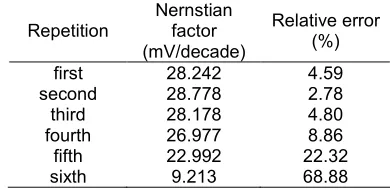
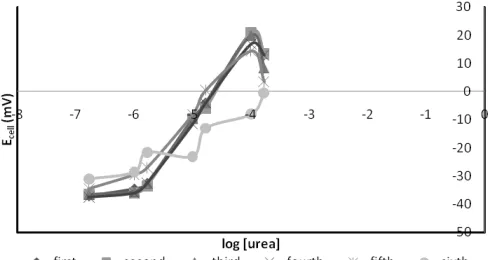
Table 2. The Nernstian factors and their relative error (%) of urea biosensor at urea solutions (0.0 ; 0.01 ; 0.06 ; 0.10 ; 0.60 ; 1.00 ; 6,00 and 10.00 ppm) with the repetition in measurement. The Nernstian factors were resulted from Fig. 4 at 0.06–6.00 ppm urea concentrations.
That is indicated kinetically, the product of CO2
depends on the urea concentration. It can be concluded, that the biosensor sensitivity is highest, when the range of urea concentration is less than KMof
immobilized urease [2,13]. The response time of urea biosensor is 280 sec.
Fig 4. The biosensor responses versus log [urea] at different time measurement
Table 3. The urea levels in urine samples are obtained from a medical laboratory compared with the urea biosensor.
Urea level in urine samples (ppm) Urea biosensor data
100 times dilution 10 times dilution Medical
Since some of the urease on the chitosan membranes was released, the diffusion rate of CO2 increases. The
detection of CO2 at the transducer is than higher at
similar urea concentration at second times measurements. The Nernstian factor decreases at third times, which is caused by a decrease of immobilized urease. Therefore the biosensor has good performance for 32 urea solutions.
Urea biosensor was used to measure urea levels in urine samples, there were compared with data from medical laboratory. Urea levels obtained by biosensor have a relative error 0.28 up to 8.15% (Table 3). The relative error at 100 times dilution is less then at 10 times dilution. It is caused by impurities in urine samples like calcium oxalate, epithel and blood cell [17], which hinders the porosity of the membranes, therefore the interaction of urea with enzyme was decreased. Impurities concentrations are less at the dilution 100 than 10 times. The relative error is different for all samples, depending on concentration and type of impurities. The impurities can be eliminated by centrifugation or filtration of samples before sample measurement.
CONCLUSION
Potentiometric urea biosensor can be made using [H3O
+
] electrode as a transducer and chitosan membrane as a urease immobilization material. The
result of research is that the performance of the biosensor is affected by the pH and thickness of chitosan membrane. The best biosensor performance is obtained at pH 7.3 and 0.21 mm of membrane thickness. The character of biosensor is 28.40 mV/decade of Nernstian factor, range of urea concentration is 0.1 up to 6.0 ppm and limit of detection is 0.073 ppm. The response time of urea biosensor is 280 sec, biosensor efficiency for measure of 32 samples and accuracy is 94–99%.
ACKNOWLEDGEMENT
Melati Husada laboratory Malang is acknowledged for the urine samples and their urea analytical results.
REFERENCES
1. Bennington, J.L., 1984, Dictionary and
Encyclopedia of Laboratory Medicine and
Technology, W.B. Saunders Co., Philadelphia. 2. Egins, B.R., 2002, Chemical Sensors and
Biosensors, John Wiley & Sons, LTD, Singapore. 3. Chaplin, M., 2004, Potentiometric Biosensors,
Faculty of Engineering, Science and The Built Environment, South Bank University, London. 4. Wang, Y., Xu, H., Zhang, J., and Li, G., 2008,
Sensors,8,2043–2081.
5. Eggenstein, C., Borchardt, M., Diekmann, C., Gründig, B., Dumschat, C., Cammann, K., Knoll, M., and Spener, F., 1999,Biosens. Bioelectron,14, 33–41.
6. Pijanowska, D.G., Dawgul, M., and Torbich, W., 2003,Sensors, 3, 160–165.
7. Grieshaber, D., MacKenzie, R., Vörös, J., and Reimhult, E., 2008, Sensors, 8, 1400–1458.
8. Yahya, P.K.I., Julianto, A., Mulyasuryani, A., and Roosdiana, A., 2007, International Conference on Chemistry, UGM, Yogyakarta, Indonesia.
9. Carroll, J.J., and Mather, A.E., 1992, J. Solution Chem., 21, 607–621.
10. Ito, A., Sato, M., and Anma, T., 1997, Permeability of CO2 Through Chitosan Membrane Swollen by
Water Vapor in Feed Gas, Department of Material and Chemical Engineering, Niigata University, Japan.
11. Mulyasuryani, A., Roosdiana, A., Sutrisno, and Srihardyastutie, A., 2008, The 2nd Penang International Conference for Young Chemists, Penang, Malaysia.
12. Krajewska, B., Leszko, M., and Zaborska, W., 1990, Urease Immobilized on Chitosan Membrane:
Preparation and Properties,
13. Wang, J., 2001, Analytical Electrochemistry, 2rd ed., VCH Publisher, Inc., 133.
14. Gu, Z.Y., Xue, and Li,, 2001,Polym. Adv. Tech., 53, 665-669.
15. Magalhães, J.M.C.S., and Machado, A.A.S.C., 2002, Analyst, 127, 1400–1458.