Climate change vulnerability
assessments in Indonesia
Where are the women’s perspectives?
About the authors
Sarah Dougherty is a graduate of Cornell University's City and Regional Planning program and international development researcher based in Washington D.C.
John Taylor is the co-founder and director of the Indonesian NGo Kota Kita. Email [email protected]. Rizqa Hidayani is an urban planner and Assistant Director for Kota Kita.
Dati Fatimah is a researcher, consultant and NGo activist for gender, social protection as well as disaster risk reduction and climate change based in Jogjakarta, Indonesia.
Acknowledgements
We would like to thank the many communities who have informed and contributed to our work on social advocacy and climate change adaptation. We are also grateful to workshop participants and interviewees from communities, universities,
city-government, and civil society groups who contributed to this speciic project. Finally, we acknowledge that ‘gender dimensions’ and ‘urban resilience’ are vast areas of inquiry, and that our research humbly aims to explore a tiny fraction of
Abstract
Indonesian cities are increasingly invested in efforts to build urban resilience, and
inding means of resisting, absorbing and recovering from climate change hazards.
Despite growing evidence that women, especially in poorer populations, suffer
disproportionately from climate change hazards, there are inadequate data and methods
for prioritising women’s perspectives in city-level resiliency initiatives. The Indonesian
NGo Kota Kita analysed its United Nations Development Programme (UNDP)-based
methodology for climate change vulnerability assessments (CCVAs) by conducting
research in three key areas:
■
■
How its CCVA process can better assess women’s climate vulnerability for urban
planning efforts;
■
■
The importance of using a gender lens for resiliency planning; and
■
■
making observations on several key gender-focused resiliency efforts in Indonesia.
Acronyms
ACCCRN Asian Cities Climate Change Resilience Network AIFDR The Australia–Indonesia Facility for Disaster Reduction
BAPPEDA Badan Perencanaan Pembangunan Daerah (City Development Agency)
BAPPENAS Badan Perencanaan Pembangunan Nasional(Indonesian ministry of National Development Planning) BLHD Badan Lingkungan Hidup Daerah (City Environment Agency)
BMKG Badan Meteorologi dan Geoisika (Meteorological and Geophysics Agency)
BPBD Badan Penanggulangan Bencana Daerah (City Board for Disaster management) CCVA Climate Change Vulnerability Assessment
DPRTR Dinas Perumahan Rakyat dan Tata Ruang (Housing and Spatial Planning Agency) FEWS Flood Early Warning System
FGD Focus Group Discussion
IPCC Intergovernmental Panel on Climate Change
IUCCE Initiative for Urban Climate Change and Environment PoKJA Kelompok Kerja (City Working Group)
Contents
About the authors 2
Acknowledgements 2
Abstract 3
Acronyms 4
1 Introduction 6
1.1 Background 6
1.2 The importance of gender-based climate change adaptation 7
1.3 Research questions 9
1.4 Research indings 9
2 Literature review 10
2.1 overview 10
2.2 Evolution of gender and development theory 11 2.3 International development’s impact on gender-based climate change planning in Indonesia 12 2.4 Barriers to women’s participation in Indonesia 12 2.5 Current gender-based climate change vulnerability assessment tools 13
3 Methodology 16
4 Findings 18
4.1 Women’s participation in CCVA processes is low 18 4.2 Limitations of current data concerning credibility, accessibility and applicability 21 4.3 Government capacity for using CCVA data is limited 22
5 Recommendations 26
6 Conclusions 30
References 31
1 Introduction
1.1 Background
Southeast Asia is the second-most vulnerable region to climate change after South Asia (IPCC, 2014). This is due to the direct effects of climate hazards such as sea-level rise and the indirect effects of poverty, disease, food insecurity and, perhaps most fundamentally, increased gender inequality. As a nation comprising more than 17,000 islands, Indonesia is particularly at risk to climate change effects. most of Indonesia’s population, industries, infrastructure and agricultural lands are concentrated along low-lying coastal areas, and 60 per cent of Indonesians live in coastal cities (UNDP, 2016). The growing focus on women in the global climate change discussion originated from the idea that patriarchal powers control the world’s resources, which oppresses both the environment and marginalised populations. much like the debate on whether climate change is a natural phenomenon or manmade has passed, the debate on whether women are disproportionately affected by climate change has become obsolete. However, using a gender lens to build urban-resilience is not simply about prioritising women’s needs over men’s; by understanding climate change impacts through marginalised women’s perspectives, practitioners more accurately confront latent societal challenges that threaten progress towards a truly resilient city. Thus, the more relevant and urgent question is how best to align institutional provision of short-term disaster relief and long-term urban resiliency planning to address fundamental gender – and therefore societal – discrepancies and grant equal opportunities to men, women and other marginalised groups.
Addressing this question requires the fundamental ‘transfer of knowledge to action’ as deined by the planning theorist
John Friedmann (1987) in light of new climate change challenges and their varying impacts on women and men. Climate
change adaptation requires planners, as Kieran Donaghy (2011) writes, to ‘[understand] adequately and [respond]
appropriately’. Responding one step further with a gender lens begins with measuring the differentiated impacts of climate change on men and women through deeply effective participatory methods.
Unfortunately, despite the growing number of gender-responsive handbooks, teaching guides, toolkits and manuals, there is a lack of discussion about the effectiveness of these tools. Academics and practitioners understand that a rigorous
participatory approach is needed to address systemic gender inequality in Indonesian cities, yet relection on methods for
1.2 The importance of gender-based climate change
adaptation
The Indonesian NGo Kota Kita recognised there was a critical need to improve its methods for collecting gender-disaggregated climate change data while conducting a series of CCVA workshops in three rapidly growing mid-sized
Indonesian cities: Manado, Makassar and Kupang. Kota Kita supports planning processes in urban areas with a speciic
focus on ensuring inclusive citizen participation. Its methodology is distinct because it has an emphasis on using visual tools, such as GIS maps, to help communities that have less technical resources to advocate for their needs in formal planning processes.
Kota Kita’s approach is designed to facilitate engagement for a wide variety of people, often not from technical
backgrounds, in discussions of planning issues as a way to open up and democratise urban planning policy. This is relevant to climate change adaptation planning because local knowledge needs to be harnessed through deep citizen participation to yield the most effective adaptation and mitigation strategies. Participatory processes to develop these strategies are more likely to meet local needs and have sustained impact on communities. Developing a participatory process that maximises its potential to affect change requires critical foresight, constant feedback and dedication to improvement.
Kota Kita developed its participatory CCVA methodology to assess climate change vulnerability with the UNDP, which
also funded Kota Kita’s previous three CCVA processes. This methodology uses the UN’s standard formula to deine
vulnerability (IPCC, 2014), which is: Exposure x Sensitivity Vulnerability = Adaptive Capacity
This methodology focuses on quantiiable indicators to calculate vulnerability. While there are other CCVA methods
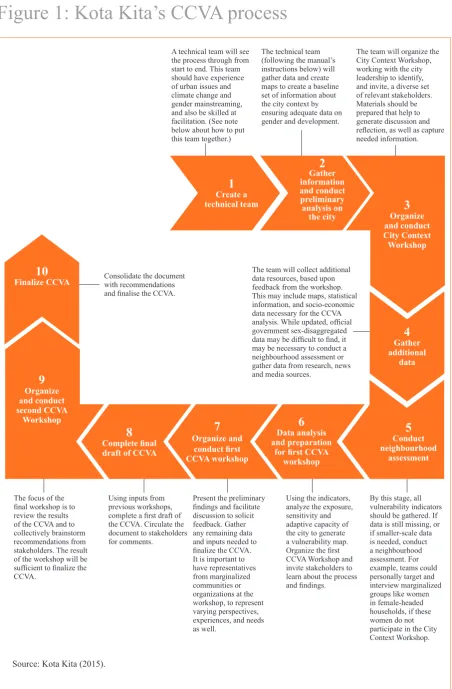
Figure 1: Kota Kita’s CCVA process
of the workshop will besuficient to inalize the
CCVA.
A technical team will see the process through from start to end. This team should have experience of urban issues and climate change and gender mainstreaming, and also be skilled at facilitation. (See note below about how to put this team together.)
Using inputs from previous workshops,
complete a irst draft of
the CCVA. Circulate the data is still missing, or if smaller-scale data
The team will collect additional data resources, based upon feedback from the workshop. This may include maps, statistical information, and socio-economic data necessary for the CCVA
analysis. While updated, oficial
government sex-disaggregated
data may be dificult to ind, it
may be necessary to conduct a neighbourhood assessment or gather data from research, news and media sources. maps to create a baseline set of information about the city context by ensuring adequate data on gender and development.
The team will organize the City Context Workshop, working with the city leadership to identify, and invite, a diverse set of relevant stakeholders. materials should be prepared that help to generate discussion and
relection, as well as capture
1.3 Research questions
Our research sought to address the task of ‘examining the extent to which gender dimensions have been, or should be,
considered in the process of assessing vulnerability, developing city resilience strategies, and implementing resilience-building initiatives at the city level’. We addressed this question using Kota Kita’s CCVA process as a focal point, and conducted primary and secondary research between September 2015 and January 2016 to better understand how to
improve the CCVA’s gender approach. Our speciic questions fall into three areas: 1) how to improve the gender focus of Kota Kita’s CCVA, 2) how does Kota Kita’s CCVA it into international and national development contexts, and 3) what
are the challenges to collecting and implementing data if we wish to create more effective gender-mainstreamed climate change policies at the city level?
1.4 Research indings
Three main indings emerged. First, we found that women’s overall participation in both the CCVA process and in
government planning sectors is low. We found that most people are aware that gender issues are important in climate change planning, but that there are still cultural and political challenges to effective gender-mainstreaming. Second, available data that supports a gender-based analysis, and planning efforts, is inadequate. This relates to both a lack of gender-disaggregated data as well as qualitative data. Third, institutions do not have the capacity to effectively use CCVA data to gender-mainstream climate change initiatives. While our research mostly focused on representing women’s perspectives in our own CCVA process rather than other institutional adaptation initiatives, we observed that even the most advanced, well-supported climate initiatives in Central Java – Semarang’s 100 Resilient Cities and mercy Corps1 – still
face challenges in effective gender-mainstreaming, and that such community-driven initiatives require further research.
2 Literature review
The purpose of our literature review is threefold. First, to establish a fundamental understanding of gender-focused environmental development within a global context, and to analyse how international actors affect Indonesian
gender-based climate change planning. Second, to understand factors inluencing women’s participation in Indonesia and possible implications of increasing women’s involvement in formal planning processes. Third, to ind out what gender-based
climate change vulnerability assessment tools currently exist and how they might be improved.
It may seem too broad to start with a global theoretical framework for understanding gender in environmental development and to then move towards a narrower focus on improving gender-based CCVA methodologies for
practitioners building urban resiliency in Indonesia, but understanding gender’s ebb and low in global development
is crucial for Indonesian planners. This is because notions of resiliency and gender equity are increasingly framed and supported by global actors. It may also be helpful for practitioners in NGos and local government working with international organisations to understand global precedents for improved gender-based CCVA tools and data.
2.1 overview
The linkages among gender, climate change and cities are well documented, especially in developing countries experiencing extreme climate change effects (UNDP-UNEP, 2011). But much of this discussion concerns the reasons why it is important to gender-mainstream climate change initiatives, not how frameworks for analysing gender-focused climate change adaptation methodologies can be improved. There is also increasing discussion about the lack of gender-disaggregated climate change data in development, but participatory methods for acquiring and using that data are still underrepresented in the literature we studied.
These results seem surprising given the prevalence of gender-focused handbooks, manuals and toolkits. CARE International is one notable exception, which we will discuss more thoroughly later in this review. Since 2009, CARE
has supplemented its ‘Gender and Inclusion Toolbox’ with gender-sensitive Climate Vulnerability and Capacity Analysis
(CVCA) resources that provide gender-focused frameworks for analysing vulnerability assessment tools (CARE International, 2014). By providing both a CVCA methodology and a tool for evaluating that methodology in practice,
CARE allows stakeholders to engage in a dynamic process for collecting gender-speciic climate change data. Not only
does this provide better data for government, it more effectively serves communities by allowing them to provide feedback on CARE’s CVCA impacts.
our literature review found that there is a lack of discussion directly critiquing gender-based tools for assessing climate
change and contextualizing the problem for practitioners within the ield of global environmental development. But it is worth noting that most of the literature identiied has a global emphasis and is not focused on Indonesia. The irst section
of this report provides the theoretical foundations of gender in development and its evolution towards gender-based climate change adaptation. The second section connects the role of international development to national gender-focused climate change initiatives, which helped frame our research in Semarang with 100 Resilient Cities, mercy Corps, and The Australia–Indonesia Facility for Disaster Reduction (AIFDR). The third section discusses issues relating to women’s participation in Indonesian informal and formal development processes in order to contextualise these theories within our region of practice. The fourth section explores the availability of existing gender-based CCVAs, focusing on CARE International’s precedent for improved methodologies. Finally, we highlight the possible consequences of a lack of
gender-focused climate change assessment tools. This inal section may be most useful for Indonesian resilience practitioners and
hopefully bridges the literature reviewed with our methodology for primary research.
2.2 Evolution of gender and development theory
Bradshaw and Linneker’s Gender and Environmental Change in the Developing World (2014) provided our framework for reviewing literature on the evolution of gender and development theory. Their review helped us make theoretical connections to local efforts as we constructed our interview questions, especially with 100 Resilient Cities in Semarang and with the AIFDR.
The beginning of gender-focused development is most commonly attributed to the Women in Development (WID)
movement, which focused on granting women’s ‘practical gender needs’ such as education, access to water, and health
(Bradshaw and Linneker, 2014). But critics of WID felt that the approach focused too narrowly on women and that a more holistic approach tackling systemic gender discrimination was needed. The Gender and Development (GAD) approach that followed sought to make these changes, targeting land rights policies as focal points for shifting power from entrenched patriarchal systems (Bradshaw and Linneker, 2014).
As WID and GAD became more established, critiques of gender and development emerged. Bradshaw and Linneker (2014) point out a robust literature emerging from these early movements, and Ester Boserup’s (1970) work on women’s roles in neoliberalism, including notable critics such as merchant (1980), Shiva (1988), Leach (1994). Bradshaw and Linneker also connect the rise of ecofeminists in the late 1970s (mies, 1986; merchant, 1980) with concern that male-dominated forces of neoliberalism and globalisation were the same forces responsible for environmental degradation and unequal control of the world’s natural resources.
By the 1990s, the World Bank had appropriated ecofeminism in its win-win approach to gender and environmental development, capitalising on the idea that women have a natural facility with the environment and should be responsible for implementing their own development strategies (Bradshaw and Linneker, 2014). Leach (1994) suggested that WED critiques should move beyond narrowly showing women as victims, but use frameworks that link political, economic and social forces to gender-based development instead. Bradshaw and Linneker (2014) attribute Resurreccion and Elmhirst’s
(2008) ‘New Feminist Political Ecology’ school of thought as the current paradigm for gender-focused development.
Focusing on sociological linkages has also dovetailed with literature on gender, globalisation and urbanisation (Sassen, 1991), and gender, environment and development in the developing world (Shiva, 1988).
Until recently, gender has been largely ignored in the climate change debate. Bradshaw and Linneker (2014) attribute some of this notable new literature to okali and Naess (2013), Alston and Whittenbury (2013), Cela et al. (2013), Dankelman (2010). Loudres Benería et al. (2015) has also written on this topic. Bradshaw and Linneker also point to
MacGregor (2010) and Denton (2004) as noting that the ‘strange silence’ on gender and climate change may be due to climate change’s ‘scientiic focus’ (MacGregor, 2010) and ‘transboundary nature’ (Resurreccion, 2012) of the problems. Bradshaw and Linneker (2014) further point out that gender emerged earlier in the disaster planning ield (Rivers, 1982)
meyreles, 2004) and of reconstructing sexual identities and orientation post-disaster (overton, 2014). But the general
lack of literature on the lack of gender-disaggregated data in both climate change and DDR ields remains a challenge
for practitioners.
2.3 International development’s impact on
gender-based climate change planning in Indonesia
Reviewing the literature on the history of gender in development helped establish initial parameters for our research in
Indonesia. It was especially illustrative of how international aid affects national initiatives. Our primary research afirmed
this, because it became clear that community-driven development demands are increasingly supplied through gender-based climate change initiatives from a host of international institutions in Indonesia. Actors such as the UNDP, AIFDR and the Rockefeller Foundation are integrally linked support networks for local actors working on gender-focused resiliency projects in Indonesian cities and other low-lying countries severely affected by climate change. For example, the Flood Early Warning System project designed for the Bringin River Basin in Semarang was designed by mercy Corps and funded by the Rockefeller Foundation in 2012. The goal is to build capacity and transition the program to BPBD (Disaster management Agency of Semarang City) and PSDA (the Water Resources management Agency) to sustain the project at both the community level and government level (ACCCRN, 2016).
The impact of international development is especially felt in terms of foreign direct investment (FDI) in Indonesian
development projects. In 2012, Indonesia received the second-most FDI funding (after India) aimed speciically at
participatory climate change development, including US$6.7 million on these adaptation projects alone (Gray, 2012). While the majority of FDI to date has been directed at mitigation strategies, it is important to acknowledge Indonesia’s interest in sustainable economic development and commitment to reducing greenhouse gas emissions by 26 per cent by 2020 and introduce how gender-focused adaptation strategies are critical for building truly resilient cities (ministry of
Finance, 2012). Harnessing this type of investment for adaptation-speciic programs may become even more relevant for
practitioners in the future.
The ministry of Finance’s 2012 publication Indonesia’s First Mitigation Fiscal Framework provided one of the more
comprehensive assessments of how gender mainstreaming its into coordinated national climate change initiatives. The
2012 mitigation Fiscal Framework (mFF) explains the role of the Indonesian ministry of National Development Planning (Badan Perencanaan Pembangunan Nasional/ BAPPENAS) in issuing the National Gender mainstreaming Program (Pengarus Utamaan Gender/PUG). PUG is primarily implemented through the Planning Gender Responsive Budget (Perencanaan Penganggaran Responsif Gender/PPRG), which provides guidelines for allocating budgets speciically for gender and climate change focused projects. While the effectiveness of these programs is outside the scope of our research, women’s participatory budgeting is an important dimension of gender-focused resiliency in Indonesia and should
be explored further – especially in Aceh, where the irst extensive participatory processes for women, elderly and disabled
populations is to be implemented in 2017 (Fatimah, 2015).
2.4 Barriers to women’s participation in Indonesia
Another dimension of climate change and gender planning concerns women’s participation in both community-driven
development and national policymaking. The literature reviewed covers factors that inluence women’s participation
in community development in Indonesia and the debates around increasing women’s participation in the creation and
Another important debate on women’s involvement in climate change planning concerns the scale of governance at which women participate. For example, Conell and Pearse (2009) suggests that the global increase in female presidents with devolution and globalisation suggests that women’s new-found political power is tokenism rather than a result of integration into the dominant, decentralised neoliberal system.
While there is little literature available regarding barriers to women’s participation in formal governance in Indonesia, there is more research on women’s ability to participate in community-driven development. Beard et al’s (2007) study from the RAND Indonesian Family Life Survey (IFLS) found that female-headed households are not as socially excluded from community development as expected given that most literature pits female-headed households as the most socially marginalised societal groups. This may be due to the fact the study controlled for poverty in the analysis, and to the large percentage (57.8 per cent) of widowed female heads of households found in lower-income urban communities, or kampungs. These widows may be allowed to participate because power-holders realise they are the only available household representatives. The study also found that lack of formal education decreases women’s participation more than it does men’s, and that there is a greater proportion of women who have not been educated beyond primary school level, if they even achieved that, than men. This study is important because it demonstrates the gender nuances in community-level indicators, and the ways in which gender exclusion is often reinforced through community development.
Another important gender nuance in community-level development concerns the difference between urban and rural development. Central Java is the most densely populated, modern region in Indonesia, while eastern Indonesia is more rural and faces harsher, drier climate conditions. Gender norms also differ regionally, and in cities compared with rural areas. While our research primarily focuses on urban factors, rapid urbanisation increases pressures, such as migration, linking urban and rural populations. Silvey (2000) analysed how increased female participation in peri-urban workforces
outside Ujung Pandang, South Sulawesi, has changed perceptions of ‘gendered morality’ in cities – particularly in terms of
women occupying previously male-dominated public spaces.
Addressing these complex factors impeding women’s and marginalised groups’ participation in development is dificult
for any city. Historically, Indonesia has made considerably strong participatory development efforts, most famously with the World Bank-funded Kampung Improvement Program (KIP) initiated by Jakarta’s city government in 1969. At that time, 75 per cent of Jakarta’s population lived in extreme poverty, forcing the city to provide housing and basic services
quickly and economically (Schübeler, 1996). KIP was designed as a ‘government-assisted, self-help community planning
programme,’ and became increasingly participatory over time (Aga Khan Development Network, 2007; Schübeler, 1996). While KIP’s early phases focused on housing and infrastructure, later phases focused more on economic and social empowerment. Critics of KIP’s gender focus often point to the program’s reliance on self-help strategies that disproportionately burdened women. Silvey and Elmhirst (2003) critique how women are especially short-changed by social capital initiatives such as KIP despite their participatory mechanisms. Beard et al.’s (2007) research also suggests that participatory development can reinforce patterns of gender exclusion, especially for women with lower levels of formal education.
2.5 Current gender-based climate change vulnerability
assessment tools
The primary critique of gender-based development is that it fails to adhere to gender-mainstreaming frameworks that
prioritise gender in every step of the planning process. Tadros (2010) refers to this as the ‘add gender and stir’ approach
As previously mentioned, CARE International’s Climate and Capacity Analysis (2009) sets a precedent for sensitive climate change assessment tools. It is unique in its inclusion of both toolkits for practitioners running gender-sensitive climate change vulnerability assessments as well as analytical frameworks for monitoring the tools’ impact. To date, CARE has a comprehensive gender-based adaptation set of tools covering areas of disaster risk reduction, community based adaptation, community visioning, using indigenous knowledge in community based planning, and
participatory monitoring, evaluation, relection and learning (CARE Climate Change Website, 2016).
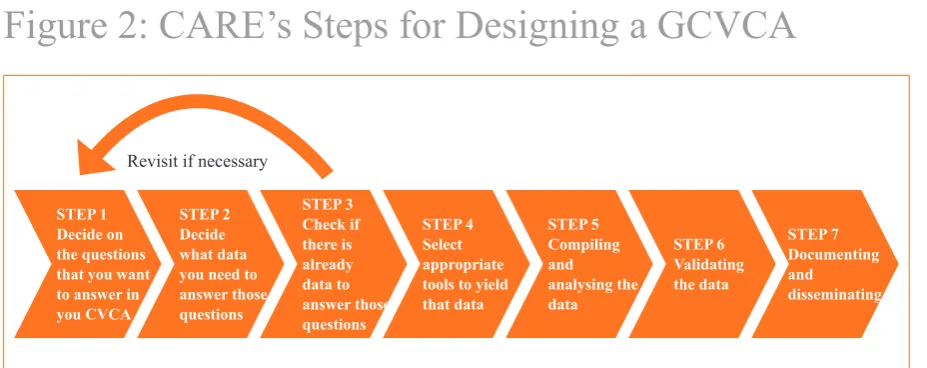
For this research, the most valuable part of CARE’s gender-based climate change tools is the Practitioner’s Guide to the Gender Sensitive Climate Vulnerability and Capacity Analysis (GCVCA). This guide, published in 2014, provides a robust framework that can be used as a point of comparison for Kota Kita’s Manual for Gender-Responsive Climate Change Vulnerability Assessments (2015). Compared with Kota Kita’s manual, which focuses more on how to collect city-level
empirical data, CARE’s steps for designing a GCVCA (Figure 2) focus more extensively on how to use speciic tools to
collect qualitative, gender-sensitive data.
Figure 2: CARE’s Steps for Designing a GCVCA
STEP 1
Source: CARE International Poverty, Environment and Climate Change Network (2014)
The section that may be most relevant for improving Kota Kita’s methodology concerns Step 4 in CARE’s schematic
(Figure 2) Selecting Appropriate Tools to Yield Data. It instructs users to ‘select appropriate tools to help you explore your questions… [including] transect walks, historical timelines, resource maps, seasonal calendars, daily time budgets,
Venn Diagrams, gender analysis, wealth rankings’ (CARE, 2010). Each tool is later explained in depth with recommended time limits, group sizes and participant characteristics, and context notes for when to use it in the GCVCA process. It also relates these tools back to a matrix that provides guiding questions for the GCVCA for local level planning (CARE, 2016).
Each tool links to a speciic question in the matrix, so that a speciic, gender-sensitive method is assigned to each research
question. Kota Kita used a similar strategy in our focus group discussion (FGD) framework shared later in the paper.
Other useful gender-based methods raised in CARE’s practitioner guide are ieldwork note-taking and instructions for
transcribing data (CARE, 2014. Instructions for transcribing visual data, including mapping, Venn diagrams and calendar wheels were particularly useful in our primary research and could help to support improvements to Kota Kita’s approach.
Another consideration from CARE’s guide is its more overt discussion of gender and ‘control over one’s body’ (Figure
Figure 3: CARE’s overt discussion of gender and
‘control over one’s body’
B.4 Control over one’s body To which degree are women, men, boys and girls in control over their own bodies and sexuality, decisions on marriage, family planning and freedom from abuse and exploitation?
What factors affect decisions over marital status, marital partner or family planning? What threats jeopardise women’s, men’s, boys’ or girls’ control over their bodies, and what factors drive these risks?
Have there been any changes in these dynamics and why?
What impacts do climate variability and disasters have on this or how is climate
change and disasters inluencing women and girls’ control over their own bodies?
Source: CARE International Poverty, Environment and Climate Change Network (2014). Gender-sensitive Climate Vulnerability and Capacity Analysis (GCVCA). CARE International.
Practices of separating men and women are useful for facilitating gender-focused discussion in the short term, but it may be counterproductive in the long run. Interestingly, both CARE and Kota Kita recommend running separated FDGs for men and women to encourage women or other marginalised groups to communicate more freely. While gender-separated FDGs appear to be standard best practice in development literature from the UN, the Gender and Agriculture Research
Network (CGIAR), World Health Organisation (WHO), CARE, and other international ieldworkers, the long-term beneits and costs of separating men and women in these workshops should be explored further. For instance, women may
be more likely to speak up without men in the short-term, but the literature reviewed fails to analyse whether or not this persuades co-ed discussion of gender issues on a societal level.
While it is not speciically gender-focused, UNDP’s Toolkit for Designing Climate Change Adaptation Initiatives (2010) may be helpful for harnessing local data collection to create city-level policies. This guide provides key principles for adaptation to climate change, key components in designing adaptation in initiatives, harnessing stakeholder consensus for designing an adaptation initiative, and key tools and methodologies for designing adaptation initiatives. The second
chapter provides a table for identifying the causes for the absence of technical capacities that may be helpful in the inal
3 methodology
The literature review serves as a foundation for the design of our methodology and analysis of our data. Both our primary and secondary research was conducted between September 2015 and January 2016 in Kupang, yogyakarta, Semarang, Surabaya, and Solo, Indonesia. our methods included desk-based research and the literature review, interviews with
practitioners and government oficials, and two FGD workshops in Yogyakarta and Kupang.
We used CARE’s format for designing a research methodology (see Box 1). our strategy was to use lessons from improving the gender-focus of Kota Kita’s CCVA process as a framework for responding to IIED’s 2015 research
prompt to ‘examine the extent to which gender dimensions have been or should be considered in the process of assessing
vulnerability, developing city resilience strategies, and implementing resilience-building initiatives at the city level’. We then mapped questions and methods into three themes: improving the gender focus of Kota Kita’s CCVA, how Kota
Kita’s CCVA its into international and national development contexts, and challenges to obtaining gender and climate
change data.
The purpose of the Kupang FGD was to gather feedback about how to improve methods for identifying gender issues for
climate change planning by inding weaknesses in Kota Kita’s current CCVA methodology. In this workshop, we met with
participants of Kota Kita’s previous CCVA workshop in September of 2014. The purpose of the yogyakarta FGD was to understand broader trends in Indonesian gender-based climate change planning by discussing these issues with gender
experts, academics, international organisations and local government oficials.
The two workshops were entitled ‘Prioritising Gender Issues in Assessing Vulnerability and Climate Change Planning’. The irst one took place in Kupang in September 2015 and gathered 23 participants, 16 of whom were women. These included government oficials (from BPBD, Dinas Kebersihan dan Pertamanan, BLHD, DPRTR, DKP, and Setda), academics, NGos and community members. The second workshop took place in yogyakarta in october 2015 and brought
together 17 participants, 15 of whom were women. These included gender experts, government oficials (Sleman City Government’s BPBD), academics (Pusat Studi BencanaUGM), NGos (IDEA, SAPDA, Paluma, AIFDR, IUCCE, Aksara), and other institutions that have worked on gender issues related to disaster risk reduction or climate change projects. Finally, we conducted 11 interviews with gender and/or climate change experts from NGos, local government, mercy Corps, and 100 Resilient Cities. These interviews took place in Surabaya, yogyakarta, Solo and Semarang in December 2015. A complete list of interviewees and focus group participants can be found in the appendix. We did not include names
of these participants to protect conidentiality. We acknowledge that the sample size from our primary research presents
a limited perspective mostly from urban, central Java. The interviews also provide a limited perspective into the mercy
Corps and 100 Resilient Cities efforts, and further research on the inluence of Indonesia’s national gender-mainstreaming
Box 1: Guiding themes for Kota Kita’s research
methodology
Improving gender focus of Kota Kita’s CCVA
T
ool development
yogyakarta and Kupang FDG workshops and follow-up interviews with participants
What aspects of the current CCVA methodology do users
ind helpful or unhelpful?
This includes content substance as well as format (ie. length, graphics to text ratio, aesthetic elements)
Interview with gender experts, yogyakarta and Kupang FDG workshops
What tools can be included to make the CCVA more helpful? This includes instructions for using the tools and examples of using the tools in context
yogyakarta and Kupang FDG workshops and follow-up interviews with participants
What is missing from the current CCVA?
Are there populations that are not represented? Would some users be unable or unwilling to use this tool?
How Kota Kita’s CCVA Fits into International and National Development Contexts
Br
oader
Context
Interviews with Kota Kita staff, yogyakarta FDG workshop
Who are the actors in Kota Kita’s network who are working on gender-based resiliency programs?
Are they international institutions? Government? Civil Society? Community leaders?
Interviews with Kota Kita staff, desk research, interviews with communities, local government, and international institutions in Semarang, Surabaya and yogyakarta
What is the proportion of these actors and how are they represented in the research?
Interviews and Venn diagram with gender experts, yogyakarta FDG
What are the scales at which these actors are working and how are they represented in the research?
This includes community/ local scale, provincial/ regional scale, national scale, and international institutional scale
Challenges to obtaining gender and climate change data
Participation and Data Collection
yogyakarta and Kupang FDG workshops, follow-up interviews with participants, interviews with mercy Corps local leaders in Semarang, literature review
How do barriers to women’s participation in community and
oficial planning processes affect Kota Kita’s CCVA?
yogyakarta and Kupang FDG workshops and follow-up interviews with participants
How can Kota Kita improve the CCVA methodology to ensure better participation from underrepresented groups including women?
Kota Kita staff interviews, interviews with gender experts, interview with Semarang 100 Resilient Cities and mercy Corps staff, literature review
What are the problems with oficial planning processes
reliance on empirical rather than qualitative data?
Kota Kita staff interviews, interviews with gender experts, interview with Semarang 100 Resilient Cities and mercy Corps staff, literature review
Why is gender-disaggregated data important and why is it lacking from resiliency efforts?
This includes issues of data availability and credibility, as well as public accessibility
Source: Authors’ contribution based on CARE International’s matrix, ‘Guiding Questions for GCVCA at the Local
4 Findings
Three main indings emerged from our research. First, we found that women’s overall participation in both the CCVA
process and in government planning sectors is low. We found that most people are aware that gender issues are important in climate change planning, but that there are still cultural and political challenges to effective gender-mainstreaming. Second, available data that supports a gender-based analysis, and planning efforts, is inadequate. This relates to both a lack of gender-disaggregated data as well as qualitative data. Third, institutions do not have the capacity to effectively use CCVA data to gender-mainstream climate change initiatives. While our research mostly focuses on representing women’s perspectives in our own CCVA process rather than other institutional adaptation initiatives, we observed that even the most advanced, well-supported climate initiatives in Central Java (Semarang’s 100 Resilient Cities and mercy Corps) still face major challenges to effective gender-mainstreaming.
Another possible gender dimension raised in our research is the potential existence of a ‘spotlight effect’ that gender and
resiliency might have on development. In other words, the extent to which gender and resiliency are development trends may ultimately inhibit their longevity as effective frameworks for addressing systematic gender discrimination. This observation comes from outside actors, such as mercy Corps and 100 Resilient Cities, whose programs are funded for a limited time, are not able to dedicate extended research and monitoring and dedication to understanding programs’ effects on gender norms over time.
Another possible consequence of the ‘spotlight effect’ might be that local practitioners are beholden to institutional
frameworks and do not critically examine how gender norms are enforced in practice. For example, we observed three mercy Corps initiatives in Semarang, which focused on educating women on protocols for climate change adaptation in
dengue fever monitoring, early lood warning systems, and mangrove restoration respectively. Each of these strategies
was home-based, such as removing mosquito larvae from the home. Consequently, these programs restrict women from participating in the labour force or other opportunities outside the home, which inhibits their capacity to earn livelihoods.
This may imply a conlict of interest between implementing strategies eficiently (particularly for DDR strategies) and
critically examining the reinforcement of gender norms through program design. of course, development practices must be wary of cultural relativism, but the general observation that development trends and implementation expediency may be prioritised over measures of addressing systematic gender and sustainability issues demands further scrutiny.
4.1 Women’s participation in CCVA processes is low
The irst inding is that women’s participation in CCVAs is low. This can mean that women’s views and knowledge are not suficiently expressed through the process and relected in policy goals. The most obvious challenge to low participation is that women do not attend CCVA workshops as frequently as men. Another signiicant challenge is assembling a
Box 2: Relevant Indonesian national
gender-mainstreaming efforts to climate change planning
from 1984–2016
■
■ Law No.7/1984: Ratiies the UN’s Convention on Eliminating All Forms of Discrimination (CEDAW). ■
■ Presidential Decree No. 9/2000: Institutes gender-mainstreaming in all levels of government.
■
■ Kepmendagari No. 132/2003: Allocates 5 per cent of the national and provincial budgets to implementing
gender-mainstreaming. This policy fails to work because local-level departments ind ways to apply this
funding to other projects (Idrus, 2015).
■
■ Law on Disaster management (Law No.24/2007): Stipulates both pre- and post-disaster response, which gives rise to the National Policy for Women’s Protection in Disaster in 2012. This plan requires gender-mainstreaming in four ways: 1) women’s participation in disaster management, 2) equal access for women and men to receive recovery assistance, 3) improvement of access for women to information on disaster management, and 4) conduct of research from a gender perspective.
■
■ The response to disaster but also management pre- and post-disaster, replaced with Permendagri No.
15/2008: At the provincial level, governors ensured effective coordination among government agencies on the implementation of gender-mainstreaming through working groups led by BAPPEDA. This structure was also imposed on district-level government. It also ensures mainstreaming gender into all development budget, not only limited to 5 per cent of government budget.
■
■ Decree of ministry of Home Affairs (Peraturan Menteri Dalam Negeri) No.67/2011: Replaces Permendagri No. 15/2008 and mainstreams development policies requiring each government sector to integrate two or more gender-mainstreamed programs by 2013. Also develops gender budget statement to equip budget proposal (Rencana Kegiatan Anggaran or RKA) in each department.
■
■ Decree of National Disaster management Agency No 13/2014 on mainstreaming Gender into Disaster management: This policy focuses on integrating a gender perspective into the disaster management process, including in the planning and budgeting phases
Source: Provided to author by Kota Kita’s gender consultant, Dati Fatimah in February 2016.
A second challenge to women’s participation in CCVA processes is ensuring that stakeholder perspectives are truly diverse. While the merits of descriptive representation, or the belief that only women can represent women’s issues, is debated, both the presence of women and gender expertise are critical. In Kota Kita’s network in Kupang, Surabaya, Semarang, yogyakarta, Solo, most of the gender experts (ie. academics or professionals dedicated to gender issues) are women. But the total proportion of women to men in Kota Kita’s workshops was about 4:10. Thus, CCVA facilitators must adjust recruitment strategies and workshop activities to encourage diverse perspectives, not just from gender professionals but also from outside women stakeholders.
A third challenge is the idea that women and men should be separated in focus group discussions to increase participation. Interviewees and participants in the yogyakarta workshop both attested to the effectiveness of separated FDGs. But it is unclear whether separating men from women necessarily results in better quality data, or whether the facilitators should promote gender equity in practice by attempting to facilitate discussion among men and women. Participants reiterated that women do not feel as comfortable speaking about community issues with men, but did not mention whether or not these methods reinforce gender norms and bear long-term consequences for gender discrimination. For example, one
workshop felt much more comfortable in expressing themselves and contributing ideas because they said there were few men around.
While interviewees and workshop participants unanimously agreed that gender inequality affected rural and less developed regions in Eastern Indonesia more than in cities in Central Java, these examples show the embedded, hidden nature of
gender inequality. Speciic feedback (direct quotes and ideas) on these challenges are sketched in Table 1 below.
Table 1: Issues affecting women’s participation in the
CCVA process
Facilitators Participants “In many communities, women are more likely to
participate and provide different responses when they are separated from men, since usually men are the ones who represent their families and speak up in the public arena. We have to know what kinds of obstacles there are for women to participate in planning processes, which relate to gender norms and practices, and how to overcome them.” (Dati Fatimah, Gender Expert in yogyakarta)
“Women can’t come to workshops if meeting locations are too far from the home. Also, the time of the meetings must be at a time when women can meet, usually between afternoon and night (3pm to 7pm)” (Woman representative BPBD, yogyakarta workshop)
The lack of gender-disaggregated data keeps facilitators
from understanding context-speciic issues, so their
questions are not as focused and discussion remains surface level
“Support from elite positions in the community is key. In Kulon Progo, women are active in community development, but because there is no support from elite positions in the community, these women’s aspirations are not met.” (Woman community member, yogyakarta workshop)
“Researching the local economy, and background research on elite positions within community organisations can help facilitators prepare questions that encourage less vocal women to participate.” (Woman gender expert, Kupang workshop)
“There usually a few women who are very engaged in gender issues and who are more active in forums. They usually become more and more dominant and may discourage other women from participating.” (Woman from NGo, yogyakarta workshop)
“my humanitarian co-worker at an NGo still had a masculine ideology. Even though he worked on projects with gender focus, what he was delivering was not sensitive to the women’s needs. It was easier to work with communities than to work with him.” (Interview with woman Surabaya-based NGo founder.)
“It is important to understand how living conditions affect workshop turnout and participation, especially during disasters. Commuting safety and personal trauma affect both. For example, after the Padang Pariaman 2009 earthquake, NGos designed shelters which did not prioritise privacy, which exposed women in bathrooms and in sleeping conditions, which increased the number of sexual attacks in the village.” (Interview with woman Surabaya-based NGo founder)
Source: Author’s primary and secondary research with Kota Kita’s workshop participants and network in 2015–2016
Tables such as this in CCVA manuals may be helpful tools for helping participants see that underlying gender norms exist in various scenarios. Due to a lack of awareness about how norms impact planning and policy design, workshop facilitators may not place enough emphasis on teasing apart differences. Either women’s perspectives are being
4.2 Limitations of current data concerning credibility,
accessibility and applicability
Accurately capturing women’s perspectives through CCVAs is also a challenge because methods for assessing vulnerability often rely disproportionately on limited empirical data. While claiming to be comprehensive, or at least giving the impression that data is able to represent contextual understanding of the city, data-driven approaches can conceal more subtle differences between men and women. The shortcomings of data are problematic because they originate at the source of data collection methods, which are conducted by government agencies, and these issues are the same for cities throughout the country. Problems with data use can be categorised in three ways: they refer to credibility, accessibility and applicability.
4.2.1 Credibility
Using data for urban analysis is useful for assessing demographic and socio-economic phenomena but unreliable for showing differentiated climate change impacts because it is rarely collected or disaggregated. If gender-disaggregated data is collected it is rarely shared between different departments or with the public – for example, a health department will not share its data with other agencies. The central planning agency, BAPPEDA, does not coordinate this data into any cohesive climate change vulnerability dataset, so piecing it together is challenging for anyone seeking to analyse gender-differentiated impacts.
Second, oficial urban statistical data is often incomplete and fails to capture more fast-moving dynamics, such as
migration patterns. As a result, if there is a difference between the number of women and men who move to cities and
work in informal sectors of the labour market, such dynamics are not revealed through oficial data.
Third, available data represents the government’s view of a certain issue, because data usually only comes from one
oficial source. Because it is ‘public data’ users might forget to question its veracity. For example, health statistics on infection rates come from oficial reports made at health centres, but the rates of infection may be much higher,
perhaps because of undercounting or ineffective data collection efforts. This means that urban data can present a limited perspective.
Lastly, urban data collection relies upon oficial jurisdictional boundaries, but these deinitions may skew understanding of phenomena that extend beyond boundaries, or that are not captured by oficial data collection areas. For example, some settlements lie in areas such as mangroves or on urban peripheries that are not oficially within city boundaries. As a result, inhabitants who live there may not be counted or represented in oficial counts because of their ambiguous nature.
In another example, the Australia-Indonesia Facility for Disaster Reduction (AIFDR) showed how harbour construction
in Semarang affected tidal patterns and increased looding in the neighbouring area, Sayung and Demak. Climate change impacts such as sea level rise and looding are not limited to speciic jurisdictions, though planning measurements are.
These limitations are problematic because they may conceal the reality of marginalised people living in vulnerable areas, whose conditions may remain unrepresented.
4.2.2 Accessibility
Data analysis for CCVAs can also be challenging because of the dificulties in accessing government data. This is
even more pronounced with gender-disaggregated data. While the Indonesian government has made efforts to make
Lack of data accessibility hinders gender-mainstreaming efforts and makes data collection dificult for researchers. Some
of the issues related to accessibility stem from the fact that different governmental departments and agencies collect their own data but do so without coordinating with other departments and agencies. There is also no central data coordination agency for this information which would facilitate and manage data sharing. For example, a member of BPBD and 100 Resilient Cities, Semarang commented that gender-disaggregated data is available from the Health Department about
dengue fever rates, and from the Disaster Prevention Department about those affected by looding. But it is not common
for these departments to inform one another of their data and they are reluctant to share it.
4.2.3 Applicability
Applicability of available gender data is also an issue because available data is not framed, managed and used comprehensibly for climate change planning purposes. This is especially a problem for local-level data, and in more remote Indonesian cities such as Kupang. In Kupang, the local weather forecasting agency Badan Meteorologi dan
Geoisika (BmKG) charges interested parties a fee to access data. In bigger cities such as Semarang, BmKG already has an established sharing mechanism to allow institutions and organisations to access its data. A further challenge is that even if data is made freely available, many NGos, consultants and organisations supporting CCVA processes may not have enough technical expertise to use it effectively. Interestingly, participants in the Kupang workshop said that Kota Kita’s current CCVA manual provided too much national-level data on climate change trends. Instead they wanted ten to 30-year forecasts to see how climate change would impact Kupang. They expressed concerns that the three neighborhoods labelled
‘most vulnerable’ to sea-level rise now may not be the same as those most vulnerable in 20 years. Efforts to improve
access to local-level climate change forecasts is crucial for education and planning purposes.
4.3 Government capacity for using CCVA data is
limited
A third inding arising from the lack of gender-disaggregated and qualitative data is that institutions do not have the capacity to effectively use and interpret CCVA data to inluence planning. As discussed, some workshop participants felt
that there was less gender awareness in planning efforts while others, notably those we interviewed in city government, thought there was a strong emphasis on gender policy in Indonesia, but acknowledged that it was not well implemented. A
member of BPBD Semarang said that gender has been an ‘after thought’ in government resiliency efforts.
Part of the challenge in implementing effective gender policies in climate change adaptation is that gender perspectives get lost in the municipal budgeting process. Although the ministry of Home Affairs (Kementerian Dalam Negeri) mandates that 30 per cent of participants are women in Indonesia’s participatory budgeting process, Musrenbang, there are still challenges towards facilitating good participation for these women (see Box 3). Further research is needed to assess the
Box 3: The case of women’s only musrenbang
in gender-based participatory budgeting
in Indonesia
Musyawarah Perencanaan Pembangunan (Musrenbang) is a deliberative process on formulating development
priorities and programs. This allows citizens (or representatives of a speciic interest group) to discuss budgeting
priorities for the next round of development programs. Musrenbang is conducted in each village, or kelurahan, and then followed by the same process in sub-district level and then district level governance.
The goal of Musrenbang is to incorporate underrepresented perspectives in annual development programs. In
reality, the more power one has, the more possibility she or he has to inluence the process and obtain project
approval. Generally, men dominate the Musrenbang process. It is common to see women representatives join
Musrenbang as part of mandatory processes but without speaking at all during the meetings. This is because many women face obstacles related to gender norms and practices, such as the expectation to serve meals during the meeting, or to be silent since usually men speak up in the public arena. Lastly, women may not have adequate tools or data to advocate for their project priorities.
Separated Musrenbang processes have recently been implemented as a way to overcome these challenges. To facilitate this process, a gender-sensitive facilitator is needed. In separated Musrenbang processes, women are more likely to share their experiences, interests and ideas regarding what kind of development programs are needed to respond to their daily needs. This brings to light priorities that might be concealed in a mixed process. For example, in many villages or kampungs, women place more attention on issues related to health, education, and water and sanitation, while men usually pay attention to basic infrastructure programs. many see separated
Musrenbang processes as a short-term solution to help women to develop conidence in physical infrastructure
programs. In the long-term, separated processes may serve as a stepping stone to having more effective mixed
Musrenbang processes.
Source: Provided to the author by Kota Kita’s gender consultant, Dati Fatimah in February 2016.
Besides budgeting, another challenge is sharing available gender-speciic data among adaptation planning stakeholders.
For example, one year after the CCVA document results had been disseminated to Kota Kita’s local government partners
in Makassar and Kupang, government oficials had not yet created any plans or policies using the provided data (Taylor
and Lassa, 2015). This suggests that gendered-perspectives for adaptation planning may also suffer from a lack of exposure due to the government’s reluctance to share reports more widely. This happens despite the fact that there have been efforts to integrate gendered perspectives into planning, both from national gender-mainstreaming policies and from international institutions such as AIFDR, 100 Resilient Cities and mercy Corps. many of these organisations have begun creating their own gendered frameworks for assessing climate change vulnerability, but they have not yet been effectively linked to local planning.
Kota Kita’s maps of vulnerability in Kupang illustrate the limitations of an exclusively quantitative approach. The
adaptive capacity indicators selected were: 1) the extent of the city’s electricity network, 2) the existence of oficially
recognised neighbourhood groups that help raise awareness, and 3) the ratio of health facilities to population numbers. These indicators were chosen because it is possible to collect data for them for each of the city’s 51 neighbourhoods. They do not reveal gendered differences in the mechanisms used for community resilience. Two of the three indicators are
focused on infrastructure and services, whereas the other looks at oficial groups, but isn’t able to account for informal,
more vulnerable groups. Without qualitative information targeting these gaps, Kota Kita’s vulnerability assessment would overlook perhaps the most critical segment of Kupang’s population.
4.2.5 Possible implications of gender and resilience development
trends
one potential consequence of the more recent trends in gender-focused resiliency efforts may be that discriminatory gender norms are actually reinforced. our research far from validates this point, but our limited observations raise questions about the role of resiliency plans in using gender lenses to critically assess systematic social inequities in the
status quo. These inequities mostly concern the potential sacriices women make as primary caretakers of the family and
home, which climate change adaptation programs must acknowledge in creating home-based strategies. Another potential implication is that the resilience, which our literature review suggests is a masculine framework, dominates and gender comes second. The prioritisation of one trend over the other suggests again that neither gender nor resilience employ a systems approach to climate change adaptation, but are development agendas with clear-cut, static goals.
The following observation from Semarang’s 100 Resilient Cities is not meant to be a substantiated inding, but rather an observation from our research that may help demonstrate the implications of gender and resilience as trends – speciically
Box 4: The case of gender-based initiatives
in Semarang
Background
In 2010, Semarang became the irst Indonesian city to adopt a Climate Resiliency Strategy (CRS). Mercy Corps
currently implements CRS projects in Semarang and in Bandar Lampung with funding from the Rockefeller Foundation, but will transfer operations to 100 Resilient Cities in 2016. The CRS involves many government and institutional actors, and has implemented a number of adaptation projects so far. Since 2011 the national government’s regulation No.67/2011, which tightens mainstreaming requirements in all development efforts, has
also been in place. Because the initiative came after the CRS, gender is reportedly still a ‘stand alone concept’
(BPBD Semarang, 2016). To understand the extent to which mainstreaming policies affected adaptation projects, 11 interviews were conducted in three communities where mercy Corps has active gender-based resilience projects in place. observations from the dengue fever initiative are outlined below.
Dengue Fever Monitoring Project
In January 2016, mercy Corps held a dengue fever monitoring workshop in Semarang to educate participants
about how climate change increases rates of mosquito-borne illnesses, such as dengue fever, in frequently looded
communities. They also shared best practice protocols for eliminating mosquito larvae from households and explained where the larvae are typically found so that the eggs can be dispelled. At this particular workshop, we
observed 18 women and four men. Further, a project oficer explained Mercy Corps’ methods of implementing the
initiatives using an incentive scheme that rewards or penalises households based on the number of larvae present
at the time of a weekly check from designated ‘local champions’, or community leaders coordinating efforts with Mercy Corps staff. The oficer explained that the workshop focuses on educating women because they are the caretakers of the home and tend to remove larvae more eficiently. At each check-in, local champions pay Rukun
Tetannga2, or RT leaders, who are typically men, 300 Rupiah per household with larvae counters below a certain threshold, but ines individual households 50 Rupiah if they exceed that threshold. The responsibility to implement
the plan hinges on the traditional role of women as household care takers, and provides mostly male RT leaders decision-making power and funds to improve community resilience.
Source: Authors’ primary research observations from interviews and site visits to the Bringin River, Semarang, in December 2015
2
2 Rukun Tetangga, or RT, is the lowest level territorial unit of an Indonesian city, for each RT there are approximately 20–30
5 Recommendations
This section puts forward a number of recommendations gathered from gender experts, civil society leaders and practitioners during the focus group discussions, interviews and analysis of the CCVA methods’ gender-responsiveness. These recommendations are intended to critically assess current practice and support the efforts of local governments, consultants and NGos who conduct the CCVAs so that women and marginalised groups can more effectively inform climate adaptation planning in Indonesian cities.
Raise gender awareness in local planning through improved participation. This is critical to ensure that gender-perspectives are successfully included in CCVAs. Local government should be encouraged to rigorously critique gender inequities in every step of climate adaptation strategy design, implementation and monitoring. Women and marginalised groups’ voices must be adequately and accurately represented in the CCVAs by improving participation. This can be achieved by providing city government with thorough, nuanced and compelling data capturing women and marginalised groups’ perspectives on urban climate change issues.
Including women’s perspectives into resilience planning helps to increase the effectiveness of adaptation strategies by enhancing ownership for new infrastructure, improving maintenance and helping position policies to be more successful. For example, if local governments decide that expanding mangroves, or replanting hillsides to avoid landslides, are important activities, then there should be provision for women’s groups to be involved in these activities because their vulnerability is linked to these hazards. Creating strategies that both include women in adaptation efforts and maximise their social and economic opportunities is essential. For example, women may be responsible for replanting efforts, community outreach or local entrepreneurship initiatives. Above all, it is essential to understand how women relate to
those hazards, places and economies, and involve them in inding ways to reduce vulnerability.
Raising the awareness of local government requires a strategic approach because key decision makers need to be targeted and convincing arguments for the gender lens must be carefully framed. Sometimes these arguments may best be delivered by outside women’s interest groups and NGos, but also internally by government and international institution leaders who understand the critical need to use a gender lens in climate adaptation planning.
Another essential step is to increase the number of women participating in CCVAs as well as the quality of their participation. Women’s NGos, gender experts, social leaders, academics and interest groups should be invited to the workshops and be asked to collaborate with the CCVA process to ensure that their perspectives are being considered. CCVA facilitators should ensure that gender-sensitive methods are being used to encourage women to participate during the assessment process. In choosing these methods, it is critical to understand how gender-sensitive methods such as
separated focus group discussions (which may incur short-term participation beneits) might ultimately fail to challenge
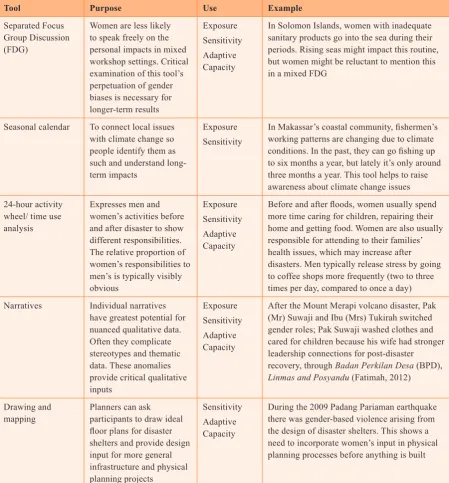
Beyond the presence of women at workshops, and as active contributors during workshop discussion sessions, women can also volunteer to be a part of working groups or the CCVA technical teams that are formed to implement the process. Women should also be able to participate with substantive inputs and contribute to the assessment process. For this we recommend that women can supply their own data and information and not merely give comments or identify weaknesses regarding an existing analysis. one way to do this, for example, is to identify where gaps may exist in knowledge about the city (eg. during the City Context Workshop), or during discussions about sensitivity and adaptive capacity, and then invite them to offer other perspectives and kinds of data. This can help improve the interpretation of existing information, or help expand the scope of analysis to include new knowledge about climate hazards and their impacts. Tools for collecting this data are explored in the next section (Table 2).
Integrate new data collection and gender-sensitive CCVA tools. There needs to be new data collection approaches
and tools for conducting CCVAs. These could signiicantly improve the capture and description of gender differences in
relation to climate hazards and urban resilience. At the moment there are clear gaps in the amount of data that is available and usefulfor understanding the differences of men and women in terms of climate change. While in the short-term it
may be dificult to reform data collection techniques at the national level, it would be possible to identify where existing data analysis needs be complemented by additional gender-speciic data, or qualitative analysis to help construct a more
comprehensive picture. For some information gaps it might also be necessary to collect additional data. Another way of resolving the problem of limited data is to create an agreement to better share and make accessible essential data points,
as had been the experience in Semarang. This involves the Mayor and high-ranking oficials to make arrangements and
synchronise efforts between different departments and agencies, all of which is possible but requires good leadership. Whereas quantitative data describes climate change’s impact on men and women broadly, stakeholders need qualitative
data to understand the complexity of speciic indings. The process of obtaining qualitative data also has a purpose to
facilitate community engagement and give women and marginalised groups a voice in planning policies. Collecting qualitative data might require interviews and focus group discussions, and then using narrative text to communicate this information. For example the use of short narrative accounts in Kota Kita’s CCVA of local women describing the
dificulties they face in collecting water was seen by workshop participants to be an effective way of describing women’s
hardships. Such narrative approaches provide a nuanced picture of the sensitivity, exposure and adaptive capacity, and help readers and workshop participants to better understand how vulnerable groups are affected. When collecting such
‘qualitative’ information it is recommended that gender experts and women-focused NGOs are engaged, because they
will have better experience and skills at noticing issues and asking the right kinds of questions. In addition, facilitators of the process may decide that a women-only focus group discussion is necessary in a post-disaster setting to discuss traumatic issues like gender-based violence. Thus facilitation can play a vital role in gathering and sharing information.
Some examples of new tools and techniques can be useful, as well as their beneits, and how they work, are explained in