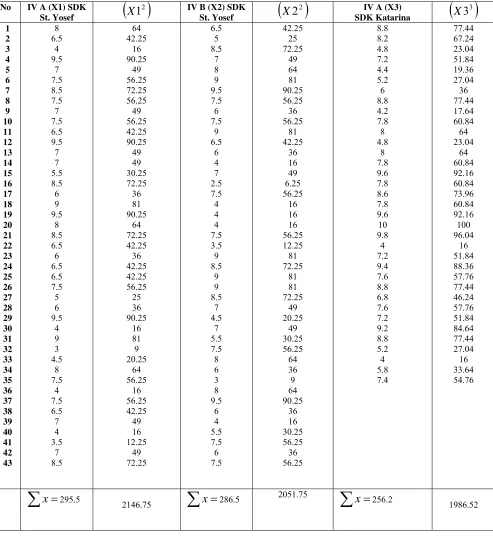
Appendix 1
Table of midterm test
No IV A (X1) SDK
St. Yosef
( )
2 1
X IV B (X2) SDK
St. Yosef
( )
2 2
X IV A (X3)
SDK Katarina
( )
3 3 X 1 2 3 4 5 6 7 8 9 10 11 12 13 14 15 16 17 18 19 20 21 22 23 24 25 26 27 28 29 30 31 32 33 34 35 36 37 38 39 40 41 42 43 8 6.5 4 9.5 7 7.5 8.5 7.5 7 7.5 6.5 9.5 7 7 5.5 8.5 6 9 9.5 8 8.5 6.5 6 6.5 6.5 7.5 5 6 9.5 4 9 3 4.5 8 7.5 4 7.5 6.5 7 4 3.5 7 8.5 64 42.25 16 90.25 49 56.25 72.25 56.25 49 56.25 42.25 90.25 49 49 30.25 72.25 36 81 90.25 64 72.25 42.25 36 42.25 42.25 56.25 25 36 90.25 16 81 9 20.25 64 56.25 16 56.25 42.25 49 16 12.25 49 72.25 6.5 5 8.5 7 8 9 9.5 7.5 6 7.5 9 6.5 6 4 7 2.5 7.5 4 4 4 7.5 3.5 9 8.5 9 9 8.5 7 4.5 7 5.5 7.5 8 6 3 8 9.5 6 4 5.5 7.5 6 7.5 42.25 25 72.25 49 64 81 90.25 56.25 36 56.25 81 42.25 36 16 49 6.25 56.25 16 16 16 56.25 12.25 81 72.25 81 81 72.25 49 20.25 49 30.25 56.25 64 36 9 64 90.25 36 16 30.25 56.25 36 56.25 8.8 8.2 4.8 7.2 4.4 5.2 6 8.8 4.2 7.8 8 4.8 8 7.8 9.6 7.8 8.6 7.8 9.6 10 9.8 4 7.2 9.4 7.6 8.8 6.8 7.6 7.2 9.2 8.8 5.2 4 5.8 7.4 77.44 67.24 23.04 51.84 19.36 27.04 36 77.44 17.64 60.84 64 23.04 64 60.84 92.16 60.84 73.96 60.84 92.16 100 96.04 16 51.84 88.36 57.76 77.44 46.24 57.76 51.84 84.64 77.44 27.04 16 33.64 54.76
∑
x=295.52146.75
∑
x=286.52051.75
∑
x=256.2
THE TEST HYPOTHESIS
The test hypothesis of class IV-A and class IV-B of SDK Santo Yosef Surabaya
1. Ho: μA = μB : There is no significant difference between two classes in
English ability.
Ha: μA > μB : There is a significant difference between two classes in
English ability.
2.T-test where df: nA+nB-2 = 84 t table = 1, 66
3. Calculation
3.1 Mean
Class IV-A (SDK St. Yosef) Class IV-B (SDK St. Yosef)
n X X =
∑
−
= 6,872 ; n=43
n X X =
∑
−
= 6,663 ; n=43
Where: x : the statistical mean
Σx : the total sum of the scores in each group
3.2 Standard Deviation
)
=
(
1, 7392(
)
9078 , 1 )
Where: S : the standard deviation
n : number of individual of each group
Σx : the total sum of the scores in each group
3.3 Calculating the standards scores (to) by using this formula.
T table = 1, 66
Where: to : the standard score
XA: the mean of subject A
XB: the mean of subject B
SA: the standard deviation of subject A
SB: the standard deviation of subject B
nA: the number of subject A
nB: the number of subject B
4. Conclusion
Because t-observation is 0,532 <t table (1, 66) so Ho is accepted. It means
that there is no significant difference in English ability between class IV-A and
class IV-B of SDK Santo Yosef Surabaya. ) 1 = n S ( 2 2 − −
∑
∑
n n X X 1 − = n S ( 2 2 = −∑
∑
n X X n(
)
(
)
1 1 0,5322 1
1 2 2
The test hypothesis of class A of SDK Santo Yosef Surabaya and class
IV-A of SDK Katarina Surabaya
1. Ho: μA = μB : There is no significant difference between two classes in
English ability.
Ha: μA > μB : There is a significant difference between two classes in
English ability.
2. T-test where df: nA+nB-2 = 76 t table = 1, 67
3. Calculation
3.1 Mean
Class IV-A (SDK St. Yosef) Class IV-A (SDK Katarina)
n X X =
∑
−
= 6,872 ; n=43
n X X =
∑
−
= 7,320 ; n=35
Where: x : the statistical mean
Σx : the total sum of the scores in each group
3.2 Standard Deviation
(
)
= 1, 7392) 1 ( 2 2 − −
(
)
8080 , 1 ) 1 ( 2 2 =∑
∑
n n X X nWhere: S : the standard deviation
n : number of individual of each group
Σx : the total sum of the scores in each group
3.3 Calculating the standards scores (to) by using this formula.
T table = 1, 67
4. Conclusion
Because t-observation is 1,111 <t table (1, 67) so Ho is accepted. It means
that there is no significant difference in English ability between class IV-A of
SDK Santo Yosef and class IV-A of SDK Katarina. =
S
− =
n
S
∑
−∑
n
X X
n
(
)
(
)
1 1 1,1112 1
1 2 2
The test hypothesis of class B of SDK Santo Yosef Surabaya and class
IV-A of SDK Katarina Surabaya
1. Ho: μA = μB : There is no significant difference between two classes in
English ability
Ha: μA > μB : There is a significant difference between two classes in
English ability.
2. T-test where df: nA+nB-2 = 76 t table = 1, 67
3. Calculation
3.1 Mean
Class IV-B (SDK St. Yosef) Class IV-A (SDK Katarina)
n X X =
∑
−
= 6,663 ; n=43
n X X =
∑
−
= 7,320 ; n=35
Where: x : the statistical mean
Σx : the total sum of the scores in each group
3.2 Standard Deviation
(
)
= 1, 9078) 1 ( 2 2 − −
(
)
8080 , 1 ) 1 ( 2 2 =∑
∑
n n X X nWhere: S : the standard deviation
n : number of individual of each group
Σx : the total sum of the scores in each group
3.3 Calculating the standards scores (to) by using this formula.
T table = 1, 67
4. Conclusion
Because t-observation is 1,549 <t table (1, 67) so Ho is accepted. It means
that there is no significant difference in English ability between class IV-B of
SDK Santo Yosef and class IV-A of SDK Katarina. =
S
− =
n
S
∑
−∑
n
X X
n
(
)
(
)
1 1 1,5492 1
1 2 2
APPENDIX 2
ITEM DIFFICULTY
Multiple choices
No Right answer Wrong
answer
IF Interpretation
1 20 15 0,57 Moderate 2 13 22 0,37 Moderate
3 26 9 0,74 Easy
4 28 7 0,80 Easy
5 19 16 0,54 Moderate 6 16 19 0,45 Moderate 7 17 18 0,48 Moderate 8 15 20 0,42 Moderate 9 25 10 0,71 Easy 10 25 10 0,71 Easy
Essay
No Right answer Wrong answer IF Interpretation
1 25 10 0,71 Easy 2 18 17 0,51 Moderate 3 25 10 0,71 Easy 4 25 10 0,71 Easy 5 22 13 0,62 Moderate 6 14 21 0,40 Moderate 7 10 25 0,28 Difficult 8 12 23 0,34 Moderate 9 20 15 0,57 Moderate 10 17 18 0,48 Moderate
ntotal ncorrect IF =
Where: IF : Item Facility
The Criteria of the Level of Difficulty
IF Index Interpretation
0.00-0.14 Very difficult item
0.15-0.29 Difficult item
0.30-0.70 Moderate item
0.71 -0.85 Easy item
APPENDIX 3
DISCRIMINATION INDEX
Multiple choices
No Upper Lower D Interpretation
1 12 8 0,41 Good
2 11 2 0,93 Excellent 3 16 10 0,62 Good 4 15 13 0,20 Satisfactory
5 10 9 0,10 Poor
6 11 5 0,62 Good
7 9 8 0,10 Poor
8 10 5 0,51 Good
9 15 10 0,51 Good 10 15 10 0,51 Good
Essay
No Upper Lower D Interpretation
1 14 11 0,31 Satisfactory
2 12 6 0,62 Good
3 13 12 0,10 Poor 4 14 11 0,31 Satisfactory
5 13 9 0,41 Good
D = Ru-RL
27½% of n
Where: D : item discrimination power
Ru : number of upper group pupils who give correct answer
RL : number of lower group pupils who give correct answer
n : number of students
The Criteria of the Item Discrimination
Discrimination Power Interpretation
APPENDIX 4
RELIABILITY ITEMS
Multiple Choices
No X 1 2 3 4 5 6 7 8 9 10 α α²
1 9 1 1 0 1 1 1 1 1 1 1 3.2 10.24
2 9 1 1 1 1 1 1 0 1 1 1 3.2 10.24
3 9 1 1 1 1 1 1 1 0 1 1 3.2 10.24
4 8 1 1 1 1 0 1 1 1 1 0 2.2 4.84
5 7 0 1 1 1 1 0 1 0 1 1 1.2 1.44
6 7 1 1 1 1 1 0 0 0 1 1 1.2 1.44
7 7 1 1 1 1 0 1 0 1 0 1 1.2 1.44
8 7 1 0 1 1 1 0 0 1 1 1 1.2 1.44
9 7 0 1 1 1 0 1 0 1 1 1 1.2 1.44
10 6 1 0 1 1 0 0 1 1 1 0 0.2 0.04
11 6 0 0 0 1 1 1 0 1 1 1 0.2 0.04
12 6 1 0 1 1 0 0 1 0 1 1 0.2 0.04
13 6 1 0 1 0 0 1 1 1 1 0 0.2 0.04
14 6 1 1 1 0 0 1 1 0 0 1 0.2 0.04
15 6 0 0 1 0 1 1 0 1 1 1 0.2 0.04
16 6 0 0 1 1 1 0 1 0 1 1 0.2 0.04
17 6 1 1 1 1 1 0 0 0 0 1 0.2 0.04
18 6 0 1 1 1 0 1 0 0 1 1 0.2 0.04
19 6 0 1 0 1 1 0 1 0 1 1 0.2 0.04
20 5 0 1 1 1 0 1 1 0 0 0 -0.8 0.64
21 5 0 0 0 0 1 1 1 0 1 1 -0.8 0.64
22 5 1 0 0 1 1 0 0 1 1 0 -0.8 0.64
23 5 0 0 0 1 1 1 0 0 1 1 -0.8 0.64
24 5 1 0 1 1 1 0 0 0 0 1 -0.8 0.64
25 5 0 0 1 0 1 1 0 0 1 1 -0.8 0.64
26 5 0 0 1 1 0 0 0 1 1 1 -0.8 0.64
27 5 0 0 1 1 1 0 1 0 1 0 -0.8 0.64
28 5 1 0 1 1 0 0 1 0 0 1 -0.8 0.64
29 5 0 0 0 0 1 1 0 1 1 1 -0.8 0.64
30 4 1 0 1 1 0 0 0 0 1 0 -1.8 3.24
31 4 1 0 1 0 1 0 1 0 0 0 -1.8 3.24
32 4 1 0 0 1 0 0 0 1 0 1 -1.8 3.24
33 4 0 0 0 1 0 0 1 0 1 1 -1.8 3.24
34 4 1 0 1 1 0 0 0 1 0 0 -1.8 3.24
35 4 1 0 1 1 0 0 1 0 0 0 -1.8 3.24
1. Mean
n X X =
∑
−
= 5, 8
Where: x : the statistical mean
Σx : the total sum of the scores in each group
n : number of individual of each group
2. Standard Deviation
= 1, 90
(
)
) 1 ( 2 2 − n − =∑
∑
n X X n SWhere: S : the standard deviation
n : number of individual of each group
Σx : the total sum of the scores in each group
3. Reliability ⎟ ⎠ ⎞ ⎜ ⎝ ⎛ − − − = KV M K M k k
r 1 ( )
1 = 0, 41
Where: R : reliability estimate
M : the statistical mean
K : the number of items in the test
The Interpretation
+.70 to + 1.00 = high to very high.
+.40 to +.70 = average to fairly high.
+.20 to +.40 = present, but low.
+.00 to +.20 = negligible or low.
4. Conclusion: The Reliability estimate multiple choice items is 0, 41 = average
Essay Items
No X 1 2 3 4 5 6 7 8 9 10 α α²
1 8 1 1 1 1 1 1 0 0 1 1 2.58 6.65
2 8 1 1 1 1 1 1 0 0 1 1 2.58 6.65
3 8 1 1 1 1 1 0 1 0 1 1 2.58 6.65
4 7 1 0 1 1 1 1 0 0 1 1 1.58 2.49
5 7 1 1 1 1 1 1 0 0 1 0 1.58 2.49
6 7 0 1 1 1 1 1 0 0 1 1 1.58 2.49
7 7 1 1 1 1 1 1 0 1 0 0 1.58 2.49
8 7 0 1 1 1 0 1 1 1 1 0 1.58 2.49
9 7 0 0 1 1 1 1 1 0 1 1 1.58 2.49
10 6 1 0 0 1 1 0 1 1 0 1 0.58 0.33
11 6 1 1 1 1 1 0 0 0 0 1 0.58 0.33
12 6 1 0 1 0 1 1 0 0 1 1 0.58 0.33
13 6 1 0 1 0 0 1 0 1 1 1 0.58 0.33
14 6 0 1 1 0 0 1 0 1 1 1 0.58 0.33
15 6 1 1 0 1 0 0 1 1 1 0 0.58 0.33
16 6 1 0 0 0 1 1 1 0 1 1 0.58 0.33
17 6 1 1 0 1 0 0 0 1 1 1 0.58 0.33
18 5 1 1 0 1 1 1 0 0 0 0 -0.4 0.16
19 5 1 0 1 1 1 0 0 0 0 1 -0.4 0.16
20 5 1 0 1 1 0 0 1 1 0 0 -0.4 0.16
21 5 1 1 1 0 0 0 0 1 1 0 -0.4 0.16
22 5 1 0 1 1 1 0 0 0 1 0 -0.4 0.16
23 5 0 1 1 1 0 1 0 0 1 0 -0.4 0.16
24 5 0 1 1 1 1 0 0 0 1 0 -0.4 0.16
25 5 1 1 1 0 0 0 0 0 1 1 -0.4 0.16
26 4 0 1 0 1 1 1 0 0 0 0 -1.4 1.96
27 4 1 0 0 1 1 0 0 1 0 0 -1.4 1.96
28 4 0 1 0 1 1 0 0 0 1 0 -1.4 1.96
29 4 1 0 1 0 0 0 1 0 0 1 -1.4 1.96
30 4 1 0 1 0 0 1 0 1 0 0 -1.4 1.96
31 4 1 0 1 1 0 0 0 1 0 0 -1.4 1.96
32 4 1 0 1 1 0 0 1 0 0 0 -1.4 1.96
33 4 1 0 1 0 1 0 0 0 0 1 -1.4 1.96
34 2 0 0 0 1 1 0 0 0 0 0 -3.4 11.56
35 2 0 0 0 0 1 0 1 0 0 0 -3.4 11.56
1. Mean
n X X =
∑
−
= 5, 4
Where: x : the statistical mean
Σx : the total sum of the scores in each group
n : number of individual of each group
2. Standard Deviation
= 2, 21
(
)
) 1 ( 2 2 − n − =∑
∑
n X X n SWhere: S : the standard deviation
n : number of individual of each group
Σx : the total sum of the scores in each group
3. Reliability ⎟ ⎠ ⎞ ⎜ ⎝ ⎛ − − − = KV M K M k k
r 1 ( )
1 = 0, 55
Where: R : reliability estimate
M : the statistical mean
K : the number of items in the test
The Interpretation
+.70 to + 1.00 = high to very high.
+.40 to +.70 = average to fairly high.
+.20 to +.40 = present, but low.
+.00 to +.20 = negligible or low.
4. Conclusion: The Reliability estimate essay items is 0, 55 = average to fairly
APENDIX 5
MEETING ONE LESSON PLAN
FOR THE EXPERIMENTAL GROUP
Subject : English
Class : Elementary school, forth year
Language component : Vocabulary
Topic : Action verbs in present continues tense
Time Allocated : 1 X 30 minutes
A. Competence : 1. Basic competence
• Students are able to master the action verbs (-ing form).
2. Achievement Indicators Students are able to:
• Students are able to act out some action verbs (-ing form).
• Students are able to guess or mention what is his/her friend doing
• Students are able to fill in the blanks with the action verbs (-ing
form) according to the picture.
B. Learning materials
• The List of Vocabularies: studying, teaching, reading, writing,
listening, speaking, drawing, sitting, standing, cleaning, knocking, pulling, pushing, sweeping, walking.
A. Pre- Activity
Teacher Students
• Greets the students.
• Students are asked the triggering
questions:
1. Mention the things around you at school.
2. Mention what you can do at school.
• The teacher introduces the name
of things around the students.
• The teacher gives the handout
consisting of some action verbs to the students but without their meanings.
• The teacher speaks and acts out the action verbs.
• The teacher asks some of the
students to be volunteers.
• The teacher asks the volunteer
to imitate him.
• The teacher asks the volunteer
to do the commands him/her self.
• The teacher asks the whole class
to act out the action verbs together with him.
• Divides the students into 8
groups
• Greet the teacher.
• Response the teacher by giving
several answer.
• Listen to the teacher
• Achieve the handout.
• Listen and pay attention to the teacher
• Response the invitation.
• Imitate the teacher by acting out
the action verbs (the volunteers).
• Act out the action verb (the
volunteers).
• Act out the action verbs
together (whole class).
B. Main Activities
Teacher Students
• Gives 6 action verbs to each
group
• Asks each group to act the
action verbs and asks the other group to guess what are their friends doing?
• Asks the students to fill in the
blanks with the action verbs according to the picture
• Received the action verbs
• Act the action verbs while
others guess what their friends are doing.
• fill in the blanks with the action
verbs according to the picture
C. Post-Activities
Teacher Students
• Asks the students to write ten action verbs which is acted by the teacher
• Says Good Bye
• Write ten action verbs which is acted by the teacher
• Say Good Bye
D. Assessment
The teacher asks the students to fill in the blanks with the right action verbs according to the picture.
Grouping the students:
Student’s Handout 1 (Experimental group)
1. Studying
Contoh : Kenny is studying English now.
2. Teaching
Contoh : Mrs Viviet is teaching English in the classroom.
3. Reading
Contoh : Josephine is reading a book.
4. Writing
Contoh : I am writing a letter.
5. Listening
Contoh : We are listening to the music.
6. Speaking
Contoh : Jimmy is speaking English.
7. Drawing
Contoh : I am drawing a mountain.
8. Sitting
Contoh : We are sitting on the chair.
9. Standing
Contoh : We are standing now.
10.Cleaning
Contoh : Tommy is cleaning the blackboard.
11.Knocking
Contoh : Mr. Christo is knocking the door.
12.Pulling
Contoh : I am pulling the chair.
13.Pushing
Contoh : I am pushing the chair.
14.Sweeping
Contoh : Johnny is sweeping the floor.
15.Walking
Post-Activities
A. Pay attention to the teacher and write the action verbs.
1. Mr. Christo is ………
2. Mr. Christo is ………
3. Mr. Christo is ………
4. Mr. Christo is ………
5. Mr. Christo is ………
6. Mr. Christo is ………
7. Mr. Christo is ………
8. Mr. Christo is ………
9. Mr. Christo is ………
MEETING ONE LESSON PLAN
FOR THE CONTROL GROUP
Subject : English
Class : Elementary school, forth year Semester : Three
Language component : Vocabulary
Topic : Action verbs in present continues tense
Time Allocated : 1 X 30 minutes
A. Competence : 1. Basic competence
• Students are able to master the action verbs (-ing form).
2. Achievement Indicators Students are able to:
• Students are able to memorize the action verbs of present continues tense
• Students are able to match the right action verbs to their native
translations
• Students are able to fill in the blanks with the right action verbs in
the “-ing” form according to the picture.
B. Learning materials
C. Learning activities A. Pre- Activity
Teacher Students
• Greets the students.
• Students are asked the triggering
questions:
1. Mention the things around you at school.
2. Mention what you can do at school.
• The teacher introduces the name
of things around the students.
• The teacher gives the handout
consisting of some action verbs to the students with their meanings.
• The teacher speaks the action verbs and asks the students to repeat after him.
• The teacher asks the students to
memorize the action verbs.
• Divides the students into 8 groups
• Greet the teacher.
• Response the teacher by giving
several answer.
• Listen to the teacher
• Achieve the handout.
• Listen, pay attention to the teacher and repeat after the teacher.
• memorize the action verbs.
• Form a group
B. Main Activities
Teacher Students
• Gives 6 action verbs to each
group
• Asks each group to match the right action verbs according to their native translation.
• Received the action verbs
• Asks the students to fill in the
blanks with the action verbs according to the picture.
• fill in the blanks with the action
verbs according to the picture.
C. Post-Activities
Teacher Students
• Mention ten action verbs in
Indonesian language and ask the students to write them in English.
• Says Good Bye
• Listen to the teacher and write
ten action verbs in English.
• Say Good Bye
D. Assessment
The teacher asks the students to fill in the blanks with the right action verbs according to the picture.
Grouping the students:
Student’s Handout 1 (Control group)
1. Studying : belajar
Contoh : Kenny is studying English now.
2. Teaching : mengajar
Contoh : Mrs Viviet is teaching English in the classroom.
3. Reading : membaca
Contoh : Josephine is reading a book.
4. Writing : menulis
Contoh : I am writing a letter.
5. Listening : mendengarkan
Contoh : We are listening to the music.
6. Speaking : berbicara
Contoh : Jimmy is speaking English.
7. Drawing : menggambar
Contoh : I am drawing a mountain.
8. Sitting : duduk
Contoh : We are sitting on the chair.
9. Standing : berdiri
Contoh : We are standing now.
10.Cleaning : membersihkan
Contoh : Tommy is cleaning the blackboard.
11.Knocking : mengetuk
Contoh : Mr. Christo is knocking the door.
12.Pulling : menarik
Contoh : I am pulling the chair.
13.Pushing : mendorong
Contoh : I am pushing the chair.
14.Sweeping : menyapu
Contoh : Johnny is sweeping the floor.
15.Walking : berjalan
Main activities
A. Match the action verbs according to their native translation.
Group 1
1. menyapu : 2. mengajar :
3. membaca : 4. mendengarkan : 5. mendorong : 6. menggambar :
The Action verbs
drawing pushing listening reading teaching sweeping
Group 2
1. menarik : 2. berjalan : 3. membersihkan : 4. duduk : 5. belajar : 6. menulis :
The Action verbs
writing studying sitting cleaning walking pulling
Group 3
1. mengajar : 2. membaca : 3. berbicara : 4. berdiri : 5. mendorong : 6. mengetuk :
The Action verbs
knocking pushing standing speaking reading teaching
Group 4
1. membersihkan : 2. duduk : 3. mendengarkan : 4. membaca : 5. menarik : 6. belajar :
studying pulling reading listening sitting cleaning
Group 5
1. membaca : 2. duduk : 3. mengajar : 4. belajar : 5. menyapu : 6. menulis :
The Action verbs
writing sweeping studying teaching sitting reading
Group 6
1. menarik : 2. menggambar : 3. berjalan : 4. mendorong : 5. mendengarkan : 6. membersihkan :
The Action verbs
cleaning listening pushing walking drawing pulling
Group 7
1. berdiri : 2. duduk : 3. menarik : 4. mendorong : 5. belajar : 6. mengetuk :
The Action verbs
knocking studying pushing pulling sitting standing
Group 8
1. membersihkan : 2. menarik : 3. duduk : 4. berbicara : 5. mendengarkan : 6. membaca :
The Action verbs
Post-Activities
A. Listen to the teacher and write the action verbs.
1. Mr. Christo is ………
2. Mr. Christo is ………
3. Mr. Christo is ………
4. Mr. Christo is ………
5. Mr. Christo is ………
6. Mr. Christo is ………
7. Mr. Christo is ………
8. Mr. Christo is ………
9. Mr. Christo is ………
MEETING TWO LESSON PLAN
FOR THE EXPERIMENTAL GROUP
Subject : English
Class : Elementary school, forth year
Language component : Vocabulary
Topic : Action verbs in present continues tense
Time Allocated : 1 X 30 minutes
A. Competence : 1. Basic competence
• Students are able to master the action verbs (-ing form).
2. Achievement Indicators Students are able to:
• Students are able to act out some action verbs (-ing form).
• Students are able to guess or mention what is his/her friend doing
• Students are able to fill in the blanks with the action verbs (-ing
form) according to the picture.
B. Learning materials
• The List of Vocabularies: Playing, eating, drinking, running, sleeping, dancing, kicking, throwing, cooking, singing, crying, swimming, driving, smiling, knocking.
C. Learning activities 1. Class activities
Teacher Students
• Greets the students.
• Review the previous materials
by asking the students to guess what is their teacher doing (the teacher perform the previous action verbs that had been taught to the students).
• The teacher gives the handout
consisting of another action verbs to the students but without their meanings.
• The teacher speaks and acts out
the action verbs.
• The teacher asks some of the students to be volunteers.
• The teacher asks the volunteer
to imitate him.
• The teacher asks the volunteer
to do the commands him/her self.
• The teacher asks the whole class
to act out the action verbs together with him.
• Divides the students into 8
groups
• Greet the teacher.
• Response the teacher by giving
several answer.
• Achieve the handout.
• Listen and pay attention to the
teacher
• Response the invitation.
• Imitate the teacher by acting out
the action verbs (the volunteers).
• Act out the action verb (the
volunteers).
• Act out the action verbs
together (whole class).
B. Main Activities
Teacher Students
• Gives 6 action verbs to each
group
• Asks each group to act the
action verbs and asks the other group to guess what are their friends doing?
• Asks the students to fill in the
blanks with the action verbs according to the picture
• Received the action verbs
• Act the action verbs while
others guess what their friends are doing.
• fill in the blanks with the action
verbs according to the picture
C. Post-Activities
Teacher Students
• Asks the students to write ten action verbs which is acted by the teacher
• Says Good Bye
• Write ten action verbs which is acted by the teacher
• Say Good Bye
D. Assessment
The teacher asks the students to fill in the blanks with the right action verbs according to the picture.
Grouping the students:
Group 1 : playing, eating, drinking, running, sleeping, and dancing. Group 2 : kicking, throwing, cooking, singing, crying, and swimming.
Group 3 : dancing, swimming, singing, kicking, sleeping, and drinking. Group 4 : driving, smiling, knocking, cooking, running, and singing.
Student’s Handout 2 (Experimental group)
1. Playing
Contoh : Kenny is playing video game now.
2. Eating
Contoh : Johny is eating rice.
3. Drinking
Contoh : Josephine is drinking milk.
4. Running
Contoh : They are running in the classroom.
5. Sleeping
Contoh : Santi is sleeping now.
6. Dancing
Contoh : Jimmy is dancing in the classroom.
7. Kicking
Contoh : I am kicking the ball.
8. Throwing
Contoh : I am throwing the ball.
9. Cooking
Contoh : Mother is cooking a noodle.
10.Singing
Contoh : Tommy is singing a song.
11.Crying
Contoh : Tina is crying now.
12.Swimming
Contoh : I am swimming in the pool.
13.Driving
Contoh : I am driving the car.
14.Smiling
Contoh : Johnny is smiling at me.
15.Knocking
Post-Activities
A. Pay attention to the teacher and write the action verbs.
1. Mr. Christo is ………
2. Mr. Christo is ………
3. Mr. Christo is ………
4. Mr. Christo is ………
5. Mr. Christo is ………
6. Mr. Christo is ………
7. Mr. Christo is ………
8. Mr. Christo is ………
9. Mr. Christo is ………
MEETING TWO LESSON PLAN
FOR THE CONTROL GROUP
Subject : English
Class : Elementary school, forth year Semester : Three
Language component : Vocabulary
Topic : Action verbs in present continues tense
Time Allocated : 1 X 30 minutes
A. Competence : 1. Basic competence
• Students are able to master the action verbs (-ing form).
2. Achievement Indicators Students are able to:
• Students are able to memorize the action verbs of present continues tense
• Students are able to match the right action verbs to their native
translations
• Students are able to fill in the blanks with the right action verbs in
the “-ing” form according to the picture.
B. Learning materials
C. Learning activities A. Pre- Activity
Teacher Students
• Greets the students.
• Review the previous materials
• The teacher gives the handout
consisting of some action verbs to the students with their meanings.
• The teacher speaks the action
verbs and asks the students to repeat after him.
• The teacher asks the students to memorize the action verbs.
• Divides the students into 8
groups
• Greet the teacher.
• Response the teacher by giving
several answer.
• Achieve the handout.
• Listen, pay attention to the
teacher and repeat after the teacher.
• memorize the action verbs.
• Form a group
B. Main Activities
Teacher Students
• Gives 6 action verbs to each
group
• Asks each group to match the
right action verbs according to their native translation.
• Asks the students to fill in the blanks with the action verbs according to the picture.
• Received the action verbs
• Match the right action verbs
according to their native translation.
C. Post-Activities
Teacher Students
• Mention ten action verbs in
Indonesian language and ask the students to write them in English.
• Says Good Bye
• Listen to the teacher and write
ten action verbs in English.
• Say Good Bye
D. Assessment
The teacher asks the students to fill in the blanks with the right action verbs according to the picture.
Grouping the students:
Student’s Handout 2 (Control group)
1. Playing : bermain
Contoh : Kenny is playing video game now.
2. Eating : makan
Contoh : Johny is eating rice.
3. Drinking : minum
Contoh : Josephine is drinking milk.
4. Running : berlari
Contoh : They are running in the classroom.
5. Sleeping : tidur
Contoh : Santi is sleeping now.
6. Dancing : menari
Contoh : Jimmy is dancing in the classroom.
7. Kicking : menendang
Contoh : I am kicking the ball.
8. Throwing : melempar
Contoh : I am throwing the ball.
9. Cooking : memasak
Contoh : Mother is cooking a noodle.
10.Singing : menyanyi
Contoh : Tommy is singing a song.
11.Crying : menagis
Contoh : Tina is crying now.
12.Swimming : berenang
Contoh : I am swimming in the pool.
13.Driving : mengendarai
Contoh : I am driving the car.
14.Smiling : tersenyum
Contoh : Johnny is smiling at me.
15.Knocking : mengetuk
Main activities
A. Match the action verbs according to their native translation.
Group 1
1. menari : 2. tidur : 3. berlari : 4. minum : 5. makan : 6. bermain :
The Action verbs
playing eating drinking running sleeping dancing
Group 2
1. berenang : 2. menangis : 3. menyanyi : 4. memasak : 5. melempar : 6. menendang :
The Action verbs
kicking throwing cooking singing crying swimming
Group 3
1. minum : 2. tidur : 3. menendang : 4. menyanyi : 5. berenang : 6. menari :
The Action verbs
dancing swimming singing kicking sleeping drinking
Group 4
1. menyanyi : 2. berlari : 3. memasak : 4. mengetuk : 5. tersenyum : 6. mengendarai :
The Action verbs
Group 5
1. menendang : 2. minum : 3. berenang : 4. menari : 5. menangis : 6. tidur :
The Action verbs
sleeping crying dancing swimming drinking kicking
Group 6
1. tidur : 2. bermain : 3. mengetuk : 4. minum : 5. melempar : 6. mengendarai :
The Action verbs
driving throwing drinking knocking playing sleeping
Group 7
1. menyanyi : 2. berlari : 3. berenang : 4. menari : 5. tersenyum : 6. menangis :
The Action verbs
Crying smiling dancing swimming running singing
Group 8
1. minum : 2. memasak : 3. mengendarai : 4. menari : 5. tidur : 6. melempar :
The Action verbs
Post-Activities
A. Pay attention to the teacher and write the action verbs.
1. Mr. Christo is ………
2. Mr. Christo is ………
3. Mr. Christo is ………
4. Mr. Christo is ………
5. Mr. Christo is ………
6. Mr. Christo is ………
7. Mr. Christo is ………
8. Mr. Christo is ………
9. Mr. Christo is ………
MEETING THREE LESSON PLAN
FOR THE EXPERIMENTAL GROUP
Subject : English
Class : Elementary school, forth year
Semester : Three Language component : Vocabulary
Topic : Action verbs in present continues tense
Time Allocated : 1 X 30 minutes
A. Competence : 1. Basic competence
a. Students are able to master the action verbs (-ing form).
2. Achievement Indicators Students are able to:
a. Students are able to act out some action verbs.
b. Students are able to guess or mention what is his/her friend doing. c. Students are able to fill in the blanks with the action verbs (-ing
form) according to the picture.
B. Learning materials
D. Learning activities 1. Class activities
A. Pre- Activity
Teacher Students
• Greets the students.
• Review the previous materials
by asking the students to guess what is their teacher doing (the teacher perform the previous action verbs that had been taught to the students).
• The teacher gives the handout
consisting of another action verbs to the students but without their meanings.
• The teacher speaks and acts out
the action verbs.
• The teacher asks some of the
students to be volunteers.
• The teacher asks the volunteer
to imitate him.
• The teacher asks the volunteer to do the commands him/her self.
• Divides the students into 8
groups
• Greet the teacher.
• Response the teacher by giving
several answer.
• Achieve the handout.
• Listen and pay attention to the
teacher
• Response the invitation.
• Imitate the teacher by acting out
the action verbs (the volunteers).
• Act out the action verb (the volunteers).
B. Main Activities
Teacher Students
• Gives 6 action verbs to each
group
• Asks each group to act the
action verbs and asks the other group to guess what are their friends doing?
• Asks the students to fill in the
blanks with the action verbs according to the picture
• Received the action verbs
• Act the action verbs while
others guess what their friends are doing.
• fill in the blanks with the action
verbs in the according to the picture
C. Post-Activities
Teacher Students
• Asks the students to write ten action verbs which is acted by the teacher
• Says Good Bye
• Write ten action verbs which is acted by the teacher
• Say Good Bye
D. Assessment
The teacher asks the students to fill in the blanks with the right action verbs according to the picture.
Grouping the students:
Student’s Handout 3 (Experimental group)
1. Playing
Contoh : Kenny is playing video game now.
2. Eating
Contoh : Johny is eating rice.
3. Running
Contoh : They are running in the classroom.
4. Sleeping
Contoh : Santi is sleeping now.
5. Dancing
Contoh : Jimmy is dancing in the classroom.
6. Kicking
Contoh : I am kicking the ball.
7. Cooking
Contoh : Mother is cooking a noodle.
8. Singing
Contoh : Tommy is singing a song.
9. Crying
Contoh : Tina is crying now.
10.Swimming
Contoh : I am swimming in the pool.
11.Driving
Contoh : I am driving the car.
12.Studying
Contoh : Kenny is studying English now.
13.Reading
Contoh : Josephine is reading a book.
14.Listening
Contoh : We are listening to the music.
15.Sitting
Contoh : We are sitting on the chair.
16.Standing
Contoh : We are standing now.
17.Cleaning
18.Pushing
Contoh : I am pushing the chair.
19.Sweeping
Contoh : Johnny is sweeping the floor.
20.Walking
Contoh : Mr. Christo is walking in the classroom.
Post-Activities
A. Pay attention to the teacher and write the action verbs.
1. Mr. Christo is ………
2. Mr. Christo is ………
3. Mr. Christo is ………
4. Mr. Christo is ………
5. Mr. Christo is ………
6. Mr. Christo is ………
7. Mr. Christo is ………
8. Mr. Christo is ………
9. Mr. Christo is ………
MEETING THREE LESSON PLAN
FOR THE CONTROL GROUP
Subject : English
Class : Elementary school, forth year Semester : Three
Language component : Vocabulary
Topic : Action verbs in present continues tense
Time Allocated : 1 X 30 minutes
1. Competence : A. Basic competence
• Students are able to master the action verbs (-ing form).
B. Achievement Indicators Students are able to:
• Students are able to memorize the action verbs of present continues tense
• Students are able to match the right action verbs to their native
translations
• Students are able to fill in the blanks with the right action verbs in
the “-ing” form according to the picture.
2. Learning materials
3. Learning activities A. Pre- Activity
Teacher Students
• Greets the students.
• Review the previous materials.
• The teacher gives the handout
consisting of some action verbs to the students with their meanings.
• The teacher speaks the action
verbs and asks the students to repeat after him.
• The teacher asks the students to memorize the action verbs.
• Divides the students into 8
groups
• Greet the teacher.
• Response the teacher by giving
several answer.
• Achieve the handout.
• Listen, pay attention to the
teacher and repeat after the teacher.
• memorize the action verbs.
• Form a group
B. Main Activities
Teacher Students
• Gives 20 action verbs to each
group
• Asks each group to match the
right action verbs according to their native translation.
• Asks the students to fill in the blanks with the action verbs according to the picture.
• Received the action verbs
• Match the right action verbs
according to their native translation.
C. Post-Activities
Teacher Students
• Mention ten action verbs in
Indonesian language and ask the students to write them in English.
• Says Good Bye
• Listen to the teacher and write
ten action verbs in English.
• Say Good Bye
D. Assessment
Student’s Handout 3 (Control group)
1. Playing : bermain
Contoh : Kenny is playing video game now.
2. Eating : makan
Contoh : Johny is eating rice.
3. Running : berlari
Contoh : They are running in the classroom.
4. Sleeping : tidur
Contoh : Santi is sleeping now.
5. Dancing : menari
Contoh : Jimmy is dancing in the classroom.
6. Kicking : menendang
Contoh : I am kicking the ball.
7. Cooking : memasak
Contoh : Mother is cooking a noodle.
8. Singing : menyanyi
Contoh : Tommy is singing a song.
9. Crying : menangis
Contoh : Tina is crying now.
10.Swimming : berenang
Contoh : I am swimming in the pool.
11.Driving : mengendarai
Contoh : I am driving the car.
12.Studying : belajar
Contoh : Kenny is studying English now.
13.Reading : membaca
Contoh : Josephine is reading a book.
14.Listening : mendengarkan
Contoh : We are listening to the music.
15.Sitting : duduk
Contoh : We are sitting on the chair.
16.Standing : berdiri
Contoh : We are standing now.
17.Cleaning : membersihkan
18.Pushing : mendorong
Contoh : I am pushing the chair.
19.Sweeping : menyapu
Contoh : Johnny is sweeping the floor.
20.Walking : berjalan
Main activities
A. Match the action verbs according to their native translation.
All group
1. bermain : 2. belajar :
3. membaca : 4. berlari : 5. tidur : 6. menari : 7. menendang : 8. mendengarkan : 9. makan : 10. menyanyi : 11. menangis : 12. berenang : 13. mengendarai : 14. menyapu : 15. duduk : 16. berdiri : 17. berjalan : 18. membersihkan : 19. mendorong : 20. memasak :
The Action verbs
Post-Activities
A. Pay attention to the teacher and write the action verbs.
1. Mr. Christo is ………
2. Mr. Christo is ………
3. Mr. Christo is ………
4. Mr. Christo is ………
5. Mr. Christo is ………
6. Mr. Christo is ………
7. Mr. Christo is ………
8. Mr. Christo is ………
9. Mr. Christo is ………
APPENDIX 6
The Pre-test Score
no IV A (x) x2 IV B ( x) x2
1 2 3 4 5 6 7 8 9 10 11 12 13 14 15 16 17 18 19 20 21 22 23 24 25 26 27 28 29 30 31 32 33 34 35 36 37 38 39 40 41 42 43 55 90 90 85 85 80 80 80 40 70 70 70 65 65 60 30 60 60 60 60 55 55 45 50 65 45 40 45 45 70 45 50 40 35 35 35 55 30 25 25 60 20 15 3025 8100 8100 7225 7225 6400 6400 6400 1600 4900 4900 4900 4225 4225 3600 900 3600 3600 3600 3600 3025 3025 2025 2500 4225 2025 1600 2025 2025 4900 2025 2500 1600 1225 1225 1225 3025 900 625 625 3600 400 225 95 80 35 85 85 85 80 80 60 75 40 75 40 60 65 60 40 30 55 55 55 45 55 60 45 45 40 40 45 40 40 40 35 50 30 30 35 25 25 20 40 65 35 9025 6400 1225 7225 7225 7225 6400 6400 3600 5625 1600 5625 1600 3600 4225 3600 1600 900 3025 3025 3025 2025 3025 3600 2025 2025 1600 1600 2025 1600 1600 1600 1225 2500 900 900 1225 625 625 400 1600 4225 1225
total 2330 143100 2220 130350
n 43 43
The Post-Test Score
no IV A (x) x2 IV B ( x) x2
1 2 3 4 5 6 7 8 9 10 11 12 13 14 15 16 17 18 19 20 21 22 23 24 25 26 27 28 29 30 31 32 33 34 35 36 37 38 39 40 41 42 43 80 55 70 80 80 60 75 85 75 70 70 70 75 50 70 75 70 40 75 50 40 60 85 70 50 80 85 55 90 65 70 35 50 50 55 60 30 45 50 35 50 55 40 6400 3025 4900 6400 6400 3600 5625 7225 5625 4900 4900 4900 5625 2500 4900 5625 4900 1600 5625 2500 1600 3600 7225 4900 2500 6400 7225 3025 8100 4225 4900 1225 2500 2500 3025 3600 900 2025 2500 1225 2500 3025 1600 85 90 95 80 80 85 80 100 85 75 90 75 70 80 85 60 80 80 60 80 80 85 55 90 75 70 80 75 70 50 60 40 85 80 75 80 75 45 50 45 55 50 60 7225 8100 9025 6400 6400 7225 6400 10000 7225 5625 8100 5625 4900 6400 7225 3600 6400 6400 3600 6400 6400 7225 3025 8100 5625 4900 6400 5625 4900 2500 3600 1600 7225 6400 5625 6400 5625 2025 2500 2025 3025 2500 3600
total 2680 177500 3145 239125
n 43 43
mean 62,33 73,14
Calculation for pre-test and post-test of experimental group (IV-B)
1. Ho: μA = μB : There is no significant difference in the vocabulary
achievement of the students after receiving and before
receiving treatments.
Ha: μA > μB : There is a significant difference in the vocabulary
achievement of the students after receiving and before
receiving treatments.
2. T-test where df: nA+nB-2 = 84 t table = 1, 66
3. Calculation
3.1 Mean
n X XA=
∑
−
= 51, 63 ; n = 43
n X XB=
∑
−
= 73, 14 ; n= 43
Where, XA : The statistical mean of pre-test of IV-B
XB : The statistical mean of post-test of IV-B
Σx : the total sum of the scores in each group
3.2 Standard deviation
(
)
721 , 14 ) 1 ( 2 2 = − − =∑
∑
n n X X n SB(
)
356 , 19 ) 1 ( 2 2 = − − =∑
∑
n n X X n SAWhere: SA : the standard deviation of pre-test of IV-B
SB : the standard deviation of post-test of IV-B
n : number of individual of each group
Σx : the total sum of the scores in each group
3.3 Calculating the standards scores (to) by using this formula.
(
)
(
)
1 1 5,801Where: to : the standard score
XA: the mean of sample A (pre-test)
XB: the mean of sample B (post-test)
SA: the standard deviation of sample A
SB: the standard deviation of sample B
nA: the number of sample A
nB: the number of sample B
2 ⎜⎝ + ⎟⎠
−
+ nB nA nB
nA
1
1 2 2
0 =
⎞ ⎛
− +
− SD A nB SD B nA
−
= XA XB
4. Conclusion
Because t-observation is 5, 801>t table (1, 66) so Ha is accepted. It means
that there is significant difference in the vocabulary achievement of the students
Calculation for pre-test and post-test of control group (IV-A)
1. Ho: μA = μB : There is no significant difference in the vocabulary
achievement of the students after receiving and before
receiving treatments.
Ha: μA > μB : There is a significant difference in the vocabulary
achievement of the students after receiving and before
receiving treatments.
2. T-test where df: nA+nB-2 = 84 t table = 1, 66
3. Calculation
3.1 Mean
n X XA=
∑
−
= 54, 42 ; n = 43
n X XB=
∑
−
= 62, 33 ; n= 43
Where, XA : The statistical mean of pre-test of IV-A
XB : The statistical mean of post-test of IV-A
Σx : the total sum of the scores in each group
3.2 Standard deviation
(
)
371 , 19 ) 1 ( 2 2 = − − =∑
∑
n n X X nSA
(
)
15,787) 1 ( 2 2 = − − =
∑
∑
n n X X n SBWhere: SA : the standard deviation of pre-test of IV-A
SB : the standard deviation of post-test of IV-A
n : number of individual of each group
Σx : the total sum of the scores in each group
3.3 Calculating the standards scores (to) by using this formula.
(
)
(
)
1 1 2,0752 1
1 2 2
0 = ⎟ ⎠ ⎞ ⎜ ⎝ ⎛ + − + − + − − = nB nA nB nA B SD nB A SD nA B X A X t
Where: to : the standard score
XA: the mean of sample A (pre-test)
XB: the mean of sample B (post-test)
SA: the standard deviation of sample A
SB: the standard deviation of sample B
nA: the number of sample A
4. Conclusion
Because t-observation is 2, 075 >t table (1, 66) so Ha is accepted. It means
that there is significant difference in the vocabulary achievement of the students
Calculation for post-test of experimental (IV-B) and control group (IV-A)
1. Ho: μA = μB : There is no significant difference between the vocabulary
achievement of the students who are taught using the Total
Physical Response and those who are taught using
the traditional method.
Ha: μA > μB : There is significant difference between the vocabulary
achievement of the students who are taught using the Total
Physical Response and those who are taught using
the traditional method.
2. T-test where df: nA+nB-2 = 84 t table = 1, 66
3. Calculation
3.1 Mean
n X XA=
∑
−
= 73, 14 ; n = 43
n X XB=
∑
−
= 62, 33 ; n= 43
Where, XA : The statistical mean of post-test of IV-B
XB : The statistical mean of post-test of IV-A
Σx : the total sum of the scores in each group
3.2 Standard deviation
(
)
721 , 14 ) 1 ( 2 2 = − − =∑
∑
n n X X nSA
(
)
15,787) 1 ( 2 2 = − − =
∑
∑
n n X X n SBWhere: SA : the standard deviation of post-test of IV-B
SB : the standard deviation of post-test of IV-A
n : number of individual of each group
Σx : the total sum of the scores in each group
3.3 Calculating the standards scores (to) by using this formula.
(
)
(
)
1 1 3,2852 1
1 2 2
0 = ⎟ ⎠ ⎞ ⎜ ⎝ ⎛ + − + − + − − = nB nA nB nA B SD nB A SD nA B X A X t
Where: to : the standard score
XA: the mean of sample A (treated with the TPR method)
XB: the mean of sample B (treated with the traditional method)
SA: the standard deviation of sample A
SB: the standard deviation of sample B
nA: the number of sample A
4. Conclusion
Because t-observation is 3, 285 > table (1, 66) so Ha is accepted. It means
that there is significant difference between the vocabulary achievement of the
students who are taught using the Total Physical Response and those who are