P H YS I C S
P R I NC I PLES
WITH
APPL I CATIONS
D O U G L A S C . G I A N C O L I
S
E V
E
NT H
E DI T I O N
Boston Columbus Indianapolis New York San Francisco Upper Saddle River
857
In this Chapter we begin our discussion of nuclear physics. We study the properties of nuclei, the various forms of radioactivity, and how radioactive decay can be used in a variety of fields to
determine the age of old objects, from bones and trees to rocks and other mineral substances, and obtain information on the history of the Earth.
Shown is one version of a Chart of the Nuclides. Each horizontal row has a square for each known isotope (nuclide) of one element with a particular
Zvalue ( number of electrons in the neutral atom number of protons in the nucleus). At the far left is a white box with the average atomic weight (or a range if uncertain) of the naturally occurring isotopes of that element. Each vertical column contains nuclides with the same neutron numberN. For (to right of pencil), starting at the bottom, there is a lone neutron, then above it , then and . Each square is color coded: black means a stable nuclide. Radioactive nuclides are blue green for decay, pink for decay or electron capture ( ) such as , yellow for
decay, and so on. Thus and are stable but (tritium) undergoes decay with half-life 12.3 years (“a” is for Latin “anno” year). The squares contain the atomic mass of that isotope, or half-life and energy released if radioactive. Other details may be alternate decay modes and certain cross sections ( ).s
=
= b–
3 1H
2 1H 1
1H
a
7 4Be
e
b± b–
4 3Li 3
2He 2
1H
N = 1
= =
C
H
A
P
T
E
R
Nuclear Physics and
Radioactivity
CHAPTER-OPENING QUESTION—Guess now!
If half of an sample of decays in 5.3 years, how much is left in 10.6 years?
(a) (b) (c) (d) (e)
I
n the early part of the twentieth century, Rutherford’s experiments (Section 27–10) led to the idea that at the center of an atom there is a tiny but massive nucleus with a positive charge. At the same time that the quantum theory was being developed and scientists were attempting to understand the structure of the atom and its electrons, investigations into the nucleus itself had also begun. In this Chapter and the next, we take a brief look at nuclear physics.0mg. 40mg. 30mg. 20mg. 10mg.
27 60Co 27
60Co 80-mg
CONTENTS
30–1 Structure and Properties of the Nucleus
30–2 Binding Energy and Nuclear Forces 30–3 Radioactivity 30–4 Alpha Decay 30–5 Beta Decay 30–6 Gamma Decay
30–7 Conservation of Nucleon Number and Other Conservation Laws
30–8 Half-Life and Rate of Decay 30–9 Calculations Involving
Decay Rates and Half-Life 30–10 Decay Series
30–11 Radioactive Dating *30–12 Stability and Tunneling
30–13 Detection of Particles
30–1
Structure and Properties of
the Nucleus
An important question for physicists was whether the nucleus had a structure, and what that structure might be. By the early 1930s, a model of the nucleus had been developed that is still useful. According to this model, a nucleus is made up of two types of particles: protons and neutrons. [These “particles” also have wave properties, but for ease of visualization and language, we usually refer to them simply as “particles.”] Aproton is the nucleus of the simplest atom, hydrogen.
The proton has a positive charge ( the same magnitude
as for the electron) and its mass is measured to be
The neutron, whose existence was ascertained in 1932 by the English physicist James Chadwick (1891–1974), is electrically neutral as its name implies. Its mass is very slightly larger than that of the proton:
These two constituents of a nucleus, neutrons and protons, are referred to collec-tively as nucleons.
Although a normal hydrogen nucleus consists of a single proton alone, the nuclei of all other elements consist of both neutrons and protons. The different nuclei are often referred to as nuclides. The number of protons in a nucleus (or nuclide) is called the atomic numberand is designated by the symbol Z. The total number of nucleons, neutrons plus protons, is designated by the symbol Aand is called the atomic mass number, or sometimes simply mass number. This name is used since the mass of a nucleus is very closely Atimes the mass of one nucleon. A nuclide with 7 protons and 8 neutrons thus has and The neutron numberNis
To specify a given nuclide, we need give only AandZ. A special symbol is commonly used which takes the form
where X is the chemical symbol for the element (see Appendix B, and the Periodic Table inside the back cover),Ais the atomic mass number, and Zis the atomic number. For example, means a nitrogen nucleus containing 7 protons and 8 neutrons for a total of 15 nucleons. In a neutral atom, the number of electrons orbiting the nucleus is equal to the atomic number Z(since the charge on an electron has the same magnitude but opposite sign to that of a proton). The main properties of an atom, and how it interacts with other atoms, are largely deter-mined by the number of electrons. Hence Zdetermines what kind of atom it is: carbon, oxygen, gold, or whatever. It is redundant to specify both the symbol of a nucleus and its atomic number Zas described above. If the nucleus is nitrogen, for example, we know immediately that The subscript Zis thus sometimes dropped and is then written simply in words we say “nitrogen fifteen.”
For a particular type of atom (say, carbon), nuclei are found to contain dif-ferent numbers of neutrons, although they all have the same number of protons. For example, carbon nuclei always have 6 protons, but they may have 5, 6, 7, 8, 9, or 10 neutrons. Nuclei that contain the same number of protons but different
numbers of neutrons are called isotopes. Thus, and
are all isotopes of carbon. The isotopes of a given element are not all equally common. For example, 98.9% of naturally occurring carbon (on Earth) is the isotope and about 1.1% is These percentages are referred to as the natural abundances.† Even hydrogen has isotopes: 99.99%of natural hydrogen is a simple proton, as the nucleus; there are also called deuterium, and tritium, which besides the proton contain 1 or 2 neutrons. (The bare nucleus in each case is called the deuteronandtriton.)
1
3H, 1
2H, 1
1H,
13 6C. 12
6C,
16 6C 11
6C, 126C, 136C, 146C, 156C, 15N;
15 7N
Z = 7. 15
7N
A ZX,
N = A - Z.
A = 15.
Z = 7
mn = 1.67493 * 10–27kg.
(q = 0),
mp = 1.67262 * 10–27kg.
= ±e = ±1.60 * 10–19C,
†The mass value for each element as given in the Periodic Table (inside back cover) is an average
Many isotopes that do not occur naturally can be produced in the laboratory by means of nuclear reactions (more on this later). Indeed, all elements beyond uranium do not occur naturally on Earth and are only produced artifi-cially (in the laboratory), as are many nuclides with
The approximate size of nuclei was determined originally by Rutherford from the scattering of charged particles by thin metal foils. We cannot speak about a definite size for nuclei because of the wave–particle duality (Section 27–7): their spatial extent must remain somewhat fuzzy. Nonetheless a rough “size” can be measured by scattering high-speed electrons off nuclei. It is found that nuclei have a roughly spherical shape with a radius that increases with Aaccording to the approximate formula
(30;1) Since the volume of a sphere is we see that the volume of a nucleus is approximately proportional to the number of nucleons, (because ). This is what we would expect if nucleons were like impenetrable billiard balls: if you double the number of balls, you double the total volume. Hence, all nuclei have nearly the same density, and it is enormous (see Example 30–2).
The metric abbreviation for is the fermi (after Enrico Fermi, Fig. 30–7) or the femtometer, fm (see Table 1–4 or inside the front cover). Thus
or 1.2 fermis.
Nuclear sizes. Estimate the diameter of the smallest and largest naturally occurring nuclei: (a) (b)
APPROACH The radius rof a nucleus is related to its number of nucleons Aby Eq. 30–1. The diameter
SOLUTION (a) For hydrogen, Eq. 30–1 gives
since
(b) For uranium
The range of nuclear diameters is only from 2.4 fm to 15 fm.
NOTE Because nuclear radii vary as the largest nuclei (such as uranium with ) have a radius only about times that of the smallest, hydrogen
Nuclear and atomic densities. Compare the density of nuclear matter to the density of normal solids.
APPROACH The density of normal liquids and solids is on the order of to (see Table 10–1), and because the atoms are close packed, atoms have about this density too. We therefore compare the density (mass per volume) of a nucleus to that of its atom as a whole.
SOLUTION The mass of a proton is greater than the mass of an electron by a factor
Thus, over 99.9%of the mass of an atom is in the nucleus, and for our estimate we can say the mass of the atom equals the mass of the nucleus,
Atoms have a radius of about (Chapter 27) and nuclei on the order of (Eq. 30–1). Thus the ratio of nuclear density to atomic density is about
The nucleus is times more dense than ordinary matter.
The masses of nuclei can be determined from the radius of curvature of fast-moving nuclei (as ions) in a known magnetic field using a mass spectrometer, as discussed in Section 20–11. Indeed the existence of different isotopes of the same element (different number of neutrons) was discovered using this device.
1015
rnucl
ratom
= A
mnucl兾VnuclB
Amatom兾VatomB
= ¢
mnucl
matom≤
4 3pr3atom
4 3pr3nucl
L (1)A10
–10B3
A10–15B3 = 10 15. 10–15m
10–10m
mnucl兾matom = 1.
1.67 * 10–27kg
9.1 * 10–31kg L 2000.
104kg兾m3
103 EXAMPLE 30;2 ESTIMATE
(A = 1).
3
1238 L 6
A = 238
A13,
d L A2.4 * 10–15mB(238)13 = 15 * 10–15m.
A13 = 1 1 3 = 1.
d = diameter = 2r L 2A1.2 * 10–15mBAA
1
3B = 2.4 * 10–15m
A = 1,
d = 2r.
238 92U. 1
1H, EXAMPLE 30;1 ESTIMATE
1.2 * 10–15m = 1.2fm
10–15m
(A13)3=A
VrA
V = 4 3pr3,
r L A1.2 * 10–15mBAA13B.
Zⱕ92.
(Z 7 92)
Nuclear masses can be specified in unified atomic mass units(u). On this scale, a neutral atom is given the exact value 12.000000 u. A neutron then has a meas-ured mass of 1.008665 u, a proton 1.007276 u, and a neutral hydrogen atom (proton plus electron) 1.007825 u. The masses of many nuclides are given in Appendix B. It should be noted that the masses in this Table, as is customary, are for theneutral atom(including electrons), and not for a bare nucleus.
Masses may be specified using the electron-volt energy unit,
(Section 17–4). This can be done because mass and energy are related, and the precise relationship is given by Einstein’s equation (Chapter 26). Since the mass of a proton is or 1.007276 u, then 1 u is equal to
this is equivalent to an energy (see Table inside front cover) in of
Thus,
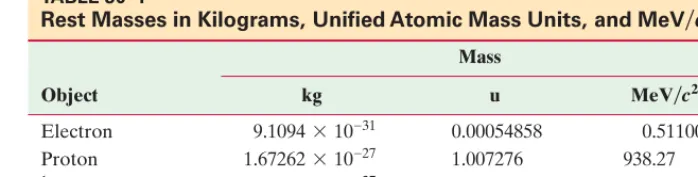
The rest masses of some of the basic particles are given in Table 30–1. As a rule of thumb, to remember, the masses of neutron and proton are about
which is about 2000 times the mass of an electronAL 1
2MeV兾c2B.
A= 1000MeV兾c2B
1GeV兾c2
1u = 1.6605 * 10–27kg = 931.5MeV兾c2.
E = mc2 = A
1.66054 * 10–27kgBA2.9979 * 108m兾sB2
A1.6022 * 10–19J兾eVB = 931.5MeV.
MeV(= 106eV)
1.0000u = (1.0000 u)¢
1.67262 * 10–27kg
1.007276u ≤ = 1.66054 * 10
–27kg;
1.67262 * 10–27kg,
E = mc2
1eV=1.6022*10–19J
1 1H 12
6C
TABLE 30–1
Rest Masses in Kilograms, Unified Atomic Mass Units, and MeV c2
Mass
Object kg u
Electron 0.00054858 0.51100
Proton 1.007276 938.27
atom 1.007825 938.78
Neutron 1.008665 1.67493 * 10–27 939.57
1.67353 * 10–27 1
1H
1.67262 * 10–27 9.1094 * 10–31
MeV
Ⲑ
c2Ⲑ
Just as an electron has intrinsic spin and angular momentum quantum numbers, so too do nuclei and their constituents, the proton and neutron. Both the proton and the neutron are spin particles, just like the electron. A nucleus, made up of pro-tons and neutrons, has a nuclear spinquantum number,I, that can be either integer or half integer, depending on whether it is made up of an even or an odd number of nucleons.
30–2
Binding Energy and Nuclear Forces
Binding Energies
The total mass of a stable nucleus is always less than the sum of the masses of its separate protons and neutrons, as the following Example shows.
mass compared to its constituents. Compare the mass of a atom to the total mass of its constituent particles.
APPROACH The nucleus contains 2 protons and 2 neutrons. Tables normally give the masses of neutral atoms—that is, nucleus plus its Zelectrons. We must therefore be sure to balance out the electrons when we compare masses. Thus we use the mass of rather than that of a proton alone. We look up the mass of the atom in Appendix B (it includes the mass of 2 electrons), as well as the mass for the 2 neutrons and 2 hydrogen atoms (= 2 protons + 2 electrons).
4 2He
1 1H
4 2He 4
2He 4 2He EXAMPLE 30;3
1 2
P R O B L E M S O L V I N G Keep track of electron masses C A U T I O N
SOLUTION The mass of a neutral atom, from Appendix B, is 4.002603 u. The mass of two neutrons and two H atoms (2 protons including the 2 electrons) is
Thus the mass of is measured to be less than the masses of its constituents by an amount
Where has this lost mass of 0.030377 u disappeared to? It must be
If the four nucleons suddenly came together to form a nucleus, the mass “loss” would appear as energy of another kind (such as radiation, or kinetic energy). The mass (or energy) difference in the case of given in energy units,
is This difference is referred to as
thetotal binding energyof the nucleus. The total binding energy represents the amount of energy that must be put intoa nucleus in order to break it apart into its constituents. If the mass of, say, a nucleus were exactly equal to the mass of two neutrons plus two protons, the nucleus could fall apart without any input of energy. To be stable, the mass of a nucleus mustbe less than that of its con-stituent nucleons, so that energy input isneeded to break it apart.
Binding energy is not something a nucleus has—it is energy it “lacks” relative to the total mass of its separate constituents.
[As a comparison, we saw in Chapter 27 that the binding energy of the one electron in the hydrogen atom is 13.6 eV; so the mass of a atom is less than that of a single proton plus a single electron by The binding energies of nuclei are on the order of MeV, so the eV binding energies of elec-trons can be ignored. Nuclear binding energies, compared to nuclear masses, are
on the order of where we used helium’s binding
energy of 28.3 MeV (see above) and mass ]
EXERCISE A Determine how much less the mass of the nucleus is compared to that of its constituents. See Appendix B.
The binding energy per nucleonis defined as the total binding energy of a nucleus divided by A, the total number of nucleons. We calculated above that the binding energy of is 28.3 MeV, so its binding energy per nucleon is
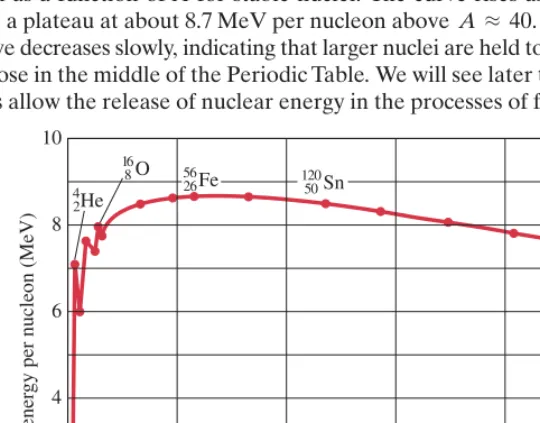
Figure 30–1 shows the measured binding energy per nucleon as a function of Afor stable nuclei. The curve rises as Aincreases and reaches a plateau at about 8.7 MeV per nucleon above Beyond
the curve decreases slowly, indicating that larger nuclei are held together less tightly than those in the middle of the Periodic Table. We will see later that these charac-teristics allow the release of nuclear energy in the processes of fission and fusion.
A L 80,
A L 40.
28.3MeV兾4 = 7.1MeV.
4 2He
3 7Li
4 * 940MeV L 4000MeV.
L
(28MeV兾4000MeV) L 1*10–2,
13.6eV兾c2. 1 1H 4
2He
(0.030377u)(931.5MeV兾u) = 28.30MeV.
4 2He,
2 4He
E = mc2.
4.032980u - 4.002603u = 0.030377u.
2 4He
sum = 4.032980u.
2mA1
1HB = 2(1.007825u) = 2.015650u
2mn = 2(1.008665u) = 2.017330u
4 2He
SECTION 30–2
861
FIGURE 30–1 Binding energy pernucleon for the more stable nuclides as a function of mass numberA.
Number of nucleons, A (mass number)
Binding ener
gy per nucleon (MeV)
10
250 0
8
6
4
2
200 150
100 50
0
1H
2
2He
3
2He
4
8O
16
50Sn
120
92U 238 56
26Fe
C A U T I O N
Mass of nucleus must be less
Binding energy for iron. Calculate the total binding energy and the binding energy per nucleon for the most common stable isotope of iron.
APPROACH We subtract the mass of a atom from the total mass of 26 hydro-gen atoms and 30 neutrons, all found in Appendix B. Then we convert mass units to energy units; finally we divide by the total number of nucleons. SOLUTION has 26 protons and 30 neutrons whose separate masses are
The total binding energy is thus
and the binding energy per nucleon is
NOTE The binding energy per nucleon graph (Fig. 30–1) peaks about here, for iron. So the iron nucleus, and its neighbors, are the most stable of nuclei.
EXERCISE B Determine the binding energy per nucleon for
Binding energy of last neutron. What is the binding energy of the last neutron in
APPROACH If lost one neutron, it would be We subtract the mass of from the masses of and a free neutron.
SOLUTION Obtaining the masses from Appendix B, we have
which in energy is That is, it would
require 4.95 MeV input of energy to remove one neutron from
Nuclear Forces
We can analyze nuclei not only from the point of view of energy, but also from the point of view of the forces that hold them together. We might not expect a collection of protons and neutrons to come together spontaneously, since protons are all positively charged and thus exert repulsive electric forces on each other. Since stable nuclei dostay together, another force must be acting. This new force has to be stronger than the electric force in order to hold the nucleus together, and is called the strong nuclear force. The strong nuclear force acts as an attractive force between all nucleons, protons and neutrons alike. Thus protons attract each other via the strong nuclear force at the same time they repel each other via the electric force. Neutrons, because they are electrically neutral, only attract other neutrons or protons via the strong nuclear force.
The strong nuclear force turns out to be far more complicated than the gravitational and electromagnetic forces. One important aspect of the strong nuclear force is that it is a short-rangeforce: it acts only over a very short distance.
13 6C.
(931.5MeV兾u)(0.005310u) = 4.95MeV.
¢m = 0.005310u
Subtract mass of 13
6C: –13.003355u
Total = 13.008665u.
Mass 1
0n = 1.008665u
Mass 12
6C = 12.000000u
12 6C 13
6C
12 6C. 13
6C 13
6C? EXAMPLE 30;5
16 8O.
492.26MeV
56 nucleons = 8.79MeV.
(0.52846u)(931.5MeV兾u) = 492.26MeV
¢m = 0.52846u.
Subtract mass of 56
26Fe: = –55.93494u (Appendix B)
sum = 56.46340u.
30mn = (30)(1.008665u) = 30.25995u
26mA1
1HB = (26)(1.007825u) = 26.20345u (includes 26 electrons)
56 26Fe
A = 56, 56 26Fe
It is very strong between two nucleons if they are less than about apart, but it is essentially zero if they are separated by a distance greater than this. Compare this to electric and gravitational forces, which decrease as but continue acting over any distances and are therefore called long-rangeforces.
The strong nuclear force has some strange features. For example, if a nuclide contains too many or too few neutrons relative to the number of protons, the binding of the nucleons is reduced; nuclides that are too unbalanced in this regard are unstable. As shown in Fig. 30–2, stable nuclei tend to have the same number of protons as neutrons up to about . Beyond this, stable nuclei contain more neutrons than protons. This makes sense since, as Z increases, the electrical repulsion increases, so a greater number of neutrons— which exert only the attractive strong nuclear force—are required to maintain stability. For very large Z, no number of neutrons can overcome the greatly increased electric repulsion. Indeed, there are no completely stable nuclides above
What we mean by a stable nucleusis one that stays together indefinitely. What then is an unstable nucleus? It is one that comes apart; and this results in radioac-tive decay. Before we discuss the important subject of radioactivity (next Section), we note that there is a second type of nuclear force that is much weaker than the strong nuclear force. It is called the weak nuclear force, and we are aware of its existence only because it shows itself in certain types of radioactive decay. These two nuclear forces, the strong and the weak, together with the gravitational and electromagnetic forces, comprise the four fundamental types of force in nature.
30–3
Radioactivity
Nuclear physics had its beginnings in 1896. In that year, Henri Becquerel (1852–1908) made an important discovery: in his studies of phosphorescence, he found that a certain mineral (which happened to contain uranium) would darken a photographic plate even when the plate was wrapped to exclude light. It was clear that the mineral emitted some new kind of radiation that, unlike X-rays (Section 25–11), occurred without any external stimulus. This new phenomenon eventually came to be called radioactivity.
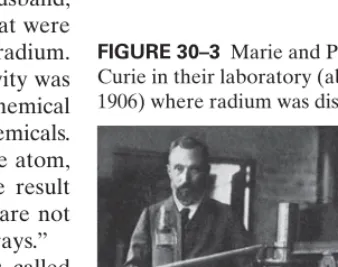
Soon after Becquerel’s discovery, Marie Curie (1867–1934) and her husband, Pierre Curie (1859–1906), isolated two previously unknown elements that were very highly radioactive (Fig. 30–3). These were named polonium and radium. Other radioactive elements were soon discovered as well. The radioactivity was found in every case to be unaffected by the strongest physical and chemical treatments, including strong heating or cooling or the action of strong chemicals. It was suspected that the source of radioactivity must be deep within the atom, coming from the nucleus. It became apparent that radioactivity is the result of the disintegrationor decayof an unstable nucleus. Certain isotopes are not stable, and they decay with the emission of some type of radiation or “rays.”
Many unstable isotopes occur in nature, and such radioactivity is called “natural radioactivity.” Other unstable isotopes can be produced in the laboratory by nuclear reactions (Section 31–1); these are said to be produced “artificially” and to have “artificial radioactivity.” Radioactive isotopes are sometimes referred to as radioisotopesorradionuclides.
Rutherford and others began studying the nature of the rays emitted in radioactivity about 1898. They classified the rays into three distinct types accord-ing to their penetrataccord-ing power. One type of radiation could barely penetrate a piece of paper. The second type could pass through as much as 3 mm of aluminum. The third was extremely penetrating: it could pass through several centimeters of lead and still be detected on the other side. They named these three types of radiation alpha beta and gamma respectively, after the first three letters of the Greek alphabet.
(g),
(b),
(a),
Z = 82.
A = 30
(N = Z)
1兾r2 10–15m
SECTION 30–3 Radioactivity
863
FIGURE 30–2 Number of neutrons versus number of protons for stable nuclides, which are represented by dots. The straight line represents N = Z.FIGURE 30–3 Marie and Pierre Curie in their laboratory (about 1906) where radium was discovered.
Proton number (Z)
Neutron number (
N
⫽
A
⫺
Z
)
20 40 60 80
120
100
80
60
40
20
0 0
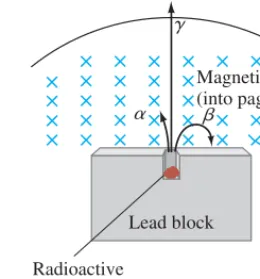
Each type of ray was found to have a different charge and hence is bent dif-ferently in a magnetic field, Fig. 30–4; rays are positively charged, rays are negatively charged, and rays are neutral. It was soon found that all three types of radiation consisted of familiar kinds of particles. Gamma rays are very high-energyphotonswhose energy is even higher than that of X-rays. Beta rays were found to be identical to electrons that orbit the nucleus, but they are created within the nucleus itself. Alpha rays (or particles) are simply the nuclei of helium atoms, that is, an ray consists of two protons and two neutrons bound together.
We now discuss each of these three types of radioactivity, or decay, in more detail.
30–4
Alpha Decay
Experiments show that when nuclei decay, the number of nucleons ( numberA) is conserved, as well as electric charge When a nucleus emits an particle the remaining nucleus will be different from the original: it has lost two protons and two neutrons. Radium 226 for example, is an
emitter. It decays to a nucleus with and
The nucleus with is radon (Rn)—see Appendix B or the Periodic Table. Thus radium decays to radon with the emission of an particle. This is written
See Fig. 30–5.
When decay occurs, a different element is formed. The daughternucleus ( in this case) is different from the parentnucleus ( in this case). This changing of one element into another is called transmutationof the elements.
Alpha decay can be written in general as
whereNis the parent, the daughter, and ZandAare the atomic number and atomic mass number, respectively, of the parent.
EXERCISE C decays by emission to what element? (a) Pb, (b) Gd, (c) Sm,
(d) Er, (e) Yb.
Alpha decay occurs because the strong nuclear force is unable to hold very large nuclei together. The nuclear force is a short-range force: it acts only between neighboring nucleons. But the electric force acts all the way across a large nucleus. For very large nuclei, the large Zmeans the repulsive electric force becomes so large (Coulomb’s law) that the strong nuclear force is unable to hold the nucleus together.
a 66
154Dy
N¿
[a decay] Z
AN S
Z-2 A-4
N¿ + 24He
88 226Ra 86
222Rn
a
88 226Ra S
86 222Rn +
2 4He.
a
Z = 86
A = 226-4 = 222.
Z = 88-2 = 86
a
(22688Ra),
(24He),
a
(= Ze).
= mass
a
2 4He;
a g
b a
FIGURE 30–4 Alpha and beta rays are bent in opposite directions by a magnetic field, whereas gamma rays are not bent at all.
FIGURE 30–5 Radioactive decay of radium to radon with emission of an alpha particle.
Radioactive sample (radium)
Magnetic field (into page)
Lead block g
b a
226 88Ra
222 86Rn
4 2He
n
n n
p 138
88 p
136
86 p
2 2
We can express the instability of the parent nucleus in terms of energy (or mass): the mass of the parent nucleus is greater than the mass of the daughter nucleus plus the mass of the particle. The mass difference appears as kinetic energy, which is carried away by the particle and the recoiling daughter nucleus. The total energy released is called the disintegration energy,Q, or the Q-value of the decay. From conservation of energy,
whereQequals the kinetic energy of the daughter and particle, and
and are the masses of the parent, daughter, and particle, respectively. Thus (30;2) If the parent had lessmass than the daughter plus the particle (so ), the decay would violate conservation of energy. Such decays have never been observed, another confirmation of this great conservation law.
Uranium decay energy release. Calculate the
disintegra-tion energy when decays to (228.028741 u)
with the emission of an particle. (As always, masses given are for neutral atoms.) APPROACH We use conservation of energy as expressed in Eq. 30–2. is the parent, is the daughter.
SOLUTION Since the mass of the is 4.002603 u (Appendix B), the total mass in the final state is
The mass lost when the decays is
Because the energy Qreleased is
and this energy appears as kinetic energy of the particle and the daughter nucleus.
Additional Example
Kinetic energy of the in decay. For the decay of Example 30–6, how much of the 5.4-MeV disintegration energy will be carried off by the particle?
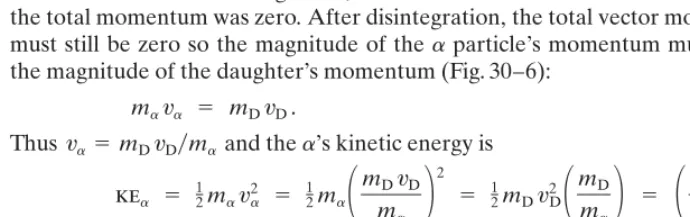
APPROACH In any reaction, momentum must be conserved as well as energy. SOLUTION Before disintegration, the nucleus can be assumed to be at rest, so the total momentum was zero. After disintegration, the total vector momentum must still be zero so the magnitude of the particle’s momentum must equal the magnitude of the daughter’s momentum (Fig. 30–6):
Thus and the kinetic energy is
The total disintegration energy is Hence
The lighter particle carries off (57 58) or 98%of the total kinetic energy. The total energy released is 5.4 MeV, so the daughter nucleus, which recoils in the opposite direction, carries off only 0.1 MeV.
兾
a
kea = 57keD =
57
58Q = 5.3MeV.
Q = kea + keD = 57keD + keD = 58keD.
= a
228.028741u
4.002603u bkeD = 57keD.
kea =
1
2mava2 =
1 2ma¢
mDvD
ma ≤
2
= 12mDvD2¢
mD
ma≤
= ¢
mD
ma≤
keD
a’s
va = mDvD兾ma
mava = mDvD.
a a
92 232U 92
232U
A
EXAMPLE 30;7
a
Q = (0.005812u)(931.5MeV兾u) = 5.4MeV
1u = 931.5MeV,
232.037156u - 232.031344u = 0.005812u.
AmU - mTh - mHeB 92
232U
228.028741u + 4.002603u = 232.031344u.
AmTh + mHeB 2 4He 90
228Th 92
232U
a
90 228Th 92
232U(mass = 232.037156 u)
EXAMPLE 30;6
Q 6 0
a
Q = MPc2 - AMD + maBc2.
a
ma
MP,MD,
a
MPc2 = MDc2 + mac2 + Q,
a a
SECTION 30–4 Alpha Decay
865
FIGURE 30–6 Momentumconservation in Example 30–7.
m
␣v␣ B
v
D
m
D
B
Daughter nucleus
␣
Why Particles?
Why, you may wonder, do nuclei emit this combination of four nucleons called an particle? Why not just four separate nucleons, or even one? The answer is that the particle is very strongly bound, so that its mass is significantly less than that of four separate nucleons. That helps the final state in decay to have less total mass, thus allowing certain nuclides to decay which could not decay to, say, 2 protons plus 2 neutrons. For example, could not decay to
because the masses of the daughter plus four separate nucleons is .061721 u, which is greater than the mass of the parent (232.037156 u). Such a decay would violate the conservation of energy. Indeed, we have never seen
Similarly, it is almost always true that the emission of a single nucleon is energet-ically not possible; see Example 30–5.
Smoke Detectors—An Application
One widespread application of nuclear physics is present in nearly every home in the form of an ordinary smoke detector. One type of smoke detector contains about 0.2 mg of the radioactive americium isotope, in the form of
The radiation continually ionizes the nitrogen and oxygen molecules in the air space between two oppositely charged plates. The resulting conductivity allows a small steady electric current. If smoke enters, the radiation is absorbed by the smoke particles rather than by the air molecules, thus reducing the current. The current drop is detected by the device’s electronics and sets off the alarm. The radiation dose that escapes from an intact americium smoke detector is much less than the natural radioactive background, and so can be considered relatively harmless. There is no question that smoke detectors save lives and reduce property damage.
30–5
Beta Decay
Decay
Transmutation of elements also occurs when a nucleus decays by decay—that is, with the emission of an electron or particle. The nucleus for example, emits an electron when it decays:
where is the symbol for the electron. The particle known as the neutrino has charge and a very small mass, long thought to be zero. It was not initially detected and was only later hypothesized to exist, as we shall discuss later in this Section. No nucleons are lost when an electron is emitted, and the total number of nucleons,A, is the same in the daughter nucleus as in the parent. But because an electron has been emitted from the nucleus itself, the charge on the daughter nucleus is greater than that on the parent. The parent nucleus in the decay written above had so from charge conservation the nucleus remaining behind must have a charge of So the daughter nucleus has which is nitrogen.
It must be carefully noted that the electron emitted in decay is notan orbital electron. Instead, the electron is created within the nucleus itself. What happens is that one of the neutrons changes to a proton and in the process (to conserve charge) emits an electron. Indeed, free neutrons actually do decay in this fashion:
To remind us of their origin in the nucleus, the electrons emitted in decay are often referred to as “ particles.” They are, nonetheless, indistinguishable from orbital electrons.
b
b
n S p + e– + neutrino.
b
Z = 7,
±7e.
Z = ±6,
±1e q = 0 e–
6 14C S
7
14N + e– + neutrino,
6 14C,
b–
b
B
ⴚAmO2.
95 241Am, 92 232U S
90
228Th + 2p + 2n. 92
232U
228.028741u+2(1.007825u)+2(1.008665u) =232
90 228Th
2p + 2n
92 232U
a a
a
A
P H Y S I C S A P P L I E D Smoke detector
C A U T I O N
Energy release in decay. How much energy is released when decays to by emission?
APPROACH We find the mass difference before and after decay, The energy released is The masses given in Appendix B are those of the neutral atom, and we have to keep track of the electrons involved. Assume the parent nucleus has six orbiting electrons so it is neutral; its mass is 14.003242 u. The daughter in this decay, is not neutral because it has the same six orbital elec-trons circling it but the nucleus has a charge of However, the mass of this daughter with its six electrons, plus the mass of the emitted electron (which makes a total of seven electrons), is just the mass of a neutral nitrogen atom.
SOLUTION The total mass in the final state is
and this is equal to
which from Appendix B is a mass of 14.003074 u. So the mass difference is which is equivalent to an energy
change or 156 keV.
NOTE The neutrino doesn’t contribute to either the mass or charge balance because it has and
According to Example 30–8, we would expect the emitted electron to have a kinetic energy of 156 keV. (The daughter nucleus, because its mass is very much larger than that of the electron, recoils with very low velocity and hence gets very little of the kinetic energy—see Example 30–7.) Indeed, very careful measure-ments indicate that a few emitted particles do have kinetic energy close to this calculated value. But the vast majority of emitted electrons have somewhat less energy. In fact, the energy of the emitted electron can be anywhere from zero up to the maximum value as calculated above. This range of electron kinetic energy was found for any decay. It was as if the law of conservation of energy was being violated, and Bohr actually considered this possibility. Careful experiments indicated that linear momentum and angular momentum also did not seem to be conserved. Physicists were troubled at the prospect of giving up these laws, which had worked so well in all previous situations.
In 1930, Wolfgang Pauli proposed an alternate solution: perhaps a new parti-cle that was very difficult to detect was emitted during decay in addition to the electron. This hypothesized particle could be carrying off the energy, momentum, and angular momentum required to maintain the conservation laws. This new particle was named the neutrino—meaning “little neutral one”—by the great Italian physicist Enrico Fermi (1901–1954; Fig. 30–7), who in 1934 worked out a detailed theory of decay. (It was Fermi who, in this theory, postulated the existence of the fourth force in nature which we call the weak nuclear force.) The neutrino has zero charge, spin of and was long thought to have zero mass, although today we are quite sure that it has a very tiny mass If its mass were zero, it would be much like a photon in that it is neutral and would travel at the speed of light. But the neutrino is very difficult to detect. In 1956, complex experiments produced further evidence for the existence of the neutrino; but by then, most physicists had already accepted its existence.
The symbol for the neutrino is the Greek letter nu The correct way of writing the decay of is then
The bar over the neutrino symbol is to indicate that it is an “antineutrino.” (Why this is called an antineutrino rather than simply a neutrino is discussed in Chapter 32.)
A B
6 14C S
7
14N + e– + R.
6 14C
(n).
A60.14eV兾c2B. 1
2U,
b
b b
b
m L 0.
q = 0
¢mc2 = (0.000168u)(931.5MeV兾u) = 0.156MeV
14.003242u - 14.003074u = 0.000168u,
mass of neutral 147N(includes 7 electrons),
Amass of 147N nucleus + 6 electronsB + (mass of 1 electron),
±7e. 7
14N,
E = (¢m)c2.
¢m.
b
7 14N 6
14C 6
14C EXAMPLE 30;8
SECTION 30–5 Beta Decay
867
C A U T I O NBe careful with atomic and electron
masses in decayb
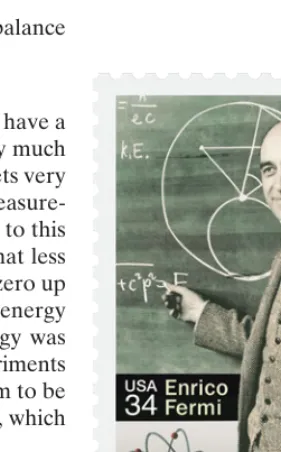
FIGURE 30–7 Enrico Fermi, as portrayed on a US postage stamp. Fermi contributed significantly to both theoretical and experimental physics, a feat almost unique in modern times: statistical theory of identical particles that obey the exclusion principle ( fermions); theory of the weak interaction and
decay; neutron physics; induced radioactivity and new elements; first nuclear reactor; first resonance of particle physics; led and inspired a vast amount of other nuclear research.
b
In decay, it is the weak nuclear force that plays the crucial role. The neu-trino is unique in that it interacts with matter only via the weak force, which is why it is so hard to detect.
Decay
Many isotopes decay by electron emission. They are always isotopes that have too many neutrons compared to the number of protons. That is, they are isotopes that lie above the stable isotopes plotted in Fig. 30–2. But what about unstable isotopes that have too few neutrons compared to their number of protons— those that fall below the stable isotopes of Fig. 30–2? These, it turns out, decay by emitting a positroninstead of an electron. A positron (sometimes called an or
particle) has the same mass as the electron, but it has a positive charge of Because it is so like an electron, except for its charge, the positron is called the antiparticle†to the electron. An example of a decay is that of
where stands for a positron. Note that the emitted here is a neutrino, whereas that emitted in decay is called an antineutrino. Thus an antielectron is emitted with a neutrino, whereas an antineutrino is emitted with an electron; this gives a certain balance as discussed in Chapter 32.
We can write and decay, in general, as follows:
where N is the parent nucleus and is the daughter.
Electron Capture
Besides and emission, there is a third related process. This is electron capture(abbreviated EC in Appendix B) and occurs when a nucleus absorbs one of its orbiting electrons. An example is which as a result becomes The process is written
or, in general,
Usually it is an electron in the innermost (K) shell that is captured, in which case the process is called K-capture. The electron disappears in the process, and a proton in the nucleus becomes a neutron; a neutrino is emitted as a result. This process is inferred experimentally by detection of emitted X-rays (due to other electrons jumping down to fill the state of the captured ).
30–6
Gamma Decay
Gamma rays are photons having very high energy. They have their origin in the decay of a nucleus, much like emission of photons by excited atoms. Like an atom, a nucleus itself can be in an excited state. When it jumps down to a lower energy state, or to the ground state, it emits a photon which we call a ray. The possible states of a nucleus are much farther apart in energy than those of an atom: on the order of keV or MeV, as compared to a few eV for electrons in an atom. Hence, the emitted photons have energies that can range from a few keV to several MeV. For a given decay, the ray always has the same energy. Since a
ray carries no charge, there is no change in the element as a result of a decay. How does a nucleus get into an excited state? It may occur because of a vio-lent collision with another particle. More commonly, the nucleus remaining after a previous radioactive decay may be in an excited state. A typical example is shown
g g
g
g
e
-[electron capture] Z
AN + e– S Z-1
A N¿ + n. 4
7Be + e– S
3 7Li + n,
3 7Li. 4
7Be,
b± b–
N¿
Cb± decayD Z
AN S
Z-1
A N¿ + e± + n,
Cb– decayD Z
AN S
Z+1
A N¿ + e– + R
b± b–
(= positron)
b–
n
e±
10 19Ne S
9
19F + e± + n,
10 19Ne:
b±
±1e.
b±
e±
B
ⴙb
†Discussed in Chapter 32. Briefly, an antiparticle has the same mass as its corresponding particle, but
opposite charge. A particle and its antiparticle can quickly annihilate each other, releasing energy in the form of two rays:g e± +e– S 2g.
Proton number (Z)
Neutron number (
N
⫽
A
⫺
Z
)
20 40 60 80
120
100
80
60
40
20
0 0
N⫽Z Stable nuclei
in the energy-level diagram of Fig. 30–8. can decay by decay directly to the ground state of or it can go by decay to an excited state of written which itself decays by emission of a 4.4-MeV ray to the ground state of .
We can write decay as
where the asterisk means “excited state” of that nucleus.
What, you may wonder, is the difference between a ray and an X-ray? They both are electromagnetic radiation (photons) and, though rays usually have higher energy than X-rays, their range of energies overlap to some extent. The difference is not intrinsic. We use the term X-ray if the photon is produced by an electron–atom interaction, and ray if the photon is produced in a nuclear process.
Isomers; Internal Conversion
In some cases, a nucleus may remain in an excited state for some time before it emits a ray. The nucleus is then said to be in a metastable stateand is called an isomer.
An excited nucleus can sometimes return to the ground state by another process known as internal conversionwith no ray emitted. In this process, the excited nucleus interacts with one of the orbital electrons and ejects this electron from the atom with the same kinetic energy (minus the binding energy of the electron) that an emitted ray would have had.
30–7
Conservation of Nucleon Number
and Other Conservation Laws
In all three types of radioactive decay, the classical conservation laws hold. Energy, linear momentum, angular momentum, and electric charge are all conserved. These quantities are the same before the decay as after. But a new conservation law is also revealed, the law of conservation of nucleon number. According to this law, the total number of nucleons (A) remains constant in any process, although one type can change into the other type (protons into neutrons or vice versa). This law holds in all three types of decay. [In Chapter 32 we will generalize this and call it conservation of baryon number.]
Table 30–2 gives a summary of and decay.
30–8
Half-Life and Rate of Decay
A macroscopic sample of any radioactive isotope consists of a vast number of radioactive nuclei. These nuclei do not all decay at one time. Rather, they decay one by one over a period of time. This is a random process: we can not predict exactly when a given nucleus will decay. But we can determine, on a probabilistic basis, approximately how many nuclei in a sample will decay over a given time period, by assuming that each nucleus has the same probability of decaying in each second that it exists.
The number of decays that occur in a very short time interval is then proportional to and to the total number N of radioactive (parent) nuclei present:
(30;3a)
where the minus sign means Nis decreasing. We rewrite this to get the rate of decay(number of decays per second):
(30;3b)
In these equations, is a measurable constant called the decay constant, which is different for different isotopes. The greater is, the greater the rate of decay, ¢N兾¢t, and the more “radioactive” that isotope is said to be.
SECTION 30–8 Half-Life and Rate of Decay
869
TABLE 30–2 The ThreeTypes of Radioactive Decay
decay:
decay:
decay:
†Electron capture.
*Indicates the excited state of a nucleus. Z
FIGURE 30–8 Energy-level diagram showing how can decay to the ground state of by decay (total energy MeV), or can instead decay to an excited state of (indicated by *), which subsequently decays to its ground state by emitting a 4.4-MeV ray.g
The number of decays that occur in the short time interval is designated because each decay that occurs corresponds to a decrease by one in the number N of parent nuclei present. That is, radioactive decay is a “one-shot” process, Fig. 30–9. Once a particular parent nucleus decays into its daughter, it cannot do it again.
Exponential Decay
Equation 30–3a or b can be solved for N(using calculus) and the result is (30;4)
where is the number of parent nuclei present at any chosen time and N is the number remaining after a time . The symbol eis the natural exponential (encountered earlier in Sections 19–6 and 21–12) whose value is
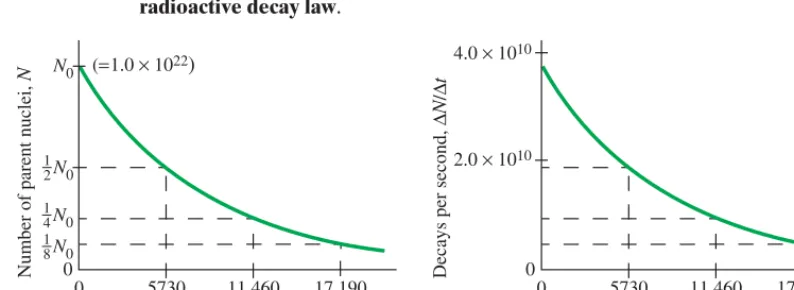
Thus the number of parent nuclei in a sample decreases exponentially in time. This is shown in Fig. 30–10a for the decay of . Equation 30–4 is called the radioactive decay law.
14 6C
e = 2.718p.
t
t = 0,
N0
N = N0e–lt,
¢N
¢t
1 2N0
N
0
1 4N0 1 8N0
Time, t (yr) Time, t (yr)
5730
Number of parent nuclei,
N
0
11,460 17,190
(a)
0 5730
4.0× 10¹⁰
2.0× 10¹⁰
0
11,460 17,190
(b)
0
Decays per second,
∆
N
/
∆
t
(=1.0× 10²²)
FIGURE 30–9 Radioactive nuclei decay one by one. Hence, the number of parent nuclei in a sample is continually decreasing. When a
nucleus emits an electron (b), the nucleus becomes a nucleus. Another decays in (c).
14 7N 14
6C
C atom (parent)
6 14
e -e
-(a) (b) (c)
Legend
N atom (daughter)
14 7
FIGURE 30–10 (a) The number Nof parent nuclei in a given sample of decreases exponentially. We assume a sample that has (b) The number of decays per second also decreases exponentially. The half-life of is 5730 yr, which means that the number of parent nuclei,N, and the rate of decay,¢N兾¢t, decrease by half every 5730 yr.
14 6C
N0 = 1.00* 1022nuclei.
14 6C
The number of decays per second, or decay rate R, is the magnitude of
and is also called the activityof the sample. The magnitude (always positive) of a quantity is often indicated using vertical lines. The magnitude of is written and it is proportional to N(see Eq. 30–3b). So it too decreases expo-nentially in time at the same rate (Fig. 30–10b). The activity of a pure sample at time is
(30;5)
where is the activity at
Equation 30–5 is also referred to as the radioactive decay law (as is Eq. 30–4).
Half-Life
The rate of decay of any isotope is often specified by giving its “half-life” rather than the decay constant The half-lifeof an isotope is defined as the time it takes for half the original amount of parent isotope in a given sample to decay.
l.
t = 0.
R0 = ∑¢N兾¢t∑0
R = `
¢N
¢t ` = R0e
–lt, t
∑¢N兾¢t∑
¢N兾¢t
For example, the half-life of is about 5730 years. If at some time a piece of petrified wood contains, say, nuclei of then 5730 years later it will contain half as many, nuclei. After another 5730 years it will contain nuclei, and so on. This is shown in Fig. 30–10a. Since the rate of decay is proportional to N, it, too, decreases by a factor of 2 every half-life (Fig. 30–10b).
The half-lives of known radioactive isotopes vary from very short ( s)
to more than The half-lives of many isotopes are given
in Appendix B. It should be clear that the half-life (which we designate ) bears an inverse relationship to the decay constant. The longer the half-life of an isotope, the more slowly it decays, and hence is smaller. Conversely, very active isotopes (large ) have very short half-lives. The precise relationship between half-life and decay constant is
(30;6)
We derive this in the next (optional) subsection.
EXERCISE D The half-life of is 2.6 years. How much will be left of a pure sample after 7.8 yr? (a) None. (b) (c) (d) (e)
EXERCISE E Return to the Chapter-Opening Question, page 857, and answer it again now. Try to explain why you may have answered differently the first time.
Deriving the Half-Life Formula
We can derive Eq. 30–6 starting from Eq. 30–4 by setting at
so
and
We take natural logs of both sides ( “ln” and “e” are inverse operations, meaning ) and find
so
and
which is Eq. 30–6.
Mean Life
Sometimes the mean life of an isotope is quoted, which is defined as
Then Eq. 30–4 can be written just as for RC and LR circuits (Chapters 19 and 21 where was called the time constant). The mean life of an isotope is then given by (see also Eq. 30–6)
[mean life] (30;7)
The mean life and half-life differ by a factor of 0.693, so confusing them can cause serious error (and has). The radioactive decay law, Eq. 30–5, can then be written as R = R
0e–t兾t.
t = 1 l =
T1 2
0.693.
t
N = N0e–t兾t,
t = 1兾l.
t
*
T1 2 =
ln 2
l =
0.693
l , lT1
2 = ln2 = 0.693
lnAelT1
2B = ln 2,
lnAexB = x
elT1
2 = 2.
1
2 = e
–lT1 2
N0
2 = N0e
–lT1 2
t = T1 2:
N = N0兾2
*
0.693mg.
1 2 mg. 1
4 mg. 1
8 mg.
1.0-mg 11
22Na 11
22Na
T1 2 =
ln 2
l =
0.693
l . l
l
T1 2
1023yrA71030sB.
L10–22
¢N兾¢t
0.25 * 1022
0.50 * 1022
14 6C,
1.00 * 1022
14 6C
SECTION 30–8 Half-Life and Rate of Decay
871
C A U T I O N30–9
Calculations Involving Decay
Rates and Half-Life
Let us now consider Examples of what we can determine about a sample of radioactive material if we know the half-life.
Sample activity. The isotope has a half-life of 5730 yr. If a sample contains carbon-14 nuclei, what is the activity of the sample?
APPROACH We first use the half-life to find the decay constant (Eq. 30–6), and use that to find the activity, Eq. 30–3b. The number of seconds in a year is
SOLUTION The decay constant from Eq. 30–6 is
From Eqs. 30–3b and 30–5, the activity or rate of decay is
Notice that the graph of Fig. 30–10b starts at this value, corresponding to the original value of nuclei in Fig. 30–10a.
NOTE The unit “decays/ s” is often written simply as since “decays” is not a unit but refers only to the number. This simple unit of activity is called the
becquerel: as discussed in Chapter 31.
Safety: Activity versus half-life. One might think that a short half-life material is safer than a long half-life material because it will not last as long. Is that true?
RESPONSE No. A shorter half-life means the activity is higher and thus more “radioactive” and can cause more biological damage. In contrast, a longer half-life for the same sample size Nmeans a lower activity but we have to worry about it for longer and find safe storage until it reaches a safe (low) level of activity.
A sample of radioactive A laboratory has of pure which has a half-life of 10.0 min (600 s). (a) How many nuclei are present initially? (b) What is the rate of decay (activity) initially? (c) What is the activity after 1.00 h? (d) After approximately how long will the activity drop to less than one per second
APPROACH We use the definition of the mole and Avogadro’s number (Sections 13–6 and 13–8) to find (a) the number of nuclei. For (b) we get from the given half-life and use Eq. 30–3b for the rate of decay. For (c) and (d) we use Eq. 30–5.
SOLUTION (a) The atomic mass is 13.0, so 13.0 g will contain
(Avogadro’s number). We have only so the number of nuclei that we have initially is given by the ratio
Solving for we find (b) From Eq. 30–6,
Then, at (see Eqs. 30–3b and 30–5)
R0 = `
¢N
¢t ` 0
= lN0 = A1.155*10–3s–1BA6.90*1016B = 7.97*1013decays兾s. t = 0
l = 0.693兾T1
2 = (0.693)兾(600s) = 1.155 * 10
–3s–1.
N0 = 6.90 * 1016nuclei.
N0,
N0
6.02 * 1023 =
1.49 * 10–6g
13.0g .
N0 1.49 * 10–6g,
6.02 *1023nuclei
l
A= 1s–1B? 7
13N,
1.49mg
7 13N. EXAMPLE 30;11
CONCEPTUAL EXAMPLE 30;10
1Bq = 1decay兾s,
s–1
N = 1.0 * 1022
= 3.83*1010 decays兾s.
R = `
¢N
¢t ` = lN = A3.83*10
–12s–1BA1.00*1022B
l = 0.693
T1 2
= 0.693
(5730yrBA3.156 * 107s兾yrB = 3.83 * 10
–12s–1.
l
(60)(60)(24)A36514B = 3.156 * 107s.
1.00 * 1022
206
(c) After the magnitude of the activity will be (Eq. 30–5)
(d) We want to determine the time when From Eq. 30–5, we have
We take the natural log (ln) of both sides and divide by to find
Easy Alternate Solution to (c) is 6 half-lives, so the
activity will decrease to of its original value, or
per second.
30–10
Decay Series
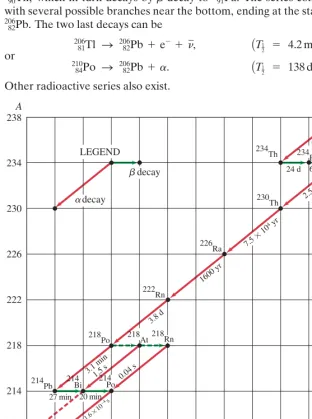
It is often the case that one radioactive isotope decays to another isotope that is also radioactive. Sometimes this daughter decays to yet a third isotope which also is radioactive. Such successive decays are said to form a decay series. An important example is illustrated in Fig. 30–11. As can be seen, decays by emission to which in turn decays by decay to The series continues as shown, with several possible branches near the bottom, ending at the stable lead isotope,
The two last decays can be
or
Other radioactive series also exist. 210 FIGURE 30–11 Decay series
beginning with Nuclei in the series are specified by a dot representingAandZvalues. Half-lives are given in seconds (s), minutes (min), hours (h), days (d), or years (yr). Note that a horizontal arrow represents decay (Adoes not change), whereas a diagonal line represents decay (Achanges by 4,
Zchanges by 2). For the four nuclides shown that can decay by both and decay, the more prominent decay (in these four cases, ) is shown as a solid arrow and the less common decay
as a dashed arrow.
Because of such decay series, certain radioactive elements are found in nature that otherwise would not be. When the solar system (including Earth) was formed about 5 billion years ago, it is believed that nearly all nuclides were present, having been formed (by fusion and neutron capture, Sections 31–3 and 33–2) in a nearby supernova explosion (Section 33–2). Many isotopes with short half-lives decayed quickly and no longer are detected in nature today. But long-lived isotopes, such as with a half-life of still do exist in nature today. Indeed, about half of the original still remains. We might expect, however, that radium with a half-life of 1600 yr, would have disappeared from the Earth long ago. Indeed, the original nuclei must by now have all decayed. However, because decays (in several steps, Fig. 30–11) to the supply of is continually replenished, which is why it is still found on Earth today. The same can be said for many other radioactive nuclides.
Decay chain. In the decay chain of Fig. 30–11, if we look at the decay of we see four successive nuclides with half-lives of 250,000 yr, 75,000 yr, 1600 yr, and a little under 4 days. Each decay in the chain has an alpha particle of a characteristic energy, and so we can monitor the radioactive decay rate of each nuclide. Given a sample that was pure a million years ago, which alpha decay would you expect to have the highest activity rate in the sample?
RESPONSE The first instinct is to say that the process with the shortest half-life would show the highest activity. Surprisingly, perhaps, the activities of the four nuclides in this sample are all the same. The reason is that in each case the decay of the parent acts as a bottleneck to the decay of the daughter. Compared to the 1600-yr half-life of for example, its daughter decays almost immediately, but it cannot decay until it is made. (This is like an automobile assembly line: if worker A takes 20 minutes to do a task and then worker B takes only 1 minute to do the next task, worker B still does only one car every 20 minutes.)
30–11
Radioactive Dating
Radioactive decay has many interesting applications. One is the technique of radioactive datingby which the age of ancient materials can be determined.
The age of any object made from once-living matter, such as wood, can be determined using the natural radioactivity of All living plants absorb carbon dioxide from the air and use it to synthesize organic molecules. The vast majority of these carbon atoms are but a small fraction, about
is the radioactive isotope The ratio of to in the atmosphere has remained roughly constant over many thousands of years, in spite of the fact that decays with a half-life of about 5730 yr. This is because energetic nuclei in the cosmic radiation, which impinges on the Earth from outer space, strike nuclei of atoms in the atmosphere and break those nuclei into pieces, releasing free neutrons. Those neutrons can collide with nitrogen nuclei in the atmosphere to
produce the nuclear transformation That is, a neutron
strikes and is absorbed by a nucleus, and a proton is knocked out in the process. The remaining nucleus is This continual production of in the atmosphere roughly balances the loss of by radioactive decay.
As long as a plant or tree is alive, it continually uses the carbon from carbon dioxide in the air to build new tissue and to replace old. Animals eat plants, so they too are continually receiving a fresh supply of carbon for their tissues.
14 6C
14 6C 14
6C. 14
7N
n + 147N S 146C + p.
14 6C
12 6C 14
6C 14
6C.
1.3 * 10–12, 12
6C, (CO2)
14 6C.
222 86Rn 226
88Ra, 234
92U
234 92U,
CONCEPTUAL EXAMPLE 30;12
226 88Ra 226
88Ra,
238 92U
226 88Ra
A226 88RaB,
238 92U
4.5 * 109yr,
238 92U
Organisms cannot distinguish† from and because the ratio of to in the atmosphere remains nearly constant, the ratio of the two isotopes within the living organism remains nearly constant as well. When an organism dies, carbon dioxide is no longer taken in and utilized. Because the decays radioactively, the ratio of to in a dead organism decreases over time. The half-life of is about 5730 yr, so the ratio decreases by half every 5730 yr. If, for example, the ratio of an ancient wooden tool is half of what it is in living trees, then the object must have been made from a tree that was felled about 5730 years ago.
Actually, corrections must be made for the fact that the ratio in the atmosphere has not remained precisely constant over time. The determination of what this ratio has been over the centuries has required techniques such as com-paring the expected ratio to the actual ratio for objects whose age is known, such as very old trees whose annual rings can be counted reasonably accurately.
An ancient animal. The mass of carbon in an animal bone fragment found in an archeological site is 200 g. If the bone registers an activity
of what is its age?
APPROACH First we determine how many atoms there were in our 200-g sample when the animal was alive, given the known fraction of to
Then we use Eq. 30–3b to find the activity back then, and Eq. 30–5 to find out how long ago that was by solving for the time .
SOLUTION The 200 g of carbon is nearly all 12.0 g of contains atoms, so 200 g contains
When the animal was alive, the ratio of to in the bone was The number of nuclei at that time was
From Eq. 30–3b with (Example 30–9) the magnitude of the activity when the animal was still alive was
From Eq. 30–5
whereR, its activity now, is given as Then
or
We take the natural logs of both sides (and divide by ) to get
which is the time elapsed since the death of the animal.
= 2.98 * 1011s = 9400yr,
t = 1 l lna
50
16b =
1
3.83 * 10–12s–1 lna 50 16b
l
elt
= 50
16. 16s–1
= A50s–1Be–lt
16s–1.
R = R0e–lt
R0 = `
¢N
¢t `0 = lN0 = A3.83 * 10
–12s–1BA1.3 * 1013B
= 50s–1.
(t = 0)
l = 3.83 * 10–12s–1
N0 = A1.00 * 1025atomsBA1.3 * 10–12B = 1.3 * 1013atoms.
14 6C
1.3 * 10–12. 12
6C 14
6C
¢6.02 *12.01023gatoms兾mol 兾mol≤(200g) = 1.00 * 1025atoms.
6.02 * 1023
12 6C 12
6C;
t 1.3 * 10–12.
6 12C, 14
6C 14
6C 16decays兾s,
EXAMPLE 30;13
14 6C兾126C 14
6C兾126C 14
6C兾126C 14
6C
12 6C 14
6C
14 6C
12 6C 14
6C 12
6C, 14
6C
SECTION 30–11 Radioactive Dating
875
†Organisms operate almost exclusively via chemical reactions—which involve only the outer orbital
electrons of the atom; extra neutrons in the nucleus have essentially no effect.