
DOI: 10.1002/zaac.201400280
The Influence of a Single Transition Metal Atom on the Reactivity of Main
Group Metal Clusters in the Gas Phase
Marco Neumaier,
[a]Christian Schenk,
[b]Hansgeorg Schnöckel,
[a]and
Andreas Schnepf*
[b]Dedicated to Professor Martin Jansen on the Occasion of His 70th Birthday
Keywords:Catalysis; Collision induced dissociation; Germanium; Quantum chemical calculations
Abstract.Collision induced dissociation experiments of the metalloid clusters [(CO)5CrGe9R3]– 2 and [(CO)3CrGe9R3]– 3 are presented,
showing that2can lose Cr(CO)5or CO to give [Ge9R3]–1or3,
respec-tively. Further dissociation from3 leads first of all to the metalloid cluster [CrGe9R3]–4, from which different elimination routes start.
Introduction
Metalloid clusters of germanium of the general formula GenRm, wheren⬎mandRis a bulky ligand such as –Si(SiMe3)3
or –N(SiMe3)2represent a novel class of cluster compounds in
group 14 chemistry, being ideal model compounds to get an insight into the area between molecules and the solid state.[1]
This borderland is of particular interest, especially for metals or semimetals, as drastic changes of physical properties take place during reduction from salt-like oxidized species (e.g. oxides, halides: non-conducting) to the bulk elemental phase (metal: conducting; semimetal: semiconducting).[2]This
Figure 1.Molecular structure of [Ge9(Si(SiMe3)3)3]–(1) without SiMe3groups (left), space filling model of1with view along the threefold
axis (middle) and FTICR mass spectrum of1(right). * Prof. Dr. A. Schepf
E-Mail: [email protected] [a] KIT - IMK-ASF
Engesserstr. 15
76131 Karlsruhe, Germany
[b] Mathematisch Naturwissenschaftliche Fakultät Universität Tübingen
Auf der Morgenstelle 18 72076 Tübingen, Germany
Supporting information for this article is available on the WWW under http://dx.doi.org/10.1002/zaac.201400280or from the au-thor.
Thereby significant differences with respect to the chromium free clus-ter [Ge9R3]–1are observed, where beside C–H also Si–C and Si–Si
bond dissociation at low threshold energy take place, showing that4, with its additional chromium atom, is an ideal model system for a single atom catalyst.
area is also important for nanoscience as the realm between molecules and the solid state is the essence of nanotechnology. Gas phase investigations open the way to observe the behavior of an isolated cluster without disturbance of other clusters or solvent molecules.[3]In the case of the metalloid cluster anion
[Ge9R3]–[R= Si(SiMe3)3][4](1) (Figure 1) the dissociation
be-havior in the gas phase after collision induced dissociation (CID) via on and off resonant excitation has given first insights into the reactivity of group 14 metalloid clusters.[5]
Additionally oxidation reactions of 1 in a chlorine atmo-sphere have been possible giving further information about the redox chemistry of1 in the gas phase.[6] However in the
fol-lowing we will focus only on the CID experiments and shortly sum-up the so far obtained results for 1: Thereby the first dissociation step is the elimination of [Si(SiMe3)3]2 to give
[Ge9R]–.[7]As shown in Figure 2 two isomers of [Ge9R]–can
be formed that show a different fragmentation behavior. Hence the isomer with an intact Si(SiMe3)3 ligand (top in Figure 2)
further reacts to [Ge9Si(SiMe3)]–, [Ge9Si]–, and [Ge9]–. In
con-trast, the remaining Si(SiMe3)3 ligand can dismantle on the
cluster surface leading to the [E10(SiMe3)3]–isomer (bottom in
Figure 2.Schematic presentation of the reaction paths of the collision induced dissociation experiments of [Ge9R3]–[R= Si(SiMe3)3] (1) after
collision with argon atoms.
E10 cluster core (E10 = Ge9Si). Further elimination from
[E10(SiMe3)3]–leads to [E10(SiMe3)]–and [E10]–.[8]
Beside these investigations on the redox chemistry of [Ge9(Si(SiMe3)3)3]– (1) in the gas phase it could be recently
shown that1is also a good starting material for further buildup reactions in solution, where the easy accessible germanium atoms of the cluster core of 1 (Figure 1 middle) are used to connect two clusters of1by various transition metals to yield [MGe18R6]x[M= Cu, Ag, Au forX= –1 andM= Zn, Cd, Hg
forX = 0; R = Si(SiMe3)3].[9] Furthermore the reaction of a
solution of 1 with (CO)5Cr(COE) (COE = cyclooctene) or
(CO)3Cr(CH3CN)3 gave the adducts [(CO)5CrGe9R3]– 2 and
[(CO)3CrGe9R3]–3, respectively as crystalline compounds. In
case of 3the chromium atom is now part of the cluster core as shown in Figure 3 (right).[10]The isostructural molybdenum
and tungsten isomers of3are known as well.[11]Lately further
reactions of1 with reactive main group molecules have been conducted too, leading to neutral cluster compounds.[12]
As the chromium adducts 2 and 3 are accessible in high yield[10]and as they can be transferred intact into the gas phase
via electrospray ionization (Figure 3) comparable CID experi-ments as performed with1 are possible. Thereby the change in reactivity of the metalloid cluster1by the addition of one transition metal atom is most interesting and can be directly observed, being thus an ideal model compound for a single atom catalyst.[13]
Results and Discussion
To get an idea if and how the reactivity of the metalloid cluster [Ge9(Si(SiMe3)3)3]–(1) is changed by the addition of a
transition metal fragment similar CID experiments to those of
1(vide supra) were carried out with2and3(see Experimental Section for details). As different transition metal fragments are bound to the cluster core in2(Cr(CO)5) and3(Cr(CO)3) also
a different reactivity of2and3might be expected and will be discussed in the following.
Figure 3.Molecular structure of [(CO)5CrGe9R3]–2(upper left) and
[(CO)3CrGe9R3]–3(upper right), without SiMe3groups. The
respec-tive experimental and calculated isotopic pattern for2and3is shown beneath.
Collision induced Decomposition Experiments (CID) on [(CO)5CrGe9R3]–2
Firstly the metalloid cluster ion [(CO)5CrGe9R3]–2was
like [Ge9R]–, or via the loss of two CO molecules to give the
cluster ion [(CO)3CrGe9R3]– 3, whereby [(CO)4CrGe9R3]– is
only detected with low intensity {i.e. up to 5 % of the [(CO)3CrGe9R3]–signal}. The formation of1(m /z= 1396.7)
is thereby not much of a surprise as the Cr–Ge bond in 2 is the weakest bond to a ligand in the cluster molecule[14]
accord-ing to quantum chemical calculations.[15] The other
dissoci-ation pathway, where two CO molecules split off to give 3
reminds of the synthesis of 3 in solution, where 1 is treated with (CO)3Cr(CH3CN)3 and where presumably acetonitrile is
set free step by step during the reaction.[10]
Figure 4. Mass spectra of collision induced decomposition experi-ments (CID) on [(CO)5CrGe9R3]–2(m/z= 1588.6) shown as a function
of the collision energy from Ecm= 1.0 eV to 4.5 eV. The different product species are indicated by their elemental formulae [R = Si(SiMe3)3].
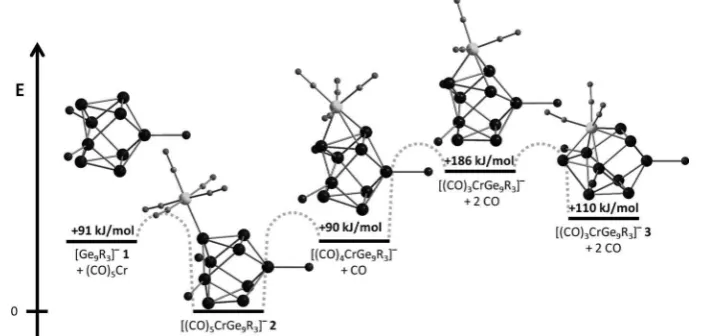
Therefore the consecutive loss of CO molecules from2to give3seems plausible. A scheme of the reaction path starting from2 to give1and (CO)5Cr or3 and two CO molecules is
emphasized in Figure 5 together with the calculated relative energies and structures. As can be seen in Figure 4, the CID experiments of [(CO)5CrGe9R3]– 2 lead to the main products
Figure 5.Assumed reaction path with calculated minimum structures of the collision induced reaction starting from2in the gas phase either losing CO molecules step by step to give3or losing (CO)5Cr to give1. Reaction barriers and transitions states haven’t been calculated.
[Ge9R3]– 1 and [(CO)3CrGe9R3]– 3 with a comparable
inten-sity. Thus competitive pathways are present with an experi-mental dissociation threshold of ca. 1.6 eV (vide infra). The formation of 1and 3 in nearly equal parts is thereby in line with a similar calculated reaction energy of 90 kJ·mol–1 and
110 kJ·mol–1 for the formation of 1 and 3 respectively (see
Figure 5).
As now the Cr(CO)3 adduct 3 is obtained during the
frag-mentation of2, similar chromium containing fragment ions of lower mass are expected for2and3. This assumption proved to be true as the mass spectrum of the CID experiments of3
(Figure 6) and2(Figure 4) are quite similar. Thus in the case of3only the chromium free products are missing as the chro-mium atom in3is now part of the cluster core and seemingly not to be removed that easy anymore. Consequently with re-spect to chromium containing fragments the dissociation path-way is similar for 2 and3 and will be discussed together in the following.
Figure 6.Selected mass spectrum of the CID experiments of3.
Collision induced Decomposition Experiments (CID) on [(CO)5CrGe9R3]–2 and [(CO)3CrGe9R3]–3
Starting from [(CO)3CrGe9R3]–3one would first expect the
[(CO)2CrGe9R3]– 3-CO, [(CO)CrGe9R3]– 3-2CO and
[CrGe9R3]–4(m/z= 1448.6), which are actually observed. The
fragment ions 3-COand 3-2COare thereby detected at low intensity during the CID experiments, whereby the intensity of the signal is sometimes so low that it can hardly be identified due to a poor signal to noise ratio.
The observed dissociation channels for2are summarized in Figure 7 together with the experimentally determined threshold energies, showing that beside the non radical compound6also a radical compound [CrGe9R2]– 5 (m/z = 1201.5) is present
within chromium containing ions at low collision energies starting from a dissociation threshold of ca. 3.0 eV. This
find-Figure 7. Fragmentation channels for the CID experiments of Ge9R3Cr(CO)5–2, together with the experimentally determined
disso-ciation threshold (right; [eV]).
Figure 8.Calculated isomers of [CrGe9R3]–4with relative energies. The chromium atom together with the discussed bonding interaction (see
text) is highlighted in yellow.
ing is in stark contrast to the chromium free system were radi-cal products like [Ge9]– 13 (m/z= 653.3) are only gained at
higher collision energies.[5] Consequently the chromium atom
seems to catalyze reaction pathways to radical species, leading to a significant reduction of the dissociation threshold. Never-theless the unambiguous determination of a radical compound, whose ion signals might be superposed by closed shell ion fragments of a mass with one hydrogen atom more or less, needs extensive gas phase experiments on one single isoto-pologue of [(CO)5CrGe9R3]– 2. The isotopologue is thereby
isolated by the SWIFT method. Afterwards the isolated isoto-pologue is used for similar CID experiments as described above.[16] The experimental fingerprint of the gained isotope
distribution was compared with isotopic distributions calcu-lated by the software IsoPatrn.[17] This combination allowed
the precise determination of the presence of radicals and closed shell systems, showing that indeed radical fragments are formed.
Now taking a look onto the different dissociation products listed in Figure 7 it appears that [CrGe9R3]– 4plays a central
role in the formation of chromium containing fragment ions of lower mass. As4is only observed in spurious amount we con-clude that the lifetime of vibrationally excited4is too short to be effectively detected under the experimental conditions. The different dissociation pathways of the short lived 4 might thereby be described as follows: On the one hand complete Si(SiMe3)3 ligands are eliminated, being thus similar so the
dissociation pathway as found for [Ge9R3]–1. However in the
case of4the elimination of one ligand is preferred, leading to the radical product ion [CrGe9R2]– 5, a reaction pathway not
signifi-cantly changed by the addition of the chromium atom. The change in reactivity is further corroborated by the fact that completely different fragmentation routes are ob-served for 4 with respect to 1, i.e. in the case of 4 ligand dismantling is taking place where also C–H and Si–C bond breaking takes place, leading to fragment ions like [CrGe9RSi(SiMe3)2(SiMe2CH2)]– 6 (m/z = 1200.5).
Conse-quently starting from 4many different reaction pathways are possible. To get an idea about the basis of the different dissoci-ation routes, different isomers of [CrGe9R3]–4were calculated,
whose calculated minimum structures are shown in Figure 8. Thereby4a is structurally closely related to3 just without the three missing CO ligands and therefore might be the kinet-ically favored primary product. The other isomers4b,4c, and
4d are energetically more stable and underwent an obvious change in structure. Those three isomers4b,4c, and4dmight thereby be the key to understand the new reaction channels observed. Hence, in case of the isomer4bthe Cr atom interacts with a SiMe3 group, leading to an elongated Si–Si bond of
262.8 pm (in contrast to 238.2 pm in an unaffected Si–Si bond), i.e. the Si–Si bond is weakened and thus4b might be an intermediate for the formation of the fragment ion [CrGe9RSi(SiMe3)2]– 8(m/z= 1128.4), where Si(SiMe3)4has
been eliminated.[18]In the case of the isomer4ca C–H bond
is already broken, leading to a Cr–Ge–Si–Si–C five membered ring, where the Cr–H bond is in beta position to one of the Si(SiMe3)3ligands. Thus4cmight be the
intermedi-ate for the formation of the detected fragment ion [CrGe9RSi(SiMe3)2(SiMe2CH2)]– 6 (m/z = 1200.5), where
HSi(SiMe3)3has been abstracted.[19]
The most favored isomer of4calculated so far is4d, where the chromium atom is located in the center of the cluster core. A comparable arrangement is also observed in the case of the Zintl anion Ge94–, where NiGe93–is observed as a product of
the reaction of Ge94–with Ni(cod)2(cod = 1,5-cyclooctydiene)
as the transition metal source.[20]In the case of the metalloid
germanium cluster4dthe incorporation of the chromium atom inside the germanium cluster core leads to the situation that the chromium atom in4dcan no longer directly interact with the Si(SiMe3)3 ligands. Nevertheless an isomer like4dcould
be responsible for the increased amount of detected radicals, as it might be able to stabilize radicals like [CrGe9R2]–5. Thus
although the chromium atom is not directly available it might significantly change the further dissociation pathway of4and thus the reactivity of the metalloid cluster.
Threshold Energies for the Dissociation Channels of [(CO)5CrGe9R3]–2
Taking a closer look onto the experimentally obtained ap-pearance energies (Figure 7) shows that for the dissociation of
2leading to1and3the threshold of 1.6 eV (154 kJ·mol–1) is
much higher than the respective calculated reaction energies (90 kJ·mol–1for1and 110 kJ·mol–1for3; see Figure 5). This
known behavior is called kinetic shift,[21]as lager systems like
2have an enormous set of vibrational degrees of freedom {414 calculated modes for the molecule [(CO)5CrGe9R3]– 2}
in-creasing the possibility that not enough of the collision energy is located in the adequate vibrational mode to cleave the bonds.[22]The dissociation energy threshold for the formation
of further chromium containing products starts with 2.8 eV for losing two Me groups and MeSi(SiMe3)3. A threshold energy
of 3.0 eV is observed for the abstraction of radical Si(SiMe3)3
or HSi(SiMe3) from 4and 3.5 eV for losing Si(SiMe3)4. The
loss of the ligand dimer (Si(SiMe3)3)2has a threshold energy
of 4.2 eV. At higher threshold energies the known fragmenta-tion behavior of the chromium free cluster [Ge9R3]– 1is
ob-served.
In summary the presence of the Cr atom opens new reaction pathways for decomposition, where also C–H and C–Si bonds break and where additionally radical fragments are commonly obtained. Consequently 3is an ideal model compound to di-rectly observe the activation of C–H and Si–C bonds by a sin-gle transition metal atom. The strong impact of the transition metal atom on the reactivity of the metalloid germanium clus-ter can also be seen on the reaction with reactive gases like chlorine or oxygen which will be presented in a forthcoming paper.
Conclusions
We described first reactions of the metalloid clusters [(CO)5CrGe9R3]– 2 and [(CO)3CrGe9R3]– 3 in the gas phase
via collision induced dissociation experiments (CID). The col-lision induced dissociation experiments on 2 show that two fragmentation routes of similar possibility exist, where on the one hand Cr(CO)5is lost, leading to the chromium free cluster
[Ge9R3]–1being thus the inverse reaction of its formation. On
the other hand 2 loses two CO molecules to give3. Further dissociation from3via CO elimination leads to the metalloid cluster [CrGe9R3]– 4, from which different elimination routes
start. The different routes might thereby be correlated to dif-ferent isomers of4, where the chromium atom has a significant influence on the reactivity of the metalloid cluster, i.e. beside Si–Si also Si–C and C–H bond dissociation, catalyzed by the chromium atom is observed. Additionally an electronic influ-ence of the chromium atom is obvious leading to radical com-pounds at lower collision energies showing that the additional chromium atom in [CrGe9R3]–4, extremely modifies the
reac-tivity of the metalloid cluster [Ge9R3]–1being thereby an ideal
model system for a single atom catalyst.
Experimental Section
Mass spectrometric experiments were performed with an IonSpec Ul-tima FT-ICR-MS (Fourier-Transform Ion Cyclotron Resonance Mass Spectrometer), equipped with a 7 T, actively shielded, super conduct-ing magnet. The instrument was coupled to a modified electrospray ionization (ESI) source from Analytica of Branford that can be evacu-ated and flushed with an inert gas (e.g. nitrogen) to prevent highly sensitive cluster compounds from oxidation.[23]All givenm/zvalues
within the text refer to the most intense isotopologue of the isotopic distribution. The cluster anion [(CO)5CrGe9R3]–2was brought intact
into the gas phase by electrospraying a solution of2(≈10 mmol·L–1)
of the fused silica desolvation capillary were typically held at ca. 3.2 kV and ca. 3.3 kV relative to the grounded electrospray needle, respectively. The potential of the capillary exit was held at ca. –30 V. After passing a skimmer (–5 V) the ions were pre-trapped in a hexa-pole for 3 s and were transferred into the ICR cell via a quadruhexa-pole ion guide. By keeping the potential difference between the capillary exit and the skimmer low, decomposition of [(CO)5CrGe9R3]– to
[(CO)3CrGe9R3]–(+ 2CO) was effectively suppressed.[6,24]The
trap-ping voltages of the ICR cell were set to –1.5 V and ion detection took place by standard ICR techniques.
In order to perform CID experiments [(CO)5CrGe9R3]–ions were first
isolated by the SWIFT (Stored Waveform Inverse Fourier Transform) excitation technique[25]followed by a resonant dipolar excitation pulse
that was applied fortex= 500µs to increase the ions kinetic energy.
The excitation energy was varied by adjusting the excitation amplitude (Vpp) of the applied RF voltage while leavingtexconstant. The kinetic
energy of the ions after resonant, dipolar excitation is given by:
Ekin=β2
is the diameter of the ICR cell (0.0625 m) andβ is a cell geometry parameter that was estimated to be 0.89.[26]Equation (1) was verified
by determining the diameter of the ICR cell via the method described inHawkridgeet al.[26]
After the excitation the ions were brought to collision with Argon (99.9990 %, Air Liquide) at a static argon pressure of ca. 2⫻10–8mbar, that was introduced into the ultra-high vacuum chamber
(base pressure ca. 5⫻10–10mbar) by a needle valve (Huntington). The
collision gas was present during the whole experiment. Assuming sta-tionary gas molecules, the maximum collision energy in the center of mass frame is given by[27]
Ecm=Ekin mg
mg+mion
wheremgis the mass of the collision gas (39.95 u for argon). The time
delay between the dipolar excitation pulse and ion detection, i.e. the collision time (tdiss), was typically 75 ms and was much longer than
the excitation timetexof 500µs.
To determine reasonable dissociation thresholds it is generally impor-tant to minimize the fraction of multiple collisions and to work under single collisions,[28]i.e. to work at low pressures and keep the collision
times short. For large molecule, with a large number of vibrational degrees of freedom, as in the case of [(CO)5CrGe9R3]–, the appearance
energy can strongly deviate from the real dissociation energy as a large amount of excess energy can be required to cause a detectable dissoci-ation within the experimental time window.[29] A collision time of
75 ms was found to be appropriate in terms of fragmentation efficiency and minimization of the fraction of multiple collisions. A longer colli-sion time of 200 ms resulted in lower appearance energies, i.e. ca. 1.1 eV for species1and3, compared to ca. 1.6 eV attdiss= 75 ms, which can be explained by the influence of multiple collisions or might be due to kinetic shift effects.
Dissociation breakdown curves were measured by taking mass spectra as a function of collision energy. The signals of the dissociation prod-uctsIiwere normalized to the sum of all detected ionsI0(educt anion 2+ all observed fragment ions) in order to account for ion loss and for instabilities of the ESI source. To determine dissociation thresholds
an appropriate function was fitted to the breakdown curves (see Figure S1, Supporting Information) that takes into account Doppler broaden-ing of the collision gas.[30]
Acknowledgements
We are grateful to the Deutsche Forschungsgemeinschaft (DFG) for financial support.
References
[1] A. Schnepf, Coord. Chem. Rev. 2006, 250, 2758–2770; A. Schnepf,Chem. Soc. Rev.2007,36, 745–758.
[2] H. Schnöckel, Chem. Rev. 2010, 110, 4125–4163; A. Schnepf,
New J. Chem.2010,34, 2079–2092.
[3] R. Burgert, H. Schnöckel,Chem. Commun.2008,18, 2075–2089; M. Neumaier, M. Olzmann, B. Kiran, K. H. Bowen, B. Eichhorn, S. T. Stokes, A. Buonaugurio, R. Burgert, H. Schnöckel,J. Am. Chem. Soc.2014,136, 3607–3616.
[4] A. Schnepf,Angew. Chem.2003,115, 2728–2729;Angew. Chem. Int. Ed.2003,42, 2624–2625; F. Li, S. C. Sevov,Inorg. Chem. 2012,51, 2706–2708.
[5] K. Koch, A. Schnepf, H. Schnöckel,Z. Anorg. All. Chem.2006,
632, 1710–1716.
[6] C. Schenk, F. Henke, M. Neumaier, M. Olzmann, H. Schnöckel, A. Schnepf,Z. Anorg. Allg. Chem.2010,636, 1173–1182. [7] This is in contrast to similar gas phase dissociation experiments
with the metalloid gallium cluster {Ga19[C(SiMe3)3]6}–, where
Ga[C(SiMe3)3] units are eliminated, indicating significant
differ-ences between metalloid group 13 and group 14 clusters. How-ever, as different ligands (Si(SiMe3)3and C(SiMe3)3) are present
this might also significantly influence the dissociation behavior, which has to be clarified by a future comprehensive analysis: K. Weiss, H. Schnöckel,Z. Anorg. Allg. Chem.2003, 629, 1175– 1183.
[8] Ge9– is thereby not observed as the incorporated silicon atom
cannot be eliminated due to a higher binding energy with respect to the germanium atoms.
[9] C. Schenk, A. Schnepf, Angew. Chem. 2007, 119, 5408–5410;
Angew. Chem. Int. Ed. 2007, 46, 5314–5316; C. Schenk, F. Henke, G. Santigo, I. Krossing, A. Schnepf,Dalton Trans.2008,
33, 4436–4441; F. Henke, C. Schenk, A. Schnepf,Dalton Trans. 2009,42, 9141–9145.
[10] C. Schenk, A. Schnepf,Chem. Commun.2009,22, 3208–3210. [11] F. Henke, C. Schenk, A. Schnepf,Dalton Trans.2011,40, 6704–
6710.
[12] F. Li, A. Munoz-Castro, S. C. Sevov,Angew. Chem.2012,124, 8709–8712;Angew. Chem. Int. Ed.2012,51, 8581–8584. [13] X. Guo, G. Fang, G. Li, H. Ma, H. Fan, L. Yu, C. Ma, X. Wu,
D. Deng, M. Wie, D. Tan, R. Si, S. Zhang, J. Li, L. Sun, Z. Tang, X. Pan, X. Bao,Science2014,344, 616–619; P. Hu, Z. Huang, Z. Amghouz, M. Makkee, F. Xu, F. Kapteijn, A. Dikhtiarenko, Y. Chen, X. Gu, X. Tang, Angew. Chem. 2014, 126, 3486–3489;
Angew. Chem. Int. Ed.2014,53, 3418–3421; J. Lu, K.-B. Low, Y. Lei, J. A. Libera, A. Nicholls, P. C. Stair, J. W. Elam,Natur Commun.2014, DOI: 10.1038/ncomms4264.
[14] The two center (2c) shared electron number (SEN) for the Cr–Ge bond in [(CO)5CrGe9R3]–2is with 1.01 lower than the 2c-SEN
for the Ge-Si (1.1) bonds, thus indicating that the Cr–Ge bond is weaker than the Ge–Si bonds in2. The Shared Electron Numbers (SENs) for bonds from an Ahlrichs-Heinzmann population analy-sis are thereby a reliable measure of the covalent bonding strength. For example, the SEN for the Ge–Ge single bond in the model compoundR3Ge–GeR3(R= NH2) is 1.04.
The electronic structure was analyzed with the Ahlrichs-Heinzmann population analysis based on occupation numbers. Turbomole: O. Treutler, R. Ahlrichs,J. Chem. Phys.1995,102, 346–354; BP-86-functional: J. P. Perdew,Phys. Rev. B1986,33, 8822–8824; A. D. Becke,Phys. Rev. A1988,38, 3098–3100; RI-DFT: K. Eichkorn, O. Treutler, H. Öhm, M. Häser, R. Ahlrichs,
Chem. Phys. Lett.1995,240, 283–290; SVP: A. Schäfer, H. Horn, R. Ahlrichs, J. Chem. Phys. 1992, 97, 2571–2577; Ahlrichs-Heinzmann population analysis: E. R. Davidson,J. Chem. Phys. 1967,46, 3320–3324; K. R. Roby,Mol. Phys.1974,27, 81–104; R. Heinzmann, R. Ahlrichs,Theor. Chim. Acta1976,42, 33–45; C. Erhardt, R. Ahlrichs,Theor. Chim. Acta1985,68, 231–245. [16] See Supporting Information for mass spectrum of the CID
experi-ments of a single isotopologue of [(CO)5CrGe9R3]–2.
[17] L. Ramaley, L. C. Herrera,Rapid Commun. Mass Spectrom.2008,
22, 2707–2714.
[18] A similar isomer could be responsible for the formation of the fragment ion [CrGe9RSi2(SiMe3)2]– (m/z = 1156) where four
SiMe3groups were lost.
[19] A similar elimination was recently seen in subsequent reactions of the metalloid germanium Cluster [Ge14(Si(SiMe3)3)5][Li(thf)2]3,
where the ion [H2Ge14(Si(SiMe3)3)5]– was detected in the gas
phase and where two neutral HSi(SiMe3)3fragments can be
ab-stracted by CID experiments; C. Schenk, A. Kracke, K. Fink, A. Kubas, W. Klopper, M. Neumaier, H. Schnöckel, A. Schnepf,J. Am. Chem. Soc.2011,133, 2518–2524.
[20] J. M. Goicoechea, S. C. Sevov,Angew. Chem.2005,117, 4094– 4096;Angew. Chem. Int. Ed.2005,44, 4026–4028.
[21] C. Lifshitz,Eur. J. Mass Spectrom.2002,8, 85–98.
[22] This seems to have an impact on the chromium free products as well because even when taking removal of (CO)5Cr with 1.6 eV
into account, which leads to the known cluster 1 the adjusted threshold energies for the reaction towards [Ge9R]–is with 2.4 eV
(4.0 eV minus 1.6 eV) about 0.4 eV higher than the afore deter-mined energy from1directly with 2.0 eV.[6]This is found to be
even stronger the case for [Ge9Si(SiMe3)]–with 3.3 eV (4.9 eV
minus 1.6 eV) and [Ge9]– with 3.5 eV (5.1 eV minus 1.6 eV),
which were measured starting from1to be 2.6 and 2.7 eV, respec-tively, and being therefore 0.7 and 0.8 eV higher than expected. It might be that by starting from2the separation of the neutral (CO)5Cr fragment from the cluster leeches more than 1.6 eV at
higher induced energies cooling down the remaining cluster and therefore might lead to higher threshold energies for the formation of all further chromium free fragment ions.
[23] R. Burgert,Dissertation, Universitätsverlag, Karlsruhe,2007. [24] O. Hampe, M. Neumaier, M. N. Blom, M. M. Kappes, Chem.
Phys. Lett.2002,354, 303–309.
[25] T. L. C. Wang, T. L. Ricca, A. G. Marshall, Anal. Chem. 1986,
58, 2935–2938.
[26] A. M. Hawkridge, A. I. Nepomuceno, S. L. Lovik, C. J. Mason, D. C. Muddiman, Rapid Commun. Mass Spectrom. 2005, 19, 915–918.
[27] S. A. McLuckey,J. Am. Soc. Mass Spectrom.1992,3, 599–614. [28] C. E. C. A. Hop, T. B. McMahon, G. D. Willett,Int. J. Mass Spec-trom. Ion Processes1990, 101, 191–208; A. B. Vakhtin, E. M. Markin, K. Sugawara,Chem. Phys.2000,262, 93–104. [29] C. Lifshitz,Eur. J. Mass Spectrom.2002,8, 85–98.
[30] H. L. Sievers, H.-F. Grützmacher, P. Caravatti,Int. J. Mass Spec-trom. Ion Processes 1996, 152–159, 233–247; J. P. Chantry,J. Chem. Phys.1971,55, 2746.
![Figure 1. Molecular structure of [Geaxis (middle) and FTICR mass spectrum of9(Si(SiMe3)3)3]– (1) without SiMe3 groups (left), space filling model of 1 with view along the threefold 1 (right).](https://thumb-ap.123doks.com/thumbv2/123dok/2794221.1685965/1.599.130.471.500.591/figure-molecular-structure-geaxis-middle-spectrum-filling-threefold.webp)
![Figure 2. Schematic presentation of the reaction paths of the collision induced dissociation experiments of [Ge9R3]– [R = Si(SiMe3)3] (1) aftercollision with argon atoms.](https://thumb-ap.123doks.com/thumbv2/123dok/2794221.1685965/2.599.307.547.294.583/figure-schematic-presentation-reaction-collision-dissociation-experiments-aftercollision.webp)
![Figure 7. Fragmentation channels for the CID experiments ofGe9R3Cr(CO)5– 2, together with the experimentally determined disso-ciation threshold (right; [eV]).](https://thumb-ap.123doks.com/thumbv2/123dok/2794221.1685965/4.599.148.448.441.705/figure-fragmentation-channels-experiments-experimentally-determined-ciation-threshold.webp)
