1 23
Journal of Indian Philosophy
ISSN 0022-1791
J Indian Philos
DOI 10.1007/s10781-014-9260-5
Intellectual
1 23
The Vai
ṣṇ
ava Writings of a
Ś
aiva Intellectual
Ajay K. Rao
©Springer Science+Business Media Dordrecht 2014
Abstract Although today Appayya Dı¯ks
˙ı¯ta enjoys a reputation as the preeminent S´aiva polemicist of the sixteenth century, it must be remembered that he also wrote works from a distinctively Vais
˙n˙ava perspective, in which Vis˙n˙u is extolled as the paramount god rather than S´iva. This paper examines one of those works, the
Varadarājastava and its autocommentary. It places special emphasis on how the
poem is patterned on theVaradarājapañcāśatof the fourteenth-century S´rı¯vais
˙n˙ava poet and philosopher, Veda¯nta Des´ika, with close attention to theVaradarājastava’s use of the Vais
˙n˙ava imagery of thedahara-vidy
āor meditation onbrahmanas the
small space within the lotus-shaped heart. While this meditation was the central devotional practice for Appayya Dı¯ks
˙ita and for his S´aiva predecessor S´rı¯kan˙˙tha, in theVaradarājastava, Appayya is able to develop a more overtly Advaita dahara-vidyā, unfettered by hermeneutic fidelity to S´rı¯kan
˙t˙ha’s S´aiva approach. The paper also considers the anomaly of Appayya writing as a Vais
˙n˙ava in the context of the institutional conflicts that took place between S´aivas and Vais
˙n˙avas at sites close to where Appayya received patronage.
Keywords Appayya Dı¯ks
˙ita · Veda¯nta Des´ika · Vijayanagara · S´iva¯dvaita · Vis´is
˙t˙a¯dvaita · dahara-vidyā · Cidambaram
Introduction
The Vais
˙n˙ava writings of the sixteenth-century S´aiva intellectual, Appayya Dı¯ks˙ita, and his complex relationship—his fascination—with his Vais
˙n˙ava predecessor, Veda¯nta Des´ika, are curiosities: why was this paradigmatic S´aiva so obsessed with the discourse of someone who ought to have been his natural adversary? Studying
A. K. Rao (&)
University of Toronto, 170 St. George Street, Toronto, ON M5R 2M8, Canada e-mail: [email protected]
the totality of Appayya’s theology reveals a S´aiva–Vais
˙n˙ava paradox: there are passages in his S´aiva works where he proclaims the supremacy of S´iva, and there are passages in his Vais
˙n˙ava works where he proclaims the supremacy of Vis˙n˙u. Appayya’s Vais
˙n˙ava writings are of especial interest given that they were composed amid documented institutional conflicts between S´aivas and Vais
˙n˙avas in the Tamil region during the post-Vijayanagara period.
Appayya Dı¯ks
˙ita, who lived from 1520 to 1592 CE and hailed from Ad˙ayapalam near Ka¯n˜cı¯, was perhaps the most important of the “new” Sanskrit intellectuals in the early modern south.1These new intellectuals distinguished themselves in part by their proficiency and productivity in a number of scholarly disciplines, and Appayya Dı¯ks
˙ita’s fidelity in representing rival perspectives in aesthetics, grammar, and theology make it at times difficult to pin down his core intellectual positions. Yet all the evidence that we have for his life history—in the form of retrospective Sanskrit biographies, characterizations by contemporary rivals, Appayya’s own writings, and the Ad
˙ayapalam inscription of 1582—indicates that one commitment was more crucial for Appayya than any other: his identity as a S´aiva. Indeed, the Ad
˙ayapalam inscription establishes Appayya Dı¯ks
˙ita as a powerful institution-builder and partisan S´aiva who inaugurated a college of five hundred students, who built the Ka¯lakan
˙˙thes´vara Temple, and who was famously bathed in gold by his patron Cinna Bomma of Vellore upon the completion of his magnum opus. theŚivārkamaṇidī -pikā, a super-commentary on S´rı¯kan
˙t˙ha’s S´aiva commentary on theBrahma Sūtra. The dramatic significance of this event became an emblem of his stature in hagiographies.2
Under the patronage of Cinna Bomma, Appayya produced a series of key S´aiva works, including theŚivārkamaṇidīpikā,Śivatattvaviveka,Bhāratatātparyanirṇaya,
Rāmāyaṇatātparyasaṃgrahastotra,Ratnatrayaparīkṣā,Ānandalaharī, andŚivā dva-itanirṇaya, which develop, in pointed, polemical fashion, a distinctive S´aiva Veda¯nta metaphysics centered around the univocal identification of S´iva with the universal spirit, brahman. In these works Appayya is passionately devoted to demonstrating S´iva’s supremacy over other gods. In the Rāmāyanatā
tpar-yasaṃgrahastotra, for example, he adduces a series of incidents from the
Rāmāyaṇawhich seem to prove that, on the pretext of telling a story about Vis ˙n˙u, Va¯lmı¯ki really shows S´iva to be paramount.3We may take one example here: the killing of the demon Lavan
˙a by S´atrughna. In theR
āmāyaṇa, before S´atrughna kills
Lavan
˙a, Ra¯ma lends him Vis˙n˙u’s weapon, but tells him not to attack the demon when the latter is in possession of the spear of S´iva, for at that time Lavan
˙a would be unconquerable. The implication of Ra¯ma’s instructions, so it seems to Appayya, is that S´iva’s weapon is simply more powerful than Vis
˙n˙u’s weapon, and by extension S´iva himself is more powerful than Vis
˙n˙u. Appayya here cites Ra¯ma’s own words: “It is impossible to surpass that which is made by S´iva” (śrīmataḥ śitikaṇṭhasya kṛtyaṃhi duratikramam).4
1
On the innovations of the new Sanskrit intellectuals, see Pollock (2001).
2 The text of this inscription is provided by Mahalinga Sastri (1929, pp. 148–149). 3
For a detailed discussion of Appayya Dı¯ks
˙ita’sRāmāyaṇatātparyasaṃgrahastotrasee Bronner (2011).
Turning from this S´aiva standpoint to Appayya’s Vais
˙n˙ava writings makes one’s head whirl, for the contrast is sharp. In addition to writing commentaries on the
Brahma Sūtra that articulate Vis´is
˙˙ta¯dvaita and Dvaita positions, presumably for pedagogical purposes, Appayya wrote two important works that engage with the seminal S´rı¯vais
˙n˙ava intellectual, Veda¯nta Des´ika (traditional dates, 1269–1370): a commentary on Des´ika’s epic poem, theYādavābhyudaya, and a Sanskrit praise poem dedicated to the form of Vis
˙n˙u at the Varadara¯ja Sva¯mı¯ Temple in Ka¯n˜cı¯, the
Varadarājastava.5We can characterize these works as Vais
˙n˙ava (rather than merely being about Vis
˙n˙u) by virtue of three characteristics that they all have: the identification of Vis
˙n˙u as paramount god, a Vais˙n˙ava theological idiom, and intertextual references to Vais
˙n˙ava canonical texts (to the near total exclusion of S´aiva sources).
TheYādavābhyudayanarrates the legendary life of Kr
˙s˙n˙a in twenty-foursargas. A close examination of Appayya’sYādavābhyudayavyākhyā leads to the
inescap-able conclusion that the great S´aiva intellectual is commenting on a Vais
˙n˙ava textas
a Vaiṣṇava. Appayya never interrupts the flow for the Vais
˙n˙ava reader, even where the Yādavābhyudaya downgrades S´iva in a way that is strangely parallel to the downgrading of Vis
˙n˙u evident in the R
āmāyaṇatātparyasaṃgrahastotra. Consider
for example S´iva’s praise of Kr
˙s˙n˙a in verses 79–86 of the twentiethsarga. Here S´iva
When you desired to create the seven worlds, the god Brahma¯ came into being through your favor. When you desired to destroy those worlds,
it was because you yourself became angry that I received my charge,
from you.6
The somewhat humiliated position of S´iva in this account constitutes a direct reversal of his supremacy in Appayya’s S´aiva works. One might expect Appayya to take exception to this marginalizing treatment of S´iva, yet not only does Appayya provide a faithful gloss of the verse but he takes the additional step of citing a corroborating verse from theMahābhārata. This verse attests the idea that the “two best among the gods” (vibudhaśreṣṭhau), the creator and destroyer Brahma¯ and S´iva, were born respectively from Vis
˙n˙u’s favor (prasāda) and anger (krodha).
7
Appayya’sVaradarājastavais even more of an entry into Vais
˙n˙ava waters. It is not a commentary but an original work, and that too a devotional poem voicing
5
For a treatment of Appayya’s engagement with Vis´is
˙t˙a¯dvaita in the Pūrvottaramīmāṃsāvā
da-nakṣatramālā, see Pollock (2004).
6
Yādavābhyudaya20.81.
7 Mahābhārata12.328.17:etau dvau vibudhaśreṣṭhau prasādakrodhajau smṛtau/ tadādeśitapanthānau
sṛṣṭisaṃhārakārakau//
praise for Vis
˙n˙u in a distinctively Vais˙n˙ava fashion. In the Varadarājastava, Appayya often asserts Vis
˙n˙u’s supremacy over other gods. For example, in the second verse Appayya calls Vis
˙n˙u the supreme being,paramapuruṣa:
jāto na vetti bhagavan na janiṣyamāṇaḥ
pāraṃparaṃparamapūruṣa te mahimnaḥ/ tasya stutau tava taraṅgitasāhasikyaḥ
kiṃmādṛśo budhajanasya bhaven na hāsyaḥ//
No one born nor yet to be born,
O blessed lord, O supreme being,
can know the full extent of your greatness. Won’t someone like me,
racing ahead in your praise, become a joke for the wise?8
In his autocommentary, Appayya strengthens the authority of the claim his own verse makes about Vis
˙n˙u’s greatness by demonstrating its patterning on a revealed
śruti source.9
These two sets of texts raise an obvious question of conceptual consistency: Can S´iva and Vis
˙n˙u be paramount at the same time? The question is especially pointed given the circumstances in which Appayya wrote: a period when the social boundaries between S´aivas and Vais
˙n˙avas were hardening, as is evident from a number of conflicts in Appayya’s near vicinity.
Sites ofŚaiva–Vaiṣṇava Conflict
State policy seems to have had a direct impact on relations between S´aivas and Vais
˙n˙avas during the rule of the the Aravı¯d˙us, the last dynasty of the Vijayanagara Empire, and in the aftermath of the collapse of the empire. Sada¯s´ivara¯ya (r. 1542– 1570) and his powerful regent, Ra¯mara¯ya, abandoned the diverse patronage that had earlier been practiced in Vijayanagara: of S´aiva, Vais
˙n˙ava, Jaina, and Muslim institutions. They commissioned the construction of Vais
˙n˙ava temples, to the almost total exclusion of others. The temples that were built did not include subsidiary S´aiva elements (Verghese1995, p. 137). A S´aiva reaction to this shift in patronage may have been the reason behind the desecration of temples in the Vijayanagara capital after the battle of Ta¯likot
˙a in 1565, which marked the end of Vijayanagara as an empire.
Many historians writing in the last century characterized the Vijayanagara Empire as a Hindu citadel against expansive Islamic imperialism. They based this account in part on the apocalyptic descriptions of Ta¯likot
˙a that are found in Persian chronicles. Consider, for example, this account by Robert Sewell (1962, p. 200):
8
Varadarājastava, verse 2.
9 Ṛg Veda7.99.2, a Vis
˙nu hymn:ná te viṣṇo jāyamāno ná jātó déva mahimnáḥpáram ántamāpa/úd
With fire and sword, with crowbars and axes, they carried on day after day their work of destruction. Never perhaps in the history of the world has such havoc been wrought, and wrought suddenly, on so splendid a city, teeming with a wealthy and industrious population in the full plenitude of prosperity one day, and on the next seized, pillaged, and reduced to ruins, amid scenes of savage massacre and horrors beggaring description.
Closer inspection, however, suggests a somewhat different picture. The desecration of temples at Vijayanagara did not result in the actual razing of temples but rather in the selective mutilation of icons in shrines that were, as it turns out, almost exclusively Vais
˙n˙ava and not S´aiva. The Viru¯pa¯ks˙a Temple remained untouched, while worship at many major Vais
˙n˙ava sites, including the central axis of the Vit
˙˙thala temple complex, was affected (Lycett and Morrison2013, pp. 457–458). Moreover, a comparison of the fortunes of S´aiva and Vais
˙n˙ava temples standing side-by-side reveals a number of cases where only the Vais
˙n˙ava temple was damaged.10
Some historians have offered convoluted explanations for this discrepancy.11It seems likely, however, that it was S´aivas in Vijayanagara who were responsible for the desecration of Vais
˙n˙ava temples, perhaps as a reaction to the dramatic loss of patronage under Sada¯s´ivara¯ya and Ra¯mara¯ya. A Kannada Vı¯ras´aiva prophetic text, theJaṅgama Kālajñāna, actually retrospectively characterizes the defeat at Ta¯likot
˙a as a punishment on the part of Viru¯pa¯ks
˙a, the form of S´iva worshipped as the state deity in Vijayanagara, for his abandonment by Vijayanagara rulers.12
After 1565, Aravı¯d
˙u rulers were more aggressive in these policies as they shifted their center of control east to Penukon
˙d˙a and Candragiri. Ven˙kat˙a II—Appayya’s third patron—provocatively replaced Viru¯pa¯ks
˙a with Vit˙t˙hala (a form of Vis˙n˙u) as the Vijayanagara ensign. It appears that the actions of figures associated with the disintegrating Vijayanagara state and its successor states were a major factor in conflicts occurring at sites close to where Appayya lived, in the triangle between Tirupati, Ka¯n˜cı¯, and Tan˜ja¯vu¯r.
Appayya Dı¯ks
˙ita’s intellectual life history can be divided into three separate periods of patronage.13He first served a ruler with blood ties to the Aravı¯d
˙us, Cinna Timma of Trichy, the nephew of Ra¯mara¯ya. He wrote all his major S´aiva works and built the Ka¯lakan
˙t˙hes´vara Temple while later serving at the court of Cinna Bomma, an independent ruler at Vellore, and this constituted the longest period of Appayya’s adult life, until Cinna Bomma’s death in 1578. His last patron was the Vijayanagara king, Ven˙kat
˙a II. The shift at this point in time from Cinna Bomma would have been a dramatic one. Ven˙kat
˙a II was the third son of the founder of the Aravı¯d˙u dynasty, Tirumala, and retained control of sections of the Tamil country from Candragiri, a
10For example, the S´aiva Giant Lin˙ga and Vais
˙n˙ava Laks˙mı¯narasim˙ha temples and the S´aiva Mudu Vı¯ran
˙n˙a and Vais˙n˙ava Tiruven˙gal˙ana¯tha temples.
11
Verghese (1995, pp. 137–138). Theories include the participation of Mara¯t
˙ha¯s, predominantly S´aivas, in the army of the Bija¯pur Sultanate, bribes on the part of Vais
˙n˙ava leaders to the invading armies, or the rapid abandonment of the capital by the Vais
˙n˙ava-leaning royal elite.
12
The text is listed in the Mackenzie Collection. Wilson (1828, p. 272).
13Mahalinga Sastri (1928) and (1929).
mere hundred kilometers from Vellore where Cinna Bomma ruled. He was crowned king at Candragiri in 1586 and returned from Penukon
˙d˙a to rule from Candragiri for stretches. The relationship between regional Na¯yakas with emerging power bases and the remnants of the Vijayanagara Empire was an unstable one, and Vijayanagara overlords struggled for control of the deep south throughout Appayya’s lifetime and beyond: just as Cellappa led an unsuccessful rebellion against Acyuytara¯ya in 1531–1532, so Ve¯lu¯ri Lin˙ga, the son of Cinna Bomma, waged a revolt against Ven
˙kat˙a II and was killed in 1603. The latter clash, between the regimes of his last two patrons, occurred only a decade after Appayya’s death.
Both Ven˙kata II and his royal preceptor Laks
˙mı¯kuma¯ra Ta¯ta¯ca¯rya, the adopted son of Pan˜camatabhan˜jana Ta¯ta¯ca¯rya, engaged in Vais
˙n˙ava proselytizing. The seventeenth-century Vais
˙n˙ava legendary chronicle, the Prapannāmṛta describes how the younger “Ta¯ta¯ca¯rya, having won over the emperor Ven˙kat
˙a, made the entire world accept Ra¯ma¯nuja” (ākrāntaveṅkaṭapatirāyaḥ śrītātādeśikaḥ/ yatīndrā
bhimu-khaṃ samyak cakārākhilaṃ jagat//).14 Laks
˙mı¯kuma¯ra Ta¯ta¯ca¯rya, born in Kumbhakon
˙am, wrote a number of philosophical and poetic texts and was also dynamically involved in religious institutions in the area between Tirupati and Ka¯n˜cı¯.15Making Ka¯n˜cı¯ his base, Laks
˙mı¯kuma¯ra Ta¯ta¯ca¯rya personally took control of the land, ritual, and functionaries at the Varadara¯ja Sva¯mı¯ Temple. Rivalry between Appayya and the elder Ta¯ta¯ca¯rya, Pan˜camatabhan˜jana Ta¯ta¯ca¯rya (who hailed from the Ta¯ta¯ca¯rya family of Et
˙˙tu¯r, also the family of Krs˙n˙adevara¯ya’s royal preceptor, Ven˙kat
˙a Ta¯ta¯ca¯rya) forms a central trope in later S´aiva biographical sources such as theAppayyadīkṣitendravijayaof S´iva¯nanda Yo¯gı¯, where Appayya is cast as the victim in cartoonish battles that are made to serve as the organizing principle for his life.16 Fanciful, colorful examples are related in these stories of Appayya’s miraculous escape from ill treatment at the hands of Ta¯ta¯ca¯rya, by such feats as curing fever induced by black magic, drinking poisoned water, and emitting fire from his hands.
The Vais
˙n˙ava Prapannāmṛta draws Appayya Dı¯ks˙ita and Pan˜camatabhan˜jana Ta¯ta¯ca¯rya together in the context of a controversy regarding Vais
˙n˙ava worship at the S´aiva center of Cidambaram. Despite Cidambaram’s significance to S´aivas, the Govindara¯ja shrine at the temple complex was also long revered by Vais
˙n˙avas. According to theKulōttuṅka Cōḻaṉ Ulā, the Col
¯a king Kulottun˙ga II (1133–1150) removed the Govindara¯ja icon and banned Vais
˙n˙ava worship at Cidambaram, leading to successive struggles by Vais
˙n˙avas to reinstate the icon. None of the pre-Vijayanagara inscriptions at Cidambaram refer to the Govindara¯ja icon, and it appears that there was no Vais
˙n˙ava worship at Cidambaram in the intervening period prior to the sixteenth century.17
In the tendentious narrative of thePrapannāmṛta, Appayya is cast as the S´aiva antagonist, a “hater of the lord” (bhagavaddveṣī), “devoted to the S´aiva dharma” (śaivadharmarataḥ), and “the foremost of experts on the S´aiva system”
14
Prapannāmṛta, p. 252.
15Vijayaraghavachari (1947). 16
On theAppayyadīkṣitendravijaya, see Yigal Bronner’s essay in this volume.
(śaivaśāstravidāṃśreṣṭhaḥ).18 The Prapannāmṛtagoes on to describe Appayya’s defeat at the hands of Pan˜camatabhan˜jana Ta¯ta¯ca¯rya and another S´rı¯vais
˙n˙ava figure, Ma¯ha¯ca¯rya (or Dod
˙aya¯ca¯rya) of Gat˙ika¯cala near Sholinghur. His defeat is brought about in connection with events at Cidambaram, where Maha¯ca¯rya and Pan˜cam-atabhan˜jana Ta¯ta¯ca¯rya eventually succeed in reinstalling the Govindara¯ja icon after they seek the assistance of the Vijayanagara ruler Ra¯mara¯ya. Pan˜camatabhan˜jana Ta¯ta¯ca¯rya received his name because of the title of his major work, the
Pañcamatabhañjana, published posthumously by his student Ran˙gara¯ma¯nuja, the famed commentator on the Upanis
˙ads. It includes critiques of Appayya’s S´aiva philosophy. Maha¯carya was a major intellectual as well who wrote a voluminous commentary on Veda¯nta Des´ika’s Śatadūṣaṇi called the Caṇḍamāruta, another work that critically engages with Appayya’s thought.
It certainly seems that Appayya Dı¯ks
˙ita had a strong personal connection to the Nat
˙ara¯ja Temple at Cidambaram. It is said that he lived his last years in retirement and died in Cidambaram. However, Appayya never makes mention in his own works of any incident at Cidambaram. In addition, epigraphic evidence indicates that it was actually Acyutara¯ya (earlier in the sixteenth century)—and not Ra¯mara¯ya —who had the Govindara¯ja icon re-installed at Cidambaram. A 1538 CE Tamil inscription on the north tier of the central structure in the Govindara¯ja shrine records the reconsecration, confirmed by another Tamil inscription a year later, this time on the south wall of the main Nat
˙ara¯ja Temple, to the right of the entrance.
19
We have one significant, if somewhat opaque, source of contextual information, expressed in Appayya’s own words. It suggests the possibility that Appayya Dı¯ks
˙ita became ensnared in a violent situation at the hands of Vais
˙n˙avas, whether at Cidambaram or elsewhere. The passage appears in the short, enigmatic poem in eight verses called the Nigrahāṣṭaka.20 This poem includes descriptions of immanent danger, a call for violent resistance, and provocative fantasies of a reversal of fortune for Appayya’s Vais
˙n˙ava opponents. In the second verse, Appayya asks S´iva to bring an end (“antaṃgamayatu”) to those who seek to harm him in a desolate forest or on a lonely path. The final verse of the poem is especially terse and direct:
sakalabhuvanakartāsāmbamurtiḥ śivaścet sakalam api purāṇaṃsāgamaṃcet pramāṇam/ yadi bhavati mahattvaṃbhasmarudrākṣabhājāṃ
kim iti na mṛtir asmaddrohiṇaḥ syāt akāṇḍe//
If S´iva together with the goddess created all the worlds,
if all the Pura¯n
˙as along with the A¯ gamas are valid, if there is greatness
in those bearing ashes and therudrākṣabeads, then why do our enemies not die suddenly?21
18
Prapannāmṛta, p. 203.
19Annual Report on South Indian Epigraphy, 1 of 1915 and 272 of 1913.
20
Cited in Ramesan (1972, pp. 147–148).
21Nigrahāṣṭaka, verse 8.
In this passage, Appayya speaks directly here of his enemies. It is very tempting to try to identify them, but there is no historically verifiable detail that connects the poem to Cidambaram.
We do have evidence that interventions on the part of local officials led to physical violence at Cidambaram just after the lifetime of Appayya Dı¯ks
˙ita. A letter by Fr. Nicolas Pimenta, a Portuguese Jesuit traveler, describes the dramatic fallout of the actions of Kr
˙s˙n˙appa Na¯yaka of Gingee in 1597. Kr˙s˙n˙appa Na¯yaka had succeeded Su¯ruppa Na¯yaka at Gingee in 1576 as a feudatory of Ven˙kat
˙a II. Although other royal patrons were also involved in Cidambaram at this time, Kr
˙s˙n˙appa seems to have been dominant in the area, as is evident from the large number of grants in his name.22He also would have been intimately involved in the affairs of Cidambaram during Appayya’s sojourn there in the last years of his life. According to Fr. Pimenta’s letter, after Kr
˙s˙n˙appa Na¯yaka ordered that the Govindara¯ja shrine be repaired and perhaps enlarged, twenty S´aivas committed suicide in protest by jumping from the temple towers, while others were shot at and killed, and a woman cut her own throat.23
Another site of conflict, closer to the relocated Vijayanagara capital, is Maha¯balipuram, recently examined by Vidya Dehejia and Richard Davis. Additions to and erasures from the cave temples at Mahabalipuram occurred in two phases: those favoring S´aivas toward the end of Pal
˙˙lava rule and those favoring Vais˙n˙avas sometime during Vijayanagara control of the south. According the Dehejia and Davis, the Vijayanagara interventions show signs of “greater tension between S´aivas and Vais
˙n˙avas,” evident in “shocking structural alterations and the drastic removal of relief sculptures.”24In the Ra¯ma¯nuja cave, for example, images are now discolored and walls have been cut away in an attempt to re-fashion the three original shines of S´iva, Brahma¯, and Vis
˙n˙u into a single space dedicated to the worship of Vis
˙n˙u. The Dharmara¯ja Man˙d˙apa and Koneri Cave, on the other hand, involve Vais
˙n˙ava projects that appear to have been abandoned or left incomplete. Dehejia and Davis date these Vais
˙n˙ava interventions to the Vijayanagara period. Given the corroborating evidence described so far, might it be the case that they took place in the sixteenth century? If representatives of Vijayanagara were involved, it is unlikely that these alterations could have occurred at any prior point.
What was the relationship between the intellectual activities of Appayya Dı¯ks ˙ita and his Vais
˙n˙ava contemporaries and these institutional sites of S´aiva–Vais˙n˙ava conflict? Textual sources and the little documentary evidence that survives suggest a strikingly different mode of engagement between intellectuals. This is indicated for example in the 1580 Sanskrit copper plate inscription of Sevappa Na¯yaka of Tan˜ja¯vu¯r. Sevappa Na¯yaka was linked to Vijayanagara as the brother-in-law of Acyutara¯ya and as the son of Ra¯mara¯ya’s minister, Cinna Ra¯ja¯. His inscription contains a reference to three figures, Vijayı¯ndra Tı¯rtha (Ma¯dhva), Ta¯ta¯ca¯rya
22Balasubramanya (1931, pp. 48–51). Vı¯rappa Na¯yaka of Madurai, r. 1572–1595, made improvements
to the Nat
˙ara¯ja Temple, including an outer wall known as “Vı¯rappa-Na¯yakan-Matil”.
23
Cited in Heras (1927, pp. 553–554).
(S´rı¯vais
˙n˙ava), and Appayya Dı¯ks˙ita (S´aiva), who debated with each other at Sevappa’s court:
Ta¯ta¯ca¯rya, the leader of the Vais ˙n˙avas and expert in all the sciences,
and the respected Appayya Dı¯ks ˙ita, emperor of S´iva¯dvaita,
met together in this court, each establishing his own views,
like embodiments of the three sacred fires.25
It is not certain whether the Ta¯ta¯ca¯rya referred to is Pan˜camatabhan˜jana Ta¯ta¯ca¯rya or his son, Laks
˙mı¯kuma¯ra Ta¯ta¯ca¯rya, since the latter served asr
ājaguruto Ven˙kat
˙a II some time after the latter’s coronation in 1586.
Vijayı¯ndra Tı¯rtha (1514–1595) was an influential figure in Tan˜ja¯vu¯r under the rule of Sevappa, and he was involved in two incidents in Kumbakon
˙am that appear to be at odds with the harmonious picture of intellectual debate depicted in the 1580 inscription: the encroachment of the Vais
˙n˙ava S´a¯rn˙gapa¯nı¯ Temple onto the Viprasabha¯patı¯s´vara shrine in the temple of Somana¯thadeva prior to 1570 and the takeover of a Vı¯ras´aiva mat
˙ha as the result of an eleven-day debate in 1576.
26
There is evidence of more sustained, heated polemics between Appayya Dı¯ks
˙ita and Vijayı¯ndra Tı¯rtha than between Appayya and his S´rı¯vais
˙n˙ava rivals, judging from texts such as Vijayı¯ndra Tı¯rtha’s Appayyakapolacāpeṭikā andMadhvādhvakaṇṭ ak-oddhāra, which leveled critiques against Appayya, and Appayya Dı¯ks
˙ita’s
Madhvatantramukhamardana, which took on the Ma¯dhvas. We are left to wonder how Appayya Dı¯ks
˙ita would have responded to his close contemporary’s activities against S´aiva institutions at nearby Kumbakon
˙am. The contextualized study of Appayya Dı¯ks
˙ita’s works remains an elusive desideratum. We are confronted in the late Vijayanagara period, as we are elsewhere in South Asian history, with severe limitations in terms of the weakness of our data, a result of a peculiar combination of historical circumstances, environmental conditions, and ideology.27 Although inscriptions and later sources consistently suggest that major intellectual figures of the day were involved in
25Annual Report of the Mysore Archaeological Department (1917, pp. 15–17, 55–56). See Yigal
Bronner’s article in this volume for another discussion of this verse.
26See Sharma (1961, pp. 399–400). Saletore (1940) studied the remarkably similar encroachment onto
the Anantes´vara Temple at Udipi, which stemmed from competition over the digging of a temple tank between another Ma¯dhva disciple of Vya¯satı¯rtha, Va¯dira¯ja (1539–1597), and the Nit
˙t˙u¯ru village corporate assembly.
27For a summary of the challenges to writing intellectual history of South Asia, including “a
institutional conflict, in nearly all the cases we are unable to connect the evidentiary dots. Artifacts of material culture represent haunting traces that offer few answers to the most relevant historical questions. What we can say with reasonable confidence is that there appears to have been a pattern of ritual contestation between S´aivas and Vais
˙n˙avas that was occurring at the same time and place as Appayya’s authorship of the works discussed in this essay. This set of facts may help us in fleshing out the significance of writing as a S´aiva or as a Vais
˙n˙ava in the Tamil country during the second half of the sixteenth century.
Who is the Lord in the Lotus-Heart?
In the remainder of this essay, I return to the paradox of Appayya’s Vais ˙n˙ava writings in the context of this history of S´aiva–Vais
˙n˙ava social conflict by examining in detail a single, crucial passage—the benedictory verse of the
Varadarājastava (henceforth, VRS), the most important of Appayya’s Vais ˙n˙ava works, together with its expansive autocommentary. The theological density of Appayya’s interpretive amplification here provides the ideal place to probe the depth of Appayya’s immersion in Vais
˙n˙ava traditions. Careful examination of the
VRS reveals close intertextual connections with Veda¯nta Des´ika’s Vara-darājapañcāśat (henceforth, VRPS), and it is through these specific patterns of influence that we may best be able to tease out Appayya’s objective in writing as a Vais
˙n˙ava.
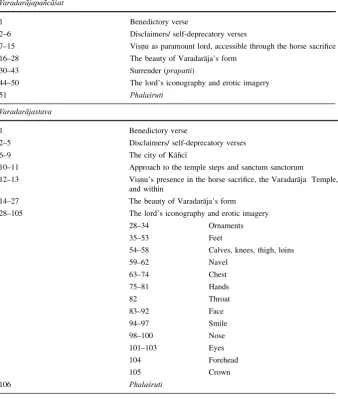
TheVRStakes the dual form of homage and critique with respect to theVRPS, evoking the predecessor through repeated allusions but also overturning it in covert and overt ways.
Table1 reveals a self-conscious mirroring. There is an identical progression from stereotyped self-deprecatory statements to concise theological speculation, then to general conceptions of the lord’s beauty, and, finally, to more detailed descriptions of Varadara¯ja’s form.
In one important sense, however, the structure of theVRSstands in contrast to that of theVRPS: it is almost exactly twice as long (106 verses instead of 51 verses). This doubling of length amounts to a not-so-subtle act of one-upmanship that is also apparent in other aspects of the poem. The change in length entails a transformation of the very genre of Sanskrit devotional poem. TheVRPSconforms to the earliest style of Sanskrit praise-poetry. It is a philosophical poem that consists of a series of epithets detailing abstract qualities of Vis
˙n˙u. While in the VRPS descriptions of erotic iconography comprise seven of the last verses, in theVRS, these descriptions are extended to such a degree that they constitute the body of the poem (seventy-eight verses or more than two-thirds). Unlike theVRPS, theVRSis an example of a new form of Sanskrit praise-poetry that incorporates modes of Tamil devotional lyric, such as liturgical imagery and descriptions of the god’s iconography.28
Although this shift might be taken as delimiting the devotional relationship with Varadara¯ja—an emphasis on physicality of form rather than on universal
qualities—early on Appayya Dı¯ks
˙ita uses the conspicuous contrast with theVRPSto turn what he calls his inadequacy as a poet into a virtue:
manye sṛjantv abhinutiṃkavipuṅgavās te tebhyo ramāramaṇa mādṛśa eva dhanyaḥ/ tvadvarṇane dhṛtarasaḥkavitātimāndyād
yas tattadaṅgaciracintanabhāgyam eti//
O lover of Laks ˙mı¯. Let the best among poets compose their poems to you.
Table 1 Parallel structures of theVaradarājapañcāśatand theVaradarājastava Varadarājapañcāśat
1 Benedictory verse
2–6 Disclaimers/ self-deprecatory verses
7–15 Vis
˙n˙u as paramount lord, accessible through the horse sacrifice
16–28 The beauty of Varadara¯ja’s form
30–43 Surrender (prapatti)
44–50 The lord’s iconography and erotic imagery
51 Phalaśruti
Varadarājastava
1 Benedictory verse
2–5 Disclaimers/ self-deprecatory verses
6–9 The city of Ka¯n˜cı¯
10–11 Approach to the temple steps and sanctum sanctorum
12–13 Vis
˙n˙u’s presence in the horse sacrifice, the Varadara¯ja Temple, and within
14–27 The beauty of Varadara¯ja’s form
28–105 The lord’s iconography and erotic imagery
28–34 Ornaments
35–53 Feet
54–58 Calves, knees, thigh, loins
59–62 Navel
63–74 Chest
75–81 Hands
82 Throat
83–92 Face
94–97 Smile
98–100 Nose
101–103 Eyes
104 Forehead
105 Crown
106 Phalaśruti
It’s someone like me who is really fortunate. Because I am so slow as a poet,
I delight in describing you.
And I get to meditate for a long time on every single one of your limbs.29
Appayya’s slowness and deficiency in composing poetry allows him to linger over the form of Varadara¯ja. Here Veda¯nta Des´ika is cast as a “best among poets” (kavipuṅgava) but one who, by implication, is focused on conventional scholastic formalism rather than on loving description.
Appayya shows his indebtedness to Des´ika on the level of specific phrases, allusions, and images. I earlier discussed the second verse as a rephrasing ofṚg Veda
7.99.2, withjāyamānofrom theṚg Vedanow replaced withjaniṣyamāṇaḥ,jātóand
mahimnáḥremaining, andpáram ántambecomingparaṃpāram. Appayya’s words also closely mirror those of Des´ika’s in acknowledging the poet-persona’s temerity in praising the lord. Just as for Des´ika in his second verse the emperors among sages are unable to know (adhigantum aśaknuvataḥ), so for Appayya neither one born (jātaḥ) nor anyone yet to be born (janiṣyamānaḥ) knows (na vetti). In both verses, the poet’s effort is taken to be a form of impetuousness (sāhasa): Des´ika asks for forgiveness despite giving himself over to boldness (sāhasam aśnuvānaḥ), and similarly, Appayya describes himself as one racing ahead (taraṅgitasāhasikyaḥ).30
Another example of imagistic echoing evokes a different work by Veda¯nta Des´ika: his allegorical play, the Saṅkalpasūryodaya. Both VRS 13 and Saṅ kal-pasūryodaya1.62 contain puns on the two meanings of the word pratyak: “west”
and “inwards.” The Varadara¯ja icon faces the west, and therefore devotees look towards the east while viewing it; but inVRS13, we are told that in looking inwards (pratyak), they are also, incongruously, facing “west” (pratyak).31Veda¯nta Des´ika’s verse in theSaṃkalpasūryodayaincludes the same compound, “facing westwards/ inwards” (pratyaṅmukha), with the same doubling of meaning.32
This pattern of creative transfiguration is nowhere more evident than in regard to the theological core of theVRS: thedahara-vidyāor meditation onbrahmanas the small space within the lotus-shaped heart. The dahara meditation is the central devotional practice for Appayya Dı¯ks
˙ita and for his S´aiva theological predecessor S´rikan
˙˙tha, and it is an important topic in Veda¯nta, the focus of an independent
adhikaraṇa in the Brahma Sūtra. The key Upanis
˙adic sources for the dahara meditation are Chāndogya Upaniṣad 8.1–6 and the Nārāyaṇa anuvāka of the
Mahānārāyaṇa Upaniṣad(attached to theTaittirīya Upaniṣad).
29Varadarājastava,verse 5. 30
Varadarājapañcāśat, verse 2: yasyānubhāvam adhigantum aśaknuvanto muhyanty abhaṅguradhiyo munisārvabhaumāḥ/ tasyaiva te stutiṣu sāhasam aśnuvānaḥkṣantavya eṣa bhavatākariśailanātha//
31Varadarājastava, verse 13: pratyaṅmukhaṃ tava gajācalarāja rūpaṃ pratyaṅmukhāś cirataraṃ
nayanair nipīya/ asthānamāptavacasām avitarkaṇīyamāścaryam etad iti niścayamāvahante//
32Saṅkalpasuryodaya, 1.62:pratyaṅmukhīsumatidīptim iha pracinvan prāptodayo
The dahara adhikaraṇa centers on a problem arising at the beginning of the
Chāndogya Upaniṣadpassage:
atha yad idam asmin brahmapure daharaṃpuṇḍarīkaṃveśma daharo’sminn antarākāśaḥtasmin yad antas tad anveṣṭavyaṃtad vāva vijijñāsitavyam iti.
Now, here in this fort ofbrahmanthere is a small lotus, a dwelling-place, and within it, a small space. In that space there is something—and that’s what you should try to discover, that’s what you should seek to perceive.33
This sentence appears to contain an ambiguity: to what exactly does the subtle space, thedahara-ākāśa, refer? The commentaries consider three options: (1) the space element; (2) the individual soul, jīva; or 3) the universal spirit, brahman. S´am
˙kara, Ra¯ma¯nuja, and S´rı¯kan˙t˙ha all concur that thedahara-ākāśa must refer to
brahman, and not to the space element or to the individual soul, since, as elaborated in Brahma Sūtra 1.3.16, brahman and not the individual soul is an established
meaning for the word ākāśa.34 And this dahara ākāśa could not be the space element because of an analogy made a few lines later—yāvān vāayamākāśas tāvān eṣo’ntarhṛdayaākāśaḥ(“as vast as the space here around us is this space within the heart”)—which would then become tautological.35
In contrast to thedahara adhikaraṇa,Brahma Sūtra 3.3.43 marks a significant point of divergence among the commentators regarding the question of the Vais
˙n˙ava or S´aiva nature of the meditation.36S´am
˙kara, Ra¯ma¯nuja, and S´rı¯kan˙˙tha all believe that thesūtraaffirms the principle that indicating marks (liṅga) trump context in the interpretation of Vedic statements, as per Pūrva Mīmāṃsā 3.3.14. Sam
˙kara, however, does not connect the sūtra to the dahara meditation. For him, the statement in question comes instead from the Agnirahasya of the Śatapatha Brāhmaṇa. For Ra¯ma¯nuja and S´rı¯kan
˙t˙ha, on the other hand, the relevant statement occurs towards the end of thedaharameditation in the Mahānārāyaṇa Upaniṣad:
tasyāḥśikhāyā madhye
paramātma vyavasthitaḥ/ sa brahmāsaśivaḥ sendraḥ
so’kṣaraḥparamaḥsvarāṭ// In the middle of that flame rests the highest self.
He is Brahma¯, he is S´iva, he is Indra.
He is the imperishable, highest, self-luminous one.37
33
Chāndogya Upaniṣad, 8.1.1. I have used Olivelle’s1996translation for theChāndogya Upaniṣad. All other translations are mine.
34
Brahma Sūtra1.3.16,prasiddheśca.
35Chāndogya Upaniṣad, 8.1.3. (Tr. Olivelle1996). 36
liṅgabhūyastvāt tad dhi balīyas tad api.
37Mahānārāyaṇa Upanisad, 11.13.
In theMahānārāyaṇa Upaniṣad, thedahara-ākāśa is described as located within a tiny flame in the heart.
The discussion forms part of the overall problematic explored in the thirdpādaof the thirdadhyāyaof theBrahma Sūtra: the hermeneutic principle of coordination or
upasaṃhāra. Coordination is defined in 3.3.5:
upasaṃhāro’rthābhedād vidhiśeṣavat samāne ca
There should be coordination of qualifications from different texts when the meditation is the same, since the meaning does not differ, as in the case of the subsidiary elements of injunctions.38
Drawing on the principle that distant passages can be brought together despite contextual differences, Ra¯ma¯nuja argues that the Mahānārāyaṇa Upaniṣad
statement is not contextually and syntactically delimited to the preceding description of the dahara meditation but in fact determines the object to be worshipped in all meditations in the Upanis
˙ads. This is due to the fact that the qualifiers of the lord included here (akṣara,śiva,śambhu,parabrahma,parajyotiḥ,
paratattva,paramātmā, etc.) are used in a wide range of meditations. Since Vis ˙n˙u is left out of the list of qualifiers, he alone can be the actual object of the meditation.
S´rı¯kan
˙˙tha makes an almost identical argument but with the reverse ideological significance—for him, theMahānārāyaṇa Upaniṣadestablishes that it is S´iva who is the object of all meditations. Citing numerous verses in the Mahānārayaṇa Upaniṣadpraising S´iva, S´rı¯kan
˙˙tha argues that in this text Vis˙n˙u is merely S´iva’s devotee, and S´iva, identified with brahman, is located in the flame in Vis
˙n˙u’s heart. The verse from theMahānārāyaṇa Upaniṣadquoted most frequently by S´rı¯kan
˙t˙ha occurs just two lines after the flame verse just cited:
ṛtaṃsatyaṃparaṃbrahma puruṣaṃkṛṣṇapiṅgalam/
ūrdhvaretaṃvirūpākṣaṃ
viśvarūpāya vai namaḥ//
Brahmanis the cosmic order, the truth, the highest. He has a personality, is blackish-brown,
and is chaste, with three eyes. We bow down to him whose form is the universe.39
Several of the qualifiers here have strong S´aiva associations (e.g. kṛṣṇapiṅgala, referring to S´iva’s color, andvirūpākṣa, referring to S´iva’s third eye). For S´rı¯kan
˙t˙ha, thedaharameditation is emblematic of the core metaphysical synthesis of S´iva with his primal consciousness (cit-śakti). In S´rı¯kan
˙t˙ha’s philosophy,
cit-śakti is the
supreme power of S´iva, the source of gross matter (prakṛti), S´iva’s conscious awareness of the phenomenal world, and the dahara-ākāśa itself. Cit-śakti as
38
Brahma Sūtra3.3.5.
dahara-ākāśa is in turn identified with S´iva along the lines of the Vis´is ˙˙ta¯dvaita substance/attribute (viśeṣaṇa-viśeṣya) or body/embodied (śarīra-śarīrin) relation.
Before examining how Appaya Diks
˙ita interprets thedahara meditation in the
VRSbenediction and its autocommentary, it may be helpful to consider briefly how Appayya develops thedaharameditation in his mainstream S´aiva theology. Despite Appayya’s penchant for novel strategies aimed at bringing S´rı¯kan
˙˙tha into conformity with his own nondualist metaphysics, he is also deeply indebted to S´rı¯kan
˙˙tha for the formulation of key concepts, and this is especially the case with the dahara meditation.40 In the Śivārkamaṇidīpikā and in works like the
Śivādvaitanirṇaya and the Ratnatrayasāra, Appayya strengthens S´rı¯kan
˙t˙ha’s argument regarding the S´aiva nature of the dahara meditation while also deftly incorporating a Vais
˙n˙ava element. In his comment on 3.3.38 in the
Śivārkamaṇidī
-pikā, for example, Appayya acknowledges that Vis
˙n˙u seems to be the object of the
daharameditation in some Upanis
˙adic passages, just as S´iva is in others. But he proceeds to provide a clear criterion for establishing the supremacy of the S´aiva
daharameditation: according to Appayya, the daharameditation described in the
Chāndogya Upaniṣad must be S´aiva because of the description of liberation contained therein; as for the Vais
˙n˙avadaharameditation, it is subsumed under the S´aivadaharameditation, with Vis
˙n˙u’s heaven (Vaikun˙t˙ha) relegated to a subsidiary point along the path of sequential liberation (krama-mukti).41
In theŚivādvaitanirṇayaand the Ratnatrayasāra, Appayya seems to contradict
himself when he asserts in connection with thedaharameditation that S´iva, and not Vis
˙n˙u, isbrahman; and that Vis˙n˙u is actually identified with S´iva. Appayya displays sleight of hand in attempting to maintain both hierarchy and non-difference between S´iva and Vis
˙n˙u, affording himself great flexibility in engaging polemically with rivals of various stripes.42However, as we will see, Appayya makes no reference to any S´aiva re-framing of the Vais
˙n˙avadaharameditation at any point in the
VRSor
the autocommentary.
40
See Lawrence McCrea’s article, as well as Jonathan Duquette’s, in this volume.
41Śivārkamaṇidīpikā3.3.38:ataśchāndogye
’pi muktiphalaśravaṇāt tadāmnātā guṇāḥśaivīṃ dahar-avidyāṃ prāpnuvantīti yuktam. vaiṣṇavī tadupasarjanabhūtā. vaikuṇṭhaṃ bhagavallokaṃ gamiṣyatīti
śravaṇena tasyāvaikuṇṭhaprāptidvārāmuktihetutvāt. muktisthānasya vaikuṇṭhasya cordhvādharabhāvaḥ
parāparabhāvaśca prāgvyavasthāpitaḥ.
42
At the same time, he is also able to play the card of hisadvaitametaphysics to tendentious effect. For example, Appayya’s polemical critique of the Ma¯dhva system in theMadhvatantramukhamardanabegins with a benedictory verse that strikes a neutral chord regarding the question of whether S´iva or Vis
˙n˙u is
saguṇa brahman:śivaṃviṣṇuṃvāyady abhidadhātiśāstrasya viṣayaṃtad iṣṭaṃgrāhyaṃnaḥsaguṇam api tad brahma bhajatām. (“If someone holds that S´iva or Vis
˙n˙u is the subject of theśāstras, we desire it and accept it.”) (Madhvatantramukhamardana,verse 1). Appayya in his commentary clarifies that his support for the worship ofsaguṇa brahman—whether S´iva or Vis
˙n˙u—ultimately rests on anadvaita position. It may be the case that such a stance furthers Appayya’s case that his critique of the Ma¯dhva system is not based on parochial differences between S´aivas and Vais
˙n˙avas but on sound exegetical and epistemological grounds, while also providing shelter to Appayya’s S´rı¯vais
˙n˙ava interlocutors who are doctrinally closer to Appayya.
DaharaMeditation in theVRPSand in the VRS
Let us turn to a direct comparison of the treatment of the dahara meditation in Veda¯nta Des´ika’s VRPS and in Appayya Dı¯ks
˙ita’s VRS. The metaphorical development of the dahara meditation in the VRPSoccurs in six verses: 12, 19, 20, 21, 28, and 33.
In verse 12, Veda¯nta Des´ika refers implicitly to the central controversy regarding the Mahānārayaṇa Upaniṣad’s flame verse—the omission of Vis
˙n˙u in the list of qualifiers, taken by Vais
˙n˙avas to indicate that Vis˙n˙u is brahman while the other deities (S´iva, Brahma¯, etc.) are mere manifestations:
brahmetiśaṃkara itīndra iti svarāḍ
ityātmeti sarvam iti sarvacarācarātman/ hastīśa sarvavacasām avasānasīmāṃ
tvāṃsarvakāraṇam uśanty anapāyavācaḥ//
You are ensouled by everything—the animate and the non-animate. “Brahma¯,” “S´am
˙kara,” “Indra,” “Self-luminous,” “Self,” “All”— these eternal expressions seek you,
O lord of the elephant hill.
You are the end point of all words, the cause of all.43
The first line is a direct rephrasing of the corresponding line in theMahānārayaṇa Upaniṣad—sa brahmā saśivaḥ sendraḥ so ’kṣaraḥparamaḥ svarāṭnow becomes
brahmetiśaṃkara itīndra iti svarāḍityātmeti sarvam iti.Veda¯nta Des´ika is referring to the Vis´is
˙t˙a¯dvaita view that names like S´iva or Brahma¯ ultimately refer to Vis˙n˙u as inner controller, since the meaning of all words terminate in him.
The verse of most interest in the VRPS, and the direct model for Appayya’s benediction, is verse 20 (verses 19, 21, 28, and 33 of theVRPScontain somewhat more subtle references to thedaharameditation)44:
43
Varadarājapañcāśat, verse 12. S´rı¯kan
˙t˙ha for his part responds to the issue of Vis˙n˙u not being listed among the manifestations by citing a variation on theMahānārāyaṇa Upaniṣadverse,Kaivalya Upaniṣad
verse 7, which does include Vis
˙n˙u:sa brahmāsaśivaḥsendraḥso’kṣaraḥparamaḥsvarāṭ/sa eva viṣṇuḥ
sa prāṇaḥsa kālo’gniḥsa candramāḥ//
44
Verse 19 describes the lord growing within the heart as consciousness (cinmayatayā): rūḍhasya cinmayatayā hṛdaye karīśa stambhānukāripariṇāmaviśeṣabhājaḥ/sthāneṣu jāgrati caturṣv api sattva-vantaḥśākhāvibhāgacature tava cāturātmye//. Verse 21 lifts an exact phrase used in theMahānārayaṇa Upaniṣadto emphasize the infinitely tiny size in which the lord appears in the heart: “a small hole” (sūkṣmaṃsuṣiram):audanvate mahati sadmani bhāsamāneślāghye ca divyasadane tamasaḥparasmin/ antaḥkalevaram idam suṣiraṃsusūkṣmaṃjātam karīśa kathamādaraṇāspadaṃte// (Mahānārāyaṇa Upaniṣad11.9:satataṃtuśirābhis tu lambatyākośasannibham/tasyānte suṣiraṃsūkṣmaṃtasmin sarvaṃ pratiṣṭhitam//). Verse 28 and verse 33 involve a shift from theMahānārayaṇa Upaniṣadto Ra¯ma¯nuja’s use of theChāndogya Upaniṣadtreasure passage (described below). Verse 28 is patterned entirely on the
Chāndogya treasure metaphor:nityaṃkarīśa timirāviladṛṣṭayo’pi siddhāñjanena bhavataiva vibhū ṣi-tākṣāḥ/ paśyanty upary upari sañcaratām adṛśyaṃmāyānigūḍham anapāyamahānidhiṃtvām//. Verse 33 refers more obliquely to thedahara-ākāśaas inner controller:antaḥpraviśya bhagavan nikhilasya jantor
āseduṣas tava karīṣa bhṛśaṃdavīyān/satyaṃbhaveyam adhunāpi sa eva bhūyaḥsvābhāvikītava dayā
nāgācaleśa nikhilopaniṣanmanīṣā -mañjūṣikāmarakataṃparicinvatāṃtvām/ tanvīhṛdi sphurati kāpiśikhāmunīnāṃ
saudāmanīva nibhṛtā navameghagarbhā//
O lord of the elephant hill, a wondrous slender flame shines
in the hearts of ascetics who contemplate you. It is an emerald in a treasure-chest
and the idea communicated by all the Upanis ˙ads. It resembles abiding lightning
bearing a new cloud.45
Here Veda¯nta Des´ika incorporates elements of the flame verse as well as the verse directly preceding it in theMahānarāyaṇa Upaniṣad:
nīlatoyadamadhyasthā vidyullekheva bhāsurā/ nīvāraśūkavattanvī pītābhāsyāt tanūpamā//
It shines like a streak of lightning within a black cloud,
as slender as an awn of rice, yellow in appearance,
comparable to the tiniest of things.46
Des´ika’s comparison reverses the normal spatial relationship between lightning and a cloud. Whereas in theMahānārayaṇa Upaniṣadverse lightning contains the cloud (nīlatoyadamadhyasthā vidyullekheva), in the VRPS verse lightning is itself contained within the cloud (saudāmanīva nibhṛtā navameghagarbhā). This counterfactual metaphor corresponds visually to Vis
˙n˙u’s dark form within the flame in the heart. In addition, by describing Vis
˙n˙u as the “idea communicated by all the Upanis
˙ads” (nikhilopaniṣanmanīṣā) Veda¯nta Des´ika also recalls Ra¯ma¯nuja’s extension of theMahānārayaṇa Upaniṣadverse to other Upanis
˙adic meditations. There is depth to the layers of reference to thedaharameditation in verse 20. The metaphor of the lord being an emerald in a treasure-chest brings to mind a passage from theChāndogya Upaniṣadthat is cited by Ra¯ma¯nuja in hisŚrībhāṣyaand that also provides the imagistic core for Appayya’s benedictory verse in theVRS:
tad yathāpi hiraṇyanidhiṃ nihitam akṣetrajñā upary upari saṃcaranto na vindeyuḥevam evemāḥsarvāḥprajāahar ahar gacchantya etaṃbrahmalokaṃ
na vindanty anṛtena hi pratyūḍhāḥ.
Take, for example, a hidden treasure of gold. People who do not know the terrain, even when they pass right over it time and again, would not discover
45
Varadarājapañcāśat, verse 20.
46Mahānārāyaṇa Upaniṣad, 11.12.
it. In exactly the same way, all these creatures, even though they go there every day, do not discover this world ofbrahman, for they are led astray by the unreal.47
In his commentary on Brahma Sūtra 1.3.14, Ra¯ma¯nuja uses this comparison betweenbrahman and a hidden treasure in order to further his argument that the
dahara-ākāśa is the lord as the inner controller (antaryāmin) concealed within all
beings.48
Veda¯nta Des´ika also compares the lord’s color to that of an emerald in verses 20, 46, and 50. The color imagery is yet another example of echoing between theVRPS
and theVRS: Appayya shifts the comparison of the lord’s dark color from that of emerald to that of sapphire in verses 26, 27, 33, and 75. He also includes echoing references to treasure in verses 10 and 16.
While the dahara meditation figures prominently as a thread running through Veda¯nta Des´ika’sVRPS, it is even more central for Appayya Dı¯ks
˙ita in theVRS, not only because it frames the poem’s benediction but also because of the unusually nuanced analysis provided in Appayya’s accompanying commentary. It is clear that this verse was important to Appayya Dı¯ks
˙ita: it serves as the benediction not only for theVRSbut also for one of Appayya’s major works on poetics, theKuvalayānanda, as well as for theMadhvatantramukhamardana, though in neither of these two latter works does it receive the theological elaboration that it does in theVRScommentary. The verse is dedicated to Vis
˙n˙u as Mukunda:
udghāṭya yogakalayā hṛdayābjakośaṃ
dhanyaiścirād api yathāruci gṛhyamāṇaḥ/ yaḥprasphuraty avirataṃparipūrṇarūpaḥ śreyaḥ sa me diśatuśāśvatikam mukundaḥ//
Through skill in contemplation
virtuous ones open their hearts like lotus buds and perceive him after a very long time, each according to their own desire. Mukunda appears
always in his absolute form.
May he grant me the supreme end.49
The parallels to VRPS 20 are several. The lotus-hearts (hṛdayābjakośaṃ) of virtuous ones (dhanyaiś) in VRS1 recall the hearts (hṛdi)of ascetics (munīnāṃ) in
VRPS20. The opening of these hearts through skill in contemplation (yogakalayā)
inVRS1 recalls the reference to ascetics contemplating (paricinvatāṃ) the lord in
47
Chāndogya Upaniṣad8.3.2. (Tr. Olivelle1996).
48Brahma Sūtra1.3.14gatiśabdābhyāṃtathāhi dṛṣṭaṃliṅgaṃca.Śrībhāṣyaon 1.3.14:antarātmatvena
sarvadā vartamānasya daharākāśasya paramapuruṣārthabhūtasyopary upary ahar ahar gacchantyaḥ sarvasmin kāle vartamānās tam ajānantyas tam na vindanti na labhante. yathāhiraṇyanidhiṃnihitaṃ tatsthānam ajānānās tadupari sarvadāvartamānā’pi na labhante tadvad ityarthaḥ
VRPS20. Appayya even lifts specific words from Des´ika: just as the flame within which the lord resides “shines” (sphurati) inVRPS20, so the lord himself “appears” (prasphurati) inVRS1. And in an allusion that is comparable to Veda¯nta Des´ika’s evocation of theMahānārāyaṇa Upaniṣadimagery of the flame in 11.13 and to its comparison with lightning in 11.12, Appayya Dı¯ks
˙ita evokes the description of the heart as shaped like an upside-down lotus bud inMahānārayaṇa Upaniṣad 11.7– 11.8.50Appayya’s reference to the treasure metaphor from theChāndogya Upaniṣad
is brought about via the double meaning of aśleṣaon Mukunda, the name used for Vis
˙n˙u/Kr˙s˙n˙a;mukundaalso has the sense of “treasure,” and theśleṣain effect turns the verse around—instead of causing hearts to open, the lord is himself a treasure who opens up his chest to grant pleasures.
Appayya’s commentary considers at length an apparent contradiction in the verse: how can the lord appear having a form that is delimited and at the same time universal? The lord is grasped by devotees in a measurable size that ranges from an awn of rice to a thumb’s breadth to the gap between the thumb and forefinger (nīvāraśūkāṅguṣṭhaprādeśādiparimāṇānāṃmadhye), but he also manifests himself in his absolute form (paripūrṇarūpaḥ). Appayya employs a series of logical arguments to resolve the contradiction. The first and most important argument rests on the scriptural corroboration of a series of five paired passages, where the pairs are drawn together either contextually or on the hermeneutic principle of coordination (upasaṃhāra). Each of the pairs comprises one passage describing the lord’s possession of a delimited form and another his possession of a universal form.
The first pair consists of the flame verse and an earlier verse in theMahānārāyaṇa Upaniṣad.51While inMahānārāyaṇa Upaniṣad11.13 the flame itself is described as being as slender as an awn of rice (nīvāraśūkavat tanvī), the lord residing within the flame is described in 11.6 as pervading everything within and without (antarbahiśca tat sarvaṃvyāpya nārāyaṇaḥsthitaḥ). The juxtaposition of these two verses gives the clear impression that the lord residing in the flame is Vis
˙n˙u. But recall that the flame verse marks a major point of divergence between Ra¯ma¯nuja and S´rı¯kan
˙t˙ha regarding the identity of the deity; Appayya seems here to be directly contradicting his efforts in the Śivārkamaṇidīpikā and elsewhere, where he provides sophisticated arguments buttressing S´rı¯kan
˙˙tha’s position.
While the second and third pairs of passages are taken from the Chāndogya Upaniṣad, the fourth and fifth pairs are drawn from different texts on the principle of coordination. The second pair includes sections of the familiarChāndogyapassage analyzed in the dahara adhikaraṇa. The main sentence here refers to the small space in the heart, but just two lines later (8.1.3) this space is compared to the vastness of the atmosphere (yāvān vā ayamākāśas tāvān eṣo’ntarhṛdaya ākāśaḥ,
“As vast as the space here around us is this space within the heart”).52The third pair comes from a remarkably similar section that appears earlier in the Chāndogya
50
Mahānārāyaṇa Upaniṣad 11.7–8: anantam avyayaṃ kaviṃ samudrentaṃ viśvaśambhuvam/ pad-makośapratīkāśaṃsuṣiraṃcāpyadhomukham// adhoniṣṭyāvitastyāṃtu nābhyām upari tiṣṭhati/ hṛdayaṃ tad vijānīyād viśvasyāyatanaṃmahat//
51
Mahānārāyaṇa Upaniṣad11.6:yac ca kiñcij jagaty asmin dṛśyateśrūyate’pi vā/antar bahiśca tat sarvam vyāpya nārāyaṇaḥsthitaḥ//
52Chāndogya Upaniṣad8.1.3. (Tr. Olivelle,1996).
Upaniṣad (3.14.3).53 The fourth pair includes passages from the Kaṭha and
Muṇḍaka Upaniṣads which have been connected apparently because they both contain the word “ātman.”54
In a similar way, the final pair is drawn together by the common inclusion of the word “prādeśamātram” (with a size measured by the gap between the thumb and the forefinger). It is of note that while all the other scriptural passages are drawn from the Upanis
˙ads, the first passage of this last pair is taken from theBhāgavata Purāṇa (2.2.8) and presents a strong Vais
˙n˙ava conception of the form of the lord:
kecit svadehāntarhṛdayāvakāśe prādeśamātraṃpuruṣaṃvasantam/ caturbhujaṁkañjarathāṅgaś ankha-gadādharaṃdhāraṇayā smaranti//
Some call to mind through concentration the person residing in their own body in the space within the heart
measuring the gap
between the thumb and the forefinger. He has four arms and bears
a lotus, a discus, a conch, and a mace.55
These four objects—the lotus, discus, conch, and mace—are unmistakable marks of Vis
˙n˙u’s iconography. The second passage of the pair, although it is an Upanis˙adic citation (Chāndogya Upaniṣad5.18.1), also includes a Vais
˙n˙ava component: the use of the word “prādeśamātram” as a qualifier of the universal (vaiśvānara) self.56 This particular reference to the universal self comes from an earlier story inChāndogya Upaniṣad5.11, which reframesŚatapatha Brāhmaṇa10.6.1.57In theŚatapatha Brāhmaṇaversion of the story,vaiśvānararefers to the digestive fire, as it does for S´rı¯vais
˙n˙avas envisioning Vis˙n˙u as inner controller residing within thevaiśvānaradigestive fire.
Somewhat surprisingly, Appayya returns to the central theological issue here and addresses it most directly in the discussion of poetic figures at the end of his comment on the verse. He analyzes here the figures of virodhābhāsa (apparent contradiction) andvyatireka(distinction).58The first, virodhābhāsa, is indicated in
53Chāndogya Upaniṣad 3.14.3: eṣa ma ātmā antarhṛdaye
’ṇīyān vrīher vā yavād vā sarṣapād vā śyāmākād vā śyāmākataṇḍulād vā. eṣa maātmāantarhṛdaye jyāyān pṛthivyājyāyān antarikṣāj jyāyān divo jyāyān ebhyo lokebhyaḥ.
54
Kaṭha Upaniṣad 4.12: aṅguṣṭhamātraḥ puruṣo madhyaātmani tiṣṭhati.Muṇḍaka Upaniṣad 2.25:
yasmin dyauḥpṛthivīcāntarīkṣam otam manaḥsaḥprānaiśca sarvaiḥ.
55
Bhāgavata Purāṇa2.2.8.
56Chāndogya Upaniṣad5.18.1:yas tv etam evaṃprādeśamātram abhivimānamātmānaṃvaiśvānaram
upāste, sa sarveṣu lokeṣu sarveṣu bhūteṣu sarveṣvātmasv annam atti.
57Olivelle (1996, pp. 344–345). 58
the verse by the wordapi(“even”, a standard marker for the figure) and involves a contradiction between terms that is ultimately resolved (usually through double meanings in aśleṣa). Appayya sees the delimited-universal contrast as an example of virodhābhāsa, and his way of explaining away the apparent contradiction may provide the best clue to his ultimate theological objective in developing a Vais
˙n˙ava
dahara meditation in the VRS. He argues that behind this apparent contrast is a relationship between limiting adjunct (upādhi) and essential nature (svabhāva): “There is a coalescence of delimited and universal as limiting adjunct and essential nature. Hence since the apparent contradiction, indicated by the word, ‘api,’ is resolved, this is the figure of ‘apparent contradiction’ (virodhābhāsa).”59 In a rare self-revelatory moment in theVRScommentary, Appayya discloses his ownsaguṇa advaitaposition, namely that the form of the lord appearing in the heart is only an adjunct whilebrahmanitself is without qualities and universal. Appayya only offers the limited-adjunct interpretation as one of two ways of addressing the theological issue. The other is explored through his elaboration of the figure ofvyatireka, which involves a distinction between the object described and another object. Appayya’s verse uses a comparison that draws a distinction between the lord and everything else (the lord stands apart from all other things in the world), and Appayya now reverts to a more straightforward Vais
˙n˙ava bhakti position regarding the lord’s divine mystery.60
However, thevirodhābhāsaanalysis may indicate what appealed to Appayya in composing his poem with the imagery used by Des´ika and in developing the meditation in a Vais
˙n˙ava, rather than a S´aiva, discursive milieu. Unfettered by the baggage of positions adapted from S´rı¯kan
˙˙tha, Appayya is able to develop a more overtlyadvaita saguṇa approach to the dahara meditation through his choice of Vais
˙n˙ava sources that more closely resemble the contours of S´am˙kara’s thought. In this way his purpose resembles the far more expansive bhakti project of his contemporary, Madhusu¯dhana Sarasvatı¯.61
59
Varadarājastava, commentary on verse 1:paricchedāparicchedayor aupādhikatvasvābhāvikatvābhyāṃ saṃghaṭanāyām apiśabdena pratyāyitasya virodhasya vastutattvadṛṣṭyā sāmādhānāt virodhābhāsālaṃkāraḥ.
60
Varadarājastava, commentary on verse 1: harivaṃśe āścaryopākhyānoktarītyā bhagavataḥ paramāścaryarūpatvena paricchinnatayā dṛśyamāne bhagavanmukhe yaśodayāsarvasya prapañcasya dṛṣṭatvena ca paricchedāparicchedayoḥsvata eva saṃbhavād vātatsamādhānaṃ.
61
S´am
˙kara’s own stance on the dahara meditation is that it involves both a saguṇa and nirguṇa dimension. S´am
˙kara lays out a clear distinction between adaharameditation focused onsaguṇa brahman and one focused onnirguṇa brahman—the former being clearly inferior and propaedeutic to the latter— most explicitly in his commentary onBrahma Sūtra3.3.39 (kāmādītaratra tatra cāyatanādibhyaḥ). This
sūtrafits within the overall focus of the thirdpādaof the thirdadhyāya, as discussed earlier: the question of whether particular passages may be brought together under a single meditation under the principle of coordination. In his commentary on thissūtra, S´am
˙kara affirms that the two passages in question, the familiar passage from theChāndogya Upaniṣad(8.1.1) and another from theBṛhadāraṇyaka Upaniṣad
(4.4.22), may be considered as a single meditation due to their shared elements:brahmanhaving desires fulfilled (satyakāma) as described in theChāndogya Upaniṣadshould be connected tobrahmanbeing a controller of all (sarvasya vaśī) in theBṛhadāraṇyaka Upaniṣad; similarly, both passages refer to the heart as a support or receptacle (āyatana). S´am
˙kara disregards a distinction between the passages raised by an opponent, which he views as superficial: whereas in the Chāndogya Upaniṣad these various qualities are related to the space orākāśain the heart, in theBṛhadāraṇyaka Upaniṣadthey are ascribed to brahman who resides within the ākāśa. S´am
Conclusion
Equipped with this knowledge of Appayya’s treatment of thedaharameditation in theVRS, we are now in a position to attempt to resolve the paradox of this S´aiva intellectual’s authorship of Vais
˙n˙ava works. Returning to the social historical context discussed earlier, it may be helpful briefly to consider the conditions under which Appayya composed the VRS. That is, what was Appayya’s purpose and strategy in constructing a distinctively Vais
˙n˙ava authorial persona?
62
Two facts of Appayya’s biography are relevant for understanding his authorship of the VRS: the close proximity of his native home, Ad
˙ayapalam, to the Varadara¯jasva¯mı¯ Temple in Ka¯n˜cı¯ (housing the deity to which the poem is dedicated), and his “mixed” parentage. Appayya’s personal devotion to the Varadara¯jasva¯mı¯ Temple may have had something to do with its location (akin to a Chicago native being a Chicago Cubs fan), and it appears that his paternal family, though S´aiva, had long had a connection to the temple. In his major work on poetics, the Citramīmāṃsā, Appayya Dı¯ks
˙ita cites a verse attributed to his paternal grandfather, A¯ ca¯rya Dı¯ks
˙ita, from a now-lost play called theVaradarāja
Vasantot-sava. This verse is believed to have attracted the attention of Kr
˙s˙n˙adevara¯ya, the Vijayanagara emperor, on a visit to Ka¯n˜cı¯. It also seems plausible that Appayya’s intertwined S´aiva and Vais
˙n˙ava lineage may have been a factor in his peculiar intellectual weaving of S´aiva and Vais
˙n˙ava traditions: Appayya’s paternal grandmother was from a S´rı¯vais
˙n˙ava family.
Another important point to consider is the identity of Appayya’s three patrons. While Appayya wrote the series of S´aiva works while receiving the patronage of Cinna Bomma, he wrote the Yādavābhyudayavyākhyā and the VRS while at the courts of Vais
˙n˙ava-favoring Aravı¯d˙us (Cinna Timma for theY
ādavābhyudayavyā
-khyā and Ven˙kat
˙a II for the VRS). It seems likely that this connection between patronage and scholarly activity was not incidental, especially in the case of the
VRS. Appayya Dı¯ks
˙ita’s composition of theVRS, directed to the very temple from which Laks
˙mı¯kuma¯ra Ta¯ta¯ca¯rya was operating at this time, may have involved some form of accommodation to his new Vais
˙n˙ava patrons.
A last biographical element of interest is Appayya’s personal emulation of Veda¯nta Des´ika. Des´ika also hailed from Ka¯ncı¯ two centuries prior to Appayya, and was the author of his own poem to Varadara¯ja. It may have been the case that Appayya was especially taken with the figure of Veda¯nta Des´ika because he represented a model of the sort of intellectual that Appaya sought to emulate: a polymath (sarvatantra-svatantra) and lion among poets and philosophers
Footnote 61 continued adhikaran
˙a, that the wordākāśahere means brahman and not the space element, and hence both passages describe qualities of the same entity,brahman. The real distinction, according to S´am
˙kara, is that in the
Chāndogya Upaniṣadpassage the meditation is focused onsaguṇa brahman, while in theBṛhadāraṇyaka Upaniṣadit is focused onnirguṇa brahman.
62Walker (1991) has proposed a form of “persona criticism,” which conceives of authorship as