The Mode of Leadership in a Traditional Islamic Boarding School
Muhaemin
Theology and Philosophy Faculty State Islamic University, Alauddin Makassar
Email: [email protected]
Abstract; The intent of this study is to elaborate the mode of leadership in a traditional Islamic Boarding School (pesantren) and explore in detail how types of leadership sustain the existence of pesantren in light of globalization of education. This study relies on qualitative research through conducting personal communication with the leaders in the pesantren as well as examining the literature which support the central theme. The research will focus on pesantren Mangkoso Barru, Indonesia. It represents a traditional pesantren in the region of South Sulawesi. The data will be collected from the staff from this particular pesantren. It will be analyzed systematically. The findings suggest that there are, at least, two leadership styles found in the pesantren, charismatic and transformational leadership. The first one basically takes place among the top leaders (senior kiais) of the pesantren while transformational leadership occurs in the middle leaders (junior kiais) of the pesantren. Both leadership styles strongly affect the sustainability of pesantren in the face of globalization of education. Moreover, the leaders of the pesantren are able to transform pesantren values into modernity which enables the pesantren DDI Mangkoso to sustain itself amid the fast wave of modernization.
Keywords: pesantren, leadership, traditional, modernization
Introduction
Islamic Boarding Schools or pesantren are the oldest form of Islamic education in Indonesia. Historically, the origin of pesantren is regarded as a consequence of an integration of
As’ariyah and Maturidiyah scholastic theology and tasawuf teachings (Islamic mysticism) that has long colored the patterns of Islam in the Indonesia archipelago. Some are of the opinion that pesantren itself refers to the Arabic word for tradition which links to local religious practice that was inherited by Indonesia’s first generation of Muslim. However, some experts argue that the term pesantren indicate a dynamic of Islam towards Hindu culture. They stated that the word pesantren derived from the text of Hindu teaching. It is true that the word pesantren inherently incorporates the values of tolerance, multiculturalism and pluralism (Yunanto and Hidayat, 2005). Apart from these controversies, it is clear that the history of pesantren is strongly associated with the history of Islam in Indonesia and therefore pesantren is the oldest form of Islamic education in Indonesia.
Pesantren as the object of research is always intriguing. A number of scholars, whether local or western, come to explore and elaborate pesantren as a central issue of their research. For example, Geertz (1960) after spending many years in Java came to have a theoretical assumption that in the global era, Kiai (the traditional leader of pesantren and community) will not be able to survive in the globalization era and will further be crushed by modernity. Geertz (1960) was then pessimistic on the role of kiai, questioning whether he possesses the competency to be a cultural broker between tradition and modernity in Indonesia.
Similarly, Abdullah (1987) also predicted that pesantren will not be able to compete with modern education.
In contrast, some scholars argue that kiai has the capability to deal with modernity. For instance, Lukens Bull (2001) advanced the view that kiai not only can be a cultural broker between local tradition and modernity, but also translate
“modernity” to Indonesia. Kiai are first imagining a modernity that needs to be reworked and then they are (re)inventing an Indonesian Islamic modernity. Lukens Bull examined the pesantren al-Hikam in Malang, East Java as the research site. He came to conclude that, in general, pesantren in Java have formulated a hybrid system of education mixing religious instruction and scientific and technical training. For this reason, pesantren with the leader (kiai) is able to encounter and negotiate with modern education.
Apart from the controversy shown above, this study will explore the type of leadership which occurs in an Islamic Boarding School (pesantren). It will focus on the relationship between leadership in particular pesantren and the existence of pesantren in line with globalization on education.
What does a traditional pesantren look like?
Characteristics
As mentioned earlier, there are two types of pesantren;
traditional (salafi) and modern (khalafi) pesantren. Traditional pesantren, based on the joint decree of the Ministry of Religious Affairs (MORA) and Ministry of National Education (MNE), is an institution that does not offer formal secular education (Pedoman Pelaksanaan Pondok Pesantren Salafiyyah Sebagai Pola Wajib Belajar Pendidikan Dasar, 2000, cited in Raihani, 2002).
From this point of view, it implies that a traditional pesantren does not integrate Islamic teaching into secular knowledge. It merely teaches Islamic knowledge through the sorogan (direct apprenticeship) as well as bandongan (general lecture).
Conversely, the modern pesantren offers secular curricula other
than Islamic teaching (Yunanto and Badrudin, 2005). However, this definition is subject to debate.
According to Dhofier (1982), the term “traditional pesantren” shows how the medieval scholars’ understanding dominated Islamic teaching taught in the pesantren, especially those who lived between seventh and eleventh century.
Nevertheless, Dhofier (1982) goes on to state that the traditional pesantren does not exclusively reject modernity but at the same time it may engage and respond to globalization through intellectual power and institutional strength. In this sense, Zubaidi (1995, cited in Muhtarom, 2005) assert that the openness of traditional pesantren to modernity will lead to strengthening the pesantren itself.
In relation to the characteristics of traditional pesantren, as contended by Muhtarom (2005, p.135), there are at least three main characteristics. They are institutional aspect, historic conventional, and cultural adaptive.
Institutional Aspect
Firstly, pesantren as an Islamic institution is regarded as the first education institution in the history of Indonesia. As a centre of academic development, particularly in Islamic knowledge, traditional pesantren mainly concern themselves with educating as well as transferring Islamic teaching to the santris.
As viewed by Mujamil (1999), the sustainability of pesantren has largely contributed to constructing society in terms of literacy and cultural literacy. In this regard, Muhtarom (2005) noted that there are three important missions of the traditional pesantren as an education institution. The first relates to transferring Islamic knowledge through face-to-face instruction by the kiais or attending kiais’ lecture in surau or mosque. The second is the
way pesantren maintains Islamic tradition in the context of globalization. It can be clearly seen that today there are many pesantrens maintaining the traditional celebration of birth and death. This is relevant to van Bruneissens’ (2004) notion that traditional pesantren is strongly associated with various devotional practices, such as the visiting of graves, and with Islamic healing practices.
The last mission is producing ulama (Muslim scholars) who, in turn, can sustain Islamic tradition to the following generation. From these points of view, kiais play a leading role in traditional pesantren in constructing santris to being ulama who further maintain the sustainability of Islamic knowledge. In other words, the continuity of the traditional pesantren depends on the type of kiais’ leadership in running the pesantren.
Historic Conventional
The second characteristic of a traditional pesantren is historic conventional. According to Muhtarom (2005,p.138), it is inevitable that the emergence of pesantren in Indonesia history is strongly associated with the role of walisongo (nine Kiais who first spread Islam in Java). Historically, as contended by Suparjo (2006), walisongo successfully built pesantren as places for people to learn Islamic doctrines and social sciences. They built mosques as the centre of Islamic education. Despite teaching Islamic classical texts, as Muhtarom (2005) continues, walisongo also presented universal values such as Islamic brotherhood, unselfishness, simple living, self-sufficiency, and ascetic life style. This sort of combination leads to maintaining the sustainability of the traditional pesantren.
Cultural Adaptation
The last characteristic relates to cultural adaptation. As stated by Suparjo (2006), one of the special characteristics of traditional pesantren is their moderate attitude toward local culture. They internalize Islamic doctrines within certain cultures rather than rejecting or destroying them. In other words, they acculturated Islam within local cultures. Similarly, Karel (1994, cited in Yunanto, 2005, p.32) stated that traditional pesantrens are those which preserve or tolerate local traditions.
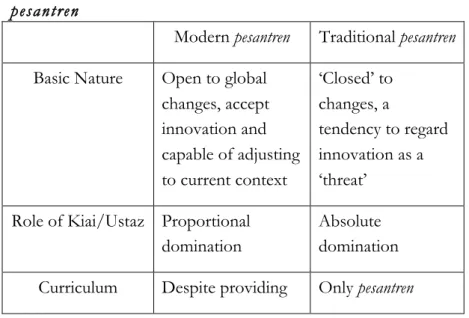
On the other hand, modern pesantrens always concentrate on delivering formal education. This type of pesantren has certain characteristics in common, such as, a collective leadership, with a curriculum based in English and modern Arabic, a class system and the yellow text (observed below) no longer serve as the main teaching material. To put it simply, the following matrix may provide illustration between modern pesantren and traditional pesantren:
Table 1: The difference between modern and traditional pesantren
Modern pesantren Traditional pesantren Basic Nature Open to global
changes, accept innovation and capable of adjusting to current context
‘Closed’ to changes, a
tendency to regard innovation as a
‘threat’
Role of Kiai/Ustaz Proportional domination
Absolute domination Curriculum Despite providing Only pesantren
pesantren curriculum, it also adopts government curriculum
standard curriculum
Facilities Lecture teaching method, supported by facilities such as cooperative, medical unit , library, sport facilities and etc
Minimum
supported facilites, some pesantrens lack facilities
Financial Support Tuition / Government / assistance/ donor
Tuition / government assistance Direction Adaptive/ not
radical
Less adaptive, prone to radicalism Source: Yunanto, et al (2005)
Some Important Elements of Pesantren
Pesantren as a unique education institution has several important elements which further differentiate it from common education institutions. Dhofier (1985) identifies five important elements associated with any sort of pesantren: pondok (dormitory), mosque, kitab kuning (classical Arabic text), santris (students), and kiais (religious leaders).
Pondok
Traditionally speaking, the term pondok literally means bamboo hut and perhaps derived from the Arabic term funduq meaning hotels or dormitory. Dhofier (1980) argues that a pondok is a main characteristic of pesantren indicating a dormitory where the santris stay. That explains why most names of pesantrens are begun by pondok, such as pondok pesantren DDI Mangkoso, pondok pesantren Modern Gontor (situated in Java), pondok pesantren Tebuireng, etc. The pondok is usually situated in the pesantren or the area surrounding it. The size of the pondok depends on the number of santris who stay. In general, as stated by Raihani (2002), it is about eight square meters where more than eight santris live. Dhofier (1985) goes on to state that santris who live in a pondok, especially in traditional pesantrens, usually provide their own meals. In contrast, modern pesantren basically provide chefs who are able to serve santris daily meals. Thus, santris do not have to consider their meals as happened in traditional pesantren.
According to Dhofier (1985), there are at least three reasons why the pesantrens provide a pondok for their santris.
Firstly, it is based on the principal of equality. Santris who live in pondok are regarded as having the same social background without allowing privilege to any particular santri. All santris are under one rule which they must obey. Secondly, it enables pesantren to integrate all santris’ activities, either academic or social (Saifullah, 1995), in order to prepare santris with the knowledge and skills which will be beneficial once they return to their own society. Lastly, as Dhofier (1985) suggests, it will build a strong relationship between kiais and santris that can be framed as a father-child relationship, and more importantly, it can ease the kiais watch on the santris over twenty four hours.
Additionally, as contended by Suparto (2000), there is a reciprocal relationship between the kiai and santri. Santri regard the kiai as the representative of their parents. In turn, the kiai consider santri as the trusteeship of God that has to be cared for. Thus, as Suparto (2000) goes on, this reciprocal relationship leads santris to be loyal. The santris devote their service to the kiais in the sense of contributing their skills and power to the interest of pesantrens’ development. Nevertheless, as noted by Geertz (1960, cited in Suparto, 2000) the pesantren is different from monasteries. Santris are not monks.
The Mosque
Another important feature of a pesantren is the mosque.
Dhofier (1980) argues that a mosque is an inseparable element of a pesantren and is regarded as the most appropriate place for training santris. This notion shows how the standing of the mosque is strongly related to the pesantren, particularly in the practice of daily prayers, Friday sermons and prayers, as well as in the teaching of the classical Islamic text (kitab kuning).
Similarly, Woodward (1989, cited in Suparto, 2000) noted the mosque within the pesantren is a place where the children are introduced to the ritual component of the santris tradition. They are taught how to perform shalat (praying), to read Arabic script, and to recite the Koran. Another important activity held in the mosques is conducting a pengajian (religious teaching led by a Kiai) that is frequently held after maghrib (sunset) prayer and subuh (dawn prayer). Geertz (1960) stated that the mosque is where the kiai chants passages from books of religious commentary and the santris echo him, line by line.
Moreover, in every part of the Muslim world, the mosque has continued to be the common place of meeting and
the centre of educational, administrative and other cultural activities in the Muslim community (Dhofier, 1980).
Furthermore, according to Suparto (2000), the mosque reflects the togetherness of the community. It can be clearly seen in the performance of daily prayer. People perform prayers together, uniting the community in a ritual of submission to Allah almighty. From this point of view, it can be assumed that the mosque is not only beneficial for pesantren but also for Moslems in general.
The Kiai
The kiai is the central figure of the pesantren. Basically, the popularity of pesantren lies in how popular a kiai they have.
In other words, the kiai plays a leading role to sustainability of the pesantren. To put it simply, Dhofier (1985) identifies three significant meanings of kiai. First of all, kiai may be defined as the person who has an association with superstition or magic.
Secondly, it refers to elderly people who are respected by the community. Thirdly, kiai can be identified as a person who has a wide range of Islamic knowledge.
According to Muthohar (2007), the term kiai derives from the Javanese word “kijaji” meaning a person who has a qualification in religious teaching. While in Sumatera, people prefer terms such as tuan guru or tuan syaikh to kiai. In West Java, kiai may be called ajengan and elang. Differently, the term kiai in Makassar where Pesantren DDI Mangkoso situated, are also called anre gurutta. Nevertheless, all these terms have similar meanings with the kiai, and as far as I am concerned, the term kiai is the most used across all of Indonesia. Zuhri (1987) stated that kiai always refers to a male Islamic scholar while a female Islamic scholar is called nyai.
According to Dhofier (1980), the kiais of major pesantrens have been able to extend their influence throughout the nation and beyond, and as a result, some of them have been appointed as government ministers, members of parliament, ambassadors, and as other high government officials. To become kiai as Dhofier (1980) continues, there are a number of stages. To begin with, he is usually a close relative of a kiai.
Having completed his studies at various pesantren, the older kiai trains him to establish his own pesantren. Sometimes the older kiai leads and finances the new project because the young kiai is a good potential ‘ulama’. Afterwards, the old kiai will find him a spouse, and encourage him to use the latter part of his stay in the pesantren to become a kiai.
However, I found in many cases a number of kiais’
relatives who are not kiai. It frequently happens in Makassar, South Sulawesi, that kiais come from ordinary family backgrounds. Therefore, I tend to contend that kiai is like a
“degree” that may be obtained in an informal way. It does not come from a school but from the community. Thus, the popularity of a kiai really depends on the eye of the community.
In other words, the community becomes the judge of kiais.
Santri
Santri is another important element of pesantren. The term pesantren itself, as contended by Dhofier (1980), derived from the word santri with the prefix pe and suffix an, thus literally meaning “the place of santri”. According to John (cited in Dhofier, 1985), the term santri comes from the Tamil language in which santiri means Islamic teacher or the religion teacher. Similarly, Berg (1932, cited in Sedyawati, 1991) stated that the term santri is derived from the word sastri which in the
Sanskrit language indicates a person who has a deep knowledge of the holy book of Hindu. The word sastri itself is adopted from the word sastra, which means the holy books or books of knowledge.
Apart from the controversy as shown above, this study will focus on the core meaning of santri as student in an Islamic school (Woodward, 1989). This notion is based on the exploration of Geertz (1960) in Javanese pesantren. According to Geertz, the term santri has a narrow and a broad meaning. The first indicates a student in a religious school called a pondok or pesantren. In the broad view, a santri is a member of the part of the Javanese population who takes their Islam seriously, go to the mosque on Friday, perform prayers, and so forth. From my point of view, these definitions tend to narrow the term santri due to the scholars’ focus merely on the Javanese population.
In fact, there are many santris spread across the country, including Makassar. Another definition that might be considered is that santri has a commitment to Islam, regardless of what and who they are (Mulkhan, 1994).
As contended by Dhofier (1985), there are at least two kinds of santri; santri mukim and santri kalong. The first indicates those who come far from the pesantren, as a result, they have to stay in pondok during their schooling. Despite studying, as Dhofier stated, santri mukim are in charge of the pondok’s daily affairs as well as teaching younger santri such as elementary version of the yellow book (kitab kuning). Santri kalong are those coming from the surrounding areas. They do not stay in the pondok, but just come daily to and from the pesantren in accordance with their learning timetable.
Hadi (1998, cited in Suparto, 2000) adds another group of santri called santri pasan. Santri pasan or santri pasaran are those who come to the pesantren at a certain time, such as in the month of Ramadhan, the fasting month. They study classical books and basic Islamic knowledge comprising fiqih (Islamic law), ushul fiqhi (Islamic jurisprudence), Arabic, and perform ritual activities. Afterwards, they return home and back to normal life. Generally speaking, according to Raihani (2002), the population of santri mukim in any pesantren in Indonesia is much higher than santri kalong or santri pasan. The age of santris in a pesantren could range from 10 to 50 years of age.
Kitab kuning
The kitab kuning (yellow book) is the classical Islamic text which is written in Arabic. Interestingly, the color of the book is usually yellow. According to van Bruinessen (1991), kitab kuning is not the product of Indonesian scholars. His view is that the origin of kitab kuning is from Arabia. Thus, all kitab kuning are written in Arabic language. This notion was further developed by Azra (2001) when he pointed out that kitab kuning is the classical religious text, which is written in Arabic, Malay, Javanese, and other local language, so that the authors are not only from the Middle East ulama but also from Indonesia.
However, as acknowledged by Azra (2001), it is difficult to identify the exact time of establishing the tradition of kitab kuning in the pesantren. In terms of the process of contact, as far as I am concerned, some kiais, such as the founding father of pesantren DDI Mangkoso, Barru, Andre Gurutta Abdurrahman Ambo Dalle, spent several years in Mecca to study Islam. Andre Gurutta Faried Wajedy, the present head of the pesantren,
followed the same course. Having been awarded as an Islamic scholar, they returned home and brought some kitab kuning that enabled them to teach Islam in the pesantren as well as the community.
In the pesantren tradition, according to Mochtar (1999, cited in Raihani, 2002), kitab kuning is regarded as the universal reference in which the community of pesantren finds the solution for each socio-religious problem. That is not to say that kitab kuning replaced the position of al-Quran (holy book of Moslem) and al-Sunnah (prophet tradition). It is considered as a commentary for both al-Quran and al-Sunnah. Kitab kuning, as Mochtar continues, covers a wide range of Islamic disciplines such fiqh (Islamic Jurisprudence), tauhid (Islamic theology), and tasawwuf (mysticism). Dhofier (1985, cited in Lukens Bull, 2000), argues that kitab kuning are central to understanding traditional Islam which he defines as:
still strongly bound up with established Islamic ideas created by scholars, jurists, doctors, and Sufis during the early centuries of Islamic theological and legal development, sectarian conflicts, and the rise of sufi movement (sic) and brotherhoods in the thirteenth century. This is not to say, however, that contemporary traditional Islam in Java remains fixed in the molds created for it by the ulama (muslim leaders) of the formative centuries.
Luken Bulls (2000) pointed out that theologies, legal and mystical theories can be found in kitab kuning. The pesantren community holds them to be of high importance in determining how to live as good Muslims in a globalizing and
modernizing world. However, Raihani (2002) stated that the community of pesantren treats kitab kuning as the sole truth which results in narrowing curriculum choices or instructional methods within the pesantren. For example, fiqhi (Islamic jurisprudence) has been prioritized as the main subject within pesantren. In contrast, ushul fiqhi (the principles of Islamic jurisprudence) tend to be neglected. In other words, pesantren are mainly concerned with the content of the subject, at the same time, fewer appreciate the methodology. Consequently, the product of a traditional pesantren is likely to lack critical thinking, which leads to extremism, even radicalism. Moreover, as contended by Muhammad (1999, cited in Raihani, n.d), the method of kiai in teaching kitab kuning rarely provides dialogue for the santris to ask a question about the concept or theory in a kitab. They both tend to accept what kitab kuning say as unquestioned truths.
The Nature of Leadership Styles
Leadership is a term that has been widely discussed by researchers. Leaming (2003) argues that leadership is a complex phenomenon which is somewhat difficult to define. It is a concept that is sometimes difficult to understand since there is so much to learn relating to it. A leader is commonly regarded as coming in different shapes and sizes and leaders’ approaches may vary. As contended by Ray (1999, p.1) leadership may be defined as “an interaction between two or more members of a group that often involves a structuring or restructuring of the situation and the perception and expectations of the members.”
This is supported by Houser (1993), who in comparing managers and leaders, stated that managers are more practical,
reasonable and decisive, whereas leaders are more visionary and more flexible. Leadership comes from within. Hence, leadership cannot be taught. However, leaders can be trained in management skills.
Daft (2005, p.5) defines leadership as “a people activity distinct from administrative paperwork or planning activities”.
He continues to state that leadership occurs among the people, it is not something done to people.
Having presented a number of definitions, it can be concluded that leadership is someone’s ability to lead and to influence followers’ behavior to achieve shared goals and visions. This means that leadership is strongly associated with certain behaviors.
The Leadership Theories
Although more than twenty four theories and styles of leadership which are applied in various organizations around the world have been identified, (Covey, cited in DeKrey, Mesick & Anderson, 2007, p.3), I will focus only on two main theories that strongly match the traditional pesantren. They are charismatic and transformational leadership.
Charismatic Leadership
In accordance with Weber (1994, p.2), charisma is “a certain quality of an individual personality, by virtue of which he or she is set apart from ordinary people and treated as endowed with supernatural, superhuman, or at least specifically exceptional powers or qualities”. It indicated that the leaders are not ordinary persons. Leaders are regarded as of divine origin or as exemplary. In addition, Conger and Kanungo (cited in
Dubrin, 2003, p.62) argue that charisma is “a special quality of leaders whose purposes, powers, and extraordinary determination differentiate them from the others”. As studied by Bass (1985), charismatic leaders engage in impression management to construct an image of competence, increase subordinate competence and subordinate faith in them as leaders. Bass (1985) argues that charismatic leadership is less likely to emerge or flourish in a transactional culture, and is more likely within a transformational culture. House (1977) called charisma “image building”. Charisma is dramaturgical, a theatrical role played by a leader that is jointly constructed with followers, as well as by suppliers, competitors, and customers (Gardner & Alvolio, 1998). Gardner and Alvolio pointed out that charismatic leadership is an impression management process enacted theatrically in acts of framing, scripting, staging and performing.
Tucker and Dow (cited in Richard et al., 2006, p.407) are of the opinion that “charismatic leadership is primarily a function of the leaders’ extraordinary qualities, not the situation”. In this sense, I personally believe that charismatic leadership is not only determined based on personal qualities but on followers and the situation of the organization as well.
In relation to followers, they regard the charismatic leader as an omnipotent archetype (leader as parent), whom they believe will nurture and guide them. Some writers state that the followers also view a charismatic leader as mystical (in touch with “higher truths”), who knows the way and knows the answers. Another point is that the charismatic leader is seen as a hero who can move mountains (Bast, 1992).
As contended by Yukl (1994, p. 319), most theorists see charisma as “the result of follower perceptions and attribution influenced by actual leader qualities and behavior, by the context of leadership situation, by the individual and collective need of followers”. Hence, Fatt (2000) stated that specific factors which make a leader charismatic in one situation but not so in another vary from people to people and circumstance and to circumstance.
Characteristics and Behavior of Charismatic Leadership There are many characteristics of charismatic leadership. As stated by Lussier and Achua (2004), charismatic leaders are visionary. They want to transform, not merely maintain. They revive failing companies, develop new products and revolutionize processes (Bass, 1981; Bass, 1985; Burns, 1978; Maslow, 1970). They can propose good vision for the future for the benefit of their organization (Dubrin, 2003;
Groves, 2005; Javidan & Waldman, 2003). The charismatic leaders envision an uplifting future and appeal to values, interests, hopes and dreams. They never lose an opportunity to repeat and share their vision and bring it to life with metaphors, stories, symbols, slogans and examples.
Another important characteristic is “the capability to inspire trust” (Dubrin & Danglish, 2003, p.68). Charismatic leaders place the responsibility for decisions and management on their followers and teams. They rarely second guess.
Charismatic leaders reduce perceived risk by focusing on success rather than failure. Moreover, they provide necessary support and resources. Marjosala and Takala (2000) argue that charismatic leaders may also take a risk and engage self sacrifice to achieve their vision. This notion can develop the good image
of leaders among the followers and be good for developing the organization as well. Furthermore, as noted by Lussier and Achua (2004), charismatic leaders have high energy and action orientation.
Based on the discussion of the characteristics above, it can be concluded that charismatic leaders are visionary, have good communication skills, are capable of inspiring trust, enable others to act, take risks, and adopt a future orientation.
Those characteristics are strongly associated with each other.
For example, leaders cannot enable others to act without good communication skills. Likewise, leaders cannot take a risk if they do not have future orientation. For this reason, it is relevant when House stated that charismatic leaders are the ones who are able to instill those characteristics in themselves.
Conger and Kanungo (1998) describe five behavioral attributes of charismatic leaders as follows:
1. Vision and articulation;
2. Sensitivity to the environment;
3. Sensitivity to member needs;
4. Personal risk taking;
5. Performing unconventional behavior.
Musser (1987) noted that charismatic leaders seek to instill both commitment to ideological goals and also devotion to themselves. The extent to which either of these two goals is dominant depends on the underlying motivations and needs of the leader. Charismatic leaders are those who can build a group whether it is a political party, a cult or a business team. They often emphasize making the group very clear and distinct. They will then build the image of the group, particularly in the minds of their followers, as being far superior to all others.
Charismatic leaders will typically attach themselves firmly to the identity of the group such that to join the group is to become one with the leader.
Based on these explanations above, I argue that the most common behavior of charismatic leaders is performing unconventional behavior. This leads to achieve and to articulate vision easily and to care about the environment of the organization and member needs.
The Strength and the Weaknesses of Charismatic Leadership
There are many scholars who have undertaken research about the effectiveness of charismatic leadership. For example, as noted by Conger and Kanungo (cited in Conger at al., 2000), charismatic leaders may result in high level sense relationship, strong sense of emotional togetherness to the leader, and high level of followers’ performance. Likewise, Javidan and Waldman (2003) argued that most theoretical and empirical research on charismatic leadership indicates positive outcomes, such as delivering high performance, more satisfied and motivated followers, and high effectiveness ratings by followers and superiors. In this sense, it can be inferred that charismatic leaders may derive significant change in their organization since they can improve followers’ performance and achieve higher job satisfaction.
However, charismatic leaders may generate a negative impact whether to the members or to the organization. As pointed out by Dubrin and Danglish (2003, p.83), charismatic leadership can be exercised for evil purposes, as the term charisma is value-neutral and it does not distinguish between good or moral and evil or immoral charismatic leadership. For
example, Stalin, Churchill, Roosevelt and Hitler were all charismatic leaders. For this reason, the followers sometimes follow the leader in blind fanaticism. Similarly, some charismatic leaders ignore social interests (Dubrin & Danglish, 2003). That is why Howell and Avolio (1992) divide charismatic leadership into two dimensions. These are unethical and ethical.
Unethical charismatic leadership indicates when the leader uses power only for personal gain or impact and promotes his or her own personal vision. They demand that their own decision be accepted without question. Furthermore, the unethical charismatic leader is insensitive to followers. Therefore, in the writer’s point of view, since charismatic leaders have good communication skills, they can gain personal vision and hide any illegal behavior within their organization. This, in turn, may harm the followers and organization.
Transformational Leadership
The idea of transformational leadership was coined by James McGregor Burns in 1978 and further developed by Bernard Bass. Both of them based their work on political leaders, military officers, and business executives. The term
‘transformational’ itself stems from the ability to inspire and develop people as resources and move them to a higher state of existence, transforming them in the process. It is a process that motivates followers by appealing to higher ideals and moral values. The transformational leader motivates followers to act in the interest of the organization rather than themselves (Bromley, Kirscher-Bromley, 2007, p.54).
According to Daft (2005, p.356), transformational leadership may be characterized by the ability to bring about significant change. It implies that transformational leaders have
the ability to play a leading role in changing the organization’s vision, strategy, and culture as well as promoting innovation in products and technology. Daft (2005, p.357) goes on to state that transformational leaders encourage their followers to be aware of the importance of change goals and outcomes and, in turn, enable them to transcend their own immediate interests for the sake of the organizational mission. In other words, as contended by Dubrin (2004, p.82), the transformational leaders move their group members beyond their self-interests for the good of the group, organization, or society. Additionally, Kirby, King and Paradise (1992, p.303, cited in Barnett, 2003, p.4) argue that transformational leaders are able to change their environment to meet their desired outcomes.
Lussier and Achua (2007, p.379) argue that transformational leaders, under certain circumstances, are similar to charismatic leaders in that they can articulate a compelling vision of the future, and influence followers by arousing strong emotion in support of the vision. Thus, Dubrin (2004) pointed out that transformational leaders are charismatics. However, as Lussier & Achua (2007, p.359) point out, charismatic leadership typically instills both awe and submission in followers, whereas transformational leadership seeks to increase the engagement of followers.
According to Dubrin (2004, p.82), a number of characteristics of transformational leaders can be drawn as follows:
1. create a vision
2. supportive leadership 3. innovative thinking 4. empowerment
5. lead by example
6. encourage the personal development of their staff Moreover, Bass and Avolio (cited in Bromley & Kirschner- Bromley, 2007, p.55) stated that transformational leadership covers four important dimensions, referred to as the “Four I”:
1. Influence
2. Inspirational motivation 3. Intellectual stimulation 4. Individualized consideration
Furthermore, according to Hackman & Johnson (cited in Bromley and Kirschner-Bromley, 2007, p.55), there are at least six central personality characteristics of transformational leaders. They are creativity, interaction, vision, empowerment, passion, and ethics. They argue that creativity is a key element of the transforming leader. In other words, creativity is
“challenging the status quo by seeking out new ideas”.
In relation to bringing about significant change through transformational leadership, Aaron (2006) argues that the leader is not the only one who is in charge of change, every member needs to be involved and be provided with broad opportunities with common ground to work collaboratively in the change process in order to attain the objective of the organization.
Likewise, Daft (2005, p. 357) argues that transformational leaders provide equal opportunities for their followers to be a leader. Followers are given more freedom to monitor their own behavior. That is not, however, to say that the transformational leader focuses on self-interest rather than collective interests.
Transformational leadership shifts individuals, organization and communities. Both individuals and organization, as contended by Bromley and Kirschner-Bromley (2007, p.57), are important
aspects of the job of any leader. By understanding and enacting transformational leadership, the organization can be managed as well as the individuals involved, and, in turn, employees can grow and flourish with the experience. However, as Bromley and Kirschner-Bromley continue, being a transformational leader is not an easy job, some have tried to begin the journey of transformation. Unfortunately, few have completed it.
All in all, research studies show how transformational leadership is positively related to work outcomes, especially to organizational commitment and job satisfaction (Lussier &
Achua, 2007, p.378). Similarly, Daft (2008) noted that transformational leadership may beneficially influence the process of performance and staff development. The explanations above clearly demonstrate how charismatic leadership is strongly related to transformational leadership.
These two theories of leadership can be used as a technique to identify how leadership occurs in traditional leadership.
Additionally, due to the engagement of some kiais in political parties and using their power for a particular party, it is important to discuss the concept of power and politic in leadership.
Description of Pesantren DDI Mangkoso, Barru
Pesantren DDI Mangkoso is located in the northern part of South Sulawesi. It is about 120 kilometers from the centre of the city of Makassar. Based on the characteristics as earlier discussed, this pesantren is classified as a traditional pesantren. It has around 3,600 santri (both male and female) living in its pondok (dormitory). Although it is categorized as a traditional pesantren, pesantren DDI Mangkoso runs
both a traditional and modern school system from primary school to university. As contended by Mastuhu (1994,p.55, cited in Suparto, 2000, p.148), the term “traditional” does not mean that this institution always follows the status quo and refuses to adapt to the emerging needs of modern life.
Pesantren DDI Mangkoso was established in 1938. This is the formal date acknowledged by the kiai who currently leading this pesantren. The pesantren was established by a charismatic kiai, Gurutta Abdurrahman Ambo Dalle (1900-1996), who came from Sengkang, one district within South Sulawesi. Sengkang was believed as the center of Islamic expansion at that time and the pesantren MAI Sengkang is considered the first pesantren established in South Sulawesi. According to Amal (2003, p.204), Ambo Dalle was the most notable student in pesantren MAI Sengkang and was popular because of his deep knowledge of Islam. He also spent several years in Mecca to strengthen his knowledge through attending different disciplines of Islamic knowledge with the syaikh (the term for kiai in Mecca). Having returned from Mecca, he became a qualified teacher within pesantren Sengkang due to his wide range of Islamic knowledge.
The idea for the establishment of pesantren DDI Mangkoso was first proposed by the local king of Soppeng Riaja, H. Andi Muh.
Yusuf Andi Dagong, who paid more than usual attention to Islamic development in his jurisdiction. He was upset at the condition of mosques within his territory, which fewer people were utilizing. For this reason, Andi Dagong sent delegations to pesantren Sengkang asking for a qualified teacher, who in turn could educate and guide the community on Islamic knowledge. Andi Dagong, for this purpose, particularly proposed Ambo Dalle to become the teacher in
head of pesantren Sengkang due to the standing of Ambo Dalle as the central figure within the pesantren and considering that pesantren Sengkang had developed through proliferation of its santri which resulted in requiring a capable teacher like Ambo Dalle. Nevertheless, due to repeated proposals towards Ambo Dalle and with the notion of strengthening Islam in the community, the head of pesantren Sengkang finally approved sending Ambo Dalle to build a pesantren in Soppeng Riaja which was eventually called pesantren Mangkoso (Amal, 2003, p.203).
Once Ambo Dalle started teaching Islam (pengajian) among the community soon after he arrived in Soppeng Riaja, he conducted an initial placement test among the people who intended to be santri.
This test was undertaken in January, 1938. As a result, there were three different levels within the pesantren. They are tahdhiriyah (kindergarten), ibtidaiyah (primary school), tsanawiyah (secondary school). The process of teaching first occurred in the mosque due to lack of facilities. This kind of shortage was solved by the local king through providing sufficient facilities, such as the venue, and the salary for Ambo Dalle. In addition, the salary of the pesantren teachers was the responsibility of the community and the santris were not expected to pay school fees.
According to Asyari (personal communication, September 12, 2008), in the early period of pesantren Mangkoso, the curriculum was merely concerned with strengthening Islamic subjects, such as Quranic exegesis, hadits (prophet tradition), tauhid (theology), fiqhi (Islamic jurisprudence), tarikh tasri’ (Islamic history). These subjects normally were taught after sunset prayer and dawn prayer. They called it a classical system. Moreover, while teaching moral theories
santris to implement the moral theories into practices as set out in the pesantren rules.
In 1941, aliyah lil baniin (High School for male santri) was built and was complemented by aliyah lil banaat (High School for female santri) in 1944. It is important to note that pesantren, in general, applied sex segregation between male and female in the learning process.
That is why, as currently occurs in pesantren Mangkoso, there is one camp (pondok) for male santri as well as another for female santri. They were not allowed to live in the same dormitory. Both can see each other only on particular occasions, such as, graduation, language competition, or theater performance (Amal, 2003, p.206).
Asyari (personal communication, September 12, 2008) stated that during the period of Ambo Dalle, pesantren Mangkoso was gaining popularity across the country. Their santris came from different places not only from across South Sulawesi but also from other provinces, such as Kalimantan and Sumatera. Most of them understood how important Islamic education is to every Moslem.
That’s why a number of pesantren established at the moment around South Sulawesi are led by the graduates of pesantren Mangkoso.
The development of pesantren Mangkoso through establishing a number of branches across the country led to Ambo Dalle building a new strategy to attain the objective of expanding Islamic education around the country. In this sense, Ambo Dalle initiated the musyawarah (conference) which involved most kiais around South Sulawesi. In 1947, the conference was held and finally produced an important organization, DDI (Irsyad Da’wah Movement). The mission of this organization is to encourage the community into correct direction and to guide them in doing good deeds under the
banner of Islamic values. Ambo Dalle was believed be the first head of this organization, with Abduh Pabbajah as the secretary.
Asyari (personal communication, September 12, 2008) stated that since DDI was established, all the branches of pesantren Mangkoso which spread across the country were integrated into DDI. Pesantren Mangkoso was further named as pesantren DDI Mangkoso and became the center of DDI (Irsyad Da’wah Movement). Due to this development, pesantren DDI Mangkoso was not only considered to focus on expanding Islamic education but also to emphasize community development. From these explanations, it can be assumed that pesantren DDI Mangkoso under Ambo Dalle experienced a period of significant development.
In 1950, Ambo Dalle was offered appointment as a judge in Pare-Pare, a district next to Barru. He then moved to this place along with the center of DDI. In other words, Mangkoso was not merely the heart of DDI but the branch of Pare-Pare became its center. This change resulted in decreasing the popularity of Mangkoso. Following Ambo Dalle was Gurutta Amberi Said. He was widely known as an expert on Islam. During the leadership of Gurutta Amberi Said, pesantren DDI Mangkoso did not developed as significantly as in the Ambo Dalle period. He only continued the policy of Ambo Dalle in providing religious teaching to the santris.
After Amberi Said died in 1984, the leadership of the pesantren passed to his son, Farid Wajedi who spent several years in al-Azhar University, Egypt, studying Islam till awarded MA degree in Islamic Jurisprudence. The impression he gained from the pattern of teaching in the al-Azhar University, an Islamic school in which they took Islamic studies, inspired him to make
a breakthrough in regard to the system of education in his own pesantren.
In the early period of Wajedis’ leadership, as stated by Firman (personal communication, September 20, 2008), pesantren started contact with modernity. In this sense, Wajedi initially reformed the system of education within the pesantren.
In 1985, he introduced a new stage in the schooling level. It was called I’dadiya (class preparation) which takes one year study.
This is a compulsory level for all new santris who intend to study in this pesantren. The materials taught at this level were tawhid (theology), tafsir (Quranic exegesis), tajwid (the method of reading al-Quran), and Nahwu (the structure of Arabic Language). Despite attending class in the morning, santris were also to join pengajian (classical teaching) after sunset prayer which was held in the mosque. As far as I am aware, pesantren DDI Mangkoso is the only pesantren which implemented I’dadiyah (class preparation) as one of the school levels. Wajedi, in this regard, was strongly influenced by the al-Azhar University, where he earned his degree in Islamic studies. The introduction of I’dadiyah within the pesantren seemed to make pesantren DDI Mangkoso more popular across the country. As a result, the proliferation of santris was undeniable. They were coming from different parts of the country, such as East Java, Papua, Kalimantan, and Sumatera. This situation continues now.
According to Firman (personal communication, September 20, 2008), as one of the biggest pesantrens across the country, pesantren DDI Mangkoso was frequently visited by local government, politicians, even national government, particularly in relation to the general elections 1992 and 1998. They came to
give financial aid or present facilities to the pesantren, such as computers, televisions, or free books. Regardless of the political interests behind the aid, Wajedi always welcomed the aid as long as it could be beneficial to the future of the pesantren.
Due to the increasing number of santri, pesantren DDI Mangkoso was extended into three campuses. The first is the main campus which is situated in the capital of sub-district Soppeng Riaja and the second (male campus) is located in the village of Kiru-Kiru which is 4 km from the centre of town.
The last campus (female campus) is situated in Valley Lampangen which is around 2 km from the centre of town.
Additionally, during Gurutta Wajedi’s period, STAI DDI (Institute for DDI) was opened to look after two faculties, syariah (Islamic law), and tarbiyah (Islamic Education). Most students in this university are graduates of the pesantren.
Additionally, despite being students in the university, they also become teachers within the pesantren. The santri in this pesantren go to school or university during the day and attend the pengajian (religious teaching) in the evening.
The Mode of Leadership in Pesantren DDI Mangkoso Generally speaking, the concept of leadership within the pesantren is such an important aspect that should be of concern to all santris. It is based on the Islamic doctrine which says;
Beware. every one of you is a shepherd and every one is answerable with regard to his flock. The Caliph is a shepherd over the people and shall be questioned about his subjects (as to how he conducted their affairs). A man is a guardian over the members of his family and shall be questioned about them (as to how he looked after their physical
and moral well being). A woman is a guardian over the household of her husband and his children and shall be questioned about them (as to how she managed the household and brought up the children). A slave is a guardian over the property of his master and shall be questioned about it (as to how he safeguarded his trust). Beware, every one of you is a guardian and every one of you shall be
…..(Sahih Muslim, p.1171).
This principle is clearly demonstrated in the life of the pesantren and the Islamic community in general. It is believed that every single person is a leader, at least for him self, and will be questioned with regard to his leadership. Thereby, the concept of leadership itself is considered as a responsibility that should be taken into account. Regardless of the style of leadership applied in the pesantren, the main concern of Islamic doctrine is how the leader commits to the interest of members and the organization.
The discourse of leadership styles has been widely discussed among scholars from different perspectives. They have tried to formulate the concept of leadership styles consonant with the nature of the organization. In fact, the implementation of an appropriate style of leadership in any organization is difficult. This is obviously true when we look at the definition of leadership, since “the concept of leadership itself is likewise an ambiguous one” (Prewitt, 2003, p.24).
Nevertheless, I contend that charismatic leadership and transformational leadership have been exhibited at the pesantren DDI Mangkoso, Barru. I assume that both styles of leadership have significantly changed the structure of the organization.
Hence, the following explanation will explore in detail both charismatic and transformational leadership in the pesantren.
Charismatic Leadership in the pesantren
According to Dubrin (2003, p.68), the outstanding characteristic of charismatic leaders is that they are charismatic.
Charisma, as contended by Weber (cited in Lussier & Achua, 2004, p.363), is a form of influence based on followers’
perceptions that a leader is endowed with the gift of divine inspiration or supernatural qualities. Although this notion has created controversy among recent scholars, it is, under certain circumstances, probably suited to Ambo Dalle as the founding father of pesantren DDI Mangkoso. According to Amal (2004, p.218), Ambo Dalle was believed to be a kiai who had a charisma or supernatural qualities in running the pesantren.
As far as I am concerned, there is a number of charismatic leadership characteristics applied in pesantren DDI Mangkoso, Barru. For example, idealized vision, anti status quo, risk taking, unconventional strategies in running the organization. Most kiais who have led the pesantren are considered to have those attributes. They tended to experience risk taking in order to develop the pesantren. As acknowledged by Asyari (personal communication, September 12, 2008), the early life of the pesantren was extremely close to the colonial era, where not many people could freely access education, especially Islamic education, due to the colonialists’ restrictions. It entailed a heavy penalty when someone was found studying Islam at that time. In this sense, Ambo Dalle kept teaching Islam to his santris in the mosque even though he was often
under threat if an inspection was held by the colonialists.
Similarly, the successor of Ambo Dalle, Farid Wajedi also took a risk when he openly supported a particular candidate in the 2004 general election (Gatra, 2004). This strategy, to some extent, may interrupt the future of the pesantren in terms of financial aid if their candidate was beaten by others.
Fortunately, Farid Wajedis’ political choice was strategically right and has led to maintenance of the sustainability of the pesantren DDI Mangkoso. Additionally, as stated by Daft (2008, p.361), by taking risks leaders can enhance their emotional appeal to followers. It did happen to both Ambo Dalle and Wajedi who were passionately accountable for their santris.
Conversely, their santris also adored as well as admired them due to their courage in taking risks.
Another characteristic of charismatic leadership that might be considered is being visionary. As noted by Lussier and Achua (2004, p.370), charismatic leaders are visionary. They concentrate on transforming and developing new products and more importantly they can revolutionize the process. Likewise, Daft (2008, p.361) stated that charismatic leaders always create an atmosphere of change and articulate an idealized vision of a future that is significantly better than before. This notion is strongly relevant to the personality of leaders within the pesantren. For instance, both Ambo Dalle and Farid Wajedi had long term visions for the pesantren. If Ambo Dalle changed the pesantren, as discussed earlier, in terms of the organizational expansion by establishing the new organization,DDI (Irsyad Da’wah Movement), which eventually led to the development of the pesantren in the national context, Wajedi, in this regard, transformed the internal organization by adding a new level,
I’dadiyah (class preparation), within the pesantren. These strategies applied by both leaders are extremely visionary. Consequently, the standing of the pesantren DDI Mangkoso could be maintained as a centre of Islamic education across the country.
Unconventional behavior is another important attribute of charismatic leadership. This leads to a distinction between non-charismatic leaders and charismatic leaders. According to Lussier and Achua (2004, p.367), a non-charismatic leader uses strategies to attain goals, while a charismatic leader is more flexible to transcend the existing order. This character is relevant with the strategy of Ambo Dalle in terms of introducing secular knowledge into pesantren curriculum.
Although it was clear that the mission of pesantren DDI Mangkoso was focused on Islamic knowledge, both Gurutta Ambo Dalle and Gurutta Farid Wajedi in running the pesantren performed unconventional behavior in relation to the mission of the organization. To put it simply, both of them further supported the integration of secular knowledge into the pesantren curriculum. In other words, as stated by Firman (personal communication, November 20, 2008), the curriculum of pesantren DDI Mangkoso not only concerns Islamic studies but also deals with secular knowledge. This change was a highly demanded education development due to globalization and modernity. As a result, there is no doubt that all graduates of the pesantren can pursue their studies in any state university across the country, which had never happened before. From these points of view, it indicates that the leaders within the pesantren DDI Mangkoso tend to perform unconventional behavior if of benefit to the development of the pesantren.
Furthermore, the final characteristic of charismatic leaders is that their source of influence comes from personal characteristics rather than a formal position of authority (Daft, 2008, p.361). In other words, charismatic leaders are the informal leaders. That is not to say that they do not transcend formal organizational position because the leaders’ influence is based on their personal qualities rather than the power of authority granted by the organization. Regarding the leaders within the pesantren, as far as I am concerned, they were chosen because of their capability and competence. The quality of leaders further determines the concept of leadership within the pesantren. Based on the Islamic teaching called tawadhu, meaning
“the right man in the right place”, the selection of all leaders within the pesantren was based on professionalism or expertise.
Although pesantren, as stated by Dhofier (1985), are regarded as the “small kingdom” which cannot be interfered with by outsiders, it does not indicate that the concept of leadership is merely based on power and authority. In relation to pesantren DDI Mangkoso, Barru, since this pesantren was established, there have been three leaders (kiais), who have led the pesantren and all of them were expert in a range of Islamic knowledge. For this reason, the pesantren leaders strongly influenced the pesantren and the community because of their specialized knowledge, skill, or abilities. In other words, as contended by Halpert (cited in Dubrin, 2004, p.83), the power which they have is expert power. This power contributes to generating group member trust, unquestioning acceptance, and willing obedience. People admire, respect, and identify with them and want to be like them. Additionally, as contended by Conger and Kanungo (2000), charismatic leaders also generate a
high level sense of relationship, strong sense of emotional togetherness to the leader, and high level of followers’
performance. This is clearly demonstrated in the strong relationship between kiai and santri.
Despite generating positive outcomes, charismatic leadership also poses negative effects either to the members or to the organization. Dubrin and Danglish (2003, p.64) point out that charismatic leadership can be exercised for evil purposes, as the term charisma is value neutral and it does not distinguish between good and evil or immoral charismatic leadership.
Similarly, as noted by Daft (2008, p.361), charisma can be a curse as well as a blessing. Because the basis of charisma is emotional rather than logical or rational, it is frequently risky and potentially dangerous. In relation to leaders within the pesantren, the santris sometimes follow the leaders (kyasi) in blind fanaticism. They accept and obey whatever the kiai says and does. This results in a diminished critical sense among the santris. In this regard, Suparto (2000, p.205) demonstrates how life in general pesantren, including pesantren DDI Mangkoso, is considered as worship and what is taught by kiai cannot be argued as it is a part of worship, love of Islamic doctrines, dedication to religious matters and the continuation of the spirit of santri. These values place kiai and some religious leaders as the highest rank in pesantren life. They hold a position of absolute privilege. A kiai’s words and opinions are generally followed without question. His religious advice is considered final. Consequently, some santris, if not all, lack criticism and creativity in relation to the religious understanding. They are strongly determined by the kiai’s understanding without trying to rethink it.
In summary, where charismatic leadership is based on the interest of members as well as the organization, it will contribute largely to attaining the objective of the organization.
Conversely, if it is used for personal gain or to promote his own personal vision, charismatic leadership will be disastrous to the future of organization. Therefore, the good charismatic leader is one who has consistently been successful in improving organizational performance as well as job satisfaction of the members of organization.
Transformational Leadership in the pesantren
As discussed earlier, transformational leaders, to some extent, are similar to charismatic leaders in that they can articulate a vision of the future, and influence followers by arousing strong emotion in support of the vision (Dubrin, 2004;
Lussier & Achua, 2007). Hence, some characteristics of charismatic leadership are also the attribute of transformational leadership, such as visionary, influencial, and innovative.
However, as contended by Lussier and Achua (2007, p.379), if charismatic leadership typically instills both awe and submission in followers, transformational leadership primarily deals with