1
stI nt ernat ional Faecal Sludge Managem ent Policy
Sym posium and Workshop
Ur ba n Ex cr e t a M a n a ge m e n t - Sit u a t ion ,
Ch a lle n ge s, a n d Pr om isin g Solu t ion s
by Eaw ag - Sandec
9- 12 May 2006 Dakar, Senegal
Co- financed by:
Table 1 Proportion of urban populations served by on-site sanitation systems (OSS)
City or country % of inhabitants served by
on-site sanitation systems
Ghana 85
Bamako (Mali) 98
Tanzania > 85
Manila 78
Philippines (towns) 98
Bangkok 65
Latin America > 50
U
RBANE
XCRETAM
ANAGEMENT-
S
ITUATION,
C
HALLENGES,
ANDP
ROMISINGS
OLUTIONSList of Contents
Introduction – On-Site Sanitation and Faecal Sludge (FS)... 1
Challenges and Initiatives in FS Management ... 2
Problems, their causes and impacts ... 2
The challenges in FS management ... 3
Pioneering Initiatives ... 4
Approaches and Tools for Improved FS Management ... 7
Involving the stakeholders in planning... 7
Important components of FS management planning... 8
Treatment at what scale and what options for FS collection, haulage and treatment ?... 8
Who will pay for what? ... 9
Regulatory ... 11
Conclusions and Recommendations ... 12
References... Appendix
Introduction – On-Site Sanitation and Faecal Sludge (FS)
In urban areas of developing countries, on-site sanitation (OSS) systems predominate over water-borne, sewered sanitation (Table 1). OSS comprise non-sewered household and public toilets, aqua privies and septic tanks. In Bangkok, Manila and Jakarta, e.g., in the order of 65 % of the houses served are linked to OSS. In sub-Saharan Africa, more than 80 % of houses in large cities and up to 100 % in towns
are served by on-site sanitation facilities (Strauss et al. 2000). Because of water scarcity and
systems might, prove feasible in some selected urban areas. It is unlikely, though, that sewerage will be the predominant sanitation option-of-choice in developing countries in the foreseeable future. On-site sanitation installations will serve the growing urban populations in developing countries for decades to come. As a consequence, growing quantities of faecal
sludge will have to be managed. This document analyses the main problems identified along
the “FS management path” (collection, haulage, treatment, and reuse or disposal) which prevent effective excreta management. It proposes institutional, regulatory, economic, financial and technical measures enabling the improved management of faecal sludges.
Challenges and Initiatives in FS Management
Problems, their causes and impacts
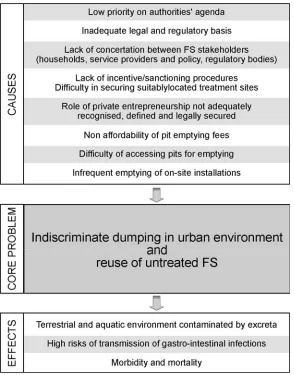
Collection and haulage of faecal sludges in large cities are associated with immense problems. Fig. 1 is a simplified problem tree of the current situation in FS management. It summarises
the major challenges (Montangero et al. 2002):
Fig. 1 Present-Day Faecal Sludge Management: Widely Observed
The challenges in FS management
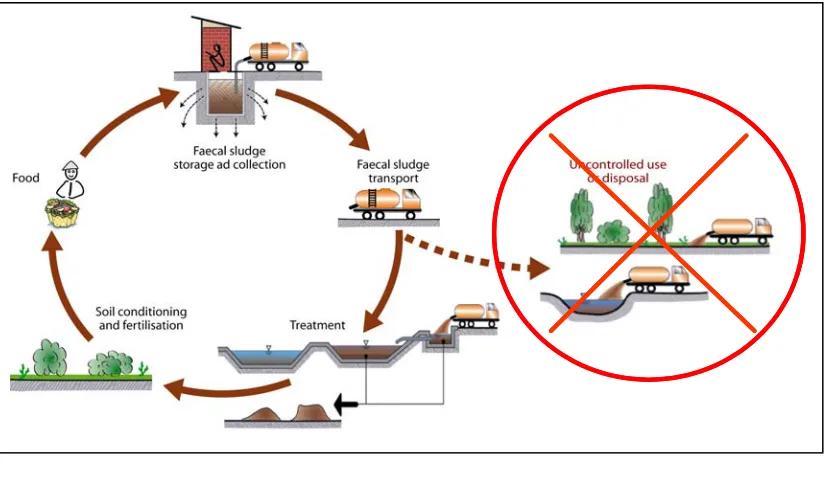
How can the situation as described above be sustainable improved? In a nutshell, the challenge consists in ensuring that all FS generated in the urban environment are discharged at designated storage or treatment sites, and that illegal and indiscriminate dumping of untreated FS is stopped (Fig. 2). An array of measures is required, comprising (Montangero et al. 2002):
• Institutional and regulatory measures
• Financial/economic measures
• Technical measures, and
• Training in on-site sanitation and FS management in academic institutions and on
all professional levels
Awareness and political will must exist and be strengthened at various levels of government to promote sustained improvements in FS management. Municipal or entrepreneurial bodies must be in place or be developed, to provide effective FS collection, haulage and treatment services, and urban dwellers must recognise the need and be willing and able to pay for improved excreta disposal.
With a few exceptions, sanitary engineering curricula offered in developing countries do not comprise FS management. Hence, professionals needing to devise strategies and technical-managerial solutions in this field must develop basic skills and expertise “hand-to-mouth”. While efforts have been made in recent years, e.g. by Sandec and its partners in Africa, Asia and Latin America, to fill gaps-in-knowledge in FSM, institutional capacities in developing countries to effectively absorb and further develop the respective expertise are still lacking.
Pioneering Initiatives
There are, to the authors’ knowledge, a few cases only, where concerted efforts to remedy the situation are under way, among them the initiatives reported about below from Danang (Vietnam), Bamako (Mali), Kumasi (Ghana) and Ouagadougou (Burkina Faso). They are used to illustrate how the stakeholders attempt to mount a mixture of measures, which emanate from the specific local context and needs. In addition to these four promising initiatives, the cases of Senegal and Guinea-Conakry stand out, too: Three FS treatment plants are ready to be taken into operation in Dakar, and more are being planned for Senegal’s secondary cities. Similarly, in Conakry, two FS treatment plants were built and commissioned in the city’s peri-urban zones recently. Thus, improved FS management has become an integral component of urban sanitation development in Senegal and Guinea.
In Danang, Vietnam (pop. 800,000), the majority of households availing of sanitation installations rely on septic tanks (Barreiro 2003). Greywater and septic tank effluents are discharged into street and surface drains, causing surface water pollution and keeping risks for transmission of GI infections high. Septic tank emptying is done by six private enterprises sharing a competitive market. As in other cities worldwide, fees are often non-affordable for many households. Tanks are thus emptied infrequently, i.e. when in-house drainage becomes blocked. This shows that even if proper systems are in place, they may not fulfil their role due to lack of awareness, affordability, and adequate operation and maintenance.
The following measures are currently being introduced:
• Intensification by municipal agencies of awareness-raising activities for improved
septic tank O+M and for raising households’ acceptance of new FS management procedures at municipal level.
• Enactment of regulations leading to compulsory and periodic septic tank
emptying (inclusive of monthly instalment payment schemes through the wastewater or solid waste collection fees).
• Certification and licensing of collector entrepreneurs, including procedures for
control and enforcement.
• Reversed money flux: payment to FS collectors for registered delivery to the
treatment site.
• Appropriate treatment of FS.
Kumasi, Ghana (pop. 1 million), is one of the few cities where authorities have
The competition among private operators and KMA’s power to revoke the licenses of collectors who do not discharge their loads at the official site appear to be the reasons for satisfactory compliance (Mensah, 2002). (In contrast, emptying enterprises in Cotonou, Benin, have organised a cartel in the absence of pricing regulations. Emptying fees are affordable by only a few. Hence, a renewed market for manual emptiers emerged, who are providing lower priced services yet in a hygienically riskful manner (CREPA Benin 2002)). One FS treatment scheme was commissioned in Kumasi in 2003. It treats septage (the FS pumped out from septic tanks) and sludges from unsewered public toilets in a series of settling and stabilization ponds. A second scheme co-treating FS and landfill leachate will be commissioned in 2004. The treatment plants are designed to each handle 200-300 m3 of FS daily, coping with the FS load being collected currently and a few years hence. Operation of both schemes will be contracted out to entrepreneurs after a trial operating period during which the schemes will be tested and experience in O+M be acquired by KMA.
In Bamako, Mali (pop. 1 million), sanitation systems in use comprise private and public latrines of various types, septic tanks and a low-cost sewerage scheme covering a small downtown zone. Collection, haulage, and final disposal of FS is done exclusively by unskilled workers using shovels and buckets or small entrepreneurs using tractor or donkey drawn
vacuum pumps or suction tankers (Visker 1998; Jeuland 2002; Bolomey et al. 2003). Urban
agriculture plays an important role, with some 6 % of the population involved in vegetable, flower and tree growing (Visker 1998; Towles 2001). FS are widely applied there, usually after some traditional mode of “composting” (storage upon mixing with organic solid waste, plant residues or cattle dung). With co-financing by the UNDP Global Environment Fund, Bamako’s most dynamic small entrepreneur in FS management is currently constructing a scheme to treat FS collected in two districts of the city. Government currently plays only a minor role in the sector of FS collection and haulage. Financial analyses show that FS collection and haulage constitutes a viable commercial activity. The entrepreneurs have signed service contracts for regular emptying with some clients and they serve others on call. A household survey furnished information on clients’ perceptions, knowledge and needs regarding FS services and their willingness-to-pay for improved FS management (accounting
for treatment mainly) (Bolomey et al. 2003). Results of the survey can be summarised as
follows:
• The willingness-to-pay for pit emptying is only half of actual prices.
• Clients prefer to pay in instalments; contracts for regular emptying appear
attractive.
• The majority of clients know that FS is used in horticulture without treatment.
• There is a need for intensive awareness-raising about excreta management and
excreta-related health risks.
• The entrepreneur owning the plant
• The municipal waste management
authority
• The provincial pollution control agency
• The mayor’s office of Commune VI of
Bamako
• NGOs representing community interests
• Research partners
This is a novel development in Mali where public entities have remained completely uninvolved in FS management, leaving its challenges to the households and private entrepreneurs. Stakeholders, including public authorities, have now become aware, though, that public entities should be made responsible for FS management given the eminent importance of improving people’s livelihood by reducing the health risks of current practices.
In Ouagadougou (pop. 1 million), Burkina Faso, the sanitation systems in use are similar to those of Bamako, i.e. mainly septic tanks, and private and public latrines. Additionally, a new sewer system for the city centre and the industrial zone was commissioned recently. A treatment scheme comprising a pond system for wastewater and evaporation tanks for faecal sludge was constructed in the industrial zone of the city in 2004. Although the treatment of FS didn’t start yet the due to technical problems of the drying beds, the planned character of the FS management is a manifestation of the fact that the national and municipal authorities are aware of the need to devise improved FSM as part of the city’s sanitation upgrading. According to the city’s strategic sanitation plan (ONEA 1993), the following innovative tariff and financial arrangements shall be put in place:
• Financing the wastewater and the FS treatment plants by levying a sanitation tax
on the drinking water consumption and a fee on the sewer connection.
• When discharging on the treatment site, the collection company will be paid a flat
discharge premium instead of having to pay a discharge fee. The premium shall constitute an incentive for entrepreneurs to deliver the FS to the treatment site instead of illicitly dumping it.
The above cases from Danang, Kumasi, Bamako and Ouagadougou exhibit the following strengths and weaknesses:
Strengths Weaknesses
• Political will and awareness within municipal authorities • Lack of regulatory system
• Devolvement of FS collection services to the local private sector
• Too complex regulatory system
• Initiatives of private sector in close contact with customers (households)
• Lack of government strategy on subsidising FS management
• Existence of an FS committee (gathering all stakeholders) • FS collectors must pay for FS delivery to treatment sites (Kumasi)
• Clearly defined terms of reference for the different stakeholders
• Lack of strategy on biosolids marketing
• Financing mechanisms based on incentives and sanctions • Emptying fees too high
• Existence of treatment plants based on sound technology
Approaches and Tools for Improved FS Management
Involving the stakeholders in planning
Planning for FS management must form an integral part of long-term urban sanitation planning. Identification, continuous involvement, and definition of the specific roles of all actors as well as sustained concertation among them constitute the single most important set of measures in devising and maintaining improved FS management. In the case of Danang and Kumasi, stakeholder identification and coordination was sought by the authorities. In Bamako, the respective initiative emerged from entrepreneur’s side. Where use of biosolids (the solids fraction of sludges treated to allow safe agricultural use) produced through FS treatment is envisaged, farmers and farmers’ cooperatives also belong to the stakeholder groups as they determine whether or not a market may develop for hygienically safe biosolids
produced in future treatment schemes (Klingel et al. 2001).
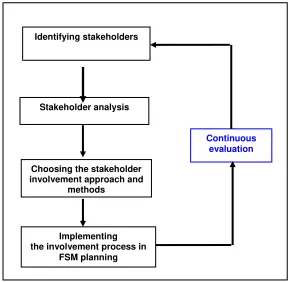
Koanda (2006) successfully tested a three-pillar approach for strategic FSM planning in the town of Ouahigouya, Burkina Faso (65’000 inhabitants). The approach comprises effective stakeholder involvement, assessing families’ willingness-to-improve the neighbourhood hygiene, and the strengthening of small entrepreneurs. Fig 3 shows the stakeholders involvement process, whose success depends on the motivation and perseverance of stakeholders and their representatives, on the commitment of the municipal authorities, on the political and institutional stability, and on a sustained support by a facilitator. For the scaling-up of the method for larger cities, it is recommended to divide the city into smaller zones and to develop to the extent feasible zone-specific strategic-technical-managerial solutions (see Fig.4).
Fig. 3 Stakeholder involvement process for faecal sludge management planning as tested in Ouahigouya, Burkina Faso
Stakeholder analysis Identifying stakeholders
Choosing the stakeholder involvement approach and
methods
Implementing the involvement process in
FSM planning
Important components of FS management planning
Effective FS management planning needs to be done as an integral component of urban sanitation planning and must comprise, among others, the following important steps and components - devised and carried out with task-specific involvement of selected or of all stakeholders:
• An assessment of the on-site sanitation installations in use and of their relative share
over the entire city as well as over individual zones.
• An assessment of the existing FSM management system and its shortcomings,
including FS collection and haulage, traditional or “modern” treatment if existing, and use and/or dumping practices - technical, institutional / managerial and
socio-economic aspects.
• Estimating the current FS quantities and the relative shares and characteristic of FS
produced in the various types on-site sanitation installations.
• Devising a plan for a future scenario on sanitation options used in the city on the basis
of which future FS quantities to be collected and treated can be estimated; giving consideration in this plan on how on-site sanitation options and FSM management are mutually dependant.
• Assessing the potential market for the sale of biosolids produced in FS treatment.
• Assessing families’ willingness and ability-to-pay for pit emptying and for
contributing to a generally improved management of FS (haulage to treatment sites, treatment).
• Assessing the cost structure and financial fluxes related to the current FSM system to
evaluate the current FSM’s sustainability.
• Devising money flux, regulatory and management scenarios which are promising
under the given political, socio-economic, institutional setting.
• Evaluating potentially appropriate FS treatment options in the framework of current or
future treatment regulations, farmers’ demand for biosolids, financial-economic conditions and institutional settings.
• Devising, where appropriate, contracts with entrepreneurs for FS collection and
treatment licensing.
• Considering and setting up if necessary new institutional structures and responsibility
sharing to enable implementation of the strategic plan.
• Devising pilot and demonstration schemes for testing technical-managerial options.
Treatment at what scale and what options for FS collection, haulage and treatment ?
contribute significantly to reducing collection and haulage cost, hence, increasing the frequency of pit emptying and reducing indiscriminate dumping of FS.
Wha t sc a le for FS t re a t m e nt : c e nt ra lise d or se m i-c e nt ra lise d ?
Objective:
minimize overall cost for collection, haulage and treatment while guaranteeing safety in FS handling, use or disposal
FSTP
Emptying equipment should be adapted to allow emptying of pits located in narrow lanes. Effective technical solutions do exist such as combined small, hand-pushed vacuum tugs of
350 L and truck-mounted vacuum tanks of 5m3, as operated in Haiphong (Vietnam) (Klingel
et al. 2001).
Several modest-cost options for FS treatment have been investigated upon and developed by Sandec and its partners in recent years. Potential options are, for example, waste stabilization ponds, plain sludge drying beds, reed-planted sludge drying beds (constructed wetlands) and composting. Preliminary guidelines for planners and engineers on different options have been
formulated (Heinss et al. 1998; Klingel et al. 2001; Montangero and Strauss, 2002; Koottatep
et al. 2005; Sanguinetti et al. 2005; Cofie et al., 2006; Koné and Strauss (submitted)). There is no single best option, which may prove equally suitable under the widely varying conditions which prevail in urban areas of developing countries.
Who will pay for what?
Sustainable environmental sanitation may be achieved or enhanced only by applying appro-priate financial incentives and sanctions (Wright 1997). Hence, municipalities must devise an effective sanctioning system (e.g. by imposing fines or non-renewal of FS collection contracts with entrepreneurs), and an incentive-based policy by, among others, paying entrepreneurs for delivering FS to the legally designated treatment or disposal site (Steiner et al. 2003; Barreiro 2003; Jeuland et al. 2004, Koanda 2006).
Based on a money flux reversal model developed by Jeuland (2002) for FS management in one of the districts of Bamako (Mali), Steiner et al. (2003) developed a series of possible financial models for the flow of fees to be paid within the customer/service provider/public authority triangular network existing or to be developed in improved FS management. Fig. 5 illustrates such a financial scheme, the most crucial element of which is the payment to collectors for FS brought to the treatment site (discharge premiums). The flux reversal principle is about to be introduced in the city of Danang, Vietnam. The city of Ouagadougou, Burkina Faso, is planning to pay collectors the equivalent of € 3.70 per standard truck load upon delivery of FS to the new wastewater/FS treatment scheme to reduce illegal and illicit dumping of FS or use of untreated FS in agriculture. For FS management to function on a sustainable basis, national or municipal governments must consider to provide subsidies, recoverable partly by a surtax on water, wastewater or sanitation charged to households. The rationale for such a policy is to render pit emptying affordable to all urban dwellers, to enable entrepreneurs to operate FS services with adequate profit margins, and to keep prices for biosolids usable in agriculture competitive. Intensive information, awareness-raising and social/commercial marketing campaigns are needed to render new money flux procedures acceptable by the urban customers and to induce the demand of farmers for biosolids.
Fig. 5 Novel money flux scheme in FS management (after Steiner et al. 2003)
stakeholder cost money flow
Legend
revenue Administration,
office cost, etc. O+M cost Capital cost
Biosolids
office cost, etc. O+M cost Capital cost
Biosolids
office cost, etc. O+M costO+M cost Capital costCapital cost
Regulatory
Management. There is in most countries, a paucity of regulatory acts, ordinances, and administrative rules related to FS management. Hence, authorities are challenged not only to create this regulatory framework but also to develop procedures and capacity to promote understanding and enforce adherence by the actors involved. Crucial elements of a regulatory basis comprise:
• Legally binding terms of reference for selected national and municipal bodies.
• Designation of and securing land for sites where FS discharge or treatment will be
allowed.
• Certification and licensing of enterprises carrying out services in FS management.
• Formulating on a municipal level the ordinances, which determine the procedures
(technical and financial), conditions, incentives, and sanctions for effective FS management.
• Continuous coordination between stakeholders.
• Profitable and balanced partnership between private sector and the municipalities.
Treatment. Replicating the strict standards or limits established in industrialized countries without taking into account the local conditions is entirely inappropriate, as the development of monitoring and enforcement is still lagging behind in most developing countries. There, numerical quality standards for treating sludges or wastewater are often established without defining locally appropriate management and treatment options. Such options, in turn, have to take into account disposal or use scenarios, type of soils, health aspects, financial and economic factors, and institutional capacities. Treatment aiming at the use of the biosolids has to meet different standards than treatment aiming at disposal or discharge into the
environment (Ingallinella et al. 2000).
A sensible strategy for public health protection in biosolids use has been adopted by the EU, the “HACCP” (hazard analysis and critical control points)-approach. Thereby, barriers or critical control points are defined, which reduce or prevent the transmission of infections. Sludge treatment options, which are found to inactivate excreted pathogens to desirable levels, are the prime element in this (Matthews 2000). “Barrier points” such as the sludge treatment works, can be easily controlled with respect to design and operations, thereby securing the compliance of the treated biosolids with stipulated quality standards. In contrast to this, the controlling of numerical quality criteria for wastewater or biosolids requires regular monitoring. In economically less developed countries, such monitoring is usually unreliable and hardly affordable.
Xanthoulis and Strauss (1991) proposed a guideline value for biosolids (as produced in faecal sludge or in wastewater treatment schemes) of 3-8 viable nematode eggs/g TS. This
recommendation is derived from the WHO guideline of ≤ 1 nematode egg/litre of treated
wastewater used for vegetable irrigation (WHO 1989), and based on an average manuring rate of 2-3 tons TS/ha·year. Well-designed and operated, modest-cost options guarantee that this limit is likely to be met under most circumstances.
Conclusions and Recommendations
References
Barreiro, W. C. (2003). Septage Management in the Cities of Haiphong and Danang: Eawag / Sandec, Switzerland. 18 p.
Bolomey, S., Koné, D., Strauss, M. (2003). Amélioration de la gestion des boues de vidange par le renforcement du secteur privé local : Etudes et Outils Cas de la Commune VI du District de Bamako. Eawag / Sandec, Switzerland. 48p. http://www.sandec.ch/FaecalSludge/Documents/Renforcement_secteur_prive.pdf
Cofie, O., Agbottah, S., Strauss, M., Esseku H., Montangero, A., Awuah, E. and Koné, D. (2006). Solid-liquid separation of faecal sludge using drying beds in Ghana: Implications for nutrient recycling in urban agriculture. Water Research, Vol.40(1); 75-82.
CREPA Bénin (2002). Gestion des Boues de Vidange au Bénin: Etat des Lieux. Project report, February. Heinss, U., Larmie, S.A., Strauss, M. (1998). Solids Separation and Pond Systems for the Treatment of Septage
and Public Toilet Sludges in Tropical Climate - Lessons Learnt and Recommendations for Preliminary Design. EAWAG/SANDEC Report No. 05/98.
http://www.sandec.ch/FaecalSludge/Documents/Solids_sep_and_pond_treatm_98.pdf
Ingallinella, A. M., Sanguinetti, G., Koottatep, T., Montangero, A. and Strauss, M. (2002). The challenge of faecal sludge management in urban areas - strategies, regulations and treatment options. Water Science and Technology, 46, pp 285-294.
Jeuland, M. (2002). Economic Aspects of FS Management in Bamako, Mali. Unpublished project report, March. Jeuland, M., Strauss, M. and Koné, D. (2004). Private Sector Management of Fecal Sludge: A Model for the
Future? Focus on an innovative planning experience in Bamako, Mali. EAWAG/SANDEC, Switzerland. 90p. http://www.sandec.ch/FaecalSludge/Documents/Private_Sector_Management_FS.pdf
Johnstone, D.W.M., Horan, N.J. (1996). Institutional Developments, Standards and River Quality: An UK History and Some Lessons for Industrialising Countries. Water Science and Technology, 33, No. 3, pp. 211-222.
Klingel, F., Montangero, A., Strauss, M. (2001). Nam Dinh (Vietnam) – Planning for Improved Faecal Sludge Management and Treatment. Paper presented at the Annual Conference of the Water Supply & Sewerage Association of Vietnam, Dec. 6-7, 2001.
http://www.sandec.ch/FaecalSludge/Documents/WSA_paper_Klingel_et_al.pdf
Koanda, H. (2006). Vers un assainissement urbain durable en Afrique subsaharienne: Approche innovante de planification de la gestion des boues de vidange. Thèse de doctorat n° 3530, Ecole Polytechnique Fédérale de Lausanne, Suisse, 306p.
Koné D. and Strauss M. Low-cost Options for Treating Faecal Sludges (FS) in Developing Countries – Challenges and Performance. Submitted.
http://www.sandec.ch/FaecalSludge/Documents/FS_treatment_Avignon_2004.pdf
Koottatep, T., Polprasert, C., Oanh, N.T.K, Surinkul, N., Montangero, A., and Strauss, M. (2002). Constructed Wetlands for Septage Treatment –Towards EffectiveFaecal Sludge Management. In: Proceedings, 8TH Int. Conference on Wetland Systems for Water Pollution Control (IWA/University of Dar es Salaam), Arusha, Tanzania, Sept. 16-19.
http://www.sandec.ch/FaecalSludge/Documents/CW_for_septage_Arusha_Koottatep_et_al.pdf
Koottatep, T., Surinkul, N., Polprasert, C., Kamal, A.S.M., Koné D., A. Montangero, U. Heinss and M. Strauss (2005). Treatment of septage in constructed wetlands in tropical climate: lessons learnt from seven years of operation. Water Science & Technology Vol 51(9) pp. 119–126.
http://www.sandec.ch/FaecalSludge/Documents/Paper_7years%20experience%20revised.pdf Kumasi Metropolitan Assembly (1995). Strategic Sanitation Plan for Kumasi, 1996-2005.
Mensah, A. (2003). Sanitation, Solid Waste Management and Storm Drainage Component. In: Afranie, K., et al.
(2003). Medium term development plan for Kumasi
Montangero, A. and Strauss, M. (2002). Faecal Sludge Treatment. Lecture Notes, IHE Delft, February. SANDEC. http://www.sandec.ch/FaecalSludge/Documents/IHE_lecture_notes_02_small.pdf Montangero, A., Koné, D., Strauss, M. (2002). Planning Towards Improved Excreta Management. In:
Proceedings, 5th IWA Conference on Small Water and Wastewater Treatment Systems, Istanbul, Turkey, Sept. 24-26. http://www.sandec.ch/FaecalSludge/Documents/ManuelGestion%20BV-1ereEd.pdf ONAS - Office Nationale de l’Eau et de l’Assainissement (1993). Plan Stratégique d’Assainissement des Eaux
Usées de la Ville de Ouagadougou. Ministère de l’Eau, Burkina Faso.
Sanguinetti, G.S., Tortul, C., Garcia, M.C., Ferrer, V., Montangero, A., and Strauss, M (2005). "Investigating helminth eggs and Salmonella sp in stabilization ponds treating septage." Water Science and Technology
51, no. 12: 239-247
Steiner, M., Montangero, A., Koné, D., Strauss, M. (2003). Towards More Sustainable Faecal Sludge Management Through Innovative Financing - Selected Money Flow Options. EAWAG/SANDEC, draft under review, 26 p. http://www.sandec.ch/FaecalSludge/Documents/Money.flow.models.pdf
Strauss, M., Heinss, U., Montangero, A. (2000). On-Site Sanitation: When the Pits are Full – Planning for Resource Protection in Faecal Sludge Management. In: Proceedings, Int. Conference, Bad Elster, 20-24 Nov. 1998. Schriftenreihe des Vereins fuer Wasser-, Boden- und Lufthygiene, 105: Water, Sanitation & Health – Resolving Conflicts between Drinking – Water Demands and Pressures from Society’s Wastes (I.Chorus, U. Ringelband, G. Schlag, and O. Schmoll, eds.). IWA Publishing House and WHO Water Series. ISBN No. 3-932816-34-X.
Towles, C. (2001). Faecal Sludge Management in Bamako, Mali – an Introductory Note. August. Unpublished
Von Sperling, M. and Fattal, B. (2001). Implementation of Guidelines – Practical Aspects for Developing Countries. In: Water Quality – Guidelines, Standards and Health. Assessment of risk and management of water-related infectious disease. Eds.: Fewtrell, L. and Bartram, J. WHO Water Series / IWA. Publishing ISBN 1 900222 28 0.
Visker, C. (1998). The Use of Human Excreta in Urban and Peri-Urban Agriculture in Bamako, Mali (in French). Royal Tropical Institute, Amsterdam, The Netherlands.
WHO (1989). Health Guidelines for the Use of Wastewater in Agriculture and Aquaculture. Report of a Scientific Group. World Health Organisation Technical Report Series 778.
Wright, A.M. (1997). Toward a Strategic Sanitation Approach: Improving the Sustainability of Urban Sanitation in Developing Countries. UNDP-World Bank Water and Sanitation Program.