EE E
Sanjit Chatterjee • Palash Sarkar
Printed on acid-free paper
Springer New York Dordrecht Heidelberg London
© Springer Science+Business Media, LLC 2011
All rights reserved. This work may not be translated or copied in whole or in part without the written permission of the publisher (Springer Science+Business Media, LLC, 233 Spring Street, New York, NY 10013, USA), except for brief excerpts in connection with reviews or scholarly analysis. Use in connection with any form of information storage and retrieval, electronic adaptation, computer software, or by similar or dissimilar methodology now known or hereafter developed is forbidden.
The use in this publication of trade names, trademarks, service marks, and similar terms, even if they are not identified as such, is not to be taken as an expression of opinion as to whether or not they are subject to proprietary rights.
Indian Statistical Institute
ISBN 978-1-4419-9382-3 e-ISBN 978-1-4419-9383-0 DOI 10.1007/978-1-4419-9383-0
Department of Computer Science
Bangalore
Indian Institute of Science and Automation
India 560012
203 B.T. Road Kolkata India 700108
[email protected] [email protected]
Springer is part of Springer Science+Business Media (www.springer.com)
Applied Statistics Unit
Preface
One of the main reasons for writing this monograph is the curiosity to know more. Identity-based encryption is a fascinating area of modern cryptography. We have done some work in this area and wanted to explore the area in some depth. This motivation, however, was not sufficient for us to take up the job. The catalytic effect is due to Peter Wild, who suggested us to take up this work and very kindly referred us to Springer.
Determining the focus of a monograph is difficult. More specifically, it is difficult to determine who would benefit from the text. Within a decade or so, identity-based encryption has emerged as a distinct area of research starting, virtually, from scratch. Naturally, IBE now attracts many research students from across the world. For a beginner, it might be a little difficult to get a unified account of the evolution of this research area from the scattered literature. It is precisely this gap that we try to fill through this monograph.
Starting from the basic ideas, the monograph attempts to cover all the important IBE schemes that have been proposed till date. Among these are included the more recently proposed lattice-based IBE schemes. A major thrust of the research in IBE is the so-called security proof. Proofs of the security reductions of most of the im-portant schemes are provided in details. Our guiding principle in selecting the proofs for inclusion is that they highlight some novel techniques. Many more schemes are described without any formal proof and in some cases an intuitive description of the security reduction is provided. Hopefully, going through the book will help a research student to grasp the central ideas involved in constructing IBE schemes. If this is indeed achieved, then our efforts will have succeeded. We also hope that the book may be useful to experts as reference for quickly looking up a particular topic. The actual writing of the monograph took several months (and included missing a deadline). We are thankful to Springer, especially Susan Lagerstrom-Fife for her enthusiasm and support to the project. Jennifer Maurer looked over the manuscript several times and provided useful feedback.
Technical feedback on the contents of the monograph were provided by several of our colleagues and students. In fact, they formed the test cases for the judging the usefulness of the monograph. We gratefully acknowledge the comments and
feedback received from Rana Barua, Sanjay Bhattacherjee, Sherman S. M. Chow, M. Prem Laxman Das, Kishan C. Gupta, Koray Karabina and Somindu C. Ramanna. Without their feedbacks, there would surely been many more mistakes present in the book than there is now. Needless to say, any errors that do remain are entirely our own responsibility.
Kolkata, India, Sanjit Chatterjee
Contents
1 Introduction. . . 1
1.1 Background . . . 1
1.2 Identity-Based Encryption . . . 8
1.3 Plan of the Book . . . 9
2 Definitions and Notations . . . 13
2.1 Public Key Encryption . . . 13
2.2 Identity-Based Encryption . . . 16
2.2.1 Hierarchical Identity-Based Encryption . . . 17
2.3 Security Model for (H)IBE . . . 19
2.3.1 Chosen Ciphertext Attack . . . 20
2.3.2 Chosen Plaintext Attack . . . 22
2.3.3 Selective-ID Model . . . 23
2.3.4 Anonymous (H)IBE . . . 24
2.3.5 Use of Random Oracles . . . 25
2.4 Structure of Security Proofs . . . 26
2.5 Conclusion . . . 28
3 A Brief Background on Elliptic Curves and Pairings . . . 29
3.1 Finite Fields, Elliptic Curves and Tate Pairing . . . 30
3.1.1 Exponentiation in General Cyclic Groups . . . 30
3.1.2 Finite Fields . . . 32
3.1.3 Elliptic Curves . . . 33
3.1.4 Tate Pairing . . . 39
3.1.5 Types of Pairings . . . 43
3.2 Hardness Assumptions . . . 44
3.3 Conclusion . . . 48
4 Boneh-Franklin IBE and its Variants. . . 49
4.1 Boneh-Franklin IBE . . . 49
4.1.1 Security Against Chosen Ciphertext Attacks . . . 54
4.2 Hierarchical Identity-Based Encryption . . . 57
4.3 Boneh-Katz-Wang CPA-Secure IBE . . . 59
4.4 Attrapadung et al’s CCA-Secure IBE . . . 60
4.5 Conclusion . . . 61
5 Selective-Identity Model . . . 63
5.1 Boneh-Boyen HIBE . . . 64
5.1.1 Security . . . 65
5.2 Constant Size Ciphertext HIBE . . . 67
5.3 Interpreting Security Models . . . 69
5.4 Conclusion . . . 70
6 Security Against Adaptive Chosen Ciphertext Attacks. . . 71
6.1 A High Level Description . . . 72
6.2 Canetti-Halevi-Katz Transformation . . . 72
6.2.1 One-Time Signatures . . . 73
6.2.2 The Transformation . . . 73
6.2.3 Security . . . 74
6.3 The Boyen-Mei-Waters Transformation . . . 76
6.4 Conclusion . . . 80
7 IBE in Adaptive-Identity Model Without Random Oracles . . . 81
7.1 Boneh-Boyen IBE . . . 82
7.2 Waters IBE . . . 83
7.2.1 Security . . . 84
7.3 Generalisation of Waters IBE . . . 93
7.4 Adaptive-Identity Secure HIBE . . . 93
7.5 Converting to a CCA-Secure HIBE . . . 94
7.6 Further Applications of Waters Technique . . . 97
7.7 Conclusion . . . 98
8 Further IBE Constructions. . . 99
8.1 Gentry’s IBE . . . 100
8.1.1 CPA-Secure Construction . . . 101
8.1.2 CCA-Secure Construction . . . 105
8.1.3 Previous and Further Work . . . 106
8.2 Dual System Encryption . . . 107
8.2.1 Extensions . . . 119
8.3 Conclusion . . . 120
9 IBE Without Pairing . . . 121
9.1 IBE Based on Number Theory . . . 122
9.1.1 Cocks’ IBE . . . 122
9.1.2 Boneh-Gentry-Hamburg IBE . . . 123
9.2 IBE From Lattices . . . 125
9.2.2 Pre-Image Sampling . . . 127
9.2.3 Gentry-Peikert-Vaikuntanathan IBE . . . 128
9.2.4 Generalized Pre-Image Sampling . . . 130
9.2.5 Agrawal-Boneh-Boyen IBE . . . 131
9.3 Conclusion . . . 134
10 Applications, Extensions and Related Primitives. . . 137
10.1 Signature Schemes . . . 137
10.1.1 Boneh-Lynn-Shacham Short Signature . . . 137
10.1.2 A Hierarchical Identity-Based Signature . . . 139
10.2 Identity-Based Key Agreement . . . 143
10.3 Broadcast Encryption . . . 145
10.4 Fuzzy Identity-Based Encryption . . . 148
10.5 Public Key Encryption with Keyword Search . . . 149
10.6 Other Applications . . . 151
10.7 Conclusion . . . 153
11 Avoiding Key Escrow . . . 155
11.1 Distributed PKG . . . 155
11.2 Certificate-Less Encryption . . . 156
11.3 Certificate-Based Encryption . . . 158
11.4 Other Approaches . . . 160
11.5 Conclusion . . . 161
12 Products and Standards . . . 163
12.1 Voltage Security . . . 163
12.2 Trend-Micro . . . 164
12.3 IEEE P1363.3/D1 Draft Standard . . . 164
12.4 IETF Memo . . . 165
12.5 Conclusion . . . 165
13 Bibliography . . . 167
References . . . 167
Chapter 1
Introduction
1.1 Background
Science, it has been argued by Kuhn in 1962 [126], advances through paradigm shifts. Concepts emerge that open-up new vistas of research, fundamentally chang-ing the way we are used to lookchang-ing at thchang-ings. Between these paradigm shifts remain the periods of consolidation. Periods when human mind explores the newly found territory, shedding light on hitherto unknown dimensions. If radical changes are the hallmarks of paradigm shifts, the period within witnesses small but continuous de-velopments, occasionally marked by its own milestones. It is in these periods that human faculty tries to grasp the full significance of the new concepts, consolidates its gains and thereby pushes the boundary of our collective knowledge further. The prospects, nevertheless, bring with it new problems too. Perhaps, by the way, mak-ing ground for the next paradigm shift.
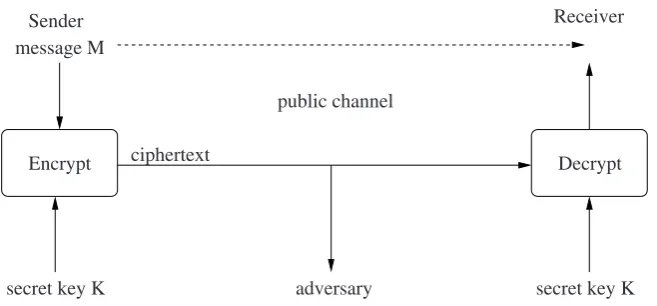
Cryptology, as a branch of human knowledge, is no exception to this common story. Whenever civilisation reached a certain level of sophistication, the need for secret communication between two geographically distant parties has arisen. Poli-tics, military and business are the three dominant areas of human activity where such communication becomes essential. With the gradual evolution of technology from ancient days to modern times, several innovative forms of encryption methodology have been developed, extensively used and then discarded after brilliant insights into new cryptanalytic methods. The cycle of development and analysis of cryptographic schemes have thus progressed to become a fascinating subject of human intellectual endeavor. There are excellent accounts of this historical development in [115, 164]. The basic problem of cryptography can be considered to be the issue of secure communication between two parties using a communication medium which is not under the exclusive control of these two parties. Such a medium is called a pub-lic channel, highlighting the fact that the information flowing across this channel is publicly accessible. An alternate view of cryptography is the task of building an implicit secure communication channel over an explicitly given insecure public
© Springer Science+Business Media, LLC 2011
channel.Figure 1.1provides an overview of the classical model of performing this task.
Receiver Sender
message M
Decrypt Encrypt ciphertext
public channel
secret key K adversary secret key K
Fig. 1.1 An overview of symmetric key encryption.
Both the sender and the receiver share a common secret keyKwhich is not known to the adversary. The ciphertext moving across the public channel is a function of the message and the secret key K. An adversary has access to the ciphertext, but, without knowledge ofKshould be unable to obtain the intended messageM. The receiver, on the other hand, knowsK and should be able to recoverM from the ciphertext.
Since antiquity, human mind had accepted this model as the natural and perhaps the only model of secure communication. There had been no reason or motivation to look beyond this model. Things, however, changed with the advent of radio com-munication. This enabled large-scale comcom-munication. But, the full functionality of radio communication could not be realised if the confidentiality of the tion could not be assured. Thus, arose the problem of ensuring secure communica-tion between any two of a number of parties.
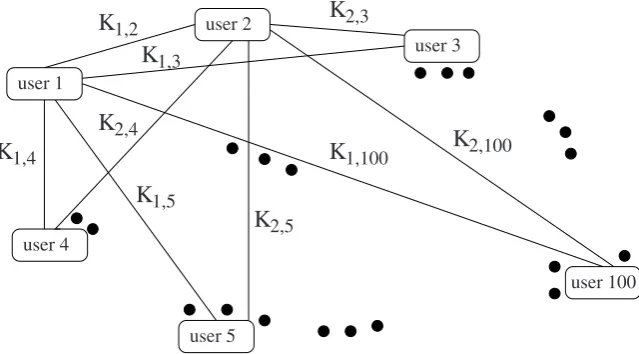
Suppose there are 100 parties. Using the classical model, secure communication between any two parties requires a secret key per pair of parties. So, the total num-ber of secret keys in the system is 1002and each party has to maintain 99 secret keys. SeeFigure 1.2for a pictorial representation of this scenario. To visualise the immensity of the problem, one may change 100 to any numbern that would be practical in the real world.
K
1,2K
1,100K
1,4K
1,5K
1,3K
2,5K
2,4K
2,3K
2,100user 100 user 1
user 2
user 3
user 5 user 4
Fig. 1.2 Secure communication among 100 users using the classical model.
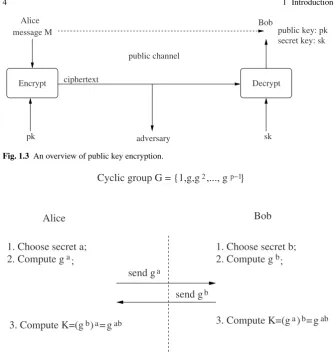
The basic idea of the new paradigm was simple. Instead of using the same key for encryption and decryption, one may consider two separate keys for each party – one key is used for encryption and the other key is used for decryption. The encryption key may be made public, so that any other party (say Alice) may send an encrypted message. The decryption key, on the other hand, should be kept secret, so that only the intended receiver (say Bob) can decrypt the ciphertext. SeeFigure 1.3for an overview of this idea. This is called public key encryption (PKE).
Though it is surprisingly simple, the idea eluded researchers for a long time. This perhaps lends credence to Kuhn’s theory of major scientific developments (alluded to in the opening paragraph) as proceeding through paradigm shifts. The human mind had grown accustomed to the belief (or paradigm) of using thesamekey for both encryption and decryption and hence, found it extremely difficult to conceive the shift where the encryption and decryption keys are different.
It was first published by Diffie and Hellman in their seminal paper [77] appropri-ately titled “New Directions in Cryptography”. Somewhat interestingly, researchers working for the British government had also obtained the same idea but, their work remain classified for several decades. See [164] for an account of the two separate histories of the development of public key cryptography (PKC).
message M
Decrypt Encrypt ciphertext
public channel
adversary
Alice Bob
public key: pk secret key: sk
pk sk
Fig. 1.3 An overview of public key encryption.
} Cyclic group G = {1,g,g2,..., gp−1
2. Compute ga
b send g a
send g
3. Compute K=(gb)a= gab 3. Compute K=(ga)b= gab
Alice Bob
2. Compute g ; 1. Choose secret b;
b 1. Choose secret a;
;
Fig. 1.4 Diffie-Hellman Public Key Agreement.
Note that the security of the Diffie-Hellman scheme relies on the facts that given gaandgb, no third party will be able to compute (i) one of the exponentsaorbor (ii) the shared secretgab. The former is a classical problem in number theory called the discrete logarithm problem and the latter has become known as the Diffie-Hellman problem. So, the assurance that Alice and Bob get is conditioned on the fact that no one can solve these problems within a reasonable time. In fact, the security of all public key cryptographic schemes is based on the assumed hardness of some computational problem(s).
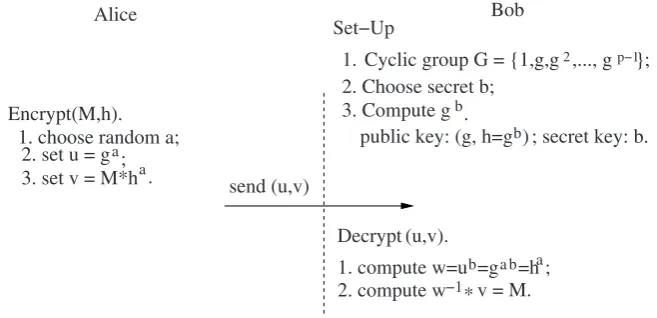
to computegaand the common secret keygab. This secret key is used to mask the message. Bob can recover the message by computinggabfromgaand his secret key bas in the DH-KA protocol.
It is indicative of the subtlety of the problem that Diffie and Hellman having proposed the notion of PKE and having discovered their key agreement protocol could not get the PKE scheme later proposed by ElGamal. It is also perhaps an issue of (a smaller scale) paradigm shift. In the ElGamal PKE scheme, the ciphertext consists of two group elements, but, the message is a single group element. So, there is a ciphertext expansion. In all previous encryption schemes, including the RSA scheme, the ciphertext is as long as the message. Though it is now considered routine, at that point of time in history, it was perhaps difficult to conceive a PKE scheme where the ciphertext is longer than the message.
}
Fig. 1.5 ElGamal public key encryption scheme.
An important aspect of PKC is the notion of digital signatures. In this primitive, each user has a secret signing key and a public verification key. A message M is signed using the signing key to produce a signature σ. Anybody can verify the correctness of a message-signature pair using the public verification key. Concrete proposals of signature schemes were made using the RSA and the ElGamal PKE schemes.Figure 1.6provides an overview of a digital signature scheme.
(M,σ)
Fig. 1.6 Overview of a digital signature scheme.
with Bob, Eve can decrypt this message. The same is true if Bob sends an encrypted message to Alice. The crucial issue is that during key establishment, Alice and Bob do not authenticate themselves to each other.
}
Fig. 1.7 (Wo)man in the middle attack.
be ensured that the public key that is claimed to belong to Alice indeed does belong to Alice.
Bob Eve, pk
Alice, pkA E
Fig. 1.8 How to trust a public key?
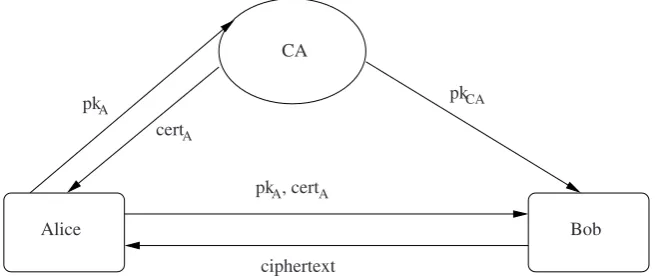
This is achieved using an authority that both Alice and Bob trust. This authority issues certificates for public keys and is called a certifying authority (CA). To obtain a certificate, Alice approaches the CA and submits her public key. The CA does the necessary (physical) verification and determines the identity of Alice. After such checking the CA uses a digital signature scheme to sign the public key of Alice. When Bob wishes to send a message to Alice, he first obtains Alice’s public key and the certificate issued to Alice by the CA. Using the public verification key of the CA, Bob can verify the signature of CA on Alice’s public key. If this verification succeeds, Bob trusts the public key to actually belong to Alice and uses it to encrypt a message intended for Alice. This is pictorially shown inFigure 1.9.
pkA pkA
, certA
pkCA
cert
ciphertext A
Alice Bob
CA
Fig. 1.9 Certifying authority and trust in public key.
1.2 Identity-Based Encryption
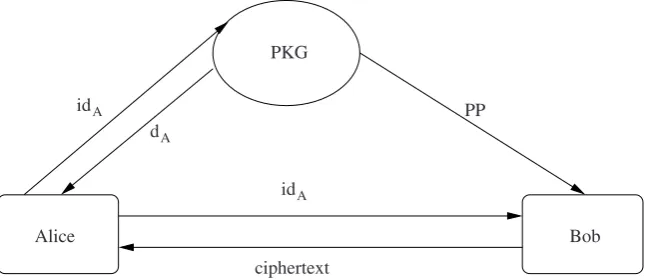
The problems associated with the practical deployment of PKE schemes motivated Shamir [155] to introduce the concept of identity-based encryption (IBE). IBE is a kind of public key encryption scheme where the public key of a user can be any arbitrary string – typically the e-mail address. An overview of an IBE scheme is given inFigure 1.10. When Bob wants to send a message to Alice; he encrypts it using the e-mail id of Alice as the public key. There is no need for Bob to go to the CA to verify the public key of Alice. This way an IBE can greatly simplify certificate management. To quote Shamir [155]:
“It makes the cryptographic aspects of the communication almost transparent to the user, and it can be used effectively even by laymen who know nothing about keys or protocols.”
idA
idA
ciphertext dA
PKG
Bob Alice
PP
Fig. 1.10 An overview of an IBE scheme.
An IBE consists of four algorithms:Set-upwhich generates a set of public pa-rameters together with a master key,Key-Genwhich generates the private key of an entity, given her identity,Encryptthat encrypts a message given the identity and
Decrypt that decrypts the message using the private key. Instead of a certifying authority, here we have a private key generator (PKG) who possesses the master secret key. In the above example, Bob authenticates himself to the PKG to obtain a private key corresponding to his identity. (This can be even after he receives the en-crypted message from Alice.) Bob uses this private key to decrypt all the messages encrypted using his identity as the public key. Note that, Alice need not verify any certificate relating the public key to send an encrypted message to Bob. What she needs is the identity of Bob along with the public parameters of PKG.
pairing over elliptic curve groups while the last one was based on factoring and is less practical. Boneh and Franklin [39] formalised the notion of IBE, gave a precise definition of its security model and related the security of their construction with a natural analogue of the Diffie-Hellman problem in the bilinear setting, called the bilinear Diffie-Hellman (BDH) problem. This work caught the immediate attention of the crypto community world wide and turned out to be a major milestone within the paradigm of public key cryptography.
Boneh and Franklin use bilinear pairing over elliptic curve groups to construct their IBE. Initially bilinear maps such as Weil and Tate pairing were introduced in cryptology [133, 84] as weapons in the arsenal of the cryptanalyst – to reduce the discrete log problem in the elliptic curve group to the discrete log problem over finite fields. Joux [113] converted it into a tool of cryptography by proposing a one round tri-partite key agreement protocol using bilinear pairing. The works of Joux and Boneh-Franklin, in some sense, ignited an explosion in pairing based public key cryptography. Even a cursory glance at a compendium [17] of these works is enough to give a feel of the research activity that has been generated in the last one decade. The concept of IBE was soon extended to hierarchical identity-based encryption (HIBE) [106, 94]. Requests for decryption keys are made to the PKG. A single PKG may become overloaded with such requests. The motivation for HIBE is to reduce the workload for the PKG. In a HIBE, instead of a single component, identities are considered to be vectors. Further, an entity having identity id= (id1, . . . ,idj)and possessing the private keydidcan generate the private key of an entity whose identity
isid′= (id1, . . . ,idj,idj+1). This way HIBE reduces the workload of the PKG. The
important thing to note is that the public parameters are that of the PKG, i.e., there are no lower level public parameters. Apart from being of some importance in its own right, a HIBE provides a flexible mechanism which can be used to construct other cryptographic primitives.
1.3 Plan of the Book
Technical discussion starts from the second chapter. Chapters 2 and 3 are of prelim-inary nature. Formal definitions of PKE and IBE schemes are given in Chapter 2. Extension to HIBE schemes are explained. The different variants of the security models for IBE and HIBE schemes are provided. Formal definition of IBE and an appropriate security model were proposed by Boneh and Franklin [39]. Later defi-nitions and security models for related primitives were based on the foundation laid out in that work. An important aspect of the cryptographic schemes is the so-called security proofs or more accurately the security reductions. Chapter 2 discusses the overall structure of security proofs. This should help the reader in going through the proofs in the later chapters.
material on finite fields, elliptic curves and pairing. This material is not intended to be encyclopedic. Rather it is provided so that the reader can get some feel about how IBE schemes can actually be implemented.
The first publicly known IBE scheme is due to Boneh and Franklin [39]. The BF-IBE scheme is presented in Chapter 4 and the security reduction is discussed in some details. The proof assumes certain functions to be random functions – the so-called random oracle assumption. All schemes discussed in Chapter 4 have this common feature. Gentry and Silverberg [94] had extended the BF-IBE scheme to a HIBE scheme. Several variants of the BF-IBE scheme has been given by other authors. Chapter 4 provides a good idea of such schemes.
Historically, the first attempts to remove the random oracle assumption from the security proofs required a weakening of the security model. This is called the selective-identity model. Several elegant (H)IBE schemes have been proposed and shown to be secure in the selective-identity model. Chapter 5 provides a description of two important (H)IBE schemes. The first one is due to Boneh and Boyen [32] and the second one is due to Boneh, Boyen and Goh [35].
Design of IBE schemes can be thought of as a two-step procedure. In the first step, a scheme is designed which can be proved to be secure against chosen-plaintext attacks (CPA-secure). The proof technique for such schemes incorporate mecha-nisms to handle key extraction procedures. The second step is to attain security against chosen-ciphertext attacks (CCA-secure). Several methods have been pro-posed to convert CPA-secure schemes to CCA-secure schemes. Chapter 6 provides a discussion of these methods.
The next major step is to obtain IBE schemes which can be proved to be se-cure in the model introduced by Boneh and Franklin without using the random or-acle assumption. An early construction of such a scheme was given by Boneh and Boyen [33]. This scheme, however, was quite impractical. An important variant of this scheme was given by Waters [169]. This variant is one of the most important IBE schemes proposed till date. Its importance stems both from the theoretical nov-elty of the construction as well as from its practicality. The only disadvantage of this scheme is the rather large size of its public parameters.
Independent work by Chatterjee and Sarkar [60] and Naccache [137] showed how to reduce the size of the public parameters with an associated degradation in the security bound. Chapter 7 discusses in details Waters IBE scheme and its variants. A new proof of Waters’ IBE scheme was given by Bellare and Ristenpart [23]. The proof of Waters’ IBE scheme that we provide is based upon the approach in [23]. Chapter 7 also provides a HIBE scheme secure against adaptive-identity attacks and its modification to attain CCA-security. This discussion is based on [61, 154].
One of the most important issues about the schemes in Chapter 7 is that the hard-ness assumption is the decisional bilinear Diffie-Hellman (DBDH) problem. This is the decision version of the bilinear Diffie-Hellman (BDH) problem introduced by Boneh and Franklin in [39]. The BDH and DBDH problems are regarded as the basic hardness assumptions in pairing based cryptography.
dis-cussed in Chapter 7). Gentry’s work is important as it is the simplest scheme which can be proved to be secure against adaptive-identity attacks without the use of ran-dom oracles. The drawback is that the hardness assumption that is used is much more complex compared to the DBDH assumption. Waters [170] recently intro-duced a new technique called dual system encryption for designing IBE schemes. This technique, though relatively new, has been used in subsequent works and ap-pears to hold out promise of further applications. Chapter 8 discusses Gentry’s [91] and Waters’ [170] IBE schemes and some of their implications.
Though most IBE schemes proposed till date use bilinear pairings, there has been some work on non-pairing based IBE schemes. These schemes are discussed in Chapter 9. The first such scheme is due to Cocks [70] and is based on the hardness of the quadratic residuacity problem. One problem with Cocks’ scheme is that the size of the ciphertext is quite large. Boneh, Gentry and Hamburg [40] proposed an IBE scheme which reduces the size of the ciphertext (at the cost of increasing the time for encryption).
Lattice based techniques have recently found applications to the design of IBE schemes. The possibility of lattice based IBE was first discovered by Gentry, Peikert and Vaikuntanathan [93]. Later work using lattices have paralleled more or less the development of pairing based IBE schemes. Chapter 9 provides a somewhat detailed description of the lattice based method for designing IBE schemes.
IBE by itself is an important cryptographic primitive. Its further importance arises from the fact that both IBE and HIBE have proved to be useful in design-ing other cryptographic primitives and new functionalities. These include signa-tures, key agreement, broadcast encryption and public key encryption with keyword search. Some idea of such applications are given in Chapter 10.
A nagging issue with IBE is that of key escrow. The PKG knows the decryption key for every identity and consequently can decrypt any ciphertext formed using its public parameters. For real-life applications this can be a drawback. (In some situations, though, this might be exactly what is required.) Chapter 11 discusses the several approaches for dealing with the issue of key escrow in IBE schemes.
Chapter 2
Definitions and Notations
In this chapter, we present definitions and notation. We start with the definition of public key encryption schemes and their security models. This forms the basis of the corresponding notions for identity-based encryption schemes. The definition of IBE schemes is given and extended to that of HIBE schemes. Security model for HIBE schemes is defined. This security model can be specialised to that of IBE schemes by fixing the number of levels to one.
There are several variants of the security model for (H)IBE schemes. These are carefully explained and the notion of anonymity is defined. A related issue is the use of random oracles in the security analysis. We mention this briefly and discuss its relevance.
2.1 Public Key Encryption
A public key encryption (PKE) scheme is specified by three probabilistic algo-rithms. The run-time of each of these algorithms is upper bounded by a polynomial in a quantity called the security parameter, denoted byκ. This is formally expressed by explicitly providing 1κ as input to the algorithms and requiring the run-times of the algorithms to be upper bounded by a polynomial in the length of this input. While this is formally appropriate, it is more convenient to simply note that the run-times are polynomially bounded inκand avoid explicitly mentioning this.
Set-Up. This algorithm takes as input a security parameterκ. It outputs descrip-tions of the message space, the ciphertext space, the key space and a key pair(pk,sk) from the key space. Here pkis a public key andskis the corresponding secret key. The pair(pk,sk)is randomly sampled from the key space. (Though it is not a defi-nitional requirement,(pk,sk)would typically be uniformly distributed over the key space.)
Encrypt. It takes as input a messageMand a public keypkand outputs a ciphertext C.
13 © Springer Science+Business Media, LLC 2011
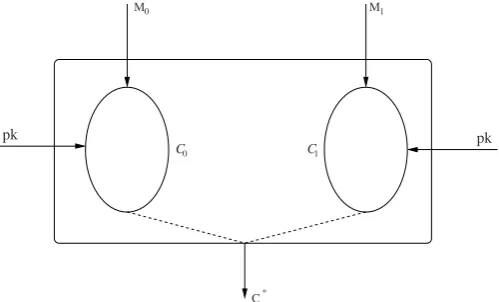
M0 M1
C0 C1
C*
pk pk
Fig. 2.1 C0(resp.C1) corresponds to the set of possible ciphertexts that can arise when the
en-cryption algorithm is applied to the messageM0(resp.M1).C∗is a uniform random choice from
Cγ, whereγis a uniform random bit.
Decrypt. It takes as input a ciphertextC and a private keysk and returns either a messageMor the special symbol⊥. The symbol⊥indicates that the ciphertext cannot be decrypted.
The encryption algorithm is a probabilistic algorithm and so there can be more than one ciphertext for a fixed message and a fixed public key. Equivalently, the encryption algorithm can be viewed as a sampling algorithm that given a messageM and a public keypksamples from the set of possible ciphertexts which correspond to Mandpk. Again the sampling will typically be done under the uniform distribution, though, it is not a definitional requirement.
A ciphertext can be said to be valid if it can be produced as an output of the encryption algorithm (on some pair of inputsMandpk) and invalid otherwise. The definition of the decryption algorithm does not require that the output has to be⊥
if the ciphertext is invalid; in this case, it may produce a random element of the message space as output.
For soundness, we require that ifCis produced byEncryptusing pk, then the output ofDecryptonCusing the corresponding secret keyskshould give backM. Since the algorithms are probabilistic, the outputs are actually random variables over appropriate sets. In particular, theSet-Upalgorithm can be seen to be sampling a pair of public and private keys from appropriate key spaces and theEncrypt algo-rithm samples from the set of possible ciphertexts which correspond to a message M and a public keypk. In principle, even though theDecryptalgorithm is allowed to be probabilistic, for most constructions, it is in fact a deterministic algorithm. We note that there are constructions, where the decryption algorithm is allowed to fail with an insignificant probability of error.
notion is formalised into what is calledsemantic securityin a landmark paper by Goldwasser and Micali [99]. They also provided a technical definition of security calledindistinguishabiltyand showed that for a passive attacker these two notions are equivalent. This result has later been extended to the case of an active adver-sary in [98, 168]. The equivalence between the natural notion of security and the technical definition turns out to be very important. Because it is more convenient to work with the technical definition of indistingushability than the natural notion of semantic security.
This technical notion of indistinguishability of ciphertexts for a PKE scheme in the case of a passive adversary can be easily understood with the help ofFigure 2.1. Fori=0,1, letCibe the set of ciphertexts which may arise from the messageMi under the public key pk. The encryption algorithm defines a distribution overCi. Suppose that a bitγ is chosen uniformly at random and a ciphertextC∗is sampled fromCγaccording to the distribution defined by the encryption algorithm.
An adversary is allowed to specify the messagesM0andM1; the bitγ is not
re-vealed to the adversary, but, the ciphertextC∗is given to the adversary. Now the adversary has to guess the value ofγ. If the adversary is unable to do so (with prob-ability significantly away from half), then, to the adversary, the ciphertexts arising fromM0are indistinguishable from the ciphertexts arising fromM1. This basic idea
is built into an appropriate security model as we describe below for an active adver-sary.
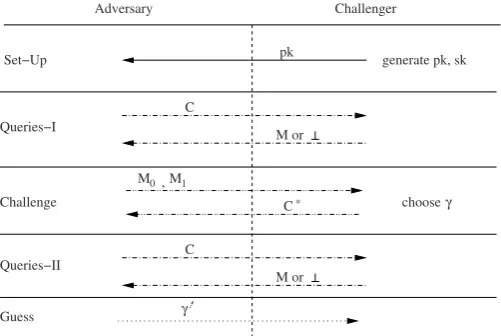
Indistinguishability against adaptive chosen ciphertext attack [21] is the strongest accepted notion of security for a public key encryption scheme. An encryption scheme secure against such an attack is said to beIND-CCA2secure. We give an in-formal description ofIND-CCA2security in terms of the following game between a challenger and an adversaryA, which is a probabilistic algorithm whose runtime is bounded above by a polynomial in the security parameter. Later we provide a more detailed explanation of the security game for an IBE scheme.Figure 2.2gives an overview of the security game for a PKE scheme.
1. Given the security parameter κ, the challenger runs theSet-Upalgorithm to generate a public and private key pair (pk,sk). It givesA the public keypk. 2. Given the public key,A adaptively issues decryption queries, which the
chal-lenger must properly answer. By adaptively it is meant that the adversary’s next query can depend on the answers to the previous queries.
3. At some point,A outputs two equal length messagesM0,M1and the challenger responds with an encryptionC∗ofMγ, whereγis a random bit.
4. The adversary continues with adaptive decryption queries but not onC∗. 5. Finally,A outputs its guessγ′ofγand wins ifγ′=γ.
The advantage ofA against the encryption scheme is
C
M or
M M
chooseγ
Adversary
pk
C
M or C* 0, 1
γ
Challenge
Queries−II Set−Up
Queries−I
Guess
generate pk, sk Challenger
Fig. 2.2 A diagrammatic depiction of the five phases of the security model for a public key en-cryption scheme.
An encryption scheme is said to be(t,q,ε)-IND-CCA2secure, if for all adversaries A running in timetand making at mostqdecryption queries,AdvA ≤ε.
In case of a passive adversary, a weaker notion of security, called indistinguisha-bility against chosen plaintext attack (in shortIND-CPAsecurity) of a public key encryption scheme is available in the literature [99, 21]. In theIND-CPAsecurity game, the adversary is not allowed to place any decryption query. In other words, this is the scenario depicted inFigure 2.1where the query phases depicted in Fig-ure 2.2are not allowed. Given a public key, the adversary simply outputs two equal length messagesM0,M1and the challenger responds with an encryptionC∗ofMγ.
The adversary wins if it can predictγ.
2.2 Identity-Based Encryption
The formal notion of an identity-based encryption scheme was developed in [155, 39]. An identity-based encryption scheme is specified by four probabilistic polyno-mial time (in the security parameter) algorithms:Set-Up,Key-Gen,Encryptand
Decrypt.
Key-Gen: This algorithm takes as input an identityid∈I together with the public parametersPPand the master secret keymskand returns a private keydid, using the
master key. The identityidis used as the public key whiledidis the corresponding
private key.
Encrypt: This algorithm takes as input an identityid∈I, a messageM∈M and the public parametersPPand produces as output a ciphertextC∈C.
Decrypt: This takes as input a ciphertextC∈C, an identity id, a corresponding private keydidand the system parametersPP. It returns the messageMor⊥if the
ciphertext cannot be decrypted.
These set of algorithms must satisfy the standard soundness requirement.
If
(PP,msk) is output bySet-Up;
didis a private key returned byKey-Genfor an identityid; Cis a ciphertext produced byEncrypton a messageM, using identityidand public parametersPP;
then
the output ofDecryptonC,id,didandPPshould beM.
The comments regarding the encryption and decryption algorithms made in the context of PKE schemes are also applicable here. Additionally, similar comments apply to key generation. Given an identity and public parameters, it might be possi-ble to have a set of corresponding decryption keys. In that case the key generation algorithm can be visualised as a strategy for sampling from this set. Note that the PKG can decrypt any message encrypted under any identity since it is the PKG who generated the private key for that identity. This is the so-calledkey escrowproperty of identity-based cryptography.
2.2.1 Hierarchical Identity-Based Encryption
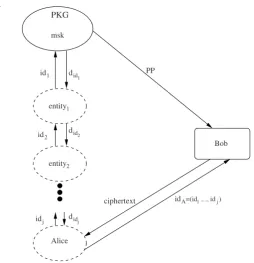
Hierarchical identity-based encryption (HIBE) is an extension of IBE. The basic motivation for HIBE schemes is based on the following rationale. The generation of private key can be a computationally intensive task. The identity of an entity must be authenticated before issuing a private key and the private key needs to be transmitted securely to the concerned entity.
HIBE reduces the workload of the PKG by delegating the task of private key generation and hence authentication of identity and secure transmission of private key to its lower levels. However, only the PKG has a set of public parameters. The identities at different levels do not have any public parameters associated with them. Apart from being a standalone cryptographic primitive, HIBE has many interesting applications.
id1
idj
id2 did
1
didj
did2
entity1
entity2
idA=(id1,..., idj) PKG
msk
Bob PP
Alice
ciphertext
Fig. 2.3 Schematic diagram of the operation of a HIBE.
(id1, . . . ,idτ)where 1≤τ≤h. Let,id′=id′1, . . . ,id′j,j≤τbe another identity tuple. We sayid′is a prefix ofidifid′i=idifor all 1≤i≤j.
As in the case of IBE, the PKG has a set of public parametersPPand a master key
msk. For all identities at the first level the private key is generated by the PKG using
msk. For identities at the second level onwards, the private key can be generated by the PKG or by any of the ancestors of that identity. In the above example, the private keydidofidcan be generated by an entity whose identity is a prefix ofidand who
has obtained the corresponding private key. This is shown inFigure 2.3.
The formal notion of a HIBE scheme is an extension of the corresponding notion of an IBE scheme and was developed in [106, 94]. A HIBE schemeH is specified by four probabilistic polynomial time (in the security parameter) algorithms:
Set-Up,Key-Gen,EncryptandDecrypt.
Key-Gen: This algorithm takes as input an identity tupleid= (id1, . . . ,idj), j≥1
and the private keydid|j−1for the identity(id1, . . . ,idj−1)and returns a private key
didusingdid|j−1. If j=1, thendid|0is defined to be the master secret keymsk. The
identityidis used as the public key whiledidis the corresponding private key.
Note that by appropriately invoking theKey-Genalgorithm the PKG as well as any proper predecessor of the identity tuple(id1, . . . ,idj)can produce a decryption key for this identity.
Encrypt: This algorithm takes as input the system parametersPP, an identityid
and a messageMand produces as output a ciphertextC. This ciphertext is the en-cryption ofMunder the identityidand the public parametersPP.
Decrypt: This algorithm takes as input the public parametersPP, an identityid, a ciphertextCand a private keydidand returns the message or⊥if the ciphertext is
not valid.
The standard soundness requirement that holds for IBE is also applicable for HIBE. Ifdidis a private key corresponding to the identity tupleidgenerated by the
Key-Gen algorithm andC is the output of the Encryptalgorithm for a message
M∈M usingidas a public key andPP; then theDecryptalgorithm must return Mon inputdidandC.
Comments on the encryption and decryption algorithms made in the context of PKE schemes are applicable here. Further, comments made on the key generation algorithm in the context of IBE schemes are also applicable here. Also note that in addition to the PKG, any proper ancestor ofidcan decrypt messages encrypted underid.
2.3 Security Model for (H)IBE
As we have already noted, HIBE is a generalisation of IBE i.e., an IBE can be thought of as a single level HIBE. So instead of describing the security models for IBE and HIBE separately, we only describe the security model for HIBE. The security model for IBE is obtained by setting the number of levels to one.
The basic idea of the security model for (H)IBE schemes is obtained by extending the security model for PKE schemes. As in PKE we focus on the technical notion of indistingushability (it is known [13] that in the case of IBE also this technical notion is equivalent to the more natural notion of semantic security). Just like in PKE, it is a formalisation of the adversary’s inability to distinguish between ciphertexts arising out of two equal length messagesM0andM1. An identity is chosen by the adversary
as the target identity, i.e., the adversary’s goal is to compromise the security of the identity it chooses as the target identity. A random bitγis chosen and the challenge ciphertext is produced by encrypting Mγ under the target identity. The adversary wins if it can predictγwith a probability significantly away from half.
valid user has a decryption key provided by the PKG for its identity. A group of users can form a coalition and attempt to compromise the security of another user. Modelling this aspect is a bit tricky, since the coalition may not be formed at the outset and may gradually grow. This modelling is done by providing the adversary with a key-extraction oracle. The adversary can query the oracle with an identity and receive a corresponding decryption key. It is allowed to place queries in an adaptive manner. Further, it can choose the target identity after making some key-extraction queries. In addition, as in PKE, the adversary may be given access to a decryption oracle. All of these is formalised in the following manner.
2.3.1 Chosen Ciphertext Attack
Recall that security against adaptive chosen ciphertext attack is the accepted notion of security for a public key encryption. This notion of security has been extended to the identity-based setting by Boneh and Franklin [39]. This is termed as IND-ID-CCAsecurity (indistinguishability under adaptive identity and adaptive chosen ciphertext attack).
LetH be anh-HIBE scheme as defined in the previous section. The IND-ID-CCAsecurity forH is defined [106, 94, 32] in terms of the following game be-tween a challenger and an adversary of the HIBE. The adversary is allowed to place two types of oracle queries – decryption queries to a decryption oracleOdand key-extraction queries to a key-key-extraction oracleOk.Figure 2.4shows a schematic di-agram of the security game defining the security of an IBE scheme. The notion of indistinguishability of ciphertexts is similar to the idea explained in the context of PKE schemes.
Set-Up. The challenger takes as input a security parameter 1κand runs theSet-Up
algorithm of the HIBE. It providesA with the system parametersPPwhile keeping the master keymskto itself.
Phase 1: AdversaryA makes a finite number of queries where each query is one of the following two types:
• key-extraction query(id): This query is placed to the key-extraction oracleOk. Questioned onid,Okgenerates a private keydidofidand returns it toA. TheKey-Genalgorithm is probabilistic and so if it is queried more than once on the same identity, then it may provide different (but valid) decryption keys. Some (H)IBE schemes can insist on storing the decryption key generated on the first query and returning the stored value on subsequent queries on the same identity. This can help in achieving a tight security reduction.
• decryption query (id,C): This query is placed to the decryption oracle Od. It returns the resulting plaintext or⊥if the ciphertext cannot be decrypted. A is allowed to make these queries adaptively, i.e., any query may depend on the
M M
Fig. 2.4 A diagrammatic depiction of the five phases of the security model for identity-based encryption.
Challenge: WhenA decides that Phase 1 is complete, it fixes an identityid∗and two equal length messages M0,M1 under the (obvious) constraint that it has not
asked for the private key ofid∗ or any prefix ofid∗. The challenger chooses uni-formly at random a bitγ∈ {0,1}and obtains a ciphertextC∗corresponding toMγ, i.e.,C∗is the output of theEncryptalgorithm on input(Mγ,id∗,PP). It returnsC∗ as the challenge ciphertext toA.
Phase 2: A now issues additional queries just like Phase 1, with the (obvious) restriction that it cannot place a decryption query for the decryption ofC∗underid∗
or any of its prefixes nor a key-extraction query for the private key ofid∗or any prefix ofid∗. All other queries are valid andA can issue these queries adaptively just like Phase 1. The challenger responds as in Phase 1.
Guess: A outputs a guessγ′ofγ.
The advantage of the adversaryA in attacking the HIBE schemeH is defined as:
AdvHA =
Pr[(γ=γ′)]−1/2.
An h-HIBE schemeH is said to be(t,qid,qC,ε)-secure against adaptive cho-sen ciphertext attack ((t,qid,qC,ε)-IND-ID-CCAsecure) if for anyt-time adversary A that makes at mostqid private key queries and at mostqCdecryption queries,
AdvHA ≤ε. In short, we sayH isIND-ID-CCAsecure or when the context is clear,
simply CCA-secure.
2.3.2 Chosen Plaintext Attack
Security reduction of (H)IBE protocols available in the literature generally concen-trate on proving security in a weaker model. This is called security against adaptive identity chosen plaintext attack orIND-ID-CPA security [39]. The corresponding game is similar to the game defined above, except that the adversary isnotallowed access to the decryption oracleOd. The adversary is allowed to place adaptive pri-vate key extraction queries to the key-extraction oracleOkand everything else re-mains the same. For the sake of completeness, we give a description of the IND-ID-CPAgame for anh-HIBEH below.
Set-Up The challenger takes as input a security parameter 1κ and runs theSet-Up
algorithm of the HIBE. It providesA with the system parametersPPwhile keeping the master keymskto itself.
Phase 1: AdversaryA makes a finite number of key-extraction queries toOk. For a private key query corresponding to an identityid, the key-extraction oracle gen-erates the private keydid of id and returns it toA.A is allowed to make these
queries adaptively, i.e., any query may depend on the previous queries as well as their answers.
Challenge: At this stageA fixes an identity,id∗and two equal length messages M0,M1under the (obvious) constraint that it has not asked for the private key of id∗ or any of its prefixes. The challenger chooses uniformly at random a bitγ ∈ {0,1}and obtains a ciphertext (C∗) corresponding toMγ, i.e.,C∗is the output of the
Encryptalgorithm on input(Mγ,id∗,PP). It returnsC∗as the challenge ciphertext toA.
Phase 2: A now issues additional queries just like Phase 1, with the (obvious) restriction that it cannot place a key-extraction query for the private key ofid∗or any prefix ofid∗. All other queries are valid andA can issue these queries adaptively just like Phase 1.
Guess: A outputs a guessγ′ofγ.
Like the IND-ID-CCA game, the advantage of the adversaryA in attacking the HIBE schemeH is defined as
AdvHA =
Pr[γ=γ′]−1/2.
Anh-HIBE schemeH is said to be(t,q,ε)secure against adaptive chosen plain-text attack if for anyt-time adversaryA that makes at mostqprivate key extraction queries,AdvHA ≤ε. In short we sayH is(t,q,ε)-IND-ID-CPAsecure or simply
M M
Fig. 2.5 A diagrammatic depiction of the five phases of the selective-identity security model for identity-based encryption.
2.3.3 Selective-ID Model
A weaker definition of security for identity-based encryption schemes is the so called selective-ID model [53, 54]. In this model, the adversaryA commits to a target identity before the system is set up. This notion of security is called the selec-tive identity, chosen ciphertext security (IND-sID-CCAsecurity in short).
Compared to the security model where the adversary can choose the target iden-tity adaptively, this is a very restricted notion of security. Correspondingly, it is also significantly easier to argue security in this model. If the sole interest is in obtaining a secure IBE, then selective identity security model is not satisfactory. On the other hand, this model is useful in other ways. In particular, it provides a new method to convert CPA-secure IBE schemes to CCA-secure PKE schemes.
Following [53, 54, 32] we defineIND-sID-CCAsecurity for anh-HIBE in terms of the game described below. A schematic diagram for the selective-identity security model is shown inFigure 2.5.
Initialization: The adversary outputs a target identity tupleid∗= (id∗1, . . . ,id∗u), 1≤ u≤hon which it wishes to be challenged.
Set-Up: The challenger sets up the HIBE and provides the adversary with the sys-tem public parametersPP. It keeps the master keymskto itself.
previous queries as well as their answers. The only restriction is that it cannot ask for the private key ofid∗or any of its prefixes.
Challenge: At this stage,A outputs two equal length messagesM0,M1and gets a ciphertextC∗corresponding toMγencrypted under the a priori chosen identityid∗,
whereγis chosen by the challenger uniformly at random from{0,1}.
Phase 2: A now issues additional queries just like Phase 1, with the (obvious) restriction that it cannot ask for the decryption ofC∗underid∗or any of its prefixes nor the private key ofid∗or any prefix ofid∗.
Guess: A outputs a guessγ′ofγ.
The advantage of the adversaryA in attacking the HIBE schemeH is defined as:
AdvHA =
Pr[γ=γ′]−1/2.
The HIBE schemeH is said to be(t,qid,qC,ε)-secure against selective identity, adaptive chosen ciphertext attack (in short,(t,qid,qC,ε)-IND-sID-CCAsecure) if
for anyt-time adversaryA that makes at mostqid private key extraction queries and at mostqCdecryption queries,Adv
H A ≤ε.
Note that, in the above game the adversary has to commit to an identity tuple even before the appropriate spaces are defined by theSet-Upalgorithm.
We may restrict the adversary from making any decryption query. An h-HIBE schemeH is said to be(t,qid,ε)-secure against selective identity, adaptive chosen
plaintext attack (in short,(t,qid,ε)-IND-sID-CPAsecure) if for anyt-time adversary A that makes at mostqidprivate key queries,Adv
H A ≤ε.
2.3.4 Anonymous (H)IBE
There is another aspect which is sometimes added to the security definition of (H)IBE. This concerns the anonymity of the ciphertext. Informally, the idea is as follows. For certain applications, it may be a security concern that the identity of the intended recipient is revealed from the ciphertext. In other words, looking only atC(andPP) it may be possible to determine the identityidwhich has been used to generateCfrom some message. Roughly speaking, if for a (H)IBE scheme this is not possible, then the scheme is said to be anonymous. The formal definition of anonymity is obtained by modifying the above security game.
1. The Set-Up and the query phases 1 and 2 of the security game remain un-changed.
2. In the challenge stage, the adversary submits two identitiesid0andid1along with two equal length messagesM0andM1.
3. The simulator chooses two independent and uniform random bitsγ1andγ2and
4. In the guess stage, the adversary outputs two bitsγ′
1andγ2′ and wins ifγ1=γ1′
andγ2=γ2′.
5. The adversary’s advantage is defined to be
Parameterization of an adversary is done in the manner it is done for the (H)IBE schemes without anonymity considerations.
In any security game for (H)IBE schemes, the key-extraction oracle is always provided to the adversary. Additionally, the different variants of the security game are based on the following three points.
1. Whether the decryption oracle is provided to the adversary or not.
2. Whether the adversary can choose the target identity adaptively, i.e., after making queries to the key-extraction oracle; or whether the adversary has to commit to the target identity before the scheme is set-up giving the selective-identity game. 3. Whether the (H)IBE scheme is defined for the anonymity game or not.
The convention is that if anonymity is required, then it is specifically mentioned. For the other two points, there are four options leading to four different sets of re-strictions on the adversary. Among these, the most restricted adversary is selective-identity and not having access to the decryption oracle which leads to the weakest (among the above four) notion of security for a (H)IBE scheme. The most pow-erful adversary is adaptive-identity and can make decryption queries leading to the strongest notion of security for a (H)IBE scheme. Several other security no-tions such as one-wayness, non-malleability, semantic security and multiple-target-multiple-challenge CCA security have been formulated in the context of IBE and it is shown [13] that IND-ID-CCA security implies all other notions of security. In this sense IND-ID-CCA security can be considered as the “right” notion of security in the identity-based setting.
As we will discuss later, there are generic methods to convert a CPA-secure (H)IBE scheme to a CCA-secure (H)IBE scheme. Non-generic methods which ap-ply to a fairly large number of schemes are also known. Due to these results, almost all schemes start out by first obtaining CPA-security. Among CPA-secure schemes, the issue is whether the scheme satisfies selective-identity or adaptive identity secu-rity. We will be seeing both kinds of schemes later.
2.3.5 Use of Random Oracles
will be seeing some of these conjectured hard problems later. For the moment, we would like to discuss a different issue.
During the security reduction (or proof), it may be necessary to assume that certain functions described in the scheme are uniform random functions. In other words, if a set of distinct inputs are provided to such a function, then the outputs are independent and uniformly distributed. Clearly, such an assumption cannot hold for any practical function that may be used to instantiate the scheme. Alternatively, this can be viewed as an idealisation of some functions that are actually used in practice. This is the so-called “random oracle” assumption used to argue about the security of many cryptographic primitives and not only (H)IBE schemes. This technique was formally introduced in [24] and has been criticised later in [52]. A rebuttal of the criticism and a robust defence of the random oracle technique has been given in [124].
Clearly, it would be better if one could build schemes where one does not have to use random oracles and there are indeed such schemes. At the same time, one should note that schemes for which the proofs require “random oracles” may also be useful in two situations: when no other scheme is known which does not require “random oracle proofs” (under the same kind of hardness assumption) and when the use of random oracles improves efficiency.
2.4 Structure of Security Proofs
We provide a few words on the structure of security proofs. All proofs are reduc-tions. Suppose a cryptographic protocol is built upon several other smaller protocols. Then the assurance provided by a reduction is of the following form.
If
(smaller protocols are secure and)
some problemΠ is computationally hard
then
the main protocol is secure.
A convenient way to structure the reductionist proof is to consider a sequence of games [160, 26]. To prove, for example, the indistinguishability of the encryption of two equal length plaintexts we construct a sequence of games of the following form.
A Game Sequence G0,
G1,
.. . Gk
• LetXibe the event thatγ=γ′in GameGi. We consider Pr[X0],
Pr[X0]−Pr[X1],
.. .
Pr[Xk−1]−Pr[Xk] Pr[Xk].
In the above sequence, the following points are to be noted
1. G0is the game which defines the security of the protocol and so Adv(A) =|Pr[γ=γ′]−1/2|=|Pr[X0]−1/2|.
2. Gkis designed such that the bitγis statistically hidden from the adversary. So, Pr[Xk] =1/2.
3. GamesGi−1andGidiffer: a. the difference is not too much;
b. the adversary should not be able to notice whether he is playing GameGi−1
or GameGi.
4. More precisely,Pr[Xi−1]−Pr[Xi]is bounded above by
a. either, the advantage of an adversary in breaking one of the smaller protocols; b. or, the advantage of solving problemΠ.
Adv(A) =|Pr[X0]−1/2| =|Pr[X0]−Pr[Xk]|
≤ |Pr[X0]−Pr[X1]| +|Pr[X1]−Pr[X2]| +···
If the adversary has a non-negligible advantage then there must be at least two consecutive games, Xi−1 andXi such that |Pr[Xi−1]−Pr[Xi]| is non-negligible –
which contradicts the original hypothesis.
2.5 Conclusion
Chapter 3
A Brief Background on Elliptic Curves and
Pairings
A bilinear pairing suitable for use in cryptography is a non-degenerate, efficient-to-compute, bilinear map
e:G1×G2→GT
whereG1,G2andGT are cyclic groups of the same prime orderp. Known examples of such maps arise from certain algebraic geometric objects. The most commonly used pairings arise from the theory of elliptic curves whereG1andG2are subgroups
of points on an elliptic curve over a finite field whereas GT is a subgroup of the multiplicative group of a finite field. Customarily, the group operation for elliptic curves is denoted by an addition and so we writeG1andG2additively whereas we
writeGT multiplicatively.
The purpose of this chapter is to provide a brief idea of how such maps are defined. This discussion is by no means exhaustive and the different techniques used to speed-up pairing computations is really outside the scope of this book. The other aspect of pairings is one of associated hard computational problems. For reduction style proofs of security of different schemes, one requires to assume that certain problems are computationally hard. We present a careful description of some of the important problems that have been used in the literature. Again, we do not aim to provide an exhaustive list of hard computational problems over pairing groups.
Before getting into details, we briefly discuss what is meant by non-degenerate, efficient and bilinear properties of the mape. LetG1=hP1iandG2=hP2i.
Non-degeneracy means that ife(P,Q)is the identity element ofGT, then eitherPis the identity ofG1orQis the identity ofG2.
Efficiency is taken to mean that there is a polynomial time algorithm which can compute the mape. Typically, the logarithm (to the base two) of the sizes ofG1,
G2andGT will be bounded above by a polynomial of a quantity called the secu-rity parameter. So, the representations of the elements of G1,G2 andGT will be bounded above by a polynomial in the security parameter and which in turn implies that the run-time of the algorithm to compute ewill also be bounded above by a polynomial in the security parameter. While this is the asymptotic notion of effi-ciency, for practical implementations, this is not enough. The requirement is to have
29 © Springer Science+Business Media, LLC 2011
algorithms to compute pairings so that commercial deployment of the associated schemes becomes viable. This has motivated tremendous amount of research into finding efficient algorithms for pairing computations which as mentioned above is outside the scope of this book. Interested readers are referred to [104, 128, 167] for more details.
Bilinearity means that the mapeis linear in both components which refers to the following two properties.
• e(R1+R2,Q) =e(R1,Q)e(R2,Q);
• e(R,Q1+Q2) =e(R,Q1)e(R,Q2).
A consequence of these two properties is the following fact which forms the basic algebraic novelty upon which all bilinear pairing based schemes are based. Fora,b∈
ZZp.
e(aP1,bP2) =e(bP1,aP2) =e(P1,P2)ab.
The other requirement on the mapeis that certain computational problems as-sociated with the elements ofG1,G2andGT must be hard. Here hardness refers to the fact that at present there are noknownprobabilistic polynomial time algorithms to solve them. The general belief in the community is that such problems indeed cannot be solved in probabilistic polynomial time, but, currently, we are far from proving any such statement. Later in this chapter, we discuss some of the basic hard problems that have been proposed in the literature.
3.1 Finite Fields, Elliptic Curves and Tate Pairing
In this section, we provide an overview of some facts regarding the algebraic struc-tures required to construct and compute a bilinear map. We start with the basic idea of exponentiation in a general cyclic group, briefly discuss finite fields and elliptic curves and present a definition of Tate pairing and describe Miller’s algorithm for computing it. For more details on finite fields the reader may refer to [132] while for implementation of finite field and elliptic curve operations one may refer to [103]. Details of pairing operations can be found in [75]. The online source [28] is an ex-cellent collection of explicit formulae for different operations over elliptic curves and pairing computations.
3.1.1 Exponentiation in General Cyclic Groups
Lethgibe a (multiplicatively written) cyclic group of orderq. Exponentiation inhgi refers to be the following computation: givena∈ZZqcomputeh=ga.
from right to left, i.e. from a0toan−1and the other works from left to right, i.e.,
froman−1toa0.
The right-to-left method can be explained as follows.
• n=1:h=ga0.
• n=2:h=g2a1+a0= (g2)a1×ga0.
t=g;r=ga0;
t=t2;r=ta1×r;h=r.
• Atith step: squaret; multiplyttorifai=1.
Similarly, the left-to-right method can be explained as follows.
• n=1:h=ga0.
• n=2:h=g2a1+a0= (ga1)2×ga0.
r=ga1;
r=r2×ga0;h=r.
• Atith step: squarer; multiplyrbygifan−i=1.
The importance of the left-to-right method arises from the fact that multiplication is always done bygwhich is a constant throughout the whole computation. In the right-to-left method, both the multiplicands change as the computation proceeds. Multiplying with a fixed element can provide certain efficiency benefits in imple-mentation.
Both the above square-and-multiply algorithms are special cases of a strategy called addition chain method. An addition chain of length ℓ is a sequence of ℓ+1 integers such that the first integer is 1; each subsequent integer is a sum of two previous integers. For example, the following sequence is an addition chain: 1,2,3,5,7,14,28,56,63 (2=1+1, 3=2+1, 5=3+2, 7=5+2, 14=7+7, 28=14+14, 56=28+28, 63=56+7). Clearly, addition chains can be used to compute exponentiation. However, finding a short addition chain is a computa-tionally hard problem. An excellent survey of exponentiation algorithms has been made by Bernstein [27].
The discrete logarithm problem. The discrete log problem over a cyclic group
hgiis the following. Givengandh∈ hgi, findasuch thath=ga. Thisais called the discrete log ofh with respect to baseg and is written as loggh=a. Suppose nis the logarithm to base two of the size of hgi. For a cyclic group to be useful in cryptography, the discrete log problem over the group should be computationally hard. By this we mean that there should no algorithm which runs in time polynomial inn. Clearly, one can findaby checking all the elements ofhgi, but, this requires timeO(2n)which is exponential inn. Generic algorithms such as the Pollard’s rho algorithm for finding discrete log requiresO(2n/2)time, which is better thanO(2n) but is still exponential. The discrete log problem over certain groups obtained from finite fields and elliptic curves are believed to be computationally hard and are used to implement cryptographic operations.