81
Improving Teachers ICT Application Competencies: A Case Study at
Vocational High School in East Kalimantan Province
Saiful Ghozi, Risty Jayanti Yuniar, & Sara Wibawaning Respati1
Dept. of Electrical Engineering, State Polytechnic of Balikpapan, Balikpapan, Indonesia [email protected]
1Dept. of Civil Engineering, State Polytechnic of Balikpapan, Balikpapan, Indonesia
Innovation in learning should be done in line with information and computer technology (ICT) literacy development for both students and teachers. One of the problems with learning using ICT is the differences in competency of teachers in a small city due to the lack of access to its development. This study is a qualitative research based on a community service activity to enhance ICT application competencies of mathematics teachers in vocational high school in Penajam Paser Utara (PPU) district, East Kalimantan Province (Indonesia), utilizing GeoGebra and Autograph™. This study consisted of five phases: (1) situation analysis, (2) training and workshops for GeoGebra and Autograph™ utilization, (3) implementation of lesson study (LS), (4) data analysis and presentation, and (5) discussion. The results of this study are: (1) students became more motivated to learn mathematics by using GeoGebra, (2) teachers found that GeoGebra can develop students’ understanding of mathematics concepts easier, and (3) ICT competencies in teaching in vocational high school in PPU, especially in the utilization of GeoGebra and Autograph™, increased. The recommendation is that LS should be continued to improve the effectiveness of GeoGebra and Autograph™ utilization in other mathematics topics. A much larger study would be needed to determine if the results of this research are due to the approach or due
to the teachers’ enthusiasm, novelty effect or what is known as the Hawthorne Effect.
Keywords: GeoGebra, Autograph™, lesson study
Introduction
Utilization of information and computer technology (ICT) in mathematics learning is becoming more relevant considering the characteristics of mathematics itself. It is known that many topics embedded in mathematics are abstract. There are five important considerations in choosing a computer application so that it can be widely used in learning mathematics, such as: using a dynamic view to analyze, expressing personal models, exploring models, storing and processing real data, and sharing and communicating (Pratt, Davies, & Connor, 2011). GeoGebra is a computer application that meets these criteria.
82
There are various applications that are specifically designed for learning mathematics such as Maple™, MuPAD™, CABRI™, Geogebra, and Autograph™. The successful use of computer applications is not dependent on the sophistication of the applications, but the teachers’ strategies that can integrate them in accordance with the materials, students’ needs and students’ level of computer literacy.
A freeware dynamic application that is undergoing fast dissemination among teachers in the world is GeoGebra. Besides being an open source, Geogebra has now become a network among teachers in the world through discussion communities and the so called International Geogebra Institute (IGI). It can be used to create innovative ideas and disseminate information easily. The growing presence of open-source tools in the mathematics classroom on an international scale is calling for in-depth research on the instructional design of Geogebra-based curricular modules and the corresponding impact of its dynamic mathematics resources on teaching and learning (Hohenwarter, Hohenwarter, Kreis, & Lavicza, 2007).
Lewis (2002) defines lesson study (LS) as a cycle in which teachers work together to consider their long-term goals for students, bring those goals to life in research lessons and collaboratively observe, discuss, and refine these lessons. Teachers form teams and collaboratively plan a lesson, then one teacher in the team teaches the lesson while the other teachers observe the lesson either in the classroom or from a video of the lesson, focusing on agreed aspects of the teaching and student learning. The team then meets to reflect on the lesson observations and to review, revise and reframe the lesson prior to the lesson being re-taught by another teacher. The team engages in cycles of planning, observing, reflecting, reviewing, and re-teaching, each time focusing on a pedagogical and content focus. The cycle of instructional development of LS has three basic components: Plan, Do, and See.
The problem raised in this study was: How can the ICT application competencies of vocational high school mathematics teachers in PPU district through LS be enhanced especially in the utilization of GeoGebra and Autograph™?
Methodology
83 Table 1.
Phases of the Qualitative Approach
Phase 1 Situation Analysis
Background, teaching experience, and computer literacy level
Phase 2
Training and Workshop
Training on GeoGebra and Autograph™ application. Workshop on writing lesson plan and utilizing GeoGebra and Autograph™
Phase 3
LS Implementation
Writing lesson plan (plan). Implementing and observing learning process (do). Discussion and reflection (see)
Phase 4 Data Analysis and Presentation Phase 5 Discussion and Conclusion
In the first phase, researchers conducted the analysis of the situation through a survey to determine the profile of the research subjects, the obstacles encountered in teaching, and the level of ICT literacy of the research subjects.
Training and workshop on the use of GeoGebra and Autograph™ were conducted during the second phase. The training was held for two days in a row, the first day was for GeoGebra and the second was for Autograph™. The workshop was held on the second day after the GeoGebra and Autograph™ training and produced several models of mathematics lesson plans utilizing GeoGebra and Autograph™.
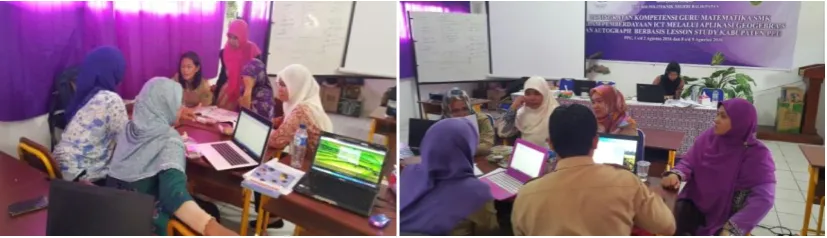
In the third phase, LS activities were carried out to see the effectiveness of the utilization of GeoGebra and Autograph™ in the classroom. The activities were started with groups who developed lesson plans and a representative teacher of each group (Plan step) was chosen.
Figure 1. ‘Plan’ step of Group 1 Figure 2. ‘Plan’ step of Group 2
After careful and mutual discussion among the group members, an agreement on the topics was reached. While one teacher gave the lesson the other teachers observed the lesson either in the classroom or from a video of the lesson, and focused on the teaching and learning (Do step).
84
planning, observing, reflecting, and reviewing which focused on the pedagogical and the effectiveness of GeoGebra and Autograph™ utilization in the classroom (See step). In the fourth phase, researchers conducted data presentation and data analysis from activities that had been implemented. The last stage was discussion and drawing conclusions.
The data collection was triangulated and researchers used multiple techniques of data collection on the same research focus (Sugiyono, 2011) by collecting teacher and student activity observation sheets, questionnaires, video recordings, as well as teacher and student interview scripts to get a better understanding of teacher competencies and improvement in ICT application through LS.
The research phases from situation analysis to core activity were done in July-August 2016. The core activities (Phase 2 and Phase 3) were held for three days starting from 1 to 3 August 2016 atSMKN 2 Penajam Paser Utara.
The instruments used in this study consisted of: ICT literacy questionnaire, model teacher observation sheet, student observation sheet, teacher questionnaire to see the teachers’ response to GeoGebra utilization, and student questionnaire to get feedback from students. Moreover, the researchers were also directly involved in all of the phases.
Results
The Situation Analysis
After discussing with the Teacher Working Group of PPU district and the headmaster of SMKN 2 Penajam Paser Utara, the following points arose:
1. The teachers had difficulties motivating students to learn mathematics. The reasons were: (1) mathematics has not been seen as a subject that can be learned visually using computers and (2) mathematics is still considered difficult that needs a high skill of calculation. 2. Most of vocational high school mathematics teachers at PPU district did not have good
knowledge of computer applications such as GeoGebra, Autograph™, and Mupad that can be utilized in the learning of mathematics. Yet, engineering vocational students need good visualization in mathematics learning especially in vector algebra and geometry. Some of the teachers have already known the GeoGebra application, but it has not been applied yet in the learning activities.
3. The availability of computers and applications for mathematics learning was limited.
85 Table 1.
Survey Result of ICT Application in the Learning Process
Question/Statement Answers
Yes No
Do you use student’s laptop in the mathematics learning process? 0% 100% Do you use laptop and projector for mathematics learning? 57% 43%
Do you use computer facility for mathematics learning? 7% 93%
I utilize a software to visualize the presentation on LCD 29% 71% I utilize a software to visualize the presentation and support the analytical approach 14% 86% The students get involved in software application that you use in the learning process 7% 93%
Table 2.
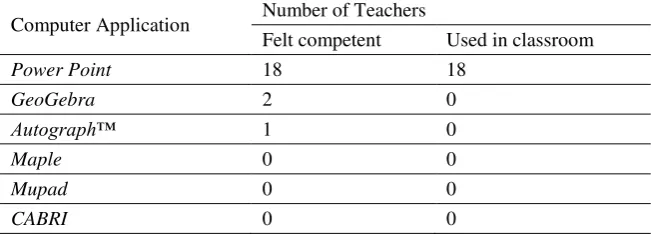
Survey Result of ICT Application Proficiencies in Mathematics Learning
Computer Application Number of Teachers
Felt competent Used in classroom
Power Point 18 18
GeoGebra 2 0
Autograph™ 1 0
Maple 0 0
Mupad 0 0
CABRI 0 0
The Training and Workshop
In the second phase, the training of GeoGebra and Autograph™ application was last for one day. Further, the selected topics in the workshop on lesson plan writing were quadratic functions with GeoGebra, linear programming with GeoGebra, linear programming with Autograph™, vectors with GeoGebra, transformations with GeoGebra, and integration with Autograph™.
The Lesson Study Activities
After planning each model, teacher presented the learning plan using GeoGebra as a learning tool and a problem solving approach for teaching the topic. Both model teachers implemented the cooperative learning method. Each group prepared and developed teaching media including worksheet and slide presentation. The learning class was grouped into five to six, each consisting of 5 to 6 students randomly chosen, with each student was given a laptop. The model teachers conducted the lesson in two classes in SMKN 2 Penajam Paser Utara, namely Class 2 TAV (Second Grade of Audio Visual Engineering Class) and Class 2 AP (Second Grade of Office Administration Class). Each class was observed by eight teachers, one school supervisor, and one academic facilitator (researcher).
86
projector, however, the students still employed their laptops using battery. Generally, the enthusiasm of students to use computer applications in mathematics was great. It is seen from the majority of students that they tried to follow all the instructions of the model teacher even though without an LCD projector. Meanwhile, the instruction and explanation from the model teacher was not effective, the teacher also took much effort since she had to check each group for each planned activity. In the end of the process, she summed up the learning activity with a good conclusion despite the fact that the percentage of the subject delivery was limited due to power outage.
Figure 3. The ‘Do’ step of model teacher in Group 1
In Group 2, generally the learning process was implemented in accordance with the planned scenario. The power outage also happened in the last 10 minutes, but it did not influence significantly the planned learning process. The students were enthusiastic in following the process. The model teacher demonstrated good competencies using the LCD projector in the learning activities.
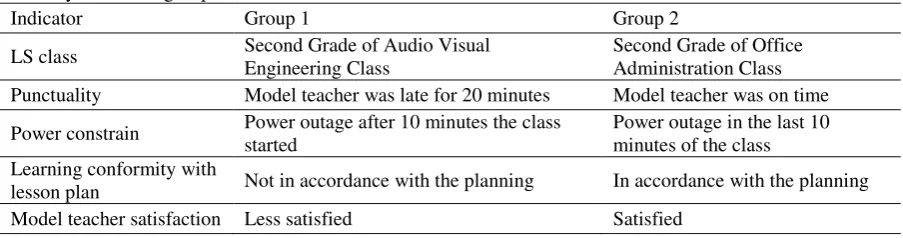
The learning process of the model teacher in both groups can be seen in Table 3.
Table 3.
Summary of Learning Implementation
Indicator Group 1 Group 2
LS class Second Grade of Audio Visual Engineering Class
Second Grade of Office Administration Class Punctuality Model teacher was late for 20 minutes Model teacher was on time
Power constrain Power outage after 10 minutes the class started
Power outage in the last 10 minutes of the class Learning conformity with
87
The reflection process was sequentially done involving a moderator (researches), model teachers, school supervisors, and teachers who participated in the LS. The learning process reflection of each teacher was done alternately in the same forum, hence both groups could observe the other group reflective discussion.
Figure 5. Reflection activity
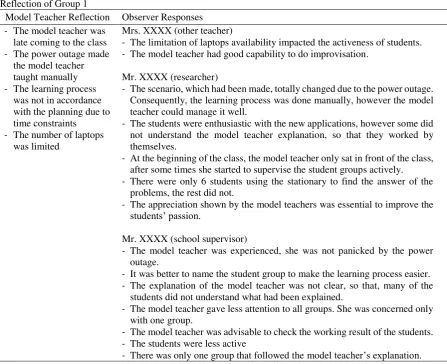
The result of Group 1 reflection is provided in Table 4.
Table 4.
Reflection of Group 1
Model Teacher Reflection Observer Responses
- The model teacher was late coming to the class
- The power outage made the model teacher taught manually
- The learning process was not in accordance with the planning due to time constraints
- The number of laptops was limited
1. Mrs. XXXX (other teacher)
- The limitation of laptops availability impacted the activeness of students.
- The model teacher had good capability to do improvisation.
2. Mr. XXXX (researcher)
- The scenario, which had been made, totally changed due to the power outage. Consequently, the learning process was done manually, however the model teacher could manage it well.
- The students were enthusiastic with the new applications, however some did not understand the model teacher explanation, so that they worked by themselves.
- At the beginning of the class, the model teacher only sat in front of the class, after some times she started to supervise the student groups actively.
- There were only 6 students using the stationary to find the answer of the problems, the rest did not.
- The appreciation shown by the model teachers was essential to improve the
students’ passion.
3. Mr. XXXX (school supervisor)
- The model teacher was experienced, she was not panicked by the power outage.
- It was better to name the student group to make the learning process easier.
- The explanation of the model teacher was not clear, so that, many of the students did not understand what had been explained.
- The model teacher gave less attention to all groups. She was concerned only with one group.
- The model teacher was advisable to check the working result of the students.
- The students were less active
88
The result of Group 2 reflection is shown in Table 5.
Table 5.
Reflection of Group 2
Model Teacher Reflection Observer Responses
- The class experienced a power outage in the last 10 minutes.
- The students could determine the visible area of linear programming problem by using GeoGebra.
- All groups finished the task using the GeoGebra laptop. Moreover, the ideal group members is 3.
- One of the students worked on the worksheet when GeoGebra application was utilized.
- The students were interested in the new application presented by the model teacher.
Mrs. XXXX (researcher)
- The concentration of the students was distracted by the power outage.
- The students were highly interested.
- The process improved the capability of the teacher in ICT utilization
- The model teacher should not have a conversation with the observer.
- The model teacher should be able to solve the problem by herself in the LS classroom without asking for observer’s help
Mrs. XXXX (school supervisor)
- All of the aspects were monitored, including the model teacher and the students.
- The classroom activity should be oriented to student.
- Geogreba and Autograph™ implementation aimed to visualize and construct understanding, as well as to check the result between manual and computer calculation.
The Effectiveness of GeoGebra in the Mathematics Classroom
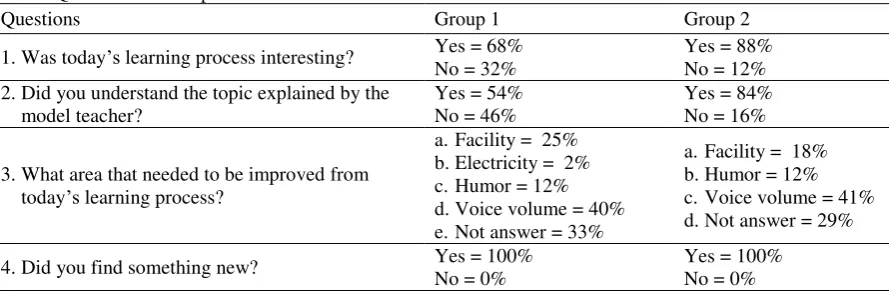
Indicators used to quantify the effectiveness of GeoGebra in this study are student response both in the learning process and afterwards and teacher response both in the learning process and afterwards. 2.Did you understand the topic explained by the
model teacher?
Yes = 54% No = 46%
Yes = 84% No = 16%
3.What area that needed to be improved from today’s learning process?
a. Facility = 25%
89 Table 7.
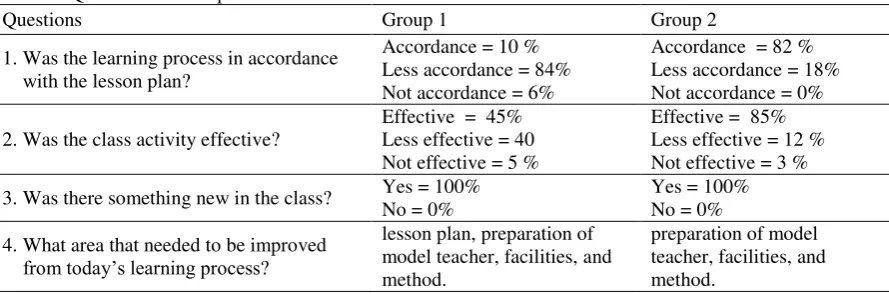
Observer Questionnaire Responses
Questions Group 1 Group 2
1.Was the learning process in accordance with the lesson plan?
2.Was the class activity effective?
Effective = 45%
4.What area that needed to be improved
from today’s learning process?
The data on competencies improvement of ICT implementation were derived from the questionnaires after the training and the workshop, the student and teacher interviews, as well as the direct observations from the researchers. It was concluded that teachers were motivated and willing to improve their capability to implement ICT in their classroom because of their experiences with Geogebra and the planning, implementation, and evaluation through the LS process. The application that was not implemented was Autograph™ due to time limitation. To sum up, the teachers improved their basic competencies to implement ICT in the learning process.
Conclusion
90
References
Fraenkel, R. J., & Wallen, N. E. (2009). How to design and evaluate research in education. New York: McGraw-Hill Companies.
Hohenwarter, M., Hohenwarter, J., Kreis, Y., & Lavicza, Z. (2008). Teaching and learning calculus with free dynamic mathematics software GeoGebra. Proceeding of the 11th
International Congress on Mathematical Education Conference /11th ICME Mexico (pp. 1-10). Retrieved from
http://geogebra.ir/geogebra/Files/PDF/6ad63497da1a471a855558f30962f84e.pdf Karim, M. A. (2013). Relevancy of lesson study with curriculum 2013. Paper presented at the
National Conference of Mathematics Education V. Malang: Universitas Negeri Malang Press.
Lewis, C. (2002). Lesson study: A handbook of teacher-led instructional change. Philadelphia: Research for Better School, Inc.
Pratt, D., Davies, N., & Connor. (2011). The role of technology in teaching and learning statistics. In C. Batanero, G. Burril, & C. Reading (Eds.), Teaching statistics in school mathematics: Challenges for teaching and teacher education. A Joint ICMI/IASE
Study (pp. 97-107). New York, NY: Spinger.