Vegetation Study Based On the Soil Properties of Konni
Reserve Forest- A Part of Western Ghats of Kerala, India
M.G. Sanal Kumar, V Jayalekshmy and R.S. Balamurali
P.G. &Research Department of Zoology, N.S.S. College, Pandalam – 689 501, Pathanamthitta (Dist), Kerala, India
Abstract- Konni Forest Division, a part of Southern Western Ghats, on the bank of River Achencoil carries long history of man-forest interface and harbours rich floral diversity supporting three different eco regions. The present study aimed to assess the floral diversity of Konni Forest Division and its distribution in relation to various edaphic factors. Forest types are identified by reconnaissance survey. The study plots were selected at random and the plants were marked and identified species wise. Braun – Blanquet model was adopted to enumerate non tree species. Soil analysis and statistical analysis were done using standard procedures. Diversity indices were also calculated to explain the plot wise variation in the floral diversity, dominance, abundance, richness, evenness and distribution. 16 tree species were identified in the moist deciduous habitat, of which 86% showed contiguous distribution, 13% enjoy random distribution and 1% enjoy regular distribution. Evergreen and semi evergreen eco regions are home to 11 tree species. 23 non – tree species were identified of which 5 species have frequency above 50% and remaining below 50%. Various biodiversity indices shows that konni reserve forest is marked with species richness, species abundance, moderate species diversity , even distribution of plant species and no over dominance among species. Soil analysis showed richness in organic carbon, nitrogen, potassium, calcium and magnesium content, but low Phosphorus content. This indicates high fertility and productivity of forest ecosystem.
Index terms: Konni Reserve forest, Vegetation studies, Soil analysis, Evergreen forest, moist deciduous forest.
I. INTRODUCTION
he physiographic divisions enrich Kerala with habitat and biological diversity. The climate of Kerala is warm tropical with high rainfall ranging from 2000 to 4500 mm per annum. The peculiar physiographic and seraphic conditions have given rise to 12 agro climatic zones which have their influence on the flora and fauna of the land. The forests, at present relegated to the high hill tops, harbour very high percentage of endemism.
The recorded forest area is 11222 Km2 (1.5% of forest cover of India) of which 10292 Km2 (26.5% of land area of Kerala) have vegetation cover with dense forests (crown density above 40%) occupying 8421 Km2 (82% in the forest area) and open forest (between 10 - 40% crown density) covering 1871 Km2 (18% of forest cover) (FSI, 1991). In the floristic spectrum
of India, the Western Ghats flora represents about 25 percentages. Of the 4000 species of flowering plants, about 1500 are endemic to Western ghats (Nayar , 2010). The forests were constituted in to Konni Reserve Forests by the Maharaja of Travancore way back in 1897, which is one among the oldest reserve forests in the State. Konni Forest Division, a part of Southern Western Ghats, on the bank of River Achencoil carries long history of man-forest interface and harbours rich floral diversity supporting three different eco regions. It comprises an area of 45 sq Km with central co - ordination 76053.5’ East and 903.00’ North. About 5% of the total area of the forest in the forest in the Division is converted to teak plantation.
The biodiversity of this forest division is facing severe threat from local foragers entering into the forest for cattle grazing, fodder and thatching grass collection, firewood and bamboo collection, etc (Manesh and Menon, 2009). The existing biodiversity of this division has not been assessed so far in detail. The degradation of floral diversity will certainly affect the faunal diversity (Philip and Layman, 2007) of the division.
The objectives of the present study was to identify the forest types of Konni reserve forest and to study the floral diversity on the basis of trees and non tree species of Konni forest area as a part of Western Ghats and to analyze the soil properties of reserve forest area to various soil edaphic factors and nutrient contents.
II. METHODOLOGY
For vegetation studies, a reconnaissance survey was conducted for identifying different forest types. Study plots of 400m2 were randomly selected. All plants >10 cm gbh (1.3m above ground level) were marked and identified species wise (Mishra, 1968). Braun – Blanquet model was adopted to enumerate non tree species (Braun -Blanquet, 1951). Twenty plots were used to study plant association. Mergalef’s richness index (Mergalef, 1958) and Hill’s abundance number (Hill, 1973) were considered to measure species richness and abundance. The attributes of vegetations were measured using the software biodiversity pro.
Soil samples were randomly collected from different layers of soil pit. Samples were pooled, air dried, passed through 2mm sieve and particular >2mm(gravel) sand, slit, clay, pH, OC, exchangeable acids, exchangeable bases, Nitrogen, Phosphorous, Potassium, Calcium and Magnesium were found out according to the procedure of Jackson (1958).
Analysis of vegetation has revealed two types of forests in the Konni Reserve, Southern moist mixed deciduous forest (MD) and west coast evergreen forests (EG). A small patch of west coast semi evergreen forest also seen adjacent to evergreen forests. Tree species like Terminalia paniculata, Dalbergia latifolia, Pterocarpus marsupium, Macaranga peltata, Grewia tiliaefolia etc predominates in the moist deciduous forest. Canarium strictum, Palaquium ellipticum, Vateria indica, Hopea parviflora etc are seen in the semi evergreen forests. Vateria indica, Palaquium ellipticum, Toona ciliate, Mesua ferrea etc predominates in the evergreen patch. Champion and Seth (1968) classify these forests as a Southern Indian Moist Deciduous Forest. The vegetation is characterized by Adina cordifolia, Albizzia odoratissima, Albizzia procera, Alstonia scholaris, Bombax ceiba, Toona ciliata, Dalbergia latifolia, Grewia tiliaefolia, Holoptelea integrifolia, Hymenodictyon excelsum, Lagerstroemia lanceolata, Lagerstroemia speciosa, Lannea coromandelica, Miliusa velutina, Pterocarpus marsupium, Schleichera oleosa, Spondias pinnata, Radermachera xylocarpa, Tectona grandis, Terminalia bellerica, Terminalia paniculata, Terminalia tomentosa, Vitex altissima, Xylia xylocarpa, and Machilus macrantha (Champion and Seth 1968).
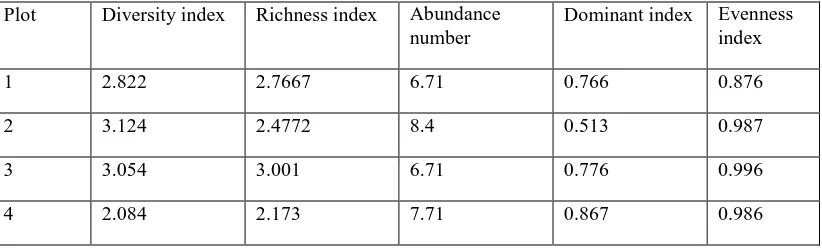
All the moist deciduous plots have good species richness index value (Table 1). Hill number of abundance also showed that all these plots were rich in species abundance. The Shannon – Weiner diversity index ranges from 2.0 – 3.5 in moist deciduous plots. The Simpson’s dominance index (0.5 – 0.8) indicating fairly poor over dominance .The Pieloe’s evenness index ranging from 0.8 – 0.9 indicating even distribution of plant species in the study area. As the Western Ghats of Kerala harbours rich diversity of flora and fauna (Manesh and Menon, 2009), the observed species richness and abundance of Konni forest supports its significance as a protected area.
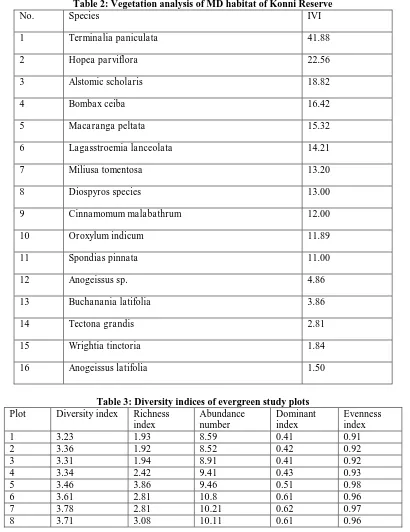
The importance value index (IVI) of the tree species in the moist deciduous habitat is gives in the table 2. The IVI value ranges from 1.5 to 41.88. Terminalia paniculata got maximum IVI value (41.88) and Anogeissus latifolia got lowest IVI value (1.5).
Of the different species identified in the moist deciduous habitat, 86% of species enjoy continuous distribution (A/F ratio > 0.05) 13% enjoy random distribution (A/F between 0.025 – 0.05) and remaining 1% enjoy regular distribution (A/F below 0.025). Terminalia – Grewia, Terminalia – Hopea and Terminalia – Macaranga association was predominant in the
moist deciduous habitat of Konni Reserve (All association coefficients +1).
The semi evergreen and evergreen habitat has predominant species as Lagerstroemia lanceolata, Lagerstroemia reginae, Vateria indica, Cullenia exarillata and Elaeocarpus tuberculatus. The species richness index ranges from 1.9 - 3.86 which indicates fairly good species richness. The Hill number of abundance ranges from 8.5 – 10.8 showed fairly good species abundance. The Shannon – weiner diversity index ranges from 3.2 – 3.8 also showed fairly moderate species diversity. The Pieloe’s evenness index is between 0.91 – 0.98 in different plots indicating even distribution of plant species. The dominant index was between 0.4 – 0.6 indicating no over dominance of species in the habitat (Table – 3).
The important value index IVI was highest for Elaeocarpus munronii (31.34) and lowest for Antidesma menasu (10.01) in the evergreen and semi evergreen habitats. The IVI enjoy random distribution and 33% enjoy contiguous distribution and 21% enjoy regular distribution (Table 5). The standing composition of herbs and shrubs in the Konni Reserve is given in Table – 6. Hundred percent frequency was observed only for one species, Heracleum candolleanum, was present in almost all the study plots. Five species have frequency above 50% and remaining below 50%.
Moist deciduous habitat has soil gravel content ranging between 7 – 20 %. Generally the soil is sandy loam and moderately acidic. The sand content varies between 60 – 85%. High organic carbon content was present. The soil has high Nitrogen, Phosphorous, Potassium and Calcium content. Magnesium content was generally low. Nitrogen, Potassium, Calcium and Magnesium content but low Phosphorous content (table 9). These results indicate high fertility and productivity of forest ecosystem.
Table 1: Diversity indices of moist deciduous forests of study area
5 3.246 2.476 9.81 0.776 0.987
6 3.486 2.412 8.46 0.717 0.911
7 3.127 2.476 7.68 0.701 0.922
8 2.897 2.008 9.71 0.701 0.912
9 3.001 2.412 7.76 0.771 0.913
10 3.248 2.008 8.71 0.817 0.903
Table 2: Vegetation analysis of MD habitat of Konni Reserve
No. Species IVI
1 Terminalia paniculata 41.88
2 Hopea parviflora 22.56
3 Alstomic scholaris 18.82
4 Bombax ceiba 16.42
5 Macaranga peltata 15.32
6 Lagasstroemia lanceolata 14.21
7 Miliusa tomentosa 13.20
8 Diospyros species 13.00
9 Cinnamomum malabathrum 12.00
10 Oroxylum indicum 11.89
11 Spondias pinnata 11.00
12 Anogeissus sp. 4.86
13 Buchanania latifolia 3.86
14 Tectona grandis 2.81
15 Wrightia tinctoria 1.84
16 Anogeissus latifolia 1.50
Table 3: Diversity indices of evergreen study plots Plot Diversity index Richness
index
Abundance number
Dominant index
Evenness index
1 3.23 1.93 8.59 0.41 0.91
2 3.36 1.92 8.52 0.42 0.92
3 3.31 1.94 8.91 0.41 0.92
4 3.34 2.42 9.41 0.43 0.93
5 3.46 3.86 9.46 0.51 0.98
6 3.61 2.81 10.8 0.61 0.96
7 3.78 2.81 10.21 0.62 0.97
9 3.61 3.12 10.02 0.47 0.97
10 3.46 3.42 8.91 0.52 0.98
11 3.82 3.31 8.46 0.52 0.97
12 3.84 3.60 9.21 0.51 0.94
Table 4: Vegetation analysis of evergreen and semi evergreen habitat of Konni Reserve
Sl. No. Species IVI
1 Elaeocarpus munronii 31.34
2 Callicarpa lanata 21.81
3 Palaquium ellipticum 21.70
4 Holarrhena antidysenterica 18.70
5 Eugenia sp. 16.01
6 Garcinia echinocarpa 10.41
7 Kingeodendron pinnatum 10.40
8 Eurya japonica 10.11
9 Hopea glabra 10.10
10 Mallotus distance 10.10
11 Antidesma menasa 10.01
Table 5: Species distribution in the Konni Reserve
Forest type Distribution Percentage
Moist deciduous Contiguous 86
Random 13
Regular 1
Evergreen and semi evergreen
Contiguous 33
Random 46
Regular 21
Table 6: Standing composition of non- tree species in Konni Reserve
Sl. No. Species Frequency %
1 Heracleum candolleanum 100
2 Impertiens seroniae 98
3 Spermacose hispida 80
4 Costus speciosus 60
5 Hedyotis stylosa 52
6 Centella asiatica 49
7 Ixora sp. 42
8 Balanophora fungosa 38
9 Lantana camera 37
10 Helicteres isora 38
11 Lucas vestita 37
12 Apama barberi 30
13 Eclipta alba 35
14 Calamus sp. 31
15 Syncaria sebastinii 30
16 Arundinella parpuria 30
17 Pennisatum palystachyon 28
18 Acacia instia 27
19 Moniera cunerfolla 27
20 Girardina lescheneltiana 26
21 Begonia malabarica 13
22 Jusminum rotalarium 10
Table 9: Soil properties of Konni Reserve (Mean ± SE) Property Moist deciduous habitat Evergreen habitat
Gravel % 82.45±0.004 14.06±0.02
pH 4.8±0.001 4.1±0.006
OC% 2.5±0.08 3.43±0.081
EA% 1.49±0.002 1.21±0.022
EB% 11.59±0.01 7.70±0.091
Sand% 77.00±0.004 80.00±0.01
Silt% 12.00±0.001 10.00±0.08
Clay% 11.00±0.08 22.00±0.11
N(ppm) 2962.2±0.11 2760.4±0.004
P(ppm) 2.00±0.08 0.04±0.01
K(ppm) 460.2±0.01 500.1±0.008
Ca(ppm) 620.1±0.081 840.21±0.04
Mg(ppm) 96.48±0.011 100.81±0.048
IV. CONCLUSION
The result obtained from the current study can be used as documentation and can be used to determine the status of vegetation in Konni reserve forest. Due to the extremely unplanned development of agriculture in the high lands, the natural forest vegetation has been fragmented in many places there by losing the continuity. Using non – conventional
timbers will help to relieve the forests from the heavy pressure of raw material supply to the wood based industries. Konni Reserve is facing all these degradational pressures. Proper management and public awareness is needed for the proper conservation of this ecosystem, harbouring good vegetation, and moderate animal diversity.
ACKNOWLEDGEMENT
We would like to extend our sincere thanks to University Grant Commission for financial support during this study.
REFERENCES
[1] BRAUN AND J. BLANQUET, Ecology and Field biology. Robert Lee Smith. Ed. London, 1951,pp362.
[2] E.C. PIELOU, Ecological diversity. Wiley New York,1975
[3] FSI. The State of Forest Report. Government of India. Forest Survey of India (Ministry of Environment and Forest, Dehra Dun),1991.
[4] H.G.CHAMPION AND SETH,S.K. “A revised survey of Forest types of India”. Government of India. Delhi,1968.
[5] K.MANESH AND K.P. MENON, “Vegetation of Parambikulam sanctuary”. Indian Foreste,2009.4th ed. Vol 1, pp38 -46.
[6] M.L.JACKSON, Soil chemical analysisi.Prentice Hall Engle Wood Cliffs, 1958,498pp
[7] M.O. HILL, Diversity and Evenness. Ecology, 1973, 61,pp237 -249. [8] M.P. NAYAR, “Plant endemism in Western Ghats and identification of
critical species and habitat. Proceedings of First Biodiversity Congress”. Trivandrum.2010
[9] PHILIP AND LAYMAN, “Bird community of Southern Western Ghats of India”. J. tropical Forestry. 2007,4th ed.Vol 2, pp 37 -46
[10] R.MERGALEF, Information theory in Ecology general Systematics.1958, 3rd ed., pp36 -71
[11] R.MISHRA, Ecology workbook. Oxford and IBH Pub.com.New Delhi,1968
AUTHORS
First Author – Dr. M.G. Sanal Kumar, Ph.D., Assistant Professor, Post Graduate and Research Department of Zoology, N.S.S. College, Pandalam, Kerala, India. [email protected]
Second Author –V. Jayalekshmy,M.Sc., Research Scholar, Post Graduate and Research Department of Zoology, N.S.S. College, Pandalam, Kerala, India. [email protected]
Third author – R.S. Balamurali, M. Phil, Assistant Professor, Post Graduate and Research Department of Zoology, N.S.S. College, Pandalam, Kerala, India . [email protected]