An Analysis of Presupposition in MakeOver Beauty Products Advertisements on
Website
THESIS
Submitted as partial fulfillment of the requirements for the Bachelor Degree of English Department, Faculty of Letters and Humanities,
Sunan Ampel State Islamic University Surabaya
By:
ELOK FAIQOH Reg. Number: A03213016
ENGLISH DEPARTMENT
FACULTY OF ARTS AND HUMANITIES SUNAN AMPEL STATE ISLAMIC UNIVERSITY
ABSTRACT
Faiqoh, Elok. 2017. An Analysis Of Presupposition in MakeOver Beauty Products Advertisements On Website. English Department Faculty, State Islamic University Sunan Ampel Surabaya.
Advisor: Raudlotul Jannah, M. App. Ling.
Key Terms : Beauty products Advertisements, Presupposition, Pragmatic.
This research aims to describe the types and functions of presuppositions contained in MakeOver beauty products advertisement on Website. In the analysis the writer uses the theory of Yule about presupposition in 1996. The research method is descriptive qualitative method because the writer describes and interprets a phenomenon of presupposition.
From the analysis that has been conducted by the writer on the type and functions of presupposition in advertisements, the writer finds 34 of presupposition of three types of presuppositions: The slogan contains three types from six types of presupposition. They were twenty of existential presuppositions one of factive presupposition, thirteen of lexical presupposition. The writer also finds three function of presupposition in beauty products advertisement. Six advertisements which containing implicit competition, fifteen advertisements contain causing reader to consider the existence and five advertisements making the advertisement short and memorable.
INTISARI
Faiqoh, Elok. 2017. An Analysis Of Presupposition in MakeOver Beauty Products Advertisements On Website. English Department Faculty, State Islamic University Sunan Ampel Surabaya.
Pembimbing: Raudlotul Jannah, M. App. Ling
Kata Kunci : Beauty products Advertisements, Presupposition, Pragmatic.
Penelitian ini bertujuan untuk mendeskripsikan jenis dan fungsi presuposisi yang terkandung dalam iklan MakeOver produk kecantikan pada website. Dalam analisa ini, penulis menggunakan teori Yule tentang presupposition pada tahun 1996. Metode penelitian yang digunakan adalah metode penelitian deksriptif karena penulis akan menjelaskan dan menafsirkan fenomena tentang presupposisi.
Dari analisis yang telah dilakukan yang telah dilakukan oleh penulis pada jenis-jenis dan fungsi presupposisi dalam periklanan,penulis menemukan 34 data yang mengandung presupposisi. Slogan terdiri dari tiga tipe presuposisi dari enam jenis presupposisi: dua puluh dari existential presupposition, satu dari factive presupposisi, satu dari lexical presupposisi. Berdasarkan pada penelitian penulis juga menemukan tiga fungsi dari perikalan pada produk kecantikan. Dua puluh periklanan terdiri dari implicit competition, satu iklan berisi causing reader to consider the existence dan tiga belas iklan terdiri dari making the advertisement short and memorable.
TABLE OF CONTENTS
Inside the Cover Page ……… i
Declaration Page ……… ii
Advisor’s Approval Page ...………. iii
Motto ………. v
Dedication Page ………. vi
Acknowledgement ………. vii
Table of Contents ……….. viii
Abstract ………. x
Intisari ……… xi
CHAPTER I: INTRODUCTION Background of the Study ………... 1
Research Problems ……… 5
Research Objectives ……….. 6
Significance of the Study ……….. 6
Scope and Limitation ……… 6
Definition of Key Terms ………... 7
CHAPTER II: REVIEW OF LITERATURE Pragmatic ...…………...……… 8
Scope of pragmatics………..……… 10
Presupposition………....………. 13
Function of presupposition ……… 21
Related Studies ……… 22
CHAPTER III: RESEARCH METHODOLOGY Research Design ……… 24
Data Collection ……….. 25
Data Analysis ………. 25
CHAPTER IV: FINDINGS AND DISCUSSION Findings ……….. 28
Discussion ……….. 45
CHAPTER V: CONCLUSION AND SUGGESTION Conclusion ………. 48
Suggestion ………. 49
REFERENCES ….………... 50
1
CHAPTER I INTRODUCTION
1.1Background of Study
People use language to communicate, interact and share their ideas, thought and feelings. By using language to communicate people can get what speaker’s purpose in conversation. Generally, communication’s purpose is to
deliver the message by the speaker to the hearer.
One of field in society that uses language as a tool to communicate and bring some profits economically is an advertisement. Advertisement is a kind of messages paid that usually used by people to inform or influence other people. Nowadays advertising uses every possible media to get its message through. It such as television, printed (newspaper, magazines, journals etc), radio, press, internet, direct selling, hoarding, mailers, contest, sponsorship, posters, clothes, events, visuals, and even people (endorsements). Advertising usually informs the potential consumer about products, services, benefit and utilities. It also persuades the consumers to purchase their products and services.
2
powerful influence over people and their behavior. The choice of language to convey specific messages with the intention of influencing people is vitally important. It is arranged as good as possible to get people’s attention.
According to Stan Rap and Tom Collins (1955), the language of advertisement must be able to arouse, to persuade and to be informative. It means that the language of advertising must pay attentions to people that can give the solution to the consumer. And the language use of advertisement must be communicative and make the people easy to comprehend the message. Persuade means that the language use makes the people interest with the products. Wang (2017) mentions that the language of advertising is indifferent degrees influenced by linguistics, psychology, economics, marketing strategy, sociology and aestheticsetc. Thus, the language used by advertisers must be multi- functional commercial to earn interest many people. It can be concluded that the content of advertisements must be objective and honest, brief and clear, not making pass to group or other producer and make attractive attention.
Advertisements often convey ideas indirectly rather them overtly. The advertisers have to use some ways to make it simple and easy, for example using one of pragmatics elements to deliver the message to the readers or the viewers. That is a presupposition, Yule (1996) states that presupposition is something the speaker assume to be the case prior to making utterance. It is an important part of any massage leaving the person’s mind that provides the meaning.
3
most importantly and avoid breaking the law. An example such use of presupposition is the one labeled at Apung Rahmawati restaurant “Ayam baka rterdahsyat di dunia” this statement presupposes that the restaurant is the best
when it is compared to the other restaurant of the same product type. To make it legal, the advertisements cannot directly assert that their product is better than other restaurants of the same product types, so they presuppose the message.
Regarding the restaurant above, the advertisement cannot directly assert, “Apung Rahmawati restaurant is better than Primarasa restaurant”, otherwise
Apung restaurant would probably into legal disputes. Therefore, they simply state that it is the best without explicitly comparing it with others. Presupposition used in this particular advertisement to indirectly compare Apung restaurant with its competitors and to state that Apung restaurant is the best, those to persuade consumers to buy its products rather than those of its competitors.
Another important function of applying presupposition in advertisement is to convey the message in short and memorable way. In this case, the information will be shared between the customer and advertiser without explanation or any other way of convincing.
4
order to persuade the consumers to buy the advertised products, the advertisement writers must convince the consumers what they said in the advertisement is true.
Presupposition can help to make the advertisement more persuasive in that presuppositions have the ability to survive under negation or question. Presupposition can also be used to cheat the consumers if the claims of the advertisements are false because in most cases the consumers are really not in a position to learn whether the presupposition in the advertisement is true or not. Consumers have been cheated by the presupposition and been attempted to purchase the product with a belief of its quality. The reason is that the consumers do not want to spend too much time in checking the truthfulness of the contents of the advertisements and at the same time, they also lack related professional knowledge and means.
In addition, advertisement is primarily persuasive in its nature. The crucial part of advertisement language is presupposition. There are many functions of presupposition use in advertisement. Some of them use it to persuade consumers to buy their products, other use it to shorten their messages and grab public attention. Finally, presupposition is multi- functional in commercials. It is considered one of the most effective communication means between the consumers and the advertiser. So, Presupposition is a very important notionin pragmatics can serve the multiple purposes of advertisement. Therefore presupposition and the language of advertising should be studied together.
5
skin care and beauty tools. The researcher is interested in analyzing presupposition that used by MakeOver and choose MakeOver as an object of the research since MakeOver is a brand that has a lot consumer in Indonesia. The products of MakeOver that will be analyzed by the researcher are Lips products and Face products. Based on Website, the best seller of MakeOver’s products are
Lip products and face products. MakeOver has a website www.makeoverforall.com which is advertise their product use English and it is easy for the researcher to analyze the presupposition that may contain in a slogan.
The researcher has two research problems to be analyzed. They are what type of presupposition that used on Website of MakeOver beauty products advertisements and function of presupposition that used on Website of MakeOver’s products. The researcher also used descriptive qualitative methodology to support the analysis.
1.2Research Problem
This study is conducted to answer the problems formulated in the following questions:
1. What are types of presupposition that used on Website of MakeOver beauty products advertisements?
6
1.3Research Objective
1. To find out types of presupposition used on Website of MakeOver beauty products advertisements.
2. To find out functions of presupposition used on Website of MakeOver beauty products advertisements.
1.4Significant of the Study
The findings of this research are supposed to give valuable contributions theoretically and practically. Theoretically, from this research are expected to be one of the sources in pragmatics studies particularly on the type of presupposition in advertisement especially in lipstick product and the function of presupposition. Practically, this study can help linguistics researchers, social media reviewers to examine a certain linguistic characteristic of some advertisements. Well, as it may also become a type and function of presupposition analysis for pragmatics studies learners. The result of this study hopefully gives advantage for advertiser who will create an advertisement in order to be better in their works.
1.5Scope and Limitation
7
is in the slogan of the picture contains presupposition. The products were lips products and face products.
1.6 Definition of Key Term
Pragmatic is concerned with the study of meaning as communicated by a
speaker (writer) and interpreted by a listener (reader). (Yule, 1996;3)
Presupposition is something the speaker assume to be the case prior to
making an utterance.( Yule, 1996;25)
Advertising is a sales message directed at mass audiences that seeks through persuasion to sell goods, service or ideas on behalf of the paying sponsor. (Burke, 1980;6)
MakeOveris a brand cosmetic from Indonesia.
CHAPTER II
REVIEW OF LITERATURE
2.1 Theoritical Framework 2.1.1 Pragmatic
Based on Yule (1996: 3) there are 4 areas about Pragmatic explanation; Pragmatics is the study of speaker meaning. It is means that pragmatic is
the science of studying about the meaning and delivered by the speaker (or writer) and interpreted by a listener (or reader).
Pragmatics is the study of contextual meaning. In this type, needed the consideration about how the speaker arrange what he want to say adapted with the listener, where the condition is, when and how.
Pragmatics is the study of how more gets communicated than is said.. This
type digs how listeners can make inferences about what is said in order to arrive at an interpretation of the speaker’s intended meaning and how great deal of what is
unsaid is recognized as part of what is communicate.
Pragmatics is the study of the expression of relative distance. This perspective generates problem on what determines the choosing between what is submitted and what is not submitted.
9
takes place without considering any world of reference or any user of the forms. Secondly, he considers semantics as the study of the relationships between linguistic forms and entities in the world - how words literally connect to things. Semantic analysis also attempts to establish the relationships between verbal descriptions and states of affairs in the world as accurate (true) or not, regardless of who produces that description. Thirdly, he regards pragmatics as the study of relationships between linguistic forms and the users of those forms.
As social individuals, people spend much of their time talking or interacting with other people. These interactions involve utterances can be analyzed by pragmatic analysis to find out the speaker’s intended meanings, the listener’s assumptions or receptions regard with some aspects such as who the
speaker and the listener are, what relationship they have, and in what context they are in when they interact. The meaning gained from an utterance may differ from one to another person; it depends on the mentioned aspects. For example, two friends, Raisa and Hamis, are having a conversation which may imply some things and infer some other things without providing any clear linguistic evidence of „the meaning’ of what was being communicated.
Raisa : “Coffee?”
Hamis : “It would keep me awake all night”
10
2.1.2 Scope of Pragmatic
Yule (1996: XII) describes the subject areas of pragmatics as follows: 2.1.2.1 Context
In which presuppositions are assumed to be true we have only considered context (Yule, 1993:29). According to Widdowson (2007:19-26), context is aspects of extra-linguistic reality that are taken to be relevant to communication. Context is the common knowledge of the speaker and the hearer involved in a conversation.
2.1.2.2 Entailment
Yule (1996: 25) states that entailment is something that logically follows from what is asserted in the utterance. For example:
(1) Mary’s brother has bought three horses.
In producing the utterance (1), the speaker will normally be expected to have the presuppositions that a person called Mary has a brother. The speaker may also hold the more specific presuppositions that Mary has only one brother and that he has a lot of money. In fact, all of these presuppositions are the speaker’s and all of them can be wrong. The sentence in (1) will be treated as having some entailments such as Mary’s brother bought something, Mary’s brother bought
three animals, somebody had bought three horses, and other similar logical consequences.
11
2.1.2.3 Deixis
Deixis is a process whereby words or expressions rely absolutely on context. It is a technical term from Greek for one of the most basic things we do with utterances which means „pointing’ through language. For example:
(6) Jim: “I’ll put this here”
(The context is Jim is telling his wife that he is about to put the key of the house in the kitchen drawer)
From sentence (6) it can be seen two deictic expressions – „this’ and „here’. These deictic expressions are conventionally understood as the expressions of being „near speaker’.
2.1.2.4 Implicature
Yule (1996: 131) states that implicature is a short version of conversational implicature which is defined as an additional unstated meaning in conversation. There is a basic assumption in conversation that each participant (the speaker and the listener) attempt to cooperate to the exchange of talk. People produce implicatures all the time but are mostly unaware of it. For example, if someone asks, “Could you close the door?” the listener does not usually answer “Yes,” instead they perform the nonlinguistic act of closing the door. In this case,
although the speaker uses a form of words that is conventionally a question; the listener can infer that the speaker is making a request.
Here are two examples of implicature which implicate “I don’t like” and
“I’m not going”:
12
(The context is - A and B are close friends and A knows well that B does not like red color) Stating that “Red is red” in (7) is apparently both too
informative (since people already know that red is red) and not informative enough because B does not directly answer the question of A. There may be some interpretations gained by anyone when hearing B’s answer, but since the context is A knows that B really does not like red, then B has given the answer of the question. Thus, A understands that B does not like the color they are talking about. B does not say that she/he does not like the color but she/he implies it. 2.1.2.5 Presupposition
Presupposition is one of important Yule (1996: 133) states that presupposition is something the speaker assumes to be the case prior to making an utterance. Speakers, not sentences, have presuppositions. For example:
(9) Where has Anne looked for the keys?
Presupposition of (9): Anne has looked for the keys, but she has not found it yet.
(10) Do you want to do it again?
Presupposition of (10): You have done it already, at least one time. (11) My wife is pregnant
Presupposition of (11): The speaker has a wife.
13
Existential Presupposition
This type of presupposition is not only assumed to be present in possessive constructions (for example, „your car’ >> „you have a car’), but more generally in
any definite noun phrase. By using any of the expressions in (12), the speaker is assumed to be committed to the existence of the entities named.
(12) The King of Sweden, the cat, the girl next door, the Counting Crows Other triggers of existential presupposition: the (definite article), a/an (indefinite article), this, that, these, those (demonstrative) my, their, her, his, our (possessive pronoun).
Factive Presupposition
The presupposed information following a verb like „know’ can be tread as
a fact and is described as a factive presupposition. Example:
(13) I regret inviting him
Presupposition of (13): I invite him. (14) It isn’t odd that she come early
Presupposition of (14): She comes early. (15) She didn’t realize that he is a teacher
Presupposition of (15): He is a teacher.
14
Lexical Presupposition
This is assumption that in using one word, the speaker can act as if another meaning (word) will be understood. For example:
(16) Fathan stopped running
Presupposition of (16): He used to run. (17) You are late again
Presupposition of (17): He was late before
In this case, the use of the expressions stop and again are took to presuppose another (unstead) concept. Others triggers of lexical presupposition: return, no more, another time, anymore, come back, repeat, still, restore.
Structural Presupposition
In this type, the assumption is associated with the use of certain words and phrases and assumed to be true. WH- question construction in English are conventionally interpreted with the presupposition that the information after the WH- form is already known to be the case.
Example:
(18) When did she travel to the USA? Presupposition of (18): She traveled. (19) Where did you buy the book?
15
Non-Factive Presupposition
This type is an assumption that is assumed not to be true. In this type, verb like dream, pretend and imagine are used with the presupposition that what follows is not true.
Example:
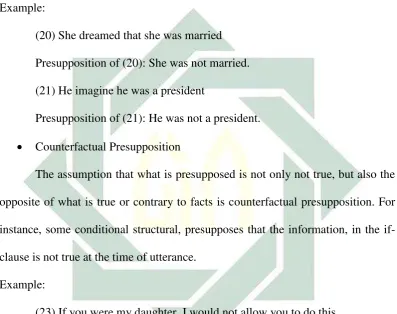
(20) She dreamed that she was married Presupposition of (20): She was not married. (21) He imagine he was a president
Presupposition of (21): He was not a president. Counterfactual Presupposition
The assumption that what is presupposed is not only not true, but also the opposite of what is true or contrary to facts is counterfactual presupposition. For instance, some conditional structural, presupposes that the information, in the if-clause is not true at the time of utterance.
Example:
(23) If you were my daughter, I would not allow you to do this. Presupposition of (23): You are not my daughter.
Indicators of potential presuppositions discussed so far are summarized in Table 21.
Type Example Presupposition
Existential The X >> X is exist
Factive I regret leaving him >> I left him
16
Lexical He managed to escape >> he tried to escape Structural When did she die >> She died
Counterfactual If I weren’t ill. >> I am ill
2.1.3 Advertisment
The term advertising is closely related to marketing strategy. In marketing strategy, advertising can be included into the promotional part. Advertising costs much money for paying the media, which is selected. So, every company must be able to choose the right media to advertise their product. It is better for us to know the definition of advertising for further understanding. There are so many definitions about advertising, but the writer chooses the simple meaning of advertising which can be understood easily.
17
2.1.3.1 Type of Advertisments
Jefkins (1997: 39) divides type of advertisements into seven types:
Consumer Advertisements
There are 3 types of goods in consumer advertisements, they are:
1. Consumer good is the goods which are sold repeatedly and people daily necessity. Such as food and beverage, shampoo, cigarette, etc.
2. Durable Goods is the goods are more expensive than consumer goods and more endurable. Such as household, clothes, electronic devices.
3. Consumer Services is services for security, prosperity and entertainment. Such as bank, hotel, restaurant, travel, insurance, machine shop, healthy treatment.
Business – to – business Advertisements
18
Every company generally needs supply from other company. Because the most made products are produced from raw materials, components or spare part which are taken from other company.
Trade Advertisements
Trade advertisement is addressed to distributors, big companies, agents and exporters / importers. This advertisement advertises products to be resold.
The function of trade press is to give information to the traders or wealthy people about products which are available to be resold by introducing new products or by reminding old products along with any sales or promotions. Mail service is usually used by company to promote their product. Another media which is used trade advertisements are trade exhibition. But television is also used to promote.
Retail Advertisements
This advertisement has different character between trade advertisements and consumer advertisements. The example of this advertisement is an advertisement which is made by supermarket or big shops. This advertisement is located in all shopping center. There are 3 objectives of this advertisements, they are:
19
3. To sell shop’s stocks
Cooperative Advertisements
This cooperative advertisement is special for retail advertisements. Besides that, there is another type of cooperate advertisements, it is to join promotion.
Financial Advertisements
Generally, bank advertisements, insurance advertisements are financial advertisements. The function of financial advertisements is to collect donation or to offer financial capital such as insurance, stock selling, debenture, and pension donation.
Newspaper, especially business newspaper is usually used by financial advertisements. It usually uses big area in a page because financial advertisements shows full information about all of company plan to influence and made investor join them.
Recruitment Advertisements
The objective of recruitment advertisements is to recruit employee candidate.
The Media of Advertisements
20
consist of newspaper, magazine, direct mail, outdoor advertisements and transit advertisements. Besides, broadcast media consist of television and radio.
Printed Media
a. Newspaper
Newspaper is a regularly schedules publication containing news, information, and advertising, usually printed on relatively inexpensive, low-grade paper such as newsprint.
b. Magazine
21
c. Direct Mail
Direct Mail is the most selective advertisements medium. It has to be supported bymany components, such as computer, modem, etc. but it still can be used as an option.
d. Outdoor Advertisements
Outdoor advertisement is essentially any type of advertising that reaches the consumer while he or she is outside the home. This is in contrast with broadcast, print and internet advertising.
e. Transit Advertisements
It is the standardize medium of another from of sign advertisements, which uses public transportation facilities.
Broadcast Media
a. Television
Television is one of the broadcast media, which is the most versatile and powerful. It is certainly the most expensive of the media.
b. Radio
22
2.1.4 The Function of Presupposition
Presupposition is used for the same functions in the world. The following is a brief explanation of the functions of presupposition in the advertisements (Lam, 2009).
1. Implicit competition
A presupposition is often used in advertising discourse and important function of it is to make comparative advertising and most importantly to avoid breaking the law. This is examples of the use of implicit competition in advertisements slogan.
Top white coffee “the authentic taste of white coffee”
Through the slogan, the readers make a presupposition that Top white coffee product is the most special taste when compared to other hands of the same products.
2. Causing readers to consider the existence of the service.
The presupposition is also used in advertisements in another function. It is may cause “the reader to consider the existence of objects, prepositions, and
culturally defined behavioral properties” (Sells and Gonzeles, 2002). The
following are example of beauty product slogans in advertisements that cause the reader to consider the existence of a product:
Wardah “Inspiring beauty”
23
3. Making the advertisement short and memorable
Further function of applying the presupposition in advertising is to make sure advertisements convey the message in a way that is short and easy to remember. By using presupposition, information can be shared between the reader and advertiser without explanation or a need for convincing (Nilsen, 1994). The following are examples of advertising slogans that short and memorable.
Indomie “seleraku”
Through the slogan, the readers make a presupposition that the food is become our appetite.
2.2 Related Study
Regarding on this study, the researcher found some other researchers which the topic are related:
24
The second is Yunita (2009). Her research aims to find out the presupposition in the play three sisters drama by Anton Chekhov. In her research to classify the type of assumption she used the theory of presupposition stated by Kartunen (in Levinson's book: 1983). In this case is very different from this study which uses the Yule theory.
25
CHAPTER III
RESEARCH METHODOLOGY
In this chapter, the researcher discusses the method of the study that is divided into five part, they are research design, research instrument, data source, data, techniques of data collection and techniques of data analysis.
3.1 Research Design
The design of this research which is used by the writer was descriptive qualitative method because the researcher described, interpreted a phenomenon such as condition and existing relationship, a growing opinion, using scientific procedures to address the actual problem. The descriptive research method was widely used in research which aimed to describe the nature of situation as it exist at the time of the study and to explore the causes of particular phenomena. That was a research method which describes systematically a situation or area of interest factually and accurately (Isaac and Michae,l 1987;42). So, this research is in accordance with descriptive method because in this research attempts to identify, classify and explain a problem or phenomenon about presupposition found of slogan in some picture that uploading by MakeOver beauty product advertisement.
3.2Research Instrument
26
who collects and observe the data. The non- human instrument is gadget that used to take the data from website.
3.3 Data and Data Source
The data were words and sentences of this research are taken from slogan advertisement in some pictures of products that are uploaded by MakeOver website and the pictures about lips and face beauty products.
3.3.1 Technique Data Collection
In this study, the writer collects the data by doing the followings steps:
1. The writer visits website of MakeOver in www.makeoverforall.com 2. The writer begins collecting the picture of MakeOver’s Lips and Face
products.
3. The writer selectsthe pictures as many as possible about the slogan predicated contains presuppositions.
4. The writer selects from all pictures into thirteen. The thirteen picture that have the captions are contains of presupposition.
3.3.2 Technique Data Analysis
After the writer collecting the data, the writer begins to analyzing the data:
27
2. To make it easier, the researcher gives the number of the data 1-20 numbers.
Data 1
“ULTRA COVER LIQUID MATT FOUNDATION”
Data 2
“PERVECT COVER CREAMY FOUNDATION”
3. The writer classifies the slogan that contain presupposition based on the type of presupposition of Yule (1996:133).
4. For frequency and percentage of the types that contains in the slogan the researcher makes a table.
No Types of presupposition Frequency Percentage
1. Existential presupposition 9 27%
2. Factual presupposition 3 9%
5. After the writer makes the table, the writer began explaining each of the presupposition that have been identifying and classifying.
28
Number of captions
Implicit competition (1)
Causing reader to consider for
existence of the products or
services (2)
Making the advertisement
short and memorable (3)
1 √ √
2 √
7. After that the writer explains about the function from each data clearly.
29
CHAPTER IV
FINDING AND DISCUSSION
This chapter is about finding and discussion of this thesis. It provides the answer of three researcher problems that have been presented in the first chapter.
4.1 Finding
In this section the researcher presents the analysis of presupposition in beauty product advertisement especially lips products and face products byMakeOver Cosmetic. In the types of presupposition, it is shown the percentage frequency from each of the type of presupposition in the form of tables. It is also followed by the screen shoot and the explanation of the sentence on Website. In the function of presupposition in advertisements show the example for each of the function of presupposition in the advertisement. It is also followed by tables and the explanations for each the functions of presuppositions in advertisements.
4.1.1 The types of Presupposition in MakeOver products
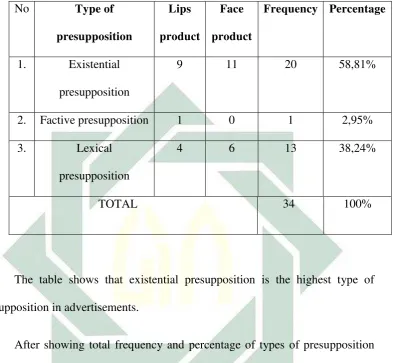
In this study, the writer finds three types of presupposition from six types of presupposition by Yule (1996). They are Existential presupposition, Factive presupposition, Lexical presupposition, this study the writer finds that a slogan can be more than one type of presupposition.
30
Table 4.1.1: The result of the types of presupposition
No Type of
After showing total frequency and percentage of types of presupposition use in MakeOver’s products advertisements, later on the researcher classifies and
explains each slogan of lipstick product advertisements that contain presupposition.
4.1.1.1 Existential Presupposition
31
data from the slogan which contain existential presuppositions are from all data. So, all data of slogan of face and lips products advertisement containing of existential presupposition. The following is more explanation of the data 5, 7, 17, 18, 20.
Data from face product;
Data 5
“BLUSH ON SINGLE”
32
Data 7
Data 7 is a face product through the slogan “face contour kit”, the readers directly makes a presupposition that there is cosmetic for face with function to contour the face and is presented in one place its by MakeOver brand. The slogan contains existential presupposition because by reading the slogan “face contour kit” the reader can see the existence of cosmetic with function to contour the face.
Data 17
33
readers can make the presupposition that there is a liquid lipstick from MakeOver brand. The data contains existential presupposition since by seeing the slogan, readers can see the existence of liquid lips that have many colors from MakeOver brand.
Data 18
34
Data 20
Data 20 also describe a lip product that has been advertised by MakeOver. The product named “Lip Colour Palettee”, it provides five gorgeous colors so
consumers have many colors to choose. Existential presupposition can be found in this data because MakeOver shows the product directly. So consumers can see that MakeOver provides a lip product named “Lip Colour Pallete” which is has
five different colors.
4.1.1.2 Factive Presupposition
35
Data 19
36
4.1.1.3 Lexical Presupposition
Lexical presupposition is the presupposition that is obtained through utterances which are interpreted through assertion in the utterances. Since all the data that have been analyzed by the writer, there are 13 slogan or 38,24%. The 13 data from the data which contain lexical presupposition are data no 1, 2, 3, 5, 6, 8, 9, 10, 11, 12, 13, 14, 19. The following is more explanation of the data 1, 2, 6, 12;
Data 1
Product that is shown in data 1 is a face product by MakeOver named “Ultra Cover Liquid Matt Foundation”. This product provides some advantages
for those who use it. By seeing slogan that has been used by MakeOver to advertise their product “Ultra Cover Liquid Matt Foundation”, the readers or
37
Data 2
There is a face product named “Perfect Cover Creamy Foundation” by
MakeOver in data 2. This product is provided to complete the applying of “Ultra Cover Matt Liquid Foundation”. So, if the readers or consumers want to get
perfect look, they have to apply this product after the previous one. They will have presupposition that this product is good for making perfect coverage because there is the word “perfect cover” which can be understood that this product is
38
Data 6
A face product in data 6 is a blush on product by MakeOver named “Cheeks Marbles”. This blush on contains five colors; mix pink, magenta, bright
crimson, pale purple and pearl white. This product can make natural and healthy looking glow. When the readers or consumers pay attention to the slogan, they may have presupposition that this product has some different color since MakeOver puts the word “Marbles” which is can be said that the product contain
39
Data 12
Data 12 provides a face product name “Hydration Serum” by MakeOver.
This product is designed to prepare the skin for make up by giving instant brightening and lightening effect. This product also help to create perfectly adheres make up. By looking at the slogan, the readers and consumers can have presupposition that this product can make the skin become moist since there is the word “hydration” which is can be interpreted that this product contains
40
Data 12
The product that is displayed in data 12 is a lip product by MakeOver named “Ultra Hi-Matte Lipstick”. This product gives some advantages for people
who use it such as intense color and matte texture. This product can be long lasting for 8 hours. The readers or consumers can have presupposition that this lipstick can be long lasting by seeing the slogan “Ultra Hi-Matte Lipstick”. There is the word “Hi-Matte” which is mean that this product is long lasting.
41
4.1.2 The Function of presupposition in advertisement
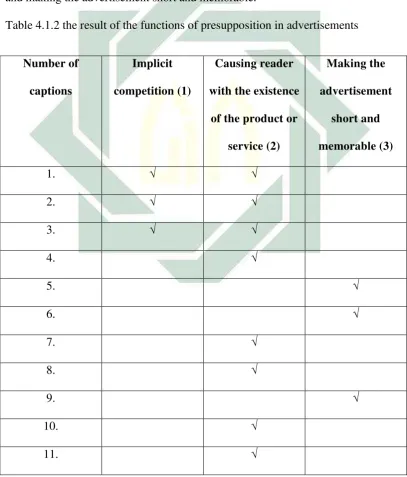
Based on Lam (2009) state that are three functions of presupposition in advertisement, and the researcher found in MakeOver beauty product advertisement also has three function The functions are presented in implicit competition, causing readers to consider the existence of the product or services and making the advertisement short and memorable.
Table 4.1.2 the result of the functions of presupposition in advertisements
42
12. √
13. √
14. √
15. √ √
16 √ √
17. √ √
18. √ √
19. √
20. √
4.1.2.1Implicit competition
It is one of the functions of presupposition in the advertisement that is often used in advertising discourse and important function of presupposition. It makes the comparative advertisement and most importantly to avoid breaking the law. From the data above the researcher finds 6 slogans that contain implicit competition. In data 2 from face product by MakeOver with slogan “perfect cover creamy foundation” is the example from the data which contain implicit
competition.
43
because other brand usually has foundation that not perfect application like this product.
4.1.2.2. Causing readers to consider the existence of the product or services Causing readers to consider the existence of the product or services is the one of functions of presupposition in advertisements. It may cause “the reader to consider the existence of objects, prepositions, and culturally defined behavioral properties (Sells and Gonzeles, 2002). From the data the researcher finds 15 slogans that contain causing readers to consider the existence of the products or services. In data 4 “silky smooth translucent powder” it is the example from the data that contain causing readers to consider the existence of the products of services.
Through the slogan the advertisers create the readers about who will disguised of face problems that realize the readers will like this product. The readers will make presupposition that if the readers have this powder the readers can easily to disguise of face problems.
44
4.1.2.3Making the advertisement short and memorable
Further function of applying the presupposition in advertising is to make sure the advertisements conveys the message in a way that is short and easy to remember. By using presupposition, information can be shared between the reader and advertiser without explanation or a need for convincing (Nilsen, 1994). From the data the researcher finds 5 slogans that contain Making the advertisement short and memorable function. In data 15 from lips product “Glitter Lipstick” is
the example from Making the advertisement short and memorable function.
The slogan is very short and very easy to remember. Through the very short slogan, the advertisers also try to inform the products with the short explanation. Although the slogan is short, but from the slogan the readers can directly know about the product. The reader will make presupposition that the product of lips in data 15 has sparkle color.
Since all data which have been analyzed by the writer, the writer found that data there are 7 slogans that contain two function of presupposition in advertisement that is data number 1, 2, 3, 15, 16, 17, 18. There are more explanations about data 16.
45
application of this lips cream by Makeover product is not owned by general lips cream from another brand because other brand usually has lips cream that not intense matte like this product.
The data 16 also has causing readers to consider the existence of the products or services because through the slogan the readers can know about the service of the product. The product will give the costumer long last lips.
From the analysis of the caption which is based on the type and function of presupposition in the advertisement, the writer concludes that the existential presupposition is the type of presupposition that is most often used by the
advertisers. In terms of the functions of presuppositions in advertisement, causing reader to consider the existence of the service is the function which is most frequently used.
4.2 Discussion
Advertisements that object can contain of presupposition. Captions utterances have been shown in MakeOver’s Website product is interested to be
46
advertiser is not interested in using counterfactual presupposition and Non factive presupposition because the advertisers are fearful if their advertisement slogan become ambiguous or biased and are not understood by the readers so that their products lost in competition. In terms of the function of presuppositions in advertisement, from the data the writer find all function that are implicit competition, causing readers to consider the existence of the product or services and making the advertisement short and memorable. Since the data will analyzed the researcher found causing readers to consider the existence of the product or services is the function which is most frequently used. The result of the analysis is
in accordance whit what is expected by the writer because the writer can find the type and function of presupposition in advertisements which are the most dominant among the people of Indonesia of this time. Unfortunately, in this research the writer only finds three functions of presupposition.
47
explanation and discussion. There is no clear explanation about non- factive presupposition because in the data there is no about it.
The second is Yunita (2009). Her research aims to find out the presupposition in the play three sisters drama by Anton Chekhov. In her research to classify the type of assumption she used the theory of presupposition stated by Kartunen (in Levinson's book: 1983). In this case is very different from this study which uses the Yule theory.
The last study of pragmatic can be seen from Diah (2013). She presented the analysis about presupposition in good advertisement slogan of The Jakarta Post. The result of her study is she found that the dominant type of presupposition applied in goods advertisement slogans is existential and the second one is lexical. So, at the completion of her research, the advertiser prefers to apply existential and lexical presumptions because they are considered to be the appropriate type of advertising slogan.
48
CHAPTER V
CONCLUSION AND SUGGESTION
5.1 Conclusion
This chapter presents the conclusion of the study from findings and discussion in the previous chapter. This chapter also presents some suggestions for further researchers who focus on the same field of analyzing presupposition that proposed by Yule (1996)
Based on the data analysis, the researcher found thirty four of presupposition which is writing by advertiser of MakeOver products on Website. The slogan contains three types from six types of presupposition. They were twenty of existential presuppositions or 58,81%, one of factive presupposition or
2,95%%, thirteen of lexical presupposition or 38,24%,
Furthermore, after the researcher analyzed all the data, the researcher find three function of presupposition in beauty products advertisement. Six advertisements which containing implicit competition, fifteen advertisements
contain causing reader to consider the existence and five advertisements making
49
5.2 Suggestion
Based on the research result, the researcher would like to give some suggestions as follows:
1. Since the researcher faces some difficulties to find an object of analysis, the researcher suggest further researcher to find and look for another object of analysis may be in conversation.
2. The researcher expects the further researchers who are interested studying in pragmatics to make other pragmatics analysis of the data in this research such as speech act, implicature, deixis or entailment in beauty product advertisements.
49
REFERENCES
Burke, J.D. 1980. Advertising in The Market Place: Second Edition, New York: McGraw – Hill, Inc.
D. Indriani, D. Nirmala. 2012. Pragmatic Presupposition on Television
Commercial Utterances(Case Study on Djarum’s Brand).Semarang: University Of Semarang.
Dewi. F. K. 2015. Mario Teguh’s presuppositions in the “Golden ways” program in the making of jodoh episode
Erssa, T. R. 2011. An Analysis of Presupposition in Newsweek Advertisement Slogan.Medan: Universitas Sumatera Utara.
Fryburger, V. 1989. Advertising Theoryand Practice. Illinois: Richar. D. Irwin, INC
Hidayati, S. 2009. Presupposition of Selected Slogans in OutdoorAdvertisements (Unpublished Thesis). Medan: Universitas Sumatera Utara.
Hornby, A. S. 1995. Oxford Advanced Learner’s Dictionary of Current English. Fifth edition New York: Oxford University Press
Huang, Y. 2007. Pragmatics. New York: Oxford University press
Issac, S. and Michael, W.B. 1987.Handbook in research and evaluation for education and the behavioral sciences. San Diego: Edits Publish.
Jefkins, F. 1997. Periklanan. Jakarta: Erlangga
Khaleel. L. M. 2010. An analysis presupposition triggers in English journalistic text. J. Of collage education for women. Vol.21.
Lydya, K and Yuheng. 2011. What We Instagram: A First Analysis of Instagram Photo Content and User Types. Department of Computer Science, Arizona State University.
Puspitasari, N. 2015. Presupposition in Mobile Phone Advertisement.English Department.Faculty of Letters and Humanities.The state Islamic University of SunanAmpel Surabaya.
50
Wang, Y. F. 2010. Analysis of Presupposition and Its Function in Advertisement. Canadian Social Science, 3(4), 55-60.
Widdowson. H. G. 2007. Discourse Analysis. USA: Oxford University