AN ANALYSIS OF PRESUPPOSITION IN NEWSWEEK
ADVERTISEMENTS SLOGAN
A THESIS
BY
TRY REZA ESSRA
REG. NO.: 070705001
ENGLISH DEPARTMENT
FACULTY OF LETTERS
UNIVERSITY OF SUMATERA UTARA
ACKNOWLEDGEMENT
AssalamualaikumWarrahmatullahiWabarakatuh
First of all I would like to give my biggest gratitude to Almighty Allah
SubhanahuwaTa’ala for blessings and endowments in my life, especially during the
process of finishing this thesis. Nothing is possible to happen without His permission.
I am also grateful to the Dean of Faculty of Letters, University of Sumatera Utara, Dr. SyahronLubis, M.A., for giving all students facilities to support their study.
The gratitude is also expressed to the Head of English Department Dr. MuhizarMuchtar, M.S. and the Secretary Dr.Nurlela, M.Hum. for the easiness and the facilities given to me during my study.
I also would like to express my gratitude to Drs. Umar Mono, M.Hum and Dra. Roma AyuniLoebis, M.A., as my Supervisor and my Co-Supervisor respectively. I am thankful for helps, guidance, and contributions in my thesis.
I would like to thank Dra. Swesana Mardia Lubis, M.Hum as my academic advisor. My gratitude is also expressed to all of my lectures in English Department who taught me much and contributed the knowledge during the academic years.
My lovely thanks are due to my beloved family, Salmi Rauf, Efi Safnida, Dian Wahyuni Essra and Aulia Essra as they believe that I can finish this thesis. They are the motivations who raise my spirit in writing this thesis.
Gusvika, Ade, Delifah, Roobby, Dody, and Andric, thank you for your support and help.
Last but not least, for all of my friends at my dormitory especially to Randi and Hengki, thank you for your help.
Medan, February 2011
Writer,
LIST OF TABLES
ABSTRAK
Skripsi yang berjudul An Analysis of Presupposition in Newsweek Advertisement Slogan menganalisis makna dan jenis pra-anggapan (presupposition) pada slogan iklan majalah
Newsweek edisi Agustus, September, dan Oktober 2010. Analisis ini bertujuan untuk
menemukan jenis-jenis pra-anggapan dalam slogan iklan dan makna yang tersembunyi dalam slogan tersebut. Dalam analisis ini menggunakan teori Yule tahun 1996 yang membagi jenis pra-anggapan kedalam 6 jenis yaitu, existential presupposition, factive
presupposition, lexical presupposition, structural presupposition, non-factive presupposition dan counterfactual presupposition. Metode penelitian yang digunakan adalah metode lapangan karena data yang diperoleh merupakan data primer yang dilakukan dengan memindai iklan dengan menggunakan alat pemindai merek HP F2410. Dari analisis yang telah dilakukan, ditemukan 15 pra-anggapan; 7 existential
TABLE OF CONTENTS
1.1Background of the Analysis ... 1
1.2Problems of the Analysis ... 4
1.3Objectives of the Analysis ... 4
1.4Scope of the Analysis ... 5
1.5Significances of the Analysis ... 5
1.6Method of the Analysis ... 5
1.7Review of Related Literatures ... 5
CHAPTER II THEORITICAL FRAMEWORK ... 7
2.1Pragmatics ... 7
2.2.1Existential Presupposition ... 13
2.2.2 Factive Presupposition ... 13
2.2.4 Structural Presupposition ... 14
2.2.5 Non-Factive Presupposition ... 15
2.2.6 Counterfactual Presupposition ... 15
2.3 Advertisement ... 16
2.3.1The Understanding of Advertisement ... 16
2.3.2The Type of Advertisement ... 17
2.3.2.1Consumer Advertisement ... 17
2.3.2.2Business – to – business Advertisement ... 17
2.3.2.3Trade Advertisement ... 18
2.3.2.4Retail Advertisement ... 18
2.3.2.5Cooperative Advertisement ... 19
2.3.2.6Financial Advertisement ... 19
2.3.2.7Recruitment Advertisement ... 19
2.3.3The Media of Advertisement ... 19
CHAPTER IV FINDINGS AND ANALYSIS ... 23
4.1 Findings ... 23
CHAPTER V CONCLUSIONS AND SUGGESTIONS... 32
5.1 Conclusions ... 32 5.2 Analysis ... 32
APPENDIX ...
ABSTRAK
Skripsi yang berjudul An Analysis of Presupposition in Newsweek Advertisement Slogan menganalisis makna dan jenis pra-anggapan (presupposition) pada slogan iklan majalah
Newsweek edisi Agustus, September, dan Oktober 2010. Analisis ini bertujuan untuk
menemukan jenis-jenis pra-anggapan dalam slogan iklan dan makna yang tersembunyi dalam slogan tersebut. Dalam analisis ini menggunakan teori Yule tahun 1996 yang membagi jenis pra-anggapan kedalam 6 jenis yaitu, existential presupposition, factive
presupposition, lexical presupposition, structural presupposition, non-factive presupposition dan counterfactual presupposition. Metode penelitian yang digunakan adalah metode lapangan karena data yang diperoleh merupakan data primer yang dilakukan dengan memindai iklan dengan menggunakan alat pemindai merek HP F2410. Dari analisis yang telah dilakukan, ditemukan 15 pra-anggapan; 7 existential
CHAPTER I
INTRODUCTION
1.1Background of the Analysis
Pragmatics in general is the study of language to communicate more than it is said by the speakers. It deals with the ways we reach our goal in communication.
Yule (1996:3) says, “Pragmatics is concerned with the study of meaning as communicated by a speaker (or writer) and interpreted by a listener (or reader).” It has, consequently, more to do with the analysis of what people mean by their utterances than what the words or phrases in those utterances might mean by themselves.
Advertising is an important part of modern life. We can find it almost everywhere, such as on TV, radio, internet, magazines, newspaper, etc. Our modern lives more and less are influenced by so many advertisements around us.
Advertisement is constructed to have the primary effect of selling products or services to the consumers. Advertisers have so many ways to catch people’s attention and persuade them to purchase the advertised products. In order to serve their purposes, they cannot ignore the role of language in advertising.
Fryburger (1989:5) says, “Advertisements can be recognized as paid and nonpersonal communication forms used with persuasive intent by identified sources through various media.”
Presupposition has an important role in persuasive language, especially in advertising language. Usually, advertisers make indirect assertion in their products through presupposition. An advertisement works properly when the meaning not only have literal meaning but also implicit meaning in order to make the readers get the ideas of advertisement maximally.
According to Hornby (1995:915), presupposition is a thing that is presupposed, while presupposes mean to assume something to be true before it is proved. In other words, presupposition is an assumption which is understood by someone before it is verified. The contents of any given presuppositional sentence will normally have to be assumed to be true “a prior” in order for the sentence to be even understood as meaningful “language”.
Yule (1996: 25) says, “A presupposition is something the speaker assumes to be the case prior to make an utterance.Speakers, not sentences have presuppositions”. For Example:
• Mary’s dog is cute
To analyze how speaker’s or writer’s assumptions are typically expressed, presupposition has been associated with the use of a large number of words, phrases and structures. The analysis is based on Yule’s (1996: 27-29) explanations:
1. The Existential Presupposition: the assumption that the entity related to the mentioned expression exist.
E.g.: John saw/didn’t see the man with two heads >> There exists a man with two head
2. Factive Presupposition: the assumption that the event following a certain class of verb (factive verb) is a fact.
E.g.: John realized/didn’t realize that he was in debt >> John was in debt
3. Lexical Presupposition: the use of one from with is asserted meaning is conventionally interpreted with the presupposition that another (non- asserted but closely related) meaning is understood.
E.g.: He is late again
>> He was late before
4. Structural Presupposition: certain sentence structures have been analyzed as conventionally and regularly presupposing that part of the structures is already assumed to be true.
E.g.: Where did you buy that book? >> You bought the book
5. Non-factive Presupposition: is one that is assumed not to be true. Verb like
dream, imagine, and pretend are used with the presupposition that what
E.g.: She dreamed that she was married >>She was not married
6. Counterfactual Presupposition: what is presupposed is not only not true, but also the opposite of what is true, or ‘contrary to facts’.
E.g.: If you were my daughter, I would not allow you to do this
>> You are not my daughter
The writer chooses Newsweek magazines since they have different kind of product’s advertisements. Then, the advertised product in this magazine is also exists in Indonesia.
Based on the previous explanations, the writer is interested in analyzing the type of presupposition and the presupposition of utterance in advertisement.
1.2 Problems of the Analysis
The problems of this study are formulated by these research questions:
1. What types of presupposition are found in the slogan of Newsweek magazine’s advertisements?
2. What do the utterances in the advertisements slogan presuppose?
1.3 Objectives of the Analysis
The objectives of this analysis are:
1. Identifying types of presupposition found in the slogan of Newsweek magazine’s advertisements.
1.4 Scope of the Analysis
In this thesis, writer focuses in advertisements slogan in Newsweek magazine to identify the type of presuppositions and the presupposition of utterance in advertisement slogan.
1.5 Significances of the Analysis
The results of the analysis are expected to have benefits both theoretically and practically. Theoretically, this paper is hopefully useful to develop the understanding of Pragmatics especially in presupposition.Practically, this paper can make us as the readers know about the language which is used in advertisements especially in magazine’s advertisements. So, we know more about the advertised products by knowing their indirect assertion in advertisements.
1.6 Method of the Analysis
1.7 Review of Related Literatures
There are some theses that are reviewed in order to support this analysis.
Panggabean (2006) in his thesis “Presuppositions in Speech by the President of Republic of Indonesia, Megawati SoekarnoPutri at AFTA 2002 Symposium, Jakarta 31 January 2002” gets the result that there is no non-factive presupposition in the text of speech.
CHAPTER II
THEORITICAL FRAMEWORK
2.1 Pragmatics
Yule (1996: 3) explains that pragmatics concerns with 4 areas. They are:
Pragmatics is concerned with the study of meaning as communicated by a speaker (or writer) and interpreted by a listener (or reader). It has, consequently, more to do with the analysis of what people mean by their utterances than what the words or phrases in those utterances might mean by themselves. Pragmatics is the study of
speaker meaning.
This type of study necessarily involves the interpretation of what people mean in particular context and how the context influences what is said. It requires a consideration of how speakers organize what circumstances. Pragmatics is the study of
contextual meaning.
This approach also necessarily explores how listeners can make inferences about what is said in order to arrive at an interpretation of the speaker’s intended meaning. This type of study explores how a great deal of what is unsaid is recognized as part of what is communicated. We might say that it is the investigation of invisible meaning.
Pragmatics is the study of how more gets communicated than is said.
This perspective then raises the question of what determines the choice between the said and unsaid. Closeness, whether it is physical, social, or conceptual, implies shared experience. On the assumption of how close or distant the listener is, speakers determine how much needs to be said. Pragmatics is the study of the expression of
Yule (1996:4) also distinguishes three fields of linguistic study to review its relationship with other areas of linguistic analysis. Firstly, he defines syntax as the study of relationships between linguistic forms – how they are arranged in sequences, and which sequences are well-formed. This type of study generally takes place without considering any world of reference or any user of the forms. Secondly, he considers semantics as the study of the relationships between linguistic forms and entities in the world – how words literally connect to things. Semantic analysis also attempts to establish the relationships between verbal descriptions and states of affairs in the world as accurate (true) or not, regardless of who produces that description. Thirdly, he regards pragmatics as the study of relationships between linguistic forms and the users of those forms.
In addition, as social individuals, people spend much of their time talking or interacting with other people; for example when they are getting together with friends, workmates or families over meal time. These interactions involving utterances can be analyzed by pragmatic analysis to find out the speaker’s intended meanings, the listener’s assumptions or receptions regard with some aspects such as who the speaker and the listener are, what relationship they have, and in what context they are in when they interact.
Maggie : “Coffee?”
James : “It would keep me awake all night”
Maggie has to know that Jamie has to stay up all night to study for an exam to comprehend that James receives her offering.
Here is another example of utterances in conversation which may often be heard, but what the participants mean depend on the shared knowledge laid between the speaker and the listener.
A: “Hey, have you?”
B: “Yap, just this morning.”
The meaning of the words in the example is understood, literally, but not what is communicated by the speaker and the listener. However, both the speaker and the listener seem to understand each other as B answers A’s question without asking what does A mean with “have you?”
2.1.1 Scope of Pragmatics
Yule (1996: XII) describes the subject areas of pragmatics as follows: 2.1.1.1 Entailment
Yule (1996: 25) states that entailment is something that logically follows from what is asserted in the utterance. For example:
(1) Mary’s brother has bought three horses.
wrong. The sentence in (1) will be treated as having some entailments such as Mary’s brother bought something, Mary’s brother bought three animals, somebody had bought three horses, and other similar logical consequences.
Moreover, there are two types of entailments; one way entailment and two way entailment. One - way entailment means that the sentences are not true paraphrases each other. For example:
(2) Harry saw a squirrel (3) Harry saw an animal
If Harry saw a squirrel, then he necessarily saw an animal. But if he saw an animal, he could have seen a squirrel, but not necessarily. It could have been a mouse, a cat, a tiger, a big crocodile or else.
Meanwhile, two – way entailment means that the sentences are paraphrases of each other. For example:
(4) Jane sits in front of Ann. (5) Ann sits behind Jane.
Sentences (4) and (5) have meaning relationships between in front of and
behind. We have a situation of two - way entailment between the sentences. These
sentences are paraphrases one to another that it is also called two - way entailment.
2.1.1.2 Deixis
(6) Jim: “I’ll put this here”
(The context is Jim is telling his wife that he is about to put the key of the house in the kitchen drawer)
From sentence (6) it can be seen two deictic expressions – ‘this’and ‘here’. These deictic expressions are conventionally understood as the expressions of being ‘near speaker’.
2.1.1.3 Implicature
Yule (1996: 131) states that implicature is a short version of conversational implicature which is defined as an additional unstated meaning in conversation. There is a basic assumption in conversation that each participant (the speaker and the listener) attempt to cooperate to the exchange of talk. People produce implicatures all the time but are mostly unaware of it. For example, if someone asks, “Could you close the
door?” the listener does not usually answer “Yes,” instead they perform the
non-linguistic act of closing the door. In this case, although the speaker uses a form of words that is conventionally a question; the listener can infer that the speaker is making a request.
Here are two examples of implicature which implicate “I don’t like” and “I’m
not going”:
(7) A: “Do you like the color?” B: “Red is red.”
Stating that “Red is red” in (7) is apparently both too informative (since people already know that red is red) and not informative enough because B does not directly answer the question of A. There may be some interpretations gained by anyone when hearing B’s answer, but since the context is A knows that B really does not like red, then B has given the answer of the question. Thus, A understands that B does not like the color they are talking about. B does not say that she/he does not like the color but she/he implies it.
For another example:
(8) A: “We’re going to the movie, are you going with us tonight?”
B: “My parents’ are visiting tonight.”
(The context is that A and B are good friends and A knows that B rarely meets her/his parents who live out of the town.)
2.1.1.4 Presupposition
Yule (1996: 133) states that presupposition is something the speaker assumes to be the case prior to making an utterance. Speakers, not sentences, have presuppositions. For example:
(9) Where has Anne looked for the keys?
Presupposition of (9): Anne has looked for the keys, but has not found it yet.
(10) Do you want to do it again?
Presupposition of (10): You have done it already, at least one time.
(11)My wife is pregnant
Presupposition of (11): The speaker has a wife.
2.2 More on Presuppositions
Types of Presupposition
In this thesis, types of presupposition are based on Yule’s (1996: 27-29) explanation. The types of presuppositions are:
2.2.1 Existential Presupposition
(12)the King of Sweden, the cat, the girl next door, the Counting Crows
Other triggers of existential presupposition: the (definite article), a/an (indefinite article), this, that, these, those (demonstrative) my, their, her, his, our (possessive pronoun).
2.2.2 Factive Presupposition
The presupposed information following a verb like ‘know’ can be tread as a fact and is described as a factive presupposition.
Example:
(13) I regret inviting him
Presupposition of (13): I invite him.
(14) It isn’t odd that she come early
Presupposition of (14): She comes early.
(15) She didn’t realize that he is a teacher
Presupposition of (15): He is a teacher.
Other triggers of factive presupposition: know, be sorry that, be proud that, be
indifferent that, be glad that, be sad that, be odd that, surprised that, know that, matter,
realize that, aware that, notice that, discover that.
2.2.3 Lexical Presupposition
This is assumption that in using one word, the speaker can act as if another meaning (word) will be understood. For example:
(16) Fathan stopped running
(17) You are late again
Presupposition of (17): He was late before.
In this case, the use of the expressions stop and again are took to presuppose another (unstead) concept. Other triggers of lexical presupposition: return, no more,
another time, anymore, come back, repeat, still, restore.
2.2.4 Structural Presupposition
In this type, the assumption is associated with the use of certain words and phrases and assumed to be true.
WH- question construction in English are conventionally interpreted with the presupposition that the information after the WH- form is already known to be the case. Example:
(18) When did she travel to the USA?
Presupposition of (18): She traveled.
(19) Where did you buy the book?
Presupposition of (19): You bought the book.
2.2.5 Non-Factive Presupposition
This type is an assumption that is assumed not to be true. In this type, verb like dream, pretend and imagine are used with the presupposition that what follows is not true.
Example:
Presupposition of (20): She was not married.
(21) He imagine he was a president
Presupposition of (21): He was not a president.
(22) He pretends to be an expert
Presupposition of (22): He is not an expert.
2.2.6 Counterfactual Presupposition
The assumption that what is presupposed is not only not true, but also the opposite of what is true or contrary to facts is counterfactual presupposition. For instance, some conditional structural, presupposes that the information, in the if-clause is not true at the time of utterance.
Example:
(23)If you were my daughter, I would not allow you to do this.
Presupposition of (23): You are not my daughter.
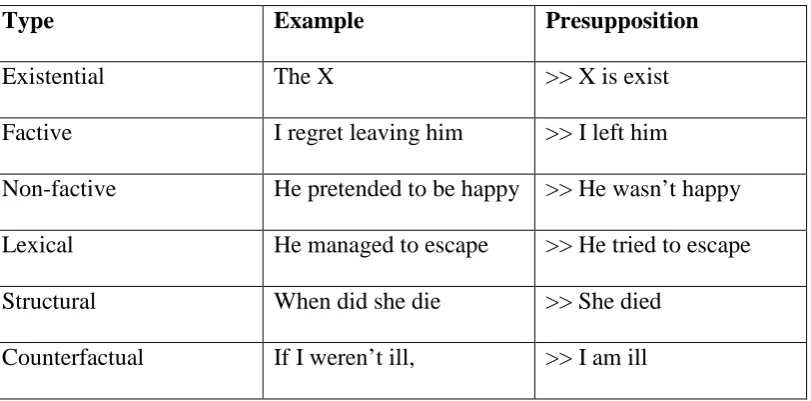
Indicators of potential presuppositions discussed so far are summarized in Table 2.1.
Type Example Presupposition
Existential The X >> X is exist
Factive I regret leaving him >> I left him
Non-factive He pretended to be happy >> He wasn’t happy Lexical He managed to escape >> He tried to escape Structural When did she die >> She died
2.3 Advertisements
2.3.1 The Understanding of Advertisements
The term advertising is closely related to marketing strategy. In marketing strategy, advertising can be included into the promotional part. Advertising costs much money for paying the media, which is selected. So, every company must be able to choose the right media to advertise their product.
It is better for us to know the definition of advertising for further understanding. There are so many definitions about advertising, but the writer chooses the simple meaning of advertising which can be understood easily.
Burke (1980: 6) states that advertising is a sales message, which is directed on mass audience that views through persuasion language to sell goods, services, or ideas on behalf of the paying sponsor.
After knowing the definition, the useful components of advertisements will be described below.
2.3.2 The Type of Advertisements
Jefkins (1997: 39) divides type of advertisements into seven types: 2.3.2.1 Consumer Advertisements
There are 3 types of goods in consumer advertisements, they are:
1. Consumer good is the goods which are sold repeatedly and people daily necessity. Such as food and beverage, shampoo, cigarette, etc.
3. Consumer Services is services for security, prosperity and entertainment. Such as bank, hotel, restaurant, travel, insurance, machine shop, healthy treatment.
2.3.2.2Business – to – business Advertisements
The function of business-to-business advertisements is to promote the goods and non-consumer service. It means that either advertiser or its target is called company. The advertised product are those which are to be processed or are the elements of production such as advertising of raw materials, components, spare parts and accessories, manufacture facilities and machines, and services like insurances, stationary and soon.
Every company generally needs supply from other company. Because the most made products are produced from raw materials, components or spare part which are taken from other company.
2.3.2.3Trade Advertisements
Trade advertisement is addressed to distributors, big companies, agents and exporters / importers. This advertisement advertises products to be resold.
The function of trade press is to give information to the traders or wealthy people about products which are available to be resold by introducing new products or by reminding old products along with any sales or promotions.
2.3.2.4Retail Advertisements
This advertisement has different character between trade advertisements and consumer advertisements. The example of this advertisement is an advertisement which is made by supermarket or big shops. This advertisement is located in all shopping center. There are 3 objectives of this advertisements, they are:
1. To make the company becomes popular 2. To sell the exclusive goods for certain shop 3. To sell shop’s stocks
2.3.2.5 Cooperative Advertisements
This cooperative advertisement is special for retail advertisements. Besides that, there is another type of cooperate advertisements, it is to join promotion.
2.3.2.6 Financial Advertisements
Generally, bank advertisements, insurance advertisements are financial advertisements. The function of financial advertisements is to collect donation or to offer financial capital. Such as insurance, stock selling, debenture, and pension donation.
Newspaper, especially business newspaper is usually used by financial advertisements. It usually uses big area in a page because financial advertisements shows full information about all of company plan to influence and made investor join them.
2.3.2.7Recruitment Advertisements
2.3.3 The Media of Advertisements
According to Craven (1987: 36), the media of advertisements is divided into two: print media and broadcast media. Further, print media consist of newspaper, magazine, direct mail, outdoor advertisements and transit advertisements. Besides, broadcast media consist of television and radio.
2.3.3.1 Printed Media
a. Newspaper
Newspaper is a regularly schedules publication containing news, information, and advertising, usually printed on relatively inexpensive, low-grade paper such as newsprint.
b. Magazine
Magazine is a publication, generally published on a regular schedule, containing of a variety of articles. They are generally financed by advertising, by a purchase price, by pre-paid magazine subscriptions, or all three. In magazine advertisement, the advertisers usually use slogan and pictures in their advertisement. The definition of slogan is a memorable motto or phrase used in a political, commercial, religious and other context as a repetitive expression of an idea or purpose. While advertising slogans are short, often memorable phrases used in advertising campaigns. They are claimed to be the most effective means of drawing attention to one or more aspects of a product
c. Direct Mail
d. Outdoor Advertisements
Outdoor advertisement is essentially any type of advertising that reaches the consumer while he or she is outside the home. This is in contrast with broadcast, print and internet advertising.
e. Transit Advertisements
It is the standardize medium of another from of sign advertisements, which uses public transportation facilities.
2.3.3.2 Broadcast Media
a. Television
Television is one of the broadcast media, which is the most versatile and powerful. It is certainly the most expensive of the media.
b. Radio
CHAPTER III
METHODOLOGY
3.1 Data Collecting Method
For this research, the writer takes the data from Newsweek magazine edition August, September and October 2010. The data are collected by extracting 15 advertisements from this magazine.
3.2 Data Analyzing Method
After collecting some advertisements, the writer analyzes the data by using descriptive qualitative method. The data are analyzed based on the theory of type of presuppositions by Yule (1994).Nawawi (1995: 97) states, “Data kualitatifbanyakdigunakandalampenelitianfilosofisdansebagianjugaterdapatdalampenelit iandeskriptifdanpenelitianhistoris (qualitative data are often used in philosophical research and some descriptive and historical research)”.
These are the steps in analyzing the data:
1. The advertisements are scanned out from magazine as the original source 2. Making the presuppositions of the advertisement
3. Describing the presupposition of utterance in the advertisement
CHAPTER IV
FINDINGS AND ANALYSIS
4.1 Data Findings
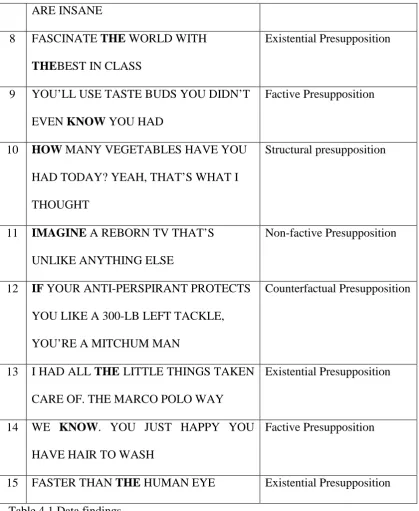
From the analysis of the data, it is found 15 advertisement slogans; there are 7 existential presuppositions or 46.6% of the findings, 2 factive presupposition or 13.33% of the findings, 1 lexical presupposition or 6.6% of the findings, 2 structural presuppositions or 13.3% of the findings, 1 non-factive presupposition or 6.6% of the findings, and 2 counterfactual presuppositions or 13.3% of the findings. The data can be seen in the table below.
No Slogan in Advertisements Type of Presupposition 1 NATURAL BEAUTY. OUR NEW SF 410
3 NO MORE LOOKIN’ DOWN Lexical Presupposition 4 EVERYONE ELSE BROUGHT WINE.
PERFECT
Structural presupposition
5 A TIMEPIECE WHICH EQUATES PERFECTION
Existential Presupposition
6 DO WHAT’S RIGHT FOR YOUR MOUTH Existential Presupposition 7 IF YOU THINK OLD SPICE ISN’T
GREAT-SMELLING, OR THAT THIS IMAGE ISN’T AVAILABLE FOR
DOWNLOAD AT OLDSPICE.COM, YOU
ARE INSANE
8 FASCINATE THE WORLD WITH THEBEST IN CLASS
Existential Presupposition
9 YOU’LL USE TASTE BUDS YOU DIDN’T EVEN KNOW YOU HAD
Factive Presupposition
10 HOW MANY VEGETABLES HAVE YOU HAD TODAY? YEAH, THAT’S WHAT I THOUGHT
Structural presupposition
11 IMAGINE A REBORN TV THAT’S UNLIKE ANYTHING ELSE
Non-factive Presupposition
12 IF YOUR ANTI-PERSPIRANT PROTECTS YOU LIKE A 300-LB LEFT TACKLE, YOU’RE A MITCHUM MAN
Counterfactual Presupposition
13 I HAD ALL THE LITTLE THINGS TAKEN CARE OF. THE MARCO POLO WAY
Existential Presupposition
14 WE KNOW. YOU JUST HAPPY YOU HAVE HAIR TO WASH
Factive Presupposition
4.2 Analysis
Datum 01
NATURAL BEAUTY.OUR NEW SF 410 NOTEBOOK. >> The existence of the old SF 310 notebook
>>The existence of the new SF410 notebook
This advertisement is categorized in existential presupposition. The first presupposition of slogan in this advertisement is the existence of the old SF 310 notebook, because the word new indicates the existence of something old (the previous product), and it is the SF 310 notebook with its slogan “our beautiful new shape”.
The second presupposition of the slogan in this advertisement is the existence of the new SF 410 notebook, the word our becomes the trigger of existential presupposition, because our new SF 410 notebook is a noun phrase, a notebook that possessed by the pronoun our namely Samsung with its slogan “natural beauty”.
Datum 02
WHAT WILL BE IN YOUR‘JEMME’ BOX FOR VALENTINES? >> There exists a product of Jemme in Jemme box
>> There exists a product other than Jemme in Jemme box
The first presupposition of this advertisement is categorized in the existential of a product of Jemme in Jemme box, because when someone brings a Jemme box, we can suppose that the content of the box is a product of Jemme itself.
Datum 03
NO MORE LOOKIN’ DOWN
>> Used to look down
The type of this presupposition is categorized in lexical presupposition. The word No Morebecomes the trigger of lexical presupposition, because in the slogan of this advertisement, the readers are directed to think that the user of computers used to look down the monitor, but by using this monitor namely Benq BL Series, the users will not look down anymore, for even the tall people.
Datum 04
EVERYONE ELSE BROUGHT WINE. PERFECT >> Everyone brought wine and it is perfect
The type of this presupposition is categorized in structural presupposition, because the structure of this slogan (using simple past tense) is already assumed to be true. When reading this slogan, the readers are directed to think that this is a perfect wine, because everyone else has brought it.
Datum 05
A TIMEPIECE WHICH EQUATES PERFECTION
>> The existence of a perfect timepiece
Datum 06
DO WHAT’S RIGHT FOR YOUR MOUTH >> The existence of someone’s mouth
The type of this presupposition is categorized in existential presupposition. The use of your becomes the trigger of existential presupposition. Your mouth is a noun phrase, a mouth that’s possessed by pronoun your, that’s why this advertisement is categorized in existential presupposition. This advertisement is presupposed as a tooth paste namely Colgate Total which does something right for your mouth in order to make your teeth looked whiter and your breath felt fresher.
Datum 07
IF YOU THINK OLD SPICE ISN’T GREAT-SMELLING, OR THAT THIS IMAGE
ISN’T AVAILABLE FOR DOWNLOAD AT OLDSPICE.COM, YOU ARE INSANE >> The old spice is great-smelling and this image is available for download at
oldspice.com
Datum 08
FASCINATE THE WORLD WITH THE BEST IN CLASS >> The existence of a camera that fascinates the world
The type of this presupposition is categorized in existential presupposition, because the definite article thein the best becomes the trigger of the existence of a camera, a camera that the best in class. The best in class means that the best camera among other cameras.
Datum 09
YOU’LL USE TASTE BUDS YOU DIDN’T EVEN KNOW YOU HAD >> You didn’t know you had the kind of taste buds
Datum 10
HOW MANY VEGETABLES HAVE YOU HAD TODAY? YEAH, THAT’S WHAT
I THOUGHT
>> Someone have had vegetables today
The type of this presupposition is categorized in structural presupposition, because the use of WH question in this presupposition becomes the trigger of structural presupposition. Then, from the structure of the slogan, it can be presupposed that it is already assumed to be true (the number of vegetables that have been had by someone). In the heading sentence of this advertisement, it presupposes that by drinking this beverage, the consumer will get the same benefit with having vegetables.
Datum 11
IMAGINE A REBORN TV THAT’S UNLIKE ANYTHING ELSE
>> A reborn-TV that’s like anything else
Datum 12
IF YOUR ANTI-PERSPIRANT PROTECTS YOU LIKE A 300-LB LEFT TACKLE,
YOU’RE A MITCHUM MAN
>>Mitchum protects you like a 300-LB left tackle
The type of this presupposition is categorized in counterfactual presupposition, because the use of ifbecomes the trigger of counterfactual presupposition. In the heading sentence, the readers are directed to think about an anti-perspirant that protects you like a 300-LB left tackle namely Mitchum. A 300-LB left tackle is the defensive team in American football, it means that even you are a left tackle, this anti-perspirant still protects you from body odor. In other word we can say “you are mitchum man if your anti-perspirant protects you like a 300-LB left tackle”.
Datum 13
I HAD ALL THE LITTLE THINGS TAKEN CARE OF. THE MARCO POLO WAY >> The existence of all little things taken care by Marco Polo
Datum 14
WE KNOW. YOU JUST HAPPY YOU HAVE HAIR TO WASH. >> You are happy you have hair to wash
The type of this presupposition is categorized in factive presupposition, because the word know presupposes that it is a fact. From the word know, the reader will assume that this product’s maker really know how to build the hair volume. This assumption will direct the readers to buy this product because of the belief in this product.
Datum 15
FASTER THAN THE HUMAN EYE
>> The existence of human eye that slower than this camera
CHAPTER V
CONCLUSIONS AND SUGGESTIONS
5.1 Conclusions
Having analyzed the data of this analysis,it is concluded that all types of presuppositions proposed by Yule are found in the Newsweek magazine slogan. It is also concluded that all utterances or sentences have presuppositions as the hidden meaning of what they (speakers or writer) means.
From the analysis of the data, it is found 15 presuppositions. There are 7 existential presuppositions or 46.6%, 2factive presupposition or 13.33%, 1 lexical presupposition or 6.6%,2 structural presuppositions or 13.3%, 1 non-factive presupposition or 6.6%,and2 counterfactual presuppositions or 13.33%.
5.2 Suggestions
BIBLIOGRAPHY
Burke, J.D. 1980. Advertising in The Market Place: Second Edition, New York: McGraw – Hill, Inc.
Cummings, Louise. Pragmatik: SebuahPerspektifMultidisipliner. Yogyakarta: PustakaPelajar.
Fryburger, Vernon. 1989. Advertising Theoryand Practice. Illinois: Richar. D. Irwin, INC
Hornby, A.S. 1995. Oxford Advanced Learner’s Dictionary of Current English. Fifth edition New York: Oxford University Press.
Leech, G. 1983. The Principles of Pragmatics. Trans. M.D.D.Oka. Jakarta: UI Press. Levinson, S.C. 1983. Pragmatics. London: Cambridge University Press.
Panggabean, Erwin R.M. 2006. Presuppositions in Speech by The President ofrepublic
Indonesia, Megawati SoekarnoPutri at AFTA Symposium, Jakarta 31January
2002 (Unpublished Thesis). Medan: UniversitasNegeri Medan.
Peccei, Jean Stilwell. 1999. Pragmatics, English Edition. Beijing: Taylor & Francis Ltd. Hidayati, Sri. 2009. Presupposition of Selected Slogans in Outdoor Advertisements
APPENDIX
These are the advertisements that were scanned out from Newsweek magazine as the original source edition August, September and October 2010.
Datum 01
Datum 02
Datum 03
Datum 04
Datum 05
Datum 06
Datum 08
Datum 09
Datum 10
Datum 12
Datum 13
Datum 14
Datum 15