PRESUPPOSITION
ON TV SERIES “GAME OF THRONES” SEASON 1
A THESIS
In Partial Fulfillment of the Requirements
for S-1 Degree Majoring Linguistics in English Department Faculty of Humanities Diponegoro University
Submitted by : PUTRI RAMADHAN NIM : 13020113190071
FACULTY OF HUMANITIES DIPONEGORO UNIVERSITY
PRONOUNCEMENT
I honestly confirms that the thesis entitled “Presupposition on TV Series
Game of Thrones Season 1” has been compiled by myself and without taking
any results from other researchers in S-1, S-2, S-3 and in diploma degree of
any university. I also ascertain that I do not quote any material from other
publications or someone’s paper except from the references mentioned.
Semarang, July 2017
MOTTO AND DEDICATION
“Do it for yourself, but once in a while think back to everyone who said you
would never be anything. Do it for them too.”
- The Better Man Project
I sincerely dedicated this thesis to my Mom and Dad who always love and
ACKNOWLEDGEMENT
Praise to God Almighty, who has given strength and the real spirit so that this
thesis entitled Presuppositions on TV Series “Games of Thrones” Season 1 came
into a completion.
The deepest gratitude and appreciation are proudly presented to Ayu Ida
Savitri, S.S, M.Hum – my humble thesis advisor – who has given her continuous
guidance, helpful corrections, advices, and suggestions. I would also love to give
my deepest thank to these following people.
1. Dr. Redyanto Noor, M. Hum., as the Dean of Faculty of Humanities,
Diponegoro University.
2. Dr. Agus Subiyanto, M. A., as the Chairman of English Department Faculty of
Humanities, Diponegoro University.
3. Ariya Jati, S.S., M.A as my academic advisor in English Department, Faculty
of Humanities, Diponegoro University.
4. All of the great lecturers in English Department, especially in Linguistics
section Faculty of Humanities, Diponegoro University who have shared their
5. My beloved family who have given their infinite love, prayers, and supports
for me.
6. My lovely friends, Megalistha Pratiwi, Monica Nuritasari, Haninta Murti,
Pradistya Hayu, Chita Murlia, Trie Wulandari, Ardha Fadhilla, Bela Pintari,
Bella Saufika Putri, Rizky Hardianti and Rina Handaruni, who always be there
for me when time gets rough.
7. All of my friends from English Department batch 2013, UKM Peduli Sosial
Undip, and Roetasi FIB Undip. Thank you for the memories, I am so glad I
could know you all.
I realize that the thesis is not perfect yet, therefore I will be glad to receive any
constructive criticism and recommendation to make it better. Last but not least, I
put big expectation that the thesis can be useful to everyone who reads it.
Semarang, July 2017
TABLE OF CONTENTS
Pages
TITLE... i
PRONOUNCEMENT... ii
MOTTO AND DEDICATION... iii
APPROVAL... iv
VALIDATION... v
ACKNOWLEDGEMENT... vi
TABLE OF CONTENTS... viii
ABSTRACT... xi
CHAPTER I (INTRODUCTION)... 1
1.1 Background of the Study ... 1
1.2 Research Questions………. 3
1.3 Objectives of the Study... 3
1.4 Previous Studies... 4
1.5 Scope of the Study ... 5
1.7 Writing Organization ... 6
CHAPTER II (UNDERLYING THEORY)... 8
2.1 Definition of Presupposition ... 8
2.2 Entailment ... 9
2.3 Implicature ... 11
2.4 Features of Presupposition ... 13
2.5 Kinds of Presupposition ... 14
CHAPTER III (RESEARCH METHOD)... 23
3.1 Type of Research... 23
3.2 Data, Population, and Sampling Technique ... 23
3.3 Method of Collecting Data ... 24
3.4 Method of Analyzing Data ... 25
CHAPTER IV (DISCUSSION)... 27
4.1 Existential Presupposition ... 27
4.2 Factive Presupposition ... 33
4.3 Non-Factive Presupposition ... 38
4.4 Lexical Presupposition ... 41
4.6 Counter-factual Presupposition ... 59
CHAPTER V (CONCLUSION)... 64
REFERENCES... 57
APPENDIX... 69
Table of Existential Presupposition... 69
Table of Factive Presupposition ... 72
Table of Non-Factive Presupposition... 82
Table of Lexical Presupposition... 83
Table of Structural Presupposition ... 85
ABSTRACT
Game of Thrones is a science fiction TV series which tells the viewers about a dynastic civil war for control two continents among several competing families. In the TV series, an effective communication plays an important role in order to win the war. Therefore, a presupposition is often used in the conversation between characters. This study aims to identify what kinds of presupposition triggers occurred in the TV series season 1 and to reveal the intentions of each presupposition conveyed by the characters. Non-participant observation is applied to collect the data and identity method is applied to analyze the data. The result shows that presupposition triggers such as existential presupposition, factive presupposition, non-factive presupposition, lexical presupposition, structural presupposition, and counter-factual presupposition occur in the data and each of presupposition really shows different intentions.
CHAPTER I
INTRODUCTION
This study is presented in five chapters; introduction, underlying theory,
research method, discussion, and conclusion. This chapter presents some
explanations about the background of the study, the research questions, the objectives
of the study, the scope of the study, the previous studies whose topics are similar
with the study, the significance, and the writing organization.
1.1 Background of the Study
Many people spend their spare time by watching television and one of the
most favorite TV programs is TV series. The example of those favorite TV Series is
“Game of Thrones” which was firstly premiered on HBO in the USA in April 17th,
2011. The TV Series that was adapted from book series “A Song of Ice and Fire”
written by George R.R Martin, has become both “The Biggest Drama” and “The
Most Talked about Show” (The Guardian, 2014). It also made history as the
first-ever science fiction/fantasy show to win the Emmy Award for Outstanding Drama
Game of Thrones tells the viewers about a fictional world with two continents,
Westeros and Essos.It is a story of a dynastic civil war for control of Westeros among several competing families. Because ruling and maintaining the kingdom has been always done in politic ways, every speaker has his/her own communication
strategies to achieve their goals. In this case, an effective communication plays an
important role. Sometimes, the speakers do not always deliver their messages in
directive ways. They use softer ways to convey their intended meaning by letting the
hearers construct and assume what the speakers truly mean via utterances. This case
is known as presupposition.
As argued by Yule (1996), Pragmatics is a study of how we recognize what is
meant through what was said or written. Thus, presuppositions are also beneficial in
communication. The speakers do not have to say something in detail to explain or
refer to what they intend to say to make the communication efficient. However, both
speakers should have shared-knowledge to make presupposition works. If both
speakers do not have the same thought, they will misunderstand each other’s
messages. Presuppositions also make conversations becomes intelligent because both
speakers won’t say anything in full explanation as they both will cover their
intentions through assumptions so the conversation will not be such boring.
From the explanation above, the writer is interested in analyzing
presupposition on the dialogue of the characters of TV Series “Game of Thrones”
writer is examining the utterances of speakers that consist of presupposition by
identifying the triggers using presupposition theory argued by George Yule (1996).
1.2 Research Questions
The research questions of this study are;
1. what kinds of presupposition are conveyed by the speakers in “Game of Thrones”
Season 1 TV Series?; and
2. what are exactly the speakers’ intentions by conveying presuppositions in “Game
of Thrones” Season 1 TV Series?
1.3 Objectives of the Study
The objectives of this study are as follows.
1. To identify kinds of presupposition conveyed by the speakers in “Game of
Thrones” Season 1 TV Series.
2. To elaborate the intentions of each presupposition conveyed by the speakers of
1.4 Previous Studies
The writer had found five studies that were similar to the topic. These studies
came from 2008 to 2015. The first study is Rachma Yulistina’s thesis (2008) which
explained the pragmatics presuppositions on drama script The Wild Duck by Henrik
Ibsen. From 629 utterances containing, she concluded that presupposition and
background knowledge took a crucial part within interaction.
The second study is Ria Apriliana’s thesis (2008) which discussed the
presupposition in Desperate Housewives TV series by grouping the presupposition
triggers after checking the presupposition result. She discovered that there were some
presupposition triggers that could not be found in references, such as ‘to mention’,
‘figure’, and ‘remember’.
The third study is Ratih Kusumaningsari’s thesis (2010) which exposed
pragmatics presupposition on Santiago’s utterances in The Alchemist novel by Paulho
Coelho. From 96 of Santiago’s utterances containing presuppositions, she figured out
that shared knowledge played an important part and it was the prior case why the
character delivered his utterance implicitly.
The fourth study is Afrin Rubiyanti’s thesis (2013) which described
presupposition in interrogative headlines on ALLKPOP news and gossip site by
questions. She found out that interrogative is aimed at increasing the readers’ interest
to read the news, so that it can improve the popularity of the website.
The last study is Winda Astuti’s thesis (2015) which showed the narrator’s
utterances containing presuppositions on TV Program Silet Infotainment. She found
some functions on the narrator’s presuppositions, such as supporting narrator’s
position, leading the viewer’s assumption, and raising the viewer’s belief. She is then
classified the presupposition triggers found in narrator’s utterances into three parts;
single trigger, double trigger, and multi-trigger.
Those previous studies were conducted by using either Yule or Levinson’s theory
of presupposition and all the data were coming from texts. The difference of those
previous studies with this study is that the data of this study were taken from the
utterances spoken by the speakers of a science fiction/fantasy TV show and it were
analyzed by theory of presupposition defined by Yule (1996). The writer also
identifies the intentions of each presuppositions conveyed by the speakers.
1.5 Scope of the Study
In this study, the writer focuses on Pragmatics analysis on presupposition in
the utterances of the speakers of “Game of Thrones” Season 1 TV Series which
consists of ten episodes. The writer identifies the data that are indicated as kinds of
presuppositions, so that the writer also checks the presupposition triggers of each
utterances before analyzing the presupposition conveyed.
1.6 Significance
The study contributes to the variation of pragmatics presupposition since the
data are derived from utterances spoken by the speakers on TV Series “Game of
Thrones” Season 1. The study consists of analysis of speakers’ utterances which are
indicated as presupposition. Besides, it contains discussion about the intentions of
each presuppositions conveyed by the speakers. All the data were analyzed using
theory of presupposition defined by Yule (1996).
1.7 Writing Organization
To finish the study, the writer has created an outline writing which was
divided into five chapters.
CHAPTER I INTRODUCTION
This chapter contains the background of the study, the research
questions, the objectives of the study, the previous studies, the scope
CHAPTER II UNDERLYING THEORY
In this chapter, the writer explains theory of presupposition argued by
Yule (1996) to support the study. It gives a brief explanation about
pragmatics, presupposition, and kinds of presupposition.
CHAPTER III RESEARCH METHOD
This chapter discusses the research method of the study. It consists of
type of the research, data, population, and sampling technique,
method of collecting data, and method of analyzing data.
CHAPTER IV DISCUSSION
The writer does the data analysis in this chapter. It defines the kinds
of presupposition of the data and examines each of the intentions.
CHAPTER V CONCLUSION
This chapter is the final chapter of the study which contains the
CHAPTER II
UNDERLYING THEORY
This chapter contains theory which supports the data analysis. Below are
some explanations about Pragmatics, Presupposition, Entailment, Implicature,
Features of Presupposition, and Kinds of Presupposition.
2.1 Definition of Presupposition
Generally, Pragmatics is a branch of Linguistics that studies about meaning in
language through what is said or written (Yule, 1996). According to Levinson
(1985:21), Pragmatics is a study of language that tries to find the connection between
the language used and the context in where the language is used. In other words, it
discusses the implicit meaning on how language is used based on the context.
One of the topics in Pragmatics is presupposition. It is a term that defines an
implicit assumption of what was said by the speaker in conversation. Stalnaker
(1998) clarified that presupposition is propositions which can have truth or false
value that becomes a background beliefs of a speaker and they are commonly being
unsaid in a conversation. It can be said that there is a difference between
uttered. If the propositions of presupposition is true, then the assertion can have the
truth value and if the propositions of the presupposition is false, then the assertion
have the lack of truth value. According to Yule (1996:25), a presupposition is
something unsaid that becomes the assumption of a speaker when producing
utterances.
When a speaker has a ‘presupposition’ on a listener, the speaker has thought
that the listener will know what the speaker is trying to ‘address’. He/she wants to
make the listener conveys their utterances. In this case, a shared knowledge plays an
important part. The speaker and the listener should have the shared knowledge to
make sure that the “assumption” assumed by the speaker is taken in a right way by
the listener as it is supported by Stalnaker (1973) that presupposition should be
something like a background beliefs of the speaker and listener. Presupposition is
also beneficial in making communication becomes efficient, because the speaker
does not have to utter the detail information to the listener.
2.2 Entailment
It needs to be noted that presupposition is different from entailment and
implicature even though they have similar focus which is implicit meaning.
According to Yule (1996:25) entailment is a logical inference made by listeners from
while listeners have inferences. There are two types of entailment. The first is
background entailment which has large number of inferences consisting truth value
from what is uttered. It can be seen that the entailments of sentence (1) are presented
in (2) in the example below.
(1) Rover chased three squirrels.
(2) a. Something chased three squirrels.
b. Rover did something to three squirrels.
c. Rover chased three of something.
d. Something happened.
When someone utter the sentence (1), the listener may have logical inferences as it is
written in (2a) to (2d), therefore the speaker needs to be more focused on what they
want to deliver to the listener so the listener can correctly infer what is exactly being
communicated. The way to reach the point is by using stress which entailment is
assumed to be the prominence. It is the second type of entailment called as
foreground entailment. The example of it is down below (still use the sentence (1) as
the utterance).
(3) a. Rover chased THREE squirrels.
b. ROVER chased three squirrels.
From the example, the main assumption of the speaker can be clearly interpreted by
the listener because there is a stress used. The focus of (3a) lies in the quantity of
Whereas, the focus of (3b) comes to the actor that has done something named Rover
and the main assumption is that something chased three squirrels.
2.3 Implicature
In a conversation, speakers do not always utter what they really mean in the
surface and listeners do not always give the responds as they should be ordered.
Sometimes, the listeners respond to the utterance of the speakers using sentences that
also need to be interpreted by the speakers in order to receive the meaning of the
listeners’ responds. This case is known as implicature. According to Yule (1996:35),
implicature is an additional conveyed meaning. It underlines that words are not just
words but something implicitly communicated. To make the implicature works for
both speakers and listeners, there is a need of cooperation in conversation between
speakers and listeners. It can be conclude that understanding an implicature is always
related to speakers and listeners cooperating with each other in a certain context.
There are some types of implicature such as generalized conversational
implicature and particularized conversational implicature. Generalized conversational
implicature is when there is no specific knowledge required in the context to figure
out the additional conveyed meaning (Yule, 1996:40-41).
(4) Doobie : Did you invite Bella and Cathy?
From the conversation (4), it is seen that Mary gives respond to Doobie’s question by
using an implicature. Doobie asked whether Mary had invited Bella and Cathy and
Mary answered her by uttering the sentence “I invited Bella.” Mary’s utterance can
be implied that she did not invite Cathy as Doobie’s requested, she only invited Bella,
not Cathy. Because Mary does not mention the name of Cathy, Doobie must interpret
that Mary only invited Bella.
Another type of implicature is particularized conversational implicature. It
differs from the previous type of implicature that there is no specific knowledge
required to calculate the additional conveyed meaning. In particularized
conversational implicature, a specific context plays important role as it is followed by
local recognized inferences assumed. These inferences are needed to work out with
the additional conveyed meaning.
(5) Leila : Whoa! Has your Boss gone crazy?
Mary : Let’s go get some coffee.
In conversation (5) Leila just walks into Mary’s room and notices all the work Mary
has to do in her desk. Leila comments on that case by uttering a question. Mary then
responds to her without saying “yes, he has” or “no, he has not” as it is should be.
She responds to Leila by uttering a sentence which needs to be interpreted by Leila in
that time. However, Leila will infer that there is a local reason why Mary gives her
respond like that. Leila will consider if there is a Mary’s Boss around them so Mary
2.4 Features of Presupposition
Presupposition has some features. The first feature is that presupposition uses
symbol to portray the analysis of it. Symbol of “>>” refers to “presuppose” to show
the analysis of presupposition in the text as it is stated by Yule (1996: 26) and
Levinson (1983:181). It can be explained through the example below:
(6) Monica’s hat is unique.
>> Monica has a hat.
Based on the example, the presupposition of text (6) is that “Monica has a hat”.
The second feature of presupposition is that it has a term known as constancy
under negation which is defined by Yule (1996: 26). It means that the presupposition
result is not influenced by a negative statement, such as:
(6a) Monica’s hat is not unique.
(6b) >> Monica has a hat.
The presupposition of the text (6b) remains the same that “Monica has a hat.” even
though the text (6a) is added by a negative word. It can be seen that putting negation
does not influence the presupposition and it can make the presupposition survives as
whether a statement contains presupposition or not except for presupposition triggers
of question (Levinson, 1983: 184).
Based on Levinson (1983), negation cannot be applied in presupposition
triggers of question because they have different form. Others are declarative forms
while presupposition triggers of question are interrogative forms. He divided the
presupposition triggers into three parts; -wh question, yes/no question, and
alternative question. Each of them has different role such as; -wh question functions
to gain the missing information, yes/no question functions to gain a possibility of a
case which is not yet known to be true, and alternative question functions to gain the
truth from choices offered.
2.5 Kinds of Presupposition
The presence of presupposition can be detected by some items that come
within the text which is called as potential presupposition. It consists of linguistic
forms that may trigger a presupposition. To make it simple, it can be said that a
potential presupposition is a foundation of a presupposition. Whether a
presupposition is right or wrong, every trigger words will trigger a potential
presupposition. Based on the combination of Karttunen (Karttunen in Levinson,
1983: 181-184) and Yule (1996), there are three main parts of types of
presupposition (implicative verbs, factive items, change of state verbs, verbs of
judging, counter-factual verbs, conventional items, iteratives), and structural
presupposition (cleft constructions, wh-questions, adverbial clause, comparative
constructions, counter-factual conditionals, non-restrictive clauses).
2.5.1 Existential Presupposition
a. Definite Descriptions
Existential presupposition is assumed to commit the existence of something.
It is usually comes within definite noun phrases or any possessive
constructions in English, such as:
(7) John buys the Pink Floyd tees.
>> The Pink Floyd tees exist.
2.5.2 Lexical Presupposition
b. Implicative Verbs
Implicative verbs are verbs which have unasserted meaning that normally
interpreted by the listener such as the verb “manage”. The verb “manage”
has unasserted meaning “try”. If someone manages something, it must be he
or she has already tried to do it.
(8) John manages to open the can.
c. Factive Verbs
Factive verbs are classifications of verbs which have complement clause after
the verb and it is assumed there is a fact within the clause. The factive verbs
are such as “realize”, “make sense”, “know”, “regret”.
(9) John knows the girl is sick.
>> The girl is sick.
d. Change of State Verbs
Change of state verbs are also known as “aspectual verbs”. As stated by
Saeed (1997), it has a switch assumption of a case which the new state is
described within the verbs. The examples of the verbs are such as “continue”,
“begin”, “finish”,” take”, “leave”, “come”, “stop”, and “go”.
(10) John begins to smoke.
>> John has not smoked.
e. Verbs of Judging
According to Levinson (1983:182), verbs of judging are difference from other
presuppositions because the implications constructed by the listener are not
related to the speaker.
(11) John accused Martha of plagiarism.
f. Counter-factual Verbs
This type of presupposition carries a falsity of a case within the complement
clause after the verb. The examples of the verbs are “pretend” and “imagine”.
(12) John pretends that he was the King of Essos.
>> He is not the King of Essos.
g. Conventional Items
Levinson (1983:206) argued that there is conventional meaning in
presupposition of sentences which are related to lexical items. Besides, not
only related to lexical items, but also nouns that can have conventional
meaning expressed through the sentences such as;
(13) John is a bachelor.
>> John is unmarried.
(14) John’s room has been cleaned.
>> John’s room was dirty.
h. Iteratives
Iterative is a term that refers to a case which has repetition. Levinson
(1983:182) gives some examples of iterative categories such as the words
“again”, “another”, “anymore”, and “another time”.
(15) John eats another pie.
2.5.3 Structral Presupposition
a. Cleft Constructions
Cleft is a construction in which some elements are transferred from its normal
place into a detached clause. It functions to give an emphasis of a sentence.
There are two types of cleft in English such as it-clefts and wh-clefts. Both
clefts share the same presupposition as argued by Levinson (1983).
(16) It was him that made the cake.
>> Someone made the cake.
(17) What she really needs is money.
>> She needs something.
b. Questions
Questions structure is a type of presuppositions which deliver the case after
the question tag itself. Therefore, the information after the question tag is
already known to be the truth.
(18) Who does eat the pizza?
>> Someone eats the pizza.
c. Adverbial Clauses
This type uses adverbial as the main clause and it can be in the initial or in the
final position. The clause triggers the presuppositions, therefore it can be said
that sentence presupposes another sentence.
>> He lived in London.
d. Counter-factual Conditionals
This type of presupposition shows not only the falsity but also the contrary of
a case that becomes the presupposition. The information after the word “if”
states the untrue of a case.
(20) If I were rich, I would travel around the world.
>> I am not rich.
e. Non-restrictive Clauses
Levinson (1983) argued that non-restrictive clauses can trigger presupposition.
In case of non-restrictive clause, the clause is not influenced by the negation
so the clause can survive from the negation.
(21) John’s brother, who finished his study in Milan, came to visit his
family after two years.
>> John’s brother finished his study in Milan.
Yule (1996: 27) simplified his own views in presupposition. He classified the
presupposition triggers into six types. They are:
a. Existential Presupposition
It can be identified by the possessive forms or any definite phrases that attach
to the sentence. It functions to lead the speaker to acknowledge that
(22) The President of USA
b. Factive Presupposition
It usually appears with the “classification of verbs” that can be regarded as a
fact. The examples of the verbs are know, realize, regret, agree, see, amuse,
and make sense and it is added the adjective and noun constructions, such as
be and aware.
(23) Paul knows that she is sick.
>> The girl is sick.
c. Non-factive Presupposition
It can be considered as the falsity of something. The expressions that describe
non-factive presupposition are dream, imagine, and pretend.
(24) She dreamt she was the queen of Essos.
>> She was not the queen.
d. Lexical Presupposition
It is a term that defines the implicit meaning of a form that is not inserted but
need to be conceived. The addressee will interpret ordinarily of what the
speaker says. For example, when the speaker says ‘I stop running’, the word
stop here can be meant that the speaker used to run, but now he does not. In
this case, the expression is used by the speaker to assume another un-applied
meaning. Other expressions of the type are such as again, before, and when.
>> He does not learn English before.
e. Structural Presupposition
In structural presupposition, the sentence structures are always the prior case
to be elaborated. After the sentence structure is analyzed, the speaker delivers
the information and also his/her presupposition ordinarily and lets the
addressee convince the case to be the truth. The structures of this case can be
the –wh questions, passive sentences, and active sentences.
(26) Who have eaten the apple?
>> Someone has eaten the apple.
f. Counterfactual Presupposition
It is a term that describes something that is false and very contrast to the fact
and it is identified as the expression that reflects a counterfactual
presupposition.
(27) If I were Courtney Love, I would not let Kurt Cobain died.
>> I am not Courtney Love.
After explicating the theories that support the data analysis, the writer
believes that pragmatic presupposition’s theory is appropriately used to analyze the
data since they are coming from utterances of the speakers of “Games of Thrones”
Season 1 TV. The writer chooses Yule’s theory instead of Karttunen’s theory
presupposition which the writer thinks it is better and more compendious. Besides,
types of presupposition of Karttunen can be included in Yule’s theory.
. There are six kinds of presupposition argued by Yule (1996) that will be
used to identify each utterance such as, existential presupposition, factive
presupposition, non-factive presupposition, lexical presupposition, structural
presupposition, and counter-factual presupposition. The intentions of each utterance
can be analyzed after the presupposition of each utterance is defined. Each intention
contained in speakers’ utterance is different from another because every kinds of
presupposition have its own purposes.
The result of this study will show what kinds of presupposition that are
mostly used and why the speakers of “Games of Thrones” Season 1 TV Series apply
CHAPTER III
RESEARCH METHOD
This chapter describes how the study is done. It concludes explanations about
type of research, data, population, and sampling technique, method of collecting data,
and method of analyzing data.
3.1 Type of Research
The type of this study is descriptive qualitative research because the writer
found that descriptive qualitative research supports the data analysis by uncovering
the deeper meaning of human experience. The writer focuses on analyzing the
utterances of speakers on TV Series “Game of Thrones” Season 1 by examining their
utterances that are indicated as presupposition. By applying the descriptive
qualitative research, the writer is able to discover the words and meaning of the
utterances.
3.2 Data, Population, and Sampling Technique
The data of this study are the utterances of speakers of TV Series “Game of
derives from the utterances spoken by speakers of “Game of Thrones” Season 1. In
addition, the purposive sampling technique is used because the population is in the
same characteristics (having triggers of presupposition). As a result, the sample of
the study is utterances containing presuppositions.
3.3 Method of Collecting Data
The method of collecting data that is applied in this study is non-participant
observation. The writer uses this method because the writer does not take any part of
the conversation. Additionally, the note taking technique is also used to obtain the
data since the data are coming from videos.
There are some steps that the writer does to collect the data. Firstly, the writer
downloads the TV Series of Game of Thrones Season 1 which consists of ten
episodes from the website www.moviescouch.com. Secondly, the writer does a
non-participant observation by watching the videos from one episode to another episode
in a full attention. While watching the videos, the writer also makes transcriptions to
gain the data. After all the data are taken, the writer will divide the data into two parts.
The first part is the data indicated presuppositions and the second is non-indicated.
Therefore, only the data that are indicated as presuppositions will be the focus of the
3.4 Method of Analyzing Data
In this study, the writer uses pragmatic identity and referential method in
analyzing the data. Based on Sudaryanto (1993), identity method is a one of the types
of analyzing method that employs the outer aspect of language as the determiners.
The determiners include referent of language, speech organ, orthography, another
language, and partner of speech. Considering this study, the writer uses pragmatic
identity method according to the data which are utterances. Pragmatic identity
method is applied to identify the presupposition that occur on the speakers’
utterances based on each context of the conversation. Additionally, referential
method is used to show the presupposition triggers conveyed by the speakers through
the linguistic features or expressions uttered. The following steps are the procedure
done by the writer to analyze the data.
1. The writer downloads the video of Game of Thrones Season 1 (consisting ten
episodes) from the website www.moviescouch.com.
2. The writer watches the video and does transcriptions based on the conversations.
3. The writer reads and tries to understand every utterance that has been transcribed
and starts to identify the utterances that are indicated as presuppositions using
presupposition triggers by George Yule; factive, non-factive, counter-factual,
4. After identifying and grouping all the data based on their types of presuppositions,
the writer analyzes each presupposition and tests the presupposition using the
negation based on Yule (1996).
5. Last but not least, the writer examines each intention of presuppositions conveyed
by the speakers. The writer also put a description of context whenever the
CHAPTER IV
DISCUSSION
This chapter discusses data analysis of utterances containing presuppositions
based on Yule’s Theory (1996) which classifies them into six kinds of Presupposition.
They are Existential Presupposition, Factive Presupposition, Non-Factive
Presupposition, Lexical Presupposition, Structural Presupposition, and
Counter-Factual Presupposition. This chapter also contains brief explanation of intentions that
come within each presupposition.
4. 1 Existential Presupposition
The existential presupposition is something which is assumed to exist and
which commonly appears within possessive constructions and definite noun phrase.
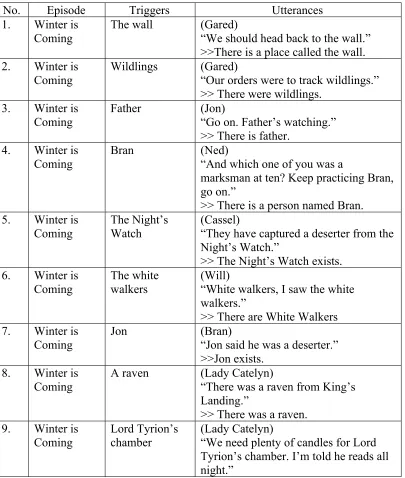
The writer found more than thirty utterances containing existential presupposition but
only used four as the example of data analysis.
There are names and referents that occurred in the data. From the story, it is
known that there exist some clans which are The Starks, The Targaryens, The
Lannisters, The Dothraki, and The Freys, and The Greyjoys. There are also Kings
creature named the White Walkers. There also exist regions in the story such as
Winterfell, Kings Landing, Riverland, Casterly Rock, the Wall, the Vale, Dorne,
Volantis, and Kingsroad.
4.1.1 Data 1
Context:
Data 1 came from episode 1 (Winter is Coming). This conversation happened
between Gared, Will, and Royce. They were the rangers of the Night’s Watch (a
community which protect The Wall). They were riding into the wood. Suddenly Will
saw a campsite which was full of mutilated body. Looking so frightened, he ran back
to Gared and Royce to tell what he had found. Gared and Will agreed to head back to
The Wall, except Royce.
Utterance of Gared (28):
(28) Our orders were to track the Wildlings. We tracked them. They won’t trouble us no more.
(28a) Our orders were not to track the Wildlings. We did not track them. They will trouble us no more.
(28b) >> There are the Wildlings.
The utterance (28) above is triggered by a definite noun phrase which is ‘the
Wildlings’. It means that the speaker (Gared) assumes that “the Wildlings” does exist
makes the utterance understandable. The presupposition of the utterance is (28b)
There are the Wildlings. The presupposition stays the same even though the utterance
is added by negation as in (28a).
The intention of the presupposition conveyed by the speaker (Gared) is that he
wants to remind and emphasize his friends (Will and Royce) that there are the
Wildlings and their main orders are only to track them as a ranger of the Night’s
Watch. For the speaker, there is no need to track other tribes, but the Wildlings who
has become real enemies since a long time ago.
4.1.2 Data 2
Contex:
Data 2 came from episode 1 (Winter is Coming). The conversation occurred
in a courtyard of Winterfell Kingdom where a death penalty took place. Ned who
was the King, his sons, and some soldiers were attending the death penalty of a
deserter. The deserter’s name was Will. He was punished because as a ranger of the
Night’s Watch, he had broken his own oath by running away after the White Walkers
killed his friends. He said that he saw White Walkers who have been gone long ago.
He kept saying this utterance as soldiers of Winterfell took him to the block.
The utterance of Will (29):
(29a) White Walkers, I did not see the White Walkers. (29b) >> There were the White Walkers.
The utterance (29) is triggered by the definite noun phrase ‘the White
Walkers’ so it is classified as the existential presupposition. The speaker (Will) has
assumption that the White Walkers does exist and it becomes the shared knowledge
between the speaker and the listener (people who attend the death penalty). The
presupposition of the utterance (29) is (29b) There were the White Walkers. After
putting negation as in (29a), the presupposition remains.
The function of presupposition conveyed by the speaker (Will) is to convince
others that what he saw, the White Walkers, were real. The speaker (Will) also
declares that he was not lying and he can prove his words that he really saw the
White Walkers. It is seen that he emphasizes others to believe in him by using
repetition. It also seems like an announcement to people of Winterfell to keep safe
because the most vicious creature of the North has returned.
4.1.3 Data 3
Context:
Data 3 came from episode 2 (The Kingsroad). The conversation happened
Tyrion. He found Tyrion falling asleep in the dog’s pen of Winterfell. He told his
uncle to ride to King’s Landing on the next day.
The utterance of Tyrion (30):
(30) Before you go, you will call on Lord and Lady Stark and offer your sympathies. (30a) Before you go, you won’t call on Lord and Lady Stark and offer your
sympathies.
(30b) >> There are Lord and Lady of Stark.
The utterance (30) is triggered by a noun phrase ‘Lord and Lady Stark’, so it
determined as existential presupposition. The speaker (Tyrion) has assumed that the
listener (Joffrey) has already known those two people he was referring to. The
presupposition of utterance (30) is (30b) There are Lord and Lady of Stark. The
presupposition of utterance (30) remains the same even though it was added by
negation (30a).
The function of speaker’s (Tyrion) utterance is telling the listener (Joffrey) to
be polite and respectful to the leaders of Winterfell by using their title, Lord and
Lady. Besides, the speaker (Tyrion) reminds the listener (Joffrey) to give sympathies
for the bad accident happened to the King’s son in order to keep the good relation
4.1.4 Data 4
Context:
Data 4 came from episode 4 (Cripples, Bastards, and Broken Things). The
conversation held between Arya and Lord Eddard. Arya was Lord Eddard’s younger
daughter. He met Arya on the way back to his room after attending the Small Council
meeting in King’s Landing. Arya was practicing her sword skill by balancing on one
foot in front of a staircase. Lord Eddard was worry if Arya fell and hurt herself.
The utterance of Arya (31):
(31) Syrio says that every hurt is a lesson and every lesson makes you better.
(31a) Syrio does not say that every hurt is a lesson and every lesson makes you better. (31b) >> There is a person named Syrio.
The utterance (31) is triggered by a noun phrase which is a proper name,
‘Syrio’ so it has one of the characteristics of existential presupposition. The speaker
(Arya) has assumed that the listener (Lord Eddard) knows the person whom she
concerns. The presupposition of the utterance (31) is (31b) There is a person named
Syrio. It is proven because the presupposition does not change even after it is tested
by negation as in (31a).
The use of existential presupposition conveyed by the speaker (Arya) in
sword trainer who comes from Bravos, a country where many professional
swordsmen were born. The speaker (Arya) also gives the listener (Lord Eddard)
additional information that Syrio has taught her not to afraid of hurt and not to stop
learning.
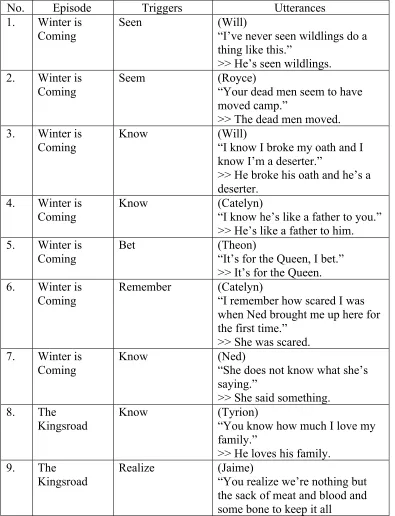
4. 2 Factive Presupposition
Factive presupposition usually appears with certain verbs that are considered
as a fact, such as know, realize, regret, see, amuse, and make sense. The writer found
more than twenty-five utterances containing factive presupposition in the data, but
only four written as data explanation. The factive verbs that the writer had obtained
are such as seen, know, seem, realize, glad, remember, and regret. The verb know
becomes the most frequent trigger among other factive verbs.
4.2.2 Data 5
Context:
Data 5 came from episode 2 (The Kingsroad). This conversation occurred
when Jaime Lannisters approaching Jon Snow who was standing near the Smith in a
courtyard of Winterfell. Jaime already knew the news that Jon would be leaving
Winterfell and joined as a ranger of the Night’s Watch. Jaime asked Jon whether he
The utterance of Jaime (32):
(32) At someone, I mean. It’s a strange thing, the first time you cut a man. You realize we’re nothing but sacks of meat and blood and some bone to keep it all standing.
(32a) At someone, I mean. It’s a strange thing, the first time you cut a man. You don’t realize we we’re nothing but sacks of meat and blood and some bone to keep it all standing.
(32b) >> We’re nothing but sacks of meat and blood and some bone to keep it all standing.
The utterance (32) is triggered by the verb ‘realize’ and it can be classified as
factive presupposition. The speaker (Jaime) has assumption that the listener (Jon
Snow) knows the fact that they are just human. The presupposition of the utterance
(32) is (32b) We’re nothing but sacks of meat and blood and some bone to keep it all
standing, since it has been tested by using negation as in (32a) and the presupposition
stays the same.
The function of factive presupposition conveyed by the speaker (Jaime) in
utterance (32) is to make the listener (Jon Snow) realizes that they both are human.
Besides, the speaker gives information about a fact of human’s body when he/she got
4.2.2 Data 6
Context:
Data 6 came from episode 4 (Cripples, Bastards, and Broken Things). The
conversation happened between Alliser Thorne and members of the Night’s Watch in
courtyard of Castle Black where all members of the Night’s Watch live. There was
Jon who was one of the members of the Night’s Watch and he was giving a group
lesson in fighting as Alliser came bringing a new member of the Night’s Watch.
Sadly, the new member had no experience in fighting. Alliser said the utterance right
after seeing the new member’s skill.
The utterance of Alliser (33):
(33) It seems they’ve run out of poachers and thieves down South.
(33a) It does not seem they’ve run out of poachers and thieves down South. (33b) >> They’ve run out of poachers and thieves down South.
The utterance (33) is triggered by the verb ‘seems’. It is one of the
characteristics of factive presupposition. The speaker has assumed that the listeners
have known the recent condition and considered it as a fact. The presupposition of
the utterance (33) is (33b) They’ve run out of poachers and thieves down South. The
The use of factive presupposition conveyed by the speaker (Ser Alliser) in
utterance (33) is to show to the listeners (members of Night’s Watch) about recent
condition. The condition itself refers to the fact that there are no bad people like
poachers and thieves who used to fighting to become new members of the Night’s
Watch. The speaker also shows his disappointment about a new member’s skill on
fighting by using presupposition on his utterance. It is an indirect way of saying that
the new member leaves the speaker unsatisfied.
4.2.3 Data 7
Context:
Data 7 came from episode 4 (Cripple, Bastards, and Broken Things). Lord
Eddard and his guard Jory Cassel were visiting an armourer in King’s Landing. Lord
Eddard was told that the former Hand of the King, Jon Arryn, had come several times
to see a boy who worked there before his death. As arrived, Lord Eddard talked to
the armourer whose name was Tobho Mott about Jon Arryn and the boy.
The utterance of Tobho Mott (34):
(34) I regret to say that he did not honor me with his patronage.
The utterance of the speaker (Tobho Mott) is triggered by the verb regret and
it makes the utterance indicated as factive presupposition. The speaker has
assumption that the listener knows the man he is referring to. The presupposition of
the utterance (34) is (7b) He said the man did not honor him with his patronage. The
utterance is also added by negation (34a) to test the presupposition and the
presupposition (34b) does not change.
The factive presupposition conveyed by the speaker (Tobho Mott) in his
utterance is aimed at telling the listener (Lord Eddard and Jorry) a fact that the man
he refers to really had come for several times. It also expresses the speaker’s feeling
that he is disappointed because the man does not become his regular buyer. It
answers the listener’s curiosity about Jon Arryn and the boy.
4.2.4 Data 8
Context:
Data 8 came from episode 5 (The Wolf and The Lion). Lady Catelyn was
accused Tyrion of pushing away his son, Brann, from the tower. Therefore, Lady
Catelyn kidnapped Tyrion and brought him to his sister’s kingdom, The Vale. This
conversation happened between Lady Catelyn and Tyrion when they stopped for a
rest.
(35) Everyone knows a Lannister always pays his debt.
(35a) Everyone does not know a Lannister always pays his debt. (35b) >> A Lannister always pays his debt.
The utterance of the speaker (Tyrion) is triggered by the verb know and it is
called as factive presupposition. The speaker has assumed that the listener knows a
fact that the speaker was born as a Lannister and a Lannister always pays his charge.
The presupposition of the utterance (35) is (35b) A Lannister always pays his debt.
The presupposition is constant under negation as in (35b).
The use of factive presupposition in speaker’s (Tyrion) utterance (35) is to
declare that the speaker (Tyrion) is one of Lannister’s family and the fact that
Lannisters are well known of never breaking their promises. By saying the utterance,
the speaker (Tyrion) wants to make an appointment with the listener (Lady Catelyn).
If the listener (Lady Catelyn) frees him, the listener (Lady Catelyn) will get return of
letting him go. A Lannister always pays his debt.
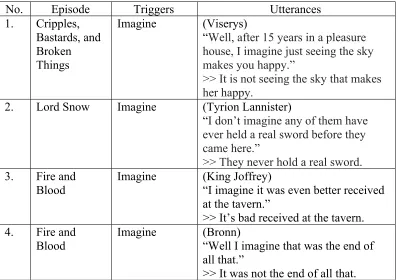
4.3 Non-Factive Presupposition
This presupposition shows the falsity of a case. It means that the information
after those expressions is not true. It is seen from the expressions such as dream,
same expressions. In the data, the writer only found one kind of non-factive verb
which were imagine.
4.3.1 Data 9
Context:
Data 9 came from episode 3 (Lord Snow). After watching a training session
led by Jon Snow, Tyrion came to visit Jon who was already in armory room of Castle
Black. Tyrion aimed at informing news from Winterfell to Jon, but as he walked in,
he saw three other rangers jumped Jon. They felt angry to Jon because he could beat
them in a training session. Realizing Tyrion came in, the three rangers stopped their
act. The conversation happened between Tyrion and Jon.
The utterance of Tyrion (36):
(36) It’s a lucky thing, none of them were trained by a master-at-arms like your Ser Rodrik. I imagine any of them have ever held a real sword before they came here.
(36a) It’s a lucky thing, none of them were trained by a master-at-arms like your Ser Rodrik. I don’t imagine any of them have ever held a real sword before they came here.
(36b) >> They never have held a real sword before they came to Castle Black.
The utterance of the speaker (Tyrion) is triggered by the word ‘imagine’. The
utterance contains non-factive presupposition because the word ‘imagine’ describes
untrue information after it. The information only exists in the speaker’s mind, not in
real sword before they came to Castle Black. The presupposition is added with
negation as in (36a) and it still stays the same.
The intention of the speaker’s (Tyrion) utterance is to implicitly state to the
listener (Jon) that the rangers are never trained by an expert like the listener got. The
speaker (Tyrion) wants to show the difference between the listener (Tyrion) who
were raised in kingdom and those who are raised in the streets. Their skills are
nothing compared to the listener’s (Jon). In this utterance, the speaker (Tyrion)
admits indirectly that the listener (Jon) is way better than them. The speaker (Tyrion)
also avenges them for what they did to the listener (Jon) through his sarcastic
utterance.
4.3.2 Data 10
Context:
Data 10 came from episode 10 (Fire and Blood). In his first day being a new
King, Joffrey Lannister sat on the Throne Room at the Red Keep listening to
Marillion the bard. His mother, Cersei stood beside him and Sansa watched them in
another place. The conversation occurred between King Joffrey and Marillion after
Marillion finished his performance.
The utterance of Joffrey (37):
(37a) I don’t imagine it was even better received at the tavern. (37b) >> It was not received at the tavern.
The utterance of the speaker (Joffrey) is triggered by the word imagine and it
is defined as non-factive presupposition. The information that follows the word
imagine is not true. It only exists in the speaker’s (Joffrey) mind. The presupposition
of the utterance (37) is (37b) It was not received at the tavern. The presupposition
(37b) has been added by negation as in (37a) and it still remains.
The intention of the utterance (37) is that the speaker (Joffrey) wants to tell
his opinion that the song should not be sung in the Throne Room. He expresses his
dislike in indirect way by conveying non-factive presupposition in his utterance. He
thinks that the song would be better sung at the tavern. Additionally, the speaker
(Joffrey) implicitly mocked the listener (Marillion) in front of public.
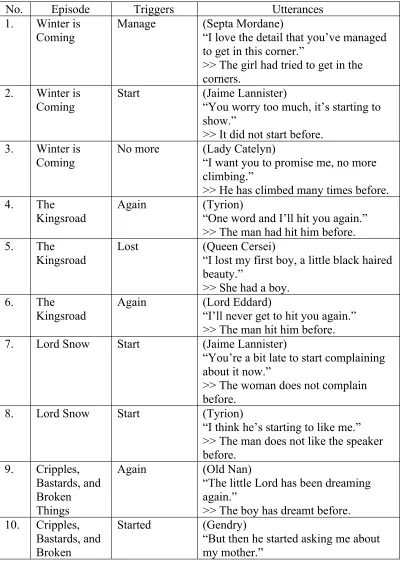
4. 4 Lexical Presupposition
Lexical presupposition usually appears within lexical items such as manage,
stop, another, start, and again. By using the items, the speaker delivers unstated
meaning to the listener. There are sixteen utterances containing lexical
presupposition in “Games of Thrones” TV Series Season 1, but only three used as
obtained are manage, start, lost, no more, stopped, accused of, another, and again.
The most frequent trigger of this type is “again”.
4.4.1 Data 11
Context:
Data 11 came from episode 1 (Winter is Coming). The conversation
happened between Sansa and Septa Mordane inside the castle. There was a practice
of needling. Sansa who was very good at needling received many compliments from
Septa Mordane.
The utterance of Septa Mordane (37):
(37) I love the detail that you’ve managed to get in this corner.
(37a) I don’t love the detail that you’ve managed to get in this corner. (37b) >> The girl had tried to get in the corner.
The utterance of the speaker (Septa Mordane) is triggered by the word
manage and it can be defined as an example of lexical presupposition. The speaker
(Septa Mordane) delivers unstated meaning to the listener (Sansa) about her work.
The word ‘manage’ have an asserted meaning which is ‘succeed’ and it means that
the listener (Sansa) had succeed to do her work, but the unasserted is ‘try’. The
has been added by negation as in (37a). As a result, the presupposition does not
change.
The intention of the presupposition conveyed in the speaker’s (Septa
Mordane) utterance is to express unstated thought with the listener. The listener
(Sansa) should convey and understand its implicit meaning from the speaker’s
utterance. The unstated meaning of the word ‘manage’ in utterance (37) is that the
listener (Sansa) had tried doing her work and she succeed, so it can be the way to
deliver a compliment to the listener (Sansa).
4.4.2 Data 12
Context:
Data 12 came from episode 2 (The Kingsroad). After the accident of Bran
falling from the bridge, her mother, Lady Catelyn kept taking care of him. She never
left Bran’s room and it made everyone felt worry about her. Queen Cersei who was
visiting Winterfell came in to see Bran and Lady Catelyn.
The utterance of Queen Cersei (34):
(38) I lost my first boy, a little black-haired beauty.
The utterance of the speaker (Queen Cersei) can be stated as lexical
presupposition because it is triggered by the word ‘lost’. The word ‘lost’ has
unasserted meaning which is something had ever existed and stayed. The word has
also being classified as a change of state verb. In this utterance, the speaker (Queen
Cersei) delivers unstated meaning that she once had a boy before she lost him (the
boy died). Therefore, the presupposition of the utterance (38) is (38b) I had a boy.
The presupposition is tested with negation as in (38a) and it stays the same.
The intention that draws in the utterance is that the speaker (Queen Cersei)
wants to express her sympathies to the listener (Lady Catelyn) in indirect way. By
conveying the presupposition, the speaker (Queen Cersei) told the listener (Queen
Cersei) that she once had a boy, but now she lost him. She also said she was ever be
in the same situation but even worse than the listener (Lady Catelyn). She tried to
make the listener (Lady Catelyn) being grateful because the listener’s (Lady Catelyn)
son does not die, but comatose.
4.4.3 Data 13
Context:
Data 13 came from episode 1 (Winter is Coming). In the day of Jon Arryn’s
death ceremony, Queen Cersei stood up in a balcony of the Iron Throne, she was
been worry if there was someone out there knowing the truth of Jon Arryn’s death.
This conversation held by Queen Cersei and Jaime Lannister.
The utterance of Jaime Lannister (39):
(39) You worry too much. It’s starting to show. (39a) You worry too much. It’s not starting to show. (39b) >> It did not start before.
The utterance of the speaker (Jaime) is triggered by the word ‘starting’ and it
means that the utterance contains lexical presupposition. The word ‘start’ has
asserted meaning that something begins to appear now and it has unasserted meaning
that something does not start before. It is also classified as a change of state verb.
The speaker has assumption that there is no worry in the listener’s face before. The
presupposition of the utterance (39) is (39b) It did not start before. The
presupposition remains the same even though it is added with negation as in (39a).
The intention of the lexical presupposition conveyed in the utterance (39) is
to tell the listener (Queen Cersei) that her worry seems to appear now. The speaker
(Jaime) also reminds the listener (Queen Cersei) not to be afraid of what had just
4.4.4 Data 14
Context:
Data 14 came from episode 6 (A Golden Crown). Tyrion was accused of
trying to kill Brandon Stark, who was Lady Catelyn’s son, because Bran became a
living witness of a secret relationship of Queen Cersei and her twin, Jaime Lannister.
Tyrion finally came to Lady Lysa to confess the real fact about this case because he
felt he did not know anything about trying to murder Bran. He stated everything he
had known in front of Lady Lysa and Lady Catelyn, but Lady Catelyn seemed not to
believe everything he said. The conversation happened between Lady Catelyn and
Tyrion Lannister.
The utterance of Lady Catelyn (40):
(40) Lord Tyrion, you are accused of hiring a man to slay my son Bran in his bed, and of conspiring to murder my sister’s husband; Lord Arryn, the Hand of the King.
(40a) Lord Tyrion, you are not accused of hiring a man to slay my son Bran in his bed, and of conspiring to murder my sister’s husband; Lord Arryn, the Hand of the King.
(40b) >> (Lady Catelyn thinks) that hiring a man to slay her son and conspiring to murder Lord Arryn are bad.
The utterance of the speaker (Lady Catelyn) consists of lexical item which is
accused of. The item can be classified as a presupposition trigger because the verb
connotation. According to Levinson (1983), this item is categorized as verbs of
judging and it is group of lexical presupposition. The speaker (Lady Catelyn)
assumes that the listener (Tyrion Lannister) has already known that what the listener
(Tyrion Lannister) done can be stated as crime. The presupposition of the utterance
(40) is (40b) (Lady Catelyn thinks) that hiring a man to slay her son and conspiring
to murder Lord Arryn are bad., it is also constant under negation as in (40a).
The speaker (Lady Catelyn) actually wants to deliver her message that the
listener (Tyrion Lannister) had done such crimes. She implicitly persuades others that
it is Tyrion Lannister that had tried to murder her son and managed to poison the
Hand of the King. Moreover, she implicitly denies the listener’s (Tyrion Lannister)
statement that he did not know anything about the murder case. In other words, the
speaker (Lady Catelyn) wants to make the listener (Tyrion Lannister) confesses his
crimes and puts him to the cells.
4. 5 Structural Presupposition
Structural presupposition has different forms from other presuppositions. It
usually comes with question forms, but it also occurs in active and passive sentences.
In passive and active structure sentences, there are it and wh- cleft structure and
adverbial clauses. In question structures, Levinson (1983) divides question structural
questions. In this analysis, the writer doesn’t use negation because the question forms
have different structures from declarative forms (Levinson, 1983). The
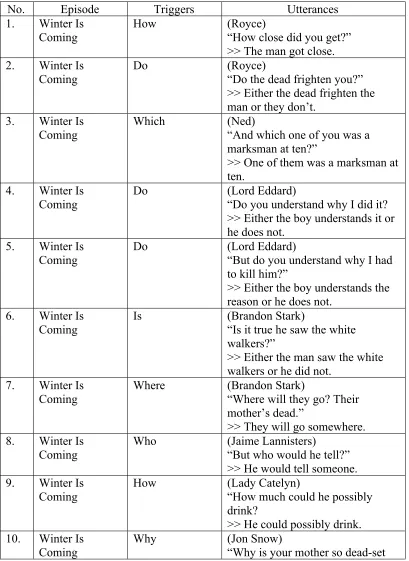
presupposition usually comes after the triggers. The writer had obtained 185
utterances containing question structural presupposition triggers such as how, what,
when, who, where, why, do, does, is, are, could, may, will, and can. For the adverbial,
the writer found one type which is when and the wh- cleft is what. The most frequent
presupposition trigger of this type comes to auxiliary verb Do. There are many
utterances containing the auxiliary verb do as a questions tag. It can be stated that the
speakers often want to clarify something from the listeners.
4.5.1 Data 15
Context:
Data 15 came from episode 1 (Winter is Coming). There was a death penalty
of a deserter of the Night’s Watch. It took place in courtyard of Winterfell. Bran, who
was Lord Eddard’s son, was asked to attend the death penalty. Her father thought this
was the time for him to see such thing because he would be no boy anymore.
Standing beside his brother, Bran finally watched the death penalty without closing
his eyes. After all finished, Lord Eddard approached his son, Bran. The conversation
occurred between Lord Eddard and Bran.
The utterance of Lord Eddard (41):
(41a) >> Either the boy understands or he does not.
The utterance of the speaker (Lord Eddard) is triggered by the word do. It is
classified as structural presupposition because do is type of yes/no questions. The
triggers show that there are two possibilities whether the listener (Bran) has
understood or not. The speaker (Lord Eddard) has assumptions that the listener
(Bran) would know the reason why the speaker (Lord Eddard) did such thing. The
listener (Bran) also has shared knowledge about the thing the speaker (Lord Eddard)
did so there is no misunderstanding. The presupposition of the utterance (41) is (41a)
Either the boy understands or he does not.
The intention of the utterance (41) is that the speaker (Lord Eddard) wants to
know the truth whether the listener (Bran) has understood or not about the reason
why the speaker (Lord Eddard) did a death penalty. The speaker (Lord Eddard) wants
to give an experience and lesson to his son that a deserter deserves a death. He
implicitly shows the listener (Bran) that an oath is not only words but commitment to
keep it unbroken.
4.5.2 Data 16
Context:
Data 16 came from episode 1 (Winter is Coming). Inside the castle of