G. Mark *
Economic Geology Research Unit,School of Earth Sciences,James Cook Uni6ersity,Towns6ille4811,Qld,Australia Received 27 May 1998; accepted 7 July 2000
Abstract
The Mesoproterozoic Mount Angelay igneous complex contained intrusions that were emplaced into amphibolite facies metasedimentary rocks during two periods of1550 and post-1540 Ma magmatism. Sm – Nd isotopic analysis together with mineralogical and chemical considerations suggest that the intrusions were produced from a Pale-oproterozoic crustal source with a T2model age 2200 Ma. On geochemical and petrological grounds, the 1550
Ma trondhjemitic intrusions are interpreted to have been produced by melting of amphibolite under garnet-stable conditions (\8 – 10 kbar). The late-syn to post-peak metamorphic timing of these intrusions suggested that they were associated with the tectono-thermal event that produced regional peak metamorphic mineral assemblages. The post-1540 Ma intrusions are K-rich and consist of two groups of synchronously emplaced intrusions, (1) a high-K monzodiorite and monzogranite suite that range between 51 and 77 wt.% SiO2; and (2) a high-K, Na-enriched
hornblende monzonite. The chemistry and mineralogy of these intrusions suggested that they were derived via plagioclase-stable and garnet-unstable melting (B8 – 10 kbar). The high-K monzodiorite and monzogranite are interpreted to have formed from a plagioclase-bearing source that contained abundant K-feldspar, biotite and/or amphibole. These intrusions are relatively enriched in K, Ca, LREE, Ba, Sr, Zr, Cl and F, and depleted in Na2O,
P2O5, Cr, V and Zn compared with slightly younger high-K monzonite, which is interpreted to have formed via one
of two mechanisms, (1) melting of a low-K amphibole- and plagioclase-rich source; or (2) melting of residual material that produces a potassic and incompatible element-rich melt. These magmas likely contained mantle-derived material, particularly the K-rich intrusions of mafic composition. The heat required for the production of post-1540 Ma intrusions appears to have been generated by the intrusion of high-T, mantle-derived, mafic material into the crust (25 – 30 km; 8 – 10 kbar). This model is consistent with the synchronous emplacement of mafic and felsic magma and the lack of a consanguineous regional metamorphic association, and suggests high-T, high-degree partial melting in localised pockets within fertile source regions in the crust. An increase in Sm – Nd model source age and decrease inoNd with increasing SiO2in the K-rich intrusions suggests the incorporation of juvenile material in the more mafic
rocks. The origin of this component is unknown, but it may represent either the incorporation of mantle-derived material during melting, or the partial melting of crust with a younger mafic component. On a district scale, the\30
* Fax: +61-7-47251501.
E-mail address:[email protected] (G. Mark).
million year period over which the K-rich post-1540 Ma intrusions were emplaced suggested that mantle-derived material continued to be injected into the crust. A mantle component to these rocks, and the global distribution of Proterozoic intrusions with similar geochemical affinities, strongly suggests a world-wide period of mantle-induced crustal melting at that time. The dominant Paleoproterozoic isotopic composition of most of these intrusions suggests melting of similarly composed and matured source rocks. © 2001 Elsevier Science B.V. All rights reserved.
Keywords:Mesoproterozoic; Cloncurry district; Neodymium; Intrusio; Petrogenesis
1. Introduction
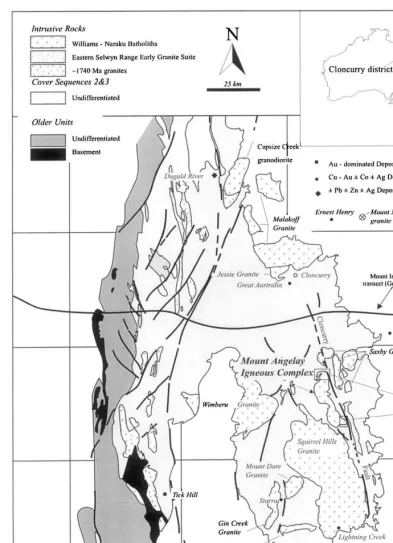
The final stages of Mesoproterozoic magmatism in the Mount Isa Inlier is represented by the Williams and Naraku batholiths within the Clon-curry district (Fig. 1). These batholiths were pro-duced during two periods (1550 and post-1540 Ma) of magmatism that formed intrusions with different chemical compositions, suggesting origins involving different melting mechanisms and/or source rocks. The most voluminous group of intrusions within the complex is the post-1540 Ma K-rich rocks that have a close geochemical affinity with Paleoproterozoic and Mesoprotero-zoic granites around the world. These ProteroMesoprotero-zoic granitic rocks also typically have an interpreted crustal source age of ca 2200 Ma (Ramo and Haapala, 1995). This global occurrence shows the presence of extensive magmatic activity during the Paleoproterozoic and given its distribution (e.g. Australia, Antarctica, North America) may provide evidence of an ancient supercontinent (Borg and DePaolo, 1994; Creaser, 1995; Ramo and Haapala, 1995). However, given the limited data available on the Sm – Nd isotopic content of intrusions within the Cloncurry district (McCul-loch, 1987; Wyborn et al., 1988; Page and Sun, 1998) further analyses are required to refine the isotopic source composition to intrusions with different compositions.
The Mount Angelay igneous complex (200 km2) is one of the larger complexes within the
Williams and Naraku batholiths (Fig. 1), and consists of ca 1550 Ma high-Al, Na-rich trond-hjemite and a suite of younger, post-1540 Ma K-rich intrusions. The older intrusions (cf. Mara-mungee granite 1545911 Ma; Page and Sun, 1998) form part of the Eastern Selwyn range early granite suite (Fig. 1), whereas the younger
potas-sic intrusions represent the typical intrusive rocks in the Williams and Naraku batholiths. Conse-quently, given that the Mount Angelay igneous complex represents a spectrum of intrusion types, an isotopic and petrological study of these intru-sions can place constraints on the origin of mag-matism in the district. Thus, this paper’s aims are (1) to place constraints on the characteristics of the intrusion’s source regions; and (2) to deter-mine the tectono-thermal mechanisms responsible for the production of the Mount Angelay igneous complex.
The ca 1550 and post-1540 Ma intrusions in the Mount Angelay igneous complex provide indica-tors on the local controls magmatism. However, the post-1540 Ma intrusions form part of a larger suite of geochemically similar intrusions that have a global distribution (e.g. Australia, North Amer-ica and Scandinavia), and therefore, they will be focus of this study. These potassic intrusions com-monly have rapakivi textures, ‘A-type’ geochemi-cal affinities, and are invariably emplaced during Paleoproterozoic and Mesoproterozoic times. The full economic potential of this world-wide suite of intrusions is still uncertain, although their associa-tion with various styles of mineralisaassocia-tion (cf. Ramo and Haapala, 1995; Creaser, 1996) suggests that investigation into their formation should continue.
2. Regional geology
of the exposed portion of the Mount Isa Inlier, represents the youngest of these periods. They intrude calc-silicate-rich rocks of the Mary Kath-leen group (B1790 – 1720 Ma; Blake, 1987; Pear-son et al., 1992; Page and Sun, 1998), and psammo-pelitic rocks of the Soldiers Cap group (B167695 Ma; Page and Sun, 1998), both derived from Paleoproterozoic crustal rocks with detrial zircon between ca 1700 and 2500 Ma (cf. Page and Sun, 1998).
The Williams and Naraku batholiths were largely emplaced after peak metamorphism, which typically ranged greenschist-lower amphibolite fa-cies conditions in the north to upper amphibolite facies conditions in the south of the district (Jaques et al., 1982). These mineral assemblages were produced during an ‘anti-clockwise’ P–T–t
path that occurred synchronously with a major east – west crustal shortening event, interpreted as the second (D2) district-scale tectonic fabric
(Rubenach and Barker, 1998). The intrusions of the Eastern Selwyn Range early granites suite were emplaced late to syn-D2 (Williams and
Phillips, 1992), and the timing of D2 was
con-strained by age of the Maramungee granite (1548911 Ma; Page and Sun, 1998). The post-1540 Ma intrusions of the Williams and Naraku
batholiths were emplaced after D2, but were
lo-cally deformed by subsequent east – west compres-sion (D3).
3. Mount Angelay igneous complex
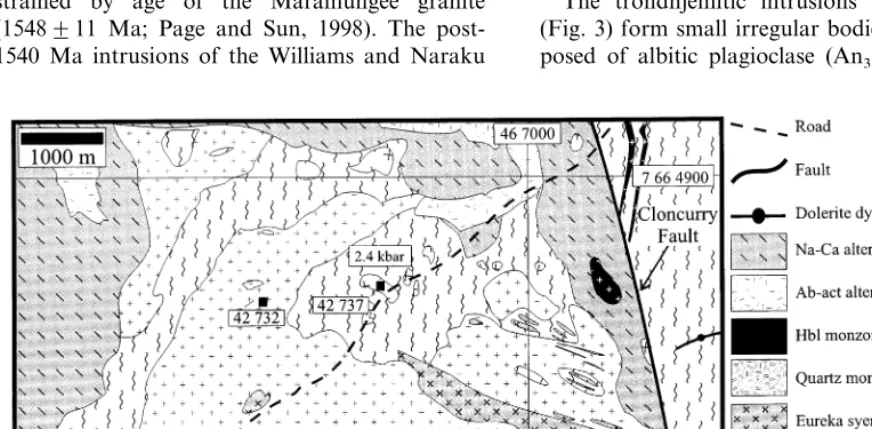
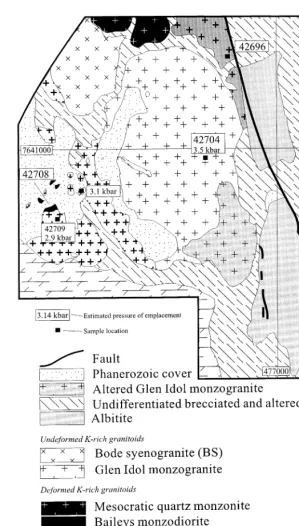
The Mount Angelay igneous complex occurs in the central portion of the Cloncurry district (Fig. 1), and is largely composed of post-1540 Ma K-rich mafic and felsic intrusions. These intru-sions were emplaced into psammite and pelite of the Soldiers Cap group, and scapolite- or diop-side-bearing calc-silicates of the Mary Kathleen group metamorphosed to amphibole facies. The southern and northern extremities of the complex (Figs. 2 and 3) display at least three distinct phases of magmatism, (1) high-Al, Na-rich trond-hjemitic intrusions; (2) a suite of pre- to post-D3
K-rich intrusions; and (3) undeformed E – W trending dolerite dykes.
3.1. Trondhjemitic intrusions
The trondhjemitic intrusions in the complex (Fig. 3) form small irregular bodies that are com-posed of albitic plagioclase (An3 – 5), hornblende,
formation. Emplaced prior to the pre- to syn-D3
potassic intrusions (Mark, 1998a), the trond-hjemites have a syn- to post-D2, but pre-D3
timing.
3.2. K-rich intrusions
3.2.1. Monzodiorite and monzogranite suite
The main period of magmatic activity was char-acterised by the synchronous emplacement of a monzodiorite to monzogranite suite of high-K intrusions, and mesocratic high-K monzonite in-trusions. The monzodiorite to monzogranite suite forms the bulk of the complex and occurs as a number of distinct magmatic phases that contain higher concentrations of quartz and alkali feldspar with each successive phase. These intru-sions range from alkaline monzodiorite to subal-kaline syenogranite. The monzodioritic intrusions are mesocratic and composed of plagioclase(An28 –
48), hornblende, clinopyroxene, biotite, K-feldspar, quartz, apatite, and accessory magnetite, titanite, allanite, pyrite and zircon. The most siliceous intrusions are composed of perthitic K-feldspar, plagioclase(AnB10), quartz, biotite,
hornblende and accessory titanite, apatite, mag-netite, zircon and fluorite. Fractional crystallisa-tion of plagioclase, hornblende, pyroxene, apatite and magnetite is interpreted to have been a major contributor to the evolution of the intrusions in this suite (Pollard et al., 1998; Mark, 1998b).
Most of these rocks are deformed and preserve post-peak metamorphic tectonic fabrics. The felsic intrusions are commonly mixed and mingled with high-K monzonite (Fig. 4a). Rapakivi textured K-feldspar phenocrysts and xenocrysts are com-mon in zones of mixed and mingled mafic and felsic rock, although rapakivi textures commonly occur outside these zones in the northern area.
3.2.2. Hornblende monzonite
Hornblende monzonite intrusions commonly occurred as small mafic bodies that were em-placed during crystallisation of the monzodiorite – monzogranite suite intrusion. This interpretation is based on the presence of irregular cuspate zones along adjoining contacts and hornblende-rimmed quartz and rapakivi textured K-feldspar
xenocrysts in monzonite. The xenocrysts are derived from the adjacent monzogranite. Mon-zonite is composed of plagioclase(An15 – 20),
horn-blende, K-feldspar, quartz, biotite and accessory magnetite, titanite, acicular apatite and pyrite.
3.2.3. Tholeiitic dolerite
Dolerite represents the last igneous phase in the Mount Angelay igneous complex and the Clon-curry district — providing an upper age con-straint for magmatism. Forming sub-vertical east – west trending dykes, these intrusions are largely composed of plagioclase, clinopyroxene, orthopyroxene and ilmenite. The dykes commonly have chilled margins and internal flow banding. These intrusions occur in the northern area and cut all phases of alkali alteration and ductile tectonic fabrics. Similar dykes occur in the Mary Kathleen district (cf. Page, 1983; Blake, 1987; Tanaka and Idnurm, 1994).
3.3. Sample strategy and geochemical techniques
Samples (45) were analysed for wholerock geo-chemistry, from which nine samples (trond-hjemitic intrusions (1); high-K monzodiorite – monzogranite suite (5); high-K hornblende mon-zonite (2); tholeiitic dolerite (1)) were selected for Sm – Nd isotope analysis (Table 2).
3.4. Hornblende geobarometry
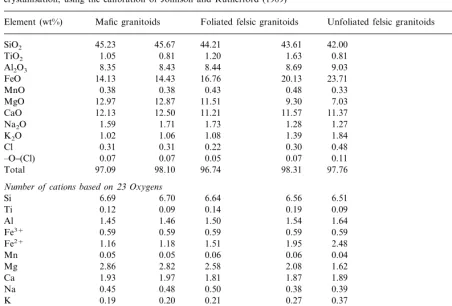
The composition of minerals in these intrusions was determined using a Jeol-840 electron probe microanalyser. Each composition represents an average of several grains, each of which is the average of three to five analyses (40 s @ 10 keV). Electron probe microanalysis of hornblende rims in intrusions with the appropriate assem-blage for hornblende geobarometry (cf. Hammer-strom et al., 1986) suggest that using the geobarometer of Johnson and Rutherford (1989), hornblende crystallised at ca 2.7 – 3.5 kbar (Figs. 2 and 3; Table 1). Estimates of solidus conditions using the hornblende – plagioclase geothermome-try technique of Holland and Blundy (1994) typi-cally estimate temperatures \900oC (Mark,
Table 1
The average rim compositions of amphibole from the three suites of granitoid intrusion, and the calculated pressure (depth) of crystallisation, using the calibration of Johnson and Rutherford (1989)
Element (wt%) Mafic granitoids Foliated felsic granitoids Unfoliated felsic granitoids Average
45.67 44.21
SiO2 45.23 43.61 42.00 44.14
0.81
FeO 14.13 23.71 17.83
0.38 0.43 0.48
0.38 0.33
MnO 0.40
12.87 11.51
MgO 12.97 9.30 7.03 10.73
12.50 11.21 11.57
0.31 0.22 0.30 0.48
Cl 0.31 0.32
0.07 0.05 0.07
0.07 0.11
O(Cl) 0.07
98.10 96.74 98.31 97.76
Total 97.09 97.60
Number of cations based on23Oxygens
6.70
Si 6.69 6.64 6.56 6.51 6.62
0.09 0.14 0.19 0.09
Ti 0.12 0.12
4. Whole rock geochemical techniques
Fresh 10 – 20 kg samples were collected for wholerock geochemistry, and each was crushed using a hydraulic press and ground into two aliquots using Cr-steel and W-carbide mills. The major and trace elements were determined by XRF on glass discs (major elements, including S and F) and pressed powder pellets. REE, Co, Hf, Th and U were determined by neutron activation analysis by Becquerel Laboratories, Sydney. Loss-on-ignition was calculated by measuring the rela-tive mass loss of a ‘dry’ (pre-heated to \100°C for \5 h) powdered sample after heating to 1000°C for \12 h.
4.1. Geochemical results
4.1.1. Trondhjemite
These alkaline, subaluminous intrusions are Na-rich, have high Al (\15 wt.% Al2O3) and low
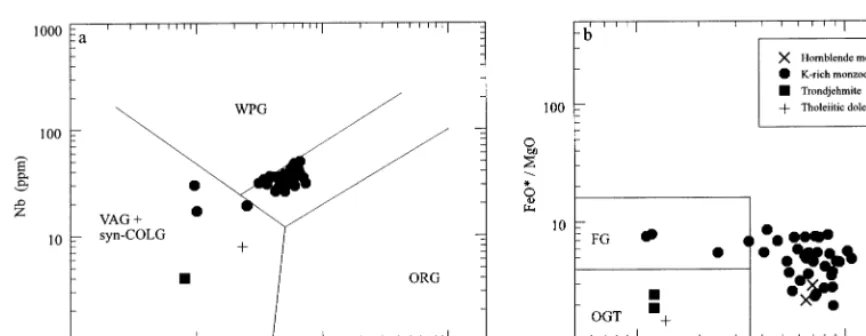
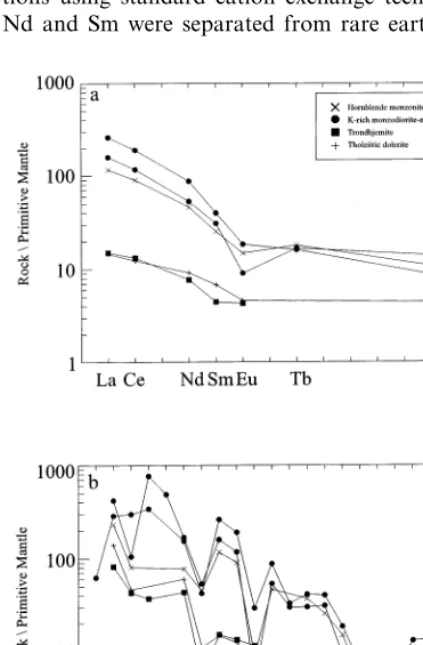
HREE and Sc. These intrusions plot as unfrac-tionated I-type volcanic arc/syn-collisional intru-sions on discrimination diagrams (Pearce et al., 1984; Whalen et al., 1985), and have Y-, Ti- and Nb-depleted and Sr-undepleted signatures on primitive mantle-normalised diagrams (Fig. 6a and b and Fig. 7a and b).
The high-Al (\15 wt.% Al2O3) and low Yb
4.2. K-rich intrusions
4.2.1. High-K monzodiorite and monzogranite suite
These intrusions represent the main body of the Mount Angelay igneous complex and are chemi-cally similar to other intrusion of the Williams
With increase in SiO2 the intrusion commonly
increase in Na2O, K2O, Rb/K2O, Fe2O3*/MgO, U,
Th, Y, Rb, Pb and HREE, and decrease in TiO2,
Al2O3, Fe2O3*, CaO, MgO, MnO, P2O5, Sr, Ba,
Cu, Zn, Nb, Eu, and LREE, Ce, Sm and Nd (Fig. 5a – d; Table 2). These intrusions are enriched in K, U, Th and LREE and depleted in Nb, Sr, TiO2, Eu and Ba on primitive mantle-normalised
G
Geochemistry of granitoids analysed for Sm-Nd from the Mount Angelay igneous complex
K-rich monzonite–monzogranite suite Rock Type Dolerite Trondhjemite Hb1 monzonite
Qtz-Mon Granite Granite Granite
Monzonite
Sample number 42 734 42 696 Monzonite Monzonite
42 737 42 709 42 704 42 732
42 708 42 739
42 762
48.93 70.18 57.29 52.01 61.51 65.87 69.86 76.42
SiO2 58.00
0.80
TiO2 1.21 0.18 1.28 1.08 1.66 0.62 0.40 0.13
15.90 14.75 14.02 12.39
16.43
Al2O3 14.20 15.62 15.45 14.12
6.09 5.69 3.45 0.47
Fe2O3* 12.10 1.42 9.05 9.47 10.34
0.04 0.05 0.03 0.01
0.13
MnO 0.18 0.02 0.12 0.12
3.35
7.44 0.76 2.84 3.97 1.56 1.11 0.60 0.05
MgO
2.90 2.68 1.68 0.49
5.20 10.13
CaO 1.40 4.06 5.56
4.22
2.11 6.95 5.26 4.49 4.84 3.71 3.72 3.89
Na2O
2.34 4.61 4.86 4.45 5.05 5.14
1.81
K2O 1.30 2.95
0.29 0.16 0.10 0.02
0.97 0.35
P2O5 0.10 0.05 0.51
0.01 0.03 0.03 0.03
S 0.02 0.01 0.01 0.01 0.20
0.13 0.06 0.13 0.00
0.42
F 0.00 0.00 0.12 0.09
0.95
1.85 0.94 1.17 0.49 0.59 0.72 0.93 0.35
LOI
99.52 99.90 99.99 99.37
100.49 100.07
Total 98.83 100.11 100.09
871
268 358 391 714 692 710 778 222
Cl
2078
322 299 766 563 1728 1039 733 274
Ba
159.0 185.0 109.0 28.6
179.0
La 10.0 10.3 108.0 80.0
336.0
21.8 23.5 227.0 160.0 304.0 332.0 208.0 57.8
Ce
119.2 105.8 72.2 9.9
118.7 12.4
Nd 10.4 74.1 63.0
16.22
3.01 2.06 14.07 11.24 18.89 17.20 12.64 1.32
Sm
6.37 7.39 6.92 1.13
Yb 2.19 B0.50 5.31 5.32 4.31
0.511599 0.511378 0.511479 0.511500 0.511554 0.511308
0.512420 143
Nd/144
Nd 0.511724 0.511526
0.095860 0.098310 0.105930 0.080300
0.082670
TDM(Ma) 1453 2214 2198 2231 2229 2229 2234 2266 2251
Fig. 6. Wholerock geochemistry of intrusions from the Mount Angelay igneous complex. (a) Y vs. Nb tectonic discrimination diagram (Pearce et al., 1984). VAG, volcanic arc granite; Syn-COLG, syn-collisional granite; WPG, within plate granite; and ORG, ocean ridge granite; (b) A-type granite discrimination diagram (Whalen et al., 1985), FG, fractionated granites; OGT, other granite types.
diagrams (Fig. 7a – b). The intrusions are enriched in Na2O relative to Phanerozoic ‘calc-alkaline’
intrusions (cf. Whalen et al., 1985). A decrease in CaO, Nb, Sr, TiO2, Eu and Ba with increasing
SiO2 suggested that fractional crystallisation of
plagioclase and amphibole were prominent pro-cesses involved in the formation of the more silicic phases. Additionally, given the Sr and Eu de-pleted nature of the least evolved phases, plagio-clase is likely to have been present in the source region.
Estimates of the initial crystallisation tempera-ture were calculated using the apatite and zircon saturation models of Harrison and Watson (1984). As both apatite and zircon occur as euhe-dral inclusions in phenocrysts they are interpreted to have formed early in the crystallisation of the mafic and felsic intrusions, respectively, and there-fore, saturation temperature estimates will ap-proximate the initial melt temperature. Estimates using these models suggest initial melt tempera-tures for the monzodiorite and monzogranite of \960°C (apatite saturation), and \900°C (zir-con saturation), respectively. These results are consistent with the high temperature K-rich melts produced during the Mesoproterozoic (cf. Creaser and White, 1991; McCarthy and Patino Douce, 1997).
4.2.2. High-K hornblende monzonite
These mesocratic alkaline mafic (58 wt.% SiO2) intrusions contain elevated K2O, and are
also relatively enriched in Na2O, P2O5 (Fig. 5b),
V, Cr, Ni and Zn and depleted in Ca, K, LREE, Ba, Sr, Rb, Zr, Cl, Hf and F compared with the monzonite – monzogranite suite and Phanerozoic calc-alkaline intrusions. On discrimination dia-grams monzonite plots as ‘within-plate’ (cf. Pearce et al., 1984) and ‘A-type’ (cf. Whalen et al., 1985) (Fig. 6a and b). Hornblende monzonite has lower LREE, but similar REE patterns to the monzonite – monzogranite suite, with a moderate negative trend and similar Eu-, Sr-, Nb- and Ti-depleted, and Y-undepleted signatures (Fig. 7a and b).
Apatite occurred as euhedral inclusions in phe-nocrysts in these intrusions and was one of the first minerals to crystallise. Temperature estimates based on apatite saturation (Harrison and Wat-son, 1984) suggest saturated temperatures 950 – 860°C.
4.2.3. Dolerite
The dolerite dykes have low SiO2, Na2O and
K2O and high Fe2O3*, CaO, MgO and Fe2O3*/
Fig. 1a). These metaluminous intrusions also plot as subalkaline (Winchester and Floyd, 1977) ocean-floor basalts (Pearce and Cann, 1973), and compared with primitive mantle are relatively en-riched in all elements especially LREE, K2O and
Rb (Fig. 7a and b).
4.3. Sm–Nd analytical techniques
Rock powders were dissolved in Teflon pressure dissolution capsules at 210°C using HF and HNO3. The solutions were then dried and
redis-solved in the same capsules in 2.3 N HCl. The rare earth elements were separated from the solu-tions using standard cation exchange techniques. Nd and Sm were separated from rare earth
frac-tions on HDEHP columns. All of the reagents were purified by sub-boiling distillation and all chemical procedures were conducted in laminar-flow HEPA filtered air. The blank contributions of about 30 pg of Nd are inconsequential com-pared with the sample contents (\100 ng). Nd and Sm were analysed as the metal on the Univer-sity of Texas Finnigan MAT 261 multicollector mass spectrometer using a dynamic data collec-tion routine for Nd and a static configuracollec-tion for Sm. Standards run with each set of samples in-clude CIT Ndb and Ames Sm. The CIT Ndb standard averageoNd of −14.4090.29 (2s;n= 40).
4.4. Sm–Nd results
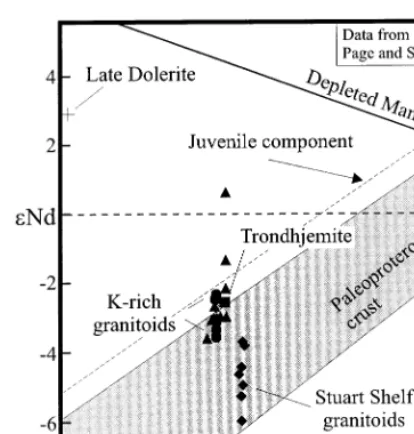
The intrusions contain between 1.32 and 17.20 ppm Sm, and 9.93 and 119.20 ppm Nd (Table 2). oNd values between −3.47 and −2.37 were de-termined, and from these values, model source ages between 2198 and 2266 Ma were calculated (Table 2).
oNd is calculated using 143Nd/144Nd CHUR=
0.512638. The T2 model source age is calculated
using the method described in Page and Sun (1998), which assumes that mantle depletion com-menced at 4560 Ma and was followed by a linear increase to a present day depleted mantle value of
+10. In this two-stage model, the Nd isotope evolutionary trajectory of measured 147Sm
/144Nd
is calculated to the geological age of the sample, where the second stage of the model uses 147Sm/ 144Nd=0.11 to accommodate samples that have
undergone fractional crystallisation. T2 was the
calculated age that defined the time when the source rocks were separated from the mantle. This age was typically not the age of magmatism, particularly for crustally-derived intrusions, where the source region was likely to be composed of components that were separated from the mantle at different periods throughout crustal evolution. Thus, T2 represents an average crustal residence
time of the source rocks.
4.4.1. Trondhjemite
Trondhjemite (42696) contains Sm (2.06 ppm) and Nd (10.45 ppm), and has a oNd of −2.49 Fig. 7. (a) Primitive mantle (Sun and McDonough, 1989)
The oNd and T2 values of the Mount Angelay
trondhjemite are similar to one value from the Maramungee granite which has 147
Sm/144
Sun, 1998). The 2200 Ma model source ages of trondhjemite in the Mount Angelay igneous com-plex and the Maramungee granite suggested that they were produced from Paleoproterozoic crust.
4.4.2. High-K monzodiorite to monzogranite suite
The age of the near by Saxby granite (Pollard et al., 1998; 152098 Ma) is interpreted to be similar to the intrusions of the Mount Angelay igneous complex (Pollard et al., 1998), and was used as an age constraint for the potassic intrusions in this study. Ages (1529 – 1512 Ma; Mark, 1998b) of paragenetic equivalent hydrothermal titanite are consistent with the above assumption. This suite of intrusions has a oNd between −2.37 and
−3.47, and T2 model source age between 2229
and 2261 Ma. Nd and Sm occur up to 118.70 and 17.2 ppm, respectively, and both decrease with increasing SiO2 (Fig. 5a). This negative
correla-tion is consistent with the continual fraccorrela-tional crystallisation of amphibole, which preferentially partitions Nd and Sm from the melt (cf. Hender-son, 1982). The oNd and model source ages of these intrusions are also similar to other granites (e.g. Wimberu, Mount Margaret and Yellow Wa-terhole granites) that have oNd (−2.60 to −
3.50) and T2 model source ages (2207 – 2261 Ma)
in the Williams and Naraku batholiths (cf. Page and Sun, 1998).
4.4.3. High-K hornblende monzonite
The hornblende monzonite has oNd of −2.99 and −2.55, and T2 model source ages of 2231
and 2198 Ma, respectively. These values are within the range calculated for the monzodiorite
emplacement age of 1100 Ma gives a calculated oNd value of 2.82, and a T2 model source age of
1453 Ma. This older model source age indicated that the dolerite was probably contaminated with radiogenically older crustal material, which was consistent with the intrusion’s enriched LREE, K and Rb content.
5. Discussion
5.1. Nature of the source region and melting mechanisms
The Mount Angelay igneous complex was em-placed over an extended period from syn- to post-D2 (1550 Ma), to pre- and post-D3
(post-1540 Ma). The post-(post-1540 Ma intrusions were emplaced after the peak of metamorphism, whereas trondhjemitic intrusions, which had a broad syn-D2 timing, were probably emplaced
late-syn to post the metamorphic peak. This pro-tracted period of magmatic activity, where the oldest intrusions were temporally related to the peak of metamorphism suggested that the mecha-nism(s) for magmatism during these two periods were probably quite different. The different com-position of the intrusions in the complex sug-gested that the source was comprised of components with fundamentally different miner-alogies, and the distinct differences in the trace element signatures might also emphasise contrast-ing mechanisms for their formation.
5.1.1. Trondhjemitic intrusions
Yb, and the late-D2 to pre-D3 timing of
trond-hjemites in the Mount Angelay igneous complex and the Maramungee granite suggested that they were formed from source rocks with similar com-positions, via comparable mechanisms during the same tectono-thermal event.
The Y-depleted and Sr-undepleted nature of these trondhjemites was consistent with being derived from an amphibole-bearing crustal source, probably amphibolite, that was heated to temperatures \900°C and pressures \8 – 10 kbar (cf. Wyllie and Wolf, 1993; Wolf and Wyllie, 1994).
amphibole+plagioclase[melt+garnet
9pyroxene (1)
The Sr-undepleted signature infers that remnant plagioclase was absent in the residual after melt-ing. This suggests that plagioclase may have acted as the rate limiting step in reaction (1), and in-duced the cessation of melting after its consump-tion in the source region. The common association of tonalitic intrusions with subduction complexes might indicate that the 1550 Ma intrusions were associated with subduction. How-ever, the lack of geological features typical of subduction complexes (e.g. ophiolites) in the dis-trict (Wyborn et al., 1988) suggests that their trace element signatures are probably related to the depth and source of melting (cf. Wyborn et al., 1992).
The emplacement of these intrusions shortly after, or during, the metamorphic peak suggested that the heat required for their formation was closely associated with metamorphism character-ised by high-T, low-P, metamorphic mineral as-semblages (Jaques et al., 1982; Rubenach and Barker, 1998). The synchronous east – west crustal shortening and peak metamorphism (Mark et al., 1998; Rubenach and Barker, 1998) is consistent with the model of Looseveld and Etheridge (1990), Oliver et al. (1991), who invoke a period of synchronous crustal shortening and mantle ac-tivity at the base of the crust. This model is consistent with producing Y-depleted, Sr-unde-pleted tonalite/trondjhemite from high-T, high-P
melting of an amphibole-rich mafic source in the lower crust. This style of melting is also consistent
with current interpretations on the thickness of the crust beneath the Mount Isa Inlier (ca 55 km; MacCready et al., 1998), which restricts this melt-ing event to the lower third.
On a district scale, similarly Na-rich and K-poor, but younger undeformed tonalite-quartz diorite intrusions lack these indicative Y-depleted trace element signatures, which indicates that they formed from melting at lower pressures. Conse-quently, the formation of Y-depleted tonalitic/
trondhjemitic magmas is most likely to be restricted to those intrusions formed during, and emplaced immediately after, the heating event as-sociated peak metamorphism. As such, the older trondhjemitic intrusions are produced via a differ-ent mechanism(s) to the younger intrusions, and melting of mafic underplated material at the base of the crust fits this hypothesis.
5.1.2. K-rich intrusions
The low oNd values (B−2.55) of monzonite and the monzodiorite – monzogranite suite sug-gested that these intrusions were derived from a source region with an average Paleoproterozoic residence age between 2198 and 2266 Ma. The high-K and Y-undepleted nature of the monzodi-orite – monzogranite suite suggested that their source contained a substantial concentration of K-bearing silicates (e.g. biotite and K-feldspar), and that melting probably occurred at B8 – 10 kbar (Drummond and Defant, 1990; Wyllie and Wolf, 1993), which would inhibit the formation of garnet from amphibole or pyroxene. Therefore, the water to produce melting is interpreted to have formed via a combination of biotite (Reac-tion (2)) and amphibole (Reac(Reac-tion (3a) and (3b)) dehydration reactions (cf. Clemens and Vielzeuf, 1987; Wyllie and Wolf, 1993; Singh and Johannes, 1996a,b).
biotite+quartz+ plagioclase
9 K-feldspar[melt+K-feldspar+pyroxene (2)
hornblende+plagioclase[melt+pyroxene (3a)
hornblende[melt+pyroxene+plagioclase
Fig. 8. Initial143Nd/144Nd (asoNd) at the emplacement age of the Mount Angelay igneous complex, compared with Clon-curry district (Page and Sun, 1998) and Stuart Shelf (Creaser, 1995) intrusions.
\900°C and B8 – 10 kbar (Wyllie and Wolf, 1993; Wolf and Wyllie, 1994).
The magmas derived from melting amphibolite are commonly Na2O-rich (Rapp et al., 1991), and
are similar to the hornblende monzonite intru-sions. However, their elevated K may represent the presence of minor quantities of other K-bear-ing silicates (e.g. K-feldspar or biotite) in the source and/or subsequent contamination by K-rich melt or crust. The lower concentration of K, Ca, LREE, Ba, Sr, Rb, Cl, Zr and F, and higher concentration of Na, P, V, Cr, Ni and Zn in monzonite compared with the monzodiorite to monzogranite suite suggested that they were derived from different sources, or successive melt-ing from the same source. The re-meltmelt-ing or batch melting of the same source would invoke that the monzonite intrusions were derived from the resid-ual material after the production and egress of the potassic magmas. This scenario may, at least in part, be highlighted by higher oNd and lower model source ages of monzonite, which indicates a more juvenile component in the source region that could be associated with melting of more mafic, radiogenically younger, residual material after earlier melting. A residual model is consis-tent with incompatible element-enriched (e.g. K, Rb, LREE, Cl and F) monzodiorite – monzogran-ite being cut by relatively compatible element-en-riched (e.g. P2O5, HREE, Cr, Ni, V) monzonite.
The change in chemistry between the two intru-sive types is consistent with melting of a source rock with a higher proportion of refractory miner-als (e.g. pyroxene, plagioclase, apatite etc.). Re-melting of a single source would require higher temperatures, and would need to be induced by the addition of heat. The introduction of mantle-derived mafic material into the crust could provide this extra heat, and would be consistent with the higher estimated temperature and rela-The melt temperatures of the monzodiorite to
monzogranite suite range between 960 and \ 900°C and are common for K-rich Mesoprotero-zoic intrusions. These temperatures are also consistent with melts formed via fluid absent par-tial melting of amphibole induced by the emplace-ment of mantle-derived material into the crust (cf. Creaser and White, 1991; Ramo and Haapala, 1995; McCarthy and Patino Douce, 1997). The intermediate to felsic composition of most of these intrusions is consistent with being their derived from a dominant tonalitic to granodioritic source (Creaser, 1995; Singh and Johannes, 1996a). However, the Si-poor (52 – 53 wt.% SiO2) composition of some of intrusions suggests
that melting involving a more mafic source rock and/or by mixing with mafic mantle may have been associated with the formation of low-Si melt, which is consistent with their higher estimated melt temperature.
The monzonite intrusions have oNd of −2.55 and −2.99, and T2 model source ages of 2198
tively lower T2 model source age of monzonite.
The differentiation between the two models pro-posed above is problematic, but a single source residual model is consistent with the wholerock and isotope geochemistry, the relative timing of the intrusions, and the relative differences in the estimated temperature of the intrusions.
Collectively, the source region to the Mount Angelay igneous complex was locally heteroge-neous, and probably contained two dominant components; one with a broadly tonalitic to gran-odioritic composition, necessary for felsic K-rich intrusions; and the other with an amphibole-rich, possibly gabbroic composition required for intru-sions with tonalitic and more mafic compositions. The presence of two crustal components could be indicated by the moderate decrease in oNd of K-rich intrusions with increasing SiO2, which may
reflect different mantle separation ages, suggesting that the mafic material contain a more juvenile component. The origin of the younger component may derive from tholeiitic intrusions emplaced into the crust prior to metamorphism (cf. Williams, 1998), and/or a direct mantle contribu-tion during the emplacement of the Mount Ange-lay igneous complex. Evidence of mantle activity during the emplacement of the post-1540 Ma intrusions has been identified by the coeval intru-sion of K-rich intruintru-sions and mantle-derived dior-ite in the ca1520 Ma Saxby grandior-ite, 10 km to the east of the Mount Angelay igneous complex (cf. Fig. 1).
5.2. Mafic underplating and global distribution?
5.2.1. Mafic underplating
The lack of a regional increase in the metamor-phic grade around pre- to post-D3 K-rich
intru-sions suggested that the heating required for their formation was likely to have been more localised than the heating event associated with the growth of peak metamorphic mineral assemblages. The synchronous emplacement of mafic and felsic in-trusions in the Mount Angelay igneous complex and throughout the Cloncurry district, particu-larly the mantle-derived mafic material (Blake, 1987; Mitchell, 1993; Pollard et al., 1998), pro-vides evidence of mantle activity during the
em-placement of the Williams and Naraku batholiths. The presence of a high velocity zone (Fig. 9) beneath these batholiths (cf. Drummond et al., 1998; MacCready et al., 1998) is calculated to occur at a paleodepth of 25 – 30 km (Pollard et al., 1998). This zone is interpreted to represent a mantle-derived, mafic body that was emplaced into the crust, and is similar to two of six hy-potheses suggested by MacCready et al. (1998). The interpreted depth and temperature of this body, and its coincidence with the aerial extent of the Williams and Naraku batholiths are all consis-tent with providing the heat-source for high-T, moderate-P (B8 – 10 kbar) melting suggested for the post-peak metamorphic intrusions. Conse-quently, the emplacement of high-T mafic mate-rial is considered to be the most likely mechanism for the introduction of a localised heat source into the crust, and the production of the post-peak metamorphic K-rich intrusions of the Williams and Naraku batholiths.
5.2.2. Global distribution
The global distribution of Proterozoic intru-sions with K-rich and ‘A-type’ geochemical char-acteristics and late-Archaean to Paleoproterozoic Sm – Nd model source ages (cf McCulloch, 1987; Ramo and Haapala, 1995) suggested the occur-rence of a world-wide, magmatic, event which expelled depleted mantle that induced high-T
melting of ‘fertile’ crust with dominant Pale-oproterozoic signatures. The high-T, potassic and ‘A-type’ geochemical, but not necessarily tectonic, character of these globally distributed intrusions (Anderson and Bender, 1989; Creaser, 1995, 1996; Ramo and Haapala, 1995) suggested that their source was broadly homogeneous, and was melted via similar mechanisms. The potassic, incompat-ible and radiogenic element-rich character of these intrusions suggested that the source material was fertile in these elements, and that these intrusions were likely to be the initial melt products of a virgin source. The emplacement of mafic material into the crust is a popular model for the forma-tion of high-T melts (Huppert and Sparks, 1988; McCarthy and Patino Douce, 1997), and the 100 – 800 Ma lapse-time between the T2 model
of mantle-derived mafic material into a globally extensive, dominantly Paleoproterozoic, source re-gion of broadly homogeneous composition.
nach, Patrick Williams and Julie Richmond for their invaluable comments and suggestions of early versions of this manuscript. Damien Foster
is thanked for his useful input during the life of this manuscript. I would also like to thank Dr Eric James at the University of Texas at Austin for Sm – Nd analysis, and Darren Mylrea and Kevin Blake of the JCU Advanced Analytical Centre.
References
Anderson, J.L., Bender, E.E., 1989. Nature and origin of Proterozoic A-type granitic magmatism in the southwest-ern United States of America. Lithos 23, 19 – 52. Blake, D.H., 1987. Geology of the Mount Isa Inlier and
environs, Queensland and Northern Territory. Bureau Miner. Res. Geol. Geophys. Bull. 225, 83.
Borg, S.G., DePaolo, D.G., 1994. Laurentia, Australia and Antartica as a late Proterozoic supercontinent: constraints from isotopic mapping. Geology 22, 307 – 310.
Clemens, J.D., Vielzeuf, D., 1987. Constraints on melting and magma production in the crust. Earth Planet. Sci. Lett. 86, 287 – 306.
Creaser, R.A., 1995. Neodymium isotopic constraints for the origin of Mesoproterozoic felsic magmatism, Gawlor Cra-ton, South Australia. Can. J. Earth Sci. 32, 460 – 471. Creaser, R.A., 1996. Petrogenesis of a Mesoproterozoic quartz
latite-granitoid suite from the Roxby Downs area, South Australia. Precam. Res. 79, 371 – 394.
Creaser, R.A., White, A.J.R., 1991. Yardea Dacite- large volume, high-temperature felsic volcanism from the middle Proterozoic of South Australia. Geology 19, 48 – 51. Drummond, M.S., Defant, M.J., 1990. A model for
trond-hjemite – tonalite – dacite genesis and crustal growth via slab melting: archean to modern comparisons. J. Geophys. Res. 95, 21503 – 21521.
Drummond, M.S., Defant, M.J., Kepenzhinskas, P.K., 1996. Petrogenesis of slab-derived trondhjemite – tonalite – dacite/ adakite magmas. Trans. R. Soc. Edinburgh 87, 205 – 215. Drummond, B.J., MacCready, T., Lister, G., Goncharov, A.,
Goleby, B.R., Page, R., Wyborn, L.A.I., 1995. AGCRC Mount Isa Transect Workshops. Aust. Geodynamics Co-operative Res. Centre Workshop publication, Melbourne, p. 50.
Drummond, B.J., Goleby, B.R., Goncharov, A., Wyborn, L.A.I., Collins, C.D.N., MacCready, T., 1998. Crustal-scale structures in the Proterozoic Mount Isa Inlier of north Australia: their seismic response and influence on mineralisation. Tectonphysics 288, 43 – 56.
Hammerstrom, J.M., Zen, E.-A., 1986. Aluminum in horn-blende: an empirical igneous geobarometer. Am. Mineral. 71, 1297 – 1313.
Harrison, T.M., Watson, E.B., 1984. Accessory minerals and the geochemical evolution of crustal magmatic systems: a summary and prospectus of experimental approaches. Phys. Earth Planet. Int. 35, 19 – 30.
Henderson, P., 1982. Inorganic Geochemistry. Pergamon Press, London, p. 353.
Holland, T., Blundy, J., 1994. Non-ideal interactions in calcic amphibole and their bearing on amphibole-plagioclase thermometry. Contrib. Mineral. Petrol. 116, 433 – 447. Huppert, H.E., Sparks, R.S.J., 1988. The generation of
granitic magmas by intrusion of basalt into continental crust. J. Petrol. 29, 599 – 624.
Irvine, T.N., Baragar, W.R.A., 1971. A guide to the chemical classification of the common volcanic rocks. Can. J. Earth Sci. 8, 523 – 548.
Jaques, A.L., Blake, D.H., Donchak, P.J.T., 1982. Regional metamorphism in the Selwyn Range area, northwest Queensland. BMR J. Aust. Geol. Geophys. 7, 181 – 196. Johnson, M.C., Rutherford, M.J., 1989. Experimental
calibra-tion of the aluminum-in-hornblende geobarometer with application to Long Valley caldera (California) volcanic rocks. Geology 17, 837 – 841.
Looseveld, R.J.H., Etheridge, M.A., 1990. A model for low-pressure facies metamorphism during crustal thickening. J. Metamorph. Geol. 88, 257 – 267.
MacCready, T., Goleby, B.R., Goncharov, A., Drummond, B.J., Lister, G.S., 1998. A framework of overprinting orogens based on interpretation of the Mount Isa deep seismic transect. Econ. Geol. 93, 1422 – 1434.
Mark, G., 1998a. Albitite formation by selective pervasive sodic-alteration of tonalite plutons in the Cloncurry dis-trict, NW Queensland. Aust. J. Earth Sci. 45, 765 – 774. Mark G., 1998b. Granites and regional alteration in the
Cloncurry district, northwest Queensland, Australia. Un-published Ph.D. thesis, James Cook University of North Queensland, p. 354.
Mark, G., Phillips, G.N., Pollard, P.J., 1998. Highly selective partial melting of pelitic gneiss at Cannington, Cloncurry District, Queensland. Aust. J. Earth Sci. 45, 169 – 176. McCarthy, A., Patino Douce, T.C., 1997. Experimental
evi-dence for high-temperature felsic melts formed during basaltic intrusion of the deep crust. Geology 25, 463 – 466. McCulloch, M.T., 1987. Sm – Nd isotopic constraints on the evolution of Precambrian crust in the Australian continent. In: Kroner, A. (Ed.), Proterozoic Lithospheric Evolution. American Geophysical Union, Washington, pp. 115 – 130. Mitchell, L.C., 1993. Geology and geochemistry of the Wiley Igneous Complex, Eastern Fold Belt, Mt Isa Inlier. Un-published BSc Honours thesis, James Cook University of North Queensland, p. 128.
Miyashiro, A., 1974. Volcanic rock series in island arcs and active continental margins. Am. J. Sci. 274, 321 – 355. Oliver, N.H.S., Holcombe, R.J., Hill, E.J., Pearson, P.J., 1991.
Tectono-metamorphic evolution of the Mary Kathleen fold belt, northwest Queensland: a reflection of mantle plume processes? Aust. J. Earth Sci. 38, 425 – 455.
Page, R.W., 1983. Chronology of magmatism, skarn forma-tion and uranium mineralisaforma-tion, Mary Kathleen, Queens-land, Australia. Econ. Geol. 78, 838 – 853.
289 – 328.
Pollard, P.J., Mark, G., Mitchell, L.C., 1998. Geochemistry of post-1540 granites spatially associated within regional sodic – calcic alteration and Cu – Au – Co mineralisation, Cloncurry district, northwest Queensland. Econ. Geol. 93, 1330 – 1344.
Ramo, O.T., Haapala, I., 1995. One hundred years of rapakivi granite. Mineral. Petrol. 52, 129 – 185.
Rapp, R.P., Watson, E.B., Miller, C.F., 1991. Partial melting of amphibolite/eclogite and the origin of Archean trond-hjemites and tonalites. Precam. Res. 51, 1 – 25.
Rubenach, M.J., Barker, A.J., 1998. Metamorphic and metaso-matic evolution of the Snake Creek Anticline, Eastern Succession, Mount Isa Inlier. Aust. J. Earth Sci. 45, 363 – 372.
Singh, J., Johannes, W., 1996a. Dehydration melting of tonalites. Part I. Beginning of melting. Contrib. Mineral. Petrol. 125, 16 – 25.
Singh, J., Johannes, W., 1996b. Dehydration melting of tonalites. Part II. Composition of melts and solids. Contrib. Mineral. Petrol. 125, 26 – 44.
Sun, S.S., McDonough, W.F., 1989.Chemical and isotopic systematics of oceanic basalts: implications for mantle composition and processes. In: Saunders, A.D., Norry, M.J. (Eds.), Magmatism in the Ocean Basins. Geol. Soc. Spec. Publ. 42, 313 – 345.
Tanaka, H., Idnurm, M., 1994. Paleomagnetism of Proterozoic
1990: geology of the Selwyn Range. James Cook University Econ. Geol. Res. Unit Contrib. 40, 21.
Winchester, J.A., Floyd, P.A., 1977. Geochemical discrimina-tion of different magma series and their differentiadiscrimina-tion products using immobile elements. Chem. Geol. 20, 325 – 343.
Wolf, M.B., Wyllie, P.J., 1994. Dehydration-melting of amphi-bolite at 10 kbar: the effects of temperature and time. Contrib. Mineral. Petrol. 115, 369 – 383.
Wyborn, L.A.I., Page R.W., Parker, A.J., 1987. Geochemical and geochronological signatures in Australian Proterozoic igneous rocks. In: Pharaoh, T.C., Beckinsale, R.D., Rickard, D.T. (Eds.), Geochemistry and Mineralisation of Protero-zoic Volcanic Suites. Geol. Soc. Spec. Publ. 33, 377 – 394. Wyborn, L.A.I., Page, R.W., McCulloch, M.T., 1988. Petrol-ogy, geochronology and isotope geochemistry of the post-1820 Ma granites of the Mount Isa Inlier: mechanisms for the generation of Proterozoic anorogenic granites. Precam. Res. 40/41, 509 – 541.
Wyborn, L.A.I., Wyborn, D., Warren, R.G., Drummond, B.J., 1992. Proterozoic granite types in Australia: implications for lower crust composition, structure and evolution. Trans. R. Soc. Edinburgh 83, 201 – 209.
Wyllie P.J., Wolf, M.B., 1993. Amphibolite dehydration-melt-ing: sorting out the solidus. In: Prichard, H.M., Alabaster, T., Harris, N.B.W., Neary, C.R. (Eds.), Magmatic Process and Plate Tectonics. Geol. Soc. Spec. Publ. 76, 405 – 416.