Narrative Discourse Analysis
and Bible Translation
Training materials based on
Acts 16:16–40
Training materials based on Acts 16:16–40
Steve Nicolle
SIL International
®2017
SIL Forum for Language Fieldwork 2017-001, May 2017 © 2017 SIL International®
All rights reserved
Scripture quotations marked ESV are from The Holy Bible, English Standard Version®, © 2001 by Crossway Bibles, a publishing ministry of Good News Publishers. Used by permission. All rights reserved.
Scripture quotations marked NIV are taken from The Holy Bible, New International Version® NIV®, © 1973, 1978, 1984, 2011 by Biblica, Inc.TM Used by permission. All rights reserved worldwide.
Scripture quotations marked NLT are taken from The Holy Bible, New Living Translation, © 1996, 2004, 2007, 2013. Used by permission of Tyndale House Publishers, Inc., Carol Stream, Illinois 60188. All rights reserved.
Scripture quotations marked NRSV are taken from The Holy Bible, New Revised Standard Version, © 1989 by the Division of Christian Education of the National Council of the Churches of Christ in the United States of America. All rights reserved.
iii
3.3 Discovery procedures for connectives and tail-head linkage
3.3.1 Application to Greek in Acts 16:16–24
3.3.2 Application to translation
4.2 Referring expressions and amount of coding material
4.2.1 Default encodings for referring expressions
4.2.2 Discourse-pragmatic functions of referring expressions
4.3 Discovery procedures
4.4 Participants in Acts 16:16–40
4.5 Application to translation
4.5.1 Plural referents: verses 16–18 and 19–23
5.3 Functions of represented speech in narratives
5.3.1 Default types of represented speech
5.3.2 Reporting thoughts
5.3.3 Major and minor participants and represented speech
5.4 Conversations
6.1.1 Movement to or from the deictic centre
6.1.2 Expressing movement as part of another event
6.2 Functions of movement expressions in narrative discourse
6.3 Discovery procedures
6.4 Movement and location in Acts 16 and application to translation
7 Highlighting
7.3 Interrupting the storyline before important information
7.4 Linguistic features of peak episodes
7.5 Discovery procedures
7.6 Highlighting in Acts 16:16–40
7.6.1 Lexical highlighting expressions
7.6.2 Backgrounding events to highlight what follows
7.7 Application to translation
9.5 Storyline and supportive material in Acts 16:16–40
9.5.1 Identifying the storyline
9.5.2 Thematic development
9.6 Application to translation
Appendix A: Text charting
v
Bible translation is sometimes described as being like a stool with three legs: if even one of the legs is weak or broken, the stool cannot be used. In the same way, a Bible translation must be accurate, clear and natural. Doing discourse analysis is the way in which a translator comes to appreciate what makes a text sound natural in his or her own language, and it is also helps to make a translation accurate and clear.
During many years involvement in Bible translation, I have often heard translators and
consultants complain that they do not feel they have the skills needed to do good discourse analysis, that they do not know how to apply discourse findings to translation, and that most of the published discourse manuals are difficult to understand. These training materials are designed to respond to these needs, at least for narrative discourse (that is, the structure of stories and factual accounts, such
as most of Genesis and the gospels, and Acts). Other discourse GENRES1 will require different training
materials.
Having led discourse analysis workshops for translators and translation consultants representing around sixty different languages (including some sign languages), I have found that the most
successful workshops have been those where discourse analysis has been combined with translation practice. When translators study discourse features in their own languages and in biblical texts, and then apply what they have just learned directly to translation, they are able to see (and hear) their translations improve. This convinces translators of the value of discourse analysis and motivates them to learn more. After one discourse workshop, a translator wrote: “The times that discourse features have been able to assist us in making a text more clear and natural are extremely many. My estimation is that maybe three-fifths of all the problems or ambiguities we run into have been solved by applying discourse features.”
This format of applying discourse analysis directly to translation works best when translators translate or revise an extended segment, such as a short book or a relatively self-contained story, rather than translating isolated verses. In these training materials, each topic is applied to the translation of Acts 16:16–40. I recommend that you read this passage (preferably in more than one language, or at least in more than one version) before using these training materials, so that you will be familiar with its content.
How to use these materials
These materials can be used for private study, for group study by a translation team, or as the basis of a workshop for a number of translation teams. Each chapter starts with an overview of a particular discourse feature followed by “discovery procedures.” I recommend that you use the discovery procedures to investigate your own language before you look at how the particular discourse feature works in the Greek text of Acts 16:16–40. Once you have studied both your own language and Acts 16:16–40, use the “Application to translation” section to guide you as you translate the passage into your language. If you have already translated this passage, you can either use what you have learnt to revise your original version, or you can do a fresh translation, compare this with your original version, and decide on the best way to translate the passage.
As you study each new chapter, you will translate a little more of the passage and revise what you have already translated. This means that you will check and improve your translation a number of times, which is normal practice in Bible translation. I hope that the final version will be one that you are very pleased with.
Chapters 1–7 contain what I consider to be the basic elements of narrative discourse analysis that are relevant to translation into any language. I recommend that you study each of these chapters, preferably in the order in which they are presented. Chapters 8 and 9 contain more
advanced material, some of which may be less directly relevant to translation into certain languages.
1 The term “genre” refers to socially expected ways of speaking or writing which develop when certain kinds of speech or writing are used repeatedly in similar situations with more or less the same function.
Chapter 8 is particularly tailored to specific issues in eastern Bantu languages. If you are looking for more of a challenge, I hope that you will find these last two chapters helpful.
Each chapter ends with some recommended readings. As far as possible, I have suggested books and articles that are freely available through the internet. As I have prepared these materials, I have benefited greatly from Dooley and Levinsohn (2001) and Levinsohn (2015), and well as other publications by these authors. I have not mentioned every time I have been inspired by these publications because they are so frequent.
1
1.1 What is a narrative text?
A narrative text is a true or fictional telling of a story. True narratives include stories in which the narrator is the main character (first person narratives) and stories in which the narrator talks about other people (third person narratives). Fictional narratives can take many forms. In Africa, they are often magical tales about mischievous spirits, animals which speak and outwit humans, and people with supernatural abilities. Other narratives, however, provide explanations of how the world was created, why different animals behave the way they do, and how different tribes and peoples came into being.
Narratives are accounts of events. According to Longacre (1996) and Dooley and Levinsohn (2001:4–5), the events in a narrative have two identifying features.
1. The events are usually described as following one after the other, there is often a cause-consequence relation between successive events. Dooley and Levinsohn (2001:8) call this
“contingent temporal succession,” but we will shorten this to TIME ORIENTATION.
2. The events are (partly) controlled by the main characters in the story (called MAJOR
PARTICIPANTS), and at least one of the major participants is involved in a number of successive
events. In technical terms, the participants are agents and a narrative has AGENTORIENTATION.
Major participants are also agents in the sense that a narrative describes their emotions and motivations (either directly, by describing their thoughts, or indirectly, through their actions).
Because of these features, discourse analysis of narrative texts is largely concerned with how the main events are connected (see chapter 3) and with how the major participants are described (see chapter 4).
1.2 Collecting your texts
To do narrative discourse analysis well you will need good narrative texts. It is possible to analyze just one text, but if you want to be sure that you understand how narrative discourse functions in your language, I recommend that you analyze at least six texts from at least three different narrators. Do not rely only on folk tales involving animal characters; instead, look at a mix of true and fictional stories, and be sure to include a few narratives which each have two or three main characters who interact during the story. Never use translated texts for discourse analysis.
A good text for discourse analysis should take about three to five minutes to read out loud. This is usually around one hundred clauses in length (texts between 80 and 150 clauses are acceptable). Before asking someone to tell you a story, it is a good idea to have them do a few practice runs; this can help to reduce “performance errors” (false starts, hesitations, etc.) and to make sure that the complete story can be told within three to five minutes. If your chosen text is written, count the number of verbs (trying to avoid verbs in relative clauses) to get a rough idea of the number of clauses.
There are various ways of collecting texts, so choose what works best for your situation. One
way is to record someone telling a story and then write it down. (The technical term is TRANSCRIBE). If
you do this, find out who people consider to be the best storytellers in the community, and ask these people if you can record them. If you are not a mother-tongue speaker of the language, I recommend that you ask someone who is to do the actual recording. When collecting stories in Digo (a Bantu language spoken in Kenya, which is not my mother tongue) I found that when I was present,
narrators would often interrupt their stories to check that I was following or to explain things to me. The stories that were recorded by a mother-tongue speaker of Digo when I was not there were far more natural. When you transcribe the recording you will need to do some editing. Remove false starts, obvious mistakes that are corrected, and fillers (like “Umm”), but keep repetition, as this is often a feature of narratives, especially oral narratives. If you are not a mother-tongue speaker of the language, ask a mother-tongue speaker to help you to transcribe the story.
languages it is possible to collect written texts. Some of the best Digo texts came out of writers’ workshops. In these workshops, people worked in groups of two or three. One person would tell a story and then the group would retell the story to each other until everyone felt that they had the best version possible. The original storyteller would then write the story (or dictate it to another person if he or she could not write). Another person would then read the story out loud and the group would edit the text together. Many of these texts were published in story books.
You should make sure that you get the narrator’s consent (agreement) to use their story for discourse analysis. One way is to record the narrator making a statement like “My name is [name] and I give permission for [your name] to use this story to study the X language.” If the narrator is literate, and if it is appropriate in the local culture, you can ask the narrator to sign a written statement. This should include the narrator’s name, your name, and the date, and can also state that you will not use the narrator’s story make money. If you intend to publish the story (for example in a story book or as an appendix of a published book or journal article) make sure that you get the narrator’s permission for this as well.
1.3 Displaying your texts
Once you have transcribed and edited a text, read it through and make sure that you understand the basic facts: who did what to whom, and what relation one event has to the other events in its immediate context. If you are not a mother-tongue speaker of the language, check your understanding of the text with someone who is.
I recommend that you use SIL’s FieldWorks Language Explorer (FLEx)—or whatever eventually supersedes it!—to help you analyze your texts, including charting the texts. Detailed instructions are provided in Appendix A. If you do not use FLEx, at least do the following:
1. Type each text out putting each sentence on a separate line. Number each line (so that you can
refer to sentences easily when you write up your analysis).
2. Divide each sentence into clauses (you can use a slash (/) to do this). A clause is basically a verb
plus any subject, object, adverbial phrase etc. that is associated with the verb. In some languages, clauses expressing existence, location, identity or possession may not have an
equivalent to the English verbs ‘be’ or ‘have’. Relative clauses (clauses that modify nouns: The
boy who climbed the tree, The tree that the boy climbed) should not be treated as new clauses. (In other words, keep relative clauses with the larger clause that they are part of.)
If the text will be read by people who do not speak your language, include a word-for-word gloss in the appropriate national language. You may need to add some information to the gloss. For
example, the English word that can function as a RELATIVE PRONOUN (The tree that the boy climbed), a
COMPLEMENTIZER (introducing DEPENDENT clauses: She said that she was happy, she knew that he was sad)
and a DEMONSTRATIVE (modifying or replacing a noun: He climbed that tree, he knew that was possible)
so the abbreviations REL, COMP and DEM are more informative than ‘that’ as glosses. Similarly, English
has a two-way distinction between demonstratives (this vs. that, or these vs. those in the plural) but
some languages have three or four demonstrative forms; English has one past tense but some
languages have more than one; you in English can be singular or plural but most languages have
different pronouns or agreement markers for singular and plural; and so forth. You may also provide a free translation of the text if this will be of use.
Recommended readings
Aaron, Uche. 1998. Discourse factors in Bible translation: A discourse manifesto revisited. Notes on
Translation 12(1):1–12.
Hollenbach, Bruce, and Jim Watters. 1998. Study guide on pragmatics and discourse. Notes on
Translation 12(1):13–35.
Longacre, Robert E., and Shin-Ja J. Hwang. 2012. Holistic discourse analysis. Dallas, TX: SIL
2 Episodes and paragraphs
A narrative text has an overall structure (sometimes called a MACRO-STRUCTURE). Certain sentences
can be grouped together to form units, which we will call EPISODES and PARAGRAPHS. In this manual
we will deal with episodes and paragraphs separately, since they are different kinds of units.
Taken together, the episodes provide the structure of the story. The same story can be told using slightly different words, with more or less detail, but so long as the content of the story is the same, each version will contain the same episodes. Different episodes are labelled according to their
function: the ORIENTATION serves the function within the story of introducing the major characters
and setting the scene, the INCITINGEPISODE serves the function of initiating the problem or situation
from which the story develops, and so forth.
Paragraphs differ from episodes in that their purpose is to help the audience (that is, the hearer or reader) to process and understand the text. This is achieved by grouping together closely related material into a manageable chunk of information, so that each paragraph in a narrative describes a different scene (for example a sequence of closely related events, or a conversation). Episode boundaries and paragraph boundaries may coincide, but often they do not. In very short texts a single paragraph may contain more than one episode, but in longer texts one episode may consist of a number of paragraphs.
To appreciate the difference between episodes and paragraphs, think of a large meal at a restaurant. A meal like this consists of a number of different dishes; for example, the meal may begin with a starter (soup or salad), followed by a main dish (usually a staple like rice, some vegetables, and meat or fish), then dessert (something sweet) and finally a cup of coffee. Each dish is like an episode in that it has its function within the meal as a whole, and the dishes follow one after the other. When a person eats the meal, he or she eats one bite at a time. When eating rice, I do not try to fit all the rice into my mouth at once (I would choke) but neither do I eat each grain of rice individually (that would take a long time and be very tedious). Instead, I take a certain amount of rice in my hand (or spoon, fork, chopsticks…) and eat this together. A handful of rice is like a paragraph: each handful of rice is the right amount to be chewed and swallowed easily, and each paragraph is the right size so that a person can understand and remember it.
2.1 Episodes
Many narratives have a structure consisting of all or most of the following episodes (based on Longacre 1996:33–38, who in turn refers to Thrall, Hibbard and Holman 1961).
2.1.1 Structure
2.1.1.1 Orientation
This is also called an “Introduction.”
• Introduces at least one major participant (see chapter 4), often using a formula such as There
was a certain man.
• Provides a time and place setting for the story, often using general time and place markers and
typical tense or aspect associated with descriptions and explanations (e.g. remote past tense, imperfective aspect).
• May indicate the purpose or theme of the story, sometimes in a relative clause: There was a
certain man who wanted to find a wife tells us that the story will be about the man’s search for a wife.
• May indicate the genre of the story: This is a true story that happened to me. Once upon a time (folk
2.1.1.2 Inciting episode
Labov and Waletzky (1967) also referred to this as the “complicating action.”
• Presents the problem, conflict, or other situation from which the story develops.
• Usually the point at which the STORYLINE starts; that is, the inciting episode includes the first
specific event in the story.
• This is often indicated through a POINT OF DEPARTURE such as One day, a verb of movement with
a major participant as the subject: This man went…, and a change from non-storyline
tense/aspect to the default storyline tense/aspect. (See also section 2.2.1, “Points of departure.”)
2.1.1.3 Developmental episodes
• There may be a number of developmental episodes. Together, they develop the situation
introduced in the inciting episode and move the story towards a resolution.
• The default storyline tense/aspect is used with occasional SUPPORTIVE CLAUSES.
• If the language uses THEMATIC DEVELOPMENT MARKERS (see chapter 9, “Storyline Concerns”) this is
where all or most of them will appear.
• The last developmental episode before the peak may have special linguistic features such as the
use of a non-storyline tense/aspect that prepare the audience for the peak, and is sometimes called the pre-peak episode.
2.1.1.4 Peak
This is also called the “peak episode” or “climax.”
• The situation introduced in the inciting episode and developed in the developmental episodes
reaches a climax. The peak may describe the resolution of the problem or tension that has developed, but it may equally be the point at which the problem or tension reaches a state in which no resolution is possible.
• The peak is “a zone of turbulence in the flow of the discourse” (Longacre 1985; Longacre &
Hwang 2012:53), meaning that it has unusual linguistic features (see chapter 7 “Highlighting” for further details). What these are cannot always be predicted, except to say that something changes. Typical features of the peak include:
• heightened vividness and detail, often involving a rapid series of verbs with fewer
connectives than usual;
• the use of expressive devices such as ideophones;
• unusual tense/aspect such as anterior (perfect) aspect or present tense;
• change from direct to indirect speech, or from indirect to direct speech.
2.1.1.5 Denouement
Longacre (Longacre 1996:36) also called this a “resolution,” or “postpeak.”
• Contains fairly predictable material either describing events which happen after the peak or
2.1.1.6 Conclusion
This is also called a “coda.”
• The conclusion brings the story to a close, for example by presenting the narrator’s
perspective on the story or summarizing the outcome of the story; a formulaic ending may also be used.
• Longacre (1996:38) divides the conclusion into “closure” which consists of the conclusion
proper, and “finis” which is a formulaic ending outside of the structure of the narrative.
Structurally, narratives can be divided into two (very broad) types: CLIMACTIC and EPISODIC. The
structure that has just been described applies to a typical climactic narrative. Episodic narratives often include an orientation, inciting episode, denouement, and conclusion, but rather than a series of different developmental episodes moving towards a peak, episodic narratives consist of a series of similar episodes. These episodes often have parallel structures and subject matter and it is their cumulative effect which is important. Each event may contain tension or a climax, but it need not, and some episodes—in particular towards the end of the narrative—may be more important than others. Many children’s stories have an episodic structure.
2.1.2 Discovery procedures
Look at your texts and try to decide where the different episodes occur. This is not an exact science, and different people may have different views on where exactly to divide episodes. Do not worry about this, as it is quite normal. Think of the structure that I have just given you as a lens through which to look at each text, rather than as a set of boxes which you are required to fill with different parts of the text. You may find that in some texts the orientation and the inciting episode overlap, particularly when the story is about well-known characters who do not need to be introduced to the audience. In some texts the denouement and conclusion may be combined.
2.1.3 Episodes in Acts 16:16–40
Because this story is part of a longer narrative, the major participants, Paul and Silas, are already known to the reader and do not need to be introduced. (The slave girl who appears at the start of the narrative is not a major participant in the technical sense of this term.) Also, the time and place have already been introduced in the preceding verses (11–15). Because of this, there is no orientation.
Verse 16 has many of the typical features of an inciting episode: the phrase ‘as we were going to
the place of prayer’ is a POINTOFDEPARTURE (see 2.2.1) describing a specific time and place; it
involves a movement verb with the major participants (Paul and Silas are included in ‘we’) as the subject. This inciting episode extends at least through verse 18, but possibly through verse 24. I prefer to treat verses 19–24 as a developmental episode.
This passage tells an exciting story but it also contains a theological lesson. For this reason, we can think of it as having two peak episodes (or a peak episode with two parts), which I will call the DRAMATIC PEAK and the THEOLOGICAL PEAK. The dramatic peak comes in verses 25–28 when there is an earthquake, the prisoners are freed, and Paul stops the jailer from killing himself. There are certain linguistic features that suggest that this is a peak episode. First, verse 25 slows down the action in preparation for the dramatic events of verse 26 (see chapter 7 “Highlighting”). Second, verse 26
contains two expressions ἄφνω‘suddenly’ and παραχρῆμα ‘immediately’ which add vividness to the
description. Finally, the use of connectives in the dramatic peak is different from the rest of the
passage: the default connective kai does not occur where it is expected, and the connective de, that
often marks a change or important development (see chapter 3), occurs four times.
back to verse 25 which begins ‘About midnight’, and verse 33 also includes the same vivid expression παραχρῆμα ‘immediately’ which occurred in verse 26.2
The denouement consists of the events of the following day (vv. 35–40). Because the narrative continues into chapter 17, there is not really a distinct conclusion.
The episodes are summarized below:
We think of paragraphs as a feature of written documents, but what we call “paragraphs” in discourse analysis refers to parts of a text that can be easily processed as units. As such, paragraphs in the discourse analysis sense are also found in speech. In spoken narratives, paragraphs may be indicated through pauses and through a change of pitch (for example, one paragraph might end on a low pitch and the next paragraph will start on a higher pitch). However, deciding where paragraph breaks occur is not always easy, and when transcribing a spoken narrative, not everyone will agree on where the paragraph breaks should go. In this section, we will try to find some more objective criteria for determining where to start new paragraphs.
In chapter 1 we asked the question “What is a narrative text?” In response, I said that narratives describe events, and that these events have two important features: 1) they occur in an orderly sequence, often in a cause-consequence relation, and 2) they are controlled by or at least influenced by the major participants in the narrative. We called these defining features “time orientation” and “agent orientation.” Skillful narrators use paragraphs to describe closely related events that involve the same major participants. In other words, in a paragraph there is continuity of both time
orientation and agent orientation. A new paragraph is expected when there is a discontinuity of some kind. The most common discontinuities relate directly to time orientation and agent orientation.
Table 1. Affect of continuity and discontinuity of time and agent orientation on paragraphs
Continuity within paragraphs Discontinuity between paragraphs
Time orientation Successive events separated by small
advances in time
Abrupt change of time or events presented out of sequence Agent orientation Same major participant or same
group of major participants
Different major participant or different group of major participants
A change in the location of the events can also be a reason for a new paragraph. If the change of location is gradual, for example if the participants are on a journey, this typically does not require a new paragraph. A change of location is usually accompanied either by a change of time (assuming that it takes time to move from one place to another) or by a change of participants (as events have participants, and the same participants cannot be in two different places at the same time).
Paragraph breaks can also be found when there is a change in the type of event or situation being described, including:
• When the storyline is interrupted to present an extended amount of supportive material
(typically more than two or three sentences). The conclusion contains non-storyline material, and is usually contained in a separate paragraph.
• Extended periods of direct speech, including long monologues (one participant speaking or thinking for a number of sentences) and long conversations (where each participant speaks more than once).
Note that in many written texts, direct speech is written on a new line so that it looks like a separate paragraph. In discourse analysis, direct speech does not necessarily require a new
paragraph. Conversations where two or more participants talk with little intervening narration (e.g.
just brief mentions of the speaker: He said… She replied…) are treated as single events, and constitute
paragraphs in their own right.
Length is also a feature of paragraphs. Dancygier (2012:15) writes: “There seem to be two major possible strategies for reading narratives: either text processing is primarily memory-based, or it relies on a search for coherence which prompts the construction of causative chains.” Coherence and the construction of causative chains relate to the various kinds of continuity that we have just
discussed; memory relates to how much information a person can store in short-term memory. This is a technical concept that we can’t go into in detail here, but roughly speaking, we can think of a paragraph (in the discourse sense) as a section of text containing as much information as the narrator believes a hearer or reader can remember in detail. How much information a person will remember depends on who the person is and how much effort they are willing to put into understanding a text, and this is reflected in the length of written paragraphs in different kinds of texts. Usually,
paragraphs are shorter in children’s story books than in novels written for adults; also paragraphs are usually shorter in newspaper articles and web pages than in academic articles and text books. We will also see later on that written paragraph lengths differ in different translated versions of the Bible.
Various linguistic expressions are used to indicate the start (or occasionally the end) of new paragraphs (in the discourse analysis sense), and these can be found in both written and spoken narratives. Some of the most common are:
• A change in the ordering of grammatical constituents (for example, using subject-verb word
order when verb-subject is normal within paragraphs).
• Special verb forms or a change of tense/aspect (for example, in Swahili, new paragraphs often
start with a verb in the past tense marked by the prefix li- while subsequent verbs describing the
events that follow within the same paragraph are marked by the consecutive tense prefix ka-).
• Particular connectives (see chapter 3).
• Special ways of referring to participants, such as using a noun phrase to refer to the subject
rather than a pronoun or verb agreement even when the subject is the same as in the previous clause (see chapter 4).
• Points of departure (see next section).
2.2.1 Points of departure
Points of departure are words or phrases that occur at the start of a sentence, or immediately after a sentence-initial connective (connectives are not considered to be points of departure). The first point of departure in many narratives occurs at the start of the inciting episode. The function of a point of departure is to create a link between what has just been said or written and what is about to follow, so that the discontinuity in the text can be recognized by the audience. Points of departure may be, temporal, spatial or referential, corresponding to discontinuities in time, location and participants respectively.
The most common points of departure in most narratives are temporal, such as these examples
from Digo.3
(1) a. Huyu mchetu ariphogbwira mimba ‘That woman when she became pregnant’ b. Juma na chisiku ‘After a week and a bit’
c. Ligundzu ra phiri ‘On the second morning’.
Points of departure may also occur when the storyline is resumed after a paragraph containing supportive material. In this case, there is no change of time, location or participants, but the narrator may use a point of departure to remind the audience of the time or place where the storyline was left. In Kabwa, this can be done by starting a new paragraph with the reduplicated demonstrative
Ruyoruyo which means ‘That same one’ (this is a short form of Orusiku ruyoruyo ‘That same day’). Spatial points of departure are very often also temporal; for example, ‘When they arrived there’ indicates a change of time as well as a change of location. If a narrative describes two sets of major participants involved in events in different locations, purely spatial points of departure may occur.
In languages with SVO or SOV word order, referential points of departure are not always easy to identify, since many sentences begin with noun phrases referring to participants even within
paragraphs. In some languages, referential points of departure are distinguished from regular subjects by putting a pause or an element such as an adverbial or exclamation between the subject and the verb. In Makonde, referential points of departure are followed by a demonstrative referring to the same participant (Leach 2015:22). In the following example, a new paragraph starts with the noun phrase ‘the elder himself who had called a feast’. We know that this is a point of departure because it
is followed by the demonstrative aju ‘this’ referring to the elder. The sentence would be grammatical
without the demonstrative, but it has the function of setting the noun phrase apart from the rest of the sentence, which makes it clear that it is a point of departure and a new paragraph starts here.
(2) Napane nang'olo mwene ave ashamíle shikukulu,
now elder himself being who.had.called feast
aju kumwona shingula aijá dimembe dindigwanga.
this saw.him hare that horns they.have.fallen
‘Now the elder himself who had called the party, this one saw that the hare’s horns had fallen off.’ (Free translation SN)
2.2.2 Marking the ends of paragraphs
Linguistic markers of paragraph breaks usually occur at the start of a new paragraph, but in some languages the end of a paragraph can also be marked linguistically.
In the Cameroonian language Bafanji, an object pronoun referring to the same participant as the subject occurs at the end of some paragraphs:
(3) A gie’, iiŋ a twotwo, ŋgiu ŋgoŋ ze mitaiŋ.
he COMP yes he come.CONT go remain him in.marketa
‘He said yes, he was coming, but he went and remained (him) in the market.’ (End of paragraph)
a comp = complementizer; cont = continuous aspect
In the Canadian language Kwak’wala, the absence of the usual connective La’m’is ‘Then’
(indicated by Ø) marks end of most paragraphs:
(4) La’m’is (Then) Raven saw the sun, moon, stars and water hanging in Grey Eagle’s house.
La’m’is (Then) he knew what he would do. La’a’m (So) he watched for his chance to take what
was hanging. La’m’is (Then) he waited for Grey Eagle to go hunting, (Ø) he stole everything,
the fire as well.
La’m’is (Then) he flew out of the smoke hole of Grey Eagle’s house, he went outside.
La’m’is (Then) he put the sun in the sky. (Ø) The light was very good.
La’m’is (Then) he was able to fly out to an island in the middle of the ocean. When the sun
set, he hung the moon in the sky, and the stars in different places. (Ø) By this new light he kept
La’m’is (Then) he flew back over the land, until he came to where he wanted. La’m’is
(Then) he dropped the water he had stolen, and it fell to the ground. (Ø) That’s the reason we
have so many streams and lakes over the entire earth.
La’m’is (Then) again Raven flew on holding the fire in his beak. La’m’is (Then) the smoke
coming from the fire went over his white feathers. (Ø) His really beautiful feathers became
blackened.
2.2.3 Discovery procedures
Look at each of your texts and note the places where you are sure that a paragraph break should occur. (Paragraph breaks can be indicated in your chart if you are using FLEx.) Look for any specific linguistic markers that help to indicate these paragraph breaks.
Now look at the places where you are uncertain whether or not to put a paragraph break. If any of these same linguistic markers occur at these places (but not elsewhere) this could be evidence that the narrator intended to make a paragraph break.
As we study other discourse features—especially connectives and participant reference (see chapters 3 and 4)—you may discover other linguistic markers of new paragraphs (or you may realize that certain linguistic features occur for other reasons). If this happens, go back and revise your decisions about where paragraph breaks should be put in your texts.
2.2.4 Paragraphs in Acts 16:16–40
The original Hebrew and Greek manuscripts of the Bible were not divided into (written) paragraphs (or verses); as a result you will see that different modern translations of the Bible often put
paragraph breaks in different places. Read Acts 16:16–40 in three or four different versions, and note where paragraph breaks occur.
You will probably find that some versions prefer longer paragraphs and other versions prefer shorter paragraphs. In general, more literal translations (like the ESV and the NRSV) prefer longer paragraphs, and the more idiomatic translations (like the NLT and the TEV) prefer shorter
paragraphs.4 Some translations also put a new paragraph after every direct speech.
As you compare the different paragraph breaks in Acts 16:16–40, try to think of possible reasons for each paragraph break and possible reasons why other versions do not have a paragraph break. Remember that you are looking for discontinuities involving time, place and participants, and also extended sections of supportive material and direct speech. If you can read the Greek text, look for linguistic clues that may support the paragraph breaks in different translations. Finally, decide where you think paragraph breaks should be made. When you have made your own decisions, compare them with the suggestions below.
Before we look at paragraph breaks, let’s just remind ourselves of the episodes. (Because it is part of a longer narrative, this passage has no orientation and no conclusion.) I suggested that the episodes correspond to the following verses:
16–18 Inciting episode
19–24 Developmental episode
25–28 Dramatic peak
29–34 Theological peak
35–40 Denouement
I propose the following paragraphs. You can see that the proposed paragraphs are almost identical to the episodes. This is not the case in all narratives. Note that these are only suggestions, and you do not have to accept them when you do your translation.
16–18 At verse 16 there is a change of time and place; a change of participants (Lydia is not
mentioned); and the Greek expression Egeneto (‘It came about’, sometimes translated as
‘Once’), which is a common indicator of a new paragraph.
19–24 There is a change of participants (the slave girl is not mentioned but her owners are) and a change of location (from the place of prayer to the market place). Some translations put a new paragraph at verse 22 at the end of the slave owners’ speech or at verse 23 where the jailer is introduced and Paul and Silas are put into prison.
25–28 There is a clear temporal point of departure at the start of verse 25: ‘About midnight’. The jailer is mentioned in verse 27 but he is an additional participant and the other
participants are still there, so there is still some continuity of participants.
29–34 There is no obvious discontinuity in terms of participants, time or location here. However, I have chosen to start a new paragraph at verse 29 for the following reasons. First, there is
a common linguistic indicator of a new paragraph at verse 29 (this is the Verb+de
construction discussed in chapter 3). Second, there is a transition from the events caused by the earthquake to the events caused by Paul and Silas proclaiming the gospel. Third, based on my own short-term memory capabilities, I prefer to make two shorter paragraphs rather than one longer paragraph.
35–37 There is a clear temporal point of departure at the start of verse 35: ‘When it was day’. There could be a new paragraph at verse 36 because the participants change (from the magistrates and the police to the jailer and Paul) and there is that linguistic construction
again: Verb+de. However, this would create a very short paragraph (just v. 35).
38–40 At verse 38 there is a change of location without a description of the police having returned to the magistrates (and so a certain amount of time must have passed). Also,
there is the Verb+de construction. This also occurs at the start of verse 40, where there is
a change of participants and location as well, so at the discourse level, I think that there is a new paragraph at verse 40. However, I have not seen any translated Bible version that makes verse 40 into a separate typographical paragraph (probably because it would be a very short paragraph) and so I suggest keeping verses 38–40 together.
2.3 Application to translation
We are not going to start translating (or revising) Acts 16:16–40 just yet. Instead, we will do some preparatory work: deciding on what section headings to add, deciding where to make paragraph breaks, visualizing the passage, and deciding on how to translate certain key terms.
2.3.1 Section heading
Most English translations have a single section heading for Acts 16:16–40. A common heading is “Paul and Silas in prison” but you could give a heading that refers to what happens at the peak of the story, such as “A Roman jailer and his household believe in Jesus.” Some translations put a new section heading at verse 25, however I do not recommend that you do this because verses 16–24 are a prelude to the events in the prison rather than a separate story.
2.3.2 Paragraphs
appropriate linguistic markers of paragraph breaks at the places where you have decided there should be new paragraphs.
2.3.3 Visualizing the passage
Before starting to translate, some translators find it helpful to present the content of each episode or paragraph without using words. Some ways to do this include acting out the events, using dolls or puppets to represent the participants, and drawing simple pictures of the events. When the pictures are put in order, this is called a storyboard.
2.3.4 Key terms
Decide what expressions you will use to translate certain key terms, including:
• slave-girl
• spirit of divination (literally: python-spirit)
• telling fortunes
• Most High God
• way of salvation (how you can be saved)
• authorities (v.19)
• magistrates
• prison
• jailer
• in the stocks (between blocks of wood)
• earthquake
• foundations
• chains
• sword
• house/household
• baptize
• police
• Roman citizens
Recommended readings
Dooley, Robert A., and Stephen H. Levinsohn. 2001. Analyzing discourse: A manual of basic concepts.
Chapters 5–7 and 15.
Dooley, Robert A. 2007. Explorations in discourse topicality. SIL Electronic Working Papers SILEWP
3 Connecting clauses, sentences and paragraphs
After you have identified the paragraphs in a text you can see how the narrator has joined the clauses and sentences within each paragraph and between paragraphs. This is often done by using, or
not using, CONNECTIVES: words like and, but and then (also called “conjunctions”). Connectives (or lack
of connectives) can be used within a paragraph or episode to indicate either continuity or
discontinuity, such as an interruption in the storyline and the resumption of the storyline after an interruption. Another way of joining clauses is to repeat the information or even the actual words of
one clause or sentence in another clause or sentence. This is called TAIL-HEAD LINKAGE, and has
different functions in different languages.
3.1 Connectives
3.1.1 Connectives indicating continuity
The events within a narrative paragraph usually exhibit continuity: the same participants are
involved, often in the same place, and the events occur one after the other. Narrators usually indicate continuity between events by joining the clauses and sentences in a paragraph in a particular way. The default (usual) way of joining clauses and sentences in narrative varies with the language. Two norms have been noted:
• In many languages, the default way of conjoining is by JUXTAPOSITION. In other words, the norm
is not to use any connective to link clauses and sentences. In some languages where
juxtaposition of clauses is the default, continuity is indicated by the way in which participants are referred to, such as the use of pronouns, or by the use of special tense markers. For example, the following paragraph from a narrative in Digo does not contain any connectives joining
clauses or sentences, except for mana ‘because’ in the second line. Continuity is indicated by the
use of first person singular subject markers (the n at the start of verbs) and the mix of the past
tense marker (á in Nálamuka ‘I woke up’ and other verbs) and the CONSECUTIVE TENSE5 marker
(chi in Nchivwala ‘I got dressed’ and other verbs).
(5) Nálamuka chiti ligundzu sana kaya Vyongwani, kudzitayarisha nkafundishe hiko Golini shule ya msingi. I woke up very early in the morning at home in Vyongwani, to get ready to go teach in Golini primary school.
Mwenye náamba, ‘Narauka nkadzitayarishe mana kala sidzangbwe kutayarisha masomo ga siku hira.’ I said to myself, ‘I am getting up early to go prepare myself because I have not yet prepared the lessons for today.’
Nárauka, ichikala saa kumi na mwenga hivi, nápiga msuwaki, nchidzitayarisha mara mwenga phara. I got up early, it was about 5 a.m., I brushed my teeth, I got myself ready at once there.
Nchivwala nguwo zangu, nchimlamusa baba na mayo.
I got dressed, I greeted my father and mother.
• In other languages (including Ancient Hebrew and Koiné Greek), the default way of joining clauses and sentences is with connectives. The following passage in Koiné Greek (Luke 22:3–6)
starts with a verb followed by δε 6 (glossed CON for ‘connective’), but after this, all the clauses
that describe separate events are joined using και ‘and’ because they exhibit continuity and
occur within a single paragraph.
3 Εἰσῆλθεν δὲ Σατανᾶς εις Ιούδαν τὸν καλούμενον Ισκαριώτην, οντα εκ τοῦ
entered CON Satan into Judas the.one being.called Iscariot, being of the
ἀριθμοῦ τῶν δώδεκα·
number of.the twelve
‘Now Satan entered Judas called Iscariot, who was one of the Twelve,
4 καὶ ἀπελθὼν συνελάλησεν τοῖς ἀρχιερεῦσιν καὶ στρατηγοῖς τὸ πῶς
and having.left he.discussed with.the chief.priests and temple.guards the manner
αὐτοῖς παραδῷ αὐτόν.
to.them he.might.deliver him
and he went to discuss with the chief priests and the temple guards how he could deliver him to them.
5 καὶ ἐχάρησαν καὶ συνέθεντο αὐτῷ ἀργύριον δοῦναι.
and they.rejoiced and they.agreed with.him silver to.pay
And they rejoiced and agreed to pay him silver.
6 καὶ ἐξωμολόγησεν, καὶ ἐζήτει εὐκαιρίαν τοῦ παραδοῦναι αὐτὸν ἄτερ ὄχλου αὐτοῖς.
and he.consented and he.sought opportunity of.the to.betray him without crowd with.them
And he consented and began to look for an opportunity to deliver him to them away from the crowd.’
Note that often the default way of joining clauses will only be used to join clauses that describe a series of events that moves the main point of the narrative on. These events are called the
“storyline.” If a paragraph contains background material or events presented out of sequence (what is called “supportive” material), another way of joining clauses will be used. For example, the default
way of joining clauses in eastern Bantu languages is by juxtaposition; when the connective na (or
similar) ‘and’ is used it may indicate a) events described out of sequence, b) the most important event in a sequence, or c) contrast between the subjects of each clause.
In summary:
• If a language seldom uses a connective in narrative (i.e. if the default means of joining clauses
and sentences is by juxtaposition) then the presence of a connective is significant, and may reflect a discontinuity.
• If a language usually employs a default connective to join clauses and sentences in narrative, its
absence is significant, and may reflect a discontinuity.
3.1.2 Special connectives within paragraphs
Often, each new clause in a paragraph simply adds more information so that the hearer or reader can construct a complete mental picture of the sequence of events. In this case, the clauses in the
paragraph are equally important, and together they function to create a complete description of a
situation. However, sometimes one clause or sentence is more important than the rest, and in some languages this can be indicated through a special connective.
The Greek connective τε is described in Louw and Nida’s lexicon as “a marker of a close
relationship between coordinate, nonsequential items.” However, it also has a discourse function: in
John 6:18, the effect of using τε instead of the default connective και is to show that the new clause
contains important information. Specifically, τε indicates that the information in this clause will
become especially significant later on in the story. Read the verses that precede John 6:18 along with verse 18 to understand why this information is important:
16. When evening came, his disciples went down to the sea
17a. και having got into a boat, started across the sea to Capernaum
17b. και it had become dark
17c. και Jesus had not yet come to them
18. the τε sea was becoming roused because a strong wind was blowing.
At other times, there is a contrast between new information and what has already been
presented; this is called CONCESSION (understood as “What I just said is true, but this other information
is also [or more] relevant”). Examples of concessive connectives in English include but, however,
nonetheless and although. In many languages, concession is not expressed by a particular connective, but has to be understood from the context (and perhaps intonation) alone; that is, concession is inferred. This is often the case in small, tight-knit communities, where speakers and hearers share many background assumptions and where there is no established written tradition. In some such
languages, concessive connectives are borrowed from languages of wider communication.7
• Swahili has borrowed lakini from Arabic lakin ‘but’, and many eastern Bantu languages have
borrowed lakini from Swahili.
• In Berta, concessive relations are inferred and a general additive connector u is used: Bakqá
katariñó nindígi u ñgó sallá sha nindígi míllañ ádqafariñ ñgó algiráya alú. ‘Do not sleep too much
and/but pray, because a lot of sleep makes you late.’ Strong contrast can be expressed using
lakín ‘but’ which is borrowed from Arabic.
• In Ik, contrast or concession is conveyed by kótó but only in the vaguest way, and sometimes
kótó expresses the next event in a sequence rather than contrast, as in kutɔɔ kótó ‘then he said’.
Ik speakers who are bilingual tend to borrow contrastive connectives from other languages such
as nai from Karimojong and lakini from Arabic via Swahili.
• In Mundari, ama ‘but, instead’ (borrowed from Arabic) can join a main clause with unexpected
information: Ilo ŋuri mar merenyeni kulik po kuta mede yu. Amanye a walanju a worani a ŋuri esa
lo iti a boroŋ! ‘That person is from the chief’s grandfather’s family. But he changed and instead of a person he became an animal!’
• The connective chɛ in the Gur language Safaliba (and similar connectives in other Gur
languages) can be translated as ‘but’ or ‘and’ depending on the context (Schaefer 2009:138); to
express a strong contrast (‘adversative’ meaning), the connective ama (borrowed from Arabic)
can be used, although this is infrequent.
In some languages, concessives are only used if the clause following the concessive describes an event which follows on the time line, and if this event is more important than the preceding event. In other languages, concessives may be used even when the clauses are out of sequence and the event following the concessive is of equal or less importance than the first event mentioned.
Koiné Greek has a number of connectives that are used to indicate concessive relations between
clauses. The following factors enable the most common ones (δε, και and αλλα) to be distinguished.
• When the second clause in a countering relationship is more important than the first, δε is used,
as in 1 Tim. 4:8: ‘For physical training is of some value, the δε godliness has value for all things.’
• When the clauses are more or less of equal importance και is used, as in Luke 1:52: ‘He has
brought down rulers from their thrones και has lifted up the humble.’ This includes occasions
when the first clause is positive and the second is negative, as in Luke 18:16 where the two
clauses are saying basically the same thing: ‘Allow the children to come to me και do not
prevent them.’
• If the first clause is negative and both clauses are more or less of equal importance, then αλλα is
used, as in 1 Tim. 4:12: ‘Let no-one despise your youth, αλλα set the believers an example in
speech and conduct.’ (This is the usual use of alla; see Mat 4:4; 7:21; 22:30; 26:39; Jhn 3:16–17;
Rom 2:13; 7:15; Eph 6:6; Php 4:6.)
3.1.3 Connectives indicating discontinuity
Connectives, or the absence of a connective, can be used to indicate discontinuities such as the transition from one paragraph to the next, a change of speaker in a reported conversation, and the transition from the storyline to supportive material (and back again). If a language uses a default connective to mark continuity within paragraphs, a different connective, or the absence of any connective, will usually be used to indicate discontinuities. This can be seen in Koiné Greek. Look at the fairly literal English translation of Luke 22:1–13 below (no paragraph breaks have been marked and most of Jesus’ speech in verses 10–12 has been omitted):
1 Now the festival of unleavened bread, which is called the Passover, was approaching. 2 And
the chief priests and the scribes were looking for a way to destroy him [Jesus] for they were
afraid of the people. 3 Now Satan entered Judas called Iscariot, who was one of the twelve,
4 and he went to discuss with the chief priests and the temple guards how he could deliver
him to them. 5 And they rejoiced and agreed to pay him silver. 6 And he consented and began
to look for an opportunity to deliver him to them away from the crowd. 7 Now the day of
unleavened bread arrived on which the Passover [lambs] had to be sacrificed, 8 and he
[Jesus] sent Peter and John saying, “Go and prepare the Passover for us, so that we may eat
it.” 9 And they said to him, “Where do you want us to prepare it?” 10–12 And he said to them,
“When you enter the city….” 13 And they left and found everything just as he had told them,
and they prepared the Passover.
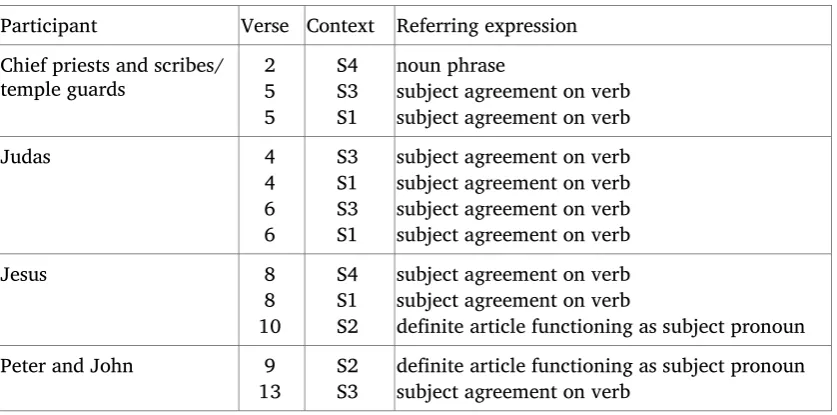
Where are the discontinuities in this passage? Clearly verse 1 is the start of a new paragraph as it introduces a new time reference (and is the start of a new chapter, although this does not always coincide with a new paragraph). At verse 3 there is a shift of attention from the chief priests and scribes to Judas; we saw earlier in this section that verses 3–6 constitute a single paragraph and the
clauses are joined by the default connective και. A new time reference is introduced at verse 7. In
verse 9 the speaker changes from Jesus to Peter and John, and in verse 10, Jesus replies. In verse 13 the conversation ends and there is a change of location, which could justify starting a new paragraph here; however, the subject is referred to using just subject agreement marking on the verb, which could indicate that this is not a new paragraph even though there is a discontinuity.
Each of these discontinuities coincides with the connective δε, highlighted in the text below.
(This is sometimes translated ‘Now’ in the English translation above but is glossed CON for
“connective” in the box below. The occurrences of και have also been highlighted.) Notice that when
δε occurs at the start of a new paragraph (verses 1, 3 and 7) and also at verse 13 it is preceded by a
verb, but when it merely marks a change of speaker (verses 9 and 10) it is preceded by a pronoun.
Often (but not always) in Luke’s writing, the construction Verb+δε indicates the start of a new
paragraph; δε in general indicates some kind of discontinuity.
1 Ἤγγιζεν δὲ ἡ ἑορτὴ των ἀζύμων ἡ λεγομένη πάσχα.
was.approaching CON the festival of.the unleavened.bread the being.called Passover
2 καὶ ἐζήτουν οἱ ἀρχιερεῖς καὶ οἱ γραμματεις τὸ πως ἀνέλωσιν αὐτόν,
and were.seeking the chief.priests and the scribes the manner they.destroy him
ἐφοβοῦντο γὰρ τὸν λαόν.
3 Εἰσῆλθενδὲ Σατανᾶς εἰς Ἰούδαν τὸν καλούμενον Ἰσκαριώτην,
entered CON Satan into Judas the.one being.called Iscariot,
ὄντα ἐκ τοῦ ἀριθμοῦ τῶν δώδεκα·
being of the number of.the twelve
4 καὶ ἀπελθὼν συνελάλησεν τοῖς ἀρχιερεῦσιν καὶ στρατηγοῖς τὸ πῶς
and having.left he.discussed with.the chief.priests and temple.guards the manner
αὐτοῖς παραδῷ αὐτόν.
to.them he.might.deliver him
5 καὶ ἐχάρησαν καὶ συνέθεντο αὐτῷ ἀργύριον δοῦναι.
and they.rejoiced and they.agreed with.him silver to.pay
6 καὶ ἐξωμολόγησεν,καὶ ἐζήτει εὐκαιρίαν τοῦ παραδοῦναιαὐτὸν ἄτερ ὄχλου αὐτοῖς.
and he.consented and he.sought opportunity of.the to.betray him without crowd with.them
7 Ἦλθεν δὲ ἡ ἡμέρα τῶν ἀζύμων, [ἐν]ᾗ ἔδει θύεσθαι τὸ πάσχα·
came CON the day of.the unleavened.bread in which it.was.necessary to.sacrifice the Passover
8 καὶ ἀπέστειλεν Πέτρον καὶ Ἰωάννην εἰπών,
and he.sent Peter and John having.said
Πορευθέντες ἑτοιμάσατε ἡμῖν τὸ πάσχα ἵνα φάγωμεν.
having.gone prepare for.us the Passover so.that we.may.eat
9 οἱ δὲ εἶπαν αὐτῷ, Ποῦ θέλεις ἑτοιμάσωμεν;
they CONsaid to.him where you.wish that.we.prepare
10 ὁ δὲ εἶπεν αὐτοῖς, Ἰδοὺ εἰσελθόντων ὑμῶν εἰς τὴν πόλιν […]
he CON said to.them look having.entered you into the city…
13 ἀπελθόντες δὲ εὗρον καθὼς εἰρήκει αὐτοῖς καὶ ἡτοίμασαν τὸ πάσχα.
having.left CON they.found just.as he.had.said to.them and they.prepared the Passover
The use of δε in the New Testament is not uniform: Matthew and Luke use it far more often than
Mark and John. In Luke’s gospel and Acts, δε often (but not always) indicates new paragraphs while
και maintains continuity within paragraphs, but in some passages, and often in Matthew, δε seems to
function more like a thematic development marker (see chapter 9 “Storyline Concerns”) rather than as an indicator of a discontinuity in the text.
It is quite common for connectives to have two functions: a “logical” function, such as indicating a conclusion or a time relation, and a discourse function, such as marking the beginning of
paragraphs or transitions between the storyline and supportive material. For example, when the Digo
connectives phahi and ndipho occur between clauses, phahi can usually be translated as ‘so’
(indicating a conclusion) and ndipho can usually be translated as ‘then’ (indicating a time relation).
But in narratives phahi and ndipho often mark new paragraphs without expressing any conclusion or
time relation (Nicolle 2015a).
Not all languages use connectives to indicate the start of a new paragraph. Some languages use
an unusual CONSTITUENTORDER (for example, subject-verb where the usual order is verb-subject);
other languages use an unusual form of PARTICIPANTREFERENCE (for example, using a particular
3.2 Tail-head linkage
3.2.1 Forms of tail-head linkage
Tail-head linkage occurs when information from one clause (the “tail”) is repeated at the start of the following clause (the “head”), and the main verb is repeated, either verbatim or as a paraphrase. The following examples from Siroi illustrate various kinds of tail-head linkage.
Exact replication of the verb phrase:
(6) Nu tumbrang kina. Tumbrang kina sulumba…
he village went village went and
‘He went to the village. He went to the village and…’ (van Kleef 1988:149)
Same verb, different tense/aspect:
(7) age ande ta tumba kina. Age ta tumba kumba ka…
dog a that taking went dog that taking going go
‘(she) took the other dog and went. Taking that dog, she went…’ (van Kleef 1988:152)
Verb followed by a generic pro-verb:
(8) Piro mbolnge ngukina. Tangamba nu kinya.
garden in planted doing.thus she slept
‘She planted it in the garden. After having done this, she slept.’ (van Kleef 1988:152)
3.2.2 Functions of tail-head linkage
In Siroi, tail-head linkage occurs within paragraphs, rather than across paragraph boundaries (van Kleef 1988:151). Its main function is to highlight the main events throughout a narrative, except at the peak where there is usually a lot of direct speech and the information rate is higher than elsewhere (1988:152).
In the eastern Bantu languages, tail-head linkage is used far less than in Siroi. Eastern Bantu languages differ over whether tail-head linkage is used within paragraphs or across paragraph boundaries.
In Makonde, tail-head linkage is often used at the start of a new episode to slow the action down
before a significant development in the story. In the following example, the verb kuudukila ‘to sweat’
is repeated at the start of the episode in which Hare’s sweat causes his horns to fall off, which is a crucial event as it causes him to be recognized and killed:
(9) Nae kwinjilinneu kuvina, kuvina shingula mpaka kuudukila.
Paanjenge kuudukila dimembe adilá kwanjanga kunyang'anyuka mwaa wakuvina namene na liduva alilá, dimembe adilá kutwala kugwanga kujaikanga.
‘So Hare joined straight in with the dancing; he danced until he sweated (lit: to sweat).
But when he began to sweat, those horns started to melt because of dancing so much and
the hot sun, those horns fell off and were ruined.’ (Leach 2015:28)
In contrast, tail-head linkage in Jita occurs within paragraphs. In the example below,
^naabhakeesya ‘he greeted them’ uses the narrative tense, but the dependent clause Ejire aamara okubhakeesya ‘When he finished greeting them’ uses the perfective aspect.
(10) Mbe rusiku rumwi, Wang’oko ^naagenda yiika ewa Wamutuuju. Ejire aakinga yiika ewa Wamutuuju,
^naabhakeesya. Ejire aamara okubhakeesya kisikisi, ^naayika…
‘So one day chicken went to Hare’s house. When he arrived at Hare’s house, he greeted them.
Digo uses tail-head linkage within sentences, so it obviously does not indicate a paragraph break. Its purpose seems to be primarily to “background” the movement of participants, that is, to indicate a change of location without starting a new paragraph. To achieve this, the repeated verb uses the anterior aspect (translated as ‘having arrived,’ ‘having left,’ etc.).
(11) Phahi tsungula wakpwedza akafika hipho waamba…
so hare he.come:PAST he.arrive:ANT there he.say:PAST
‘So the hare came (and) having arrived there he said…’ (Nicolle 2015a:21)
3.3 Discovery procedures for connectives and tail-head linkage
Connectives and tail-head linkage function in different ways in different kinds of text (that is, in different genres). Also, connectives in narrative texts may function in different ways depending on whether the clauses they join contain storyline (i.e. foreground) material or supportive (i.e. background) material. Therefore you should study a variety of narrative texts in your language.
1. First, identify the episodes and paragraphs within each text.
2. Highlight all of the connectives that join clauses and sentences. (Ignore connectives that join noun phrases such as ‘Paul and Silas’). Also note the clauses and sentences that are not joined by connectives (i.e. where there is juxtaposition).
3. Identify all the clauses that contain connectives such as ‘that’, ‘because’, ‘so that’ and ‘until’; make a note of these connectives. These are dependent (or subordinate) clauses which should not be included in your analysis of the default way of joining clauses.
4. Next, look at the main clauses and sentences (the clauses that are not covered by point 3 above) and note how they are joined (e.g. using juxtaposition or a certain connective).
5. Try to determine the default way of joining main clauses and sentences within paragraphs (e.g. by juxtaposition, or with a certain connective, or with a variety of connectives, or by
juxtaposition between sentences and with a certain connective between clauses, etc.). 6. Look at the use of connectives and juxtaposition between paragraphs. Do certain connectives
occur at the start of new paragraphs? Do certain connectives occur at the end of paragraphs? Are there usually no connectives linking paragraphs?
7. Check to see whether certain episodes have a different distribution of connectives. For example, the orientation section and conclusion usually do not contain sequences of events and so may differ from the developmental episodes; the peak episode may use more or fewer connectives than the developmental episodes; the inciting episode may contain a special connective not found elsewhere.
8. Read through your text and decide whether any of the conjoined clauses/sentences express a relation of contrast or concession. Is a special connective used in such cases, or not?
9. Look at other connectives (not the default connectives or concessive connectives) and decide what kind of relationship between the clauses or sentences each connective indicates. 10. Go through your texts looking for cases of tail-head linkage. See whether these occur within
paragraphs or between paragraphs. Try to determine the function of tail-head linkage (if it occurs). Check to see whether certain episodes have a different distribution of tail-head linkage.
These discovery procedures can be made easier by charting your texts (see Appendix A: Text Charting for detailed instructions). In your chart, all of the connectives should be placed in a single column (usually one of the pre-nuclear columns). Your chart should also indicate dependent clauses and paragraph breaks.
3.3.1 Application to Greek in Acts 16:16–24