Analysis of Job Fit Influence on Role Performance
Setyabudi Indartono, Hawjeng Chiou, and Chun-Hsi Vivian Chen ([email protected])
Department of Business Administra�on Na�onal Central University, Taiwan
ABSTRACT
This paper investigates how work design predicted Performance mediated by personal job Fit. This Study also explored difference of servant Leadership style moderate the model. 407 teachers from several schools in Indonesia were examined. The result indicates personal job fit mediate informa�on processes of knowledge characteris�cs related to in role performance. Servant leadership moderate the rela�onship between knowledge characteris�cs and personal job fit, and moderate the relationship between personal job fit and in role performance. Servant leadership also found moderate these two rela�onships, differently. Implica�on of the findings for organiza�ons and sugges�ons for future research are discussed.
Keywords: Knowledge characteris�cs, personal Fit, intra Role Performance, Servant Leadership
INTRODUCTION
Changing the nature of work a�er Industrial Revolu�on, spawning the use of assembly-line systems that maximized employee efficiency and minimized the employee skills needed to perform the work. Gilbreth and Taylor (1911) study, focused on specializa�on and simplifica�on in an a�empt to maximize worker efficiency. Yet, one of the problems of designing work to maximize efficiency was to increase employee satisfaction, to decrease turnover and absenteeism, and manage employees in simplified jobs (Hackman & Lawler, 1971). Now days, work design become something of a fad among Leaders and organiza�onal consultants (Hackman, 1975). Work design con�nues to be of great prac�cal significance to organiza�ons as they try to a�ain conflic�ng outcomes such as efficiency and sa�sfac�on. The most popularity programs such as total quality management (Deming, 1986; Juran et al 1988; Waldman, 1994) and reengineering (Hammer et al, 1993), also current trends in human resource management research that consider to HR strategic (Delery & Shaw, 2001) and human capital management (Lepak & Snell, 1999), considered on theore�cal and prac�cal implica�ons of job-design research. Trends in designing work, illustrate an important insight the nature of work. It has substan�al impact on an employee’s performance and a�tude (Morgeson, 2005).
Successful work-design ini�a�ves must overcome many obstacles in order to have impact and influences on mul�ple outcomes such as increase posi�ve behavioral (e.g., job performance) and a�tudinal (e.g., job sa�sfac�on) and decrease nega�ve behavioral (Humphrey, 2007).
Work Design has major characteris�cs categories: task, knowledge, social and work context characteris�cs (Morgeson and Campion, 2003). They have difference contribu�on to performance. Highest supporting of performance on work design is average of knowledge characteris�cs (Humphrey, 2007). Knowledge characteris�cs reflect the kinds of knowledge, skill, and ability demands that are placed on an individual as a func�on of what is done on the job (Morgeson, 2006). Knowledge characteris�cs cover job complexity, informa�on processing, problem solving, skill variety and Specializa�on (Campion & McClelland, 1993, Morgeson, 2006). Knowledge characteris�c has significant influence to wellbeing outcomes such as work overload, job sa�sfac�on and involvement at a�tudinal outcomes, and significant to all of cri�cal psychological states (Humphrey, 2007).
Cri�cal psychological cover experienced meaningfulness, experienced responsibility, and knowledge of results (Humphrey, 2007). Critical psychological states would independently act as mediators (Johns et al., 1992; Oldham, 1996). Performance mediates differently by these of cri�cal psychological states. Job sa�sfac�on and internal work mo�va�on are fully mediated experienced meaningfulness and experienced responsibility. Literally thousands of studies have been conducted examining work design issues. There is good reason for such interest, as study a�er study has shown that work design is important for a range of individual, group, and organiza�onal (Morgeson & Campion, 2003; Parker & Wall, 1998; Wall & Mar�n, 1987). Previous study also found that there was a rela�onship of Performance and personal fit (O’Reilly et al 1991, Chatman 1991, Edward 1996, Judge 1996, Saks 1997).
Personal Fit is described as an inventory assessment of both the needs-supplies and the knowledge, Skills, and abili�es associated with the job (Kristof et all, 2005). If employee perceives of fit on job or organiza�on, he/she will support cri�cal psychology appeared. Based on this rela�onship, we suggested that there are rela�ons among knowledge characteris�cs of work design, personal job fit and performance. Thus, this study was to extend the literature on work design inves�gate how Personal Job Fit mediate rela�onship between knowledge characteris�cs and Performance. We also explored modera�on of servant leadership style on the model.
Since job design study interest and discussions, conceptually and prac�cally development of job design was widely accepted and applied in several situa�on. Variety program has developed job design such as total quality management (Deming, 1986; Juran et al 1988; Waldman, 1994), reengineering (Hammer et al, 1993), Job enlargement and enrichment (Hackman, 1975), and growth or downsizing jobs. Work design also a�ract to discuss more on mul�ple outcomes, different approaches studies, predic�ng the nature of the job, individual differences complica�ons, and it’s long and short-term effects (Campion et al, 2005).
In the first stage, job design concept was concern of Taylor studies (1911). It is intense interest in mo�va�onal aspects of work in the 1970s (Hackman & Oldham, 1975). Then, it became most commonly used on job design measure, the Job Diagnos�c Survey (Hackman & Oldham, 1980). Work design was focused on a narrow set of mo�va�onal job characteris�cs, retains a central place in work design theory today. Extended by Campion 1988; Campion & Thayer, 1985, they developed more comprehensive Mul� method Job Design Ques�onnaire (MJDQ). Hackman and Oldham (1976) suggested that five work characteris�cs make jobs more sa�sfying for workers: autonomy (i.e., the freedom an individual has in carrying out work), skill variety (i.e., the extent to which an individual must use different skills to perform his or her job), task iden�ty (i.e., the extent to which an individual can complete a whole piece of work), task significance (i.e., the extent to which a job impacts others’ lives), and feedback from the job (i.e., the extent to which a job imparts informa�on about an individual’s performance). These work characteris�cs were expected to increase posi�ve behavioral (e.g., job performance) and a�tudinal (e.g., job sa�sfac�on) outcomes and decrease nega�ve behavioral outcomes (e.g., absenteeism). It also mediated their influence on three cri�cal psychological states: experienced meaningfulness (i.e., the degree to which an employee feels the job has value and importance), experienced responsibility (i.e., the degree to which an employee feels liable and accountable for job results), and knowledge of results (i.e., the degree to which the employee is aware of his or her level of performance).
Although work design research has slowed in the Industrial/Organiza�onal (I/O) psychology and management fields during the past 20 years, it is important that researchers con�nue to inves�gate this topic, as the design of work has a profound effect on employees’ behavior, a�tudes, and well-being (Campion, Mumford, Morgeson, & Nahrgang, 2005). More than 34% of the variance in performance and more than 55% of the variance in job sa�sfac�on was a func�on of the 14 work characteris�cs and behaviors (Humphrey et al 2007).
McClelland, 1993, Morgeson, 2006), reflect the kinds of knowledge, skill, and ability demands that are placed on an individual as a func�on of what is done on the job (Morgeson, 2006). Job complexity refers to the extent to which the tasks on a job are complex and difficult to perform. Informa�on processing mean that the amount of informa�on processing needed at work reflects the degree to which a job requires a�ending to and processing data or other informa�on. Some jobs require higher levels of monitoring and ac�ve informa�on processing than others (Mar�n & Wall, 1989; Wall & Jackson, 1995; Wall et al., 1995). Problem solving reflects the degree to which a job requires unique ideas or solu�ons and reflects the more ac�ve cogni�ve processing requirements of a job (Jackson, Wall, Mar�n, & Davids, 1993; Wall et al., 1995). Problem solving involves genera�ng unique or innova�ve ideas or solu�ons, diagnosing and solving non rou�ne problems, and preven�ng or recovering from errors (Jackson et al., 1993; Wall, Corbe�, Clegg, Jackson, & Mar�n, 1990). It is conceptually related to the crea�vity demands of work and is a natural extension to the informa�on demands of a job (Shalley, Gilson, & Blum, 2000). Skill variety reflects the extent to which a job requires an individual to use a variety of different skills to complete the work (Hackman & Oldham, 1980). It is important to dis�nguish skill variety from task variety because the use of mul�ple skills is dis�nct from the performance of mul�ple tasks. The use of mul�ple skills is o�en challenging and thereby engaging to perform. Specializa�on reflects the extent to which a job involves performing specialized tasks or possessing specialized knowledge and skill. Average of knowledge characteris�cs has highest suppor�ng to performance (Humphrey, 2007) Therefore, the research extended predic�on:
Hypothesis 1: Knowledge characteris�cs is posi�vely related to performance
Personal Fit
performance (Caldwell and O’Reilly, 1990), job sa�sfac�on and subjec�ve performance (O’Reilly, Chatman and Caldwell 1991, cable and judge 1996, Chatman, 1989; Chatman and Barsade, 1995; Harris and Mossholder, 1996; Silverhart and Hinchliffe, 1996, Saks and Ashfort 1997).
Hackman and Oldham (1976) suggested that work characteris�cs impact behavioral and a�tudinal outcomes through cri�cal psychological states. They are experienced responsibility (i.e., the degree to which an employee feels liable and accountable for job results), knowledge of results (i.e., the degree to which the employee is aware of his or her level of performance) and varie�es of performance mediators (Caldwell and O’Reilly, 1990, Chatman and Caldwell 1991, cable and judge 1996, Saks and Ashfort 1997). Humprey (2007) suggested that modifica�on of media�on model for work characteris�cs to work outcome rela�onships is experienced meaning. It is not surprising that meaningfulness is the best mediator rela�onships between work characteris�cs and work outcomes. We also expected the personal job fit relates to knowledge characteris�cs and performance.
Thus we predict
Hypothesis 2: Knowledge characteris�c is posi�vely related to Personal Job Fit Hypothesis 3: Personal Job Fit is posi�vely related to performance
Hypothesis 4: Personal Job Fit mediated correla�on between Knowledge Characteris�cs and in role Performance
Servant Leadership
Several meta-analy�c summarized and extended the literature on work design for individual-level jobs. Few studies tested the rela�onship between leader behaviors and person–fit (Li 2006). Leader can influence the level of person fit (Reichers, 1987). These indica�ons directed us to define rela�on between work design with job and performance in the broader work environment (Morgeson & Humphrey, 2006), such as Leadership contribu�ons.
were able to both supported and withdraw employee desire and close to performance effort.
Organiza�onal leaders show wide varia�ons in the styles and behaviors. The styles are charisma�c, transac�onal, and transforma�onal leadership (Oshagbemi, 2005). Each Style relate with behavioral and a�tudinal outcomes differently. Such as affec�ve commitment, job enrichment, sa�sfac�on, performance (Jung, 2000, Whi�ngton 2004, Chen, 2005, Roward 2007, Schaubroeck 2007, Daviddizar 2007, Vecchio 2008, Limsila 2008), obliga�on and trust (Jung, 2000; Chen, 2005; Twigg, 2008), s�mulates employees’ crea�vity and innova�on (Poli�s, 2004), related to emo�onal intelligence (cherril, 2008), Organiza�on Condi�on (Leithwood, 1999), value (Jung, 2000), provides addi�onal endorsement for model (Schwartz 1999). These leadership styles and behaviors were varying in the extent to which leaders adopted the following styles and behaviors in their day-to-day ac�vi�es (Bass, 1974; Bass et al., 1975; Bass and Avolio, 1990). Some leaders use a variety of leadership styles and behaviors in their day-to-day ac�vi�es, while others u�lized one or two of the leadership styles or behavior dimensions (Oshagbemi, 2005).
Previous study found a concept of servant leadership. It began with the natural feeling that one wants to serve and to serve first. It was iden�fied by ten characteris�cs as the essence of a servant leader. The characteris�cs were listening, empathy, healing, awareness, persuasion, conceptualiza�on, foresight, stewardship, commitment to the growth of others, and building community. Several educa�onal theorists, such as Bolman, Deal, Covey, Fullan, Sergiovanni, and Heifetz also reference these characteris�cs as essen�al components to effec�ve leadership. This concept of servant-leadership addresses to the leader’s personal characteris�cs such moral objects (Turner, 1998). Servant leadership also relate to both behavioral and a�tudinal outcomes such as Job sa�sfac�on (Ikel, 2005) and mo�va�on (Graham, 1995). Servant leaders serve their followers best and encourage others not only to engage in independent moral reasoning, but also to follow it up with construc�ve par�cipa�on in organiza�onal governance (Graham, 1995).
Thus, this Study also tried to observe servant leadership style as moderator within WDQ and performance rela�onship, and we predict:
Hypothesis 5: Servant Leadership style moderated rela�onship between Knowledge Characteris�c and personal job fit
Hypothesis 6: Servant Leadership style moderated rela�onship between personal job fit and performance
Hypothesis 7: Servant Leadership style moderate rela�onship of knowledge
METHOD
Par�cipants
The sample in this study consists of 407 teachers from several schools. Thirty three point four percent samples are male. The age of sample range from 18.92 to 60 years, and mean sample ages was 34.7 years. Collec�ng data process were conduct in several province of Indonesia from Aceh to east Java in February to May 2008. Data collected directly from the par�cipants by staff researchers, and pooled in each regions.
Hypothesis tes�ng
A confirmatory analysis usedFactor analysis with maximum likelihood extrac�on (Costello and Osbourne, 2005; Fabrigar et al., 1999) construc�ng development ques�onnaire items. Cronbach’s coefficient will be used as the test of ques�onnaire reliability. Analysis of regression used to indicate the correla�on, media�on and modera�on. Amos version 7so�ware, used by this study to evaluate the adequacy of the model of fit (arbucle and wothke 1999, joreskog and sorborn 2001, kelloway 1998, McDonald and Ho 2002, Reykov et al. 1991). Index of fit used were Goodness of fit Indext (GFI), Adjustment Goodness of fit Index (AGFI), Compara�ve fit index (CFI), Norm Fit Index (NFI), Tucker-Lewis coefficient (TLI) and root mean square residual (RMR).
RESULT
Descrip�ve sta�s�cs
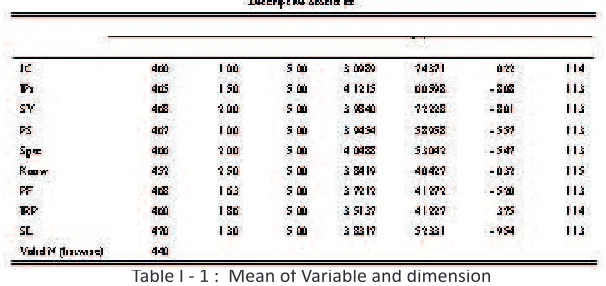
Table I reports the means for all Variable and dimension ques�onnaire. All ques�ons had answers spanning the en�re range, from the minimum of one to the maximum of five.
Table I - 1 : Mean of Variable and dimension
Reliability and Validity Analysis
The coefficient cronbach’s alpha for reliability of the kowledge characteris�c items scale is .797 with instruments validi�es from .337 to .562. Four items of kowledge characteris�c <.3 were deleted. Personal job fit items scale is .764 with instruments validi�es from .443 to .628. Three items of personal job fit <.3 were deleted. In Role Performance items scale is .655 with instruments validi�es from .442 to .511. Service leadership items cronbach’s alpha was .950 instruments validi�es from .361 to .784.
Confirmatory Factor Analysis (CFA)
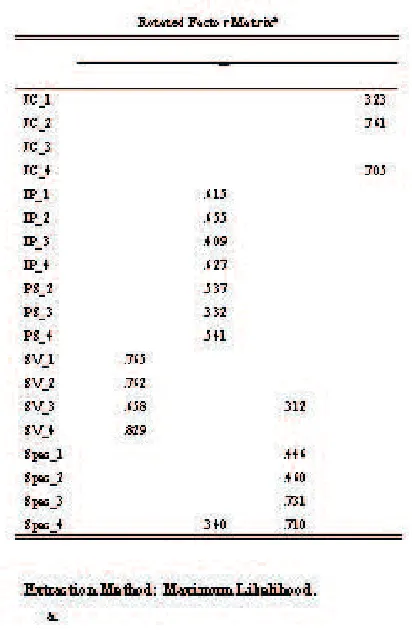
Table - 2 : Factor Analysis of Knowledge Characteris�cs items
per the Eigenvalue >1 criterion), using an oblique rota�on (Costello and Osbourne, 2005).
Table II displays the results of factor solu�ons. The solu�on were job characteris�c (JC_1, JC_2, JC_4), informa�on processing (IP_1 to IP_4), problem solving (PS_1 to PS_4), Skill Variety (SV_1 to SV_4), and Specializa�on (Spec_1 to Spec_4). Based on Tabachnick and Fidell’s (2001), we recommend employing criterion of at least 0.32 as the minimum loading for keeping items. This study found factor load consistently items to each dimension of conceptual knowledge characteris�cs dimensions approach.
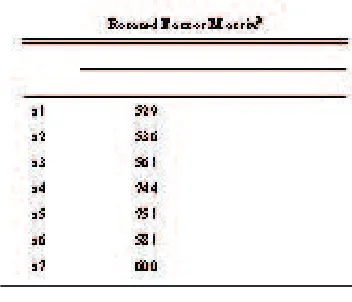
Table - 3 : Factor Analysis of Person Fit
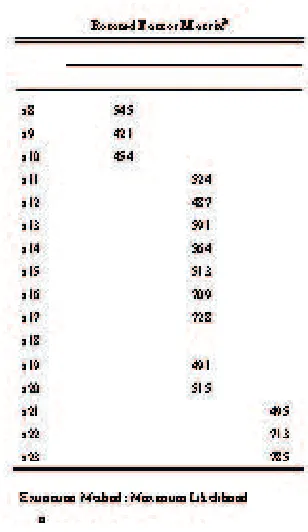
Table - 4 : Factor Analysis of Service Leadership
Factor analyzed in table IV of servant leadership using maximum likelihood extrac�on, for the ini�al Eigenvalue factor analysis, the first factor has total of 11.613, and 50.491% accounted variance. The other factor had total value 1.316 ranging from 5.721% to 56.212% of the variance and 1.130 ranging from 4.914% to 61.126% of the variance. This study found factor load consistently items to each dimension of conceptual servant leadership dimensions approach. S1 to s10 were represented of commitment dimension, s11 to s15 were represented of service dimension and s21 to s23 were represented of vision dimension.
Factor analyzed showed in table IV of in role performance using maximum likelihood extrac�on, for the ini�al Eigenvalue factor analysis, the first factor has total of 3.047, and 43.531% accounted variance. The other factor had total value 1.522 ranging from 21.744% to 65.274% of the variance. This study found factor load consistently items to each dimension of conceptual in role performance approach (ip1 to ip5).
Overall of fit
Mul�ple fit indices were adopted to evaluate the adequacy of the model of fit (arbucle and wothke 1999, joreskog and sorborn 2001, kelloway 1998, McDonald and Ho 2002, Reykov et al. 1991). The final CFA model knowledge characteris�cs showed an fairly fit to our data: goodness of model fit sta�s�cs were ?2(df=160)=3.48, Compara�ve fit index (CFI) = .896, Norm Fit Index (NFI) = .871,
root mean square error of approxima�on (RMSEA)= 0.063.
Hypothesis tes�ng
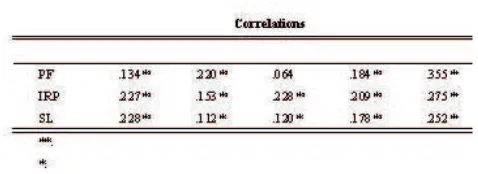
Table - 6 : Correla�on between data characteris�cs and variables
Table VI showed the rela�on between all dimension of knowledge characteris�cs and in role performance (r-JC=.227, r-IPs=.153, r-PS=.228, r-SV=.206, r-spec=.275) were significant (p< 0.01), thus supported hypothesis-1. Rela�on between dimensions of knowledge characteris�cs (excluded problem solving) and personal job fit (JC=.135, r-IPs=.220, r-SV=.184, r-spec=.355) were significant (p< 0.01), thus supported hypothesis-2. Also rela�on between personal job fit and in role performance (r=.274) was significant (p< 0.01), thus supported hypothesis-3.
Personal Fit Media�on
mediator on the independent variable, dependent variable on the independent variable, and finally dependent variable simultaneously on both the independent variable and on the mediator. According to Baron and Kenny (1986), media�on is demonstrated if the independent variable affects the mediator in their first equa�on and the dependent variable in their second equa�on, the mediator affects the dependent variable in their third equa�on and the effect of the independent on the dependent variable is less in the third than the second equa�on. Table-VII (VIIa to VIIe) showed that personal fit have no media�on the rela�onship between knowledge characteris�cs and in role performance (?=.348**; ?’=.288**), personal fit have no media�on the rela�onship between job characteris�cs and in role performance (?=.227**; ?’=.194**), personal fit mediated the rela�onship between informa�on processes and in role performance (?=.153**; ?’=.097), personal fit have no media�on the rela�onship between Skill Variety and in role performance (?=.209**; ?’=.156**), personal fit have no media�on the rela�onship between Problem Solving and in role performance (?=.228**; ?’=.208**), personal fit have no media�on the rela�onship between Specifica�on and in role performance (?=.275**; ?’=.202**). Therefore only personal fit mediated the rela�onship between informa�on processes and in role performance, Thus Hypothesis-4 was not supported.
** Significant at the 0.01 level * Significant at the 0.05 level
Table - 7 : Mediated regression analysis for knowledge characteris�cs
** Significant at the 0.01 level * Significant at the 0.05 level
** Significant at the 0.01 level * Significant at the 0.05 level
Table 7.b. : Mediated regression analysis for Informa�on processing
** Significant at the 0.01 level * Significant at the 0.05 level
Table 7.c. : Mediated regression analysis for Skill Variety
** Significant at the 0.01 level * Significant at the 0.05 level
Table 7.d. : Mediated regression analysis for problem solving
** Significant at the 0.01 level * Significant at the 0.05 level
Servant Leadership Modera�on
Modera�ng effect of knowledge characteris�cs and personal job fit and in role performance
Table Cap�on
** Correla�on is significant at the 0.01 level (2-tailed). * Correla�on is significant at the 0.05 level (2-tailed). gender 1 female
Table 8 : Mean and standard devia�on
** Significant at the 0.01 level * Significant at the 0.05 level
Table 9.a. : Servant leadership moderator regression analysis for knowledge characteris�cs
** Significant at the 0.01 level * Significant at the 0.05 level
Table 9.b. : Servant leadership moderator regression analysis for personal job fit
knowledge characteris�cs and personal job fit (? and ?R change of X*Mo was significant), thus hypothesis-5 was supported. Table IX-b showed that service leadership moderated the rela�onship between personal job fit and in role performance (? and ?R change of X*Mo were significant), thus hypothesis-6 was supported.
Table 10 : Effect of modera�on showed for high and low of each independent variable:
Table X showed the value of Effect of modera�on showed for high and low of each independent variable of servant leadership moderate on knowledge characteris�cs (LE=.037;HE=.379) that was less than servant leadership moderate on personal job fit (LE=.067;HE=.455), thus hypothesis-7 was supported.
CONCLUSION
Discussion
From above finding, we see that all dimensions of knowledge characteris�c related to
work characteris�cs would increase performance.
Knowledge characteris�cs dimensions (excluded problem solving) related to personal job fit. It was consist with previous Kristof et all (2005) study. This characteris�c was one of demand-ability fit of person job fit (Edwards, 1991) such as skill variety or specializa�on with the demands of the job such as job complexity. This study found that problem solving was not needed on ability’s fit. It is open opportuni�es to observe this finding more deeply.
Rela�on between personal job fit and in role performance consist with previous studies. The fit involves iden�fying the complete set of skills and abili�es that are necessary for successful performance in a par�cular job (Caldwell and O’Reilly, 1990, O’Reilly, Chatman and Caldwell 1991), fit are significantly related to work outcomes (Saks and Ashfort 1997, Cable and judge 1996, Chatman, 1989; Chatman and Barsade, 1995; Harris and Mossholder, 1996, Silverhart and Hinchliffe, 1996).
The finding that personal job fit mediates the rela�onship between informa�on processes
dimension of knowledge characteristics and in role performance provides insight into how job aspects and individual characteris�cs are translated into performance outcomes. Informa�on processing has theore�cally link to performance (Morgeson & Humphrey, 2006). It is expected to change the requirements for jobs in order complete their work. This direct rela�onship has been small. Personal job fit increase R2, rela�on
between informa�on processes and in role performance, from 0.023 to 0.084, change the requirements in order complete the works.
Service Leadership moderated the rela�onship between knowledge characteris�cs
and personal job fit, and moderated the rela�onship between personal job fit and in role performance consisted with previous research. Previous research has shown that leadership was related to expanded work roles. By inves�ga�ng servant leadership, it shows individuals with greater been served are likely to perform more work tasks (Hofmann et al., 2003).
Effect of modera�on of servant leadership, moderate on knowledge characteris�cs was less than moderate on personal job fit. It was because the self effort on job fit is greater to support encourage to performance.
Managerial Implica�on
By inves�ga�ng knowledge characteris�cs, this research demonstrates the personal job fit mediate informa�on process of knowledge characteris�cs on in role performance. These findings are important, although personal job fit mediated only on informa�on processes dimension of knowledge characteris�cs. Secondly, adequate informa�on were needed in an occupa�on would help the job perform be�er (Saks and Ashfort 1997). The current research suggests that it would influence how the informa�on be flowed through the job, organiza�on structure and organiza�onal chart.
Servant leadership was act as moderator of rela�on between knowledge characteris�cs-personal job fit and relation of knowledge characteristics-in role performance. The implica�ons of this research adds to our understanding of indica�ons define work design as the a�ributes of the task, job, social and organiza�onal environment, relate the job and the broader work environment (Morgeson & Humphrey, 2006). Previous research sought servant leadership related to both behavioral and a�tudinal outcomes such as Job sa�sfac�on (Ikel, 2005), and mo�va�on (Graham, 1995). This research demonstrates servant leadership is useful to meaningfully group on fi�ng and perform the job (Oshagbemi, 2005). The current research also suggests that how to maximize leader natural feeling that one wants to serve and to serve first (Turner, 1998, Ikel, 2005, Graham, 1995)
Limita�on and Future Research Direc�on
Notwithstanding these contribu�ons, this study also has several limita�ons. As noted, this research has a single occupa�on. They are teachers from several school levels. Although this allows us to rule out knowledge characteris�cs of job design-related explana�ons for the observed findings (i.e., personal fit, in role performance and servant leadership), it is an open ques�on as to whether these results will generalize to other, different occupa�ons. It is also important to recognize that our performance measure focused on in role performance (O’Reilly and Chatman 1986). Extra role performance such as organiza�onal ci�zenship behavior-OCB (Katz, 1964, Larry J William, 1991) was not included. In role performance reflects ac�vi�es that are formally recognized as part of the job and support the organiza�on’s technical core, whereas contextual performance such as OCB reflects the ac�vi�es that support the organiza�onal, social, and psychological environment (Borman & Motowidlo, 1993). Our results are likely limited to an in role performance because our work design reflects to the knowledge characteris�cs. We suggest extra role performance elements reflect to the social characteris�cs on work design (Morgeson, 2006).
References
Baron R. M., & Kenny, D. A. (1986), The moderator–mediator variable dis�nc�on in social psychological research: Conceptual, strategic, and sta�s�cal considera�ons. Journal of Personality and Social Psychology, 51, 1173–1182.
Bass, B.M. and Avolio, B.J., (1990), The implica�ons of transac�onal and transforma�onal leadership for
individual, and organiza�onal development, Research inOrganiza�onal change and development,
vol, 4 pp 231-72.
Bass B.M., Farrow, D.L., Valenzi, E.R. and Solomon, R.J,(1975), Management styles associated with organiza�onal, task, personal and interpersonal con�ngencies, Journal of Applied Psychology, vol 60., No 6, pp. 720-9
Bass, B.M., (1974), The bass-valenzi management styles profile: A computerized systems survey feedback
procedure, IRGOMTR report 74-12, Management Research center, University of Rochester, Rochester,
NY.
Bechtel, W. (1988), Philosophy of science: An overview for cogni�ve science. Hillsdale, NJ: Erlbaum. In Humphrey, et all 2007, Integra�ng Mo�va�onal, Social, and Contextual Work Design Features: A
Meta-Analy�c Summary and Theore�cal Extension of the Work Design Literature, Journal of Applied
Psychology, Vol. 92, No. 5, 1332–1356
Cable D.M. and Judge, T.A. (1996), person organiza�on fit, job choice decision and organiza�onal entry,
Organiza�onal behavior and Human decision processes 67 pp 294-311
Caldwell, David F., O’Reilly, Charles A., III, (1990), Measuring Person-Job Fit with a Profile-Comparison Process,. Journal of Applied Psychology, Washington: Dec 1990. Vol. 75, Iss. 6; p. 648 (10 pages)
Campion M. A., & McClelland, C. L. (1993), Follow-up and extension of the interdisciplinary costs and benefits of enlarged jobs, Journal of Applied Psychology, 78, 339–351.
Campion M.A (1988), Interdisciplinary approaches to job design: A construc�ve replica�on with extensions.
Journal of Applied Psychology, 73, 467–481.
Campion, M. A., & Thayer, P. W. (1985), Development and field evalua�on of an interdisciplinary measure of job design, Journal of Applied Psychology, 70, 29–43.
Campion, M. A., Mumford, T. V., Morgeson, F. P., & Nahrgang, J. D. (2005). Work redesign: Obstacles and
opportuni�es, Human Resource Management, 44, 367–390.
Chatman, J.A., (1991), matching people and organiza�ons: selec�on and socializa�on in public accoun�ng firms, Administra�ve science quarterly, 36 pp. 459-484
Chen, Lien-Tung, D.B.A., (2005), Exploring the rela�onship among transforma�onal and transac�onal leadership behavior, job sa�sfac�on, organiza�onal commitment, and turnover on the IT Department of Research and Development in Shanghai, China, 202 pages; AAT 3169070
Davidhizar, Ruth, and Robbins, Beverly, (2007), Transforma�onal Leadership in Health Care Today The Health Care Manager, Vol. 26, Iss. 3; pg. 234
Deci, E. L., & Ryan, R. M. (2000). The “what” and “why” of goal pursuits: Human needs and the self-determina�on of behavior, Psychological Inquiry, 11, 227–268.
Edward, JR. (1996), An examina�on of compe�ng versions of the person-environment fit approach to
stress, Academy of Management Journal, 39(2), 292-339.
Edwards J. R., Scully, J. A., & Brtek, M. D. (1999). The measurement of work: Hierarchical representa�on of
the mul�method job design ques�onnaire, Personnel Psychology, 52, 305–334.
Edwards, (1991). Person–job fit: A conceptual integra�on, literature review, and methodological cri�que. In I. T. Robertson & C. L. Cooper (Eds.), Interna�onal review of industrial and organiza�onal psychology
(Vol. 6, pp. 283–357). Oxford, England: Wiley.
Fabrigar L. R., Wegener, D. T., MacCallum, R. C., & Strahan, E. J. (1999). Evalua�ng the use of exploratory factor analysis in psychological research, Psychological Methods, 4, 272–299.
Gilbreth, F. B. (1911). Mo�on study. London: Constable. In Humphrey et al, 2007, Integra�ng Mo�va�onal, Social, and Contextual Work Design Features: A Meta-Analy�c Summary and Theore�cal Extension of the Work Design Literature, Journal of Applied Psychology, Vol. 92, No. 5, 1332–1356
Hackman J. R., & Oldham, G. R. (1975). Development of the Job Diagnos�c Survey, Journal of Applied
Psychology, 60, 159–170.
Hackman J. R., & Oldham, G. R. (1976). Motivation through the design of work: Test of a theory,
Organiza�onal Behavior and Human Performance, 16, 250–279.
Hackman J. R., & Oldham, G. R. (1980). Work redesign. Reading, MA: Addison-Wesley.
Hackman, J. R., & Lawler, E. E. (1971). Employee reac�ons to job characteris�cs, Journal of Applied Psychology Monograph, 55, 259– 286.
Harris SG, Mossholder KW. (1996). The affec�ve implica�ons of perceived congruence with culture
dimensions during organiza�onal transforma�on, Journal of Management, 22(4), 527-547.
Hofmann D. A., Morgeson, F. P., & Gerras, S. (2003). Climate as a moderator of the rela�onship between LMX and content specific ci�zenship: Safety climate as an exemplar, Journal of Applied Psychology, 88, 170–178.
Humphrey, Stephen E, Jennifer D. Nahrgang and Frederick P. Morgeson, (2007), Integra�ng Mo�va�onal, Social, and Contextual Work Design Features: A Meta-Analy�c Summary and Theore�cal Extension of the Work Design Literature, Journal of Applied Psychology, Vol. 92, No. 5, 1332–1356
Ikel, (2005), Servant leadership in higher educa�on: Exploring percep�ons of educators and staff employed in a university se�ng, 86 pages; AAT 3199527
Johns , G., Xie, J. L., & Fang, Y. (1992). Media�ng and modera�ng effects in job design, Journal of Management, 18, 657–676.
Kristof, R.A., 1996, Person organiza�on fit: An integra�ve review of its conceptualiza�ons, measurement and implica�ons, Personnel psychology, 49, pp.1-49
Kuhn, T. S. (1970). The structure of scien�fic revolu�ons. Chicago: University of Chicago Press. In Humphrey et al, 2007, Integra�ng Mo�va�onal, Social, and Contextual Work Design Features: A Meta-Analy�c
Summary and Theore�cal Extension of the Work Design Literature, Journal of Applied Psychology,
Vol. 92, No. 5, 1332–1356
Laudan, L. (1977). Progress and its problems: Toward a theory of scien�fic growth. Berkeley: University of California Press. In Humphrey et al, 2007, Integra�ng Mo�va�onal, Social, and Contextual Work Design Features: A Meta-Analy�c Summary and Theore�cal Extension of the Work Design Literature,
Journal of Applied Psychology, Vol. 92, No. 5, 1332–1356
Leithwood, K., Jantzi, D., & Steinbach, R. (1999). Changing leadership for changing �mes. London: Open University Press.Lepak & Snell, 1999. in Samuel Ngunia, Peter Sleegersb, and Eddie Denessen, 2006, Transforma�onal and Transac�onal Leadership Effects on Teachers’ Job Sa�sfac�on, Organiza�onal Commitment, and Organiza�onal Ci�zenship Behavior in Primary Schools: The Tanzanian case, School Effec�veness and School Improvement, Vol. 17, No. 2, June 2006, pp. 145 – 177
Li Ji, (2006), The interac�ons between person–organiza�on fit and leadership styles in Asian firms, an
empirical tes�ng, Interna�onal Journal of Human Resource Management, 1689–1706
Limsila, Kedsuda , and Ogunlana, Stephen O., (2008), Performance and leadership outcome correlates of leadership styles and subordinate commitment, Engineering, Construc�on and Architectural Management. Vol. 15, Iss. 2; pg. 164
Mar�n R., & Wall, T. D. (1989). A�en�onal demand and cost responsibility as stressors in shopfloor jobs,
Academy of Management Journal, 32, 69–86.
Meglino, BM, Ravlin EC, Adkins CL. (1991). Value congruence and sa�sfac�on with a leader: An examina�on of the role of interac�on, Human Rela�ons, 44(5), 481-495.
Morgeson , F. P., & Campion, M. A. (2002). Minimizing tradeoffs when redesigning work: Evidence from a longitudinal quasi-experiment, Personnel Psychology, 55, 589–612.
Morgeson F. P., & Campion, M. A. (2003), Work design, In W. C. Borman, D. R. Ilgen, & R. J. Klimoski (Eds.), Handbook of psychology: Industrial and organiza�onal psychology (Vol. 12, pp. 423–452). Hoboken, NJ: Wiley.
Morgeson F. P., Delaney-Klinger, K. A., & Hemingway, M. A. (2005). The importance of job autonomy,
cogni�ve ability, and job-related skill for predic�ng role breadth and job performance, Journal of
Applied Psychology, 90, 399–406.
Morgeson Frederick P. and Stephen E. Humphrey, (2006), The Work Design Ques�onnaire (WDQ): Developing
of Applied Psychology, Vol. 91, No. 6, 1321–1339, Copyright 2006 by the American Psychological Associa�on
O’Reilly III, C.C., Chatman, J., and Caldwell, D.F., (1991), people and organiza�onal culture: A profile comparison approach to assessing person-organiza�on fit, Academy of Management Journal, pp. 487-516
Oldham G. R. (1996). Job design. Interna�onal Review of Industrial and Organiza�onal Psychology, 11, 33–60.O’Reilly, 1990, In Humphrey et al, 2007, Integra�ng Mo�va�onal, Social, and Contextual Work Design Features: A Meta-Analy�c Summary and Theore�cal Extension of the Work Design Literature,
Journal of Applied Psychology, Vol. 92, No. 5, 1332–1356
Oshagbemi Titus, (2005), Age influences on the leadership styles and behaviour of managers Employee Rela�ons, pg. 14
Parker S. K. (1998). Enhancing role breadth self-efficacy: The roles of job enrichment and other organiza�onal interven�ons, Journal of Applied Psychology, 83, 835–852.
Poli�s, John D.,(2004), Transforma�onal and Transac�onal Leadership Predictors of the ‘S�mulant’ Determinants to Creativity in Organisational Work Environments, Higher Colleges of Technology,UEA
Roward, Jens, Heinitz, Kathrin, (2007), Transformational and charismatic leadership: Assessing the convergent, divergent and criterion validity of the MLQ and the CKS, Leadership Quarterly, Vol. 18, Iss. 2; pg. 121
Saks, A.M., and Ashfort, B.E., (1997). A longitudinal inves�ga�on of the rela�onships between job informa�on source, applicant percep�ons of fit, and work outcomes., personnel psychology, 50, pp. 395-426
Schaubroeck, Lam, John, Simon S K, Cha, Sandra E, (2007), Embracing transforma�onal leadership: Team
values and the impact of leader behavior on team performance, Journal of Applied Psychology, Vol.
92, Iss. 4; pg. 1020
Schwartz, Susan M., D.B.A., (1999), Transforma�onal, transac�onal and laissez faire leadership: An inves�ga�on of Bass’s (1985) theory in the periopera�ve environment, 150 pages; AAT 9938888
Staw, B. M., & Boe�ger, R. D. (1990), Task revision: A neglected form of work performance. Academy of Management Journal, 33, 534–559.
Taylor F. W. (1911), The principles of scien�fic management, New York: Norton.
Twigg, Nicholas W J, Fuller, Bryan, Hester, Kim, (2008), Transforma�onal Leadership in Labor Organiza�ons:
The Effects on Union Ci�zenship Behaviors, Journal of Labor Research, Fairfax: Mar 2008. Vol. 29,
Iss. 1; pg. 27
Vecchio, Robert P, Jus�n, Joseph E , Pearce, Craig L, (2008), The u�lity of transac�onal and transforma�onal
leadership for predic�ng performance and sa�sfac�on within a path-goal theory framework, Journal
Wall T. D., & Mar�n, R. (1987). Job and work design. In C. L. Cooper & I. T. Robertson (Eds.), Interna�onal review of industrial and organiza�onal psychology (pp. 61–91). Oxford, England: Wiley.
Wall, T. D., & Jackson, P. R. (1995). New manufacturing ini�a�ves and shopfloor job design. In A. Howard (Ed.), The changing nature of work (pp. 139–174). San Francisco: Jossey-Bass.
Wall, T. D., Corbe�, J. M., Clegg, C. W., Jackson, P. R., & Mar�n, R. (1990). Advanced manufacturing
technology and work design: Towards a theore�cal framework, Journal of Organiza�onal Behavior,
11, 201– 219.
Werbel, J.D., and Gilliland, S.W., (1999). Person-environment fit in the selec�on process. Research in personnel and human resources management, vol. 17, pp. 209-243
Williams J larry and Anderson E stella, (1991), Job sa�sfac�on and organiza�onal commitment as predictors of organiza�onal ci�zenship and in role behavior, Journal of management, Vol. 17., no. 3, p 601-617
Measurement Appendix
Work Design Ques�onnaire Knowledge Characteris�cs
Job Complexity
1. The job requires that I only do one task or ac�vity at a �me (reverse scored). 2. The tasks on the job are simple and uncomplicated (reverse scored).
3. The job comprises rela�vely uncomplicated tasks (reverse scored). 4. The job involves performing rela�vely simple tasks (reverse scored).
Informa�on Processing
1. The job requires me to monitor a great deal of informa�on. 2. The job requires that I engage in a large amount of thinking. 3. The job requires me to keep track of more than one thing at a �me. 4. The job requires me to analyze a lot of informa�on.
Problem Solving
1. The job involves solving problems that have no obvious correct answer. 2. The job requires me to be crea�ve.
3. The job o�en involves dealing with problems that I have not met before. 4. The job requires unique ideas or solu�ons to problems.
Skill Variety
1. The job requires a variety of skills.
2. The job requires me to u�lize a variety of different skills in order to complete the work. 3. The job requires me to use a number of complex or high-level skills.
4. The job requires the use of a number of skills.
Specializa�on
1. The job is highly specialized in terms of purpose, tasks, or ac�vi�es.
2. The tools, procedures, materials, and so forth used on this job are highly specialized in terms of purpose.
4. The job requires a depth of knowledge and exper�se.
Person Job Fit (Cable & Judge, 1996 ; Saks & Ashforth, 1997).
1. I believe my skills and abili�es match those required by the internship 2. My job performance is hurt by a lack of exper�se on the job.
3. My knowledge, skills and abili�es match the requirements of the internship 4. I possess the skills and abili�es to perform this job.
5. I feel that this internship enables me to do the kind of work I want to do. 6. This internship measures up to the kind of internship I was seeking. 7. This internship is a good match for me.
8. This internship fulfills my needs.
In Role Performance (7 items by William and Andersons 1991) 1. Adequately completes assigned du�es
2. Fulfills responsibili�es specified in job descrip�on 3. performs task that are expected
4. meets formal performance requirements of the jobs
5. engages in ac�vi�es that will directly affect performance evalua�on 6. neglect aspects of the job is obligated to perform ®
7. fails to perform essen�al du�es ® Servant leadership instrument
Page and Wong (2003): vision (0.97 Cronbach alpha), empowerment (0.89 Cronbach alpha), and service (0.94 Cronbach alpha).
Service leadership: empowering (10) –service (5) –vision (8)
1. Ac�vely seeking ways to u�lize people’s differences as a contribu�on to the group 2. Valuing everyone on his/her team
3. very forgiving when others make a mistake and helping them learn from their mistakes 4. se�ng clear and realis�c goals
5. Usually coming up with solu�ons accepted by others as helpful and effec�ve 6. deriving sa�sfac�on from bringing out the best in others
7. modeling for others how everyone can improve the process of produc�on 8. willing to have his or her ideas challenged
9. not asking anyone to do what he or she is unwilling to do 10. willing to share his or her power and authority with others 11. not seeking recogni�on or rewards in serving others 12. able to learn from subordinates whom he or she serves 13. willing to make personal sacrifices in serving others 14. seeking to serve rather than be served
15. commi�ed to the concept that leadership is more of responsibility than a posi�on 16. mo�vated by a sense of a higher calling
17. driven by values that transcend self interests and material success 18. suppor�ve of the belief that every organiza�on needs a higher purpose
19. able to ar�culate a clear sense of purpose and direc�on for his or her organiza�on’s future 20. aware f what he or she wants his or her organiza�on to become or do for society
21. Able to inspire other with his or her enthusiasm and confidence for what can be accomplished 22. very focused and disciplined at work