Gadjah Mada International Journal of Business Vol. 18, No. 1 (January-April, 2016): 83-105
Debunking the Monday Irrationality through the External
Affection of Investors
Rayenda Brahmana,
1Chee-Wooi Hooy,
2and Zamri Ahmad
21 Faculty of Economics and Business Universiti Malaysia Sarawak
2 School of Management Universiti Sains Malaysia
Abstract: This study aims to reveal the mechanism of the influences of the full moon and high tempera-tures on investors’ Monday irrationality. In contrast to other studies, this research was built under a retroductive approach by using a time series quasi experimental study. Investors were directly assessed for their irrationality by using an adapted psychometric test on 4 occasions. The results indicate that there were indeed effects of the full moon and high temperatures on investors’ irrationality. Because the full moon and high temperatures frequently occurred on Mondays, it is most probably those two variables that were the drivers of the Monday irrationality. In the end, we concluded that the rational behaviour assumption can no longer be held. Instead of rationality, the investors were quasi rational. The utility function of Von Neumann-Morgenstern in decision making has to be replaced by the hedonic utility.
Abstrak: Penelitian ini bertujuan untuk mengungkap mekanisme pengaruh bulan purnama dan suhu ting gi terhadap irasionalitas Senin pada investor. Berbeda dengan studi lain, penelitian ini dibangun di baw ah pendekatan retroductive dengan menggunakan studi eksperimental kuasi runtun waktu. Investor dinilai secara langsung untuk irasionalitas mereka dengan menggunakan tes psikometrik yang dilakukan empat kali. Hasil penelitian menunjukkan bahwa memang ada efek bulan purnama dan suhu tinggi pada irasionalitas para investor. Karena bulan purnama dan suhu tinggi sering terjadi pada hari Senin, hal ini sangat mungkin kedua variabel tersebut yang menjadi pendorong irasionalitas pada hari Senin. Pada akhirnya, kami menyimpulkan bahwa asumsi perilaku rasional tidak dapat lagi menjadi pegangan. Bukannya rasionalitas, para investor merupakan pelaku rasional semu. Fungsi utilitas Von Neumann-Morgenstern dalam pengambilan keputusan harus diganti oleh utilitas hedonik.
Keywords:experimental economics; high temperature; Monday irrationality; moon phase; psychological biases
Introduction
The rational motive for investment is value optimization, where investors tend to buy low, wait for the price to increase, then hopefully sell at the peak, and thus make a profit. This mechanism is modeled by con-ventional economics under the assumption of rational behavior. However, this tradi-tional tenet has been hugely disputed by be-havioral scholars; for instance Kahneman and Tversky (1979), who proposed the prospect theory, that stated that the behavior of indi-viduals was different due to different situa-tions of uncertainty, and argued that losses hurt more than gains felt good. This theory addressed the psychological biases that have intervened in the process of editing and evaluation in decision making (Daniel et al. 1998; Brahmana et al. 2012b).
One of the tenet violation dossiers of traditional economics is the day-of-the-week anomaly or the Monday Irrationality (hereaf-ter MI). First documented by French (1980), it shows that stock returns on Mondays have significant differences compared to the other days, indicating that investors behave differ-ently on Mondays. The importance of the MI has been addressed by many scholars. For in-stance, Bell and Levin (1998) found the role of MI on the efficiency of the market. Chen and Singal (2003) labeled the best day for speculative trading or active trading is dur-ing the MI. There are also Angel et al. (2003) who mentioned that the best trading day for short selling is during the weekend effect. In short, MI has practical importance for active investing.
Much research into MI has proposed the investors’ behavior as an explanation of the anomalous market conditions (see Abraham and Ikenberry 1994; Clare et al. 1995; Berument and Kiymaz 2001; Wong et al.
1992; Yahyazadehfar et al. 2006). Thus, re-search that has investigated it empirically, especially from the psychological point of view, is rarely found. Hence, linking the trad-ing behavior with psychological perspectives might give a new explanation for MI. This is in line with what is proposed in the psychol-ogy literature, such as by Krebs and Blackman (1999), who addressed three stimulants of human behavior, affection, learning, and the cognitive, in human psychology which can cause biased or irrational decision making.
In the perspective of the prospect theory, this MI is driven by psychological fac-tors, and might be caused by a perception bias. This means that MI’s occurrence might be due to psychological factors such as affection and cognition. Previous research by Abraham and Ikenberry (1994), and Wong et al. (1992), addressed trading behavior as the explanation of this MI, yet rarely found that research had investigated it empirically; a gap that this study wants to fill. Therefore, this research aims to investigate the psychological drivers of MI from the psychological perspective.
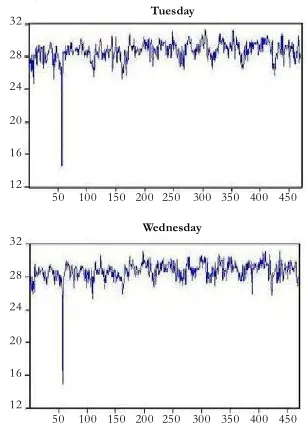
Interestingly, the anomalies in our natu-ral environment are in line with this MI, for instance the research paper of Forster and Solomon (2003). By using surface measure-ments of maximum and minimum tempera-tures from the Global Daily Climatologically Network data set, they documented that many climate stations in the world reported high temperature levels from Saturday to Monday, similar occasions to MI. Our plot also showed the same. Temperature season-ality in global temperatures documented the Monday temperatures as being relatively higher than those of other weekdays. The range of the Monday temperatures rises from around 26oC up to around 33oC. However,
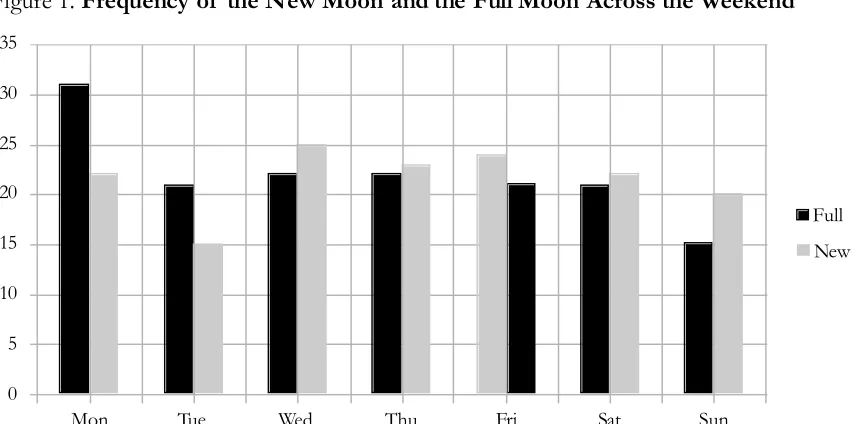
Mondays are relatively hotter than the other days on average. This is in line with the MI in the stock market. Mother nature also has an-other anomaly, where the full moon-new moon occurs more on Mondays than on other weekdays (see Figure 1). This preliminary finding encourages us to surmise the role of the full moon on the investors’ MI. If the full moon occurs more on Mondays, and contrib-utes to human behavior, it is possible that MI is caused by the phases of the moon.
Malaysia is chosen as the sample for the research because this country offers a unique environment for examining the role of exter-nal factors on stock trading performance.
Firstly, Malaysia is one of the fast-growing emerging markets, with a high FDI, stable economic growth, and huge market capitali-zation (see Goh and Wong 2011). Secondly, in terms of the behavior of market participants, many research papers have found the
irratio-nality. For instance Muhammad and Ismail (2008) addressed that Malaysian investors tended to follow sentiment. It is strengthened by Wong and Lai (2009) who stated that Malaysian investors had representativeness bias and overconfidence in their trading ac-tivities. However, these arguments were re-futed by Lai and Lai (2010) who found that Malaysian investors were rational in terms of their reference dependence. Lastly, the unique environment of Malaysia, because of its po-sition in the equatorial region, means the tem-peratures should be the same throughout the year. Hence, it makes this research more in-teresting, as many scholars have found no relationship between temperatures and stock returns (see Trombley 1997; Kramer and Runde 1997; Pardo and Valor 2003). As those researchers tested in developed and four-season countries, the findings of this research enrich the available literature.
Figure 1. Frequency of the New Moon and the Full Moon Across the Weekend
Note:Y axis is the numbers of occurrences; Mon is Monday, Tue is Tuesday, Wed is Wednesday, Thu is
Thursday, Fri is Friday, Sat is Saturday, and Sun is Sunday
Mon Tue Wed Thu Fri Sat Sun
0 5 10 15 20 25 30 35
Friday
50 100 150 200 250 300 350 400 450 12
16 20 24 28 32
Thursday
50 100 150 200 250 300 350 400 450 18
20 22 24 26 28 30 32
Monday
25 26 27 28 29 30 31 32 33
The main focus of our study is how nature influences the investors’ trading deci-sions, whereby full moon phases and tempera-ture are the sources of the investors’ irratio-nality. Those two variables shape the moods and the cognition of investors, which leads to their stock performances. Note that even though much research has attempted to ex-plore the deter minants of this MI (see Abraham and Ikenberry 1994; Clare et al.
1995; Berument and Kiymaz 2001; Brahmana et al. 2012b), based on our knowledge, no research has examined the relationship, es-pecially in an experimental study.
This study is different from other stud-ies in 4 senses. Firstly, it takes and elaborates the behavioral psychological perspective, which states that external factors are the source of moods, in answering the market anomaly. Secondly, it is constructed under a
Figure 2. Continued
Tuesday
50 100 150 200 250 300 350 400 450 12
16 20 24 28 32
Wednesday
50 100 150 200 250 300 350 400 450 12
16 20 24 28 32
retroductive design where an experimental study is used to confirm the mechanism of the influences of the moon and temperature on MI. Thirdly, unlike standard behavioral economic studies, our study interacts directly with the investors. These investors were the subject of the time-series quasi experiment.
Finally, this study used a robust analysis which was a partial least regression. This regression included the latent variables in the model to minimize variance errors.
Conceptual Background
This research aims to investigate the role of temperature and the full moon on inves-tors’ behavior. It is postulated based on prior studies in psychology which document how the temperature and full moon affect human behavior. The research into the relationship between moods and decision making has been conducted since the early 1980s. For instance, there was Tversky and Kahneman (1992) who concluded that there is a signifi-cant relationship between moods and ratio-nal choices. Forgas (1995) stated that moods affect decision making strategies. The ings of happiness, sadness, and a neutral feel-ing have rewarded efficient decision makfeel-ing, inefficient and costly decision making, and controlled decision making respectively. Forgas concluded that the effects of the vari-ous moods were generally dependent on the personal relevance of the decision. Hockey et al. (2000) surmised that negative moods encouraged people to take risky decisions. They named the states of fatigue, anxiety, and depression as the key determinants of nega-tive moods in triggering risky decision mak-ing. This indicates moods have a significant influence on decision making. Further, Loewenstein and Lerner (2003) stated that there were cognitive errors that people made
in their decision making. They offered the role of emotion in decision making as the causal factor for the cognitive errors. Further, they argued that the role of emotion, which was induced by various moods, degraded the qual-ity of the decision making.
There are many proxies for moods in psychological studies. Yet, this study stands on the affection-driven mood where the weather and full moon may become one of the factors (see Brahmana et al. 2012a). Weather is a comprehensively researched source of misattributed moods. Schwarz and Clore (1983) found that people received greater satisfaction when the weather was sunny rather than when the weather was re-ported as being rainy. Further, Howarth and Hoffman (1984) summarized that weather affected an individual’s mood or emotional state, creating a particular kind of behavior. A study by Hansen et al. (2008) examined the role of high temperatures on mental, be-havioral, and genitive disorders. By estimat-ing hospital admissions and mortalities attrib-uted to mental, behavioral, and cognitive dis-orders during the period from 1993-2006, they suggested that high temperatures pose a salient risk to mental health. This finding is aligned with previous results that also stated that high temperatures had a relationship with mental health (Basu and Sumet 2002; Kovats and Ebi 2006).
to match precise phases of the lunar month, including Islamic, Hebrew et al. (Yuan et al. 2005). Because of these patterns, psychol-ogy scholars have investigated the role of the moon’s phases on human moods.
Early studies of the full moon’s impact were conducted by Kane et al. (1967). They examined the role of the moon’s phases on human behavior. They found that the lunar phases, especially in the full moon phase, af-fected human moods and changed them to more depressive behavior, emotional distur-bance, and other normal changes. Dewey (1971) also documented that births and deaths exhibited a moon cycle effect. Dewey stated that more births occurred during the waxing rather than the waning of the moon; death rates increased after a full moon. Cuningham (1979) investigated the role of temperature and the moon on the feeling of generosity. Cuningham found the full moon phase affected the generosity of humans. Wilkinson (1997) found that moon cycles really affected the moods of humans. He con-tinued by explaining that the moon’s cycle can cause anxiety and depressive mood disorders. Another study was conducted by Barr (2000), who conducted a study comprising of 100 samples by using the ANOVA statistic to in-vestigate the role of the moon’s cycle. Bar concluded that the moon’s cycle had a sig-nificant relationship to the quality of life of humans, in terms of their moods.
In finance, these mood factors, the weather and moon, have been employed as a factor for investors’ behavior. For instance, Saunders’s work (1993) found a relationship between the cloud cover level in New York and the equity returns in New York. Sauders (1993) found when the level of cloud cover was 100 percent, the stock returns were sig-nificantly below average, and when the cloud cover level was 0-20 percent, the stock
re-turns were significantly above the average. These findings are very important in support-ing the behavioral finance theory. When rep-licating Saunder’s work, Hirshleifer and Shumway (2003) documented the same re-sults within broader markets over a longer period. Pardo and Valor (2003) found the ef-fects of weather on the financial markets in the behavior of the markets’ traders. Kramer and Runde (1997), Brahmana et al. (2012b, 2014a, 2015) found a positive relationship between the weather conditions and stock market returns.
Bombay stock exchange’s returns. After in-vestigating 17 years of stock returns, they concluded that the moon’s cycles did link with the returns. Gao (2009) also investigated the relationship between the moon’s cycles and market returns in two major Chinese stock markets over 16 years. Gao concluded that the lunar phases did affect the stock returns. Gao showed that the returns are relatively lower when there is a new moon and rela-tively higher during a full moon. Further, Brahmana et al. (2014b, 2014c) have found the same conclusion, that the occurrence of the full moon may affect the investors’ trad-ing behavior.
Therefore, based on the studies men-tioned above, this research hypothesizes that the existence of a full moon and high tem-peratures influence the behavior of investors. The seasonality of the full moon occurrences and temperature conditions generate the MI.
Research Design
This research employed a time series quasi experimental study to achieve its ob-jective. Investors were asked to fill in the adopted psychometric test to measure their moods, cognitive disarray, aggressiveness, decision making style, risk behavior and stock trading performance. The mood was mea-sured by a Profile Of Mood State (hereafter POMS). This is a psychometric assessment which measures mood disturbances in 6 do-mains: fatigue-inertia, vigour-activity, tension-anxiety, depression-dejection, tension, and confusion-bewilderment. This psychometric assessment has been adopted to capture hu-man mood disorders. Instead of using a lengthy version of POMS such as McNair et al. (1989) with 65 items, and Shacham et al., (1987) with 37 items, this research adopted
Cella et al. (1987) with 11 items as the adopted psychometrics to precisely mimic mood disorders.
Note that in choosing which POMS psychometric items would be used, a pilot study was conducted on 182 undergraduate and postgraduate students with the McNair et al. (1989) items. The factor analysis result suggested deleting up to 48 of the items as the cross loading factors were very high. The respondents also complained about the length of the study. Moreover, as there were only 17 items of Cella et al. (1987), it was decided to use that as the measurement.
The disarray of cognition was adopted from the Cognitive Style Index (CSI). The Allinson and Hayes (1996) CSI questionnaire was used to capture cognitive disarray, which can be defined as the mental behavior involv-ing a pattern of deviation in judgment that occurs in a particular situation. Additionally, the Buss and Perry (1992) aggressiveness (AGGR), Risk Behavior Index (RBI), and the Decision Making Style Index (DMSI) were introduced to capture the psychological con-ditions on a particular day and occasion. In the latter, psychometrics constructed a re-search model/framework with stock perfor-mance as the endogenous factor. In addition to that, the return performance was retrieved by asking “How much return did you gain today?”
were run under a partial least square regres-sion, a nonparametric regression that consid-ers the latent variables of the equation.
The object of the experiment was cho-sen by following the non-probability sampling method. This was done by distributing an adopted psychometric question to all the in-vestors in Malaysia on a certain day. Using an online survey, this research sent the vey website link at 6am and closed the sur-vey at 8pm. The email stated that participa-tion in the test was voluntary, to agree to do it during the first break or after the trading day, and to agree to do it four times. The sur-vey recorded the times and encoded the names of the investors. For instance Mr. Lim, the second respondent completed the survey at 5.32pm. This was recorded and the sys-tem automatically gave him the code R_2. Because the number of respondents in this research was 316, the codes ranged from R_1 to R_316; however, only 274 samples were used because not all the respondents com-pleted the study process. Note that the in-vestors were not informed that we were con-ducting research into MI and psychological biases. They only knew that the form was purely for psychological profiling only.
The experimental study timetable can be reviewed in Table 1. The first study took place on the 4th of April 2011 (Monday) when
the temperature was 31.3 degrees Celsius; the highest temperature for that particular week (4th-10th of April 2011). The moon phase on
that day was a new moon. In the first study, there were 316 subjects. The second experi-ment was conducted on the 18th of April 2011
(Monday) when the temperature was 28.4 degrees Celsius; the highest temperature for that particular week (18th-24th of April 2011).
The moon phase on that day was a full moon. Study 3 was conducted on the 12th of
Octo-ber 2011 (Wednesday) when the temperature was 26.7 degrees Celsius; the second lowest temperature for that particular week (10th-16th
of October 2011). The moon phase on that day was a full moon. Lastly, the fourth study was conducted on the 26th of October 2011
(Wednesday) when the temperature was 26.5 degrees Celsius; the lowest temperature for that particular week (24th-30th of October
2011). The moon phase on that day was a new moon. This research only used the 274 respondents who completed all four psycho-metric tests, which means 42 subjects were excluded from this research. In short, the ex-periments were conducted according to the following timeline schedule. Wednesday was chosen as a representative day for the week-day trading because stock returns on Wednes-days were usually free from anomalies and noise, which implies that the investors’ ag-gressiveness or tranquillity on Wednesdays were at normal levels. Tuesdays might have been influenced by Monday trading, and Thursdays might have been influenced by Friday (the Friday effect), which is why they were not chosen.
Table 1. The Eexperimental Study Schedule
Monday Wednesday
Full Moon 18 April 2011 12 October 2011
Results
Goodness of Measures
1The validity and reliability are com-monly used for testing the goodness of mea-sures. Reliability tests how consistently an instrument measures its construct, whereas validity is a test to measure how well an in-strument measures the particular concept it is intended to measure (Sekaran and Bougie 2010).
The reliability results were based on Cronbach’s alpha results, where all alpha val-ues were higher than 0.6 as sug gested by Nunnally and Bernstein (1994). The Compos-ite Reliability (CR) also ranged from 0.61 to 0.846 for the entire study. Interpreted as a Cronbach’s alpha for the internal consistency reliability estimate, a CR of 0.70 or greater was considered acceptable (Fornell and Larcker 1981). As such we concluded that the measurements were reliable.
The discriminant validity results showed the squared correlations for each construct were less than the Average Variance Extracted (hereafter AVE) by the indicators measuring that construct, indicating adequate discrimi-nant validity (refer to Compeau et al. 1999). In total, the measurement model demon-strated adequate discriminant validity. The
AVE values ranged from 0.5084 to 0.6160. The convergent validity results were also passed the threshold, as suggested by Hair et al. (2010). The CR results ranged from 0.610 to 0.8465 for the entire study. They exceeded the recommended value of 0.5 by Barclay et al. (1995). Hence, we concluded the items used in the study were convergently valid.
Does Monday Irrationality Truly
Exist?
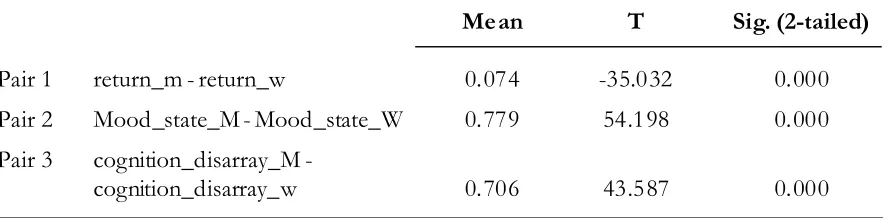
The results showed that the returns per-formance on Monday were significantly dif-ferent to the returns performance on Wednes-day (see Table 2). The mood state and cogni-tive disarray on Mondays were also signifi-cantly different to those on Wednesdays. The findings demonstrated that the behavior of investors on Mondays was significantly dif-ferent to Wednesdays. This conclusion sup-ported the MI hypothesis, i.e. investors can-not be assumed to be rational as they have a different mood state and cognitive disarray on Mondays. The hedonic utility, where the decision making in satisfying the needs is built under emotion-feeling, is supported by our quasi experimental results.
These findings support both the previ-ous research studies in the psychology litera-ture (i.e., Dobbins 1982; Willich et al. 1994; Koeske et al. 1994; Gill and Scharer 1996; Table 2. The Paired T-Test Results
Mean T Sig. (2-tailed)
Pair 1 return_m - return_w 0.074 -35.032 0.000
Pair 2 Mood_state_M - Mood_state_W 0.779 54.198 0.000
Pair 3 cognition_disarray_M
-cognition_disarray_w 0.706 43.587 0.000
Card and McCall 1996; and Muvakami et al. 2004) and in the economic literature (i.e., French 1980; Lim et al., 2010; and Lim and Chia 2010). Koeske et al. (1994), and showed that both personal and job satisfaction on Mondays was less when compared to other days. This idea of the Monday blues hypoth-esis continued in Gill and Scharer’s (1996) research, in which they showed how students nervously misspell words on Mondays. The emotion of nervousness means that the stu-dents could not score highly in exams. Muvakami et al. (2004) showed that blood pressure levels on Mondays were significantly different compared to other days. This was tested by monitoring the community-dwell-ing population and observcommunity-dwell-ing the repeated ambulatory information. Blood pressure had a deviant behavior, especially on Mondays. The psychology literature has confirmed our quasi-experiment, whereby the stock trading performance, mood states and cognition dis-array of the investors on Mondays were sig-nificantly different from the norm. The causes could be the occurrence of the full moon and or a high temperature on that particular day.
Result of the Study 1
2: 4
thof April
2011
The first study was conducted on Mon-day during the new moon phase. The quasi experimental results documented the effect of temperature. In this experimental study the temperature was not the room temperature, but the outdoor weather temperature which was obtained from the Malaysian meteoro-logical office and found to be 31.3 degrees Celsius on that particular day. Investors were presumed to be inside air-conditioned rooms. It can be argued that a hot outdoor
tempera-ture can be eliminated by a cold indoor tem-perature because of air-conditioning. How-ever, if one believes this hypothesis, only the sensation of temperature not the sentiment would be examined. In the psychology litera-ture, it is stated that temperature has an ef-fect on the cognitive process and transforms the sensations of heat into perception or memory.
The results show the psychological bias on investors during Monday trading (See Appendix 2). The R-squared values were 13.5 percent, 3.4 percent, and 8 percent for the aggressiveness model, risk behavior model, and decision making style model respectively. The full model itself was 10.2 percent of R-squared, which validates the goodness of the model.
The first quasi-experiment showed that investors’ were aggressive and indulged in a risky decision making style. However, only the decision making style had an effect on the stock trading performance. It implied that the high temperature had an effect on the in-vestors’ stock trading performance. The re-sult is analogous to previous rere-sults in finance studies such as those by Saunders (1993), Kramer and Runde (1997), Kamstra et al. (2000), Pardo and Valor (2003), and Brahmana et al. (2012a). In the psychology literature, this result is in line with Basu and Samet (2002), and Kovats and Ebi (2006).
Based on our quasi-experiment, the in-vestors did not ultimately follow the Von Neumann-Morgenstern utility function. The investors did not have rational judgment when the temperature was high. The choices made by the investors might contain emotion or affection. Rational behavior can no longer be held to be the basic assumption because
of the findings, as it is indeed the case that temperature has an effect on investors.
Study 2: 18
thof April 2011
The second study was conducted on a Monday in a full moon phase and with a high temperature. It confirms the hypothesis of the moon and temperature affecting investor irrationality on this particular day. The model is much better than that of the first study (the best among the others) as depicted by the R-square result. The full model shows 8.1 per-cent of R-squared indicating that variance can explain the model well enough. Mean-while, the aggressiveness model was up to 41.3 percent of the R-squared value, indicat-ing that 41.3 percent of the variance can ex-plain the model. The risk behavior and deci-sion making style model was documented at 29.9 percent and 14 percent of R-squared respectively, which surmises the model is ro-bust.
In terms of investor moods, Study 2 demonstrated a positively significant effect on the psychological bias outcomes (aggres-siveness, risk behavior, and decision making style), and was significant at a level of 1 per-cent. The positive sign implies that the higher the mood disturbance, the higher the psycho-logical bias outcomes. For instance, the higher the mood disturbance is, the more ag-gressive the investors become. Similarly, cog-nitive disarray influenced the outcomes, ex-cept for the decision making style. It was also positively significant on the outcomes at a 1 percent level. Aggressiveness influenced the performance at a 1 percent level with a nega-tive coefficient value of 0.162. Meanwhile, risk behavior and decision making style shaped performance at a 10 percent level. The risk behavior coefficient value was -0.101 implying that risk behavior was inverse to
lower the performance. The quasi experimen-tal results supported the hypothesis. It should be noted that the high temperature and the full moon were during the day of the experi-ment. In other words, the full moon and high temperature interacted with each other to influence the investors’ behavior.
The results showed that the mood state and cognitive disarray made the investors more and more prone to engage in risky be-havior and decision making (See Appendix 3 for detail). This aggressiveness, risky behav-ior and decision making partially mediated the relationship between the mood state, aggres-siveness, and stock trading performance. In other words, when a full moon and high tem-perature were present, there were effects on the relationship between the mood state and stock trading performance, as well as the re-lationship between the cognitive disarray and stock trading performance. The interaction between a full moon and a high temperature had a different level of magnitude in influ-encing the investors. This is in line with Isen et al. (1978), Janis and Mann (1977), Warneryd (2001), Basu and Samet (2002), Slovic et al. (2004), and Lucey and Dowling (2005).
Study 3: 12
thof October 2011
had a consequence on the psychological out-comes (aggressiveness, risk behavior, and decision making style) at a 1 percent level. The directions of the relationship were posi-tive with coefficient values of 29 percent, 39.3 percent, and 29.7 percent on aggressive-ness, risk behavior, and decision making style respectively. The effect of cognitive disarray only occurred with a 1 percent aggressive-ness level; however, it did not influence the risk behavior and decision making style at a 10 percent level. The coefficient values were 5.1 percent and 9.7 percent for risk behavior and decision making style respectively, which implies that the cognitive disarray on the day of the least disturbance did not bias the risk behavior or the decision making style of the investors. The results also showed that the outcomes of the psychological biases failed to generate changes in the trading perfor-mance on Wednesday, as it was insignificant. The decision making style had a significant effect at a 10 percent level, but aggressive-ness and risk behavior failed to determine the performance. The coefficient values were 3 percent, 3.4 percent, and 19.3 percent for aggressiveness, risk behavior, and decision making style respectively.
In summary, the results documented that psychological biases failed to determine the investors’ performance on Wednesdays. Psychological biases had an effect on the outcomes, but not as far as the performance of the investors. These findings support the hypothesis whereas psychological biases are the determinants for the MI only. The result is in line with previous financial study results such as Dichev and Janes (2003), Yuan et al. (2005), Herbst (2007), and Gao (2009). The results are also the same as those found in several psychology papers, such as Wilkinson (1997) and Barr (2000) who discovered the role of the moon’s cycles on human
behav-ior. Therefore, the quasi-experimental results confirmed that the full moon effect influences mood states and cognitive disarray, but only the decision making style from the mood state successfully influences stock trading perfor-mance.
Study 4: 27
thof October 2011
Study 4 is the last study conducted to confirm the hypothesis. It was performed on a Wednesday in a new moon phase and with the same respondents. The purpose is to com-pare the results with the other new moon re-sults. It also aims to show the difference be-tween a Wednesday with a full moon and a Wednesday with a new moon. As shown in Appendix 5, the results were expected to con-firm there was no role for psychological bias in the trading performance.
phase, only affected the psychological biases outcome but did not influence the trading performance on that particular day. The mag-nitudes of the influence are also highly dis-persed. For instance, the mediating effect of risk behavior has a negative influence on the performance by up to 1.2 percent. However, mood has a positive influence on aggressive-ness by up to 43.3 percent. There is a nega-tive relationship between aggressiveness and risk behavior on stock performance. Even though it is not significant, it shows tempera-ture has a negative effect on performance. In terms of the model’s robustness, the R-squared of the full model is only 1.6 percent. Meanwhile the R-squared of the aggressive-ness model, risk behavior model, and deci-sion making style model are 19 percent, 8 percent, and 18.4 percent, respectively, which confirms that the predictors are good enough to explain the model.
A normal day on the fourth experimen-tal study confirmed the quasi rational behav-ior. Quasi rational means that irrational be-havior was not present in all decision mak-ing. If there are no psychological biases such as sentiment or mood disturbance, the inves-tors will remain rational (Thaler 1994). In-deed, it is in line with the utility equation func-tion of the prospect theory which is addressed by Kahneman and Tversky (1979). The evaluation of choice can be rational and maxi-mize utility, if the individual has not received any psychological sentiments. Daniel et al. (1998) documented the role of overreaction under uncertainty to momentum anomaly. They stated that if there are no psychologi-cal biases on the investor, the market will not experience under-reactions and over-reac-tions. Butler and Loomes (2002) and Nelson
and Bessler (2006) reached the same conclu-sion by using an experimental approach. The non-existence of the psychological biases means that the investor makes rational deci-sions. Hence, the fourth experimental study showed that without a full moon and a high temperature, the mood and the cognitive dis-array of the investors did not affect the stock trading performance.
Theoretical Explanation for
the Findings
The role of a high temperature and a full moon on the investors’ moods and cog-nition, and how they affect the stock trading performance can be explained by examining 3 main theories which are: (1) the cognition process, (2) the affect infusion model, and (3) the psychologically biased decision mak-ing.
Cognition Process – In the cognition process, human senses are the media to cap-ture incoming stimuli.3 The stimuli could be
high temperatures or the gravity of the full moon. For instance, the temperature on the day of the experiment was the highest in that week. The temperature affected the investors when they were outside (going to the office, having lunch, opening the curtains, etc). At that second, their senses (skin or eyes) cap-tured the incoming stimuli and sent it to their ner ves. The nerves encoded the stimulant (the effect of the temperature) as energy and transformed it to a perception. This percep-tion went to their cognipercep-tion process and was matched against previous experience (our memory would restore the cognition process and also keep it). During the decision mak-ing process, this memory affects the verdict
and is based on emotions or feelings, which is how the temperature or the full moon might influence our behavior.
Affect Infusion Model – This model was proposed by Forgas (1995). It explains how the affection variables, such as a moon-induced mood or temperature-moon-induced mood, affect (infuse) the decision making of an in-dividual. For example, the full moon affects investors by gravity (direct access process). Then, the full moon generates biological dis-turbances in the human body (motivational process). The disturbances in the human physiological system lead to irrationality, which causes a heuristic bias (the heuristic process). Finally, the infusion inside the hu-man being leads to a biased decision (the sub-stantive process). In our results, a full moon influenced the investors’ moods and cogni-tive disarray (direct access and motivational). Their mood and cognitive disarray influenced their aggressiveness, risk behavior, and deci-sion making style (heuristic process). Even-tually, it affected their stock trading perfor-mance (a proof of the substantive process). This AIM is one of the best models to ex-plain how temperature or a full moon affects stock trading performance.
Psychologically Biased Decision Making/ABC Model– the psychology lit-erature already shows how decision making is influenced by psychological factors (i.e. Janis and Mann 1977; Cunningham 1979; Daniel et al. 1998; Warneryd 2001; Slovic et al. 2004). This is what is called psychologi-cally biased decision making. The best model to explain the relationship is Ellis’ ABC Model. This model surmises the activating event (in our case a full moon and high tem-perature), influences core beliefs in decision making, and as a consequence, causes deci-sion making to be biased. The easy way to understand Ellis’ ABC model is by looking
back at the prospect theory of Kahneman and Tversky (1979). The screening and evalua-tion process before making a decision are in-terrupted by an activating event such as a full moon or high temperature. Because of those two factors, the screening and evaluation pro-cess (the core belief) are influenced by these factors. As a result (the consequences), deci-sion making is psychologically biased and re-sults in irrational behavior. Forgas (1989), Forgas (1994), Kahneman et al. (1999), and Slovic et al. (2004) addressed the hedonic utility as the outcome of this psychologically biased decision making. Instead of being ra-tional and maximizing the utility, the inves-tors tend to use their feelings, sentiments, or moods when they are making a judgment or a decision. On a day when there is a full moon and/or a high temperature, the investors tend to be more aggressive, sentimental, or suffer from mood disorders. This eventually affects their stock trading performance through irra-tional judgments and decision making.
Conclusion
A lot of research on MI has suggested trading behavior as the explanation for this phenomenon. However, it has rarely been empirically investigated. Motivated by behav-ioral psychology, this paper has aimed to ex-plore what determines MI. The examination was performed using the retroductive ap-proach, while the method was a time series quasi experiment.
indirectly illustrated that the experimental study was good enough.
The results support our hypotheses. A full moon and a high temperature are the fac-tors that can cause investor irrationality. On a day when there is only a full moon, it was only the investors’ moods that influenced their stock trading through their decision making style. On a day when there was a high temperature, it was again only the investors’ moods which influenced their stock trading performance through the decision making style. These two results demonstrate that if there is an external affection, investors might experience irrationality via mood disturbances. Interestingly, when a full moon and high temperature co-existed, the mood distur-bances and cognitive disarray influenced the stock trading performance through aggres-siveness, risk behavior, and decision making style. In other words, the existence of two external factors can cause a bigger degree of irrationality. Investors might have mood dis-turbances and cognitive disarray, and these two variables encourage investors to be more aggressive, engage in high risk behavior, and deviant decision making. As a consequence, the stock trading performance was negative. When there was no moon or a normal tem-perature, the market was normal. There is no bias because of the mood state or cognitive disarray. The result concludes that without any external affection, the market might be normal.
In summary, a full moon phase and high temperature usually occur on Mondays. Those two variables are the drivers in making in-vestors act irrationally; as without those vari-ables, the market tends to be normal and the investors are more likely to be quasi rational. If there is no full moon or high temperature
(a normal day), investors make rational deci-sions in terms of their evaluation of infor-mation. However, if there is a full moon or a high temperature, or some other psychologi-cal biases, investors are irrational in their de-cision making. As a full moon occurs more often on Mondays, and the temperature is higher on average on Mondays, these two fac-tors cause the MI. It infers that these two psychological biases are the determinants for MI. These results also show that the assump-tion of raassump-tional behavior can no longer be held as investors tend to have a quasi hedonic utility. External factors of human affections affect the rationality of investors on Mon-days or whenever there is a high temperature or a full moon. Chugh and Bazerman (2007) addressed this bounded awareness as the cog-nitive deficiency. Investors are influenced by the psychological biases of the gravity of the moon and high temperatures.
References
Abraham, A., and D. L. Ikenberry. 1994. The individual investor and the weekend effect. The Journal of Financial and Quantitative Analysis 29 (2): 263-277.
Angel, J. J., S.E. Christophe, and M. G. Ferri. 2003. A close look at short selling on Nasdaq. Financial Analysts Journal 59 (6): 66-74.
Allison, C. W., and J. Hayes. 1996. The cognitive style index: A measure of intuition-analysis for organiza-tional research. Journal of Management Studies 33 (1): 119-135.
Barclay D. W., R. Thompson, and C. Higgins. 1995. The Partial Least Squares (PLS) approach to causal modeling: Personal computer adoption and use an illustration. Technology Studies 2 (2): 285–309. Barr, W. 2000. Lunar revisited: The influence of the moon on mental health and quality of life. Jour nal
Psychosocial Nurse Mental Health Serice 38 (5): 28-35
Basu, R., and J. M. Samet. 2002. Relation between elevated ambient temperature and mortality: A review of the epidemiologic evidence. Epidemiologic Reviews 24: 190-202.
Bell, D., and E. Levin. 1998. What causes intra-week regularities in stock returns? Some evidence from the UK. Applied financial economics 8 (4): 353-357.
Berument, H., and H. Kiymaz. 2001. The day of the w eek effect on stock market volatility. Journal of Economics and Finance 25 (2): 181-193.
Brahmana, R., C. W. Hooy, and Z. Ahmad. 2012a. Psychological factors on irrational financial decision making: The case of day-of-the week anomaly. Humanomics 28 (4): 236-257.
Brahmana, R., C. W. Hooy, and Z. Ahmad. 2012b. Weather, investor irrationality and day-of-the-week anomaly: case of Indonesia. Journal of Bioeconomics 14 (2): 129-146.
Brahmana, R., C. W. Hooy, and Z. Ahmad. 2014a. The role of weather on investors’ monday irrational-ity: Insights from Malaysia. Contemporary Economics 8 (2): 175-190.
Brahmana, R., C. W. Hooy, and Z. Ahmad. 2014b. Moon phase effect on investor psychology and stock trading performance. International Journal of Social Economics 41 (3): 182-200.
Brahmana, R., C. W. Hooy, and Z. Ahmad. 2014c. Moon Phase as the cause of Monday irrationality: Case of Asean day of the week anomaly. The International Journal of Economic Behavior-IJEB 4(1): 51-65.
Brahmana, R., C. W. Hooy, and Z. Ahmad. 2015. Does tropical weather condition affect investor behaviour? Case of the Indonesian stock market. Global Business and Economics Review 17 (2): 188-202.
Buss, A. H., and M. P. Perry. 1992. The aggression questionnaire. Journal of Personality and Social Psychology
63: 452-459.
Butler, D., and G. Loomes. 2002. Quasi rational search under incomplete information: Some evidence from experiments. Manchester School 65 (2): 127-144
Card, D., and B. P. McCall. 1996. Is workers’ compensation covering uninsured medical cost? Evidence from the Monday effect. Industrial and Labour Relation Review 49 (4): 690-706.
Chen, H., and V. Singal. 2003. Role of speculative short sales in price formation: The case of the weekend effect. The Journal of Finance 58(2): 685-706.
Chugh, D., and M. X. Bazerman. 2007. Bounded awareness: What you fail to see can hurt you. Mind and Society 6: 1-18
Clare, A. D., Z. Psaradakis, and S. H. Thomas. 1995. An analysis of seasonality in the U.K. equity market.
The Economic Journal 105 (429): p. 398-409.
Compeau D. R., C. A. Higgins, S. Huff. 1999. Social cognitive theory and individual reactions to comput-ing technology: A longitudinal-study. MIS Quaterly 23 (2):145–158.
Cunningham, M. R. 1979. Weather, mood and helping behaviour: Quasi-experiment w ith the sunshine samaritan. Journal of Personality and Social Psychology 37: 1947–1956.
Daniel, K., D. Hirshleifer, and A. Subrahmanyam. 1998. Investor psychology and security market under and over reaction. Journal of Finance 53 (6): 1839-1885.
Dewey, E. R. 1971. Cycles: The Mysterious Forces that Trigger Events. Foundation for the Study of Cycles, New York
Dichev, I. D., and T. D. Janes. 2003. Lunar cycle effects in stock returns. Journal of Private Equity 6 (Fall): 8 –29.
Dobbins, J. G. 1982. A menstrual anomaly: Calendar cycling in a Malays population. Medical Journal of Malaysia 37 (3): 253-256.
Forgas, J. P. 1989. Moods effect on decision making strategies. Australia Journal of Psychology 41: 197-214. Forgas, J. P. 1994. The role of emotion in social judgement: An introductory review and an affect infusion
model. European Journal of Social Psychology 24: 1-24.
Forgas, J. P. 1995. Mood and judgment: The affect intrusion model. Psychology Bulletin 117: 39-66. Fornell C., and D. F. Larcker. 1981. Evaluating structural equation models with unobservable variables
and measurement error. Journal of Marketing Research 18 (1): 39-50.
Forster, P. M. D. F., and S. Solomon. 2003. Observations of a “weekend effect” in diurnal temperature range. Proceedings of the National Academy of Sciences 100 (20): 11225-11230.
French, K. R. 1980. Stock returns and the weekend effect. Journal of Financial Economics 8: 55-69.
Gao, Q. 2009. Lunar Phases Effect in Chinese Stock Returns. International Conference on Business Intelligence and Financial Engineering. Beijing, China July 24-July 26
Gill, C. H. and P. L. Scharer. 1996. Why do they get it on Friday but misspell it on Monday? Language Arts
73 (2): 89-96
Goh, S. K., and K. N. Wong. 2011. Malaysia’s outward FDI: The effects of market size and government policy. Journal of Policy Modelling 33:497–510.
Hair J. F., W. C. Black, B. J. Babin, and R. E. Anderson. 2010. Multivariate Data Analysis. Upper Saddle River: Prentice-Hall.
Hirshleifer, D., and T. Shumway. 2003. Good day sunshine: Stock returns and the weather. The Journal of Finance 58 (3): 1009-1032.
Hockey, G. R. J., A. John Maule, P. J. Clough, and L. Bdzola. 2000. Effects of negative mood states on risk in everyday decision making. Cognition and Emotion 14 (6): 823-855.
Howarth, E., and M. S. Hoffman. 1984. A multidimensional approach to the relationship between mood and w eather. British Journal of Psychology 75 (1): 15-23.
Isen, A. M., and N. Geva. 1987. The influence of positive effects on acceptable levels of risk: The person with a large canoe has a large worry. Organization Behaviour and Human Decision Process 39: 145-154 Isen, A. M., T. E. Shalker, M. Clark, and L. Karp. 1978. Affect, accessibility of material in memory and
behavior: A cognitive loop? Journal of Personality and Social Psychology 36: 1-12.
Janis, I. L., and L. Mann. 1977. Decision Making: A Psychological Analysis of Conflict, Choice, and Commitment. New York: Free Press
Kahneman, D., and A. Tversky. 1979. Prospect theory: An analysis of decision under risk. Econometrica 47: 263-292.
Kahneman, D., E. Diener, and N. Schwartz. 1999. Well Being: The Foundation of Hedonic Psychology. New York: Russel Sage Foundation
Kamstra, M. J., A. K. Lisa, and D. L. Maurice. 2000. Winter blues: Seasonal affective disorder (SAD): The January effect, and stock market returns. Working Paper.
Kane, F. J., R. J. Daly, J. A. Ewing, and M. H. Keeler. 1967. Mood and behavioural changes with progestational agents. The British Journal of Psychiatry 113 (496): 265-268.
Koeske, G. F., S. A. Kirk, R. D. Koeske, and M. B. Rauktis. 1994. Measuring the Monday blues: Validation of the job satisfaction scale for the human services. Social Work Research 18 (1): 27-35
Kovats, R. S., and L. K. Ebie. 2006. Heatwaves and public health in Europe. The European Journal of Public Health 16 (6): 592-599.
Krämer, W., and R. Runde. 1997. Stocks and the weather: An exercise in data mining or yet another capital market anomaly? Empirical Economics 22: 637-641.
Krebs, D., and R. Blackman. 1999. Psychology: A First Encounter. New Jersey: Harcourt College Pub. Lai, M. M., K. L. T. Low, and M-L. Lai. 2010. Are Malaysian investors rational? Journal of Psychology and
Financial Market 2 (4): 210-215
.Lieber, A. L., 1978. The Lunar Effect. Garden City, NY: Doubleday
Lim, S. Y., and R. C. J. Chia. 2010. Stock market calendar anomalies: Evidence from ASEAN-5 stock markets. Economics Bulletin 30: 996-1005.
Lim, S. Y., C. M. Ho, and B. E. Dollery. 2010. An empirical analysis of calendar anomalies in the Malaysian stock market. Applied Financial Economics 20: 255-264.
Lucey, B. M., and M. Dowling. 2005. The role of feelings in decision making. Journal of Economics Survey 19 (2): 211-231.
McNair, D., M. Lorr, and L. Droppleman. 1989. Profile of Mood States.
Muvakami, S., K. Otsuka, Y. Kubo, M. Shinagawa, T. Yamanaka, S. Ohkawa, and Y. Kitaura. 2004. Repeated ambulatory monitoring reveals a Monday morning surge in blood pressure in a commu-nally-dwelling population. American Journal of Hypertension 17: 1179-1183
Nelson, R. G., and D. A. Bessler. 2006. Quasi rational: Experimental evidence. Journal of Forecasting 11 (2): 141-156.
Nunnally J., and I. Berstein. 1994. Psychometric Theory. New York: McGraw-Hill.
Pardo, A., and E. Valor. 2003. Spanish stock returns: Where is the weather effect? European Financial Management 9 (1): 117-126.
Saunders, Jr, E. M. 1993. Stock prices and Wall Street weather. The American Economic Review 83 (5) (Dec): 1337-1345.
Schwarz, N., and G. L. Clore. 1983. Mood, misattribution, and judgment of well-being: Informative and directive function of affective States. Journal of Personality and Social Psychology 45 (3): 513-523. Sekaran, U., and R. Bougie. 2010. Research methods for business: A skill building approach. Wiley, UK. Shefrin, H. and M. Statman. 1985. The disposition to sell winners too early and ride losers too long:
Theory and evidence. The Journal of Finance 40 (3): 777-790.
Slovic, P. 1999. Perceived risk, trust, and democracy. In G. Cvetkovich and R. E. Lofstedt (Eds). Social Trust and Management of Risk (pp.42-52). London: Earthscan
Slovic, P., M. L. Finucane, E. Peters, and D. MacGregor. 2004. Risk as analysis and risk as feelings: some thoughts about affect, reason, risk, and rationality. Risk Analysis 24: 311-322.
Thaler, R. 1994. Quasi Rational Economics. Russel Sage Foundation.
Trombley, M. A. 1997. Stock prices and Wall Street weather: Additional evidence. Quarterly Journal of Business and Economics 36: 11–21.
Tvede, L. 2002. The Psychology of Finance (Revised ed.). John Wiley and Son.
Tversky, A., and D. Kahneman. 1992. Advances in prospect theory: Cumulative representation of uncertainty. Journal of Risk and uncertainty 5 (4): 297-323.
Viale, R. 2008. Cognitive constraints of economic rationality. In Simon, H. A., M. Egidi, R. Viale, and R. L. Marris (Eds.), Economics, Bounded Rationality, and the Cognitive Revolution (pp. 174-181). Cheltenham: Edward Elgar Publishing
Warneryd, K. E. 2001. Stock Market Psychology: How People Value and Trade Stock. Edward Elgar Publishing. Wilkinson, G. 1997. Lunar cycle and consultation for anxiety and depression in general practice.
Interna-tional Journal of Social Psychiatry 43 (1): 29-34.
Willich, S. N., H. Lowel, M. Lewis, A. Hormann, H. R. Arntz, and U. Keil. 1994. Weekly variation of acute myocardial infarction, increased Monday risk in the working population. Journal of America Heart Association, 90, 87-93
Wong, K. A., T. H. Hui, and C. Y. Chan. 1992. Day of the week effects: Evidence from developing stock markets. Applied Financial Economics 2 (1): 49-56.
Wong, W-C., and M-M. Lai. 2009. Investor behaviour and decision making style: A Malaysian perspec-tive. Bankers Journal Malaysia 133: 3-13.
Appendix 1
1. The moon’s phase cannot be seen during the day, it is not because there is no moon during the day, it is because sunlight is much brighter than the moon’s reflected light, so it cannot be seen by the naked eye.
Phase Visibility Standard Time
of Culmination (Mid-Phase)
New moon after sunset 12 Noon
Waxing crescent moon afternoon and post-dusk 3 PM First quarter moon afternoon and early night 6 PM Waxing gibbous moon late afternoon and most of night 9 PM Full moon sunset to sunrise (all night) 12 midnight Waning gibbous moon most of night and early morning 3 AM Third (last) quarter moon late night and morning 6 AM Waning crescent moon pre-dawn and morning 9 AM
Dark moon before sunrise 12 noon
2. The psychometric test is available upon request
Appendix 2.The Results of Experimental Study 1
POMS
COGNI-TION
INVEST-M ENT
PERFOR-MANCE 1.186
(0.090)
1.442 (0.360)
1.001 (0.082)
1.022 (-0.161)
0.785 (-0.032)
7.176 (-0.2
82)*** (-0.155)***3.305
R2= 0.034
R2= 0.080
R2= 0.102
0.104 (0.006) R2= 0.135
1.445 (0.290) AGGR
RISK
DMSI
POMS
Appendix 3. The Results of Experimental Study 2
Appendix 4. The Results of Experimental Study 3
Appendix 5. The Results of Experimental Study 4
Appendix 6. The Results of Experimental Study 5
POMS