THE STUDY OF PHONETIC AND PHONEMIC CHANGES OF
ENGLISH LOANWORDS IN SEVEN SHORT STORIES
WRITTEN BY DEWI LESTARI
A Study of Historical Linguistics
A Research Paper
Submitted to the English Education Department of Indonesia University of Education
as a Partial Fulfillment of the Requirements for SarjanaSastra Degree
by
Selvy S Fitrian
0906426
ENGLISH LANGUAGE AND EDUCATION PROGRAM
ENGLISH EDUCATION DEPARTEMENT
FACULTY OF LANGUAGE AND ART EDUCATION
INDONESIA UNIVERSITY OF EDUCATION
THE STUDY OF PHONETIC AND PHONEMIC CHANGES OF ENGLISH LOANWORDS IN SEVEN SHORT STORIES WRITTEN BY DEWI LESTARI
A Study of Historical Linguistics
By
Selvy S Fitrian
Submitted to the English Education Department of Indonesia University of Education as a Partial Fulfillment of the Requirements for SarjanaSastra Degree
© Selvy S. Fitrian 2014
UniversitasPendidikan Indonesia
Juni 2014
HakCiptadilindungiundang-undang.
Skripsiinitidakbolehdiperbanyakseluruhyaatausebagian,
PAGE OF APPROVAL
THE STUDY OF PHONETIC AND PHONEMIC CHANGE OF
ENGLISHLOANWORDS IN SEVEN SHORT STORIES WRITTEN BY DEWI LESTARI
A Study of Historical Linguistics
By
Selvy S Fitrian 0906426
Approved by
Supervisor I Supervisor II
DadangSudana, M.A., Ph.D. RipanHermawan, S.S., M.A. NIP.196009191990031001 NIP.198010242005011001
Head of English Education Department Faculty of Language and Arts Education
Indonesia University of Education
Selvy S Fitrian, 2014
The Study Of Phonetic And Phonemic Changes Of English Loanwords In Seven Short Stories Written By Dewi Lestari
Universitas Pendidikan Indonesia | repository.upi.edu | perpustakaan.upi.edu TABLE OF CONTENTS
STATEMENT OF AUTHORIZATION ... i
PREFACE ... ii
ACKNOWLEDGEMENTS ... iii
ABSTRACT ... Error! Bookmark not defined. TABLE OF CONTENTS ... v
LIST OF TABLES ... ix
CHAPTER I INTRODUCTION ... 1
1.1 Background of the Study ... 1
1.2 Research Question ... 3
CHAPTER II THEORETICAL FOUNDATIONS ... 7
2.1 Language Contact Influences the Loanwords ... 7
2.1.1 Loanwords ... 7
2.2 Phonetic and Phonemic Change ... 10
2.2.1 Phonetic Change without Phonemic Change ... 11
2.2.2 Phonetic Change with Phonemic Change ... 12
Selvy S Fitrian, 2014
The Study Of Phonetic And Phonemic Changes Of English Loanwords In Seven Short Stories Written By Dewi Lestari
Universitas Pendidikan Indonesia | repository.upi.edu | perpustakaan.upi.edu
2.2.2.2 Phonemic addition ... 13
2.2.2.3Rephonemicisation ... 14
2.2.2.3.1 Merger………...………..15
2.2.2.3.2 Split ... 16
2.2.2.3.3Shift... 17
2.2.3 Phonemic Change without Phonetic Change ... 18
2.2.3.1 Loss of Conditioning Environment ... 18
2.2.3.2Words copied from Foreign Language ... 19
2.2.3.3 Change of Sructural pressure……….20
2.3 The Guideliness of Indonesian Loanwords of the Foreign Language .... 20
2.4 Loss of Conditioning Environment ... 21
CHAPTER III METHODOLOGY ... 23
3.1 Design of the Study ... 23
3.2 Data Collection ... 24
3.2.1 Source of Data Collection ... 24
3.2.2 Procedures of Data Collection ... 25
3.3 Data Analysis ... 26
3.4 Closing Remarks... 27
CHAPTER IV FINDINGS AND DISCUSSIONS... 30
4.1 Findings ... 30
4.1.1 Loanwords found in seven short stories written by Dewi Lestari ... 30
4.1.2 Phonetic and Phonemic Change ... 31
Selvy S Fitrian, 2014
The Study Of Phonetic And Phonemic Changes Of English Loanwords In Seven Short Stories Written By Dewi Lestari
Universitas Pendidikan Indonesia | repository.upi.edu | perpustakaan.upi.edu
4.1.2.2.1. Phonemic loss ... 33
4.1.2.2.2 Phonemic addition ... 34
4.1.2.2.3Rephonemicisation ... 36
4.1.2.2.3.1 Merger………...………….………..36
4.1.2.2.3.2 Split ... 39
4.1.2. Phonemic Change without Phonetic Change………..41
4.2 Discussion ... 42
4.2.1Loanwords ... 19
4.2.2Phonetic and Phonemic Change………...…….20
4.2.2.1Phonetic Change without Phonemic Change………..31 4.2.2.2Phonetic Change with Phonemic Change………..33
4.2.2.3Phonemic Change without Phonetic Change………..47
4.3 Closing Remarks ... 47
CHAPTER V CONCLUSION AND SUGGESTION ... 48
Selvy S Fitrian, 2014
The Study Of Phonetic And Phonemic Changes Of English Loanwords In Seven Short Stories Written By Dewi Lestari
Universitas Pendidikan Indonesia | repository.upi.edu | perpustakaan.upi.edu
1.1 2008 Di Pinggir Selokan ... 53
1.2 Cinta tak bertuan ... 54
1.3 Imagosentris ... 55
1.4 Kiamat Memang Sudah Dekat ... 57
1.5 Mengenang Sendok dan Sedotan ... 59
1.6 Menyibak Aku Melalui Kamu ... 60
1.7 Satu Orang Satu Pohon ... 62
APPENDIX 2Phonetic and Phonemic Change ………...….64
2.1 Phonetic Change Without Phonemic Change ... 64
2.2 Phonetic Change With Phonemic Change ... 65
2.2.1 Phonemic loss ... 65
2.2.2 Phonemic addition ... 66
2.2.3Rephonemicisation ... 67
2.2.3.1 Merger………...……… …..67
2.2.3.2 Split ... 77
2.3 Phonemic Change without Phonetic Change ... 81
APPENDIX 3 The Seven Short Stories by Dewi Lestari...64
3.1 2008 Di Pinggir Selokan ... 82
3.2 Cinta tak bertuan ... 85
3.3 Imagosentris ... 87
3.4 Kiamat Memang Sudah Dekat ... 90
3.5 Mengenang Sendok dan Sedotan ... 92
3.6 Menyibak Aku Melalui Kamu ... 95
Selvy S Fitrian, 2014
The Study Of Phonetic And Phonemic Changes Of English Loanwords In Seven Short Stories Written By Dewi Lestari
Universitas Pendidikan Indonesia | repository.upi.edu | perpustakaan.upi.edu
APPENDIX 4The Rules of Spelling adaption In Indonesian Spelling System
Selvy S Fitrian, 2014
The Study Of Phonetic And Phonemic Changes Of English Loanwords In Seven Short Stories Written By Dewi Lestari
Universitas Pendidikan Indonesia | repository.upi.edu | perpustakaan.upi.edu ABSTRACT
The present study is entitled The Study of Phonetic and Phonemic Changes of English Loanwords in Seven Short Stories Written by Dewi Lestari: A Study of Historical Linguistics. This study aims to analyze and reveal the English loanwords found in those short stories and their kinds of phonetic and phonemic change.The main theoretical framework used in this study is from Crowley (1997) elaborating the phonetic and phonemic change. This study used a qualitative descriptive method. There are two findings of this study. Firstly, there are 226 loanwords which are included into incorporated-loanwords found in this study. Secondly, this study also reveals the kinds of phonetic and phonemic change of English loanwords that are found in this study. Those changes are divided into three kinds: phonetic change without phonemic change, phonetic change with phonemic change and phonemic change without phonetic change. First, the finding shows that there are two changes included phonetic and phonemic change: ([(r)][r] and [ph][p]). Next, phonetic change with phonemic change is divided into three: phonemic loss (the loss of the phoneme /t/ in the end of a word), phonemic addition (/ø//e/; /ø//a/; and /ø//o/), and rephonemicisation. Rephonemicisation is also divided into three kinds: merger (e.g. the /a/, /æ/, /ei/,
/ǝ/, /a:/, and /ᴐ:/ change into /a/), split (/v/ /v/ or /f/; /k/ /k/ or /s/; and /dӡ/
Selvy S Fitrian, 2014
The Study Of Phonetic And Phonemic Changes Of English Loanwords In Seven Short Stories Written By Dewi Lestari
Universitas Pendidikan Indonesia | repository.upi.edu | perpustakaan.upi.edu
Abstrak
Penelitian ini berjudul The Study of Phonetic and Phonemic Changes of English Loanwords in Seven Short Stories Written by Dewi Lestari: A Study of Historical Linguistics. Penelitian ini bertujuan menganalisis dan mengungkap kata serapan yang berasal dari Bahasa Inggris yang ditemukan dalam tujuh cerpen karya Dewi Lestari dan perubahan fonetik dan fonemik dalam kata-kata serapan tersebut. Kajian teori utama yang digunakan dalam penelitian ini adalah “Phonetic and
Phonemic Change” yang dikemukakan oleh Crowley (1997). Penelitian ini menggunakan metode kualitatif deskriptif. Dalam penelitian ini ditemukan dua hasil. Pertama, dalam penelitian ini ditemukan 226 kata serapan yang berasal dari Bahasa Inggris. Kedua, penelitian ini juga mengungkap jenis-jenis perubahan phonetik dan phonemik yaitu perubahan fonetik, perubahan fonetik dan fonemik, dan perubahan fonemik. Perubahan fonetik yang ditemukan adalah ([(r)][r] and [ph][p]). Selanjutnya, perubahan fonetik dan fonemik dibagi menjadi tiga jenis, yaitu phonemic loss (hilangnya fonem /t/ di akhir kata), phonemic addition
(/ø//e/; /ø//a/; and /ø//o/), and rephonemicisation. Rephonemicisationjugadibagi menjadi tiga jenis yaitu merger (e.g. the /a/, /æ/,
/ei/, /ǝ/, /a:/, and /ᴐ:/ change into /a/), split (/v/ /v/ or /f/; /k/ /k/ or /s/; and
Selvy S Fitrian, 2014
The Study Of Phonetic And Phonemic Changes Of English Loanwords In Seven Short Stories Written By Dewi Lestari
Selvy S Fitrian, 2014
The Study Of Phonetic And Phonemic Changes Of English Loanwords In Seven Short Stories Written By Dewi Lestari
Universitas Pendidikan Indonesia | repository.upi.edu | perpustakaan.upi.edu CHAPTER I
INTRODUCTION
This chapter introduces the main points covering the whole content of the
present research entitled The Study of Phonetic and Phonemic Change of English Loanwords in Seven Short Stories Written by Dewi Lestari: a Study of Historical Linguistics. This comprises the background of the study, the research questions, the aims of the study, the scope of the study, the research methodology, the
clarification of terms, and the organization of the paper.
1.1Background of the study
Language is one of the tools of communication. In the world, there are so
many kinds of language used by people in the world to communicate. According to Saussure (1966, p.68), “linguistics is the study of language, and is also concerned with the history of languages, and with the social or cultural influences that shape the development of language”. Linguistics includes such fields of study as: phonology (the study of the sound patterns of language), phonetics (the study of the production and perception of the sounds of speech), morphology (the study of word formation and structure), syntax (the study of grammar and sentence structure), semantics (the study of meaning), pragmatics (the study of the purposes and effects of uses of language), and language acquisition.
The study of language can be described synchronically and diachronically.
According to Crowley (1997, p.19), “diachronic point of view describes the
relationship between various aspects of language over periods of time; while
synchronic point of view describes the basic units of the language used at a particular time”. One of the reasons that language should be described diachronically is that language changes over the time. Anderson (1978) mentions
that when one language continues to grow, its vocabulary is gradually changing
Selvy S Fitrian, 2014
The Study Of Phonetic And Phonemic Changes Of English Loanwords In Seven Short Stories Written By Dewi Lestari
Universitas Pendidikan Indonesia | repository.upi.edu | perpustakaan.upi.edu
meet new words. There are some reasons that lead to that change such as language
contact. As Rusyana (1984, p.53) states that the process of taking over and using
one element of other language in international relationship are simply called
language contact. Thus, language contact enables one language borrows or copy
words from another language in making new words.
In addition, according on Appel (1987, p.1, as cited in Mukhuba, 2005), “language contact inevitably leads to bilingualism”. Because, when the nation carries out international relationship in the world life, cultural contact among
nations can happen. Cultural contact is certainly followed by language contact.
Language contact is mirroring linguistic contact. The effect of contact because
contact situation, and then they became elements of a language can be transferred
from one language to another, and at the final, effect of contact cause language
change.
As the result of language contact and bilingualism, loanword is one of the
evidence found mostly in one language. According to Mulyawati (2003), it plays
an important role in borrowing process. As we can see, in Indonesian, loanwords
are often found, especially English loanword. English loanwords become the main
external cause of language change in Indonesian. Because, English is the
International language which creates a lot of probabilities in borrowing process of
English words when cultural and language contacts between Indonesia with other
countries happen. So, English loanwords enrich the lexicon of Indonesian through
language contact and bilingualism.
The previous research done by Rahayuningdiyah (2008) discusses English
borrowing words in Indonesian language based on their reason, ways, forms,
meaning and process of writing English borrowing words in Indonesian language used in “Annida” magazine. That research focused on the English borrowing word
itself like its form whether it is loanshift or loanword; its change in meaning like
total, permanent, narrowing and broadening meaning; its way borrowing like
Selvy S Fitrian, 2014
The Study Of Phonetic And Phonemic Changes Of English Loanwords In Seven Short Stories Written By Dewi Lestari
Universitas Pendidikan Indonesia | repository.upi.edu | perpustakaan.upi.edu
integration. Meanwhile, this study focuses only on the loanwords and their
phonetic and phonemic changes. Because the aims of this research are to figure
out the patterns and kinds of phonetic and phonemic changes which happen in
English loanword in Indonesian in seven short stories written by DewiLestariand
to reveal its process of those changes. Moreover, the fact that English spoken is
not always same with English written, like based on Yule (1996, p.40), “the
sounds of spoken English do not match up, a lot of the time, with letters of written English”. While in Indonesian, spoken and written form is same. So, the researcher wants to figure out the borrowing process from original words in donor
language (English), to recipient language words (Indonesian) whether the most
dominant changes is phonetically, or phonemically, or both. Because, based on
Crowley (1997, p.72) phonetic and phonemic change is divided into three kinds
which are phonetic change without phonemic change, phonetic change with
phonemic change, and phonemic change without phonetic change. Moreover, this
study also aims to figure out the pattern and the process of those changes.
Since this research applies a different aspect which is analyzed from the
previous research, it is expected that the research will offer a different or new
knowledge in understanding English loanwords in Indonesian phonetically and
phonemically. Therefore, the difference in the findings and conclusions will also
enrich the knowledge since they come from different aspect of analysis.
1.2Research Questions
This research is conducted based on these following questions:
1. What are the loanwords found in those seven short stories written by Dewi
Lestari?
2. What kinds of phonetic and phonemic change found in those loanwords?
Selvy S Fitrian, 2014
The Study Of Phonetic And Phonemic Changes Of English Loanwords In Seven Short Stories Written By Dewi Lestari
Universitas Pendidikan Indonesia | repository.upi.edu | perpustakaan.upi.edu
This research aims to analyze what kinds of phonetic and phonemic changes
which are found in the English loanwords of the seven short stories written by
Dewi Lestari. Moreover, the identification is needed to figure out the process of
the phonetic and phonemic changes of borrowing words from English which
occur in Indonesianas well to reveal its pattern and change.
1.4Scope of the Study
The analysis will focus only on loanwords in Indonesian from English in
seven short stories written by Dewi Lestari. There are so many loanwords in
Indonesian from English found in those ten short stories. And those words will be
taken as the data to be analyzed in this research which to figure out the process of
Phonetic and phonemic changes of loanwords from English which occur in
Indonesian language.
1.5Research Methodology
The study applied a descriptive qualitative method since it explored the
phenomena of loanwords from English to Indonesian (Alwasilah, 2009, p.107). It
is because the collected data were in text form, not numbers, and were analyzed
by describing, elaborating, and interpreting the findings. Thus, the analysis was
emphasized by means of description, not numerical measures.
The subject of this study is about the analysis of phonetic and phonemic
change of Indonesian in loanwords from English in seven short stories written by
Dewi Lestari. There are many English loanwords found in those seven short
stories, so they have been sufficient enough to be analyzed their phonetic and
phonemic change.
The data for this study were taken and collected from seven short stories
written by Dewi Lestari which were retrieved June 14th – 15th, 2013 from
http://www.lokerseni.web.id . The prosess of identification of English loanwords
was classified based on their types of phonetic and phonemic change using theory
Selvy S Fitrian, 2014
The Study Of Phonetic And Phonemic Changes Of English Loanwords In Seven Short Stories Written By Dewi Lestari
Universitas Pendidikan Indonesia | repository.upi.edu | perpustakaan.upi.edu 1.6Clarification of Terms
These following terms are clarified to avoid misunderstanding:
1. Loanwords
According to Yule (1996, p.65), borrowing is one of the most common
sources of new words in English which means taking over of words from other
languages. Moreover, the most commonly borrowed element is lexical item, known as loanwords. According to Campbell (2004, p.62) “Borrowing is the process of taking words from another language and making them part of its own vocabulary, and while that words called Loanwords”. In borrowing process, there are donor language and recipient language. According to Fasold (2006, p.294)
donor language is the language that is borrowed, while the recipient language is
the borrowing language. For example in this research, the donor language is
English, while the recipient language is Indonesian.
2. Phonetic and Phonemic changes
According to Crowley (1997, p.72), there is a difference between phonetic
and phonemic descriptions of a language. Phonetic description is the physical
facts of the sounds of the language (e.g. [p], [m]), while phonemic is the way of
these sounds are related to each other for the speaker of that particular language
(e.g. /p/, /ph/, /m/). However, phonetic and phonemic change is divided into three
kinds which are phonetic change without phonemic change, phonetic change with
phonemic change, and phonemic change without phonetic change.
1.7Organization of Paper
This research will consist of five chapters. It will be organized as follows:
CHAPTER I
This chapter will focus on the introduction of the research including the
background of the research, research purposes, research questions, the scope of
Selvy S Fitrian, 2014
The Study Of Phonetic And Phonemic Changes Of English Loanwords In Seven Short Stories Written By Dewi Lestari
Universitas Pendidikan Indonesia | repository.upi.edu | perpustakaan.upi.edu
CHAPTER II
The second chapter will discuss the theoretical frameworks and the
literature reviews as the foundation of the research.
CHAPTER III
The third chapter will discuss the research methodology describing the
steps and procedures of the study as well as the data resources in conducting the
study.
CHAPTER IV
The fourth chapter will present the findings and discussion of the research.
It will be the part of where the discussion of the research which is the essential
part of research is elaborated.
CHAPTER V
While the last chapter, this section will be the conclusion of the research
Selvy S Fitrian, 2014
The Study Of Phonetic And Phonemic Changes Of English Loanwords In Seven Short Stories Written By Dewi Lestari
Selvy S Fitrian, 2014
The Study Of Phonetic And Phonemic Changes Of English Loanwords In Seven Short Stories Written By Dewi Lestari
Universitas Pendidikan Indonesia | repository.upi.edu | perpustakaan.upi.edu CHAPTER III
METHODOLOGY
This chapter presents the research methodology applied in the present
study. It elaborates in detail about design of the study, data collection, and data
analysis. This study aims to find out 1) the loanwords of the seven short stories
written by Dewi Lestari and 2) the kinds of their phonetic and phonemic changes.
3.1 Design of the Study
This study primarily used qualitative method in order to reveal the
loanwords of the seven short stories written by Dewi Lestari and the kinds of their
phonetic and phonemic changes. This method was chosen to better understand any
phenomenon about which little is yet known. In addition, qualitative method was
used to gain new perspective on things about which much is already known, or to
gain more in-depth information that way be difficult to convey quantitatively
(Strauss & Corbin, 1990, as cited in Hoefpl, 1997, p.3). In other words, this
method used to better understand and gain more in depth about phonetics and
phonemics change in English loanwords in seven short stories written by Dewi
Lestari.
This method is appropriate to this study because the collected data are in
text form and are analyzed by describing, elaborating, and interpreting the
findings. The analysis is emphasized by means of description and some numerical
measures. Because, the use of numbers in this study was only as the distribution
of loanwords found; and phonetic and phonemic change occurred in this study in
order to get the percentage of their occurrences. The process of counting the
percentage of the distribution was through a simple formula as seen below:
Where: n1% = percentage of one unit
Selvy S Fitrian, 2014
The Study Of Phonetic And Phonemic Changes Of English Loanwords In Seven Short Stories Written By Dewi Lestari
Universitas Pendidikan Indonesia | repository.upi.edu | perpustakaan.upi.edu
Σn = sum of number data
3.2 Data Collection
This section describes the sources of the data and the procedures of the
data collection.
3.2.1 Source of Data Collection
The objects used in this research are seven short stories written by Dewi
Lestari. Those short stories, which were retrieved June 14th – 15th, 2013, were
taken and collected from the site (http://www.lokerseni.web.id). This site consists
of many kinds of literary work such as short stories, drama script, poetry, fairytale
and many so on, from many writers including Dewi Lestari.
The seven short stories are “2008 di PinggirSelokan”, “CintaTakBertuan”,
“Imagosentris”, “KiamatMemangSudahDekat”, “MengenangSendokdanSedotan”,
“MenyibakAkuMelaluiKamu” and “Satu Orang SatuPohon”. Mostly, short stories
written by Dewi Lestari are about her experience, thought and even herself
including the seven short stories which are the object of this study. Those short
stories will be told in brief below:
The first short story is “2008 di PinggirSelokan” whichis about her
routine journey with her son to the gutter behind her house. In this journey, which
in the day of the beginning of 2008, she thought for a while what she has done and
got in previous years; and what she wishes and hopes in this year and the next
years. But, she believed everything has its own time.
The second is “CintaTakBertuan”. This story is about most people‟s perception of love which is wrong. They should change the perception about
blaming someone else about their disappointments of love to be more honest to
Selvy S Fitrian, 2014
The Study Of Phonetic And Phonemic Changes Of English Loanwords In Seven Short Stories Written By Dewi Lestari
Universitas Pendidikan Indonesia | repository.upi.edu | perpustakaan.upi.edu
The third is “Imagosentris” which is about the world of image and symbol.
The images that do not only build, but also cover us from the real we are. So,
sometimes we should look at the mirror and then see the reality that more real without covering by the “image”.
The fourth “KiamatMemangSudahDekat” tells us about the day of the end
of the world which was stated by the experts and supported by nowadays‟ nature condition like such as a lot of disasters happen in this world. The message from
this story is that we have to keep the world safe and clean.
The fifth story entitled “MengenangSendokdanSedotan” is about Dewi Lestari‟s experience with ODHA (HIV/AIDS sufferer). For them, every single moment although is only a little interaction like sharring one spoon and a straw is
really meaningfull. But, we, as the healty people, often live without meaning and
purposes, and do not appreciate the beauty and the prosess of life.
The sixth, “MenyibakAkuMelaluiKamu” is about Dewi Lestari‟s
experience in doing Retreat Enlightment Intensive using Dyad method for three
days in Ubud at 3-5 August 2007. Listening and revealing were the activities done
in Dyad by every partner (which consists of two people). At the last day of Dyad,
Dewi Lestari found her-real-self through her Dyad partner, her Zyoah, the blue
sky of Ubud and the crowing of rooster.
The last short story is “Satu Orang SatuPohon” is about her way back to
Jakarta from Bandung. There is difference view of long the way Bandung-Jakarta
from years to years. Now, Bandung is not as green as in the past anymore because
of many illegal logging. So, we should teach our generation to go-green.
3.2.2 Procedures of Data Collection
The way of collecting data in this study is analyzing the text which is one
Selvy S Fitrian, 2014
The Study Of Phonetic And Phonemic Changes Of English Loanwords In Seven Short Stories Written By Dewi Lestari
Universitas Pendidikan Indonesia | repository.upi.edu | perpustakaan.upi.edu
documents as suggested by Silverman (2006). The seven short stories chosen were
analyzed by identifying the loanwords and revealing their phonetic and phonemic
change.
3.3 Data Analysis
After choosing seven short stories written by Dewi Lestari, the data analysis
was conducted through the following procedures:
1. Selection and Transcription
The second step was selecting the loanwords found in those short stories.
Those selecting loanwords (which are Indonesian) are checked in KamusBesar Bahasa Indonesia and are transcribed based on Oxford Learner’s Pocket
Dictionary (2008). Then, the loanwords, their origins and transcriptions which are the object of this research would be identified.
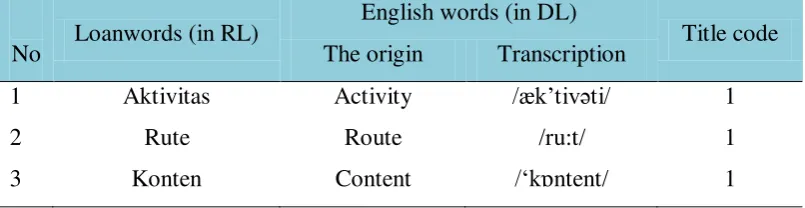
Table 3.1 example of Selection and Transcription
No Loanwords (in RL)
data), words (to list the data that had been identified as loanwords), the origin (the
original words which is English) and its transcription, and title code.
2. Calculating
Calculating process in this study was just to enrich the data which means that
to figure out the frequency and percentage of among loanwords which one that
Selvy S Fitrian, 2014
The Study Of Phonetic And Phonemic Changes Of English Loanwords In Seven Short Stories Written By Dewi Lestari
Universitas Pendidikan Indonesia | repository.upi.edu | perpustakaan.upi.edu
most appeared. Because, “the most frequently appeared” is not on the list of research questions of this study. The process of counting the percentage of the
distribution was through a simple formula as seen below:
Where: n1% = percentage of one unit
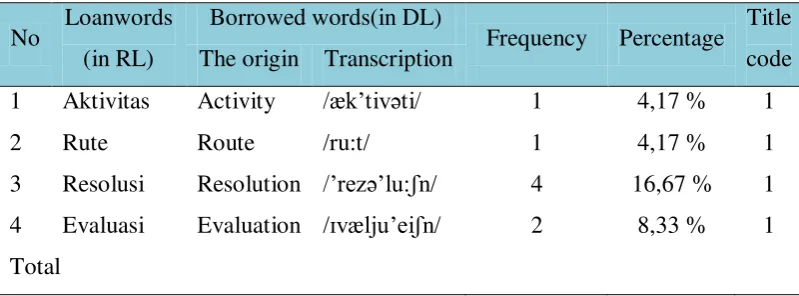
Frequency Percentage Title code
data), words (to list the data that had been identified as loanwords), the origin (the
original words which is English) and its transcription, 4) frequency (to know how
often the each word that used in the data), percentage(making it easier knowing the percentage of the data), and title code. The table also provides „total‟ to know the total of the frequency and the percentage of loanwords.
3. Identification
The loanwords found in seven short stories by Dewi Lestari were identified
their phonetic and phonemic change such as phonetic change without phonemic
change; phonetic change with phonemic change; and phonemic change without n1% =n1
Selvy S Fitrian, 2014
The Study Of Phonetic And Phonemic Changes Of English Loanwords In Seven Short Stories Written By Dewi Lestari
Universitas Pendidikan Indonesia | repository.upi.edu | perpustakaan.upi.edu
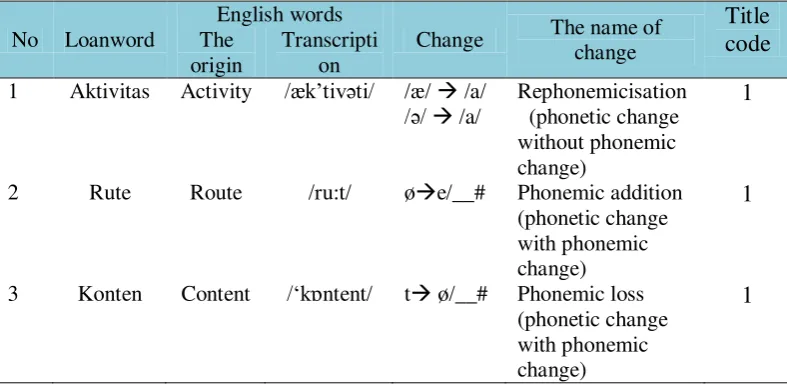
phonetic change in each short story. The example of process identification is
data), words (to list the data that had been identified as loanwords), the origin (the
original words which is English) and its transcription, the name of change (to
make easier in classifying data), and the title code.
4. Classification
After identifying all phonetic and phonemic change of the loanwords, the
writer classified each change into a table to make easier the data to be analyzed.
Selvy S Fitrian, 2014
The Study Of Phonetic And Phonemic Changes Of English Loanwords In Seven Short Stories Written By Dewi Lestari
Universitas Pendidikan Indonesia | repository.upi.edu | perpustakaan.upi.edu
2 Relevant /‟relǝvǝnt/ Relevan t ø/___# 1
3 Object /‟ɒbdӡikt/ Objek t ø/___# 3
The table above consists of four columns: number (to know the amount of
data), words (to list the data that had been identified as loanwords), the origin (the
original words which is English) and its transcription, the changes (to know the
pattern of changes from the origin (the borrowed words) to the loanwords), and
title code.
5. Analyzing and Discussing
The data that had been classified was analyzed to get the answer of the
research questions of this study. It also supported by description to help the
understanding of the analysis. Then, the result of the analysis was discussed and
elaborated based on the theory that supported by some theories from chapter II
and compared with previous studies.
3.4 Closing Remarks
This chapter has described the methodology of this study. It consisted of
formulation of problem, design of the study, data collection (source of data
collection and procedures of data collection), and data analysis. This method was
Selvy S Fitrian, 2014
The Study Of Phonetic And Phonemic Changes Of English Loanwords In Seven Short Stories Written By Dewi Lestari
Selvy S Fitrian, 2014
The Study Of Phonetic And Phonemic Changes Of English Loanwords In Seven Short Stories Written By Dewi Lestari
Universitas Pendidikan Indonesia | repository.upi.edu | perpustakaan.upi.edu CHAPTER V
CONCLUSION AND SUGGESTION
This final chapter provides the conclusions of the research on the grounds of
findings and discussions presented in the previous chapter. In addition, this
chapter also offers suggestions for future research on similar topic.
5.1 Conclusion
The aim of this study is to reveal the pattern of phonetic and phonemic
change of Indonesian loanwords in seven short stories written by Dewi Lestari.
Based on the findings and its discussions, there are some conclusions that can be
drawn. First, there are 226 loanwords found in this study. In addition, all of those
loanwords are included into incorporated loanwords because they change
phonetically, phonemically, or both.
Moreover, the phonetic and phonemic change is divided into three kinds:
phonetic change without phonemic change, phonetic change with phonemic
change, and phonemic change without phonetic change. Firstly, there are two
changes included into phonetic change without phonemic change: [(r)][r] and
[ph][p]. Secondly, phonetic change with phonemic change is divided into three:
phonemic loss (the loss of the phoneme /t/ in the end of a word), phonemic
change of English loanwords into Indonesian whether phonemically, phonetically,
Selvy S Fitrian, 2014
The Study Of Phonetic And Phonemic Changes Of English Loanwords In Seven Short Stories Written By Dewi Lestari
Universitas Pendidikan Indonesia | repository.upi.edu | perpustakaan.upi.edu
comparison of the rules of spelling adaptations of Indonesian Spelling System
(PedomanUmumEjaan Bahasa Indonesia yang Disempurnakan, 2004).
5.2 Suggestion
There aresome suggestions that can be proposed for further research on
related topics.First, it is suggested that other researchers should go wider on the
issues surfaced in the topic of English loanwords in Indonesianbeside their
phonetic and phonemic change. Phonemic and phonetic change is not the only
issue emerged in the loanwords; there are also other interesting issues such as
loan-blend and loan-shift that can be taken up for future studies. Furthermore, a
deeper look on other objects will provide different knowledge or views towards
the loanwords such as in novel and article.
In addition, studying phonetic and phonemic change can be challenging at
some points. For example, there have not been many journals or articles that study
phonetic and phonemic change regarding to English loanword in Indonesian
loanwords as well. It could make easier the research process if there were many
Selvy S Fitrian, 2014
The Study Of Phonetic And Phonemic Changes Of English Loanwords In Seven Short Stories Written By Dewi Lestari
Selvy S Fitrian, 2014
The Study Of Phonetic And Phonemic Changes Of English Loanwords In Seven Short Stories Written By Dewi Lestari
Universitas Pendidikan Indonesia | repository.upi.edu | perpustakaan.upi.edu
REFERENCES
Abhipraya, A. E. A. (2012). Fonem ‘’hantu’’. Retrieved Januari 18, 2013 from
http://www.riaupos.co
Alwasilah, A. C. (2009). Pokoknya kualitatif. Jakarta: Pustaka Jaya.
Anderson, T. (1978). Billingual schooling in the United States. Austin, Texas:
Crowley, T. (1997). An introduction to historical linguistics. Melbourne: Oxford University Press.
DinasPendidikandanKebudayaan.(2004). Pedomanumumejaan Bahasa Indonesia yang disempurnakan&pedomanumumpembentukanistilah. Jakarta: DinasPendidikandanKebudayaan
Fasold, R.W & Connor-Linton. (2006) .An introduction to language and linguistics. New York: Cambridge University Press
Grosjean, F. (1992).Life with two languages: An introduction to bilingualism. Cambridge MA: Harvard University Press
Haugen, E. (1972). The ecology of language. California: Standford University Press
Selvy S Fitrian, 2014
The Study Of Phonetic And Phonemic Changes Of English Loanwords In Seven Short Stories Written By Dewi Lestari
Universitas Pendidikan Indonesia | repository.upi.edu | perpustakaan.upi.edu
Lestari, D. (2013, June 14). 2008 dipinggirselokan. Retrieved from
Lestari, D. (2013, June 14). Kiamatmemangsudahdekat. Retrieved from http://www.lokerseni.web.id
Lestari, D. (2013, June 15). Mengenangsendokdansedotan. Retrieved from http://www.lokerseni.web.id
Lestari, D. (2013, June 15). Menyibakakumelaluikamu.Retrieved from http://www.lokerseni.web.id
Lestari, D. (2013, June 15). Satu orang satupohon. Retrieved from http://www.lokerseni.web.id
Mukhuba, T.T. (2005). Bilingualism, language attitudes, language policy and language planning: A sociolinguistic perspective. Journal of Language and Learning Vol. 3 No. 2 ISSN 1740 – 4983
Mulyawati , F. S. (2003). The Influences of English loanwords in French borrowing words. Unpublished paper, UPI Bandung
Ohala, J. J. (1993). The phonetic of sound change. USA : University of California Rahayuningdiyah, S. (2008). A Study of English borrowing word in andonesian
Selvy S Fitrian, 2014
The Study Of Phonetic And Phonemic Changes Of English Loanwords In Seven Short Stories Written By Dewi Lestari
Universitas Pendidikan Indonesia | repository.upi.edu | perpustakaan.upi.edu
Roach, P. 2009. English phonetic and phonology (4thed). Cambridge: Cambridge University press
Rusyana, Y. (1988). Perihal kedwibaha-saan. Bandung :Pustaka Luang
Saussure, F. D. (1966). Course in general linguistic. New York: McGraw-Hill Book Company.
Silverman, D. (2006). Interpreting qualitative data: Methods for analysing talk,
interaction (3rded). London : Sage
Sudiana, I.M. (2014, April 6).
PersoalanortografipenyerapanSansekertadalambahasa Indonesia. Retrieved from http//www.imadesudiana.wordpress.com
Selvy S Fitrian, 2014
The Study Of Phonetic And Phonemic Changes Of English Loanwords In Seven Short Stories Written By Dewi Lestari