BY:
HILMA NURAINI SASRI REG. NUMBER: A7316069
ENGLISH DEPARTMENT
FACULTY OF ART AND HUMANITIES UIN SUNAN AMPEL SURABAYA
2020
LEMBAR PERNYATAAN PERSETUJUAN PUBLIKASI KARYA ILMIAH UNTUK KEPENTINGAN AKADEMIS
Sebagai sivitas akademika UIN Sunan Ampel Surabaya, yang bertanda tangan di bawah ini, saya:
Nama : Hilma Nuraini Sasri
NIM : A73216069
Fakultas/Jurusan : Adab & Humaniora/ Sastra Inggris E-mail address : [email protected]
Demi pengembangan ilmu pengetahuan, menyetujui untuk memberikan kepada Perpustakaan UIN Sunan Ampel Surabaya, Hak Bebas Royalti Non-Eksklusif atas karya ilmiah :
√ Sekripsi Tesis Desertasi Lain-lain (………)
yang berjudul :
MONOLOGUE HUMOUR IN THE ELLEN DEGENERES SHOW SEASON 17 : A PRAGMASTYLISTIC STUDY
beserta perangkat yang diperlukan (bila ada). Dengan Hak Bebas Royalti Non-Ekslusif ini Perpustakaan UIN Sunan Ampel Surabaya berhak menyimpan, mengalih-media/format-kan, mengelolanya dalam bentuk pangkalan data (database), mendistribusikannya, dan menampilkan/mempublikasikannya di Internet atau media lain secara fulltext untuk kepentingan akademis tanpa perlu meminta ijin dari saya selama tetap mencantumkan nama saya sebagai penulis/pencipta dan atau penerbit yang bersangkutan.
Saya bersedia untuk menanggung secara pribadi, tanpa melibatkan pihak Perpustakaan UIN Sunan Ampel Surabaya, segala bentuk tuntutan hukum yang timbul atas pelanggaran Hak Cipta dalam karya ilmiah saya ini.
Demikian pernyataan ini yang saya buat dengan sebenarnya.
Surabaya, 25 Agustus 2020
Penulis
( Hilma Nuraini Sasri )
ABSTRACT
Sasri, H. N. (2020). An Analysis of Monologue Humour in “The Ellen Degeneres Show” season 17: A Pragma Stylistic Study. English Department, UIN Sunan Ampel Surabaya. Advisor: Murni Fidiyanti, M.A.
Keywords: pragmatic, stylistic, humour, The Ellen Show.
This thesis discusses humour on monologoue performances of Ellen Degeneres in The Ellen Show season 17. The researcher conducted a pragmastylistic research with the theory of flouting maxims and figurative languages. This study aimed to investigate the type of flouting maxims and figurative languages that created the humour. There are three points disscusses in this research; (1) what are the figurative language delivered by Ellen Degeneres.
(2) how figurative language flouted the maxims in creating humour delivered by Ellen Degeners. (3) to what extent the use of figurative language as flouting maxims effective to create the function of humor delivered by Ellen Degeneres.
This research applied descriptive-qualitative method. By using this method, the researcher investigated and analyzed the flouting maxims and figurative languages in Ellen Degeneres monologue performances. Then, the researcher desrcibed the function of humour that created through the flouting maxims and figurative languages. The data of this research were taken from 30 videos of Ellen Degeneres monologue performances in The Ellen Show season 17.
The result of this research, the researcher found nine types of figurative language that flouted all types of maxim are performed by Ellen Degeneres.
Furthermore, the most dominant figurative language occured is irony and the most dominant maxim flouted is the maxim of manner. The researcher found that through the figurative language that flouts the maxim, Ellen Degeneres delivered the four functions of humour; those are Social Management, Mediation, Decommitment, and Defunctionalization. From the findings, it can be concluded that humour can be created through pragmatic and stylistic approch. In this case, Ellen Degeneres performed humour within her monologue performances through figurative languages and flouting maxims in order to attracts the attention of audiences.
ABSTRAK
Sasri, H. N. 2020. Analisis Humour Monolog pada “The Ellen Degeneres Show”
season 17: Studi Pragmastilistik. Program Studi Sastra Inggris, UIN Sunan Ampel Surabaya. Pembimbing: Murni Fidiyanti, M.A.
Kata Kunci: pragmatik, stilistika, humour, The Ellen Show.
Penelitian ini membahas tentang humour pada pertunjukan monolog dari Ellen Degeneres di The Ellen Show musim 17. Peneliti melakukan penelitian pragmastilistik dengan menggunakan teori pelanggaran maksim dan bahasa kiasan. Tujuan dari penelitian ini adalah untuk menyelidiki jenis pelanggaran maksim dan bahasa kiasan yang menciptakan humor. Ada tiga poin yang dibahas dalam penelitian ini; (1) apa saja jenis bahasa kiasan yang disampaikan oleh Ellen Degeneres dalam menciptakan humor. (2) bagaimana bahasa kiasan yang disampaikan Ellen Degeneres melanggar maksim dalam menciptakan humor. (3) sejauh mana penggunaan figurative language yang melanggar maksim efektif dalam menciptakan fungsi humor.
Penelitian ini menggunakan metode deskriptif-kualitatif. Dengan menggunakan metode ini, peneliti menyelidiki dan menganalisa pelanggaran maksim dan bahasa kiasan dalam pernampilan monolog Ellen Degeneres.
Kemudian, peneliti mendeskripsikan fungsi humour yang dibuat melalui pelanggaran maksim dan bahasa kiasan. Data yang digunakan dalam penelitian ini diambil dari 30 video pertunjukan monolog Ellen Degeneres di The Ellen Show musim 17.
Dari hasil penelitian ini, peneliti menemukan bahwa sembilan tipe bahasa kiasan yang melanggar maksim telah digunakan oleh Ellen Degeneres. Sebagai tambahan, bahasa kiasan yang paling dominan digunakan adalah personifikasi yang memiliki arti sebuah benda mati dinyatakan seolah-olah memiliki sifat makhluk hidup dan maksim yang paling dominan dilanggar adalah maksim kualitas yang mana pembicara menyampaikan suatu hal tidak sesuai fakta yang ada. Peneliti menemukan bahwa melalui bahasa kiasan yang melanggar maksim, Ellen Degeneres menyampaikan empat fungsi humour; mereka adalah Manajemen Sosial (fungsi humor untuk mempererat interaksi sosial), Mediasi (fungsi humor sebagai media untuk mengkritik), Decommitment (fungsi humor sebagai bahan pertimbangan atas persetujuan dan indikasi situasi yang tidak serius) dan Defunctionalization (fungsi humor dengan tujuan untuk bersenang-senang dan bergurau). Dari temuan di atas, dapat disimpulkan bahwa humor dapat diciptakan melalui pendekatan pragmatik dan stilistika. Dalam hal ini, Ellen Degeneres menampilkan humor dalam penampilan monolognya melalui bahasa kiasan dan pelanggaran maksim untuk menarik perhatian penonton.
TABLE OF CONTENTS Cover
Inside Cover page ... i
Approval sheet ... ii
Examiner sheet ... iii
Publication Approval Sheet ... iv
Declaration ... v
Acknowledgement ... vi
Abstract ... vii
Abstrak ... viii
Table of Contents ... ix
List of tables ... xi
List of figures ... xii
CHAPTER I INTRODUCTION ... 1
1.1. Background of Study ... 1
1.2. Problem of the Study ... 9
1.3. Significance of the Study ... 9
1.4. Scope and Limitation of the Study ... 10
1.5. Definition of Key Terms ... 10
CHAPTER II REVIEW OF RELATED LITERATURE ... 11
2.1. Maxim Cooperative Principle ... 11
2.1.1. Flouting Maxims... 20
2.2. Figurative Language ... 14
2.3. Humour ... 11
CHAPTER III RESEARCH METHODS ... 25
3.1. Research Design ... 25
3.2. Data Collection ... 25
3.2.1. Research Data ... 26
3.2.2. Data Sources ... 26
3.2.3. Research Instrument ... 26
3.3. Data Analysis ... 27
CHAPTER IV FINDINGS AND DISCUSSION ... 32
4.1. Findings ... 32
4.1.1. Types of Figurative Language ... 33
4.1.2. Types of Flouting Maxim... 47
4.1.3. The Function of Humour Created by Ellen Degeneres through Flouting Maxim and Figurative Language. ... 58
4.2. Discussion ... 68
CHAPTER V CONCLUSION AND SUGGESTION ... 74
5.1. Conclusion ... 74
5.2. Suggestion ... 74
REFERENCES ... 77
APPENDIX ... 84
LIST OF TABLES
Tables Pages
3.1 Table of Data Classification ... 31 4.1 Table of Percentage of the Figurative Language in The Ellen Show
Monologue Performances Season 17 ... 33 4.2 Table of the Percentage of Flouting maxim through Figurative Language the
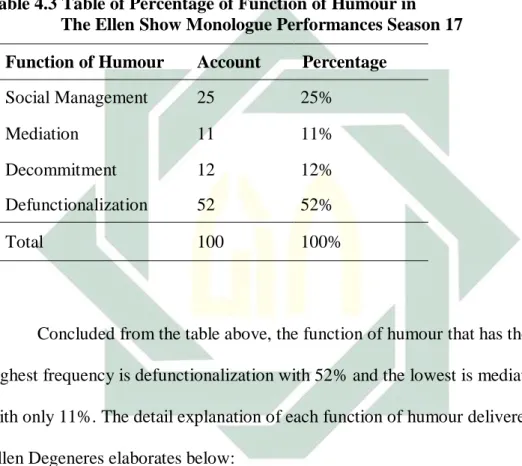
in The Ellens Show Monologue Performance Season 17 ... 46 4.3 Table of Percentage of Function of Humour in The Ellen Show Monologue
Performances Season 17 ... 57
LIST OF FIGURES
Figures Pages
3.1. Figurative Language’s Code ... 29 3.2. Function of Humour’s Code ... 29 3.3 Sample of Coding ... 30
CHAPTER I INTRODUCTION
In this chapter, the researcher presents the background and the focus of the research. This chapter consists of background of the study, problems of study, significance of the study, scope and limitation of the study, and definition of key terms. Each of these items discusses as follow.
1.1. Background of Study
In everyday life, we undoubtedly realize that such a significant number of our activities have been affected by funniness. Through this way, we should recognize that humour is indeed a reflection of certain specific parts of our daily life. Moreover, it is the way that a significant number of people typically make fun for their expressions and actions (Schwarz, 2010, p.39). Oring's (2003, p.29) statement also demonstrated that “Amusingness and laughing as cultural
universals represents a state of humankind.” Gruner (1978, p.1) stressed this point that, without funny things, our everyday life might eventually wind up exhausting and empty. In addition, Schwarz (2010, p.30) stated that "humour can describe into four terms of 'language', 'rationale', 'personality', and 'activity', this further divided into four groups of 'verbal', 'ideational', 'existential', and 'physical' humour."
Sitcom, stand-up comedy and any kind of silly advertisements on
television are kind of mass media that contain the sense of humour. Therefore, the
restlessness in a funny way to the audience. Even though stand-up comedy delivers a monologue as a kind of storytelling, the speakers have to pay attention to the communication aspects, so that the audiences will be able to catch on with the topic discussed. Hence, Paul Grice extended four basic cooperative principles that people need to follow as the way to make a successful communication. "The four basic principles are maxim of quality, maxim of quantity, maxim of manner, and maxim of relation" (Grice, 1975, p.45).
Regarding to create a humorous words, Attardo (1990, p.355) stated that
"Commonly research of humour showed that every joke violates and flouts at least one maxim of the cooperative principle". In adition, Oring (2003, p.95) also stated that "Jokes should lack the talkative effect since no talkative effect should follow a violation or flouting the maxim of the cooperative principle." Thus, the concept of flouting the maxim of cooperarive principle is supposed to be followed by the comedians to engage the audience's understanding of the topic and able to laugh as the joke delivered by the comedians.
The linguistics approach, which discusses flouting the maxim of the cooperative principle in communication is pragmatics. Crystal (1985, p.240) explained that "Pragmatic is the investigation of language from the user's point of view, especially from the decision they make, the power they experience in using language within the social interaction and also the effect of the language used on certain participants in the scope of communication." On the other hand, Leech (1983, p.11) stated that "General pragmatics is the study of language, depending on the complexity of the circumstances, and the study of further specific uses of
social language." Hence, it obvious that pragmatics is an approch that cover the connection between language and its context, as is used for human
communication.
Since humour contains the correlation between language and context, the style of text is also considered, because it may help the speakers delivers their statement's meaning further. A study that pointed out the style of text called stylistics. According to Verdonk (2002, p.4), stylistics is a branch of both
literature and linguistics that analyze the distinctive expressions in language, and it's a description of their purpose. Moreover, according to Leech and Short (1981, p.75), stylistic has been divided into subfields, words and phrases choices,
grammatical, lexical context, and figurative language. Mostly, comedians assign to use figurative language to create a punchline of their jokes. The use of
figurative language mostly requires the comedian to illustrate their real intention instead of using direct and offensive words. Any figure of speech that create a humorous context contains in some mass media, for example, in a sitcom, stand- up comedy etc. which show the correlation between language and context.
One of the examples is on The Ellen DeGeneres Show, or people often called it as Ellen show or Ellen. This show is one of the most popular daytime comedy talk show on American television. In 2017, The Ellen Show won fifty- nine Daytime Emmy Awards. The show considers as the most popular daytime show based on its high rating, which averages around 4 million viewers per episode. Ellen DeGeneres has a role as the producer, director, and the host of her talk show. Ellen DeGeneres, known as a humourist person who proved from in
each segment of her show, she delivered a statement that almost always makes her audience laughed.
The show contained several segments, such as music live performances, interviews, and monologues. The content of monologues is varied, such as her experiences, her current activity, or her opinion about the recent news. Since the genre of her show is a comedy, she delivered her monologues designed to be humorous and comical. Regarding the language's variations, Ellen's monologues show that there is a relation between language and context, which especially in a humorous context.
Several researchers have been working on humour in a certain scope of research. Reed (2007) conducted a psychological study that analyze facial expression and coding as a response to a comedy. The researcher presented the findings according to the dynamic reactions of various individuals. The findings showed that depression influenced by emotion and social cognition, and it caused the different facial expression in response to comedy. Yi He (2008) conducted a discourse analysis research that investigate the Chinese dialect in Crazy Stone movie. The findings discovered the way how to make a humourous effect in verbal interactions. The linguistic's elements that is used to create a humorous effect are phonetics, lexical and discourse devices, the irony of the current social situation in China. Moreover, the language choices and the correlation within the culture in the socio-political context of modern China.
Since this study uses The Ellen Show as the subject of data, there are some previous researches that also use The Ellen Show. One of them is from Monica
Nuritasari (2017) entitled Intertextuality In The Monologue Of “The Ellen
Degeneres Show” Season 13. This research used a qualitative descriptive method.
The data of the research used to analyze the kind of intertextual references and the purpose of using intertextual references. The finding showed that from seven types of intertextuality, it is only three types found within the data. Those three types of intertextuality are Quotation, Source, and Paralogues. This research also found the subtypes of Source, and they were a source of remote, Source of
proximate, and Source of coincident. This previous study used Ellen's monologues on season 13, while the present study uses Ellen's monologues on season 17.
However, this present research explores more to analyze The Ellen Show by using different theories. The researcher uses flouting maxim and figurative language.
Furthermore, the researcher also shows the function of humour delivered by Ellen DeGeneres within The Ellen Show monologue performances season 17.
Therefore, since this present research designs as pragma-stylistic research, a few previous research was conducted as pragma-stylistic research. The first research is from Marta Dynel (2011) with her article entitled “I’ll be there for you!”:On participation-based sitcom humour. The research showed that the sense of humour in sitcom devised by the collective sender (the film crew) and based on the participation phenomena. Alexander Brock's article (2015) also designed as pragma-stylistic research Participation frameworks and participation in a televised sitcom, candid camera and stand-up comedy. The article reconstructed the participant frameworks for a sitcom, candid camera and stand-up comedy.
Resulted from the article analysis, one of the participant frameworks that is
created within the TV comedy subgenres is the sense of humour. Besides, there are also include the use of camera position, sound, and other technical tools. The last is the research from Nurita Widyanti entitled A Stylistic-Pragmatic Analysis of Figurative Language in Harper’s Bazaar Magazine Advertisement (2013).
Qualitative research was the method of this research. As the data, the
advertisement used to analyze the function of figurative language that create a persuasive speech act. The first findings showed that the six types of figurative language that commonly appear within an advertisement, which metaphor as the dominant type of figurative language that applied. The second findings showed that six advertisements put the symbolic in the body copy, and only two
advertisements placed it in the sub-headline. There are also 13 advertisements applied figurative language as declarative, four advertisements as imperatives, one as interrogative, and one as exclamative. The last findings represented the speech act in which four types of illocutionary acts. They are representatives, directives, commissives, and verdictives, which representative as the dominant occurrences.
Moreover, the researches about Flouting Maxim done by some researchers.
Septi Dyah Anggraini (2014) research's title A Pragmatic Analysis of Humour in Modern Family Season 4. In her study, she analyzed the character's conversations that contain humour through flouting maxims, and she also analyzed the forms and functions of humour that was created through flouting maxim Modern Family Season 4. The research employed the descriptive qualitative method. The
researcher finished her research by giving three findings in the research. First, the researcher found that each character used all types of flouting maxim to produce
comedy. Second, the forms of humour found in Modern Family Season 4are jokes and spontaneous conversational humour. Moreover, there are ten forms of
spontaneous conversational humour terms employed by the character. Third, the researcher found that all the function of humour delivered by the characters in the Modern Family Season 4.
Another previous research is from Nilta Herawati (2015) with her title A Pragmatic Analysis of Humour Expressed by Aladeen in The Dictator Movie, which analyzed the type of flouting maxim, the form and the function of humour that created through the flouting maxims. Qualitative and quantitative methods mixed to conduct this research. The findings showed the most dominant flouting maxim that expressed by Aladeen as the main character to create humour is the flouting maxim of quality. Moreover, the researcher also mentioned and explained the forms of humour expressed by Aladeen. There were also jokes and
spontaneous conversational humour. The analysis of the function of humour placed as the last findings. The researcher only found two functions of humour.
They are social management and defunctionalization.
Based on the previous studies, there are some differences from others, and they have a different focus. Reed (2007) and Yi He (2008) focused on analyzing humour in the scope of psychology and discourse analysis. Monica (2017) focused on analyzing The Ellen Show by using intertextuality theory. Nurita Widyanti (2019) designed pragma-stylistic research focused on analyzing figurative language in magazine advertisements. Then, Septi (2014) and Nilta (2015) focused on analyzing the maxim of cooperative principle by using sitcom
and movie as the source of data. Despite the previous studies dealing with flouting maxim and figurative language theory in different research, to the best for
broadening knowledge, none has been done by combining both theories between flouting maxim and figurative language to conduct research. Also, an interest in pragma-stylistic research that combined two theories between pragmatic and stylistic is still quite limited.
Recently, pragmatic and stylistic has been moving as the speaker’s choices for creating grammatically linguistic forms. Thus, we can see that pragmatic coincides with stylistic in the context of language, in which stylistic is about the context of language variation and pragmatic is the relationship between language and its context. The combination of both approaches is an appropriate way to investigate about humour. Therefore, according to Polemi and Reiss (2006, p.359)
“Humour is kind of linguistics phenomenon that covers a string of complex word”, in which it comprises the combination between language style (stylistic effect) and its context (pragmatic effect).
Hence, this present research designed as pragma-stylistic research that investigates how flouting maxim and figurative language created a humourous situation and the function of humour. In this case, the researcher uses Ellen's monologues performances season 17 in The Ellen Show as the subject of data.
The data source of this study used Ellen's monologues segment because, in her monologues, Ellen able to combine various language form and humour aspects to produce any funny word and punchline to make her audiences laughed.
Yet, this study also shows that branches of linguistic can be useful for the needs of human languages, especially in delivering humorous words. Therefore, the researcher hopes that this study can be a beneficial reference for the readers, either linguistics learners or comedians.
1.2. Problem of the Study
A. How figurative language is used by Ellen DeGeneres to create the sense of humour in The Ellen Degeneres Show Season 17?
B. How maxims are flouted through figurative language delivered by Ellen Degeneres to create the sense of humour in The Ellen Degeneres Show Season 17?
C. How the use of figurative language as flouting maxim are effective to create the function of humor delivered by Ellen DeGeneres in The Ellen DeGeneres Show Season 17?
1.3. Significance of the Study
The researcher intends this present study to have both theoretical and practical significance. The theoretical significance here means that this study contributed scientific knowledge in pragma-stylistic research about the way maxim flouting and figurative language can be a means to make a humourous situation. The practical significance here means that this present research can help the readers or comedians to know and to understand that linguistic aspects can be applied to create jokes in a humourous situation.
1.4. Scope and Limitation of the Study
Along with the reader’s concern to the topic, the researcher tends to limit this study to focus on a pragmatic and stylistic scope. More detailed focuses on the Grice's Cooperative Principle in flouting maxim and also figurative language.
In this case, it uses in humourous topic delivered on 30 videos of Ellen DeGeneres monologues performances on The Ellen Show season 17.
1.5. Definition of Key Terms
Cooperative Principle is “a form of opinions that guide the rules of
communication and also the statements that are consider as a rule of efficient and effective language” (Grice, 1975, p.45).
Figurative language is the way how to express something using language in
other taken as their literal meaning.
Humour seems to be the ability to produce something that are laughable,
amusing, cheerful, and funny (Singh, 2012, p.65).
The Ellen Show is an American daytime comedy talkshow which is handled by a comedian host, Ellen DeGeneres.
CHAPTER II
REVIEW OF RELATED LITERATURE
In this chapter, the researcher presents several theories that required for this research. The theories related to the research problems and the key terms.
2.1. Humour
In almost 2000 years ago, the first of today's modern theories of humour created from a collaboration between Plato and Aristotle. Thus, this theory of humour influence any linguistics experts. Singh (2012, p.65) categorizes two kinds of humour meanings. Firstly, humour defines as an ability to recognize something that considered as funny things. Secondly, it assigns as an ability to express a sense of witty or amusing things. As a result, in general, it can be said that something laughable, witty, funny, and amusing can define as humour.
Humor not only has entertainment function but also contains various social functions. "The main functions of humour in communication are the effect that directly achieved by the speakers by using humourous context in their discourse"
(Attardo, 1994, p.322). Attardo (1994, p.323-329), categorized functions of humour within the communicative process into four classes:
1) Social Management
Since humour used as a tool to facilitate social interaction and strengthen social bonding or rejection, it called a social management function of humour.
There are several uses of social management:
a. Social control: Humour is often use as a social repairment. The speakers may use it to intimidate or embarrass someone in the member of a group.
b. Social norms conveyance: Humour used to attract attention to taboos, unacceptable behaviour or things, etc.
c. Ingratiation: Humour created by the speaker to attract attention and boost liking. It indicated how the listener laughter appeared.
d. Discourse management: The speaker creates humour as the use of initiation, termination, passing, exchange control, and topic shifting.
e. Social play: According to Attardo (1994, p.324), the speaker generated humour through such a play to strengthen social bonds and foster group cohesiveness.
f. Repair: The speaker may defusing unpleasant situation through humourous comments, connoting positive attitude, bonding and careless
2) Decommitment
Attardo (1994, p.325) portray decommitment as "denying any destructive intention for action and articulating that the speakers did not have any reason behind keeping up, completing or rewarding truly an activity that had been first begin". In addition, Attardo (1994, p.325) stated the essential principle of decommiment function of humour is that humourous communication is retractable. It implied that the speakers might back off their statements without loss of face. Decommitment strategies incorporate probing and salvaging which the speakers may inspect the listener responses by demonstrating the indication of
non-seriousness, or the speaker may protect a circumstance that is getting socially unpleasant by decommiting themself (Attardo, 1994, p.326).
a. Probing
The speaker could get a piece of information through humourous statements by using probing as the function of humour. Probing seek to discover information that others might not want you to know through asking the question explicitly and carefully. Furthermore, humour used to pass on serious implicit context. It additionally made as an instrument for revolving an issue that may be too difficult to be deal with. "In other words, humour can be utilized to convey a very explicit meaning of an agreement or question towards an individual or a group plainly in the case of aggressive humour" (Attardo, 1994, p.326).
b. Salvaging
Salvaging is a function of humour wherein the speakers need to improve a horrible situation better. Attardo (1994, p.326) stated that "salvaging appears wherein someone going to encountering an unpleasant social situation and it may attempt to spare the condition by demonstrating that it was not serious action".
However, it was implied as a joke. Yet, it does not only assign the burden of beginning an unpleasant social exchange on the audiences but also gives the speakers an excuse, for instance, by saying, "I did not mean it seriously."
3) Mediation
Humour can be seen as a mediating device, whereas teasing seen as a tool for criticizing an individual without an overt attack. Thus, humour often creates an embarrassing or aggressive response. It happens when the speaker is not able to
convey the maxim of quality so that the speakers would then avoid responsibility for what they say. "Therefore, the speakers do not have to confront the consequences of their statements, since the joke is in a negotiated mode of communication. In other words, the speaker can argue that they were just kidding"
(Mulkay in Attardo, 1994, p.327).
4) Defunctionalization
Nonsense humour often conducted as defunctionalization of languages (Guiraud in Attardo, 1994, p. 328). Defunctinalization is a function of humour showed that a language did not use for any transmission of information, but it is only as a playful purpose. Moreover, Guiraud in Attardo (1994, p.329) added that
“if within language humour seen as a playful, it is conducting the effect of switching the focus from language communication to language as an art”.
2.2. Figurative Language
Most people assume that language is conducted as a transparent and literal approach for human communication. However, the shifting of misunderstanding and meanings typically happen once people use language properly. Words may contain denotative, connotative and implicit or hidden meanings. Thus, figurative language is that the approach as the way to express something using language in expect taken as their literal meaning. Giroux & Williston (1974, p.10) declared that figurative language could be a language that leaves from the straight-forward utilization of words. It creates an embellishment, explains a thought, and compose increasingly colourful and intense. Furthermore, as indicated by Wales (2001, p.176), figurative language is that the device to create the artistic imagination by
comparing a minimum of two various things, and it violates the principle of communication.
Taylor (1981, p.167) has arranged three categorizes of figurative expressions. They are as follows:
1. Comparison and substitution: simile, metaphor, allusion, metonymy, analogy, and allegory.
2. Representation by substitution: synecdoche, personification, symbol.
3. Contrast by discrepancy and inversion: overstatement, understatement, paradox (oxymoron), irony.
Below is the detail explanation of each type of figurative language from those three kinds of figurative expression.
a. Simile
The comparison of two things that basically unlike is called a simile.
However, it still based on a similarity in one aspect. As said by Pardede (2008, p.22), a simile is a figure of speech in which kind of comparability between two objects indirectly expressed. Also, Perrinev (1984, p. 62) describes that simile is a figurative language used when people want to explain the resemblance of two objects directly using the connectors, such as like, as, than, similar to, resembles, or seems. For example, Romis’ smell like a pickle.
b. Metaphor
According to Pardede (2008, p.23), metaphor is a similarity distinguishing one object with another and portraying a lot of quality of the primary objectives than the second. The way to delivering metaphor may be simple, and it may
happen in a single isolated comparison. In addition, a broad metaphor may have the function as the controlling image of the whole work. For example, life is a roller coaster.
c. Metonymy
Pardede (2008, p.25) stated that metonymy is a figure as the replacement of one term for another, but it is still strictly associated, for example, The
Executive was busy in work.
d. Allegory
Pardede (2008, p.27) characterizes that allegory is an interesting expression of figurative language that lies somewhere close between
personification and metaphor. In other words, allegory represents a reflection in concrete imagery, it almost constantly in the form of a human characterization, for example, Dewi’s explanation is always beat around the bush.
e. Synecdoche
As stated by Pardede (2008, p.23) “synecdoche is a figure of speech that represents a part refers to indicate a whole and vice versa”, for example, The car is going round and round in a miles away.
f. Personification
Gill (1995, p.30) stated that "personification is a kind of figurative language that defines an abstract object that had been given the human qualities and characteristics to create a dramatic effect". For example, The moon smiles beautifully. The sun is angry.
g. Symbol
As stated by Pardede (2008, p.24), "a symbol is a figure of speech that combines a literal and luxurious quality with an abstract object". Yet, it used to imply to another description, for example, Rebels raised a white flag to declare a negotiation.
h. Overstatement (Hyperbole)
According to Perrine (1984, p. 102) "hyperbole is an exaggeration response of an object's attribute used to illustrate a fact or emotion to make an emphasis on its importance". In other words, hyperbole used as exaggerated terms for attention. For example, the phone is blowing up, and they are ringing my doorbell.
i. Understatement
According to Perrine (1984, p.103), understatement is a thing with underemphasis to create a more significant effect. It is the opposite of hyperbole, too. Understatement produced to portray the objects less than it should be, for example, I won 10 million dollars, and I'm delighted.
j. Paradox
Kennedy (1991, p.595) stated that paradox occurs throughout the statement that in the beginning, it seems to be self-contradictory, but that the interpretation still makes some sense, for example, I wrote all the struggles with happiness within my biography.
k. Irony
According to Pardede (2008, p.25), irony delivers as the opposite meaning of an object in the meaning of the sense, whether it based on the dictionary or contextual, for example, Clever bastard! Lucky devil! Murray (1978, p. 69) describing irony as a contrast between what is being said, implied, or suggested, for example, his house is clean and orderly. Nothing dust settled on the picture, and there was no furniture to clutter the living.
2.3. Maxim Cooperative Principle
Paul Grice (1975, p.45) stated that "There are a set of assumptions that formulated as an effective guideline for the success of language". Grice also divided four main maxims of the conversation's guidelines that express a general cooperative principle. The maxims are quality, quantity,irelation, and manner. The principle will guide the speaker during the talk exchange. Thus, it means that the speakers must offer the contribution as needed and relates to the context of the topics within the conversation. The four maxims of the conversation's guidelines distinguished by Grice (1975, p.308) are as follows:
1) Maxim of Quality
Maxim of quality does not make it possible for the speakers to mention one thing that they assumed to be false, and another thing that needs sufficient proof. Thus, the speakers should be sincere and telling the for example:
Heri: Santi, where have you been? Why do you come late?
Santi: Oh, I broke the car, then I have to fix it first. I'm so sorry.
In that conversation, Santi explained the reason why she came late to Heri’s party sincerely and did not lack adequate evidence.
2) Maxim of Quantity
Maxim of quantity needs the speakers to create a statement as informative as is needed and no more than that. For example:
Lail: Can you tell me what page of Pragmatic theory in this book?
Sam: It’s on page 320.
Sam directly answers Lail's question in an appropriate response by saying as informative as required.
3) Maxim of Relation
Maxim of Relation need the speakers to mention one thing that connected and relevant to the conversation’s topics or to what had been For example:
Nabila: Did you know where was Alya last night?
Desy: Yes, I knew, I saw her last night at the supermarket. She bought some fruits and a lot of chocolates.
From the dialogue above, Desy answered Nabilas’ question throughout the relevant contribution, and then she is not talking about anything other than the topic.
4) Maxim of Manner
The speaker describes things orderly and clearly by using the maxim of manner (Cutting, 2002, p.35). “This also allows the speakers to prevent
ambiguity, to be brief and to avoid any confusion of expression” (Cruse, 2000, p.357). For example:
Donny: James, do you see my phone?
James: I see it in the bathroom.
From the example above, it can be seen that James replies Donnys’ question as orderly as is necessary.
2.3.1. Flouting Maxims
Flouting maxim appears once the speakers on purpose failed to interact with a maxim during which they actually mean to be (Cutting, 2002, p.36). The speakers are willing to boost the audiences' attention to the second or implicit meaning, which totally different from the actual meaning. According to Attardo (1990, p.355), flouting maxim is a disobeying maxim that can create humorous effect. Flouting can interpret all told of the main four maxims.
1) Flouting Maxim of Quality
"Flouting maxim of quality might occur once the speakers are saying something untrue or lie" (Levinson, 1983, p.109). There is another way to conduct the flouting maxim of quality, and that they are hyperbole, sarcasm, and irony (Cutting, 2002, p.37). The example of the flouting maxim of quality is below:
Robi: Spongebobs' color is red, isn't it, Mr?
Mr Dewa: And Patrick is yellow, Plankton is pink, and Mr Crab is blue, I suppose
The example above showed that both of them flout the maxim of quality by telling something untrue. Dewa exaggerates the situation by flouting the maxim of quality in order to offer his implicit meaning proving that Robi's statement is wrong.
2) Flouting Maxim of Quantity
"The speakers may flout the maxim of quantity by providing more or less information than the situation is required" (Cutting, 2002, p.37). For example:
Tina: Did you bring a coat?
Yessy: No, I did not. My neighbour borrowed it, I was in a hurry.
In the example above, Yessy flouts the maxim of quantity after saying more information than Tina wants to inquire. Tina does not need the explanation about "My neighbour borrowed it, I was in a hurry".
3) Flouting Maxim of Relation
Speakers may flout the maxim of relation once their utterances do not have any reference to the previous context. Cutting (2002, p.39) stated that the speakers require the listeners to be able to interpret the implicit meaning of the speaker's statement and to apply it to predefined statements.” For example:
Deby: I don’t think that Mrs Walt’s face is full of wrinkles, don’t you?
Jess: Yes, it very cold today.
Jess did not have an adequate answer to Deby’s question. The reason why Jess flout the maxim of relation by switching the conversation’s topic is to offer, and implicitly inform that Mrs Febby's son is standing behind Deby.
4) Flouting Maxim of Manner
Flouting maxim of manner happens once the speaker failed to be brief, and therefore the speakers delivering over then what they mean. For example:
Imam: Do you love me?
Lisa: Yes, of course, I do, you are the apple of my eyes.
Lisa delivers ab obscurity through flouting maxim of manner in the statement "you are the apple of my eyes." The statements imply that Imam is mean a lot to Lisa because Lisa very loves him.
In Schwarz (2010) research, it is mentioned some features and techniques in order to attract the audiences interest and to deliver an effectively humourous words. Therefore, the features is in line with the strategy of creating humor by using flouting maxims. Each techniques defines as follow:
1) Paralanguage
Schwarz (2010, p.105) states that “Paralanguage plays a central role in general and represents a crucial characteristic in humour.” Paralanguage emphasis the use of nonverbal expressive movement as the joke techniques. Paralanguage comprises intonation and body language as the way to convey the nonserious context of the verbal message. Apte (1985, p.205) defines that “gestures are important in humour that depends heavily on performance and acting.”
2) Ridicule
Berger (1993, p.48) defines ridicule as “A form of direct verbal attack against a person, thing, or idea.” Ridicule is one of joke techniques that performs aggressiveness and impoliteness. Ridicule used by the speakers to create humour
through insult or attact someone’s behavior verbally. However, sometimes the speakers may deride themselves, it called as self-deprecating. According to Schwarz (2010, p.107) “The speakers may use self-deprecating humour to reveal vices or weakness that can be generalized for all human beings.” Therefore, it means that by telling personal embarrassing stories, the speakers tends to admit the audiences to not being perfect themselves.
3) Ambiguity
According to Schwarz (2010, p.129) “The context of ambiguity plays a central role in joke techniques since ambiguous statements are a common aspect of comedy.” Ambiguity comprises two different meaning of sentence that creates incongruity. Schwarz (2010, p.129) emphazises that “Humour often creates through ambiguous word because it involved incongruity.” In addition, Nilsen (1978, p.210) stressed that “The importance of ambiguity for language as in satire, sarcasm, allusion, simile, metaphor etc.” Ambiguity possible to play a role in human language because the human thought is able to covers an ambiguity.
4) Allusion
Baldick (1990, p.6) stated that an allusion is “An indirect or passing reference to some event, person, place, or artistic work, the nature and relevance of which is not explained by the writer but relies on the reader's familiarity with what is thus mentioned.” Allusion deals with indirect representation of nonverbal expression. Freud (1960, p.89) emphasizes that by means of an allusion
"Something is suggested that is not said straight out.”
5) Hyperbole
Cuddon (1977:310) defines hyperbole as “A figure of speech which contains an exaggeration for emphasis.” According to Schwarz (2010, p.133)
“Hyperbole plays as a common feature in joke telling in which mainly serves to exxagerate the situation and enchange the audiences laughter.” Hyperbole often used by the speakers starting with telling about simply story but suddenly the speakers delivers overstated situations to increase the humour and the result appers as a hearty laughter.
6) Repetition
One of the most frequent features of humour is repetition. Repetition can be a means to exxagerates or dramatize situations in order to make people laugh, this is why it is appears in many forms of joke. According Schwarz (2010, p.138)
“Repetition often used to determine the rhythm of joke performances.” Many famous linguists such as Freud (1960) Nilsen (1978) etc. dealt with the appearances and the function of repetition in creating humour.
CHAPTER III RESEARCH METHODS
This chapter provides the procedures related to the research methods in conducting the research. This chapter consists of several subchapter those are research design, data collection techniques, and data analysis.
3.1. Research Design
The researcher designed this study as descriptive qualitative research because this study aimed to analyze and interpret the written materials in context.
Suryana (2010, p. 14) explained that “descriptive research is focused on making a description systematically and accurately based on facts about a particular object as the data”. In addition, according to Ary (2010, p. 424), “the qualitative method is designed for involving the data in the form of words or pictures rather than numbers and statistics”. The descriptive qualitative used to collect, analyze and interpret the data, which includes flouting maxims and figurative language that created the function of humour to make a humourous situation uttered by Ellen DeGeneres in The Ellen Show season 17.
3.2. Data Collection
This subchapter related to the data collection techniques of this research.
This subchapter consists of research data, data sources, research instruments, and data collection techniques.
3.2.1. Research Data
The data in this research was taken from a transcription of Ellen DeGeneres's monologue performance utterances in The Ellen Show season 17. In this monologue performances, Ellen able to combine various language style and humour aspects to produce any funny words and punchline to make her audiences laugh. The form of the data was a humorous statements which included flouting maxim and figurative language. The sense of humorous statements was proven by the laughter response of the audiences.
3.2.2. Data Sources
The data were taken online from The Ellen Show youtube channel (https://www.youtube.com/user/TheEllenShow) in the part of monologue performances season 17. The monologue performances season 17 performed such a kind of stand-up comedy. There are many videos within the monologues performance season 17’s playlist, but the researcher only chooses 30 videos that performed Ellen’s story telling since this study focused on the utterances of Ellen Degeneres.
3.2.3. Research Instrument
The main instrument of this research is a human, the researcher herself. As introduced by Lincoln and Guba (2010, p.424) “the role of the human as an instrument to emphasize that qualitative researchers play a specific role in the research”. Also, according to Mukhtar (109, p.2013), he stated that the researcher has a role as the instrument if direct observation. The reason is that all sense of the
researcher essentially as the tool of observation. The researcher was the main instrument that collected and analyzed the data. However, the researcher also used a supporting instrument named DownSub.com, a software that could help the researcher transcript the video of Ellen's monologue performances as the source of data.
3.2.4. Data Collection Techniques
Bogdan and Biklen (1982, p.67) stated that in collecting the data, the researcher should choose particular subjects included in their study since those subjects believed to present the expansion of the developing theory. This research's technique of data collection was note-taking and coding. The data were collected from the sentences uttered by Ellen monologues performances on The Ellen Show season 17. Below are the procedures:
1. Selected Ellen Degeneres’s videos from several guest perfromances in monologue performance season 17’s playlist;
2. Watched and transcripted each videos of Ellen Degeneres monologue performances;
3. Read and matched the transcription with the videos to identify any body language or intonation that is performed the humorous utterances of Ellen Degeneres in her monologue performances.
3.3. Data Analysis
Moleong (2011, p.268) stated that "the data analysis process starts with the reading of data, the reduction of data, the arrangement of data into several other
Flouting Maxim of Quality Flouting Maxim of Quantity Flouting Maxim of Relation Flouting Maxim of Manner
units, the categorization of data, the coding, the validation of data and the interpretation of data." In this present study, after transcribing and getting the data, the researcher re-read the data to identify and divide the code between kind of maxim flouting, figurative language, and function of humour produced by Ellen Degeneres. Then, the researcher organized and categorized the data in a table. The table conducted to classify the types of flouting maxim, the types of figurative language, and the function of humour. As a result, the researcher described the data in order to answer the research problems and to make a conclusion based on the finding of the research. Below is the simulation of data analysis:
1. Identifying
The researcher identified the use of flouting maxim, figurative language and function of humor on each humorous utterances delivered by Ellen Degeneres.
2. Coding
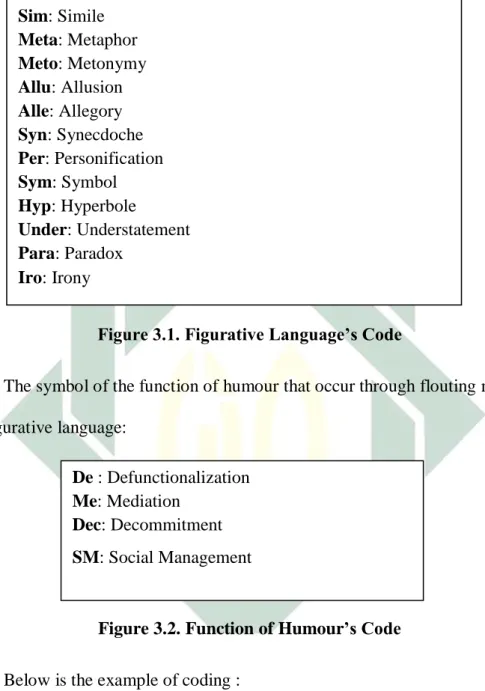
The researcher coded the data into each type of flouting maxim, figurative language, and function of humour. The researcher coded the type of flouting maxim used four kinds of color in each type as below:
The symbol of the type of figurative language:
Figure 3.1. Figurative Language’s Code
The symbol of the function of humour that occur through flouting maxim and figurative language:
Figure 3.2. Function of Humour’s Code
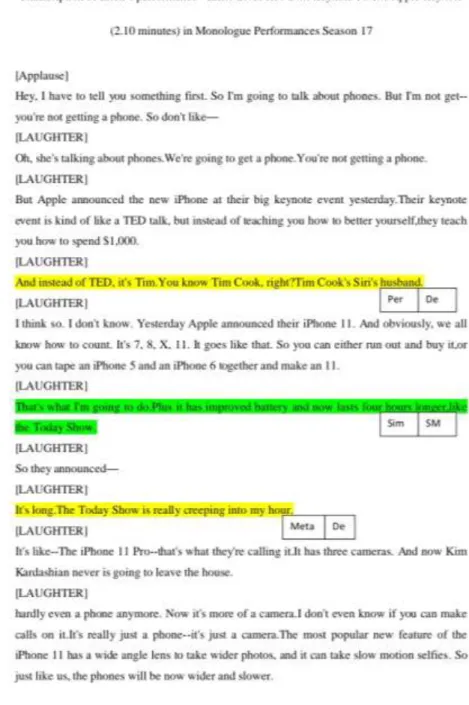
Below is the example of coding : De : Defunctionalization Me: Mediation
Dec: Decommitment SM: Social Management Sim: Simile
Meta: Metaphor Meto: Metonymy Allu: Allusion Alle: Allegory Syn: Synecdoche Per: Personification Sym: Symbol Hyp: Hyperbole
Under: Understatement Para: Paradox
Iro: Irony
Figure 3.3. Sample of Coding
3. Classifying
The researcher classified the data based on each type of flouting maxim, figurative language, and function of humour in the form of a table :
Table 3.1 Table of Data Classification
4. Describing
The researcher described the analysis of each type of flouting maxim, figurative language, and the function of humour that found based on the research problems.
5. Concluding
The researcher concluded the research based on the result of the analysis Data
Flouting maxim Type Of Figurative Language Function of Humour
Quality Quantity Relation Manner Simile Metaph Metony Allusion Allegory Synec Personi Symbol Hyper Paradox Under Irony Social Mg Mediation Decomm Defunc
TOTAL
CHAPTER IV
FINDINGS AND DISCUSSION
This chapter consists of finding and discussion. The researcher shows the findings, which includes data description and result of the analysis. The researcher analyzes Ellen Degeneres monologues performances using a theory of pragmatic, stylistic and humour. The researcher presents the result of the research through the steps that already mentioned in the data analysis.
4.1. Findings
In finding section, the analysis of data is the answer of three research problems. The first research problem is to know the type of figurative language that is uttered by Ellen Degeneres.The data those set in this research is from 30 videos of Ellen’s monologues performances season 17 in The Ellen Show. From the second research problem, the finding shows the types of maxim that flouted by Ellen Degeneres. Then, the last research problem investigates the function of humour that is occured through the flouting maxim and figurative language delivered by Ellen Degeneres.
There are three tables of the findings. The first table is about the percentage of figurative language happened. Then, the second table shows the percentage of the flouting maxims. It is to know which maxim is mostly flouted by Ellen Degeneres through figurative language. The last table shows the percentage of the functions of humour that occurs through flouting maxim and figurative language.
4.1.1. Types of Figurative Language
This part shows the results of the first findings. Moreover, it aims to answer the first research question. There are 100 data of the humorous utterances from 30 videos of Ellen Degeneres's monologue performance that is identified as containing figurative language. The explanation in this section shows the kind of figurative language used by Ellen Degeneres to create a jokes.
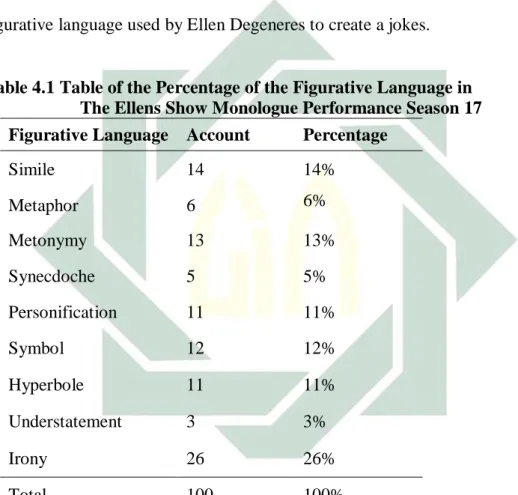
Table 4.1 Table of the Percentage of the Figurative Language in The Ellens Show Monologue Performance Season 17
The table shows the percentage of the kind of figurative languages.The researcher only finds nine from eleven types of figurative language that is
delivered by Ellen Degeneres. The type of figurative language that has the highest frequency is irony with 26%, and the lowest is an understatement with only 3%.
Figurative Language Account Percentage
Simile 14 14%
Metaphor 6 6%
Metonymy 13 13%
Synecdoche 5 5%
Personification 11 11%
Symbol 12 12%
Hyperbole 11 11%
Understatement 3 3%
Irony 26 26%
Total 100 100%
The details analysis explanation of each type of figurative language uttered by Ellen Degeneres elaborates below.
4.1.1.1.Simile
Simile is occured 14 times within Ellen Degeneres performances. Below are the detail explanation of simile delivered by Ellen Degeneres.
Datum 1
Ellen: “I get all the free mints that I want. I know what Ryan Gosling smells like. You want to know what he smells like? Pickles. Sweet, sweet pickles.(LAUGHTER).”
(Ellen Shares The Perks Of Being A Talk Show Host) The datum above is when Ellen describes Ryan Gosling’s smell. In this sentence, Ellen uses a simile since she compares Ryan Gosling’s smell with pickle taste. She performs simile to make a sarcastic statement describes how Ryan Gosling’s smell like pickles, which as we know that the taste of pickles is sour.
Ellen delivers her simile without any intention. This is the way how she delivers her comedy. The funniest part is supported by the intonation how Ellen describes the smell. Therefore, according to Schwarz (2010), make a pun by insulting someone verbally is one of the jokes telling techniques. Below is another analysis of simile.
Datum 2
Ellen: “No, I really have no idea. I woke up totally fine. Fit as a fiddle, as they say.”
(Ellen is Hurt!) In the datum above, Ellen describes her condition before the back fall accident. The condition of Ellen is very good. The phrase “Fit as a fiddle”
desribes her condition and also performs a simile since it contains a comparison words ‘as’ to compare body’s fit and a fiddle. However, "Fit as a fiddle" is an idiom that implies the condition of someone is very healthy and full of energy. In this case, it describes that the condition of Ellen when she was just waking up is totally fine. Another simile finds in another datum below.
Datum 3
Ellen: “Cup your fingers, I guess, like that, right? Like a cute little raccoon, or something like that.(LAUGHTER).”
(Ellen Wants to Help Protect You from Getting Coronavirus) The datum above is when Ellen describes and practices how to do proper handwashing. The sentence considers as simile since it compares handshape to animal shape. The simile creates without any intention, supports by Ellen’s movement shaping her hand to look like a little racoon, this is the way how Ellen create her comedy.
4.1.1.2.Metaphor
Metaphor is occured 6 times within Ellen Degeneres performances. Below are the detail explanation of metaphor delivered by Ellen Degeneres:
Datum 4
Ellen: “We have someone who works here, who loves crafts. Her name is Betsy, and she's like the Martha Stewart of Santa Clarita, is what she is. She makes her own peanut brittle, which we get every year.
Thank you for my peanut brittle, Betsy. And pancake mix, and canned fruit, and she says they're better because they're made with love. Love is what Betsy calls marijuana.(LAUGHTER).”
(Ellen Has Questions About ‘5-Minutes Crafts’) From the datum above, Ellen tries to explain about Betsy. She is one of her
performs a metaphor. Since the word “marijuana” describes the meaning of love, it considers a metaphor. Waldau (2010) stated that “metaphor uses the qualities from one object to describe another object, while simile shows a more visual relationship between the objects”. The metaphor uses as controlling image to describe the meaning of love from Betsy. Ellen wants to imply the fun fact about Betsy, that one of her favorite things is marijuana.
Datum 5
Ellen: “I don't understand why people still go to the mall. I don't understand it.
You can do all your shopping online at home without even putting pants on. Although if you've been to a 7-11 after midnight, people shop like that anyway. The mall is a nightmare.(LAUGHTER).”
(Ellen Brings The Mall Holiday Spirit to The Riff Raff Room) The datum above is when Ellen tells her opinion about going to shopping in the mall. Ellen performs a metaphor since the word “nightmare” is not the real meaning. It is the controlling image of “mall”. Since the phrase does not use the comparison word, it is more considered as a metaphor than simile. The word
“nightmare” contains an implicit meaning that Ellen hates to go to the mall
because it wasting time. While nowadays, we can go shopping on the online store.
Hence, supports by her intonation, this is the way how Ellen tries to make a pun by using a metaphor.
4.1.1.3.Metonymy
Metonymy is occured 13 times within Ellen Degeneres performances.
Below are the detail explanation of metonymy delivered by Ellen Degeneres:
Datum 6
Ellen: “But I was thinking about it. And so many things have changed, like in
the last 10 years, at the beginning of the decade, there were three Kardashians and nobody knew what happened at the end of Lost. And now there are literally thousands of Kardashians. We still don't know what happened at the end of Lost.”
(Ellen’s Tips On How To Slow Down Life) The datum above is from the video when Ellen wants to give an advice to slow down in life. Within the datum, Ellen feels about the time has been moving so fast and changing many things. Ellen performs a metonymy when she tells that
nobody know about the ending of “Lost”. The meaning of the word “Lost” is not the real meaning. It is related to something other. “Lost” refers to an American TV series. In this case, Ellen directly uses the title to describe the series.
According to Perrine (1987, p. 67), metonymy is the subtitution of a word naming an object for another word closely associated with it. Hence, Ellen tries to make a pun through those metonymy to desrcibe that it has been 10 years going and the ending of Lost is still mysterious. Another metonymy is elaborated in the next datum below.
Datum 7
Ellen: “A green line is an enemy. And then this line right here is how Waze got me home last night.
(These Penguin Relationships Are More Scandalous Than ‘The Bachelor’ ) The datum above is when Ellen describes her chart lines about penguin’s
relationship. Ellen performs metonymy and creates a pun when she directly switch the topic from the penguins relationship’s line to the line as the way how she went home last night. The word “waze” identifies as metonymy since it is related to something other. In other word, waze is an application that help and guide the users the quicker navigation routes. However, this metonymy is delivered without
any intention, but it is the way how Ellen delivers her joke. Below is another explanation of a metonymy.
Datum 8
Ellen: “My parents drove me home in a Buick. I think it was a Buick. It could have been a Ford or a Chrysler or a-- it was a Bu-- I think it was a Buick.”
(Ellen Reflect On Her Big Night At The Golden Globes) Another metonymy contains in the datum above when Ellen describes about her born story. Ellen tells that her parents drove her to went home by using a Buick. The word “Buick” performs a metonymy since it is related with the name of the oldest American car. According to Keraf (2009, p. 142), metonymy is a close relationship which uses the name or characteristics of things as a subtitution of something itself. Ellen was expect that it looks like a Ford, Chrysler or any kind of a luxurious car, but the fact it is just a Buick. Ellen does not mean any intention. Yet, this is how she made up the humourous situation, since, according to Attardo (1994) the use of figurative language is as the basic strategy for joking materials.
4.1.1.4.Synecdoche
Synecdoche is occured 5 times within Ellen Degeneres performances. The detail explanation of data analysis is presented below:
Datum 9
Ellen: “And the good news is my neck is feeling a lot better. So (APPLAUSE) shout out to my pain killers.(LAUGHTER).”
(Insane Food Even Ellen Thinks Are Expensive) The datum above is when Ellen describes her condition after healing from the pain after the back fall accident. The sentence in bold is regarded as
synecdoche, since Ellen simplifies the doctor by saying “pain killers”. Ellen uses
“pain killers” to equate the Chiropractor, who help her to cure her back's pain.
Ellen uses the synecdoche to sharpen the feeling of her pain and also the way how Ellen delivers her comedy. Another synecdoche finds in another datum, see below.
Datum 10
Ellen: “We're all different, and I think that we've forgotten that that's OK that we're all different. For instance, I wish people wouldn't wear fur. I don't like it, but I'm friends with people who wear fur. And I'm friends with people who are furry, as a matter of fact.”
(This Photo Of Ellen & George W. Bush Will Give You Faith In America Again) The datum above is when Ellen explains that even every people is
different, it does not change the relationship between each other. Within the explanation, Ellen performs a synecdoche in the word "furry". According to Urban Dictionary, furry is the name that represents the people of a fandom which like to dress up as animals and has an interest in anthropomorphized animals. In this case, the synecdoche performs as a word represent a group of people, which, according to Zainuddin (1992) it called Pars pro toto. The next datum is another analysis of synecdoche, see below:
Datum 11
Ellen: “Many things you can do each and every day to show someone how much they mean to you--for instance, you know, a simple little gesture of filling up their car with gas.”
(Ellen Isn't A Fan Of Valentine's Day) When Ellen explains about how to show our special feeling for someone by simple things, she performs the type of synecdoche. From the datum above, Ellen uses the word “car” as the whole body instead of “tank” as a part which can
fill with gas. According to Zainuddin (1992), since it is a whole represent a part, it called as Totem pro parte. Ellen uses this synecdoche as the purpose behind her joke.
4.1.1.5. Personification
Personification is occured 11 times within Ellen Degeneres performances.
Below is the detail explanation of personification uttered by Ellen Degeneres.
Datum 12
Ellen: “That's what I'm going to do. Plus it has improved battery and now lasts four hours longer, like the Today Show. (LAUGHTER) So they
announced— (LAUGHTER) It's long. The Today Show is really creeping into my hour.”
(Ellen Gives Her Own Keynote To The Apple Keynote) The example above contains personification since Ellen stated that the
showtime is something that bothered her by using the word “creeping”. Ellen personifies the showtime as creeping as a human being. However, the word
"creeping" is not the real meaning. It is the controlling image of the showtime.
Ellen tries to imply her feeling when the show becomes longer, it will be spending a lot of time from her life. However, Ellen does not take it seriously. It is the way how she delivers her joke. Another personification finds in the datum below.
Datum 13
Ellen: “But Apple announced the new iPhone at their big keynote event yesterday. Their keynote event is kind of like a TED talk, but instead of teaching you how to better yourself, they teach you how to spend
$1,000. (LAUGHTER) And instead of TED, it's Tim. You know Tim Cook, right? Tim Cook's Siri's husband. (LAUGHTER)”
(Ellen Gives Her Keynote To The Apple Keynote)
In the datum above, Ellen explains her opinion about the phone’s improvement. Ellen tells about the new keynote of iPhone calls Siri. Siri is introduced as an innovative and revolutionary search that changes the way users interact with devices and obtain information. The phrase “Tim Cook is Siri’s husband” contains personification since Ellen personifies Siri as the wife of Time Cooks. Hence, from those personification, Ellen creates a joke and punchline.
Ellen breaks the fact that it is impossible for human has a relationship with software, especially as a husband or wife. Whereas, Tim Cook is actually the Chief executive officer of Apple Inc. Another personification finds in the datum below.
Datum 14
Ellen: “There was one name that was mentioned over and over all night long.
And I would like to thank him for being there. His name, Don Julio.”
(Ellen Recaps Her Star-Studded Gorillapalooza Fundraiser) The datum above is delivered when Ellen explains about her fundraiser event. There is a personification identified within her explanation. Ellen gives a human quality when she calls Don Julio. She personifies Don Julio as the famous guest during her event. She calls Don Julio with “Him” and “His”, in which it belongs to male’s pronouns. Whereas, Don Julio is a brand of tequila produced in Mexico. Hence, from those personification, Ellen creates a joke and punchline.
4.1.1.6.Symbol
Symbol is occured 12 times within Ellen Degeneres performances. The detail explanation of data analysis is presented below:
Datum 15