Isolation of Antioxidant Compound from Endophytic Fungi
Acremonium sp.
from the Twigs of Kandis Gajah
Elfita
1*), Muharni
1, Munawar
2, and Rizki
11. Department of Chemistry, Faculty of Mathematics and Natural Sciences, Sriwijaya University, Indralaya, Palembang 30662, Indonesia
2. Department of Biology, Faculty of Mathematics and Natural Sciences, Sriwijaya University, Indralaya, Palembang 30662, Indonesia
*)
E-mail: [email protected]
Abstract
The endophytic fungi Chrisonilia sitophila, Acremonium sp., and Penicilliumsp. have been isolated from the tissues of the twigs of kandis gajah. All of the fungi strains were grown in 3 L potatoe dextrose broth medium (PDB) at a room temperature for 28 days. To extract the antioxidant compounds, the culture broth were filtered for mycelia removal followed by extraction and evaporation. All of the extracts were evaluated for their antioxidant activities by using 1,1-diphenyl-2-picrylhydrazyl (DPPH) radical scavenging activity. The extract of Acremoniumsp. have strong activity with IC50 value of 10.3 μg/mL, which is equivalent to ascorbic acid activity with IC50 value of 9.8 μg/mL. The extract was subjected to column chromatography on Si gel twice to obtain a high purity antioxidant compound in the form of yellow oil. The molecular structure was determined based on spectroscopic data, including 1H-NMR, 13C-NMR, HMQC, HMBC, and COSY. The compound was determined as sesquiterpene 3,5-dihydroxy-2,5-dimethyltrideca-2,9,11-triene-4,8-dione.
Abstrak
Isolasi Senyawa Antioksidan dari Jamur Endofitik Acremonium sp. dari Ranting Kandis Gajah (Garcinia griffithii). Jamur endofitik Chrisonilia sitophila, Acremonium sp., dan Penicillium sp. telah diisolasi dari jaringan ranting tumbuhan kandis gajah. Ketiga strain jamur telah ditumbuhkan dalam 3 L medium potato dextrose broth (PDB) pada temperatur kamar selama 28 hari. Masing-masing kultur disaring untuk memisahkan miselium dan dilanjutkan dengan ekstraksi dan evaporasi. Semua ekstrak dilakukan uji aktivitas antioksidan berdasarkan aktivitas peredaman radikal bebas 1,1-diphenyl-2-picrylhydrazyl (DPPH). Ekstrak Acremonium sp. memiliki aktivitas yang kuat dengan nilai IC50 10,3 μg/mL yaitu setara dengan aktivitas asam askorbat dengan nilai IC50 9,8 μg/mL. Ekstrak aktif selanjutnya dikromatografi kolom dan diteruskan dengan rekromatografi hingga diperoleh senyawa antioksidan murni berupa minyak bewarna kuning. Struktur molekul ditentukan berdasarkan data spektroskopi yang meliputi 1H-NMR, 13C-NMR, HMQC, HMBC, dan COSY. Senyawa hasil isolasi adalah golongan seskuiterpen yaitu 3,5-dihidroksi-2,5-dimetiltrideka-2,9,11-triena-4,8-dion.
Keywords: Acremonium sp., antioxidant compound, endophytic fungi, Garcinia griffithii, sesquiterpene
1. Introduction
Plant endophytes are a group of microorganisms living within plant internal tissues or organs without causing any apparent symptoms or diseases in the hosts. They can serve as important sources of bioactive compounds, presumably due to the symbiotic relationship with their hosts [1]. Endophytic fungi are rich sources of novel organic compounds with interesting biological activities
and a high level of biodiversity. Medicinal plants have been recognized as a repository of fungal endophytes with novel metabolites of pharmaceutical importance [2-3].
the earth to support local human populations. Environmental degradation, loss of biodiversity and spoilage of land and water also add to problems facing mankind. Endophytes are relatively unstudied and potential sources of novel natural products for exploitation in medicine, agriculture, and industry [4-6].
In the previous studies, it was found that bioactive compounds are potentially more active compared to commercially available drugs. However, the problem is that the compounds were found with low rendemen and their sources are mainly from endemic plants which are difficult to cultivate, harvested for such a long time, and believed to have a socio-religious function for people living in their habitat. One kg dry powder of stem barks of kandis gajah (Garcinia griffithii) can only produce 5 mg of antioxidant compounds of 1,6,7-trihydroxyxanthone, 5 mg guttiferone I, and 7 mg isoxanthochymol. Those compounds have antioxidant activities twice higher than a synthetic antioxidant butyl hydroxy anisole (BHA). Besides, it can also produce 14 mg of 1,5-dihydroxy-3,6-dimethoxy-2,7-diprenyl-xanthone (antimalaria); 110 mg of 1,7-dihydroxy1,5-dihydroxy-3,6-dimethoxy-2,7-diprenyl-xanthone (antibacterial); 34 mg β-sitosterol -3-O-β-D-glucoside, 21 mg of stigmasterol-3-O-β-D-glucoside. Furthermore, it can also produce 12 mg of the compound 1,6-dihydroxy-3-methoxy-4,7-diprenylxanthone which shows antioxidant activity lower than standard BHA [7-12].
In this paper, we report the isolation ofantioxidant compound extracted from Acremonium sp., an endophytic fungi from the twigs of kandis gajah. It is also reported the structure elucidation of the compound as well as its antioxidant activity.
2. Methods
Source of endophytic fungi. Plant materials of kandis gajah were collected in April 2010 from Sarasah Bonta, Lembah Arau, Kabupaten Lima Puluh Kota, West Sumatra. Voucher specimens have been deposited in the Laboratory of Herbarium Universitas Andalas, Padang.
Isolation of endophytic fungi. The twigs were cut into small rods (about 5 cm in length) and rinsed in running tap water followed by successive surface sterilization in 70% ethanol and 0.2% HgCl2 for 2 min (twice). The twigs rods were rinsed three times in sterilized distilled H2O and cleaved aseptically into small segments, which were deposited on a Petri dish containing potato dextrose agar medium (PDA) (200 g potato, 20 g dextrose, and 15 g agar in 1 L of H2O, supplemented with 100 mg/L of chloramphenicol to suppress bacterial growth) and then incubated at room temperature (25 °C). The germinating hypha tips were observed and transferred to new PDA plates and then subcultured until pure cultures were obtained [13-14].
Identification of the fungi. The fungi strains were identified base on their colony and their cell morphology characteristic. Macroscopic characterization based on colony morphology was done by growing the isolates in three different media; czapez dox agar (CDA), malt extract agar (MEA), and potato dekstrose agar (PDA) and observing the size, the growth, the color, and color of the colony reverse. IN addition, microscopic characterization was also done by observing the non-reproductive structures, non-reproductive structures, conidia, and conidiophores by comparing its morphological characteristics [15].
Fermentation, extraction, and antioxidant activity test. The purified fungi (a small park) were transferred under a sterile condition to the PDB medium. For chemical investigations, the fungal strains were static cultivated in 3 L PDB medium for 28 days at room temperature [16]. The culture broth was filtered to remove mycelia. The culture was extracted with 3 L ethyl acetate (twice), after removal of the solvent in vacuum, the resulting residue was subjected to antioxidant activity test.
Isolation of antioxidant compound and structure elucidation. The extract which has antioxidant activity was subjected to column chromatography on Si gel eluted by a gradient of n-hexane : ethyl acetate from 1:0 to 0:1 (v/v), continued with recolumn to afford antioxidant compound. The molecular structure is identified by spectroscopic methods including 1H-NMR, 13
C-NMR, HMQC, HMBC, and COSY.
Antioxidant activity test. The free radical scavenging activity was tested as bleaching of the stable 1,1-diphenyl-2-picrylhydrazyl radical (DPPH). The reaction mixture (4 mL) continued 3.8 mL of daily prepared DPPH solution (0.05 mM) and 0.2 mL various concentrations of tested compound or of positive control (ascorbic acid) dissolved in dimethyl sulphoxide (DMSO). After 30 min in the dark at room temperature, the absorbance was recordes at 517 nm. Radical scavenging activity was expressed as inhibition percentage and was calculated using the following formula [17].
% inhibition = {( Ak - As )/ Ak } x 100 (1) Ak = control absorbance
As = sample absorbance
3. Results and Discussion
All of the extracts were evaluated for their radical scavenging activities by using the 1,1-diphenyl-2-picrylhydrazyl (DPPH) radical scavenging assay. DPPH is a free radical molecule with a purple color that can be changed into a stable compound in yellow by the reaction with antioxidant. Antioxidant compound give a single electron in DPPH resulting in reduction in free radical DPPH [18].Extract R2showed strong activities with IC50 values of 10.3 µg/mL, which was equivalent
of the well-known synthetic antioxidant ascorbic acid (IC50= 9.8 μg/mL). However, extract R3 were not
active (IC50= 272 µg/mL) and extract R2 only showed weak or moderate activities (IC50 = 23,8 µg/mL).
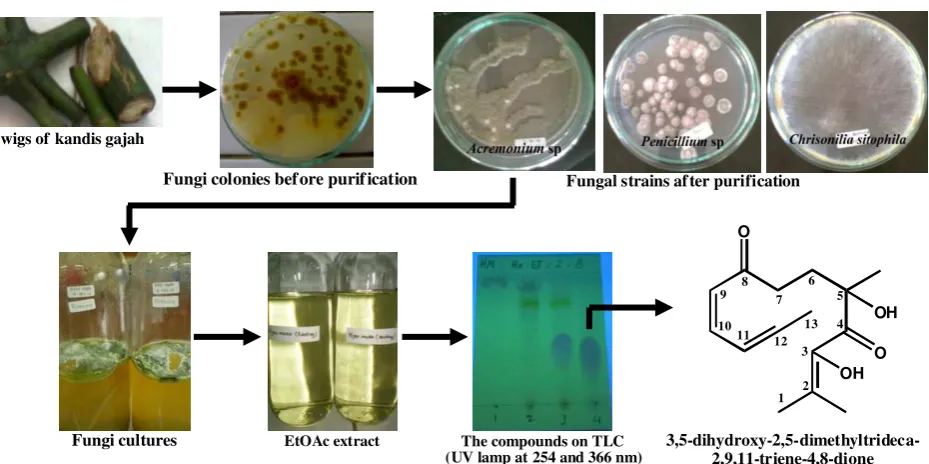
Ethyl acetate extracts of Acremonium sp. (3.8 g) was subjected to a column chromatography (CC) over silica gel and eluted with n-hexane-ethyl acetate by increasing polarity, to yield fourfractions (F1-F4). F4 was further fractionated by and eluted with n-hexane-ethyl acetate (2:8) to obtain four fractions (F4.1-F4.4). F.4.4 was subjected to yield compound 1 (374 mg) in the form of a yellow oil. Compound 1 showed strong activitiy with IC50 value of 10.8 µg/mL. Minami et al. classify the power of antioxidant activity based on IC50 values. A sample is grouped to strong, moderate, and not active antioxidant if the IC50 valueare less than 10, less than 100 and more than 100 μg/mL respectively [19]. Deachathai et al. reported that the antioxidant compounds with IC50 values ≤11.4 μg/mL was grouped as strong [20]. The isolation procedure for compound 1
is showed in Figure 1.
The 1H-NMR spectrum reveal the presence of signals due to four methyl at δH 1.25 (3H, s), 1.48 (3H, s), 1.69 (3H, s), and 1.89 ppm (3H; d; 6.2). Three methyl signal (s) indicated that the three methyl groups are bound to the quaternary carbon. Furthermore, one methyl signal (d) showed that the methyl group attached to carbon methyne. There are also two signals for methylene protons are not chemical shift, at {δH 2.66 (1H, m) and 2.49 ppm (1H, m)} and {2.17 (1H, m) and 2.13 ppm (1H, m)). In addition, revealed the presence of signals to four vinilic protons at δH 7.18 (1H; dd: 10.4: 4.9), 6.27 (1H, m), 6.21 (1H, d: 10.4), and 6.04 ppm (1H, d; 15.3).
The 13C-NMR spectrum exhibited the presence of 15 carbon signals attributed to 4 methyls, 2 methylenes, 4 methines, and 5 quartenary carbon atoms according to the HMQC spectrum. The complete assignment of carbon and proton made by 2D NMR analysis is showed in Table 1.
The HMQC spectrum shows that the vinylic protons at
δH 7.18 (1H; dd: 10.4: 4.9), 6.27 (1H, m), 6.21 (1H, d; 10.4), and 6.04 ppm (1H, d: 15.3), each is bound to carbon at δC 145.5; 142.8; 130.2, and 127.0 ppm. Furthermore, two signal for methylene protons at δH {2.66 (1H, m) and 2.49 ppm (1H, m)} and {2.17 (1H, m) and 2.13 ppm (1H, m)}, each bound to carbon at δC 34.1 and 30.9 ppm. Four signals for methyl protons at
δH 1.25 (3H, s), 1.48 (3H, s), 1.69 (3H, s), and 1.89 ppm (3H, d: 6.2), each bound to carbon at δC 29.9: 23.5: 6.2; and 19.1 ppm.
Figure 1. Brief Procedures to Isolation of Compound 1 from Endophytic Fungi Acremonium sp. from the Twigs of Kandis Gajah
Twigs of kandis gajah
Fungi colonies before purif ication
Fungi cultures EtOAc extract The compounds on TLC (UV lamp at 254 and 366 nm)
Fungal strains af ter purification
O
O OH
OH
1
8 6
10
11 12 13
9 7 5
4 3
2
O
9 127.0 6.04 (1H;d;15.3) H-10
10 145.5 7.18 (1H;m) C-12 H-11; H-9
11 130.2 6.21 (1H;m) H-10
12 142.8 6.27 (1H;m) C-10; C-13 H-13
13 19.1 1.89 (3H;d; 6.2) C-11; C-12
2-CH3 29.9 1.25 (3H;s) C-1
5-CH3 23.5 1.48 (3H;s) C-4; C-5; C-6
The HMBC spectrum of the compound 1, vinylic protons at δH 7.18 ppm (H-10) correlated with the Furthermore, methylene protons at δH 2.66 (H-7A) and 2.49 ppm (H-7B) correlated with carbon at δC 201.8 (C-8), 82.8 (C-(C-8), 30.9 (C-6) ppm. The emergence of two methylene protons at two different chemical shifts indicates that both protons are rigid. Similarly, the methylene protons attached to C-6, each of which appears at 2.17 (H-6A) and 2.13 ppm (H-6B) correlated with the carbon at δC 201, 8 (C-5), 82.8 (C-5), 34.1 (C-7) ppm, while the H-6B continued its correlation with carbon C-4. Correlation of two pairs of methylene protons indicates that the proton is bound through two and three bonds to the carbonyl carbon. The methyl protons at 1.89 ppm (C-13) correlated with the two carbon atoms at 130.2 (C-11) and 142.8 ppm (C-12). Similarly, the methyl protons at 1.69 ppm (C-1) correlated with carbon at 174.7 (C-3) and 97.8 (C-2), and methyl protons at 1.25 ppm (2-CH3) correlated with carbon at 6.2 (C-1). This indicates that both the methyl group is geminal. Furthermore, the methyl protons at 1.48 ppm (5-CH3) correlated with the carbon at 201.2 ppm (C-4). The HMBC correlation of compound 1 is showed in Figure 2.
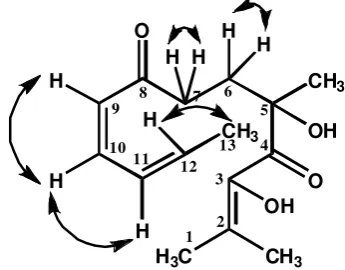
The 1H-1H COSY spectrum revealed the presence of three vinylic protons. The proton at δH 7.18 ppm (H-10) showed correlation with vinilic proton at 6.21 ppm
(H-11) and 6.04 ppm (H-9). Similarly, the vinylic protons
Figure 2. The HMBC Correlation of Compound 1
Figure 3. The 1H-1H COSY Correlation of Compound 1
chemical shift (H-6A; H-6B and H-7A; H-7B) are correlated each other, where the correlation continued with beside methylene protons. This indicates that the two methylene protons located on beside to carbon atom. The COSY correlation of compound 1 is showed in Figure 3.
The antioxidant activity test of pure compoundsshowed strong activities with IC50 values of 10.8 µg/mL, but
slightly lower when compared to the antioxidant activity of extracts (IC50 = 10.3 µg/mL). This might be due to the occurrence of synergistic compounds in the extracts. When compound 1 was reacted with DPPH, the radical (3-O.) may be stabilized as in the form of epoxide (C2-O-C3) by radical at C-3and in the form diketone (on C3 and C4) by leaving the tertiary radical at C-2. Besides the radical (3-O.) may be stabilized through the binding hydrogen of 5-OH, so that the radical move to (5-O.). This can lead to radical stability due to the distribution of radical in the molecule.
4. Conclusion
The endophytic fungi Acremonium sp. from the twigs of kandis gajah (G. griffithii T. Anders) produces a pure compound 374 mg from 3 L of PDB medium at room temperature for 28 days. The compound have strong antioxidant activity equivalent to ascorbic acid. Based on the spectroscopic data (1H-NMR, 13C-NMR, HMQC, HMBC, and COSY), the compound is identified as 3,5-dihydroxy-2,5-dimetiltrideka-2,9,11-triene-4,8-dione.
Acknowledgement
The authors are grateful to the Directorate General of Higher Education for research funding through the Strategis Nasional Grant in 2010 contract No. 514/SP2H/PP/DP2M/VII/2009 and 2011 contract No. 39/SP2H/PL/Dit. Litabmas/IV/2011.
References
[1] H. Xue, C. Lu, L. Liang, Y. Shen, Rec. Nat. Prod. 6/1 (2012) 28.
[2] H. Hussain, K. Krohn, S. Draeger, K. Meier, B. Schulz, Rec. Nat. Prod. 3/2 (2009) 114.
[3] K. Nithya, J. Muthumary, Recent Res. Sci. Tech. 3/3 (2011) 44.
[4] G. Strobel, B. Daisy, U.Castillo, Plant Pathol. J. 4/2 (2005) 161.
[5] V. Gangadevi, J. Muthumary, Mycologia Balcanica. 5 (2008) 1.
[6] H. Yu, L. Zhang, L. Li, C. Zheng, L. Guo, W. Li, P. Sun, L. Qin, Microbiol. Res. 165 (2010) 437. [7] E. Elfita, Disertasi, Pascasarjana Kimia,
Universitas Padjadjaran, Indonesia, 2008.
[8] E. Elfita, M. Muharni, L. Madyawati, D. Darwati, W. Ari, S. Supriyatna, H.H. Bahti, D. Dachriyanus, P. Cos, L. Maes, K. Foubert, S. Apers, L. Pieters, Phytochem. 70 (2009) 907.
[9] E. Elfita, S. Supriyatna, H.H. Bahti, D. Dachriyanus, Indonesian J. Chemistry 8/1 (2008) 97.
[10] E. Elfita, S. Supriyatna, H.H. Bahti, D. Dachriyanus, J. Ilmu Dasar 9/2 (2008) 142.
[11] E. Elfita, S. Supriyatna, H.H. Bahti, D. Dachriyanus, Biosfera. 24/1 (2007) 24.
[12] E. Elfita, S. Supriyatna, H.H. Bahti, D. Dachriyanus, J. Ilmu Kefarmasian Indonesia 9/1 (2011) 35.
[13] S.H. Wu, Y.W. Chen, S.C. Shao, L.D. Wang, Z.Y. Li, L.Y. Yang, S.L. Li, R. Huang, J. Nat. Prod. 71 (2008) 731.
[14] A. Debbab, A.H. Aly, R.A.E. Ebel, W.E.G. Müller, M. Mosaddak, A. Hakiki, R. Ebel, P. Proksch, Biotechnol. Agron. Soc. Environ. 13/2 (2009) 229.
[15] G.A. Johnson, R. Ziegler, J.T. Fitzgerald, L. Hawley, In: E.S. Yulius, Mikrobiologi dan Imunologi, Binarupa Aksara, Jakarta, 1994, p.170. [16] L.D. Li, X.M. Li, B.G. Wang, J. Microbiol.
Biotechnol. 19/7 (2009) 675.
[17] A.T. Selvi, G.S. Joseph, G.K. Jayaprakasha, Food Microbiology 20 (2003) 455.
[18] Y. Yuhernita, J. Juniarti, Makara Sains 15/1 (2011) 48.
[19] H. Minami, M. Kinoshita, Y. Fukuyama, M. Kodama, T. Yoshizawa, M. Suigura, K. Nakagawa, H. Tago, Phytochem. 36 (1994) 501. [20] S. Deachathai, W. Mahabusaracam, S.