Corresponding author: [email protected]
Ondansetron serum concentration and
polymorphisms of
CYP2D6, ABCB1
and
5-HT3B
receptor genes in the treatment of
chemoterapy induced nausea and vomiting
DA Perwitasari1, Mustofa2
1Faculty of Pharmacy, University of Ahmad Dahlan, Yogyakarta, 2Department of Pharmacology and Therapy, Faculty of Medicine, Universitas Gadjah Mada, Yogyakarta
DOI: http://dx.doi.org/10.19106/JMedSci004801201603
ABSTRACT
This study was aimed to understand differences of ondansetron serum concentration in each antiemetic responses, polymorphisms of 5HT3B receptor, CYP2D6 and ABCB1
genes in Indonesian cancer patients treated with high emetogenic cytostatics. We recruited cancer patients in Dr Sardjito Hospital treated with cisplatin (≥ 50 mg/m 2) as monotherapy or combination therapy. Patients were treated with ondansetron 8 mg intravenously and dexamethasone 8 mg intravenously and metoclopramide (10 mg orally) after cytostatic
administration until 5 days after chemotherapy. We cathegorized the nausea and vomiting
grade according to the National Cancer Institute Common Toxicity Criteria v.3. We also determined some SNPs of ABCB1, 5HT3B and CYP2D6 genes using realtime PCR. We recruited 191 cancer patients in this study with the average of ondansetron serum
concentration reached 33.48 ng/ml (SD: 18.54). According to the patients’ response to
the antiemetic, during the acute phase, 21.8% patients experienced acute nausea and 30.2% patients experienced acute vomiting. Only the haplotype of CTG-CTG of ABCB1
which have signiicant association with ondansetron serum concentration. EM patients of
CYP2D6 and patients with haplotype of delAG of 5HT3B had lower ondansetron serum concentration. However, IM patients of CYP2D6 showed higher ondansetron serum concentration and lower grade of nausea and vomiting. Variations of ABCB1, CYP2D6
and 5HT3B may be used as pharmacogenetic marker in predicting antiemetic response in cancer patients receiving highly emetogenic cytostatic.
ABSTRAK
Penelitian ini bertujuan untuk mengetahui perbedaan konsentrasi ondansetron serum
dalam setiap respon antiemetik, polimorisme gen reseptor 5HT3B , CYP2D6 dan ABCB1 pada pasien kanker yang mendapatkan sitostatika emetogenik tinggi di Indonesia. Subjek dalam penelitian ini adalah pasien kanker di RSUP Dr Sarjito Hospital yang mendapatkan
gen ABCB1, 5HT3B dan CYP2D6 diidentiikasi dengan metode realtime PCR. Sejumlah 191 pasien berpartisipasi dalam penelitian ini dengan rerata konsentrasi ondansetron
dalam serum adalah 33.48 ng/ml (SD:18.54). Pasien yang mengalami fase akut mual
adalah 21.8% dan yang mengalami fase akut muntah adalah 30.2%. Haplotype CTG-CTG dari ABCB1 mempunyai hubungan yang signiikan dengan kadar indansetron dalam
serum. Pasien dengan fenotipe EM dari CYP2D6 dan pasien dengan haplotipe delA dari
5HT3B mempunyai kadar ondansetron rendah dalam serum. Pasien dengan fenotipe IM dari CYP2D6 mempunyai konsentrasi ondansetron tinggi dan tingkat mual dan muntah yang rendah. Variasi gen ABCB1, CYP2D6 dan 5HT3B dapat digunakan sebagai penanda farmakogenetik untuk mengetahui respon antiemetik pada pasien kanker yang menerima sitostatik emetogenik tinggi.
Keywords : pharmacogenetics – antiemetic – cancer – polymorphism - Indonesia
INTRODUCTION
Nausea and vomiting is the most distressfull side effect of chemotherapy in cancer patients.1,2 These symptoms may
affect patient’s quality of life and furthermore cause the decrease of patients’ adherence in following the chemotherapy treatment.3 In
cancer patients treated by high and moderate emetogenic cytostatic as chemotherapy agent, the antiemetic which should be given to the patients are combination of 5-hydroxytriptamine 3 receptor antagonist (HT3RA), dexamethasone and neurokinin 1 receptor antagonist (NK1 antagonist).4,5
However, around 30% of patients receiving high emetogenic cytostatic and moderate emetogenic cytostatic still did not have good response to this combination treatment.4
One of the causal of response variabilities of the antiemetic is the polymorphisms of
5-HT3B receptor, CYP2D6 and ABCB1 genes. Even some previous studies did not show the consistency about the signiicancy of statistical results, however the pattern of the genotypes and the patients’ response were similar.6-10
One of the previous study supported that the polimorphism of CYP2D6 resulted the signiicant difference of tropisetron serum
concentration in poor metabolizer, extensive metabolizer and ultra-rapid metabolizer.8
This study is aimed to evaluate the association between ondansetron serum concentration and the antiemetic responses, polymorphisms of 5HT3B receptor, CYP2D6
and ABCB1 genes in Indonesian cancer patients treated with high emetogenic cytostatics.
MATERIALS AND METHODS
Patients
We recruited cancer patients in Dr Sardjito General Hospital, Yogyakarta who were treated with cisplatin (≥ 50 mg/m2) as monotherapy or
within the last 2 weeks, use of inducers of CYP3A4 or inhibitors of CYP2D6, patients with concomitant diseases that might cause nausea or vomiting, patients with AST-ALT > 2,5 x ULN for patients without liver metastases > 5 x ULN for patients with liver metastases, renal dysfunction deined by creatinine clearance < 60 ml/minute, brain metastases and patients with artiicial stoma or pregnancy.8,9 We did the informed consent
to all of the patients before the recruitment. This study has been approved by The Medical and Health Research Ethics Committee of the Faculty of Medicine, Universitas Gadjah Mada, Yogyakarta, Indonesia.
Measurement of nausea and vomiting
We evaluated the nausea using 0-100 of Nausea Visual Analog Scale (NVAS) for 5 days after chemotherapy. The vomiting was assesed by quantifying the number of vomiting that was separated at least 1 minute betweeen each of vomiting episode.9
Study outcome deinitions
We cathegorized the nausea and vomiting according to the previous study. The nausea and vomiting were grouped into grade 1-2 and grade 3-4 nausea vomiting of the National Cancer Institute Common Toxicity Criteria v.3 (NCI CTC v.3).9,11
Ondansetron serum concentration assay
The blood was taken from vena mediana cubiti 1.5 hour after intravenously injected to the patients. The ondansetron peak serum concentration reaches 30 ng/ml on the administration of 8 mg ondansetron intravenously.12 Ondansetron serum
concentration was measured using High Performance Liquid Chromatoghraphy as described in the previous method.13,14
Genotyping assay
We used patients’ saliva as the samples. DNA concetration was measured using Nanodrop and the genotype assays were established using pre-designed Taqman assays and analysed on ABI 7500 realtime PCR System from Applied Biosystems. We also calculated the Hardy-Weinberg equilibrium and all of the assay were on the Hardy Weinberg equilibrium.
SNPs selection
We used three SNPs in the 5-HT3B
receptor gene: rs3831455 (deletion AAG in 5’-UTR position), rs4938058 (intron) , and rs7943062 (3’ near gene); three SNPs in the ABCB1 gene: rs1045642 (exon 26), rs2032582 (exon 22), rs 1128503 (exon 12) and three SNPs of CYP2D6; rs16947 (CYP2D6*2), rs3892097 (CYP2D6*4), rs1065852 (CYP2D6*10). Those particular SNPs were selected from the National Center for Biotechnology Information SNP database using these criteria: a minor allele frequency of >0.2, a validated SNP according to the NCBI database, and preferably a perfect Linkage Disequilibrium (LD) with other SNPs (for 5-HTR3B receptor gene: D’- =1 and r-square ≥0.7) and/or indications for relevance based on previous publications.6,8-10
Statistical analysis
The student-t test was performed to understand the differences between ondansetron serum concentration. We performed haplotype frequency estimation and individual haplotype from genotype data using gPlink. The metabolizer’s phenotypes of SNPs of CYP2D6 were deined according
TABLE 2 shows the differences between
CYP2D6 phenotypes, nausea and vomiting
grades and ondansetron serum concentration. There were no signiicant asssociation among RESULTS
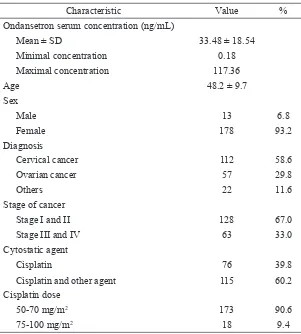
We recruited 191 cancer patients in this study. The mean age of patients was 48.23 ± 9.7 years and most of them were female (93.1%). Around 58 % patients were diagnosed as cervical cancer , around 67 % of them were in the early stage and around 90% patients were treated with cisplatin (50-70 mg/m2)
either as monotherapy or in combination. We
found that the average of ondansetron serum concentration reached 33.48 ± 18.54 ng/mL. This infomation is in line with the literature which reported that after 1.5 treatment of ondansetron intravenously, the peak ondansetron concentration will reach 30 ng/ mL.12 According to the patients’ response to
the antiemetic, during the acute phase, 21.8% patients experienced acute nausea and 30.2% patients experienced acute vomiting.
Characteristic Value %
Ondansetron serum concentration (ng/mL)
Mean ± SD 33.48 ± 18.54
Minimal concentration 0.18 Maximal concentration 117.36
Age 48.2 ± 9.7
Sex
Male 13 6.8
Female 178 93.2
Diagnosis
Cervical cancer 112 58.6
Ovarian cancer 57 29.8
Others 22 11.6
Stage of cancer
Stage I and II 128 67.0
Stage III and IV 63 33.0
Cytostatic agent
Cisplatin 76 39.8
Cisplatin and other agent 115 60.2 Cisplatin dose
50-70 mg/m2 173 90.6
75-100 mg/m2 18 9.4 TABLE 1. Characteristics of cancer patients treated with antiemetics
(n = 191)
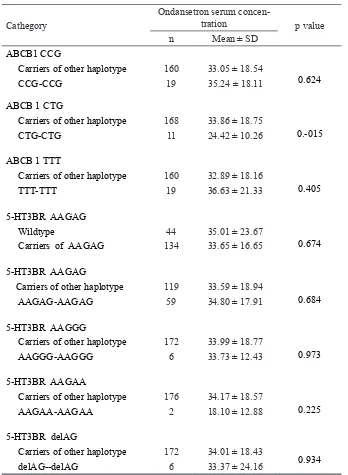
TABLE 3 lists the differences between ondansetron serum concentration and haplotype of 5HT3B and ABCB1 genes.
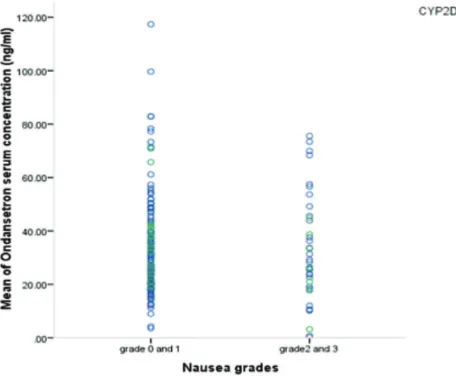
FIGURE 1 shows the ondansetron serum concentration in the vomiting grades
and CYP2D6 phenotypes. In EM patients,
serum concentration of ondansetron are higher in subjects with grade 2 and 3 vomiting than subjects with grade 0 and 1
Cathegory Ondansetron serum concentration p value n Mean ± SD
CYP2D6 phenotype
EM 165 33.30 ± 18.96 0.862
IM 23 34.02 ± 14.83
Nausea grade
0 and 1 150 33.62 ± 18.14
0.850
2 and 3 41 32.99 ± 20.18
Vomiting grade
0 and 1 135 32.26 ± 17.94
0.158
2 and 3 56 36.43 ± 19.77
TABLE 2. Differeces between ondansetron serum concentration and CYP2D6
phenotypes, nausea and vomiting grade
vomiting. In contrast, among the subjects with IM phenotype, serum concentration of ondansetron are higher in subjects with low grade of vomiting than subjects with high grade of vomiting.
FIGURE 1. Serum concentration of ondansetron in CYP2D6 phenotypes and vomiting grades
The signiicant difference of ondansetron concentration is shown in the variant of
CTG-CTG haplotype had lower ondansetron concentration than subjects with other haplotype. The subjects with delAG-delAG
variant of 5HT3B had lower concentration of ondansetron than subjects with other haplotype.
Cathegory
Ondansetron serum
concen-tration p value
n Mean ± SD
ABCB1 CCG
Carriers of other haplotype 160 33.05 ± 18.54
0.624
CCG-CCG 19 35.24 ± 18.11
ABCB 1 CTG
Carriers of other haplotype 168 33.86 ± 18.75
0.-015
CTG-CTG 11 24.42 ± 10.26
ABCB 1 TTT
Carriers of other haplotype 160 32.89 ± 18.16
0.405
TTT-TTT 19 36.63 ± 21.33
5-HT3BR AAGAG
Wildtype 44 35.01 ± 23.67
0.674 Carriers of AAGAG 134 33.65 ± 16.65
5-HT3BR AAGAG
Carriers of other haplotype 119 33.59 ± 18.94
0.684 AAGAG-AAGAG 59 34.80 ± 17.91
5-HT3BR AAGGG
Carriers of other haplotype 172 33.99 ± 18.77
0.973 AAGGG-AAGGG 6 33.73 ± 12.43
5-HT3BR AAGAA
Carriers of other haplotype 176 34.17 ± 18.57
0.225 AAGAA-AAGAA 2 18.10 ± 12.88
5-HT3BR delAG
Carriers of other haplotype 172 34.01 ± 18.43
0.934 delAG--delAG 6 33.37 ± 24.16
TABLE 3. Differences between ondansetron serum concentration and haplotypes of
DISCUSSION
Our present study was aimed to understand the differences between the polymorphisms
of 5HT3B, CYP2D6 and ABCB1 genes
and ondansetron serum concentration. Our preliminary data cannot show signiicant differences between the variables. However, we can present some pharmacogenetic markers which could affect the antiemetic response. Around 30% patients did not show good response to the ondansetron. The previous studies with almost similar regimen without NK1 antagonist also showed that the complete response of 5HT3RA reached around 70%.2,15
In the future, Indonesia Health Institute should consider the use of NK1 antagonist in the guideline of prevention of chemotherapy-induced nausea vomiting in cancer patients treated with highly or moderately cytostatic agents.
As seen in the patients’ characteristics, cervical cancer was the most diagnosed cancer in this study. This fact is in accordance with the statistic data on 2014 which was stated that the cervical cancer was the 2nd most frequent cancer in female and the 2nd most
frequent cancer as well in the age range of 15-44 years old.16 Cisplatin was mostly used in
combination which may have the increase of CINV severity. This situation may prolong the existence of CINV in to the delayed phase.17
Thus, the use of antiemetics should be closely monitored to increase patients’ compliance in the treatment of chemotherapy.
In this study, we did not ind patients with ultra rapid metabolizers phenotype of CYP2D6. However, we found that EM patients had lower serum concentration of ondansetron than IM patients. Over the IM patients, patients who experienced lower grade of nausea and vomiting showed higher serum concentration of ondansetron. This result is supported by previous study using tropisetron which showed that patients with higher
number of active alleles experienced more nausea and vomiting and showed the lower serum concentration of tropisetron.8 The other
previous study with polymorphisms of OCT1 also supported this inding. Patients with higher number of active allele experienced higher grade of nausea vomiting with the lower serum concentration of ondansetron and tropisetron.14
According to the other two genes, only one haplotype of ABCB1 which shows signiicant differences between ondansetron serum concentration and the haplotype of CTG-CTG. However, related with the 5Ht3BRA gene, there were 6 patients with the haplotype of delAG-delAG had lower serum concentration of ondansetron. This inding is supported by previous study which stated that patients with the del AAG experienced higher score of nausea and vomiting.10
Our study has limitation about the number of patients. Because the number of variant in our study is low, thus we need further study with larger sample size to reach the signiicant result of statistical analysis. In our study, even though the most of statistical result is not signiicant, but we can show the difference patterns which are supported by some previous study.
CONCLUSION
Variations of ABCB1, CYP2D6 and 5HT3BRA may be used as pharmacogenetic marker in predicting antiemetic response in cancer patients receiving highly emetogenic cytostatic.
ACKNOWLEDGEMENTS
REFERENCES
1. Hernandez TC, Mazzarello S, Ng T,
Dranit-saris G, Hutton B, Smith S, et al. Deining
optimal control of chemotherapy-induced nausea and vomiting-based on patients’
ex-perience. Support Care Cancer. 2015. http:// dx.doi.org/10.1007/s00520-015-2801-y
2. Palli SR, Grabner M, Quimbo RA, Rugo HS.
The impact of 5-hydroxytryptamine-recep-tor antagonists on chemotherapy treatment adherence, treatment delay, and nausea and vomiting. Cancer Manag Res. 2015; 7:175-88.
3. Perwitasari DA, Atthobari J, Mustofa M,
Dwiprahasto I, Hakimi M, Gelderblom H, et
al. Impact of chemotherapy-induced nausea
and vomiting on quality of life in indonesian patients with gynecologic cancer. Int J Gyne-col Cancer. 2012; 22(1):139-45.
http://dx.doi.org/10.1097/IGC.0b013e
-318234f9ee
4. Molassiotis A, Nguyen AM, Rittenberg CN,
Makalinao A, Carides A. Analysis of aprepi-tant for prevention of chemotherapy-induced nausea and vomiting with moderately and highly emetogenic chemotherapy. Future
Oncol. 2013; 9(10):1443-50. http://dx.doi. org/10.2217/fon.13.155
5. Yeo W, Mo FK, Suen JJ, Ho WM, Chan SL,
Lau W, et al. A randomized study of
aprep-itant, ondansetron and dexamethasone for chemotherapy-induced nausea and vomiting in Chinese breast cancer patients receiving moderately emetogenic chemotherapy. Breast Cancer Res Treat. 2009; 113(3):529-535.
http://dx.doi.org/10.1007/s10549-008-9957-9
6. Perwitasari DA, Gelderblom H, Atthobari J,
Mustofa M, Dwiprahasto I, Nortier JW, et al.
Anti-emetic drugs in oncology: pharmacolo-gy and individualization by pharmacogenet-ics. Int J Clin Pharm. 2011; 33(1):33-43. http://dx.doi.org/10.1007/s11096-010-9454-1
7. He H, Yin JY, Xu YJ, Li X, Zhang Y, Liu ZG,
et al. Association of ABCB1 polymorphisms
with the eficacy of ondansetron in chemo -therapy-induced nausea and vomiting. Clin Ther. 2014; 36(8):1242-1252.
h t t p : / / d x . d o i . o r g / 1 0 . 1 0 1 6 / j . c l i n -thera.2014.06.016
8. Kaiser R, Sezer O, Papies A, Bauer S,
Schelenz C, Tremblay PB, et al.
Patient-tai-lored antiemetic treatment with 5-hydroxy-tryptamine type 3 receptor antagonists ac-cording to cytochrome P-450 2D6 genotypes. J Clin Oncol. 2002; 20(12):2805-2811.
http://dx.doi.org/10.1200/JCO.2002.09.064
9. Perwitasari DA, Wessels JA, van der Straaten
RJ, Baak-Pablo RF, Mustofa M, Hakimi M, et
al. Association of ABCB1, 5-HT3B receptor
and CYP2D6 genetic polymorphisms with ondansetron and metoclopramide antiemetic response in Indonesian cancer patients treat-ed with highly emetogenic chemotherapy. Jpn J Clin Oncol. 2011; 41(10):1168-1176.
http://dx.doi.org/10.1093/jjco/hyr117
10. Tremblay PB, Kaiser R, Sezer O, Rosler N,
Schelenz C, Possinger K, et al. Variations in
the 5-hydroxytryptamine type 3B receptor
gene as predictors of the eficacy of antiemet -ic treatment in cancer patients. J Clin
On-col. 2003; 21(11):2147-2155. http://dx.doi. org/10.1200/JCO.2003.05.164
11. Cancer Therapy Evaluation Program. Com-mon Terminology Criteria for Adverse Events, Version 3.0. 2006. 15-7-2015.
12. Anonymous. Zofran injection. 2015. 17-7- 2015.
13. Bauer S, Stormer E, Kaiser R, Tremblay PB, Brockmoller J, Roots I. Simultaneous deter-mination of ondansetron and tropisetron in human plasma using HPLC with UV detec-tion. Biomed Chromatogr. 2002; 16(3):187-190.
14. Tzvetkov MV, Saadatmand AR, Bokel-mann K, Meineke I, Kaiser R, Brockmoller J. Effects of OCT1 polymorphisms on the cellular uptake, plasma concentrations and
eficacy of the 5-HT(3) antagonists tropise -tron and ondanse-tron. Pharmacogenomics J.
2012; 12(1):22-29. http://dx.doi.org/10.1038/
tpj.2010.75
15. Wenzell CM, Berger MJ, Blazer MA,
Craw-ford BS, Grifith NL, Wesolowski R, et al.
Pilot study on the eficacy of an ondanse -tron- versus palonose-tron-containing anti-emetic regimen prior to highly emetogenic
chemotherapy. Support Care Cancer. 2013;
21(10):2845-2851. http://dx.doi.org/10.1007/
s00520-013-1865-9
16. ICO HPV Information Center. HUman Pap-illoma Virus and Related Cancers. 2015. 23-7-2015.
17. Kris MG, Tonato M, Bria E, Ballatori E,
Es-persen B, Herrstedt J, et al. Consensus
rec-ommendations for the prevention of vomit-ing and nausea followvomit-ing high-emetic-risk chemotherapy. Support Care Cancer. 2011; 19 Suppl 1:S25-S32.