Pharmaceutical Inventory Management Issues in Hospital
Supply Chains
Ilma Nurul Rachmania
*, Mursyid Hasan Basri
School of Business and M anagement, Bandung Institute of Technology, Bandung, 40132, Indonesia
Abstract
The primary focus of the healthcare sector is to provide patients with the best quality of ca re. While the healthcare cost is keep on growing, effect ive healthcare supply chain should be achieved to reduce some unnecessary costs. To address this issue, this study aims to exa mine inventory manage ment practice in one of Indonesian public hospital and focus on the role o f inventory to drive hospital supply chain performance. Th ree ma jor issues regarding inventory manage ment practice has been identified such as overstock, unjustified forecasting technique and lack of IT support. Proposed (s,Q) policy using continuous review can reduce by 50% total inventory value on hand of oncology medication. Among several forecasting technique that’s presented, Holt’s model appears to be the best adapted for oncology medication. Future study is needed to simu late the outlook condition using proposed policy. By imp le ment ing a new inventory policy that cope all the constraints and problems will help hospital to manage its pharmacy inventory in effective and effic ient way.Keywords
Inventory Management, Oncology Medication, Public Hospital, Indonesia1. Introduction
Today’s healthcare organizations have evolved into highly comple x organizat ions. As healthcare costs are growing rapidly, both practitioner and acade micians seek for so me ways to overcome that problem. While cost of healthcare is keep on increasing, healthcare organizations is required to provide the high quality of care. By increasing the efficiency of supply chain, healthcare cost savings could be achieved[1]. It also mentioned, based on previous studies 30-40% of hospital e xpenses are spent in terms of logistical activ ities. As in[2], several studies showed with imp le menting effective supply chain management (SCM) practices can reduce significant healthcare cost.
According to[3], supply chain mac ro process is classified into three ma jor parts, such as customer re lationship manage ment (CRM ), internal supply chain management (ISCM ) and supplier re lationship management (SRM ). This study will discuss about the internal supply chain manage ment in the hospital, wh ich the ma jor aim is to fu lfil patient demand produced by the supply chain management process in a time ly manner with the lo west possible cost.
This study aims to present a case study of Indonesian public hospital and focus on the role of inventory in hospital supply chain and proposed how the managers can use inventory to drive supply chain performance.
* Corresponding author:
[email protected] (Ilma Nurul Rachmania) Published online at http://journal.sapub.org/mm
Copyright © 2013 Scientific & Academic Publishing. All Rights Reserved
In the next section, we reviewed so me literature of hospital supply chain particularly in hospital pharmacy inventory settings that guided our study. Then, outline of the methodology that used in data co llect ion is presented. The next sections present the case data analysis and discuss some ma in issues regarding pharmaceutical supply chain inventory. Finally, potential improve ments are detailed.
2. Hospital Pharmacy Supply Chain
Hospitals are co mple x organization provid ing a mu ltitude of service to patient, physicians and staff. These services include pharmacy, laboratory, surgery, dietary, linen, housekeeping, administration and others. Moreover, each area has specific and often unique materia l and supply need[4]. The hospital product line consists of high cost and low cost items as well as perishable and durable goods that are consumed in la rge and sma ll.
Pharmaceutical co mponents characterize as a large amount of hospital’s operating expenses. Several researchers pointed out that inventory costs in the healthcare sector are substantial and are estimated between 10% and 18% of total revenues[5]. Any measures to control e xpenditures in this area can have significant impacts on the overall effic iency of the organization.
hospital pharmacy. First, pharmaceutical industry is influenced by strong institutional and regulatory pressures. The regulatory pressures affected in determining accurate demand forecast. Second, hospitals are operationally diffe rent with another business, because it’s e xtre me ly difficult to ma ke a forecast about the patients and their consumption of drugs. Third, hospital pharmacy main ly holds a large amount of safety stock to cope with uncertainty demand, which resulting in a high operational cost and have to deal the drug expiry proble ms[7]. Also, several reasons why pharmaceuticals deserve e xtraordinary consideration in controlling inventory, such as: medic ine a re developed, manufactured and distributed according to strict regulatory require ments and it ma kes funda mental d iffe rences between med icines and other consumer products; medic ines are most often selected by a physician for a specific patient and reimbursed in whole or in part by a third-party insurer or state[8].
2.1. Role of Inve ntory in Hos pital Suppl y Chain
American Production and Inventory Control Society (APICS)[9] define inventory manage ment as the branch of business management concerned with planning and controlling inventories. The major a ims of hospital inventory manage ment and healthcare supply chains research is to reduce healthcare cost without sacrific ing the quality of service to the patient by imp roving effic iency and productivity of healthcare system[10].
Inventory management has a significant role in the supply chain. A mong various SCM issues, inventory manage ment is a greater e xtent relevant to the entire supply chain. Inventory manage ment has been recognizes as one of the most important functions that has huge impact on their overa ll performance[11]. Supply chain inventory management is focused on end-customer de mand and aims at improving customer service while lowe ring relevant cost[12].
2.2. Inventor y Contr ol
Inventory control is the process of managing inventory in order to meet customer de mand at the lowest possible cost and with a min imu m investment[13]. Severa l object ives in inventory control such as min imize inventory investment; determine the appropriate of customer service leve l; balance supply and demand; minimize ordering cost and holding cost; also preservation of inventory control system.
Among various inventory control model, Economic Order Quantity (EOQ) which developed by F.W Harris in 1915 has been the most commonly used in practice. He mentioned that EOQ derives the optima l lot size for purchasing by minimizing the total operating cost. EOQ formu la helps inventory manager to determine how many optimu m products to buy[4]. Ho wever, the classical EOQ model assumes such as: constant demand, constant lead time , fixed order cost per order, instantaneous replenishment, no stocks out allowed, no demand uncertainty and quantity discount aren’t availab le[14]. In order the above assumptions do not
reflect in all situations, EOQ model must be modified in a real inventory system analysis.
Replenish ment process also one of common practices in inventory control. Replenish ment divided two types, which is continuous review and periodic revie w[3]. Continuous review placed the order when the inventory declines to the re-order-point (ROP). While pe riodic rev iew placed the order at regular periodic intervals. ROP a lso used in inventory control to seek suitable level for replenish ment.
Another model in controlling inventory is safety stock. Safety stock must be considered where there is an uncertainty in demand; also safety stock is needed during the replenishment lead time when there is a mis match between actual demand and e xpected demand[4].
In order to reduce cost and improve service level, hospital is considered to imp le ment various innovative supply chain strategies. Based on the lite rature, the standard or conventional supply chain was replaced by a nu mber of initiat ives that have been undertaken such as just-in time (JIT)[15], stockless inventory[16] and vendor managed inventory (VMI)[17].
3. Method
This study is carried out as a case study analysis. Case study analysis involves in-depth and contextual analyses of matters re lating to similar situations in other organization[18]. A lso, case study analysis is used in understanding certain phenomena and generating further theories for e mpirica l testing.
Both of qualitative and quantitative data were collected. Qualitative data were gathered through observations and interviews. We conduct direct observation to know about the e xisting inventory system in hospital pharmacy inventory. By doing observation, we record the behavioral patterns of people, objects and occurrences related to hospital pharmacy inventory. Semi structured interviews were carried out with various hospital staffs, such as supply chain professionals, pharmac ist, IT managers, customer service and nurse. The purpose of these interviews are to achieve a clear understanding of the problems e xperienced within the hospital setting, collect info rmation about the supply chain process and also discuss possible solutions to the problems.
Data analysis was co mpleted in order to illustrate the potential advantages and disadvantages of the proposed solutions to the inventory issues that present in the hospital. Data analysis was also exa mined the benefits of inventory reductions and various cost
4. Problem Description
directly under supervisory Indonesian Ministry of Hea lth. Also, this hospital becomes the highest referral hospital in Province.
Hospital has various types of drugs in its inventory with diffe rent characteristic. To ma ke it easier in ana lysis, drugs sampling is done. Oncology medication drugs are chosen as drugs sampling because of its huge value. Oncology med ication also suggested by the principal pharmac ist as the representative of drugs inventory problem in this hospital. A litt le imp rovement in oncology medication inventory control can have a significant impact in effic iency of the hospital.
Figure 1. Overview Pharmaceutical Flow
Figure 1 presents the overview of the pharmaceutica l flow system in this hospital. As shown below, the system of interest of this study is focus on the internal chain of the hospital. Th is hospital adopted mult i-echelon inventory system, wh ich has two medica l warehouses with 20 depots throughout the hospital. Warehouses A serves depot for government insurance holders for poor citizens, while warehouses B serves depot for civil-servant insurances holders, private insurance holders and regular patients. Regular patients are the patient that they are paid the med ication by their self.
Third-party managed inventory used to be adopted in this hospital. However since the new regulation fro m Indonesian Ministry of Hea lth No.68 Yea r 2010, hospitals have to manage a ll ma in activ ity in the hospital by their own, including pharmaceutical inventory management. Based on that situation, the existing condition of the hospital is back to the traditional supply chain where the hospital is fully managed their inventory. Currently, hospital is using base stock (S) policy with periodic rev iew replenish ment for control its inventory. Every depot places an online order to the warehouse once a wee k. The quantity of o rder is based on mean de mand last week plus 10%-20% buffer stock. Urgent orders can be placed if there ’s a c rit ical situation at the depot.
Fro m the data gathered fro m the hospital, three main issues has been identified regard ing pharmaceutical supply chain manage ment and affect patient service performance. These issues have been recognized through triangulating findings based on different data collection techniques. These issues are:
a. Overstock. Warehouse carried out too much inventory. b. Unjustified de mand forecasting technique.
c. Lack of IT support and some organizational factors due to the changing systems fro m third-party managed inventory.
5. Discussion
5.1. Inventor y Contr ol
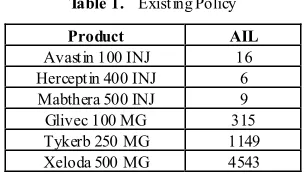
As mentioned above, this hospital is using base stock (S) policy to control their inventory. Under this policy inventory is replen ished up to the base stock point S, every time the inventory is reviewed. Average inventory level (AIL) using e xisting policy during period January – June 2012 is described below.
Table 1. Existing Policy
Product AIL
Avastin 100 INJ 16
Herceptin 400 INJ 6
Mabthera 500 INJ 9
Glivec 100 MG 315
Tykerb 250 MG 1149
Xeloda 500 MG 4543
A different policy should be investigated to find an appropriate policy in controlling the inventory. Basic inventory (R,S) and (s,Q) policy are proposed to improve the efficiency of drugs inventory. Periodic revie w (R,S) policy controls that every review interval (R) units of time is ordered to raise inventory position to the order up to level (S). Given the lead t ime is three days, review interval is one week and customer service level (CSL) is 95%, average inventory level is calcu lated below.
Table 2. (R,S) Policy
Product µ D σ D ss S AIL
Avastin 100 INJ 18 10 10 16 12
Herceptin 400 INJ 16 3 3 8 5
Mabthera 500 INJ 13 5 5 9 6
Glivec 100 MG 375 254 241 366 285
Tykerb 250 MG 464 122 116 271 170
Xeloda 500 MG 2237 515 489 1235 750
(R,S) policy is calcu lated using this following formu la: (1) 𝑠𝑠𝑠𝑠= 𝐹𝐹𝑠𝑠−1(𝐶𝐶𝐶𝐶𝐶𝐶) 𝑋𝑋𝜎𝜎
𝑅𝑅+𝐶𝐶
(2) 𝐶𝐶= 𝐷𝐷𝑅𝑅+𝐶𝐶 + 𝑠𝑠𝑠𝑠
(3)𝐴𝐴𝐴𝐴𝐶𝐶= 1
2𝐷𝐷𝑅𝑅+ 𝑠𝑠𝑠𝑠
(s,Q) policy is proposed using continuous review. A fixed quantity Q is ordered whenever the inventory position drops to the re order point (s) or lowe r.
Table 3. (s,Q) Policy
Product µ D σ D ss s Q AIL
Avastin 100 INJ 18 10 5 7 4 7
Herceptin 400 INJ 16 3 2 3 2 3
Mabthera 500 INJ 13 5 3 4 2 4
Glivec 100 MG 375 254 132 170 108 186
Tykerb 250 MG 464 122 63 110 195 181
Xeloda 500 MG 2237 515 268 492 683 609
(s,Q) policy is calculated using this following formu la : (1) 𝑠𝑠𝑠𝑠= 𝐹𝐹𝑠𝑠−1(𝐶𝐶𝐶𝐶𝐶𝐶) 𝑋𝑋𝜎𝜎
𝐶𝐶
(3) 𝑄𝑄=�2𝐷𝐷𝐶𝐶
Avastin 100 INJ 69,875,900 52,406,900 30,570,700
Herceptin 400 INJ 106,952,900 89,127,400 53,476,500 Mabthera 500 INJ 129,469,300 86,312,900 57,542,000
Glivec 100 MG 60,374,900 54,625,000 35,649,900
Tykerb 250 MG 83,870,738 12,409,100 13,212,000
Xeloda 500 MG 130,834,400 21,600,000 17,539,200
Based on the calculat ion above, we can see the differences of total value using proposed inventory policy and existing policy. Exist ing policy carries higher a mount inventory on hand than two proposed inventory policy. However proposed inventory (s,Q) policy carries on less inventory than (R,S) policy. Thus, it is better to adapted the (s,Q) policy fo r oncology med ication.
5.1. De mand Forecasting
In order to develop an appropriate inventory control, demand forecasting is highly needed. The ma jor forecasting techniques in healthcare settings such as historical data analysis which e mploy analysis fro m previous data to determine future de mand[19]. A lthough to do forecasting the accurate demand for drugs is difficult[6]. One of the problems regarding this situation is difficultness to have a correct data for drugs consumption. Moreover, different drugs brand preference of physicians creates additional uncertainties for predicting the demand .To cope this thing, demand patterns analysis can be done firstly then the mathe matica l modelling for accurately describe and simulate those patterns[20]. Table 4 shows the general nature of mean daily de mand of oncology medicat ion across all depots from warehouse B fro m January – June 2012.
Table 5. Mean Daily Demand of Oncology Medication
Demand Level Description Total %
High Moving Above 10 items / day 18 5
Moderate 5-10 items / day 12 4
Slow Moving Less than 5 items / day 314 91
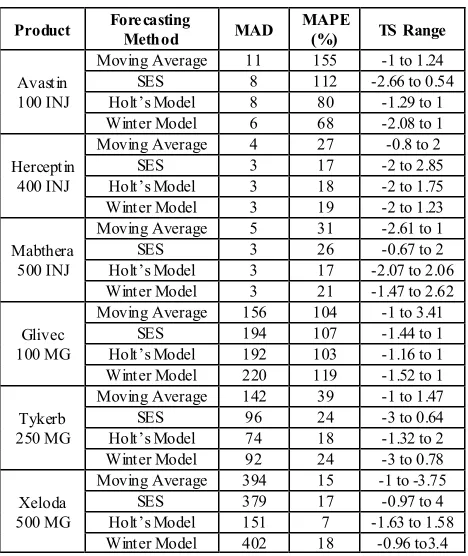
Adaptive forecasting technique is used such as moving average, simple e xponential smoothing, trend-corrected e xponential s moothing (Holt ’s model) and trend-seasonality -corrected e xponential s moothing (Winter’s model). Measures of forecast error are used to find a suitable technique for oncology medication, such as mean absolute deviation (MAD), mean absolute percentage error (MAPE) and tracking signal (TS).
Table 6 shows TS range for every product is in between -6 to 6, it means that all the forecasting technique is acceptable. However, Ho lt’s model has the smallest MAD and MAPE for a ll products, e xcept for Avastin. MAD represents the average of the absolute deviations over all
periods while MAPE represents the average absolute error as a percentage of the demand. It can be conclude, Holt’s model is an appropriate technique for oncology medication demand forecasting. It e xpla ins that oncology medication demand has level and trend in the systematic co mponent.
Table 6. Oncology Medication Demand Forecasting
Product Fore casting
Reengineering is not just automating the existing system, but it is about changing the existing system and then automating the new system[21]. A research has been conducted in India, shows that by reengineering the inventory system lead to several cost savings and improve ment[22]. Several things could be done in order to deal with the lac k o f IT in hospital, such as the replace ment of e xisting spreadsheets by imple ment ing a software tool in order to record and monitor drugs distribution flow in the hospital, build ing integrated software that linkage between the hospital inventory system and the inventory management. The shaping of organizational structure is also considered. Top management support, role of pharmacy director is also needed. Since hospital is more heavily re ly on different coalitions of stakeholders with d ifferent interest and responsibilit ies. Regarding the scope of this study is about inventory and operational management, this issue need to be e xa mined further and analysed separately.
6. Conclusions
system fro m third-party managed to own managed inventory made further obstacles in managing its inventory. Historical data inventory showed that hospital still ho lds too large amount of inventory on hand. With the same customer service level, (s,Q) proposed policy can reduce by 50% total inventory value on hand of oncology medication. Several forecasting techniques have been undertaken to seek the most suitable forecasting technique for oncology med ication. Holt’s model turns to be the best technique for oncology med ication because has the smallest error co mpared to another.
By managing inventory effectively savings could be achieved in total inventory cost. Exp loring factors that might affect hospital inventory manage ment are needed in the ne xt study. By e xa min ing the contextual side of hospital, a new inventory model will be build to cope with all the constraints and problems that will help hospital to imp le ment a new model to manage hospital pharmacy inventory in effective and efficient way. Further study will be done by simu lating inventory policies with forecast demand to find an appropriate inventory control model for the ne xt period.
REFERENCES
[1] Sang M an Kim, “An Empirical Investigation of the Impact of Electronic Commerce on Supply Chain M anagement: A Study in the Healthcare Industry”, Dissertation, University of Nebraska, USA, 2004.
[2] Vikram Bhakoo, Prakash Singh, Amrik Sohal, “Collaborative M anagement of Inventory in Australian Hospital Supply Chains: Practices and Issues”, Supply Chain M anagement: An International Journal, Vol. 17, No. 2, pp. 217-230, 2012. [3] Sunil Chopra, Peter M eindl, Supply Chain M anagement:
Strategy, Planning and Operation. 4th ed, Pearson Education Inc, USA, 2010.
[4] Chuleeporn Laeiddee, “Improvement of Re-Order Point for Drug Inventory M anagement at Ramathibodi Hospital”, M .Sc Thesis, M ahidol Universty, Thailand, 2010
[5] Peter Kelle, John Woosley, Helmut Schneider, “Pharmaceutical Supply Chain Specifics and Inventory Solutions for a Hospital Case”, Operation Research for Healthcare, No. 1, pp. 54-63, 2012.
[6] Noorfa Haszlinna M ustaffa, Andrew Potter, “Healthcare Supply Chain M anagement in M alaysia: A Case Study”, Supply Chain M anagement: An International Journal, Vol. 14, No. 3, pp. 234 – 243, 2009.
[7] Nilay Shah, “Pharmaceutical Supply Chains: Key Issues and Strategies for Optimization”, Computers and Chemical Engineering, Vol. 28, pp. 929-941, 2004.
[8] Anna Birna Almarsdottir, Janine M . Traulser, “Cost-containment as Part of Pharmaceutical Policy”, Pharmacy World Science, Vol. 27, No. 3, pp. 144-148, 2005. [9] James F. Cox, John H. Blextone, APICS Dictionary. 9th ed.
American Production Inventory Control Society, USA, 1998 [10] M anuel D. Rossetti, “Inventory M anagement Issues in Healthcare Supply Chains”, University of Arkansas, USA, 2008.
[11] George Nenes, Sofia Panagiotidou, George Tagaras, “Inventory M anagement of M ultiple Items with Irregular Demand: A Case Study”, European Journal of Operation Research, Vol. 205, pp. 313-324, 2010.
[12] Kwangyeol Ryu, Ilkyeong M oon, Seungjin Oh, M ooyoung Jung, “A Fractal Echelon Approach for Inventory M anagement in Supply Chain Networks”, Special Issue of International Journal of Production Economics, 2012. [13] Jeff Blackburn, “Fundamental of Purchasing and Inventory
Control for Certified Pharmacy Technicians: A Knowledge Based Course”, The Texas Tech University, 2010.
[14] John W. Toomey, Inventory M anagement: Principles, Concepts and Techniques, Kluwer Academic Publishers Dordrecht, Netherlands, 2000.
[15] P. Garry Jarrett, “The Benefits and Implications of Implementing Just-In-Time System in the Healthcare Industry”, Leadership in Health Service, Vol. 19, No. 1, pp. 1-9, 2006.
[16] Hugo Rivard-Royer, Sylvain Landry, M artin Beaulieu, “Hybrid Stockless: A Case Study: Lessons for Healthcare Supply Chain Integration”, International Journal of Operations and Production M anagement, Vol. 22, No. 4, pp. 412-424, 2002.
[17] Scot Hsiang-Jen Cheng, Graham J. Whittemore, “An Engineering Approach to Improving Hospital Supply Chains”, M .Eng Thesis, M assachusetts Institute of Technology, USA, 2008.
[18] Uma Sekaran, Roger Bougie, Research M ethods for Business: A Skill Building Approach. 5th edition, John Wiley and Sons, USA, 2010.
[19] William P. Pierskalla, David J. Brailer, “Applications of Operational Research in Healthcare Delivery”, Handbooks in OR and M S, Vol. 6, pp. 469-505, 1994.
[20] Derek T. DeScioli, “Differentiating the Hospital Supply Chain for Enhanced Performance”, M .Eng Thesis, M assachusetts Institute of Technology, USA, 2005.
[21] M ichael Hammer, “Reengineering Work: Don’t Automate, Obliterate”, Harvard Business Review, pp. 104-112, 1990. [22] K.V. Ramani, ”M anaging Hospital Supplies: Process