Edited by
Vandana Desai and Robert B. Potter
● ●
SAGE Publications
First published 2006
Apart from any fair dealing for the purposesof researchor privatestudy, or criticism or review, as permittedunder the Copyright, DesignsandPatents Act, 1988, this publication may be reproduced, storedor transmittedinany form, or by any means, only withthe prior permissioninwriting of the publishers, or inthecaseof reprographic reproduction, inaccordancewiththetermsof licencesissuedby the CopyrightLicensing Agency. Inquiriesconcerning reproductionoutsidethosetermsshouldbesenttothe publishers.
SAGEPublicationsLtd 1 Oliver’s Yard 55 City Road LondonEC1Y 1SP
SAGEPublications Inc. 2455 Teller Road
ThousandOaks, California 91320
SAGEPublications IndiaPvtLtd B-42, PanchsheelEnclave Post Box 4109
NewDelhi 110 017
British Library Cataloguing in Publication data
Acatalogue record for thisbookisavailable from the BritishLibrary
ISBN10 1 4129 0284 3 ISBN13 978 1 4129 0284 7 ISBN10 1 4129 0285 1 (pbk) ISBN13 978 1 4129 0285 4 (pbk)
Library of Congress Control Number 2005934837
Typesetby C&M Digitals (P) Ltd., Chennai, India Printedon paper from sustainable resources
List of contributors viii
Preface x
PART I INTRODUCTION 1
1 The Raison d’être of Doing Development Research 3
PART II STRATEGIC ISSUES IN PLANNING SOUND RESEARCH 11
2 Doing Fieldwork in Developing Countries: Planning
and Logistics 13
Tony Binns
3 Ethical Practices in Doing Development Research 25 Lynne Brydon
4 Working in Different Cultures: Issues of Race,
Ethnicity and Identity 34
Caesar R.A. Apentiik and Jane L. Parpart
5 Women, Men and Fieldwork: Gender Relations and Power Structures 44 Janet Henshall Momsen
6 Working with Children in Development 52 Lorraine van Blerk
7 Collecting Sensitive and Contentious Information 62 Margaret E. Harrison
8 Dealing with Conflicts and Emergency Situations 70 Morten Bøås, Kathleen M. Jennings and Timothy M. Shaw
9 Working with Partners: Educational Institutions 79 Bill Gould
vi
11 Working with Partners: NGOs and CBOs 94
Claire Mercer
12 Doing Development Research ‘at Home’ 104
Tim Unwin
PART III INFORMATION AND DATA COLLECTION METHODS 113
(i) METHODS OF SOCIAL RESEARCH AND ASSOCIATED FORMS OF ANALYSIS
13 Quantitative, Qualitative or Participatory? Which Method,
for What and When? 115
Linda Mayoux
14 Field Surveys and Inventories 130
David Barker
15 Interviewing 144
Katie Willis
16 Focus Groups 153
Sally Lloyd-Evans
17 Your Questions Answered? Conducting Questionnaire Surveys 163
David Simon
18 Lost in Translation? The Use of Interpreters in Fieldwork 172 Janet Bujra
19 Ethnography and Participant Observation 180
Jan Kees van Donge
20 Participatory Methods and Approaches: Tackling the Two Tyrannies 189 Harriot Beazley and Judith Ennew
21 Diaries and Case Studies 200
JoAnn McGregor
(ii) USING EXISTING KNOWLEDGE AND RECORDS 207
22 Literature Reviews and Bibliographic Searches 209
Paula Meth and Glyn Williams
23 Using Indigenous Local Knowledge and Literature 222
vii
24 Using Images, Films and Photography 231
Cheryl McEwan
25 Using Archives 241
Michael Jennings
26 Remote Sensing, GIS and Ground Truthing 251
Dennis Conway and Shanon Donnelly
27 The Importance of Census and Other Secondary
Data in Development Studies 262
Allan M. Findlay
28 Using the World Wide Web for Development Research 273
Emma Mawdsley
29 Data from International Agencies 282
Jonathan Rigg
(iii) DISSEMINATING FINDINGS/RESEARCH 295
30 Writing an Effective Research Report or Dissertation 297
Stephen Morse
31 How is Research Communicated Professionally? 310
Sally Gainsbury and Cheryl Brown
Mansoor Ali, Water, Engineering and Development Centre (WEDC), University of
Loughborough, UK.
Caesar R.A. Apentiik, InternationalDevelopmentStudies, Dalhousie University, Canada.
David Barker, Departmentof Geography andGeology, University of the West Indies, Mona, Jamaica.
Harriot Beazley, School of Social Workand Applied Human Sciences, University of Queensland, Brisbane, Australia.
Tony Binns, Departmentof Geography, University of Otago, Dunedin, New Zealand.
Morten Bøås, Fafo – Institute for Applied InternationalStudies, Oslo, Norway.
Cheryl Brown, Instituteof DevelopmentStudies, University of Sussex, UK.
Lynne Brydon, Centreof WestAfricanStudies (CWAS), University of Birmingham, UK.
Janet Bujra, Departmentof PeaceStudies, University of Bradford, UK.
Dennis Conway, Departmentof Geography, Indiana University, USA.
Andrew Cotton, Water, Engineering andDevelopment Centre (WEDC), University of
Loughborough, UK.
Vandana Desai, Departmentof Geography, Royal Holloway, University of London, UK.
Shanon Donnelly, Departmentof Geography, Indiana University, USA.
Judith Ennew, Centre for Family Research, University of Cambridge, UK.
Allan M. Findlay, Departmentof Geography, University of Dundee, UK.
Sally Gainsbury, Public Finance Magazine, London, UK.
Bill Gould, Departmentof Geography, University of Liverpool, UK.
Margaret E. Harrison, Department of Natural and Social Sciences, University of
Gloucestershire, UK.
ix
Michael Jennings, Centre for DevelopmentStudies, University of WalesSwansea, UK.
Sally Lloyd-Evans, Departmentof Geography, School of Human andEnvironmental Sciences, University of Reading, UK.
Emma Mawdsley, Schoolof Geography, Birkbeck College, University of London, UK.
Linda Mayoux, InternationalDevelopment Consultant, 61 Cheney Way, Cambridge, UK.
Cheryl McEwan, Departmentof Geography, University of Durham, UK.
JoAnn McGregor, Department of Geography, School of Human and Environmental Sciences, University of Reading, UK.
Cathy McIIwaine, Departmentof Geography, Queen Mary, University of London, UK.
Claire Mercer, Departmentof Geography, University of Leicester, UK.
Paula Meth, Departmentof Townand RegionalPlanning, University of Sheffield, UK.
Janet Henshall Momsen, Department of Human and Community Development, University of California, Davis, USA.
Stephen Morse, Department of Geography, School of Human and Environmental Sciences, University of Reading, UK.
Jane L. Parpart, International Development Studies, Dalhousie University, Canada; Research Fellow, London School of Economics; Political Studies, Stellenbosch University, SouthAfrica.
Robert B. Potter, Department of Geography, School of Human and Environmental Sciences, University of Reading, UK.
Jonathan Rigg, Departmentof Geography, University of Durham, UK.
Timothy M. Shaw, Instituteof CommonwealthStudies, University of London, UK.
David Simon, Departmentof Geography, Royal Holloway, University of London, UK.
Tim Unwin, Departmentof Geography, Royal Holloway, University of London, UK.
Lorraine van Blerk(née Young), Departmentof Geography andEarthSciences, Brunel University, UK.
Jan Kees van Donge, PublicPolicy andDevelopment Management, Instituteof Social Studies, The Hague.
Glyn Williams, Departmentof Geography, King’s College, University of London, UK.
Our intentionastheeditorsof Doing Development Research hasbeentobring together
informationand guidance from startto finishthatwill proveinvaluable totheinexperi
-encedstudentor researcher embarking on researchand fieldworkoverseas. We realize thatstudentscannotbetotally prepared for alleventualitiesthat mightoccur, butwethink useful preparations canbe madeand some common problemsavoidedto maximize academicusefulnessandto help ensure rewarding fieldwork. Wehopeto providean overviewof the major issuessurrounding development researchtoday.
From theoutset, itwasenvisagedthatthebookwouldoffer aone-stop reference guide
for anyone with a practical, professional or academic interest in doing development
research.Thebook is of particular relevanceto those doing researchin the fieldsof
developmentstudies, geography, economics, politics, sociology, socialanthropology and social policy, along withNGO practitionersandthoseindonor agencies.
Doing Development Research recognizes the prior existence of numerous good
generaltextsondoing researchindeveloping countries.Our bookisnotinany way a standard manual. Rather, wehopeto givea rangeof tipsandsoundadvicetothosecon
-templating thechallengesof undertaking fieldworkin ‘developing’areas. However, this book performsaunique functioninbringing together awide rangeof issuesconcerning
doing researchindeveloping countries, from thestartof the processtotheendof the
research.Assuch, thebookcaneffectively beusedasacoursetextbook for research training, methodology courses, while, withtheexerciseof selective judgement, itcanbe treated asasource of key course readingsanddiscussion piecesinconnectionwith higher-leveloptionsandtraining courses, for example, atthe Mastersdegreelevel. In order to guidebothinterestedstudentsand general readerswhowantto pursuedoing research, eachchapter is followedby some questions for discussion, a further reading
sectionandalistof usefulwebsites. Itisalsoour hopethatstudentswillbeabletouse the book for theduration of their research and fieldwork andnot just for one or two aspectsof doing research.
Althoughevery fieldworkcontextisunique, many featuresarecommontoall.Doing
Development Research coversawide rangeof issues from preparing to gointothe field,
theeventualitiesof actually working inthe field, the positionality of the researcher, work
-ing with variousorganizations, using interpreters, or different methodsto collectdata,
using varioustypesof information from differentsourcesto finally presenting the findings of the research.
secondsectionis further dividedintothree parts, dealing respectively with methodsof
social researchandassociated formsof analysis, using existing knowledgeand records,
and finally disseminating research.
Oneof the major strengthsof thebookisthatitiswritten mostly by academics who havesupervisedand guidedstudentsatbothundergraduateand postgraduatelevels,
whodrawontheir extensive, richanddiverseexperiencesof a rangeof researchcarried out in various developing countries. We have also tried to incorporate authors from
aroundtheworldwhoareinvolvedindevelopment. Wearethankful for their supportand contributions.
Wehopethatour readers finddoing development researchanexciting and memorable lifeexperience andnot just anintellectualexercise. Inessence, we seedevelopment
researchasacontinuouslearning process, andwehopethisbookwillstimulatecritical thinking.
VandanaDesaiand RobPotter
The aim of Doing Development Research is to provide a comprehensive introduction to the process of undertaking research in the multi-and interdisciplinary field of development studies. This volume seeks, therefore, to pro-vide the bases for a thorough initial training for anyone aiming to carry out research in, or on, developing countries. In this context, the geo-graphical category ‘developing countries’ is to be interpreted in the broadest of fashions.This geographical signpost might more properly be referred to as ‘overseas’, referring to cases where somebody is researching in an area, region or culture other than the one in which they grew up, or with which they are now familiar. But we do not preclude doing devel-opment work in, or on, one’s own country, fol-lowing the premise that development is change in either positive or negative terms, and thereby occurs in all localities and regions to a greater or lesser extent (see Brookfield, 1975; Potter et al., 2004).
Having said this, although it is hoped that the volume will address the concerns of prac-titioners and consultants working on ‘hands-on’ or applied development issues, the book is primarily designed with the needs of under-graduate and postunder-graduate students to the fore. For generations of students, the requirement that they should prepare a dissertation or thesis has represented their first professional-academic contact with doing development research at first hand, and this represents the starting point
for Doing Development Research. We assume, therefore, that the person aiming to undertake development research has attended introduc-tory courses and read the background literature (see Chapters 22 and 28) on development the-ory and practice. We also hope that as part of their general undergraduate or postgraduate training they will have read a little about dif-ferent research methods and the ways in which data can be collected and analysed.
The volume brings together a range of experts who have extensive first-hand experi-ence of undertaking overseas research. It starts from the premise that overseas development is a more complex, personal, professionally demanding and nuanced experience than most manuals on research methodology acknow-ledge. It follows that at the outset of their work, starting students need all the help and assistance they can get.Doing Development Research aims to bring a much-needed cross-cultural perspec-tive to the issues surrounding working overseas. Doing Development Research enters a field where there are already some very good books and our intention has been to complement these, both in terms of the level of treatment and the subject areas covered. For example, a very helpful volume is provided by Scheyvens and Storey (2003). Their practical guide to doing development fieldwork considers the nature of quantitative and qualitative research at the outset, before the major parts of the book deal with preparing to go into the field, the
1
4
eventualities of actually working in the field and, subsequently, the issues involved in leaving the field. Overall, there is a strong and much needed emphasis on the researchers’ positionality while preparing for, completing and acting on field-work, which will directly influence the research process and outcomes. We envisage that our readers who are strongly fieldwork-based may well progress to use Scheyvens and Storey (2003), having first consulted Doing Development Research.The same is true of several other books that deal primarily with the issues surrounding the completion of fieldwork in developing countries, like Robson and Willis (1997) and Devereux and Hoddinott (1992).
Several other very good books,while cover-ing more than fieldwork logistics and methods, are distinguished by the fact that they are pri-marily aimed at the development practitioner – that is those professionals who are involved in implementation projects and consultancy research, etc. Laws, Harper and Marcus (2003) concentrate on topics such as quality issues in research, organizing a brief, approaches to evaluation, re-evaluating research for develop-ment work, as well as managing impacts. Mikkelson (2005) takes a very strongly partici-patory view of research and her book is aimed primarily at practitioners. Other books are avowedly aimed at postgraduates, as for exam-ple is the case with those by Robson and Willis (1997) and Scheyvens and Storey (2003). In contrast, Doing Development Research endeavours to provide a clear overview for the beginning student – whether undergrad-uate or postgradundergrad-uate. How can they set about their work – what published secondary data are already available? How can they make use of archives? (see Chapter 25) How can the lit-erature on the chosen topic be reviewed? (see Chapter 22) How can they use the internet and other innovate sources such as images, films and photography to aid their research endeavours? If they are going into the field, what practical and logistical issues do they face? (see Chapter 2) What ethical factors are
to be borne in mind (see Chapter 3), and what are the special concerns of working across lines of race, ethnicity and identity? What about gender issues and the special requirements of working with children – what special consid-erations do these entail?
As we detail more fully in the next section, Doing Development Researchcovers more than fieldwork (logistical issues,working in different cultures, gender issues in fieldwork, using interpreters, field surveys, interviews, focus groups and questionnaires, etc.). The volume considers doing development research not only overseas in the field, but also doing development ‘at home’. This is specifically covered in Chapter 12. But Doing Development Research also covers this important topic in respect of using data from international agen-cies, using the World Wide Web for develop-ment research and other secondary sources, such as remote sensing, GIS, census data, archives, indigenous literature, etc. Working with partners such as educational institutions, government departments and ministries, non-government organizations and community-based organizations is also covered under this wider remit.
Structure and content
After the brief introduction and overview of the aims and scope of Doing Development Researchprovided in this chapter, which com-prises Part I of the volume, the book is divided into two principal sections (Parts II and III):
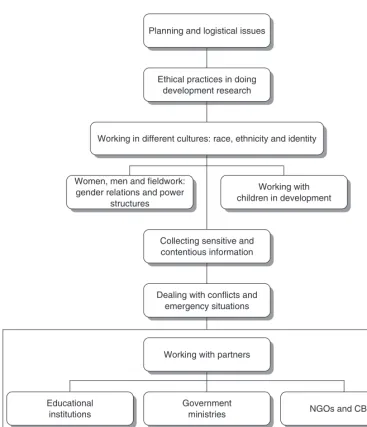
The strategic issues involved in planning and executing sound researchare first surveyed in Part II of the book (see Figure 1.1). The chapters in this part cover both working in the field and working via secondary sources. It aims to introduce readers to both the practicalities and the realities of undertaking development-oriented research.
5
out development-oriented research.This is designed to assist with selecting appropriate methods. Part III is itself split into three sub-parts:
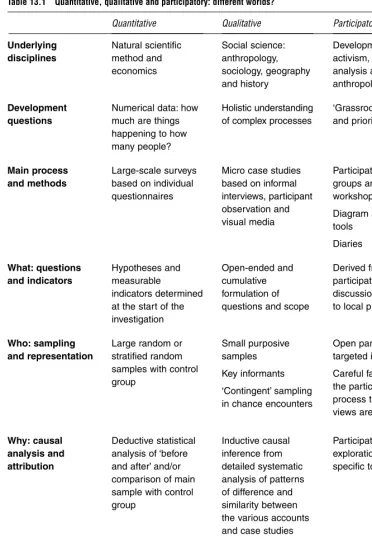
• Section (i) deals with methods of social research by which data can be collected at first hand.These chapters also cover associ-ated forms of analysis, where these are rel-evant. However, the primary aim of Doing
Development Researchis not to cover statis-tical and other forms of data analysis.These issues are covered in far greater detail in books written for this purpose (for exam-ple, see Kitchen and Tate, 2000; Robinson, 1998).
• Section (ii) deals with how existing know-ledge and sources can be used to inform analyses of development issues.Too often these can be Ethical practices in doing
development research Planning and logistical issues
Collecting sensitive and contentious information
Dealing with conflicts and emergency situations
Working with partners
Government ministries Educational
institutions NGOs and CBOs
Doing development at home
Working with children in development Women, men and fieldwork:
gender relations and power structures
Working in different cultures: race, ethnicity and identity
6
forgotten in the rush to collate new and relevant data. This section also makes a valuable contribution in focusing atten-tion on up-to-date, state-of-the art innov-ative approaches such as those afforded by the use of the internet, using images, films and photography, and data from inter-national development agencies such as the United Nations and World Bank. • Section (iii), consisting of two chapters,
points the way in terms of how research can be written up effectively, and how the results of research can be disseminated profes-sionally. This final section is not a substi-tute for texts which deal specifically and comprehensively with how to write up the results of research. Such guides exist for the undergraduate (Walliman, 2004), for Masters candidates (Hart, 2004), with respect to theses and dissertations in gen-eral (Glatthorn and Joyner, 2005; Oliver, 2003; Roberts, 2004; Rudestam and Newton, 2000), and for the doctoral stu-dent (Craswell, 2004; Wellington et al., 2005). Rather, this section provides a start-ing point to get readers thinkstart-ing about such issues and hopefully to refer to the specialist texts that exist.
Throughout, Doing Development Research tries to maintain a basically common-sense approach and adopts a much needed cross-cultural perspective. The book seeks to use straightforward language to guide those doing overseas research through the choice of an appropriate set of research methods, the imple-mentation of the research, and how to com-municate the findings to a range of audiences (see Chapter 30 and 31).
Doing Development Research and paradigms of development
One of the main reasons that we regard Doing Development Researchto be so necessary is that development studies and associated research have been, and still are, characterized by a
multiplicity of philosophical approaches and associated epistemologies. By an epistemology, we mean theories as to how we find out about the world. Different development agendas reflect different political, economic, social, cultural, ethical and even moral and religious goals (Cowan and Shenton, 1996; Potter et al., 2004; Power, 2003; Rapley, 1996). Thus, thinking about development has shown many sharp twists and turns over the past 150 years. Further, the various ideas about develop-ment that have taken centre stage have not commanded attention in a strictly sequential manner. In other words, as new sets of ideas about development have come to promi-nence, earlier theories and models have not been totally discarded. For example, the right wing of the political spectrum have held on to free-market policies and have re-promulgated them as part of the ‘New Right’. Equally, even given the near total collapse of state socialism since 1989, Marxist-inspired views and theo-ries still pervade many areas of development thinking. So, as argued by Potter et al. (2004), theories and strategies of development have tended to stack up upon one another. Thus, Hettne (1995: 64) drew attention to the argument that theories of development in the social sciences ‘accumulate rather than fade away’.
7
that have been associated with different the-ories of development are also still in currency. As a broad generalization, early approaches stressed development as economic growth and therefore emphasized quantitative approaches. Later, more humanistic approaches to devel-opment saw the rise of participatory and qual-itative lines of investigation, with the aim being to put fewer words into respondents’ mouths and to listen more effectively (see Chapter 18).
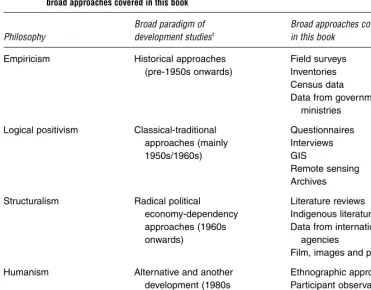
Broadly speaking, the earliest approaches in any discipline tend to be empiricist. They subscribe to the view that we find out about the world by observing what has happened and how it is structured.In development studies, this has meant looking at what history tells us
about how countries and regions have devel-oped and changed through time. As shown in Table 1.1, early and continuing approaches in the subject, therefore, have been associated with collecting data out in the field – for example, doing farm and rural surveys (see Chapters 13 and 14), urban and village assess-ments and inventories. Of course, just as we were arguing above, empirical data are still frequently collected as part of development research, whether collected in the field or from national censuses or data collated by govern-ment ministries or international agencies (see Chapters 27 and 29). They are often the ‘sta-ples’ of basic and applied or practical research. In most areas of intellectual endeavour,over time, pure empiricism tends to be replaced by
Table 1.1 The broad association between philosophies of science, paradigms of development and the broad approaches covered in this book
Broad paradigm of Broad approaches covered Philosophy development studies1 in this book
Empiricism Historical approaches Fieldsurveys
(pre-1950s onwards) Inventories
Censusdata
Data fromgovernment
ministries
Logical positivism Classical-traditional Questionnaires approaches (mainly Interviews
1950s/1960s) GIS
Remotesensing
Archives
Structuralism Radical political Literaturereviews economy-dependency Indigenous literature approaches (1960s Data frominternational
onwards) agencies
Film,imagesand photography
Humanism Alternativeandanother Ethnographic approaches development (1980s Participant observation
onwards) Participatoryresearchmethods
Focusgroups
Diariesand casestudies
8
logical positivism. Positivism is associated with the rise of the scientific method under condi-tions of modernity, subscribing to what is gen-erally referred to as ‘enlightenment thinking’ (Power, 2003). Positivism basically argues that we come to understand the world by observ-ing what has been the case experimentally. When formal ideas are tested repeatedly, this is referred to as logical positivism. The rise of what may be referred to as classical-traditional approaches to development (see Potter et al., 2004: Chapter 3) in the 1950s and early 1960s can be temporally associated with the rise to prominence of positivism in geography and development studies, as shown in Table 1.1. During this period, empirical data, such as numbers of hospital beds per 1,000 of the population, road network densities, were mapped to show levels of so-called modern-ization. And surveys were also done using questionnaires (see Chapter 17) and inter-views (see Chapter 15) in order to capture data that can be tested against ‘reality’. Indeed, the tenets of logicial positivism remain with us to the present day, in the form of remote sensing and GIS (see Chapter 26) and other areas of quantification and hypothesis-testing in development-oriented work.
In the 1960s and 1970s, there were two broad reactions to the general hegemony of the classical-traditional approach which stressed the salience of economic growth (Potter et al., 2004: Chapter 3). The first is referred to as structuralism and is principally associated with the 1960s; and the second is humanism, which came to prominence in the 1970s. These paradigm changes were both linked with yet further changes in epistemo-logy and associated methodological approaches. 1 Structuralismis the idea that there are unseen structures and forces that guide the path of global and local events, with these often being of a political-strategic nature.This was the approach adopted by radicals in the 1960s, who argued that the global capitalist system was inherently biased against ‘true’
development, and had served to accentuate extremes in wealth and inequality. This was associated with the rise of neo-Marxist and dependency approaches in the arena of devel-opment studies (Desai and Potter, 2002). Data from international agencies and indigenous Latin American and Caribbean writings became grist to the data mill during this era.
raise awareness of such issues. Similarly, a lot of research is now done in collaboration or in part-nership with either academics or various types of institution based in developing countries. Chapter 9,10 and 11 specifically concentrate on educational institutes, government ministries, and NGOs and CBOs.
The important point is that approaches to data collection in development studies remain as diverse as philosophies of development them-selves.And this is even more so today, in an era associated with what may be referred to as post-structuralism and postmodernity.The world is significantly more global and more complex than ever before – and it is argued that singular theories and conceptualizations are too limiting by far. Meta-theories and narratives have been replaced by a multiplicity of conceptualizations and approaches. Hence, students of develop-ment studies, defined broadly, need to be aware of the wide variety of approaches that are open to them, before embarking on their intensive work. This explains the raison d’être of Doing Development Research.
Format of chapters
Excluding this introduction, Doing Develop-ment Researchconsists of 31 short chapters. As
already noted,the overarching aim is to provide a user-friendly introduction to the process of carrying out development research, covering the conceptualization of the piece of work to its write-up and dissemination.
In respect to each chapter, the authors were asked to include short summaries of the content of their chapters. The contributors were also invited to include graphics or photo-graphs, and tables, wherever these would add considerably to the text. Likewise, boxed case studies could also be included at appropriate points in the text where they would aid understanding. It was requested that chapters should finish with a list of key items of further reading as an aid for those wishing to take topics further. In addition, authors were invited to add a maximum of fifteen additional biblio-graphic references. If pertinent websites exist, then it was suggested that no more than five useful sites should be listed.At the end of each chapter, approximately five questions or dis-cussion topics are provided to act as a guide for class and tutorial discussions.
These features were all designed to try to ensure that Doing Development Studies is a practical learning tool for students who are setting about undertaking their first, or early, piece of development-oriented research, whether in the field, study, library or archive.
9
References
Brookfield, H. (1975) Interdependent Development, London:Arnold.
Cowan, M.P. and Shenton, R.W. (1996) Doctrines of Development, London and New York:
Routledge.
Craswell, G. (2004) Writing for Academic Success:A Postgraduate Guide, London:Sage.
Desai, V.and Potter, R.B. (eds) (2002) The Companion to Development Studies, London:Arnold andNew York:Oxford University Press.
Devereux, S.and Hoddinott, J. (1992) Fieldwork in Developing Countries, London:Sage.
Glatthorn, A.and Joyner, R. (2005) Writing theWinning Thesis or Dissertation, London:Sage.
Hart, C. (2004) Doing your Masters Dissertation, London:Sage.
Hettne, B. (1995) Development Theory and the ThreeWorlds, 2ndedn, Harlow:Longman. Kitchen, R.and Tate,N.J. (2000) Conducting Research in Human Geography:Theory, Methodology
Laws, S., Harper, C.and Marcus, R. (2003) Research for Development:A Practical Guide, London:
Sage.
Mikkelson, B. (2005) Methods for Development Work and Research, London:Sage.
Oliver, P. (2003) Writing your Thesis, London:Sage.
Potter, R.B., Binns, T., Elliott, J.and Smith, D. (2004) Geographies of Development, 2nd edn,
Harlow, LondonandNew York:Pearson/Prentice Hall.
Power, M. (2003) Rethinking Development Geographies, LondonandNew York:Routledge.
Rapley, J. (1996) Understanding Development, London:UCL Press. Roberts, C.M. (2004) The Dissertation Journey, London:Sage.
Robinson, G.M. (1998) Methodsand Techniquesin Human Geography, Chichester:JohnWiley
and Sons.
Robson, E.andWillis, K. (eds) (1997) Postgraduate Fieldwork in Developing Countries:A Rough Guide, 2ndedn, Developing Areas Research Group, Monograph No. 9, London:Royal Geographical Society
and the Institute of British Geographers.
Rudestam, K.andNewton, R. (2000) Surviving your Dissertation, London:Sage.
Scheyvens, R.and Storey, D. (eds) (2003) Development Fieldwork:A Practical Guide. London: Sage.
Walliman,N. (2004) Your Undergraduate Dissertation:The Essential Guide for Success, London: Sage.
Wellington, J., Bathmaker, A.-M., Hunt, C., McCulloch, G.and Sikes, P. (2005) Succeedingwith your Dissertation, London:Sage.
Introduction
Thirty years ago, as an impressionable doc-toral student, I left the UK on my first aero-plane flight to spend a year doing fieldwork in Sierra Leone, West Africa. Although I had studied a good range of geography and devel-opment courses, both as an undergraduate and postgraduate, I had received absolutely no training in ‘doing fieldwork in developing countries’. I recollect that my pre-trip reading on fieldwork methodology consisted mainly of poring through manuals on conducting farm surveys and formulating and administer-ing questionnaires. In those days (the early 1970s), there was an over-obsession with col-lecting mountains of quantitative data that could (often dubiously) be subjected to a gamut of statistical tests. Participatory research
had scarcely been heard of, to say nothing of the soul-searching involved in evaluating complex ethical aspects of the fieldwork experience. In retrospect, I now realize just how naïve I was about the practicalities of living and working among remote and poor communities in a tropical country. Yet at the end of the fieldwork, I was in no doubt that it had been the best year of my life. Indeed, it was an experience that provided the stimulus for me to embark on a career in teaching and researching about development issues.
In recent years, a number of authors have examined ethical issues related to ‘First World’ researchers undertaking fieldwork in ‘Third World’ countries (see, for example, Adams and Megaw, 1997; Madge, 1993, 1994; Potter, 1993; Sidaway, 1992, 1993). The coming together of the relatively rich ‘researcher’ with the relatively
2
Doing Fieldwork in Developing Countries:
Planning and Logistics
Tony Binns
• •The value of fieldwork in Third World countries • •Selecting a fieldwork location • •Developing overseas contacts • •Finding a research assistant and/or interpreter • •Being aware of local customs and protocol • •Evaluating what you and the host community will get from the field research • •Action-based
14
poor ‘respondent’ does undoubtedly raise many questions about ‘power’ and ‘positionality’, which are considered briefly later in this chap-ter and then in more detail elsewhere in this book. It is certainly important to be aware of such issues, but I would disagree with Bronfenbrenner (1952: 453) that the only safe way of not violating professional ethics is to refrain from doing research altogether. While some academics have expressed firm objections to research by ‘outsiders’ (Kobayashi, 1994), others argue that research across boundaries (of ethnicity, culture, gender, etc.) can be justified because difference is an inherent aspect of all social interactions, and we can never truly be ‘insiders’ or ‘outsiders’ in any absolute sense (Nast, 1994: 57).
I would go along with Potter (1993), in asserting that teaching about the Third World should be informed by recent first-hand field experience. Indeed, across all sec-tors of the education system, I firmly believe that a detailed understanding of people and environment in different parts of the Third World is essential to the development of global understanding, empathy and action. In motivating the general populace to act during humanitarian crises caused by drought, floods, famine and civil war, up-to-date media reports and evidence from the field are essen-tial if charities such as Oxfam, Christian Aid and Save the Children are to convey the urgency of the situation.
Preparing for fieldwork
The decision to work in Sierra Leone on my chosen research topic (the relationships between food production, rural development and diamond mining), emerged from long conversations with my supervisor, who had worked in the University of Sierra Leone during the 1960s. In the absence of personal computers, the internet and email, communi-cation with Sierra Leone was very difficult in
the early 1970s, other than through expensive telephone calls and painfully slow letters.Today, the internet provides an invaluable tool for discovering a wealth of information about a proposed location for fieldwork. Affordable long-haul and exotic travel were also in their infancy in the 1970s – trips to Africa were still the preserve of the wealthy. My air ticket to Sierra Leone in 1974 cost £750 (well over £1000 at today’s prices), whereas 30 years later it is only about £600. Other useful sources that are now available include travel guides such as the Rough Guide and Lonely Planet series.
Irrespective of whether your fieldwork is in a rural location, I would strongly recom-mend that you read Robert Chambers’s clas-sic book,Rural Development: Putting the Last First (Chambers, 1983). Although published over twenty years ago, it still provides a splen-did introduction to some of the key issues concerning rural research in poor countries. Other valuable sources are The Oxfam Handbook of Development and Relief(Eade and Williams, 1995) and Development Fieldwork: A Practical Guide(Scheyvens and Storey, 2003).
15
factors as the willingness of local elders and community leaders to support your research, local transport and travel arrangements, the accessibility of the research area, where you might live, the safety and security situation in your proposed location, and health aspects.
The timing of your fieldwork can be quite crucial and should be based on local knowledge that you have managed to acquire. For example, undertaking fieldwork during the rainy season can be difficult and uncom-fortable. But if you avoid the rainy season you could actually miss much of the farming activity, when people are working at their hardest, when food may be in short supply (the so-called ‘hungry season’), and when community health and welfare are often under considerable pressure. For example, the incidence of malaria and other diseases is gen-erally greater during the rainy season. Chambers is critical of what he calls ‘dry sea-son bias’, since field research undertaken entirely in the dry season, although perhaps logistically more straightforward, fails to appreciate the annual seasonal pattern and the pressures which exist at specific times of the year. Key aspects of rural poverty can be missed by not doing fieldwork in the rainy season (Chambers, 1983). In timing your fieldwork you should also consider cultural factors, such as the timing of religious festi-vals. For example, fieldwork undertaken in Muslim countries during the month of Ramadan can be interrupted by the obliga-tion for Muslims to pray at certain times, and respondents may be tired or irritable due to not eating or drinking between sunrise and sunset. Understandably, the early evening meal, taken after the daily fast is broken, is an important social occasion and not a good time to conduct interviews.
While postgraduates will nowadays nor-mally receive training in field-based survey methods, and are also generally introduced to issues concerning the ethics and protocol of undertaking fieldwork in Third World
countries, for many undergraduates there could be a limited induction in these aspects. Those who have already travelled overseas, or have worked on gap year programmes are at an advantage, but before setting off on field-work, it is essential that all fieldworkers should discuss their proposed study with someone who has had recent practical experience, preferably in the area where you propose to base your study. Some universities organize field courses in Third World countries that pro-vide a useful insight to the nature of possible field research and the different field-based methods that might be used (Binns, 1992; Robson, 2002).
A good contact in the country where you plan to undertake your fieldwork can play a key role in advising on the practicalities of research and, if necessary, assisting with obtaining research permission. In the last decade, I have been involved in establishing three collaborative higher education links through the British Council with universities in Nigeria, Sierra Leone and South Africa. These links have proved invaluable in gaining research permission (where necessary) and in providing a supportive framework for both students and myself who are undertaking field research in these countries. It may not actually be necessary to obtain research permission if you are undertaking collaborative fieldwork with local researchers. Short periods of field-work might also be undertaken with a tourist visa, but where extended field research is planned, such as for a doctoral thesis, it is advisable to obtain official approval. This can actually take some time, but can be expedited with the assistance of a local university or NGO, which is familiar with the application procedure and can write in support of the application.
16
of steps, such as identifying potential hazards, examining how they might affect you, evaluat-ing the risk, and decidevaluat-ing on what precautions you should take to avoid risk.The risk assess-ment should then be under constant review during your time in the field, with contin-gency arrangements in place should problems
occur. Most higher education institutions and professional bodies publish guidelines for field-work risk assessments, many of which are avail-able on the internet. The UK government’s Health and Safety Executive (HSE) also issues advice on formulating risk assessments (http://www.hse.gov.uk) (see Box 2.1).
• Consult the internet, Rough Guide (http://www.roughguides.com/) and/or Lonely
Planet (http://www.lonelyplanet.com/) for country information – currency, climate, visa requirements, international and local travel, accommodation, etc.
• The UK Foreign and Commonwealth Office (FCO) website (http://www.fco.gov.uk)
gives up-to-date travel advice – details on safety and security aspects in specific countries.
• For health advice (vaccinations, malaria prophylaxis, etc.), there are various
web-sites, for example MASTA (http://www.masta.org/).
• For information on field expeditions and expedition planning, contact the Royal
Geographical Society Expedition Advisory Centre (http://www.rgs.org). See also Pawson and Teather (2002).
• Wherever possible, establish links with local individuals and/or institutions in the
country you will be visiting. A local university or college, a non-governmental orga-nization (NGO), the British Council, or your country’s embassy or high commission can be useful contacts.
• It is vital that you obtain good travel insurance for yourself and your possessions for
the duration of your time overseas. This should include comprehensive health cover, with repatriation by ‘air ambulance’ should that be necessary.
• Undertake a risk assessment and review it regularly.
Box 2.1 Checklist: Preparing for fieldwork
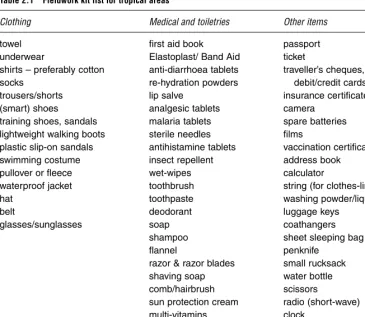
Concerning what clothing and personal items you should carry during your field research,Table 2.1 is a tried and tested ‘kit list’ for tropical countries, which may be helpful.
Into the field
On arrival in the country where you will be doing fieldwork, you should first make contact with the individuals and institutions with whom you have been corresponding. Hopefully, they will provide you with a base
17
of up-to-date information from local experts, it may then be necessary to modify your plans, for example if there is a security risk in a particular area, or if the road is impassable due to heavy rain.
Another very important matter that you will need to resolve is who will actually accompany you on your fieldwork. It is likely that you will not be fluent in the local lan-guage(s), but even if you do regard yourself as competent linguistically, I would strongly advise that you should be accompanied on fieldwork by at least one local person. In the past, I have undertaken fieldwork with col-leagues from local universities, and with local undergraduate or postgraduate students. It is
always useful to be able to ‘bounce ideas off ’ someone else, and a local person will also be more aware of safety issues and protocols that could affect the success of your fieldwork.The opportunity to live and work with local people will add much to your fieldwork experience and should help you to discover so much more about the country.While working with local students, I have been able to discuss their own research and career interests; while with academic colleagues we have considered our joint plans for future research and publication, curriculum development and their reciprocal visits to UK. Being accompanied in the field by local people is also vital in the context of helping to build up rapport and trust with
Table 2.1 Fieldwork kit list for tropical areas
Clothing Medical and toiletries Other items
towel first aid book passport
underwear Elastoplast/ Band Aid ticket
shirts – preferably cotton anti-diarrhoea tablets traveller’s cheques, cash,
socks re-hydration powders debit/credit cards
trousers/shorts lip salve insurance certificate
(smart) shoes analgesic tablets camera
training shoes, sandals malaria tablets spare batteries lightweight walking boots sterile needles films
plastic slip-on sandals antihistamine tablets vaccination certificates swimming costume insect repellent address book
pullover or fleece wet-wipes calculator
waterproof jacket toothbrush string (for clothes-line, etc.)
hat toothpaste washing powder/liquid, pegs
belt deodorant luggage keys
glasses/sunglasses soap coathangers
shampoo sheet sleeping bag
flannel penknife
razor & razor blades small rucksack shaving soap water bottle comb/hairbrush scissors
sun protection cream radio (short-wave)
multi-vitamins clock
ear plugs torch
tissues mirror
18
potential respondents in the communities where your fieldwork is based.
University or NGO staff should be able to advise on who would be the best person to act as your interpreter and/or research assis-tant, and what payment they would expect for the work. University students are often keen to perform such a role, in return for having an opportunity to work closely with someone from overseas. It may not be necessary to pay them a wage as such, but it would be both polite and reasonable to cover their travel, accommodation and subsistence expenses, and to make a gift to them when the work has been satisfactorily completed. I have invariably found the fieldwork to be the most inter-esting and enjoyable phase of all my research projects. But the success of your fieldwork will depend on many things, most notably gaining the confidence, interest and support of the communities where you are working, and developing a good relationship with your interpreter/field assistant.
Before embarking on fieldwork you will need to find somewhere to live during the field-based investigation.This may be a guest-house, possibly owned by the community or an NGO, or alternatively you may choose to live with a local family. There is much to be gained from the latter, as the family will be able to learn more about you and your research, and you will be able to learn about family life and local customs.You should make an allowance in your budget to pay the fam-ily for their hospitality. It is a good idea to have your own room, so that you can retire to rest and reflect, and also to allow both your hosts and yourself to ‘have your own space’. It is important that you have a comfortable place to live while undertaking fieldwork.You should also take particular care of your health and nutrition, since ill-health could jeopar-dize your entire research project. Your host family may be keen for you to eat with them. Take care that you have a well-balanced daily food intake. You should take advice on
whether it is safe to drink the local water, and if in any doubt, you should drink boiled water or bottled mineral water, which is now avail-able worldwide.
Ideally, you should try to make a short reconnaissance trip to your field location, to introduce yourself and explain the objectives. You should carry some form of identification, and preferably a letter of introduction from a local university or NGO. It is important to gain the interest and support of the commu-nity elders for your work. In most African communities, an audience with the chief at an early stage is an essential prerequisite for successful field research. Sometimes this will involve an exchange of gifts – you should take advice on what is expected. Understandably, the researcher will probably be asked by com-munity leaders what the comcom-munity is likely to gain from the research. This is always a difficult question to answer, but you should be prepared for this. Realistically, published books and journal articles, which are usually the principal outputs of most research pro-jects, will have very little positive bearing on the lives of poor people in the Third World (Edwards, 1989: 123). It is important not to promise anything that you cannot deliver. As Sidaway observes: ‘Particularly when the outsider is perceived as relatively powerful/rich (or even not), it is surprisingly easy for her/him to be drawn into commitments and promises that one may not be in a position to fulfil’ (Sidaway, 1992: 406). Community members are often interested that the research will discover more about their community, which may or may not lead to some form of development intervention. Field researchers should be pre-pared to arrange regular feedback sessions, at which local people can ask questions and hear about progress in the research.
been much discussion in the past of whether research in Third World countries is ‘parasitic’, or may be characterized as ‘data mining’.The field researcher should give careful thought as to how the community might be repaid for their help. You will need to take advice on whether respondents should be paid for giving their time and knowledge to the pro-ject. Arrangements vary from one location to another, and could be influenced by pre-cedents created by earlier research projects. If you do not intend to pay respondents, then you should make this clear at the outset when discussing your project with community lead-ers. Rather than giving to individuals, it is a good idea to identify and give support to a community project that will benefit more people – for example, the local school or clinic. In Sierra Leone recently, after a suc-cessful period of field-based data collection, my research assistant decided it would be a good idea to give some funds for a local car-penter to construct a set of desks and benches for the local school – a gesture which was greatly appreciated by the community.
Elsewhere in this book there is much ref-erence to different types of research strategy. Fortunately, the obsession with questionnaires in the 1960s and early 1970s has faded, though in the right place and at the right time questionnaires can still be useful. But the trend in recent years towards utilizing more participatory field-based research strategies has been a great step forward. If handled sen-sitively, such methods can play a key role in fostering a positive relationship between the researcher(s) and the individuals and commu-nities being studied. Field researchers must be constantly aware of their position vis-à-visthe local people. As Adams and Megaw observe:
We come from outside the village. We speak other languages and follow arcane practices (socio-economic research), and we seem to have powerful friends because we bring letters of introduction. … Above all, we can come and
go: we are not committed. (Adams and Megaw, 1997: 219)
The issue of power and control of knowledge is of concern here, in the context of the capa-bilities and ethics of ‘outsiders’ who are con-ducting research on, and ultimately speaking about ‘others’.Ake (1979) describes the power of Western knowledge as ‘academic imperial-ism’, while Minh-ha (1989) suggests thatThird World research is mainly a conversation of ‘us’ with ‘us about them’.While undertaking field-work, it is essential to reflect constantly on how you as an outsider should relate to local people. The issue of ‘positionality’ has been raised, particularly in the context of men researching women, but is also of relevance when working with such groups as poor people and children. Howard (1994) warns that the positionality of the researcher can affect an interview,because there is often a ten-dency for respondents to tell the researcher what they believe he or she wants to hear, especially when there is a marked power inequality between the two.
It is important to ask yourself how rele-vant your research is to the local community. So many lengthy field-based data collection exercises merely end up as conference papers which are then subsequently published in books and journals. I believe there is a real opportunity for field-based development researchers to get involved in so-called ‘action research’, in which they might actually play a role in improving conditions in the commu-nities where they are working. For example, one of my doctoral students, undertaking research recently among a poor farming com-munity in Eastern Cape Province, South Africa, discovered that selling their impressive vegetable crop was proving to be a major con-straint on economic upliftment. Nobody in the community owned a telephone, and there was only one rather unreliable public tele-phone nearby. Since South Africa has relatively good mobile phone coverage, the researcher
decided to buy two (inexpensive) mobile phones for the community’s agricultural pro-ject leaders. This enabled producers to liaise with wholesalers regularly, to alert the latter when produce would be ready for sale, and to make the necessary transport arrangements to get the produce to market. In the same com-munity, a large debt had been accumulated for electricity to drive the water pump that irri-gated the fields.The researcher was suspicious of the electricity account statement that the project leaders had received, so he arranged a meeting at the headquarters of the electricity company, in which he acted as a mediator between the electricity company officials and the project leaders. The meeting was success-ful and boosted the confidence of the project leaders. The company officials agreed to change the electricity tariff, such that the amount owed by the community was reduced considerably. In addition to delivering tan-gible benefits to the community, action research can also strengthen relationships between the community and the researcher. However, some caution is needed, since there is a fine dividing line between a researcher helping the community to deal with a specific problem and the community then looking to the researcher to solve all their problems. Megaw’s involvement with an NGO in Ghana provides some useful lessons for those who may be considering more active involve-ment with their host communities (Adams and Megaw, 1997).
In relation to studying women, there has been some debate about whether men should actually interview women, but Scheyvens and Storey suggest that the key thing is that researchers are ‘informed of and sensitive to local socio-cultural contexts’ (Scheyvens and Storey, 2003: 170). However, in certain cir-cumstances it is possible only for women to talk with women. In northern Nigeria, for example, a strict form of Islam exists, under which Hausa women of childbearing age are
in seclusion. I have been involved in a number of collaborative projects with Nigerian academics in this region, and in a field study which evaluated the incidence of urban agriculture, it was necessary to have a team of women researchers who went into house-holds to talk with women who were growing fruit and vegetables inside the walls of their compounds. Without this team of women researchers, the Hausa women’s quite signifi-cant horticultural activities would have been completely ignored. In sharp contrast to this, in South Africa, where women are generally more empowered and articulate, I recollect some very lively focus group meetings with both men and women, where women domi-nated the discussion.
In recent years, children have, somewhat belatedly, become an important focus of research in Third World countries. When working with children, it is important to explain the purpose of the research in simple and straightforward language and to use child-friendly and less intimidating data collection strategies such as drawing, story writing and role play (Scheyvens and Storey, 2003: 174). Matthews and Tucker are concerned that research with children should not misrepre-sent them, or be embarrassing or harmful (Matthews and Tucker, 2000).
The key point to bear in mind while conducting research in Third World commu-nities is that during your fieldwork you are a guest in that community, and how you relate to individuals and groups will be likely to affect the responses you receive, and can ultimately determine the success of your entire research project. Above all, you should respect local customs and make a deter-mined effort to be unobtrusive, polite and deferential. At the end of your fieldwork you should report back on your findings to the community, explaining how you intend to follow up the fieldwork after you have left (see Box 2.2).
Leaving the field
Leaving the field is often not easy and requires careful planning. If fieldwork has gone well, it can be difficult to withdraw from a situation where you may have lived and worked for some time (Scheyvens and Storey, 2003: Chapter 10). It is often the case that you have just one opportunity to collect field data for your pro-ject, so it is vital that you leave with all the neces-sary data,since funding and time constraints may preclude a return visit.There is too often a ten-dency among field researchers to ‘take the data and run’, but it is important to reflect on how much time others have given to your fieldwork enquiries. Without their help, data collection would probably have been impossible.
It is particularly difficult to leave inter-preters and field assistants, with whom you have developed a close relationship. Keeping in touch with communities and individuals with whom you have worked should be a high priority. In my own case, I have managed to maintain strong links with people I met in Sierra Leone during my doctoral field research thirty years ago, despite the political instability and civil war which have afflicted
the country and its people. In the intervening period, I have supported a community mem-ber through his education, and have main-tained strong links with my former research assistant, who is now Dean at the university. On my recent return to the communities where I had lived in 1974, I took a series of laminated photographs that I had taken as a research student, and presented these to the community elders. The photos provided a valuable archive of the pre-war community.
Rather than abandoning local contacts after the fieldwork, it is important to involve them as far as possible in the data analysis and writing-up phases of projects, though there may be practical difficulties in doing this. For many Third World academics, research may be low on their personal agendas, primarily because of practical difficulties. As Porter so rightly points out: ‘the difficulties of obtaining a livelihood have made sustained research problematic for most indigenous academics’ (Porter, 1995: 140).While a lack of electricity, water, transport and fuel are everyday problems, inadequate salaries and impoverished libraries further militate against research by academics in many Third World countries. The UK Department
21
• On arrival in the overseas country you should discuss your study and fieldwork
logistics with local experts.
• Take advice on who would be best to accompany you as an interpreter/field assistant
and discuss remuneration at an early stage.
• Investigate local travel and accommodation arrangements.
• Undertake a short reconnaissance trip to your fieldwork area, to meet community
leaders and to conduct a small pilot survey.
• In the light of experience gained on your reconnaissance and pilot survey, you
should consider carefully your field research objectives and methods.
• Remember that when you are in the field you are a guest of the local communities.
Be polite, friendly and business-like in your work.
• Plan carefully your leaving the field. Ensure you have all necessary data and
for International Development (DfID) ‘Higher Education Links Scheme’, managed by the British Council, has provided me with a valu-able opportunity to collaborate with colleagues in Nigeria, Sierra Leone and South Africa.The Scheme has supported visits in both directions, which have enabled field-based data collection and joint publication. The formulation of research grant applications and the facilitation of research student supervision have also devel-oped through these links. We have purposely targeted international journals for publication, a strategy that has strengthened the capacity and achievement record of African colleagues. Returning to the field with the final results of your work may be difficult logistically, but local collaborators can usually assist in reporting back to the communities. It is useful for com-munity leaders to have some clear policy recom-mendations emerging from the fieldwork that might lead to concrete action. Local collabora-tors can also make contact with government and NGO officials to report on the study’s main findings and to identify ways of taking these for-ward. In the written output from the project, you should consider carefully whether it is best to maintain anonymity, in case there could be repercussions on specific individuals where sensitive issues are involved (see Box 2.2).
Conclusion
Fieldwork in Third World countries is usually enjoyable, but there will undoubtedly be moments of exhilaration and despair, often in the same day.The important thing is to try to stay calm and do not be afraid to ask for help. You will need to take regular breaks from the fieldwork, to ‘recharge your batteries’, and to reflect both on what you have achieved and where you go next. Use these ‘time-out’ peri-ods to possibly spend a weekend away from your field location, or alternatively to devote time to socializing with your host family and community. Teaching English to children or adults, chatting informally in the marketplace, or playing sport with schoolchildren, should help you to relax and at the same time strengthen rapport with the community.
It is likely that memories of your field-work will stay with you throughout your life. Share your experiences with others, and con-sider carefully how your fieldwork relates to your broader studies, perhaps exemplifying more theoretical statements on development issues. Preparing for fieldwork might be a daunting experience, but actually doing field-work and reflecting on it afterwards can be highly pleasurable.
22
Q Q Q
QUUUUEEEESSSSTTTTIIIIOOOONNNNSSSS FFFFOOOORRRR DDDDIIIISSSSCCCCUUUUSSSSSSSSIIIIOOOONNNN
1. Examine the arguments ‘for’ and ‘against’ undertaking fieldwork in Third World countries. 2. What are the key factors involved in choosing a location for field research?
3. How can you ensure that the results of your fieldwork are reported back to the communities where you collected data?
4. What specific strategies would you adopt in undertaking field-based data collection with marginalized and/or disadvantaged groups, e.g. women, children, disabled, poor, ethnic minorities?
Further reading
Devereux, S. and Hoddinott, J. (eds) (1992) Fieldwork in Developing Countries, Hemel Hempstead: Harvester Wheatsheaf.
Eade, D. and Williams, S. (eds) (1995) The Oxfam Handbook of Development and Relief, Oxford: Oxfam.
Robson, E. and Willis, K. (eds) (1994) Postgraduate Fieldwork in Developing Areas: A Rough Guide, Developing Areas Research Group, Monograph No. 8, London: Royal Geographical Society and the Institute of British Geographers.
Scheyvens, R. and Storey, D. (eds) (2003), Development Fieldwork: A Practical Guide, London: Sage.
References
Adams, W.M. and Megaw, C.C. (1997) Researchers and the rural poor: asking questions in the Third World, Journal of Geography in Higher Education, 21 (2): 215–229.
Ake, C. (1979) Social Science as Imperialism: The Theory of Political Development, Ibadan, Nigeria: Ibadan University Press.
Binns, T. (1992) The role of fieldwork in teaching development geography: some African perspec-tives, in R.B. Potter and T. Unwin (eds), Teaching the Geography of Developing Areas, Developing Areas Research Group, Monograph No 7, pp.113–129, London: Royal Geographical Society and the Institute of British Geographers,
Bronfenbrenner, U. (1952) Principles of professional ethics: Cornell studies in social growth, American Psychologist, 7: 452–455.
Chambers, R. (1983) Rural Development: Putting the Last First, London: Longman.
Eade, D. and Williams, S. (eds) (1995) The Oxfam Handbook of Development and Relief, Oxford: Oxfam.
Edwards, M. (1989) The irrelevance of development studies, Third World Quarterly, 11 (1): 116–135.
Howard, S. (1994) Methodological issues in overseas fieldwork: experiences from Nicaragua’s northern Atlantic coast, in E. Robson and K. Willis, (eds), Postgraduate Fieldwork in Developing Areas: A Rough Guide, Developing Areas Research Group, Monograph No. 8, pp. 19–34, London: Royal Geographical Society and the Institute of British Geographers.
Kobayashi, A. (1994) Coloring the field: gender, ‘race’ and the politics of fieldwork, Professional Geographer, 46 (1): 73–80.
Madge, C. (1993) Boundary disputes: comments on Sidaway (1992), Area, 25 (3): 294–299. Madge, C. (1994) The ethics of research in the ‘Third World’, in E. Robson and K. Willis (eds),
Postgraduate Fieldwork in Developing Areas: A Rough Guide, Developing Areas Research Group, Monograph No. 8, pp. 91–102, London: Royal Geographical Society and the Institute of British Geographers.
Matthews, H. and Tucker F. (2000) Consulting children, Journal of Geography in Higher Education, 24 (2): 299–310.
Minh-ha, T.T. (1989) Woman, Native, Other: Writing Postcoloniality and Feminism, Bloomington: Indiana University Press.
Nast, H.J. (1994) Opening remarks on ‘women in the field’, Professional Geographer, 46 (1): 54–66. Pawson, E. and Teather, E.K. (2002) ‘Geographical Expeditions’: assessing the benefits of a
student-driven fieldwork method, Journal of Geography in Higher Education, 26 (3): 275–289.
Porter, G. (1995) ‘Third World’ research by ‘First World’ geographers: an African perspective, Area, 27 (2): 139–141.
Potter, R. (1993) Little England and little geography: reflections on Third World teaching and research, Area, 25 (3): 291–294.
Robson, E. (2002) An unbelievable academic and personal experience: issues around teaching undergraduate field courses in Africa, Journal of Geography in Higher Education, 26 (3): 327–344.
Scheyvens, R. and Storey, D. (eds) (2003) Development Fieldwork: A Practical Guide, London: Sage.
Sidaway, J.D. (1992) In other worlds: on the politics of research by ‘First World’ geographers in the ‘Third World’, Area, 24 (4): 403–408.
Sidaway, J.D. (1993) The decolonisation of development geography? Area, 25 (3): 299–300.
• •What do we mean by ‘ethics’? • •Informed consent • •Funding and funders • •Power • •Change • •Contexts and their importance • •Doing
research: ‘before, during and after’• •Deviations from the ‘ideal’!
3
Ethical Practices in Doing Development Research
Lynne Brydon
This chapter is in two main sections, the first looks at what is meant by ‘ethics’ in develop-ment research, the practices of ‘doing ethical research’, and is further divided into subsec-tions.The second section is shorter and more personal and shows how textbook-derived research plans and ambitions can go awry, how research ‘on the ground’ is a much finer-grained complex of quick thinking and responsiveness and, in some cases, the aban-doning of the rules. A good and ethical researcher (the distinction is made in the earlier part of the paper) has to be readily responsive to any situation that might come up.
Ethical research
What do we mean by ‘ethics’?
What do we mean by ‘ethics’ in the writing – and doing – of development research? Why is it important to make sure that research plans
and practices are ‘ethical’? Thinking about ethics, to paraphrase Grix (2004), involves a heavy reliance on the idea of ‘ought’. What ought we to do when carrying out develop-ment research or writing? Is ‘ethical’ research practice, whether fieldwork, analysis or writ-ing and presentation, the same thwrit-ing as ‘inci-sive’ fieldwork or analysis, or ‘brilliant’ writing and presentation?
26
a voice, when the developers were there to ‘develop’ the less- or under-developed and ‘obviously’ knew best, what was considered to be good was also considered ethical in the sense that this was what development research ought to be. But with more than fifty years of development research and practice behind us now, it has become clear that any such earlier ideas about ethical research have proved inad-equate. Not only have notions of what consti-tutes appropriate and ‘good’ development research changed radically, but also the signifi-cance of ethical research has also moved from what was formerly, in effect, a background assumption, to an overt planning strand in the very forefront of research projects and practices. So, in the past ten to fifteen years in research contexts in the North, the idea of ethical social research has grown hugely in importance.This is partly as a response to crit-icism of earlier research that ignored local practices or had a covert goal, for example, of gathering information on security issues or to promote insurrection or to foster support for a particular political party or candidate, in addition to an overt ‘research’ objective, say, to investigate local needs in respect, perhaps, to water supplies, education or health. It is also in accordance with changing contemporary ideas about the standards expected in all kinds of social research, whether of accountability and transparency or, more generally, in recog-nition of the rights of the ‘researched’. The significance of the ideas about ethical research and best practice have come to the fore-ground (through the 1990s) to such an extent that all research agencies or university depart-ments, in addition to the funders, are now expected to have formal codes of practice relat-ing to the ethics of research carried out under their auspices. Researchers are expected to sign up to these codes of practice when they undertake their research projects. Perhaps a simple way to remember this is that, say, thirty years ago, it was common to write of the people among whom we carried out
research as (even sometimes) the objects of research, let alone subjects of our research. Now the emphasis is on collaboration, facili-tation and participation, where the people among whom the research is being carried out are involved not only in the ‘data collec-tion’ phase of the research (as passive ‘sub-jects’), but also in formulating key questions in, and foci of, the research, in the design phase of the research, as well as in the analysis and evaluation of the findings.
I cannot hope completely to cover the range of factors covered by the term ‘ethical’ research in so short a space. What follows is a discussion of several key (and personally idio-syncratic) features to be taken into account.
Informed consent