The Growing Phenomenon of Private
Tutoring: Does It Deepen Human Capital,
Widen Inequalities, or Waste Resources?
Hai-Anh Dang† F. Halsey Rogers
Does private tutoring increase parental choice and improve student achievement, or does it exacerbate social inequalities and impose heavy costs on households, possibly without improving student outcomes? Private tutoring is now a major component of the edu-cation sector in many developing countries, yet eduedu-cation policy too seldom acknowl-edges or makes use of it. This survey of the literature examines the extent of private tutoring, identifies the factors that explain its growth, and analyzes its cost-effectiveness in improving student academic performance. It also presents a framework for assessing the efficiency and equity effects of tutoring. The results suggest that even taking equity concerns into account, tutoring can raise the effectiveness of the education system under certain reasonable assumptions. Guidance is offered for attacking corruption and other problems that diminish the benefits of private tutoring.JEL codes: I21, I22, D10.
Developing country policymakers recognize that education is a key determinant of individual productivity and economywide growth. But their sector diagnoses and policy attention have focused on public schools. Much less attention has been paid to the private school sector, and policy discussion rarely mentions what is emerging as a third important education sector: the private tutoring industry.
In many countries, private tutoring has arisen as a parallel education sector that provides supplementary instruction to students enrolled in the public school system. Substantial private tutoring industries can be found in countries as economically and geographically diverse as Cambodia, the Arab Republic of Egypt, Japan, Kenya, Morocco, Romania, Singapore, the United States, and the United Kingdom.
This survey cites evidence on the prevalence of tutoring in 23 developing and developed countries. In almost all of them, 25 – 90 percent of students at certain levels of education are receiving or recently received private tutoring. In some
countries, such as the Republic of Korea (hereafter Korea) and Turkey, spending by households on private tutoring now rivals public sector education expenditures.
Private tutoring has elicited mixed responses from policymakers. In some countries it is ignored; in others it is actively controlled and regulated. Private tutoring has been banned at various times in Cambodia, Korea, Mauritius, and Myanmar (Bray 1999a), out of concern that it exacerbates social inequalities, disrupts the public education system, and fails to increase academic performance or build human capital.
Policymakers need evidence to formulate good policy toward private tutoring. What factors (micro and macro) drive the demand for private tutoring? Do only rich households use private tutoring? How is private tutoring different from private or public education? What effects does private tutoring have on students’ academic performance? Is private tutoring a cost-effective form of education? Does the evidence suggest that increased use of private tutoring is a welcome develop-ment or one governdevelop-ments should discourage?
Policymakers may find it preferable to formulate views on these questions before private tutoring becomes even more entrenched. Once it emerges as a major industry—especially if wealthier parents see it providing competitive advan-tages to their children—it will likely be harder for governments to adjust policy in ways that threaten vested interests.
This article reviews what is known about the determinants and effects of private tutoring and analyzes the equity and efficiency issues, with a focus on developing countries. It begins by establishing the economic importance of private tutoring in much of the developed and developing world. It then provides a simple framework of the supply of and demand for education, which guides the discus-sion of equity and efficiency issues. The next sections review the determinants of private tutoring, from both a micro and a macro perspective, and the effects of tutoring on student achievement, paying special attention to the statistical pro-blems associated with identifying these effects and to recent studies that have addressing these problems. The last section uses these results and the theoretical framework to discuss the efficiency and equity implications of private tutoring, explore their implications for policy toward tutoring, and identify areas that may warrant more research.
The Widespread Phenomenon of Private Tutoring
Private tutoring is defined here as fee-based tutoring that provides supplementary instruction to children in academic subjects they study in the mainstream education system.1 Because the literature focuses primarily on tutoring for
children or adolescents paid for by their households, tutoring can generally be considered a form of private education. However, the definition is broad enough to cover special tutoring programs financed by other sources, including the gov-ernment (for example, remedial education programs).
There are good reasons why a private supplementary tutoring sector might emerge to complement the public and private schooling systems. Private tutoring can provide more individualized instruction than is possible in public schools, using a more flexible delivery mechanism. The private tutoring industry is also differentiated from the private school sector in that its existence depends on the mainstream education system; it does not stand alone as an independent edu-cational activity. This aspect of private tutoring helps explain why it has been referred to as “shadow education” (Bray 1999a). Private tutoring is also less formal and more flexible than private schooling: it can include not only one-to-one tutoring but also group classes, it can be provided not only by full-time tutors and teachers but also by university students, retired teachers, university pro-fessors, and community members (Russell 1997). Because it supplements rather than replaces the public sector, the combination of public schooling and private tutoring is also more affordable for many households than private education would be.
Japan has been a pioneer in the provision of this type of supplementary edu-cation. Private tutoring has long been a huge commercial industry in Japan, with annual revenues reaching an estimated $14 billion by the mid-1990s. Nine private tutoring schools were already listed on the Japanese stock exchange at that time, and the tutoring sector had become a “crucial component of Japanese education” (Russell 1997). Many Japanese students enroll in intensive tutoring programs during school vacations, including the important New Year’s holiday. To stimulate school spirit, several private tutoring schools (juku) have had their students wear white headbands similar to those once worn in battle by samurai warriors (Rohlen 1980). About 30 percent of university students spend additional years after high school graduation cramming for their university entrance exam-inations, often in specialized private tutoring classes. At the top-ranked schools, more than 60 percent of students may have spent time after high school prepar-ing for these exams (Ono 2007).
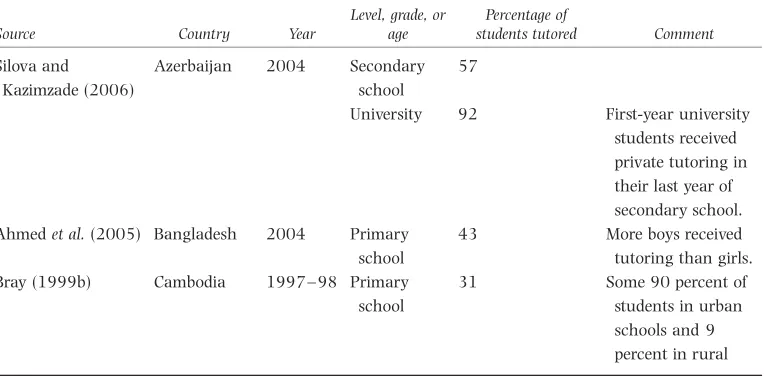
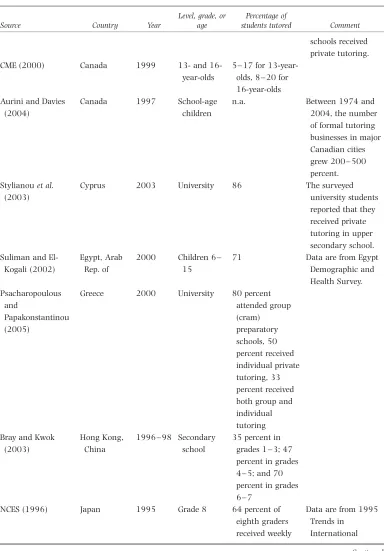
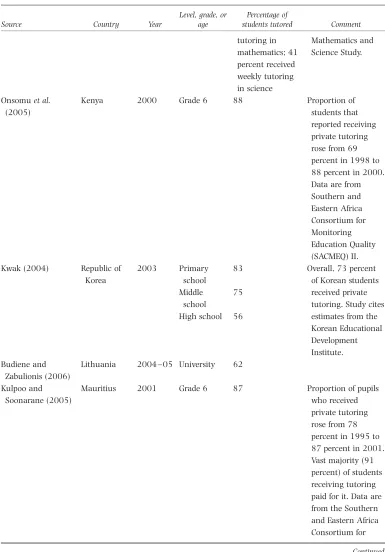
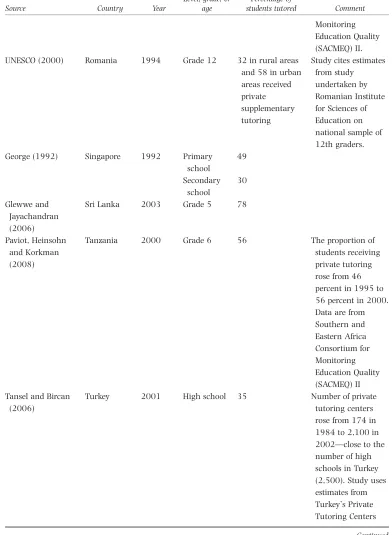
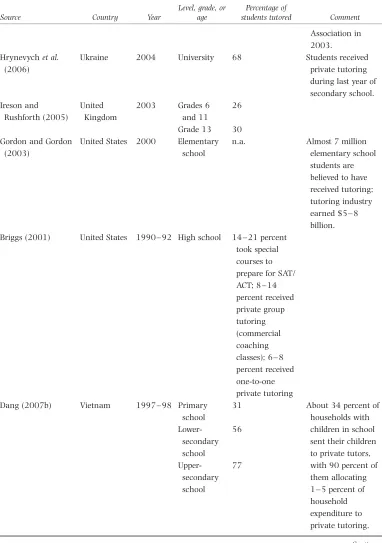
Japan is not alone in supporting a large and vibrant private tutoring industry. Tutoring is now widespread in many parts of the world, including developing countries (appendix table A.1).
Certain patterns are clear. First, while the incidence of tutoring appears highest in East Asia, private tutoring is an important phenomenon in countries of different sizes, levels of economic development, political institutions, and locations. In some cases, spending on private tutoring approaches the level of spending on the formal public school system. In Korea, for example, households
spent 2.9 percent of GDP on private tutoring in 1998—almost as much the 3.4 percent of GDP the public sector allocates to education (Kim and Lee 2004). In Turkey households spend more than 1.4 percent of GDP on private tutoring—close to the 2.0 percent the country spends on public education (Tansel and Bircan 2006).
Second, private tutoring is an important phenomenon not only for upper-sec-ondary students preparing for university exams but also for students at the primary and lower-secondary levels. In some countries, such as Japan, it is wide-spread among upper-secondary graduates as well.
Third, the private tutoring industry appears to be growing in many countries, both in absolute terms and relative to the formal education sector. The percentage of students receiving tutoring is rising in Kenya and Mauritius, and the number of private tutoring firms is rising in Canada and Turkey (see table A.1).2 Evidence on tutoring expenditures also supports the notion that the sector is growing. In Korea, for example, household spending as a share of GDP on private tutoring rose continuously, from 0.7 percent of GDP in 1977 to 1.2 percent in 1990 and 2.9 percent in 1998 (Kim and Lee 2004). Finally, anecdotal reports suggest that private tutoring is expanding in other countries as well. In both low-income countries (such as Vietnam; Dang 2007a) and high-income countries (such as the United States; Fuchs 2002; Borja 2005), some households in some areas have begun sending their children to private tutoring to give them an edge as early as preschool.
A Framework of Private Tutoring Supply and Demand
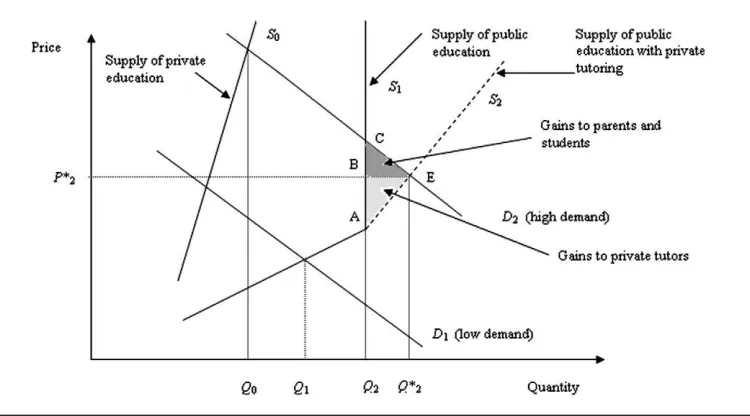
A simple graphical framework based on the standard microeconomic theory of supply and demand is useful in interpreting the private tutoring phenomenon. Consider the supply of and demand for education by a typical household where private tutoring is available (figure 1). The supply of education is represented by the supply curves S0 for private education, S1 for public education, and S2 for
public education with private tutoring. S1 is different from S2 in that while the
two curves share a common solid upward-sloping part ending at point A, S1includes the solid vertical line rising from point A while S2 includes a dashed
diagonal line starting from point A. (It is possible to think about the dashed line as the supply curve for private tutoring alone.)
The rationale for the vertical part of S1 (starting at point A) is that regardless
of consumer demand, after a certain point public schools reach their capacity limit, preventing them from offering as much education—in terms of both quan-tity and quality—as parents or students want (that is, supply becomes perfectly inelastic).3 By contrast, the dashed portion of the supply curve S2 ( public
education with private tutoring) is flatter than the vertical part of S1, indicating
the ability of private tutoring to meet the demand for education where the public education system cannot. This portion of S2 is steeper than the lower part of S1,
reflecting the assumption that even where public school is not free, private tutoring usually costs the household more than public schooling does.4
Even if tuition is not charged, a household incurs certain costs in sending a child to school (for example, school-related fees, the opportunity cost of the child not working). Household demand for education is represented by the demand curveD1 (low demand) or D2 (high demand). The demand curve D2 represents a
household that is assumed to have higher income, stronger education preferences, higher expectations about future returns, or some combination of these variables relative to a household whose demand is given by D1. (Other factors, such as the
price of substitute goods and the number of buyers in the market, also shift the demand curve. The focus here is strictly on the factors cited above.)
The amount of education the household consumes is represented by the amount on the horizontal axis corresponding to the point where the supply and demand curves meet. If the representative household’s demand for education is represented by the demand curve D2, the amount of public education the
house-hold consumes is Q2. In the presence of private tutoring the same household can
consume a larger amount of education (Q2*), because the supply curve is no longer constrained by the vertical segment rising at point A. Were the household instead to enroll all their children in private school, the consumed amount of education would be lower, atQ0.
Figure 1. Education Supply and Demand with Private Tutoring
This “standard framework” underlies the discussion of the determinants and welfare consequences of tutoring. It incorporates certain assumptions that may not always be valid. One such assumption is that the market for private tutoring is competitive and that households are free to choose whether to purchase tutor-ing services. A second is that public schooltutor-ing reaches a strict capacity constraint after a certain point, which is likely a better description of the short run than the long run. The last section of this article explores how relaxing these assumptions affects the analytical and policy conclusions.
Drivers of Private Tutoring
To understand the equity and productivity effects of the large and growing private tutoring sector and design effective policies, it is essential to understand the micro and macro factors that create demand for tutoring. Factors at the micro level may include the characteristics of individuals, households, schools, and communities. Macro-level factors may include the share of public spending allocated to public education, the characteristics of the education system and labor market, and national cultural values. Together these factors determine the level and slope of the tutoring demand curve for society as a whole. This section presents the evi-dence from the literature on both sets of explanatory factors.
Micro Factors
Standard economic theory would suggest that certain factors increase household demand for education: households’ income, preference for education, and expec-tations about the returns to education for their children. These factors explain the heterogeneity of demand across household types. Compared with households on demand curve D1, which consume no private tutoring given the supply curveS2,
households on demand curveD2consumeQ2* – Q2of private tutoring.
Empirical research supports the theoretical prediction about which factors increase demand. Studies of Egypt (Assad and El-Badawy 2004), Japan (Stevenson and Baker 1992), Korea (Kim and Lee 2004), Turkey (Tansel and Bircan 2006), and Vietnam (Dang 2007b) are highlighted because they draw on nationally representa-tive data. The private tutoring sector is also relarepresenta-tively prominent in all of these countries, which together capture some of the geographic variation in the phenom-enon. (Buchmann 2002, Davies 2004, and Psacharopoulous and Papakonstantinou 2005 investigate the determinants of private tutoring using smaller data sets.)
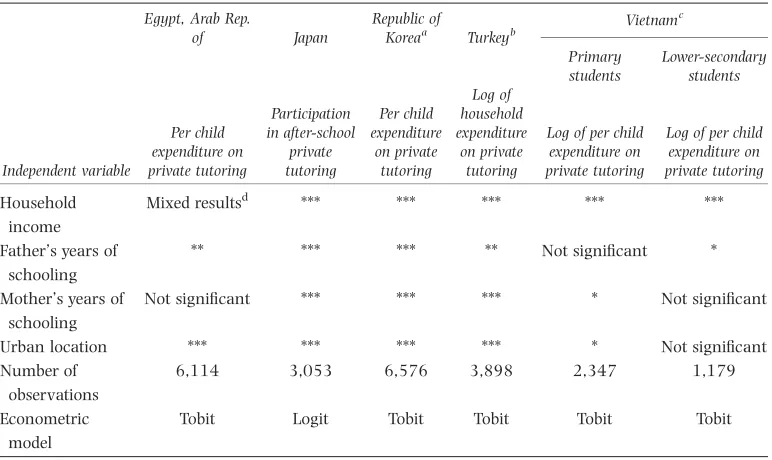
The variables that most influence consumption of private tutoring in these studies are household income (household wealth in Egypt, household expenditure in Turkey and Vietnam); parental education; and urban location (table 1).
The last two variables arguably correspond to household preferences for edu-cation. These results are not unexpected, but they are surprisingly consistent across countries and fairly robust to the models used.5
Other factors that may matter across countries are grade level and household size. In Egypt students in diploma-granting grades spend more on private tutoring (Assad and El-Badawy 2004). In Vietnam the closer students are to the last grade in their current school level the more they spend on private tutoring (Dang 2007b). In Korea, Turkey, and Vietnam the number of children in the household is negatively correlated with private tutoring expenditures (Kim and Lee 2004; Tansel and Bircan 2006; Dang 2007b). Presumably, the grade-level pattern reflects the use of private tutoring to prepare for school-leaving examinations. The household-size effect hints at the much-studied tradeoff between quantity and
Table 1. Leading Determinants of Private Tutoring in Selected Countries
Egypt, Arab Rep.
of Japan
Republic of
Koreaa Turkeyb Vietnam
c
Not significant *** *** *** * Not significant
Urban location *** *** *** *** * Not significant
Number of observations
6,114 3,053 6,576 3,898 2,347 1,179
Econometric model
Tobit Logit Tobit Tobit Tobit Tobit
*Significant at the 10 percent level; **significant at the 5 percent level; ***significant at the 1 percent level. aSignificance level of the urban variable is inferred from the strong significance levels for the dummy variables indicating living in high-density residential areas, living in Seoul, and living in metropolitan city or small or medium-size city.
bHousehold income is the log of total household expenditure. Father’s years of schooling are for household heads.
cHousehold income is the log of household expenditure per capita.
dSignificance level of household income is inferred from that of dummy variables indicating households in different wealth quintiles, which range from insignificant to highly significant.
Source: Estimates are from the following: Egypt, Assaad and El-Badawy (2004); Japan, Stevenson and Baker
(1992); Republic of Korea, Kim and Lee (2004); Turkey, Tansel and Bircan (2006); and Vietnam, Dang (2007b).
quality (number of children and average child educational achievement; see, for example, Becker and Lewis 1973; Blake 1989). This variable is likely to be endogenous (see the next section), which may bias the estimates. Not all of these variables are used in all of the studies. It is thus not possible to investigate whether these patterns hold for all five countries or to draw firm conclusions from them.
Other variables that affect spending on private tutoring vary from country to country. This diversity of findings may reflect differences in the models or in the variables available in the data sets. It could also reflect country-level differences in tutoring patterns, perhaps as a result of differences in institutions, cultures, or relative prices.
Do students receive private tutoring for remedial or enrichment purposes? Are most students who receive tutoring performing at levels below or above their (con-ditionally) expected levels? Analyzing data from the 1995 Third International Mathematics and Science Study (TIMSS) in 41 countries Baker and others (2001) show that in three-fourths of these countries private tutoring is used significantly more often by low math achievers than by high achievers (controlling for family income, student, and community characteristics). They show that the probability of receiving private tutoring increases by 3.5 percent for each one-point decrease in TIMSS math scores in Denmark, Germany, and the United States.
The core explanatory factors common to all studies—income, parental edu-cation, urban location—echo those usually found to be important determinants of schooling attainment and performance in developing countries. In their study of 35 developing countries, for example, Filmer and Pritchett (1999) find that household wealth is strongly related to the educational attainment of children nearly everywhere. The multicountry analysis by Hanushek and Luque (2003) finds that on average parental education and family asset ownership are as important in explaining children’s test scores in developing countries as they are in developed countries. Tansel (1997, 1998) finds that parental education, house-hold consumption, and urban location are associated with higher educational attainment in Coˆte d’Ivoire, Ghana, and Turkey.
Macro Factors
Several factors are likely drivers of the demand for private tutoring at the macro level. First, the transition to a market economy substantially increased the amounts of private tutoring (supplied and demanded) in countries where it had not existed, including China, Vietnam, some African countries, and many Eastern European transition economies (Bray 1999a).
Second, tight linkages between education and work may result in intense competition for more education and thus private tutoring (Stevenson and Baker 1992). Private returns in the labor force are generally higher to higher education
than to secondary education (Psacharopoulos and Patrinos 2004), and the gap appears to be widening in many developing and developed countries (Brunello, Comi, and Lucifora 2000; Bourguignon and Rogers forthcoming). These high returns can lead to intensely competitive behavior by students and their parents, including the use of private tutoring to increase chances of university admission. An extreme form of these linkages is “diploma disease” (Dore 1976), whereby firms and governments rely heavily on a university degree as an initial screening tool for employment, in the belief that the degree signals skills that contribute to productivity but are hard to measure directly. This phenomenon has arguably fueled the demand for private tutoring in a number of countries (see Rogers 1996 for a model of this effect based on the experiences of Japan and Korea).
Third, parents may resort to private tutoring to compensate for the poor quality of a deficient public education system (Kim and Lee 2004). Low pay levels and weak monitoring of teachers in the public system can also cause teachers to force tutoring on students (Buchmann 1999; Silova and Bray 2006a), as formalized in a theoretical model by Biswal (1999).6
Fourth, cultural values may explain why private tutoring is more prevalent in some countries. Such values may be particularly important in East Asia (Bray 1999a).
Little formal empirical research has been done to test these hypotheses. The only cross-country study that has looked at the macro (economywide) factors determining the use of private tutoring is Baker and others (2001). Using data on 41 countries participating in the Third TIMSS assessment, they find that higher public education expenditures (as a share of GNP) and gross enrollment rates predict lower use of private tutoring. A high-stakes testing system has no signifi-cant impact on private tutoring.
The first result suggests that private tutoring is more popular in countries with weak and deficient public education systems. The analysis does not control for per capita income levels, however. This omission may bias the results, because income levels are highly correlated with both public education expenditures and gross enrollment rates.7
Impact of Private Tutoring on Student Learning
Understanding the policy implications of the growth of the private tutoring industry requires understanding not only its determinants—who is investing in tutoring and why—but also the consequences for those being tutored. Does spending on private tutoring yield substantial returns for individual learners? For society as a whole?
In standard models the presumption is that private tutoring must yield substan-tial increases in learning, because most students consider tutoring an investment
rather than consumption. If households consist of well-informed, sovereign consu-mers focused on learning—and ultimately on increased productivity in the work-force—one would expect significantly positive returns to individuals. But this is not the only possibility, for three reasons. First, consumers could be poorly informed about returns. Even econometricians find it challenging to tease out the returns to tutoring (as discussed below); it may be very hard for households to know for sure that their investment will pay off, particularly as any wage returns may be realized only after many years. Second, consumers may not be sovereign: parents who pay for tutoring may have objectives other than improving their chil-dren’s learning and productivity, such as finding child care. Third, students may view tutoring as consumption rather than investment.
Endogeneity: Unobserved Factors may Affect Both Investment in Private Tutoring and Student Performance
Analyzing the evidence on learning gains attributable to tutoring is tricky because of the potential endogeneity of tutoring, which many studies have failed to address. For this reason this review of the literature focuses on the results from the handful of studies that have dealt with endogeneity.
A naive first approach to estimating the effects of private tutoring on perform-ance would be to use micro-level data to estimate the following equation:
A¼aþbTþgXþe
whereAis a student’s academic performance;Tis the student’s attendance at or spending on private tutoring classes;X is a vector of other student, household, school, and commu-nity characteristics (for example, the student’s age and gender, the household’s socioeco-nomic status and place of residence, and school quality);e is the error term; anda,b, and
gare the parameters to be estimated, withbthe estimated return to private tutoring.
This approach, at least as it is usually implemented, is likely to yield unreliable estimates of the coefficient on private tutoring, because students who receive private tutoring may differ in various unobserved but important dimensions from those who do not. One such dimension is the level of parental concern about their children’s education. This variable is hard to measure and is therefore usually excluded from these analyses. Yet parents who place high value on their children’s education may directly assist their children to succeed in school by helping them with their homework, for example, while also spending money on private tutoring.
Another example is a student’s motivation for studies, which is also difficult to measure. Highly motivated students may be more willing to receive private tutor-ing than their less motivated peers, but they are likely also to outperform students who did not receive tutoring for reasons unrelated to tutoring.
Private tutoring is thus endogenous, in that these unobserved factors affect both investment in private tutoring and the performance at school. If not properly controlled for in regression analysis, these unobserved characteristics will end up in the error term, rendering the estimation results inconsistent and unreliable. This selection bias is commonly addressed in other contexts in the education litera-ture, such as estimating whether religious and other private schools yield better student outcomes than public schools do (see, for example, Bedi and Garg 2000 and Newhouse and Beegle 2006 for public–private comparisons in Indonesia).
Three econometric techniques have been used to deal with the endogeneity of private tutoring. The first—and perhaps cleanest—approach is to run experiments that randomly assign students into comparable treatment and control groups. With such a set-up, researchers can use a straight difference-in-difference com-parison of the gains in education outcomes for the two groups to estimate the returns to private tutoring.8 Even with this arrangement, however, interpreting the results is challenging, because students cannot be assigned to purchase private tutoring. Such studies must provide free tutoring, which may differ from tutoring that is paid for. Providing tutoring free seems likely to reduce its effective-ness in promoting learning; if anything, this should bias downward the estimates of the returns to tutoring.
A second approach, implemented ex post using observational data, relies on quasi-experimental identification of the effects of tutoring by using a difference-in-difference analysis as a program is rolled out across the country. Like the first approach, this approach has had to rely on tutoring provided by the program rather than purchased by households.
The third approach is to rely on instrumental variables that correlate with private tutoring attendance, expenditure, or both but that do not correlate with unobserved characteristics such as parental concern or student motivation.9 This approach has the advantage of measuring the effects of private tutoring sought as a result of household decisions rather than government programs. The disadvan-tage is that such estimates are likely to be more sensitive to econometric assump-tions than are experimental and quasi-experimental estimates.
Evidence on the Impact of Private Tutoring
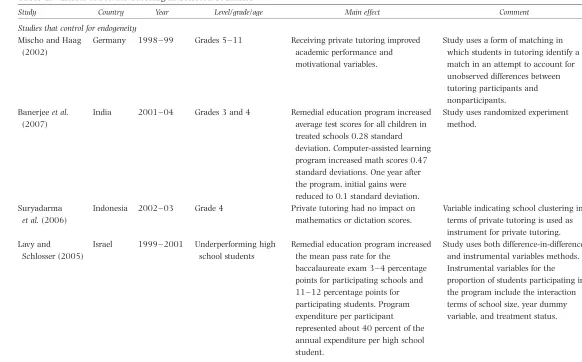
Research on the impact of private tutoring can be divided into studies that control for the endogeneity of private tutoring and those that do not (table 2). In addition to the standard type of tutoring paid for by the household, some studies include remedial education programs financed by sources other than households.
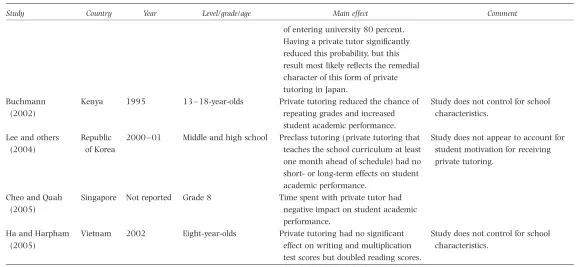
Studies that do not control for endogeneity yield mixed results on the impact of private tutoring on academic performance. They indicate that private tutoring has positive impacts in Japan (Stevenson and Baker 1992), Kenya (Buchmann
Table 2. Effects of Private Tutoring in Selected Countries
Study Country Year Level/grade/age Main effect Comment
Studies that control for endogeneity Mischo and Haag
(2002)
Germany 1998 – 99 Grades 5 – 11 Receiving private tutoring improved academic performance and motivational variables.
Study uses a form of matching in which students in tutoring identify a match in an attempt to account for unobserved differences between tutoring participants and nonparticipants. Banerjeeet al.
(2007)
India 2001 – 04 Grades 3 and 4 Remedial education program increased average test scores for all children in treated schools 0.28 standard deviation. Computer-assisted learning program increased math scores 0.47 standard deviations. One year after the program, initial gains were reduced to 0.1 standard deviation.
Study uses randomized experiment method.
Suryadarma
et al.(2006)
Indonesia 2002 – 03 Grade 4 Private tutoring had no impact on mathematics or dictation scores.
Variable indicating school clustering in terms of private tutoring is used as instrument for private tutoring. Lavy and
Schlosser (2005)
Israel 1999 – 2001 Underperforming high school students
Remedial education program increased the mean pass rate for the
baccalaureate exam 3 – 4 percentage points for participating schools and 11 – 12 percentage points for participating students. Program expenditure per participant represented about 40 percent of the annual expenditure per high school student.
Ono (2007) Japan 1995 Male high school and university graduates
Years spent after high school graduation cramming in private tutoring centers (ronin) improved the quality of the university that students attend, thus raising earnings indirectly (through this improvement in college quality).
Study uses instrumental variables method but does not control for other household, school, or community characteristics (such as parental education or household income).
Briggs (2001) United States
1990 – 92 High school Commercial private tutoring courses increased SAT math scores 14 – 15 points, SAT verbal scores 6 – 8 points, and ACT math and English scores 0 – 0.6 points; they decreased ACT reading scores 0.6 – 0.7 points.
Study does not report variables used as instruments for private tutoring and does not control for school
characteristics.
Jacob and Lefgren (2004)
1997 – 99 Grades 3 and 6 Summer remedial programs increased math and reading achievement by about 12 percent of average annual learning gains for third-graders and 6 percent for sixth-graders.
Study uses regression discontinuity method.
Dang (2007b) Vietnam 1997 – 98 Primary and lower-secondary school
Private tutoring improved students’ academic performance.
Study uses private tutoring fees charged by schools as instruments for students receiving private tutoring. Studies that do not control for endogeneity
Stevenson and Baker (1992)
Table 2. Continued
Study Country Year Level/grade/age Main effect Comment
of entering university 80 percent. Having a private tutor significantly reduced this probability, but this result most likely reflects the remedial character of this form of private tutoring in Japan.
Buchmann (2002)
Kenya 1995 13 – 18-year-olds Private tutoring reduced the chance of repeating grades and increased student academic performance.
Study does not control for school characteristics.
Lee and others (2004)
Republic of Korea
2000 – 01 Middle and high school Preclass tutoring (private tutoring that teaches the school curriculum at least one month ahead of schedule) had no short- or long-term effects on student academic performance.
Study does not appear to account for student motivation for receiving private tutoring.
Cheo and Quah (2005)
Singapore Not reported Grade 8 Time spent with private tutor had negative impact on student academic performance.
Ha and Harpham (2005)
Vietnam 2002 Eight-year-olds Private tutoring had no significant effect on writing and multiplication test scores but doubled reading scores.
Study does not control for school characteristics.
Source: Authors’ summary based on cited data sources.
2002), and Vietnam (Ha and Harpham 2005) and negative impacts in Korea (Lee, Kim, and Yoon 2004) and Singapore (Cheo and Quah 2005). The results from these studies should be interpreted with caution, however, because of the endogeneity resulting from self-selection into tutoring (as some of the studies acknowledge). In addition, two of these studies do not control for school charac-teristics, which may further bias the estimation results.
Studies that control in some credible way for the endogeneity of private tutoring generally find that private tutoring boosts student academic perform-ance. Tutoring is found to increase test scores in India (Banerjee and others 2007), mean pass rates on the baccalaureate exams in Israel (Lavy and Schlosser 2005), the quality of universities students attend in Japan (Ono 2007), Scholastic Aptitude Test (SAT) and ACT test scores (except for ACT reading scores) and aca-demic performance in the United States (Briggs 2001; Jacob and Lefgren 2004),10 and student academic performance in Vietnam (Dang 2007b). The sole exception is in Indonesia (Suryadarma and others 2006), where tutoring was not associated with higher performance by fourth graders.11 No studies appear to have exam-ined whether the estimated negative correlations between private tutoring and achievement in Korea and Singapore change when endogeneity is properly addressed.
The three studies on India, Israel, and Vietnam are examined in some detail because they include cost data, making it possible to consider both the impact of tutoring on academic performance and the cost-effectiveness of tutoring. Furthermore, these studies reflect the variation in the usage and financing of tutoring. They include both low-income (India and Vietnam) and high-income (Israel) countries; they include estimation of tutoring effects on students of all academic abilities (Vietnam) and on underperforming students (India and Israel); and they include tutoring that is financed by a nongovernmental organization (NGO; India), publicly financed (Israel), and financed by households (Vietnam).
NGO-financed Remedial Tutoring in India. Pratham, a large Indian NGO, financed the implementation of a two-year in-school randomized tutoring program that targets poor children in two large cities. This remedial education program targeted children in grades 3 or 4 who had not mastered basic skills. These stu-dents were taken out of their classrooms and given two hours of supplemental instruction each day by young women from the community.
Banerjee and others (2007) find that this tutoring program improved student test scores by large and statistically significant amounts. Children randomly assigned to the treatment group improved their test scores by 0.6 standard devi-ations in the second year; control group children remaining in the regular class-room did not benefit. Overall, the test scores of children in schools participating in the program rose 0.14 standard deviations in the first year and 0.28 standard
deviations in the second year. These gains fell substantially one year after the program ended, however. More research is needed on the long-term impact of such programs.
Banerjee and others attribute the relative success of the program to regular tea-chers’ lack of motivation to help lagging students and to the common background shared by the students and the tutors. They also show that this tutoring program is cost-effective. At about $10 – $15 a month, the tutors’ salary is equivalent to just 6 – 10 percent of the salary of a starting teacher. They calculate that scaling up the tutoring program would be much more cost-effective than hiring new tea-chers, at least in terms of raising test scores. The program, which has already reached tens of thousand of children across India, is estimated to cost about $2.25 per student a year.
A second program used computers, rather than human tutors, to deliver the tutorials. This program raised math scores by 0.36 standard deviations the first year and 0.54 standard deviations the second year. However, it is much more expensive than the first program, at $15.18 per student a year.
Government-financed Remedial Tutoring in Israel. Israel has been operating a reme-dial education program for underperforming high-school students since 1999. By 2004 the program was reaching about a third of all high schools (Lavy and Schlosser 2005). The objective of the program is to increase the number of stu-dents who earn baccalaureate certificates by providing them with increased instructional time. In each school the program identifies up to five students in the 10th, 11th, and 12th grades judged most likely to fail the exams. The classroom teachers then provide these students with after-school tutoring in the subjects in which they are weak.
To examine the effects of the program, Lavy and Schlosser (2005) use a quasi-experimental difference-in-difference methodology (supplemented by instrumental variables as an alternative identification strategy). Their approach relies on the fact that the program was rolled out over time, allowing them to compare learning gains in schools that received it early on with those in schools that received it later. Lavy and Schlosser find that the program had a positive impact on both the students and the participating schools. The program increased the probability of a tutored student earning a baccalaureate certificate by 12 percentage points, an average improvement of 22 percent over the base rate. The targeted schools saw an increase of about 3.3 percentage points in mean pass rates on the baccalaure-ate exams, equivalent to an improvement of 6 percent over the base rbaccalaure-ate. The program did not appear to affect nontutored students.
At $1,100 per tutored student (about 40 percent of annual expenditure per high school student in Israel) the average cost of the program is very high. Nevertheless, Lavy and Schlosser estimate the program’s internal rate of return at
20 percent. Although this makes the remedial tutoring program less cost-effective than two other incentive-based programs in Israel examined by the authors, 20 percent is an impressive rate of return.
Household-financed Tutoring in Vietnam. Private tutoring is very popular in Vietnam, with about 34 percent of households with children in school purchasing private lessons. Ninety percent of these households allocate 1 – 5 percent of total household expenditure to private tutoring. Some 31 percent of primary students, 56 percent of lower-secondary students, and 77 percent of upper-secondary school students receive private tutoring (Dang 2007b).
Dang addresses the endogeneity of tutoring with an instrumental variables strategy that uses tutoring prices as the instrument. Using data from the Vietnam Living Standards Surveys for 1992 – 93 and 1997 – 98 he shows that private tutoring improves student academic performance. After controlling for other indi-vidual, household, school, and community characteristics he finds that raising annual spending on private tutoring from 0 to 20,000 dong (D)—about $1.50 in 1998, equivalent to about 0.4 percent of mean consumption or 2 percent of spending on education by households with children in school—has strong positive effects on performance. For primary school students, tutoring reduces the prob-ability of obtaining a “poor” academic ranking by about 1 percentage point, reduces the probability of average performance by 4 percentage points, and increases the probability of good or excellent performance by 5 percentage points. For the same increase in expenditure at the lower-secondary level it reduces the probability of poor performance by about 1 percentage points, reduces the probability of average performance by 7 percentage points, and increases the probability of good or excellent performance by 8 percentage points.
These estimates can be used to make a rough calculation of the cost-effective-ness of tutoring in promoting grade progression among lower-secondary school students. Students with “poor” academic rankings usually have to repeat grades in Vietnam. A year of lower-secondary schooling has a total cost (direct costs to households and the government plus assumed opportunity cost of forgone wages) of about D3 million a year. Everything else being equal, if the household’s aim is for the child to complete a given level of education, a reduction of 1 percentage point in the probability of earning a “poor” academic ranking reduces the expected costs of grade repetition by about D30,000. Similar calculations for primary students also show that D20,000 worth of private tutoring reduces the expected costs of grade repetition by about D25,000.12 This means that the benefits from lower repetition rates alone exceed the costs of tutoring. The total benefits are likely to be much higher, because these calculations do not account for any economic benefits of better academic ranking categories or for avoided psychological costs associated with grade repetition.
Interpreting the Evidence
Recent studies that have dealt with the endogeneity of tutoring and estimated cost-effectiveness find that private tutoring has strong positive returns. Some caution is needed in interpreting the evidence, however, for several reasons. First, this line of analysis is made difficult by the nature of private tutoring transactions: typically it is the household (rather than an NGO or government) that decides whether to purchase private tutoring. It is hard to imagine how that decision could be randomized across households in order to obtain clean measurement of the returns to privately purchased tutoring. At best a government could random-ize access to potential tutors—by, for example, flooding certain randomly chosen communities with unemployed graduates—and then examine whether house-holds chose to consume more tutoring and if so how it affected student performance.
Second, estimation results from these studies should be considered in context and neither generalized to all students nor narrowed to specific subgroups of tutored students. Most of the studies cited in table 2 estimate only the average return for all students enrolled in tutoring. This approach implicitly assumes that all students share the same returns to private tutoring, regardless of their innate ability or socioeconomic background (exceptions include the studies by Jacob and Lefgren 2004; Lavy and Schlosser 2005; and Banerjee and others 2007.) If this homogeneity assumption is violated, the estimated benefits of tutoring will not apply to subgroups and may be biased as well (see Heckman, Lochner, and Todd 2006 and Heckman, Urzua, and Vytlacil 2006 for discussions of the heterogen-eity in returns to education in instrumental variables models). For example, while the studies for India (Banerjee and others 2007), Israel (Lavy and Schlosser 2005), and the United States (Jacob and Lefgren 2004) show that remedial private tutoring improves student performance, this result may hold only for the grades evaluated.
It is not easy to take account of this heterogeneity in returns to private tutoring. Doing so requires detailed data on the student variables that may affect returns, as well as more sophisticated estimation techniques. Crafting more detailed policies demands more in-depth analysis of specific groups in particular contexts.
Third, the evidence presented here on the returns to investment in private tutoring refers only to private returns. Little is known about the social returns to private tutoring. Even if tutoring is completely financed by households, any externalities of private tutoring would need to be estimated before social returns could be calculated (but see discussion below on the social costs of tutoring in a signaling equilibrium).
Subject to these caveats, it appears that tutoring has strong positive private returns as a supplement to formal public school education. The programs on
which there is evidence may provide good starting points for policymakers seeking to design and implement supplementary education programs.
What Stance Should Policymakers Take toward Tutoring?
Efficiency and Equity Considerations
How does private tutoring affect efficiency and equity? This section first analyzes this question while maintaining the assumptions that the market is perfect and the supply curve for public schooling perfectly inelastic after a certain point. It then examines how these conclusions change when these assumptions are relaxed.
Efficiency Considerations in the Standard Case
The micro evidence on private tutoring suggests that it generally improves student academic performance for the average tutored student. More limited evi-dence suggests that these improvements can be cost-effective. A question for pol-icymakers is whether, from a broader social perspective, the availability of private tutoring increases overall welfare. Are the societal gains from private tutoring likely to exceed its costs?
No studies appear to have been conducted on the efficiency of private tutoring at the macro level. However, combining the micro evidence with the analytical framework set forth above can help answer this question.
The availability of private tutoring increases efficiency and welfare, under certain assumptions revisited below (figure 1). For a household whose demand for education is represented by demand curve D2, the availability of private
tutor-ing raises consumption of education to Q2*. This is more than the amount of public education (Q2) that the household consumes in the absence of private
tutoring and more than the amount of private education (Q0) that the household
can afford. (If the household’s demand for education is on the low-demand curve, D1, the household would consume no private tutoring given this supply curve.)
Household consumer surplus increases by the amount represented by the triangle BCE. Tutors gain the producer surplus represented by the triangle ABE.
One other effect is not shown directly in figure 1. High-demand households that in the absence of private tutoring would have chosen private schools may now enroll their children in public school. As demand for public schools increases, the costs to the government might be expected to rise and the producer surplus to private schools to fall. But because public schools are assumed to be on the verti-cal portion of their supply curve—that is, they have reached their capacity—the
quantity of education provided by the government (and therefore government outlays) does not actually increase. Standard micro analysis makes it clear that the total gains to households and tutors should exceed the losses in the private school sector. Thus offering the opportunity to supplement public education with private tutoring increases welfare for households and society as a whole—at least in the standard model.
Equity Considerations in the Standard Case
Suppose policymakers are convinced that a robust private tutoring sector improves welfare but worry that it may increase inequality. There is indeed reason for concern. More privileged households—those with higher income and more education who live in urban areas—invest more in tutoring than other house-holds do, and private tutoring appears to increase learning achievements for these children, at least on average. If learning achievement translates into higher lifetime earnings, one would expect the availability of household-financed tutoring to increase social inequalities.
One should not be too quick to equate tutoring with increasing inequality, however, or to assume that an equity-focused government should try to limit tutoring, for several reasons. First, when the appropriate counterfactual—what would happen in the absence of a private tutoring sector—is specified, tutoring may not increase educational inequality by as much as suggested above. Even productive tutoring may confer only a minor advantage on children from weal-thier and more-educated households, because these households already give their children educational advantages in many other ways—by providing them with more books, more learning equipment, and even full-time private schooling, for example, or by teaching their children themselves. Even if it were enforceable, a ban on private tutoring would likely simply redirect the education expenditures of better-off households into these other investments. Furthermore, access to sup-plementary private tutoring may benefit poorer households if it helps their chil-dren compete with wealthier chilchil-dren enrolled in private schools.
Second, tutoring may emerge as an unintended result of other government education policies, including some policies aimed at promoting equity. Imagine, for example, that the government substantially increases its per student financing for public education in poor (low-demand) neighborhoods. This would shift the supply curve (S2 in figure 1) downward. If the shift is substantial enough, it will
induce low-demand households to consume more education, including more private tutoring.
To control educational inequality, governments may find it more effective to attack its roots than to discourage tutoring, which is in part a symptom of inequality. Korea took this tack in 1974, when it sought to control the growth of
private tutoring by adopting a secondary school equalization program (Kim 2005). That program switched to allocating secondary school entrance by lottery rather than examination, reducing the quality advantages of higher-ranking schools and the incentive for exam-preparation tutoring. While demand for tutor-ing has remained high, Korea is not generally believed to have severe intergenera-tional transmission of inequality through education.
Third, governments can use tutoring to improve equity. The household-financed tutoring in the market equilibrium in figure 1 benefits children from high-demand households, which tend to be wealthier, but governments and others can target special tutoring programs at underperforming students, as Israel (Lavy and Schlosser 2005) and the United States (Jacob and Lefgren 2004) have done. In effect, the government would be segmenting the market depicted in figure 1 by driving the supply curve downward for low-demand households only. In this case the equity implications are clearly positive, as long as the subsidy is financed progressively.
What if the Availability of Tutoring Impedes Public School Improvements?
The first assumption that needs to be relaxed is that public education is capacity-constrained—meaning that at the upper end of its range the supply of education is perfectly inelastic. This assumption is likely to hold only in the short term. Over the longer run, governments can and do take steps to increase the quantity of effective education, for example by expanding school capacity to allow longer schooling hours, improving teacher attendance and time on task, and ultimately hiring more teachers and building more schools. Such improvements extend the upward-sloping portion of the public supply curve in figure 1 and shift the vertical section outward.
Distinguishing between the short and long runs therefore matters. Under the earlier assumptions of the short-run standardized framework model depicted in figure 1, private tutoring occupied a neutral territory unaffected by the debate that pits public schools against private ones. Public and private schools are typi-cally depicted as substitutes, which they generally are, at least at the level of the individual student (from the perspective of the school system as a whole, private schools may be viewed as a useful complement to government schools). But in the situation depicted in figure 1, tutoring is a complement to public schooling. It enables parents to invest in an optimal amount of education for their children, increasing both consumer and producer surplus.
Thus private tutoring and public education appear to be complements in the short run. In the long run—defined here as the time it takes to make substantial improvements in the quality and quantity of public schooling—private tutoring may substitute for public education. The availability of tutoring could diminish
parents’ interest in lobbying for long-term improvements in public education. If urban elites find that tutoring gives their children an advantage in competitive examinations or the labor market and they fear that any future public school improvements would go primarily to schools serving disadvantaged areas, they may prefer the status quo. In Japan it has been argued that education reforms to expand public school activities have been blocked by the dependence on private tutoring to perform these tasks (LeTendre 1994). The tutoring market may serve as an outlet releasing political pressure for reform and quality improvement.
In the long run, private tutoring may provide less of a spur to public quality than competition from private schools does. Some scholars (Hoxby 1994; Rouse 1998; Bishop and Wossman 2004) argue that the loss (or potential loss) of students to private schools puts pressure on public schools to improve quality. Private tutoring would likely have no such effect, because it does not cause students to abandon public schools.
The question is not whether private tutoring enables or undermines the public sector’s role as a provider of education. Public schooling will continue to be a part of virtually every national primary and secondary school system. The point is simply that where tutoring is widespread, it will likely have important effects on the quality and efficiency of public schools. Policy will need to take account of these effects over both the short and long terms.
What if Teacher Corruption makes the Tutoring Market Uncompetitive?
A second assumption underlying the standardized model is that the market for tutoring is competitive. This may not be the case. Public school teachers may have substantial market power as suppliers of private tutoring, especially in remote rural areas, where they may be the only potential suppliers of private tutoring.
More worrisome is the fact that teachers who are corrupt and poorly monitored sometimes force their public school students to take private tutoring lessons from them or omit part of the curriculum during regular classroom hours and save it for their tutoring lessons (Buchmann 1999; Foondun 2002; Glewwe and Jayachandran 2006; Silova and Bray 2006a). Others give preferential treatment to particular children in return for a fee. This practice may reduce teacher time and energy in mainstream classes, or it may encourage teachers to work additional hours.
Teachers’ monopoly power reduces the consumer surplus of high-demand con-sumers. The dysfunctional monitoring system coupled with teacher corruption blurs the line between public education and private tutoring. Graphically, this would increase the slope of the (now ostensibly public) supply curve S2 and shift
it to the left in figure 1, forcing households to pay a higher price for the same amount of education. The more market power teachers have, the farther leftward
they may try to shift the supply curve. As one would expect, given teachers’ mon-opoly power, consumer surplus falls by more than the gain in producer surplus to the teacher. In such cases, private tutoring is not likely to yield the substantial returns to tutoring documented in the empirical studies cited above.
This outcome is worse than the no-corruption competitive private tutoring equilibrium; for households it may also be worse than having no tutoring at all. In the worst case, tutoring fees are simply a net transfer from households to tea-chers: the amount of education provided remains the same, but the teacher deli-vers part of it for a fee outside of school hours. In rural areas, where teacher governance is poor and this type of corruption is most likely to flourish, the trans-fer will usually be regressive, because teachers tend to have considerably higher incomes than the average rural resident. Moreover, evidence on service delivery suggests that it is the poorest households that suffer most from failures in service delivery (World Bank 2003) and pay the largest bribes relative to their consump-tion level (Hunt and Laszlo 2005). As a result, the transfer will likely reduce equity and overall welfare.
This analysis of potential teacher corruption suggests that in the absence of mechanisms to control teacher corruption, allowing private tutoring may be counterproductive in some cases. Given the difficulties and undesirability of banning tutoring outright, it provides a rationale for measures to prevent public school teachers from tutoring their own students privately. Ukraine’s education ministry imposed such a ban in 2004 in response to complaints from parents that teachers were providing “compulsory private tutoring” (Hrynevych and others 2006).
What if the Purpose of Tutoring is not only to Increase Human Capital?
How does the diagnosis change if tutoring is not necessarily productive from a societal perspective? The analysis assumed that an increase in education units consumed not only increases a student’s future productivity (and hence wages) but also increases societal productivity by an equivalent amount. In theory this need not be the case. If tests measure student characteristics that have signaling value but no productive value, tutoring may not increase the productivity of tutored students, even though it increases their wages. This would be the extreme version of the signaling model introduced by Spence (1973). In such a signaling equilibrium policymakers would be right to worry about the social costs of the tutoring industry, which would in essence be an arms merchant in a negative-sum education arms race.
While this extreme theoretical case certainly does not apply anywhere, criticism of some aspects of otherwise high-performing education systems in Korea and Japan—both of which have very large private tutoring sectors—has cited the
perceived uselessness of some of the material tutoring students master in pre-paration for university entrance examinations. Concerns about the heavy finan-cial burden of tutoring on parents have led to reform in Korea (Kim 2001).
These concerns are consistent with the argument that the long-term financial returns do not justify the costs of private tutoring. Empirical evidence suggests a bunching of private tutoring investment immediately before school-leaving or uni-versity entrance exams, which is consistent with a signaling story. Standardized tests for admission to law school in the United States, which have given rise to a large test-preparation industry, have been criticized for being widely used despite their inability to predict applicants’ performance as lawyers (Haddon and Post 2006). The fact that students in the United States prepare for the Law School Admission Test (LSAT)—supposedly an aptitude test—by acquiring test-taking skills taught in tutoring courses suggests that the test results contain an element of signaling. If tutoring were contributing only to productive human capital, it would not likely raise scores on an aptitude test, at least not as a result of the short courses offered by tutoring companies.
Although it is analytically difficult to distinguish between the signaling and productive human capital stories, signaling incentives are likely to explain some tutoring in societies that make heavy use of tutoring (Rogers 1996; Chae, Hong, and Lee 2004; Lee 2007). But three points should be kept in mind. First, although a ( partial) signaling story changes the situation depicted in figure 1 to a degree, it does not qualitatively change the conclusions. A signaling equilibrium makes the slope of the private tutoring supply curve steeper, by reducing the effec-tive units of education (human capital) received, but the outcome does not change fundamentally.
Second, countries such as Korea that apparently make greater use of signaling are among the highest performers on well-designed, internationally normed student assessments such as the Programme for International Student Assessment (PISA) and the TIMSS. These high scores suggest that students are acquiring a large amount of real human capital even if they are also investing in signaling value.
Third, the appropriate response in the signaling case is probably not to discou-rage tutoring—as Korea did in 1980 by banning it—but to address the problem at its source. The government could, for example, revise university admissions policies so that they place less reliance on a single examination, which makes for a tempting signal of a student’s ability.
Policy Implications
The evidence suggests that tutoring can raise educational outcomes as a comp-lement to formal school systems. In the absence of corruption, and given the
assumptions discussed above, private tutoring increases the welfare of households and society as a whole. Private tutoring may place poorer households at some dis-advantage relative to richer households, however, particularly when corruption distorts the tutoring market. Corruption also reduces the efficiency of the tutoring equilibrium. This section explores what these drawbacks imply for education policy in developing countries.
Government Policy and the Control of Corruption
Before turning to policy recommendations, it is useful to consider the policies govern-ments have implemented. Bray (2003) divides governgovern-ments into four types: those that ban private tutoring (type I), those that ignore it (type II), those that recognize and regulate it (type III), and those that actively encourage it (type IV; table 3).
Bray and Silova (Bray 2003, 2006; Silova and Bray 2006b) offer helpful detail on the different types of governments. They note that type I governments all failed in their attempts to ban private tutoring. Bans in Cambodia and Myanmar failed because those countries’ institutions were too weak to implement the policy. In Korea and Mauritius the bans faced too much opposition from vested interests, forcing the governments to lift the bans and regulate private tutoring.
Type II governments ignore private tutoring. These governments can be divided into two groups based on their reasons for ignoring private tutoring. Countries in the first group (including Nigeria and Sri Lanka) have weak institutions and little capacity to monitor private tutoring. Countries in the second group (including Canada and the United Kingdom) have stronger institutions and adequate capacity to monitor private tutoring. They choose not to regulate the sector, either because they consider it to have small and insignificant effects or because they prefer to let market forces govern the sector.
Type III governments (such as Hong Kong, China; Mauritius; and Vietnam) take a more active role in controlling private tutoring. These governments recog-nize the importance of private tutoring and attempt to control it both directly and indirectly. They may prohibit private tutoring in early grades; forbid teachers from tutoring their own students; stipulate fees, class sizes, or syllabi for private tutor-ing classes; and reduce disparities across schools.
Type IV governments (including Singapore, South Africa, Tanzania) actively encourage private tutoring. These governments believe that private tutoring con-tributes to human capital development and that private tutoring is an effective means of tailoring education to the needs of students. Policies in type IV countries range from offering general encouragement to providing subsidies for private tutoring, training courses for tutors, and tax incentives.
It may be useful to add another dimension to this framework: control of cor-ruption (see table 3). By this measure (taken from Kaufmann, Kray and Mastruzzi
Table 3. Government Policies toward Private Tutoring in Selected Economies
Type Policy Measure Country Comment
I Prohibit private tutoring
Total ban on private tutoring. Cambodia (7), Republic of Korea (65), Myanmar (1), Mauritius (67)
Tutoring was banned, but the bans were ineffective because of government’s inability to enforce them.
II Ignore private tutoring
Croatia (58), Georgia (45), Nigeria (6), Mongolia (37), Sri Lanka (49)
Most of these countries have weak institutions and do not have the capacity to regulate private tutoring. Canada (94), United Kingdom (94) These countries have strong institutions
and the capacity to regulate private tutoring, but they consider the private tutoring market outside of their sphere of responsibility.
III Recognize and regulate private tutoring
Generally prohibit private tutoring in early grades and prohibit teachers from tutoring their own students. Regulations are accompanied by inspections and sanctions on private tutoring fees, class sizes, and syllabi. Regulations are placed on infrastructure of private tutoring centers. Policies seek to reduce stratification in the education system, reduce disparities in schools, and raise public awareness about negative effects of private tutoring.
IV Actively encourage private tutoring
Provide subsidies for private tutoring, disseminate information to link potential tutors and clients, offer training courses for tutors, and provide tax incentives for tutoring.
Singapore (98), South Africa (71), Tanzania (43)
These countries believe that private tutoring contributes to human capital development and caters to the needs of students.
Note: Measures shown are for illustration purposes only; countries in each category may not implement all measures. The numbers in parentheses indicate percentile ranking in control of corruption (higher rankings represent greater control). The timing of the corruption measure does not always coincide with the timing of government actions. However, in all countries except Tanzania there has been little change in this index over time.
Source: Bray (2003, 2006); Silova and Bray (2006b); for Croatia, Dedic and others (2006); for Mongolia, Matiashvili and Kutateladze (2006); for Georgia, Dong and
others (2006); for Lithuania, Budiene and Zabulionis (2006); for Ukraine, Hrynevych and others (2006); and for Vietnam, Dang (2007a). Corruption rankings are from Kaufmann, Kray, and Mastruzzi (2007).
Dang
and
R
ogers
2007), the first group in type I governments appears to have weak control of cor-ruption, while the second group has sound control of corruption. (It should be remembered that neither group was successful in banning private tutoring.) Among type II governments, the first group has only weak to moderate control over corruption, while the second group has strong control. Control in Type III governments ranges from weak to strong; control in type IV governments ranges from moderate to strong. These associations between type and governance quality should be useful in gauging the feasibility of different policies.
A (tentative) Agenda for Policy Toward Private Tutoring
Some tentative policy recommendations can be proposed based on these results and the casual (but intuitive) observations about the association between corrup-tion and government policies. First, since private tutoring is widespread and growing, it is time for governments to devote more attention to it. The benign neglect policy of type II governments runs the risk of letting tutoring-related cor-ruption go unchecked in countries with weak control over corcor-ruption. Even countries in this group with stronger control over corruption may be missing opportunities to use tutoring to address imbalances between education supply and demand. Possible government actions range from monitoring (for example, collecting data on private tutoring attendance and private tutoring businesses) to trying to ensure that private tutoring can operate free of corruption and unnecessary barriers to competition.
There is still too little empirical evidence on the macro-level determinants of private tutoring. In particular, more cross-country data need to be collected to allow researchers to tease out the impacts of government policies and interven-tions (including, for example, education subsidies, public expenditure on edu-cation, high-stakes testing systems) on creating demand for private tutoring.
At the micro level, more research should be conducted on the household decision to send children to school (for example, the choice of private education over public education, with or without private tutoring; the choice between investing in the quantity and the “quality” of children), as well as the short- and long-term effects of private tutoring on student well-being (for example, student satisfaction levels, health status, labor-market outcomes, and so forth). Research should also investigate whether social returns to private tutoring differ from private returns.
Second, while it may be welfare enhancing to ban private tutoring when all tutoring is provided by corrupt teachers, a total ban is difficult to implement and is likely to have the unintended effect of preventing more beneficial tutoring by tutors who are not corrupt. Resources would be better allocated to monitoring and regulating—rather than trying to eradicate—private tutoring. Regulatory
approaches can focus on reducing opportunities for corruption by prohibiting public school teachers from tutoring their own students.
Third, private tutoring markets in economies with low levels of corruption are likely to be more competitive than those in economies in which corruption is more entrenched. If this is the case, private tutoring is likely to be welfare enhan-cing. Governments may even want to encourage the private tutoring industry, as Singapore, South Africa, and Tanzania have done. Policymakers should monitor the development of the industry and address concerns. This may require going to the root of the education quality problem rather than holding the private tutoring sector responsible. Where tutoring appears to exacerbate social and geographical inequalities, government action will be most effective if it targets the source of the underlying inequalities, possibly by equalizing public school finance across rich and poor districts.
Finally, governments may want to explore financing tutoring programs as a flexible means of educating disadvantaged children. While more evidence is needed, the findings on targeted government- and NGO-financed tutoring pro-grams suggest that this can be an effective means of improving education out-comes for disadvantaged children. Such programs have the added benefit of avoiding any equity-efficiency tradeoffs: by increasing the productivity of disad-vantaged children, they promote equity goals as well.
Appendix A
Table A.1. Incidence of Private Tutoring in Selected Countries
Source Country Year
Level, grade, or age
Percentage of
students tutored Comment
Silova and Kazimzade (2006)
Azerbaijan 2004 Secondary school
57
University 92 First-year university students received private tutoring in their last year of secondary school. Ahmedet al.(2005) Bangladesh 2004 Primary
school
43 More boys received
tutoring than girls. Bray (1999b) Cambodia 1997 – 98 Primary
school
31 Some 90 percent of
students in urban schools and 9 percent in rural
Continued
Table A.1. Continued
CME (2000) Canada 1999 13- and
16-year-olds
Cyprus 2003 University 86 The surveyed
university students
71 Data are from Egypt
Demographic and
Greece 2000 University 80 percent
attended group
NCES (1996) Japan 1995 Grade 8 64 percent of
eighth graders
Table A.1. Continued
Kenya 2000 Grade 6 88 Proportion of
students that
Lithuania 2004 – 05 University 62
Kulpoo and Soonarane (2005)
Mauritius 2001 Grade 6 87 Proportion of pupils
who received paid for it. Data are from the Southern and Eastern Africa Consortium for
Continued
Table A.1. Continued UNESCO (2000) Romania 1994 Grade 12 32 in rural areas
and 58 in urban George (1992) Singapore 1992 Primary
school
Sri Lanka 2003 Grade 5 78
Paviot, Heinsohn and Korkman (2008)
Tanzania 2000 Grade 6 56 The proportion of
students receiving
Turkey 2001 High school 35 Number of private
tutoring centers