vii
Contents
List of Tables and Boxes ix
Acknowledgements x
List of Abbreviations xi
1 Introduction 1
Introduction 3
Laying the foundations 4
Introducing disability 5
Locating recent past and current policies 7 Introductions: the parents and a research process 10
Organisation of the book 18
2 Mothering and Disability: The Social, Cultural and
Political Spheres 21
‘Natural’ mothering 22
Mothering in context 27
Being human? 29
‘Inclusive’ education and exclusion 30
Experiencing disability 34
Introducing the conceptual: exclusion, denial
and disappointment 36
Reflections 40
3 Mothering: Identification and Diagnosis of Impairment 41
‘Loss’ of the expected child: shock, denial
and disappointment 42
Parental identification, emotional responses and labels 51
Professional diagnosis 59
Conclusions 64
4 Statementing and Partnership: Working Together? 66
The assessment and statementing process 67 A route to assessment: a family problem? 74
Parents and ‘partnership’ 90 Conclusions 98
5 Experiencing a ‘Special’ Education 101
Parental hopes for mainstream education 102 Adverse reactions to the ‘special’ school 108 Experiences within the ‘special’ school 113 Experiencing exclusion: the child and the parent 119 Residential placement: respite or provision? 126 Conclusions 131
6 Living with Impairment 134
Exclusion and isolation as disabling 135 Support as a foundation of well-being 138 Depression, anxiety and mental health 148 Siblings and their impaired brother or sister 153 Professional parenting: the work involved 156
Conclusions 163
7 Discovering Difference, Experiencing Difficulty 165
Introduction 165
Within the social, cultural and political spheres 168 Problematic inclusive discourses and the ‘disabled’ family 173
. . . Finally 175
Bibliography 178
1
Introduction
Because I wanted it to be right this time and I suppose what it was is you have this fairy tale in your mind, where you get married and you have a baby and you push a pram around and you are going to have this beautiful baby that is gorgeous and lovely and cooing and all that, and it’s just an illusion and it’s just some-thing that little girls have and then that illusion was shattered . . .
(Kim, son with cerebral palsy)
Maybe it [anti-depressants] would have helped me get through my depression quicker, I don’t know. To me it’s like no matter what drug I take I’ve still got the problem to deal with at the end of it. . . . But I’ve always liked to drink, but I went heavy at it . . . I hated coming home . . . I hated going to work . . .
(Neil, son diagnosed with autistic spectrum disorder)
I think it was so hard to be a parent of a child with spe-cial needs . . . you don’t really know what to expect, you don’t really know what to look for . . . and it’s emo-tionally traumatic . . . you’ve got to think your child’s different . . . I think that parents; . . . if their child’s in mainstream school, their child’s less different.
(Stella, son diagnosed with a ‘brain disorder’, possibly on the autistic spectrum)
When we went to a birthday party a little girl got scratched on the eye, quite badly actually. He really did scratch her . . . the mother went absolutely berserk, and I was standing there trying to reason with her and say, ‘you know I’m really sorry’, and, ‘my son has a speech and language problem, and he can’t hear very well . . . and he has a problem with children around him’, and she was saying things like, ‘well that’s not my problem that’s yours’. Then I discovered I was struggling at this point trying to fight back the tears, trying to be in control, bearing in mind there were about 30 people standing around me all silent and her screaming at me.
(Kerry, two sons, one with verbal dyspraxia and the other possibly dyspraxic)
[Speaking about mainstream education] I don’t agree with it at all for children with speech and language prob-lems, particularly with receptive disorders, because . . . they barely understand what the teacher is saying.
(Tina, daughter with speech and language difficulties)
line, and me willing her to . . . whatever . . . she was great. Back in the audience I’m sad and angry. I know that the philosophical underpinning of inclusive edu-cation is in some way right, or is it I ponder . . . but anyway is it not a little premature to celebrate it, when we haven’t got there? I go back to my room and cry, for myself and for my daughter who will always be different and indeed difficult? I think about how the researcher and her self have merged: how I often go to conferences, as a sociologist and end up reflecting on my position as a mother.
(Personal research notes, 2005)
Introduction
These windows into parents’ lives capture just a snapshot of the dilem-mas of becoming (and being) a mother or father with a ‘disabled’ child, as well as telling us something about policy discourse and practice within the context of social inclusion and, more specifically, ‘inclusive’ educa-tion. The stories that unfold in this book, from the very beginning, aim to capture in depth what it is like to mother a child with impairments and, more specifically, a child identified with ‘special’ educational needs (SEN), in a British context, with a view to contribute to debates on par-enting, disability and education. What this book actually does is not only capture these sensitive parental narratives, but also create a sociological space to discuss in depth, issues about dealing with difficulty and, specif-ically, learning disability at both a theoretical and experiential level.
This research developed out of a desire to examine conflict and con-tradiction within education policy and how children identified with SEN were assessed and provided for. This concern arose from my own diffi-cult experiences with mothering a learning disabled child, the education process and changes in education policies. While education policy and practice remained a central focus in the research, it became obvious as I carried out interviews with parents that their personal experiences of mothering were the driving force. The education process became sec-ondary in relation to the mothers’ and fathers’ narratives, but it is so embedded in their experiences as their child reaches school age that it is difficult to separate the two.
through to young adulthood. Not all the children in this study have reached adulthood yet, but listening to mothers and fathers who have been through and are going through this mothering journey has enabled me to obtain life course data. In addition to this, the actual interview process was in-depth and informal. It engaged with questions about par-ents’ experiences, from how they felt about the birth of their child, their expectations and initial reactions to a diagnosis of impairment, to dealing with the transformation of their lives, including changing social relations and career prospects. Some of the parents in this research still have young children and are at the beginning of their mothering journey. Others, like myself, have young adults and can reflect on the education and social process so far.
Laying the foundations
Becoming a mother, or mothering (I use the term ‘mothering’ to describe a culturally recognised gendered role, but some fathers also take on a significant mothering role), a learning impaired child dramatically changes the expected horizon of what becoming a mother involves, her public performance and her private internal and external dialogues. Expectations of a certain norm – whether that is celebrating a birth, maternal bonding, returning to work, a child’s healthy body, speech and language, hearing, sight, socially appropriate behaviour, academic ability, mainstream schooling, for example – means that some of the above expectations are shattered and the expectations of a normative life course are changed forever. Moreover (especially in the Western world), mother-ing has been explicitly associated with a private and personal life but has become publicly surveyed by health and education professionals. This process has not necessarily been driven by ‘the professional’, but by wider public policy and political and cultural discourses.
issues of social structure’. This distinction, according to Wright Mills (1959: 8), ‘is an essential tool of the sociological imagination and a fea-ture of all classic work in social science’. He suggests that the sociological imagination is brought to life by distinguishing between the personal and public, the micro world of experienced everyday life and the public issues that form part of the macro social world.
By studying the personal and private lives of individuals, questions and answers about the broader social picture – in this case, mothering, impairment, learning disability and SEN – can be asked and addressed. For example, we can address public issues about education policy and provision, social services, the medical profession and family practices. We can also address personal and private troubles about mothering, emotional angst, mental health and coping mechanisms. Importantly, concepts such as disappointment, denial and exclusion are drawn on and referred to in analysing such qualitative data and policy documents. Significantly, the two aspects of the private and public spheres experi-entially merge.
The private and personal narratives are the most important part of this research, as is the tellingof intimate stories (Plummer, 1995). Certainly the stories in this book are an intimate window into lives lived. But the private world has often been mistaken for something that can only be studied psychologically or psychoanalytically, although the private world (experience) is an emotional response to the social world in relat-ing it to the self and well-berelat-ing. This is experienced both personally and in relation to the public self. My understanding of the private, personal and public has been aided not only by Wright Mills, but also by feminist researchers such as Ribbens and Edwards (1998). Women researchers have had to face criticism about their involvement and subjectivity when researching issues close to their hearts but continue to suggest, ‘[t]he central dilemma for us as researchers is that we are seeking to explore such privately based knowledges and personal understandings, but to then reconstitute them within publicly based disciplinary knowl-edge’ (ibid.: 13).
Introducing disability
or mechanism of the body’ (Oliver, 1996: 22). Disability is said to be ‘a form of disadvantage which is imposed on top of one’s impairment, that is, the disadvantage or restriction of activity caused by a contem-porary social organization that takes little or no account of people with physical impairments’ (ibid.).
Children’s impairments are often problematised (Armstrong and Barton, 1999) and can be categorised in the Foucauldian sense (Foucault, 1973, 1980), but experiencingdisability, according to Oliver (1996), is a result of social construction within a social model of disability. The par-ents I interviewed report that they experience both the actual difficulties that come with dealing with an impairment on a day-to-day basis and the disability via cultural and political spheres that feeds into these day-to-day experiences. It is an interrelated experience merging per-sonal experiences or responses to childrearing in adversity, and the external forces of disabilism within the cultural and political spheres, based upon disadvantage and social/cultural perception. An important point to make here is that there are actual difficulties experienced by the parents that are directly related to their child’s impairment and associ-ated problems, butthat the parents also experience disability as a social construction.
There are a growing number of medical and psychological terms for dif-ferent kinds of impairments, such as Asperger’s syndrome (AS), attention deficit/hyperactivity disorder (AD/HD), autistic spectrum disorder (ASD), cerebral palsy, Down’s syndrome, dyslexia, dyspraxia and speech and lan-guage difficulties (SPLD), to name a few. Some children are classified as having low intelligence and others as having high intelligence. These labels in themselves may or may not be useful when it comes to the edu-cation of a child who has been diagnosed or identified with such impair-ments, but all the same, they can influence the inclusion/exclusion of the child (as too can the actual physiological/learning impairment).
Locating recent past and current policies
In carrying out this research and writing this book, it is important, because of the context within which the mothers and fathers who have participated in my research live – that of inclusive education policy and directives – to contextualise the policy discourse: the political sphere. ‘The Warnock Report’ (DES, 1978) defined SEN positively by dismissing the use of labels such as ‘imbecile’, ‘feebleminded’, ‘maladjusted’ and ‘educationally sub-normal’ and began to work on a continuum of need where children would be able to access mainstream education and work alongside their peers, with a greater involvement of the parents. (I realise ‘need’ is a subjective term and often dependent on the professional iden-tifying it. However, for the present purpose I continue to use the frame-work of SEN as it remains within the narratives of both the parents and the professionals.)
The Warnock Report found that although only 2 per cent of school-age children had educational difficulties that affected them so severely that they could only be educated in a special school, 18 per cent were found to have some educational difficulties but were clustered in the bottom sets or placed in remedial classes within mainstream schools. The Warnock committee recommended (and it was agreed) that special help and protection was necessary for children with difficult or complex SEN. As a result of the report, it was suggested that certain children may need a statement of SEN, a formal process of identification and assess-ment in an attempt to highlight their difficulties and therefore make provision for those children. The Education Act 1981, which came into effect in 1983 (influenced by the Warnock Report), was based on the identification and assessment of a child’s needs in order to make suit-able provision for the education of all children.
were to provide education for children with SEN where possible. The emphasis was on ‘where possible’ and has been the loophole in exclud-ing children with SEN since the 1980s.
In 1988 the Education Reform Act centralised power in the then Department of Science (DES) and invoked a national requirement for all children to reach certain academic standards at certain stages. This reform had a dramatic effect on SEN with the introduction and enforcement of the National Curriculum – which supported a homogeneous teaching structure. Children with different types of abilities would follow a simi-lar, if not the same, curriculum nationally, and it was agreed that where possible children with SEN should have access to it. This meant that performance could then be tabled and inter- and intra-school competi-tion encouraged. Nacompeti-tionally, levels of ability could be charted and a homogeneous curriculum could be followed. However, this does not allow for individuality or diverse and different abilities.
Maclure (1992: v) considers the 1988 Education Reform Act as by far the most important piece of education legislation since the Education Act of 1944. He argues that it changed the ‘basic power structure of the education system’. The power that was once localised in local education authorities (LEAs) moved to central government, increas-ing the responsibility of the Secretary of State for Education and Science. The result was that the role of the LEAs in education had lim-itations in and around the whole structure of provision and they were in fact duty bound to give ‘greater autonomy to schools and governing bodies’ (ibid.).
Centralised power invoked a national requirement to reach certain aca-demic standards at certain stages and ages. The 1988 Education Reform Act and the National Curriculum has encouraged
• Competition between schools and the public tabling of perform-ances and targets.
• The charting of levels of ability.
• A homogeneous curriculum that could be followed by all children.
Other government directives include the Excellence in Schools: White Paper (DfEE, 1997b), in which raising British educational standards has been paramount. No one would dispute the aim of raising standards, but along with this are ‘Oscar’-like rewards for teaching performance, zero tol-erance for under-performance, league tables and the privileging of exami-nation results. Here there is a clear conflict between inclusion and school performance. The pressure to sit and pass exams is experienced by parents via their children’s experiences and education professionals’ actions, as highlighted by Benjamin (2002: 43). ‘Attention is focussed on the num-bers and percentages of students scoring five or more passes at C grade or above, since this is the “expected level” and the benchmark for externally recognised success. It is also the measure used in compiling local league tables.’ She goes on to reveal an example of this in a school staff room.
Dave passes round the list of results from the top point-scorer to those who have scored no points at all. The room is full of exclamations – ‘I knew she could do it!’ ‘Only three C’s for Zina!’ [. . .] I turn straight to the last page to see if Cassandra got any grades. She didn’t get English Literature (which is no surprise) but she got an F in textiles. No one else on my row seems interested in the last page.
(ibid.)
Not only are General Certificates of Secondary Education (GCSEs) grade C and above the externally recognised pass mark in England and Wales, it would seem that there are pressures to eliminate anything that may interfere with the efficient running of the education process, which has a negative impact on the inclusion of impaired children with SEN.
Furthermore, the Code of Practice (DfES, 2001a), the Education Act 1996 (DfEE) and the Special Education Needs and Disability Act (DfES, 2001b) all make up guidance or legislative directives for educating children with SEN. The last of these is supposed to bring together the SEN part of the 1996 Act and the Disability Discrimination Act 1995. Part 1 of the 2001 Act
• Strengthens the right of children with SEN to be educated in main-stream schools where parents wish it and where the interests of other children can be protected.
• Requires LEAs to ensure that parents of children with SEN are pro-vided with advice and information and a means of resolving disputes with schools and LEAs.
• Requires schools to inform parents where they are making SEN pro-vision for their child, to allow schools to request a statutory assess-ment of a pupil’s educational need.
Part 2 of the Act amends the Disability Discrimination Act 1995 by assigning new duties to providers of school and post-16 education. This is intended to ensure that within education there should now be rea-sonable adjustments made to accommodate children with impairments. While Lindsay (2003) points to the fact that one of the previous caveats has been lost, in the main it seems what is described is no different, in effect, to what is stipulated in the caveats of the previous Education Act with regard to SEN and therefore will not necessarily ease the process for families and carers.
These documents explicitly suggest that the education of children identified with SEN should take place within the mainstream setting and that parental involvement is strongly encouraged. Alongside this move towards mainstream education is a push for higher academic standards and specialist schooling where specific skills are prioritised and honed. That is to say, privileging academic certification and creaming off chil-dren in specific areas of expertise. Parents’ rights, chilchil-dren’s rights and teachers’ rights often conflict, and can cause tension, dissatisfaction and difficulty. It is the parentsthat this research concentrates on as they live within this policy context.
Introductions: the parents and a research process
Between March 2001 and November 2002, and in May 2003 I carried out 40 unstructured interviews with 24 parents (21 mothers and 3 fathers) in the south of England. All the parents had one or more child or young adult aged between 4 and 19 with one or more of the following impair-ments: ASD; AS; Down’s syndrome; cerebral palsy; AD/HD; a ‘rare’ syn-drome; learning disabilities; dyslexia; dyspraxia; speech, language and/or communication difficulties; hearing impairment; visual impairment; medical problems such as epilepsy, hole in the heart or bowel problems; obsessive compulsive disorder (OCD) and EBD.
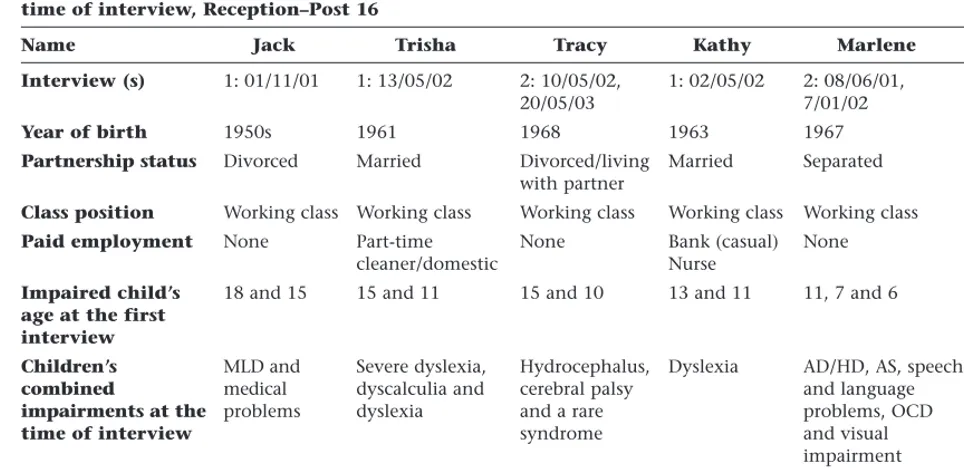
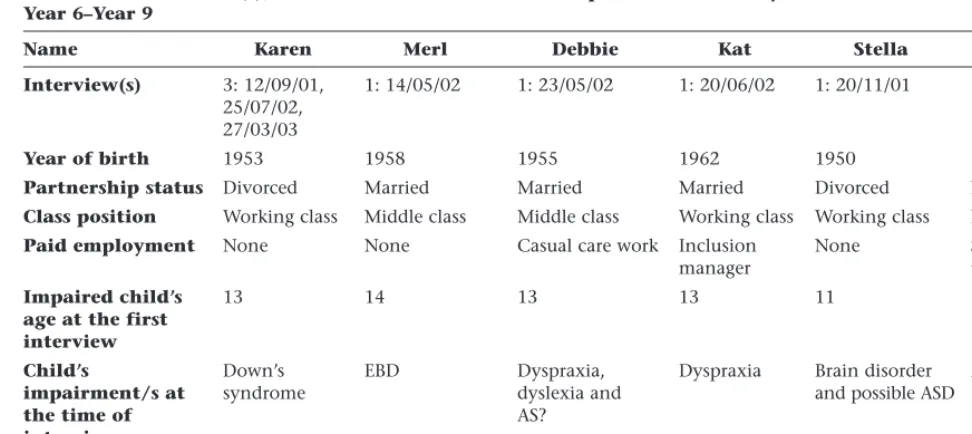
that I did not know anyone of an ethnic minority with an impaired child. This is problematic in gaining ethnic diversity, but it also indi-cates there may be an absence of ethnic minorities in these particular places due to the set-up of user groups at the conferences I attended. I interviewed six parents who have two or more impaired children aged 5–18 years, six parents who have impaired children aged 4–8 years, six parents who have impaired children aged 11–14 years and six parents who have impaired teenagers aged 15–19 years. Fifteen parents were working class and nine middle class. For a fuller illustration of the parents, see Table 1.1.
‘It’s all a bit easy’ (or not!): issues of access
As a mother of a teenager with impairments I realised that my position handed me an ‘insider’ role very early on. This was based on our shared identity as parents of an impaired child identified with SEN. While this assisted my ability to access respondents, both professionals and parents, it was often difficult to negotiate the role. Our shared knowledge about particular difficulties and dealing with professionals meant at times there were questions left unasked or comfortable silences and nods of the head as described here:
Lynne talks about her difficulties in dealing with ‘experts’ language tells me, ‘I can remember saying to the speech therapist it’s as if I’m talking a different language and he has to repeat it because he’s trans-lating it. Know what I mean?’ ‘Yeah . . .’ I reply. [Lynne, Pp 2]. If I did not know what she meant, or I was not so ‘involved’ in the conversa-tional process then maybe I would have said to her, and many of my participants, ‘No I do not, could you explain please?’ Or ‘yes I do but could you explain what you mean?’ Neither of which happened. Is that so bad? If I was not an insider then it is possible that my partici-pants would not have got to the point of even suggesting I knew what they meant, and it would have been a different experience for exam-ple if a researcher without children had been conducting the research.
(Rogers, 2003: 52)
Par
enting and Inclusive Education
Table 1.1 Interview grids
Interview Grid: Table (a), Mothers (father) with more than one child with impairments. School year at the time of interview, Reception–Post 16
Name Jack Trisha Tracy Kathy Marlene Kerry Interview (s) 1: 01/11/01 1: 13/05/02 2: 10/05/02, 1: 02/05/02 2: 08/06/01, 6: 13/03/01–
20/05/03 7/01/02 22/07/02
Year of birth 1950s 1961 1968 1963 1967 1964
Partnership status Divorced Married Divorced/living Married Separated Separated with partner
Class position Working class Working class Working class Working class Working class Working class
Paid employment None Part-time None Bank (casual) None Full-time
cleaner/domestic Nurse studying
Impaired child’s 18 and 15 15 and 11 15 and 10 13 and 11 11, 7 and 6 7 and 5
age at the first interview
Children’s MLD and Severe dyslexia, Hydrocephalus, Dyslexia AD/HD, AS, speech Verbal
combined medical dyscalculia and cerebral palsy and language dyspraxia, AD/
impairments at the problems dyslexia and a rare problems, OCD HD?
time of interview syndrome and visual impairment
Access point Daughters nasen conference Sister of an Infocus/ Snowball from the Friend networks acquaintance LEA parents Afasic conference
Intr
oduction
13
interview, Pre-school–Year 3
Name Mary Tina Brenda Neil Trinny Christine Interview(s) 2: 08/06/01, 2: 28/06/01, 1: 04/06/01 2: 27/07/01, 1: 13/05/02 2:04/06/01,
22/05/03 22/05/03 27/09/02 22/05/03
Year of birth 1965 1959 1963 1960 1967 1954
Partnership status Married Married Married Married Single Second marriage
Class position Middle class Middle class Working class Middle class Middle class Working class
Paid employment P/t lecturer at P/t accountant and None Primary school Part-time Part-time University helpline volunteer teacher management civil servant
for one session a consultant
week.
Impaired child’s 8 7 5 5 4 4
age at the first interview
Child’s AD/HD and SPLD and SPLD ASD ASD ASD
impairment/s at AS or ASD dyspraxia.
the time of interview
Access point Afasic Afasic conference nasen Afasic Infocus/LEA nasen conference 2001 conference conference in parents evening conference
2001 2000 2001
Par
enting and Inclusive Education
Table 1.1 (Continued)
Interview Grid: Table (c), Mothers with one child with impairments. School year at the time of interview, Year 6–Year 9
Name Karen Merl Debbie Kat Stella Francis Interview(s) 3: 12/09/01, 1: 14/05/02 1: 23/05/02 1: 20/06/02 1: 20/11/01 1: 14/05/02
25/07/02, 27/03/03
Year of birth 1953 1958 1955 1962 1950 1955
Partnership status Divorced Married Married Married Divorced Married
Class position Working class Middle class Middle class Working class Working class Middle class
Paid employment None None Casual care work Inclusion None Sister and nurse manager trainer
Impaired child’s 13 14 13 13 11 12
age at the first interview
Child’s Down’s EBD Dyspraxia, Dyspraxia Brain disorder AD/HD or AS
impairment/s at syndrome dyslexia and and possible ASD
the time of AS?
interview
Intr
oduction
15
of interview, Year 10–Post 16
Name Katy Una Lynne (with Kim Tim Babs (with husband) partner)
Interview(s) 1: 07/05/02 1:20/08/01 1: 06/03/02 3: 02/04/01– 1: 10/05/02 2: 30/04/02,
04/11/02 18/11/02
Year of birth Early 1960s 1950s 1952 1965 1947 1949
Partnership status Married Married Second Second marriage Married Married (had a
partnership two year
separation)
Class position Working class Middle class Middle class Working class Working class Working class
Paid employment Part-time Parent advocate Data access Fire-fighter Retired at 52 None
dinner lady manager
Impaired child’s 19 18 18 15 16 15
age at the first interview
Child’s AS ASD, semantic AS and epilepsy Cerebral palsy Down’s AS and
impairment/s at pragmatic and hearing syndrome epilepsy
the time of disorder and impairment
interview severe dyspraxia.
Access point Infocus/LEA Afasic Snowball Friend of a Acquaintance Infocus/LEA
parents conference friend of a friend parents
parent, rather than as a researcher, and needed to access the group for my own personal reasons. Instead, I asked the head teacher to put a request for participants in the school newsletter. That way parents were able to make a decision about participating without feeling under pressure.
As a mother of a child identified with SEN I became a member of nasen (the national association of special educational needs). They hold an annual exhibition that usually spans three days in central London. I attended this exhibition in November 2000 and 2001. I did gain some participants via this route; however, being involved in the workshops as an observer informed the research significantly. To demonstrate this, here are some snapshots from my field notes written immediately after I left a seminar on ‘inclusive practices within the mainstream classroom’.
The main speaker (a senior member of the then, Department for Education and Employment {DFEE}) said, ‘Inclusion is not about a place but about a setting where we are able to fulfil the children’s potential to become a citizen’. The speaker claimed that knowledge would dispel fear. Two teachers in the audience came back at this saying that EBD children affect every pupil they come into contact with. [. . .] Another teacher spoke and said that ‘training is needed, not just educational or practical, but environmental too. “Mainstream” children don’t always want to open doors for disabled students, and they don’t always take SEN children into consideration.’ By this time the speaker was becoming a little agitated as it was becoming clear that the teachers in the room had expected something from this sem-inar in the way of help, but seemed to feel they were getting little more than snap shot examples of less than difficult cases. [. . .] One teacher said how the teacher has to provide evidence to ‘exclude’ children which can take a long time and in the mean time affecting all around. [. . .] There is a conflict between the teachers’ demands, and one teacher spoke out and added, ‘that on top of all this pressure you have the parents sticking their oar in’.
(Field notes, 2000)
parents evening, run jointly by an LEA and a charity for supporting parents of children identified with SEN, in February 2002 is where I gained the most participants.
Doing the ‘right’ thing: ethical implications
I was guided in my research by the British Sociological Association’s (BSA’s) ethical guidelines. However, I also recognise that there may be tensions between professional bodies of ethics models such as the BSA and theo-retical and feminist approaches to ethics (Edwards and Mauthner, 2002). I agree that feminist theory can inform ethical research. The stories I have been told were personal, private and sensitive windows into the tellers’ lives. In this research there were some occasions where anonymity was impossible: those involving my daughter. I have talked to her about this research and her inclusion (which she agreed to), and I do not apologise for the lack of anonymity here because unlike children in general, many of whom become ‘able’ adults, she, like many of the participants’ children, will never be able to ‘tell’ her story via this particular medium.
There were also the ethical implications of truth – whose truth, whose knowledge? This research is based on 24 parents who are the main or predominant carers of an impaired child. This is about their truths based upon their personal experiences. My role in constructing their stories is an active and particular one and I am very aware that ‘recogni-tion of the researcher’s role on constructing “knowledge” about women [or men] has generated numerous debates about the ethics of “repre-senting the other”’ (Gillies and Alldred, 2002: 39). Returning to Wright Mills (1959) and the ‘Sociological Imagination’, this book focuses on the private and personal troubles of parents who discover their child has an impairment. These intimate narratives form the sociological backbone of this research, and the ‘sociological imagination’ aids the sociological thinking about the public issues that the social world faces when talk-ing about impairment, disability and exclusion more generally.
A biographical reflection
attainment was increasingly delayed. I found this very difficult to deal with and consistently denied the severity of her learning disability. However, for me, there was a point when it became difficult to deny, and at that point (certainly by the mid 1990s), and as a single mother I began the fight: the fight for mainstream school, home schooling, no school and special school! I really did not know what I wanted, or indeed what was the most appropriate way forward for my daughter. What I did know was that however consuming ‘the work’ became (visiting professionals, read-ing books, payread-ing for private consultations, carryread-ing out extra homework and, of course, mothering), I continued; what else I was supposed to do?
Organisation of the book
In focusing on the experiences of parents of children with impairments this research therefore fills an important gap in understanding all the above issues. By giving voice to parents, I highlight specific problem areas in current debates around education policy and provisions for impaired children identified with SEN. It is within these debates that I draw out the ambiguous and liminal spaces participants in this research inhabit when negotiating their private and public, dependent and independent and (dis)abled worlds.
Chapter 2 lays down the theoretical framework based on ‘natural’ mothering within the empirical and the cultural and political spheres. It engages with literature, empirical work and theoretical constructions of mothering, inclusion/exclusion, inclusive education and disability. It also begins the engagement with social theory in looking at exclusion, denial and disappointment.
above feelings happen and trigger the next one in a predictable order. Rather, it shows that these feelings can surface sporadically and in a messy and unpredictable way. Feelings of shock, disappointment, loss and grief in the early stages of a diagnosis are often compounded with feelings of anxiety brought on by difficulties in dealing with the unknown.
Chapter 4 highlights how pivotal the identification and assessment process is in relation to how parents negotiate and become part of the process of ‘special’ education and support services. While the mothers and fathers may have come into contact with health and social work professionals prior to this assessment process, the statutory assessment and statementing process sees a growth of professional involvement. It is here that there seems to be a point of conflict between the parents and the professionals. However, I am under no illusion that the profes-sionals are the ‘baddies’ and the parents are ‘victims’. I unpack the par-ents’ stories in relation to New Labour policies and directives, especially with regard to professional/parental partnerships and inclusion and anti-exclusionary discourses (followed up in Chapter 5). I illustrate how the parents I interviewed struggle with their own desire to have a child without impairment, and in addition, have a strong desire to take care of and fight for their impaired child, and yet still need the support and help of special education or health services. This chapter shows that the official process is not set up forthe parents, but ‘includes’ the parents. This process includes education providers (mainly schools), LEAs, health and social work professionals and policies and directives. This means that relationships between them are often fraught with conflict and dif-ficulty. Parents enter this process with certain expectations often fuelled by emotions and desire, whereas the professionals enter from the position of an ‘employee’.
the parents’ own preconceived prejudices about special education provi-sion and other mothers’ negative attitudes towards ‘difficult’ behaviour within a mainstream environment. Ultimately, though, this chapter reveals that these arguments are not simply about inclusive education and exclusion, but about acceptance of difference and difficulty.
Chapter 6 shows that a family with an impaired child is, in fact, in some ways ‘disabled’. Support networks are often strained. A mother’s or father’s mental health can be dramatically affected, leading to depression and anxiety and treatment with anti-depressants and beta-blockers. This has an effect not only on the individual, but on the family, on relation-ships between parents and their other children and on medical and health professionals. This chapter highlights the fact that the main carer often has to maintain longer periods of responsibilities in the home, and the role of the mother often changes into that of multi-functional ‘pro-fessional parent’ – of social worker, advocate, carer and nurse – which then impacts on the mother’s potential career path. Furthermore, it indi-cates that the mother may choose to work outside the home, not only for financial gain but also for respite. Chapter 6 also reveals that a parent can become isolated in a world where she or he has already compromised a large part of her or his potential working life and feels unable to break free from it. This is experienced both emotionally and practically, as others’ reactions to her or his impaired child result in a withdrawal from main-stream public places, as well as imposed exclusions from others.
Index
184 abuse, 115, 117, 177
(ab)normalising barometer, 171
acceptable difficulties, 47
acceptance, 33, 64, 104, 117, 119, 171, 173, 177
Afasic, 16
Allan, J. 30, 33, 104, 107, 108 anti-social behaviour, 37, 75, 76, 105,
106, 110, 119, 126, 136, 147, 153, 169
Armstrong, F. Armstrong, D. and Barton, L. 34, 172
Armstrong, F. and Barton, L. 6, 172 assessment process, 66–70, 81, 86, 90,
98, 112, 177
Avery, D. M. 24, 34, 43, 65, 135 Babs, 45, 60, 61, 63, 93, 118,
143–145, 169
Baldwin, S. and Carlisle, J. 6, 139, 143, 147–149
Barnes, C. 6, 65
Barnes, C. Mercer, G. Shakespeare, T. 56, 135, 146, 156, 157 Beck, U. and Beck-Gernsheim, E. 22,
26, 50, 163, 166 Becker, H. 56, 65
Benjamin, S. 9, 30, 31, 104, 119–121, 124
Benn, M. 24
Beresford, B. 22, 100, 135, 139, 143, 145, 148, 161
blame, 55, 74, 75, 77, 78, 81, 161 Bowring, F. 99, 157
Braun, D. 93 Brenda, 91
Carpenter, B. 85, 153, 156 Chadwick, R. 22, 28, 111 childrearing, 22, 23, 38
advice, 23 children
‘normal’, 26
‘perfect’, 22, 24 Christine, 146, 152
Clarke, J. and Glendinning, C. 90 Cole, B. 26 credit ratings, 166, 171, 172 Crozier, G. and Reay, D. 71, 78, 90 cruel
condition, 60 dependency, 96 Culpitt, I. 94–97 cultural
assumptions, 166 aversion, 108 ignorance, 132
sphere, 6, 21, 30, 34, 57, 124, 156, 163, 164, 167, 168, 171–174 curriculum
homogenous, 8 national, 8 Darlington, C. 132
David, M., Edwards, R., Hughes, M. and Ribbens, J. 82
David, M., Davis, J., Edwards, R., Reay, D and Standing, K. Debbie, 57, 58, 75–77, 81, 100 delinquency, 80
denial, 36–38, 40, 58, 143, 144, 167, 176
diagnosis, 48, 52–64, 142, 145 ambiguous, 42
Down’s syndrome, 42–45, 50 dyslexia, 47, 62
epilepsy, 52 late, 60, 79
rare syndrome, 51, 52, 79 unsupported in, 53
difficult difference, 30, 37, 165, 167, 168, 176
disabilism, 6, 34, 35, 174 disability
experiencing, 6 introductions to, 5, 6 perceived, 30
family as, 6, 137, 147, 152, 156, 164, 166, 173, 174
mascot, 132 networks, 139 ‘other’, 110 status, 113
disappointment, 24, 33, 36, 39, 40, 49, 70, 96, 141, 142 explanations of, 168–170 Docking, J. 83
doubly dammed, 24 Douglas, J. W. B. 82 Douglas, M. 29, 111, 136 Donzelot, J. 26, 80, 98 dribbling, 29, 110
dysfunctional family, 78, 80 Edwards, R. and Mauthner, M. 17 embarrassment, 135, 136, 155 Emerson, E. 65, 139, 140 emotional
resources, 149 roller coaster, 64, 151 security, 139
vulnerability, 76 eugenics, 29, 177 exclusion, 29
experiences of, 31, 147, 151 explanations of, 171–173 of ‘imperfect’ 28 mother’s, 119, 125 social, 36, 137, 157 tactics, 27
within inclusive education, 32, 121, 131
expectations, 21, 22, 70, 118, 169, 176 childbirth and childrearing, 22, 27,
38, 40, 41, 99, 166 celebration/lack of, 49, 50, 170 dashed, 50
high, 39
mainstream education, 30, 102–105, 108, 112, 120, 127 romantic, 22
support of, 138, 140, 143 unrealistic, 71
family
consultation meeting, 76, 77 problem, 67, 76
therapy, 81 father
caring commitments, 28 becoming or being, 3, 41 fatherhood
preparing for, 22 feminist researchers, 5 feminist approaches, 17 Forna, A. 23, 24
Foucault, M. 6, 25, 94, 98, 99
Francis, 46, 52, 54, 75, 77–82, 100, 129, 130, 137, 150, 154, 155, 159, 169 Friel, J. 83
Furedi, F. 149 Gascoigne, E. 61, 65 gaze, 25, 34, 94, 96, 165 Gillies, V. and Alldred, P. 17 Gittens, D. 156
Glendinning, C., Powell M. and Rummery, K. 90, 99 Goffman, E. 34, 56, 65 graded normality, 48
Gray, D. E. 6, 22, 26, 27, 32, 34, 56, 126, 135
‘grotesque’, 28, 29, 132, 133, 136, 166 guilt, 24, 25, 148
hierarchies of impairment, 47, 171 Hilpern, K. 104, 105
Hollway, W. and Featherstone, B. (eds.) 80, 148
home tuition, 105 Houyhnhnms, 29 human
all too, 177 being, 29, 30, 137 condition, 39
denigration of form, 29 existence, 111
accommodation of children with, 10
definitions of, 5, 6 identification of, 51 impostition of, 34 performative aspects of, 29 proof of, 60
political discourse, 21, 30, 34, 36, 173
promotion of, 30
‘where possible’ 8, 30, 171 independency, 176
infertile, 51 interference, 23
internal and external dialogues, 4 interviews
in-depth and informal, 4 introductions to, 10 –17 process, 4
imprisonment, 137 IQ , 46, 47, 78
Jack, 71, 72, 99, 113, 141, 152, 161, 162, 169
Karen, 44–46, 91, 104, 106, 113–118, 127, 128, 131, 144, 149, 150, 154 127, 131, 143, 144, 147, 150, 151, 159, 168, 171, 172 Kim, 42, 49–51, 91, 99, 112, 124, 131,
136, 137, 152, 168
labels, 7, 51, 52, 55–59, 63, 65, 148,
Levitas, R. 27, 99, 157 Liddiard, M. 23 life course, 21 Lindsay, G. 10, 124 Lister, R. 27, 99, 157
loss, 27, 39, 40–44, 49, 60, 61, 147, 153, 160, 166, 170
love/hate dualism, 149
Lynne, 47, 52, 56, 58, 75, 78, 79, 81, 82, 86–90, 100, 124, 145, 152, 168
Maclure, S. 8
Mactavish, J. B. and Schleien, S. J. 135, 147
Marlene, 58, 75, 78, 80, 81, 94, 97, 119, 121–126, 132, 136, 147, 158, 162, 171
Mary, 58, 137, 145, 150 maternal ambivalence, 80, 148,
149 McDonnell, P. 124
mental health, 116, 138–141, 144, 147, 148, 152, 162, 164, 167, 170 Morris, J. Abbot, D. Ward, L. 127 mother
as ‘disabled’, 6 bad, 151
becoming or being, 3, 41 caring commitments, 28 good, 25, 26, 148 ‘instinct’, 43, 51, 52 love, 25 pressures of, 23, 24 mothering
abilities, 25, 76 definitions of, 4, 23 ‘good enough’ 22, 25
my own personal experiences of, 3, 4, 17, 18, 44, 46, 47, 57, 61–63, 143, 163, 164, 166, 167, 170 nasen, 16, 132
Neil, 53–55, 91, 95, 111, 112, 137, 138, 147, 150, 153, 154, 172 New Labour, 8, 98–99, 102 ‘normal’, 48
celebration/lack of, 39, 42, 44 family practice, 21, 45, 166 peers, 112
normalisation, 24–26, 37, 111, 171 norms, 26, 75
desired, 25
expectations of, 4, 29, 80 internalised, 41, 64 social, 136
Norwich, B. 30, 31, 33, 104, 124, 173 Oakley, A. 134, 139, 145, 156, 175 Oliver, M. 6, 34, 172
‘Oscar’-like rewards, 9
‘out of county’ placement, 128 parent
autonomous power, 26 becoming, 34, 37 introductions to, 10–17 partnership, 36, 71, 90, 91, 94,
169
professional relationship, 61, 92, 93, 95–97, 115, 118, 164 (un)gendered significance, 41
Phillipson, C. Allan, G. Morgan, D. (eds.) 139
Plummer, K. 5 policy
policy—continued
documents/directives, 7–10, 108, 119, 124, 131, 167, 168, 176 political
discourse, 21, 38, 168
sphere, 6, 7, 21, 30, 34, 38, 119, 124, 156, 163, 164, 167, 168, 171–174 practical autonomy, 139
pre-school services, 114 private
sphere, 26, 98, 164 troubles, 5
professional parent, 135, 156, 157, 160, 164, 172
promotion of choice, 30 provision, 7
PRU, 121, 124 public
discourses, 165, 167 issues, 5, 17, 175 perception, 57
Read, J. 22, 25, 26, 27, 65, 78, 135, 136, 146, 148, 153, 156, 161, 162 ‘real’ world, 109, 112, 113, 164 Reay, D. 82, 90, 92, 101 reproductive technologies, 28 respite, 78, 80, 130, 135, 157, 164, 175 rhetoric, 30, 32, 111
Ribbens, J. 22, 26, 64, 80, 135, 136, 148, 156, 159, 163, 166 Ribbens, J. and Edwards, R. 5, 166 Ribbens McCarthy, J. with Kirkpatrick,
S. 166
Richardson, D. 24, 25 Riddell, S. 33, 76 rights Russell, P. 93, 99, 118
scapegoats, 61
Seligman, M. and Darling, R. 46, 52, 55, 153, 156
SENCO-FORUM, 57, 122 SENT, 9, 83
Shakespeare T. 29, 30, 34, 111, 132, 172
shameless prejudice, 105 Shelley, M. 29
Sibley, D. 28, 111, 132, 136, 175, 176 siblings, 128, 135, 153–156
Silva, E., (ed.) 148 Simmons, K. 33, 173 Slack, S. 6, 35, 174, 175
sphere, 21, 57, 163, 167, 168, 171–174
sociological
imagination, 4, 5, 17, 167, 175 space, 3
Sontag, S. 6, 110, 111 Spock, B. 23, 166 special educational needs
definitions of, 4
statement of SEN, 7, 26, 66, 67, 69–72, 81, 82, 113 ceasing, 88
inappropriate, 71
legally binding document, 70, 82 statutory assessment, 10, 81, 87
tests, 123
Stella, 52, 113, 114, 117, 118, 131, 136, 142, 146, 158, 159, 162, 169
sterilised, 80 Stoppard, M. 23, 166
stigma, 27, 32, 34, 35, 56, 126, 135, 172, 174
support networks, 146 surveillance, 25, 74, 78, 149 Swain, J. and Cook, T. 99 Swift J. 29, 111, 137, 177 termination, 43
Tim, 42, 44, 103, 104, 106, 113, 131, 136, 143, 152
Tina, 46, 50, 54, 56, 82, 85–87, 118, 155, 156, 161, 162
tolerance, 31, 32, 172, 177 Tomlinson, S. 66
Tozer, R. 135, 139
Tracy, 42, 48, 49, 51, 52, 75, 78–80, 97, 98, 100, 105–108, 110, 118, 119, 123, 124, 128, 129, 132, 138, 140, 147, 151, 152, 154, 155, 162, 171
Trinny, 72, 96, 140, 144
Trisha, 62, 63, 70, 82, 130, 140, 152, 161, 162
Una, 59, 60, 71, 72, 80, 91, 98, 104, 106, 107, 119, 120, 123, 129, 132, 137, 160
underclass, 108
‘vile’, 29 vindicated, 79
Vincent, C. 34, 71, 78, 82, 85, 90, 92, 172
Walkerdine, V. and Lucey, H. 78 Wallbank, J. A. 22, 24, 25 Warnock Report, 7 Warren Dodd, L. 153, 156 Wilson, J. 32, 104, 124 Winnicot, D. W. 22, 166 Wright Mills, C. 5, 17, 166, 167,
175
Wyness, M. G. 81, 98 Yahoos, 29
Young, J. 29, 36, 37, 111, 119, 165, 166, 172