vii ABSTRACT
This skipsi entitled “Social Class in The Princess Casamassima Novel by Henry James” is analyzing the social problem which focuses on the social class that exists in The Princess Casamassima. The aim of this research is to find out the effect of the social class towards the social condition in the novel The Princess Casamassima. In conducting the research comparative method is used to explain the effect of social class and to relate the problem with the social condition at that time.
In this research the data found is fifteen (15) data which shows the effect of social class in society. The social class effect towards the main character first is the effect of social class in dealing with society. Second is the effect of social class in getting the education and job field. Third is the effect of social class in getting the marriage. Then, the last is the effect of social class in political position. The result of the discussion found that the power and dominance of the upper class makes their treatment towards the lower class arbitrary for example in giving the low wages. Thus, the lower class cannot meet their ends therefore they want to revolt the upper class to demand justice by forming the democratic movement together with the lower middle class. However, they cannot run the movement without help from the upper class since the lower class has no money.
viii ABSTRAK
Skripsi ini berjudul “Social Class in The Princess Casamassima Novel by
Henry James”, skripsi ini menganalisis masalah sosial yang terjadi dalam novel
The Princess Casamassima terutama masalah kelas sosial. Penelitian ini bertujuan untuk menemukan efek dari adanya pengkelasan sosial dalam masyarakat terhadap keadaan sosial dalam novel tersebut. Dalam melakukan penelitian ini penulis menggunakan metode deskriptif komparatif untuk menjabarkan dan menjelaskan efek dari kelas sosial yang terjadi dalam novel dan merelasikannya dengan keadaan sosial yang terjadi pada masyarakat pada zaman saat novel tersebut dibuat.
Dalam penelitian ini penulis menemukan lima belas (15) data yang menunjukan efek dari adanya kelas sosial dalam novel. Efek dari kelas sosial yang terjadi pertama adalah efek pada karakter utama dan kelas bawah yang ada dalam novel dalam berhadapan dengan perlakuan dan keputusan masyarakat terutama perlakuan masyarakat kelas atas. Kedua efek dari kelas sosial adalah dalam mendapatkan pendidikan dan pekerjaan. Ketiga efek dari kelas sosial adalah dalam masalah pernikahan. Dan terakhir efek dari kelas sosial adalah dalam menentukan posisi dalam dunia politik.
Berdasarkan hasil penelitian penulis menemukan bahwa kekuasaan dan dominasi dari masyarakat kelas atas telah membuat mereka berbuat semena – mena dalam memperlakukan masyarakat kelas bawah, sebagai contoh dalam memberikan upah kerja, para pekerja hanya mendapatkan upah yang rendah. Hal ini kemudian menyebabkan masyarakat kelas bawah ersama dengan kelas menengah bawah tidak dapat memenuhi kebutuhan hidup mereka sehingga dengan kondisi yang seperti ini mereka ingin menuntut keadilan dengan cara mendirikan gerakan demokratik.
1
CHAPTER I
INTRODUCTION
1.1Background to the Study
Literature is a medium used by the author in conveying his idea and opinion to express his point of view towards life. Through literature the author could write the condition that happen around the society he lives in. As Wellek and Warren (1977, p 94) stated, literature reserve about life and life, in most part, is part of the real society. Therefore, literary work is the reflection of the real life. It can describe the events in our life, and also contains the cultural and social background which indicates that literature and society is closely related because literature expresses the situations and problems existing in society.
The social problem often occurs in literary works as can be found in the novel. The story in a novel describes the situation and the social problem happening in the society at a particular time. The social problem in the novel usually illustrates about poverty, gender, discrimination and social class, for example Henry James in his novel The Princess Casamassima telling about the social classes.
2
are the different social treatment for upper class and lower class in the Princess Casamassima.
The issue about the social class has raised the writer’s curiosity to analyze it and to find out the effect of social class to the social condition in The Princess Casamassima. In this research Marxist theory is considered appropriate in analyzing the class struggle problems.
There are some researchers using Marxist theory in analyzing their studies. The previous analysis used Marxist theory is written by Krishnawaty from English Department, Indonesia University of Computer. In her skripsi entitled “The Representation of Ideology of Doris Lessing in Good Terrorist Novel” she
tells that Marxism considered as the ideology of the author. Besides, there is also a skipsi by Anggi Anggraeni Ramadliyantie entitled “Patron Slave Relationship in the Novel: Girl with a Pearl Earring by Tracy Chevalier (A Study of Marxist Feminism Theory)”, which tells about the condition of woman as a slave and her research emphasizes on the Marxist feminism analysis.
3
1.2Research Question
1. How does the social class in ‘The Princess Casamassima’ and its relation with the social condition at that time?
2. To what extent does the social class affect the social condition in The Princess Casamassima?
1.3Objectives
1 To find out the relation of social class in The Princess Casamassima with the social condition at that time.
2 To find out the effect of the social classes towards the social condition in The Princess Casamassima.
1.4Significance to Knowledge
4
1.5Theoretical Framework
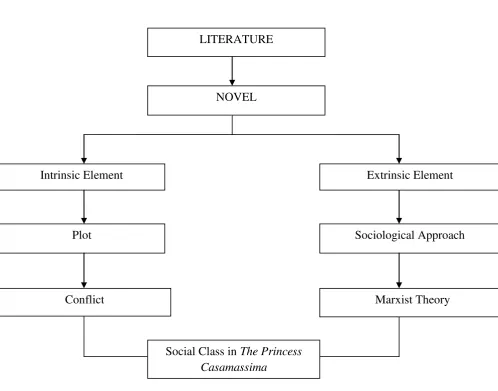
Since this research analyzes the social classes in Henry James’s The Princess Cassamasima, therefore sociological approach is used. The society also has a great role in shaping the literary work as Wellek and Warren state that the social problems, of the work can be analyzed as part of literary analysis. The sociological approach in analyzing the content of the novel is known as the analysis of the external elements of literature. Besides, to understand the social class in The Princess Casamassima Marxist theory is considered appropriate to be used.
According to Peter Barry (2002) Marxism see struggles among the social class to get higher position (2002, p 157). It means that Marxist theory analyzed the struggles that happen among the class of society to get better life for whatever status they have because the more money someone has, the more respect and power they can get in the society. In this case, struggles between the upper, middle and lower class.
5
6
Figure 1.1
LITERATURE
Intrinsic Element
Marxist Theory Extrinsic Element
Conflict
Sociological Approach
Social Class in The Princess Casamassima
Plot
7
CHAPTER II
THEORETICAL REVIEW
This chapter explains the literature and sociological theories. Both theories are used in collecting and analyzing the data.
2.1 Literature
Literature is work of written expression as Mario Klarer (1998) stated that literature is referred to as the entirety of written expression, with the restriction that not every written document can be categorized as literature in the more exact sense of the word (1998, p 1). It means that not all text documents can be said as literature, one of genre of text which can be said as the literary text is fiction; novel.
2.1.1 Novel
8
times are portrayed in a plot of more or less complexity. It means that novel is a reflection of the story in real life which appears in literary work. From both statements we can conclude that novel is written in a long length because it describes about the event that happened in real life in which it is presented by the experience of the characters.
2.1.2 Plot
Plot is the chronological event which is experienced by the characters in novel, Hawthorn argues that ‘plot is an ordered, organized sequence of events and
actions’ (2001, p 96). Therefore, plot is the pattern of the way of how the story is
being told. Ian Milligan states that plot is
composed of all the elements which, taken together, suggest the direction, or tendency of the work. It is the way in which the author has arranged his material so that it can be seen as having an analyzable form or meaning (1983, p 143)
9
According to Klarer (1998, p 15) there are four elements of plot; exposition is where the character is introduced in the beginning or the introduction of the story, complication is the indication of the raised conflicts which will lead to the main problem, then climax is when the characters face the main conflict and they have to decide their decision which will lead to the resolution. The resolution is the result of the decision that the characters take and the story ends.
As mentioned above, the main problem in a story begins in complication where there appear the conflicts faced by the characters. According to Laurence Perrin, conflict is a class of actions, ideas, desires, or wills (1988, p 42). Thus, conflict is the essence of fiction and it is the main problem of the story which will lead to the main problem of the story.
Furthermore, Perrin also divides conflict into four; first is man versus man, conflict that puts one person against another. Second is man versus society where one person has to face the society, for example when the characters have to face the values and rules that exist in society. The third there is man versus nature conflict where one have to face the force of nature. The last is man versus self conflict where one has to face that the enemies is within himself.
2.2 Literature and Society
10
of society like in literary works, such as novel which can become the illustration of a certain society. It is mentioned by Umar Junus (1986) that “karya sastera dilihat sebagai dokumen sosiobudaya, yang mencatat kenyataan sosiobudaya suatu masyarakat pada suatu masa tertentu” (1986, p 3). Besides, Lucien
Goldmans (1964) also states that novel is a social chronicle (1964, p 4). Therefore, novel can be a story of the certain society and also can be a historical document because it describes the situation when the novel is produced and the society where the author lives.
Wellek and Warren say that the author is not only influenced by society, he influences it. Art not merely reproduces life but also shapes it (1977, p 102). From the statement above we can draw a conclusion that it is not only society which affects the work of author but also the work itself which can affect the society. Thus, the work can create a new trend in a society.
11
2.2.1 Marxist Theory
Marxism is known as the school of thought of Karl Marx and Friedrich Engels about the inequality in the society which covers the economic terms between the company or land owner and workers. According to Peter Barry, the aim of Marxism is to make the classless society, based on the common ownership of the means of production, distribution and exchange (2002, p 156). Thus, according to Marxist theory a fair society is society where there is equality and fair treatment from the employers towards employee. The position of someone in society is also determined by their social class.
Social class is a grouping of people based on their occupation and position in society. D Stanley Eitzen and Maxine Baca Zinn (1991) stated that social class is a complex concept that centers on the distribution on the economic resources (1991, p 231). It means that the social class is based on how much money that one’s had in society also determines the society treatment towards somebody.
Marx argues that all mental (ideological) systems are the products of real society and real economic existence. The material interests of the dominant social class determine how people see human existence, individual and collectives (Shelden and Widdowson, 1993, p 71).
From the excerpt above we can see that the social status has a certain role in determining someone’s position in society. The power in society is held by the
upper class and upper middle class who have a lot of money so that they can get the privilege. Furthermore Ralf Dahrendorf in Giddens mention;
12
model of class relations which is basically dichotomous; all class societies are built around a primary line of division between two antagonistic classes, one dominant and the other subordinate. (1994, p 37)
The excerpt means that the social class appears because there is a difference income and property which one has. Besides, the division of social class is separated into four groups groups, the upper class which contains of aristocrat and the wealthy people, the upper middle class who has a lot of money or own a company, lower middle class and the lower class consisting of little merchant, workers and poor people. Thus, the upper class and upper middle class that is wealthy and has power in society is known as the dominant one and then the lower middle class and lower class containing of workers who works for the upper class is known as the subordinate one because they are dependent on the upper class. Thus, their dominancy among the society becomes obvious either in economic and political aspects. Royle mentions;
Instead of multiplicity of status groups within the social hierarchy, bonded together by community, deference and paternalism, horizontal cases to and control over economic resources, in conflict with one another about the distribution not only of economic but also of political, social and ideological power. (1987, p 83)
13
employers of company and only get low wages which is not enough to meet their ends since the upper class only thinking about their own profit. As Barry stated;
…workers are bereft of their full humanity, and are thought of as ‘hands’ or ‘the labour force’, so that, for instance, the effects of industrial closures are calculated in purely economic terms. People, in a word, become things (2002, p 157).
It implies that the employees are only tools for the employers to get a lot of profit for their own benefit and make their company succeed. Besides, the workers do not get fair payments for their work and dedication in developing the company. In class society, the upper class is become the oppressor and the lower class is the oppressed as mentioned by Shelden and Widdowson (1993)
Marx was arguing that what we call ‘culture’ is not an independent reality but is inseparable from the historical conditions in which human being create their material lives, the relations of exploitation and domination which govern the social and economic order of a particular phase of human history will in some sense ‘determined’ the whole cultural life of the society (1993, p 71).
Moreover, Giddens (1994) also stated that
Any and every ‘economic’ phenomenon is at the same time always a social phenomenon, and the existence of a particular kind of ’economy’ presupposes a definite kind of society (1994, p 10)
14
(1994, p 6) stated that the ownership of property still largely determines political power. It implies that the power of governments is determined by those who have a lot of money.
The domination of upper class in society makes the lower class demand for changing because the power of upper class harmful for them. The lower class makes some movement in society by collecting people from their class to revolt the rule in society which is controlled by the upper class. The aim of revolution is to get their rights and fair treatment from the government and upper class. It is as form of their disappointments toward the government’s policy. Giddens mentions
that the class engaging in a revolutionary struggle for power fights in the name of absolute human rights, presenting its ideas as ‘the only rational, universally valid
ones’ (1994, p 44). It implies that the appearance of revolution is in order to get
the fair treatment.
It concludes that Marxism sees the problem happened in society; the struggles among the people in class society economical and political terms. As mentioned by Barry;
15
The people from all the social class wants to reach the higher position in society in order to get power and wealth and to reach such position they used all their effort to accomplish their ambition to reach the higher position in society.
2.3 Literature and History
The function of literature also can be as the social document. The history describes the society. It has been mentioned before that literary work can be a historical document in yielding the outlines of social history (Wellek and Warren, 1977, p 103). Literary work can illustrate the condition of certain society. We can see that there are many literary works that illustrates the condition such as in The Princess Casamassima by Henry James which illustrates the struggles of lower middle class and lower class in London to fight for their rights and the rising of democratic movements in the late eighteen centuries.
16
and Dodd states ‘Liberal freedom was cast as the English, in history, clawing back
margins of freedom from an arbitrary State’ (1986, p 32). One of the upper class policies which are considered harm to the lower class is in the education field.
The privilege in getting the education at that time for the lower class seems impossible. Although education is a right of everyone to get lower class cannot get good education since the cost is expensive and they do not have money to pay. Eitzen and Zinn (1991, p 205) mentioned that better-off people can purchase good education, good medical care, comfortable homes, fine vacations, expert services of all kinds, safe and satisfying occupations which poor people cannot because they had no money. Moreover, Joseph Barker in Royle states that education was not easily come by because;
Almost the only opportunity I had of learning anything, except what I might learn at home, was by attending the Sunday-school. when we had work, we had no time to go to school; and when we had not work, we had nothing with which to pay school wages, so that a Sunday-school was our only resource. (1987, p 349)
From the excerpts above we can see that the opportunity of the lower class to get education seems impossible because to get education they have to work to get money so that they can pay for the school fees. However, they have to work every day in a week except Sunday so they only can learn on the Sunday-school. Thus, they only get a little knowledge and still they cannot get a better job since they do not have good education which they need to apply to company. ‘…it was the basis
17
part’ (Royle, 1987, p 386) it means that education is really important for the lower
class to get a good job.
The problems of the society at that time are not only about the condition of the lower class which cannot get education and job but also their position in getting marriage. Since, women at that time looking for a man who has a good job and position in society it limits the opportunity of the man from lower class to get woman they loved. David Waldron Smithers states that man were largely judge by their wealth and position and ladies by the profitable marriage they secured (1981, p 23). It implies that woman looks for a man from his background and position in society since they think marriage as the opportunity to improve their social status and to assure their future. This matter prevails for both the lower class and upper class women. As for the upper class marriage is seen as the way to pretend their aristocracy as Rolye mentions ”…together with the junior members of aristocratic families who might expect to have to seek fortunes through marriage, political office or the professions”. It means that the upper class woman or for the young
man of the families which will not get the legacy from their family the way to get them stand in the aristocracy is by marrying the aristocrat family or get good position in the governments.
18
19 CHAPTER III RESEARCH METHOD
This chapter describes about the research objects and methodology used in analyzing the data.
3.1 Research Object
This study is conducted to analyze the social problem appearing in novel The Princess Casamassima by Henry James. The social problem analyzed id focused on the social class problems.
3.2 Research Method
20 3.3 Data Collection
The process of collecting the data for this research is first the writer searched the novel and the writer choses The Princess Casamassima, one of Henry James’s novels since, this novel exists of some social problems happened
in the late eighteen centuries. Second, the writer read the whole novel comprehensively, and then the writer found the major social problem appearing in the novel which is social class. The analysis focuses on social class effect and its relation with the social condition at that time. Third, the writer makes a limitation of the data which would be analyzed through conflict. Then, the social class problems appearing in the novel is related to literary theory.
3.4 Data Analysis
21 Example;
Below is the conversation between Miss Pynsent and Mrs. Bowerbank. They are talking about Hyacinth father, Miss Pynsent does not want the lady have a low opinion about Hyacinth because his father is a Lord.
„I suppose we oughtn’t to forget that his father was very high,’ she suggested, appealingly, with her hands clasped tightly in her lap.
„His father? Who knows who he was? He doesn’t set up for having a father, does he?’
40 CHAPTER V
CONCLUSIONS AND SUGGESTIONS
This chapter deals with the conclusion from the discussions in this research and the suggestion of this research for the next scholars who is interested in the social analysis.
5.1 Conclusions
From the discussion in chapter IV, we can conclude in the novel class society in The Princess Casamassima there are four classes the upper class which consists of aristocrat and the wealthy people, lower middle class and lower class consisting of workers and poor people. Thus, in society the power is hold by the upper class whose dominance is in economic and political aspects since they have the power their treatment towards the lower middle and lower class is considered arbitrary.
In this research, there were 15 data indicating the conflict which affected by the social class. There were 2 data shows the effect in dealing with the society, 2 data shows the effect in getting education and job field, 3 data shows the effect in getting marriage, and 9 data shows effect in the political position. The represented data show that:
41
Hyacinth case, since he is an illegitimate child of Lord Frederick and the society has low opinion toward the illegitimate child, the society put him in lower class. Therefore, Hyacinth feels and experiences the hardest way in dealing with society as the lower class, for instance the arbitrary treatment that he and people in his class get from the government and upper class.
2. 2 data show the effect of social class in getting education and job field. The lower class also cannot get good education since they do not have enough money to purchase it. Thus, they cannot get a good job to improve their life.
3. There are 3 data indicating the effect of social class in getting marriage. The position of someone can determine his chance to get woman that he love since women at that time looking for a man who has position in society to their social status. Therefore, it is limited the chance of lower class to love a woman.
42
The social class effect in The Princess Casamassima shows the lower class struggles to get a better position in society. The condition that is illustrated in novel also illustrates the social condition in late eighteen centuries where the upper class dominance in society makes the lower class suffer and they want to roll over the upper class dominance which later their action leads into the revolution era.
5.2 Suggestions
There are several suggestions in analyzing the novel. The following are the suggestions;
1. In studying the novel, there are two elements intrinsic and extrinsic element. The intrinsic deals with the content of the novel while the extrinsic deals with the outside aspects of the novel which affected the form of the novel. Here, the researchers have to aware of both aspects because both is still have the relation.
43
3. In studying the sociology of novel we have to see either the social aspects appearing in novel, the social aspects of the author, and the social condition when the novel is published.
22
CHAPTER IV
FINDINGS AND DISCUSSION
The social class in the novel has a certain effect to the social condition. The effect of distribution of social class makes a different social treatment towards the upper class and lower class. Society praise more to the aristocracy and their treatment towards the lower class seems unfair. Here in the novel The Princess Casamassima, the writer attempts to find out how are the effect of social class towards the characters and the effect of social class towards its relation to the society of the time represented in the novel.
4.1 The Effect of Social Class in Dealing with Society
23
opinion of illegitimate child. Thus, he also feels sympathized for those who come from a lower class.
When Hyacinth was not letting his imagination wander among the haunts of the aristocracy, and fancying himself stretched in the shadow of the ancestral beech, reading the first page of the Revue des Due Mondes, he was occupied with contemplations of a very different kind; he was absorbed in the struggles and sufferings of the millions whose life flowed in the same current as his, and who, though they constantly excited his disgust, and made him shrink and turn away, had the power to chain his sympathy, to make it glow to a kind of ecstasy, to convince him, to the time at least, that the real success in the world would be do something with them and for them. (James, 1886, p 111 - 112)
Hyacinth sometimes imagines himself as descendant of an aristocrat as illustrates ‘…the haunts of the aristocracy, and fancying himself stretched in the shadow of ancestral beech’ (James, 1886, p 111 - 112). Besides, when he is not
thinking about the aristocracy, he thinks about his fate and those who come from same class as him ‘he was absorbed in the struggles and sufferings of the millions whose life flowed in the same current as his’ (James, 1886, p 111 - 112). The fact
that his father is an aristocrat make Hyacinth feels proud, but since he is an illegitimate child the society has low consideration about illegitimate child which put him in the lower class. Therefore, he feels sympathized for people in his class since he is in the same position as them.
24
giving them low wages. They work for the upper class but they still do not get enough wages and get arbitrary treatment; the workers become a slave of the object..(Giddens, 1994, p 11). It implies that the upper class does treat the workers as a slave and does not even appreciate their work. In the class society, people who come from lower class always become the sufferer one because they do not have any power to fight against the arbitrary government. Giddens mentions the worker payment becomes an ever cheaper than the goods he creates (1994, p 11). From this statement it is true that the worker only gest a low wage while the price of the goods they produce is even more expensive. As a result, although the workers have worked very hard, they cannot make a better living for their family because the price of the goods is high and their wages are not enough to pay the high living cost.
The problems above are also experienced by Hyacinth in which although he tries very hard to get better living he still in his position as the lower class. Thus, in class society when someone is in lower class, no matter how hard they try to get a better life, they still cannot reach that position although Hyacinth has an opinion that someday they can make a change to the time at least, that the real success in the world would be do something with them and for them (James, 1886, p 111 - 112).
25
aristocrat blood. It is because Hyacinth is only an illegitimate child in which the society has a low opinion about this matter. Hyacinth’s position as the lower class makes him see and experience some problems in dealing with the society for instance the arbitrary treatment that he and the people from his class get from the government and upper class especially in economic terms. Therefore, the social class affected Hyacinth’s in dealing with the society.
4.2 The Effect of Social Class in Education and Job Field
The effect of the position of Hyacinth in the story makes him cannot get the same privilege as the upper class. Although he is an illegitimate child of Lord Frederick, but his foster mother cannot give him a good education because she is only a poor dressmaker. Therefore, Hyacinth cannot get a good job as stated in the conversation below between Hyacinth and Millicent Henning, his childhood friends. Millicent thinks that Hyacinth would be someone who can succeed in the future and when they met again she is surprised that Hyacinth only becomes a bookbinder.
„You might be, really, for all the tea you drink! Why didn’t you go for some high profession?’
„How was I to go in? Who the devil was to help me?’ (James, 1886, p 61)
26
1886, p 61). Her disappointment may be because when they were child, all of people around them have said that Hyacinth is a son of Lord Fredrick. Thus, she expects that Hyacinth to be someone that has better position than he is now, as a bookbinder.
However at that time, someone who comes from the lower class is hard to get a good job if they do not have a good education and position in society. According to Wellek and Warren, the lower class had a little opportunity for education (1977, p 96). It indicates that Hyacinth who comes from a lower class could not get a good job because he does not go to school. We can see from the statement „How was I to go in?’ It indicates that at that time people who can get education are only people who have money as Eitzen and Zinn (1991, p 205) mentioned that better-off people can purchase good education, good medical care, comfortable homes, fine vacations, expert services of all kinds, safe and satisfying occupations and which poor people cannot because they had no money. It means that Hyacinth does not have any qualification to get good job since he has no money to get education.
It concludes that if someone like Hyacinth wants to improve his life he has to have good education while to get this, they have to come from upper class or at least they have a connection with people who has power in society as Hyacinth stated ‘Who the devil was to help me?’. It means that he and his family do not
27
classes’ society and it also shows that people who come from the lower class cannot get a good job because they do not get education.
The hardest ways in searching a job is because education is not only felt by Hyacinth but also by those who come from lower class as presented in the following statement
There were members of the clubs who were apparently always in the enjoyment of involuntary leisure – narrating the vainest peregrinations in search of a job, the cruelest rebuffs, the most vivid anecdotes of the insolence of office. (James, 1886, p 237)
In the democratic community where Hyacinth becomes a member there are a lot of people who have the same fate as him. They come from the same class where they also feel the hardest way in getting job because they do not have education ‘in search of a job, the cruelest rebuffs’. It implies that they get bad treatment
from the staff of the office which rejects them because they do not have the qualification.
28
We can conclude that the social class can also affect the lower class in getting the education; since the lower class do not have enough money to pay the education fee. Thus, they cannot have a good job to improve their life, in Hyacinth case he only becomes a bookbinder and not as a clerk as Millicent expected „I should have thought you’d be a clerk at a banker’. It is because Hyacinth’s foster mother cannot give him good education because she does not have money. Besides education, the effect of social class existence in society also can determine the marriage of someone.
4.3 The Effect of Social Class in Marriage
The social class of someone also has a role in deciding the relationship of someone and their marriage. In Hyacinth case, he realizes his position as the lower class makes the limitation of his chance to get a woman he loved and as women at that time chose the man from upper class to get the social status. Therefore he has no confidence to make relationship with woman as he stated below.
„Does who expect me? I should like to see the woman who does!’ (James, 1886, p 105)
29
Hyacinth does not have any confidence in marriage because he believes that all woman want to get a man with a good occupation and can give them good future.
Marriage at that time has been considered as a way for woman to raise their social status and get a good future. Thus, woman should marry well, which means married to a man who has position and social status. As Smithers states man were largely judge by their wealth and position and ladies by the profitable marriage they secured (1981, p 23).
The phenomenon above also shown in The Princess Casamassima as Hyacinth stated ‘one of these days she’ll marry an alderman’ (James, 1886, p
107). Hyacinth sees that most women wish to marry someone with a better position and job, and there are no women wishing to marry him. So, if Hyacinth wants to marry someone he has to work to collect some money. If he has no money, there no is one that wants to marry him.
Since Hyacinth comes from the lower class, he does not have confidence in getting a relationship with a woman because he does not have position and money. Below is Hyacinth statement which illustrates his low confidence to ask Millicent a date since Millicent wants to go to theater a place where only people with money who come there
30
revanche, as the French say – it occurred to me that you might be able to get me an order. The piece has been running a long time, and most people (except poor devils like me) must have seen it: therefore there probably isn’t a rush.’ (James, 1886, p 124)
Hyacinth is ashamed that he could not take Millicent Henning on a date to the fancy theatre because he has no money. He also never goes to a theatre as he mentions that ‘…and most people (except poor devils like me) must have seen it’
(James, 19886, p 124). It implies that people from lower class rarely go to entertainment place since they do not have money. We can conclude that at that time people who can get such privilege like going to the theatre and other entertainment place is an upper class.
31
4.4 The Effect of Social Class in Political Position
As the climax of the effect of the existence of class society is in the political aspect. The dominance power of the government and upper class in treating the lower middle class and lower class makes the lower middle class and the lower class suffers and demands for justice. The existence of social classes is considered as something unfair for lower class because the high classes have power either in economic and political aspect. They used their power in controlling the aspects of life of society. Therefore, the lower class wants to change the structure of society so that they can get their rights in conveying their opinion and in getting the fair wage for their hard work. To achieve their goal, they make a democratic movement to revolt to the government and upper class. As illustrates from the statement below;
„He doesn’t know, and – if you will allow me to say so – I don’t think you know. How should you? I am one of many thousands of young men of my class – you know, I suppose, what that is – in worse brains certain ideas are fermenting. There is nothing original about me at all. I am very young and ignorant; it’s only a few months since I began to talk of the possibility of social revolution with men who have considered the whole ground much more than I have done. I’m a mere particle in the immensity of the people. All I pretend to is my good faith, and a great desire that justice shall be done.’ (James, 1886, p 150)
32
The economic force from the upper class is one of the most influential reasons for the formation of democratic community. Giddens mentioned that the political power was directly contingent upon an expressive of the division of society into stable economic orders (1994, p 4-5) it implies that the dominance of government and upper class leads into the economic control by them in society in order to take a lot of benefit for themselves. Because of that, lower middle class together with the lower class makes the democratic movement to roll over the dominance of upper class and make a fair society. As stated by Captain Sholto who is suspected the movement.
„About the lower orders, the rising democracy, the spread of nihilism, and all that’
„The lower orders? Does she think we belong to them?’ (James, 1886, p 140)
It is the conversation between Millicent and captain Sholto in which he suspected Millicent and Hyacinth belong to the democratic movement. From the statement of captain Sholto ‘About the lower orders, the rising democracy, the spread of
nihilism,’we can see the terms ‘nihilism’ is means that the democratic community formed by the lower middle class and lower class aimed to make the classless society since ‘nihilism’ itself means that there is no limitation in society it implies
33
Hence, the lower class is always be careful in holding the existence of the community since they do not want the upper class to know what they are doing in which can ruin their plan.
„…Seriously, as you say, it’s perfectly conceivable. I am not in the least surprised at the aristocracy being curious to know what we are up to, and wanting very much to look into it; in their place I should be very uneasy, and if I were a woman with angelic manners very likely I too should be glad to get hold of a soft, susceptible little bookbinder, and pump him dry, bless his heart!’ (James, 1886, p 160)
It is the conversation between Hyacinth with Paul Muniment. From the statement, we can see that the movements of the community always being watched by the upper class „the aristocracy being curious to know what we are up to’ (James, 1886, p 160). It indicates that the upper class has a curiosity of the
group made by the lower class. The upper class has feel threaten because they are afraid that the lower class can obstruct their way in controlling the society and threat their power. We can see from Muniment statement „in their place I should be very uneasy’ (James, 1886, p 160) from the statements Muniments imagines if he were in the upper class position he would feel uneasy and want to know what are lower class up to. In this case Hyacinth should be aware of everyone from the upper class since they are suspected every move of the lower class as stated by Mr. Muniment ‘if I were a woman with angelic manners very likely I too should be
glad to get hold of a soft, susceptible little bookbinder, and pump him dry, bless his heart!’ (James, 1886, p 160). From the statement we can see that even a
34
because they afraid the lower class will take over their power. In the fact there are some parties in the upper class in which sees this movement as something impossible to be done.
For some party of upper class they think that the democratic movement which form by the lower class is means nothing; however, for several parties they see it as the opportunity to strengthen their position. Therefore, they start to collect people from lower class.
„I was looking for anything that would turn up, that might take her fancy. Don’t you understand that I’m always looking? There was a time when I went in immensely for illuminated missals, and another when I collected horrible ghost-stories (she wanted to cultivate a belief in ghosts), all for her. The day I saw she was turning her attention to the rising democracy I began to collect little democrats. That’s how I collected you’. (James, 1886, p 304)
It is the statement of captain Sholto who is the right hand man of Princess Casamassima. From the statements we can see that he would do anything the princess order. As we can see when the Princess is interested in the democratic movement issues, he begins to collect the lower people like Hyacinth to become their tools to reach their goal in reforming the power of noble people in Britain government and getting society’s reliance. Besides, the lower class cannot run the
35
„I have no such pretensions, and my good old friend is laughing at me. Of course that is very easy; for what, in fact, can be more absurd, on the face of it, than for a woman with a title, with diamonds, with a carriage, with servants, with a position, as they call it, to sympathise with the upward struggles of those who are below? “Give all that up, and we’ll believe you,” you have a right to say. I am ready to give them up the moment it will help the cause; I assure you that’s the least difficulty. I don’t want to teach, I want to learn; and, above all, I want to know a quoi m’en tenir. Are we on the eve of great changes, or are we not? Is everything that is gathering force, underground, in the dark, in the night, in little hidden rooms, out of sight of governments and policemen and idiotic “statesmen” – heaven save them! – is all this going to burst forth some fine morning and set the world on fire? Or is it on sputter out and spend itself in vain conspiracies, be dissipated in strerile heroism and abortive isolated movements? I want to know a quoi m’en tenir.’ (James, 1886, p 153)
It is princess Casamassima statements. From the statements we can see that the princess interested to know what the democratic movements up to and how they run the community ‘I don’t want to teach, I want to learn; and, above all, I want
to know a quoi m’en tenir’ (James, 1886, 153). The princess wants to learn what the lower class is up to and she will help them so that they can run the democracy ‘I am ready to give them up the moment it will help the cause; (James, 1886, 153).
She also hopes that it will bring the changes in society and will not be fiddlesticks movement.
36
„It is more strange than I can say. Nothing of it appears above the surface; but there is an immense underworld, peopled with a thousands forms of revolutionary passions and devotion. The manner in which it is organised is what astonished me; I knew that, or thought I knew it, in a general way, but the reality was a revelation. And on top of it all, society lives! People go and come, and buy and sell, and drink and dance, and make money and make love, and seem to know nothing and suspect nothing and think of nothing; and iniquities flourish, and the misery of half the world is prated about as a “necessary evil,” and generations rot away and starve, in the midst of it, and day follows day, and everything is for the best in the best of possible worlds. All that is one half of it; the other half is that everything is doomed! In silence, in darkness, but under the feet of each one of us, the revolution lives and works. It is a wonderful, immeasurable trap, on the lid of which society performs its antics. When once the machinery is complete, there will be a great rehearsal. That rehearsal is what they want me for. The invisible, impalpable wires are everywhere, passing through everything, attaching themselves to objects in which one would never think of looking for them. What could be more strange and incredible, for instance, than that they should exist just here?’ (James, 1886, p 287 - 288)
From the statement above we can see that there are many people want the changes and the democratic movement will lead to the revolution. It makes princess Casamassima amazed of how the community runs their plan without upper class known ‘In silence, in darkness, but under the feet of each one of us,
the revolution lives and works’. Their plan every step that they will take to roll over the upper class neatly and once they do the plan there will be a great changes in society which can make the aristocrat shocked because they never imagine the great revolt from the lower class ‘It is a wonderful, immeasurable trap, on the lid
of which society performs its antics. When once the machinery is complete, there will be a great rehearsal.’ (James, 1886, p 287 -288).
37
politically. Thus, princess Casamassima gives the financial support to the movement but actually she exploits them. As illustrates below the princess Casamassima exploit lower people like Hyacinth to get what she wants.
He was not in the least a natural human being, but had a hundred affectations and attitudes, the result of never having been obliged to put his hand on anything; having no serious taste and yet being born to a little „position.’ The Princess remarked that she was so glad Hyacinth had no position, had been forced to do something else in life but amuse himself; that was the way she liked her friends now. (James, 1886, p 310)
This is the statement of Princess Casamassima that she is glad she has Sholto who is able to do anything for her and he does not have position that could make her order anything without get interruption. Then, now she has Hyacinth who has no position „she was so glad Hyacinth had no position, had been forced to do something else in life but amuse himself; that was the way she liked her friends now’ (James, 1886, p 310). The position of someone can determined what they want to do the upper class can get whatever they want since they have everything power and wealth. Here, princess Casamassima can get what she want since she has people who will do anything as her order.
The movement that conducts by the lower class with the help of upper class still makes the lower class not satisfied since they are used as a tool to expand the upper class power. Thus, they still cannot get a significant change since in the end they trapped in the other power.
38
all the beastly buncombe (you know) that you and I myself have poured out, damme, with an elloquance worthy of a better cause. Don’t you remember what I’ve said to you – all as my own opinion – about the impending change of the relations of class with class? Impending fiddlesticks! I believe those that are on top of the heap are better than those that are under it, that they mean to stay there, and that if they are not a pack of poltroons they will.’ (James, 1886, p 302)
This statement indicates that although they already dedicate themselves to work for the upper class but they still do not get what they should get ‘something which it never does lead to’ (James, 1886, p 302). Captain Sholto has worked for the Princess for a long time and he see that what he doing is only the same as labors who work for their employers. From his experiences, he can see that the relation between the classes in class society will always be the same since people always sees someone based on their position and society praise aristocracy much. Therefore, Sholto sees the democratic party as something useless because the lower class will not that easily to get what they want since they work under guidance of the upper class we can see it from his statement „Impending fiddlesticks!’ (James, 1886, p 302). It is because Sholto seen that the lower class is
always dependent on the upper class so that they become the tool for the lower class to reach into position that the upper class want.
39
society is where the power is held by the upper class and the lower class is dependent to the upper class power. As Dahrendorf in Giddens mentions;
Classes are constituted by the relationship of groupings of individuals to the ownership of private property in the means of production. This yields a model of class relations which is basically dichotomous; all class societies are built around a primary line of division between two antagonistic classes, one dominant and the other subordinate. (1994, p 37)
SOCIAL CLASS IN THE PRINCESS CASAMASSIMA NOVEL BY HENRY JAMES
SKRIPSI
Submitted to fulfill one of the requirements of Sarjana Sastra Degree
JUNIARTI EKA SAPITRI NIM 63706008
ENGLISH DEPARTMENT FACULTY OF LETTERS
INDONESIA UNIVERSITY OF COMPUTER BANDUNG
44 REFERENCES
Barry, Peter. 2002. The Beginning Theory; an Introduction to Literary and Cultural Theory. Manchester University Press; Manchester.
Colls, Robert and Phillip Dodd. 1986. Englishness Politics and Culture 1880 – 1920. Croom Helm Ltd: Kent.
Eitzen, D. Stanley and Maxine Baca Zinn. 1991. In Conflict and Order Understanding Society. Simon & Schuster, Inc; Massachusetts.
Giddens, Anthony, 1994. Capitalism and Modern Social Theory An Analysis of Marx, Durkheim and Max Webber. Cambridge University Press: New York.
Goldman, Lucien. 1964. Towards the Soiology of the Novel. Tavistock Publications.
James, Henry. 1886. The Princess Casamassima. The Millenium Library: UK.
Hawthorn, Jeremy. 2001. Studying the Novel: Forth Edition. Oxford University Press: New York
Junus, Umar. 1986. Sosiologi Sastera; Persoalan Teori dan Metode. Dewan Bahasa dan Pustaka; Selangor.
Klarer, Mario. 1998. An Introduction to Literary Studies. Routledge: London.
Krishnawati. 2009. “The Representation of Ideology of Doris Lessing in Good Terrorist Novel”. UNIKOM: Bandung.
Milligan, Ian. 1983. The Novel in English An Introduction. Macmillan Publishers LTD: London
45
Ramadliyantie, Anggi Anggraeni. 2009. “Patron Slave Relationship in the Novel: Girl with a Pearl Earring by Tracy Chevalier (A Study of Marxist Feminism Theory)”. UNIKOM: Bandung.
Ratna, Nyoman Kutha. 2007. Teori, Metode dan Teknik Penelitian Sastra: Edisi Revisi. Pustaka Pelajar: Yogyakarta.
Royle, Edward. 1987. Modern Britain A Social History 1750 – 1985. Edward Arnold Ltd: London
Sari, Retno P. 2006. “Analisis Sintaksis dan Semantis Beban Informasi Pada Beberapa Cerita Anak – Anak dan Terjemahannya: Tinjauan Terjemahan Komunikatif”. Bandung: UNIKOM. Unpublished Paper.
Selden, Raman and Peter Widdowson. 1993. A Reader’s Guide to Contemporary Literary Theory (Third Edition). Harvester Wheatsheaf: Hertfordshire.
Smithers, David Waldron. 1981. Jane Austen in Kent. Hurtwood Publications.
ix
ACKNOWLEDGEMENT
This research entitled Social Class in The Princess Casamassima Novel by Henry James is submitted to fulfill one of the requirements of Sarjana Sastra Degree. Thus, the writer would like to appreciate and express the deepest acknowledgements for the following people:
1. Prof. Dr. Moh. Tadjuddin, M.A as the Dean of Faculty of Letters Unikom,
2. Retno Purwani Sari, S.S.,M.Hum., as the Head of English Department, 3. Dr. Nia Kurniasih as the first advisor. Thank you for guiding me in
writing this skripsi,
4. Nungki Heriyati S.S., M.A as the second advisor. Thank you very much for your patient in guiding and advising me in writing this skripsi, 5. All lecturers in UNIKOM, especially in English Department for
teaching and sharing all the knowledge.
The writer expects that this skripsi will be useful especially for the writer, and generally for the readers. Hopefully, by reading this skripsi, the readers can understand about the social class problems. The writer is also looking forward for the critics and advices.
Bandung, July 2010
DECLARATION OF OWNERSHIP
I hereby certify that this skripsi entitled “Social Class in The Princess Casamassima Novel by Henry James” is honestly my own work. I am fully aware that I have quoted some statements and ideas from various sources, and they are properly acknowledged in the text.
Bandung, July 2010
xiii
LIST OF APPENDICES
1. Appendix 1 : All Corpuses 47