Risk factors for bacterial vaginosis among Indonesian women
Dwiana Ocviyanti,1 Yeva Rosana,2 Shanty Olivia,1 Ferry Darmawan1
1 Department of Obstetry and Gynecology, Faculty of Medicine University of Indonesia 2 Department of Microbiology, Faculty of Medicine University of Indonesia
Abstrak
Tujuan Untuk mengetahui faktor-faktor risiko bakterial vaginosis (BV) pada perempuan Indonesia.
Metode Penelitian ini merupakan studi deskriptif potong lintang yang melibatkan 492 perempuan yang berusia 15-50 tahun. Sekret vagina diambil kemudian dilakukan tes Whiff dan tes Nugent untuk mengetahui ada atau tidaknya BV. Tempat penelitian adalah Puskesmas Karawang, Pedes, Cikampek, Tempuran, Klinik Batalyon 201 Cijantung, Fakultas Kedokteran Universitas Indonesia dan Rumah Sakit Cipto Mangunkusumo.
Hasil Subjek memiliki usia 15-25 tahun (26,8%), 26 – 40 tahun (59,1%), ¬> 40 tahun (14%). Usia rata-rata adalah 30.9 tahun. Status pernikahan subjek adalah belum menikah (16,9%), menikah 1x (76,4%), dan menikah > 1x (6,7%). Prevalensi bakterial vaginosis pada penelitian ini adalah 30.7% sesuai dengan skor Nugent. Usia >40 tahun (OR=3,15 95% CI = 1,15-1,48) dan pasangan yang tidak disirkumsisi (OR=6,25,95% CI=2,54-15,38) merupakan faktor determinan yang secara signifi kan berpengaruh terhadap kejadian BV (p<0,05).
Kesimpulan Prevalensi BV pada penelitian ini adalah 30,7%. Faktor risiko BV adalah usia dan pasangan yang tidak disirkumsisi.(Med J Indones 2010; 19:130-5)
Abstract
Aim To identify risk factors for bacterial vaginosis (BV) among Indonesian women.
Methods This is a cross sectional study involving 492 women with age ranged 15-50 years. Vaginal discharge was collected. Whiff test and Nugent scoring were utilized to identify BV. Settings are Puskesmas Karawang, Pedes, Cikampek,Tempuran, Batalyon 201 Clinic Cijantung, Faculty of Medicine University of Indonesia and Cipto Mangunkusumo Hospital.
Results Age of the subjects were 15-25 years old (26,8%), 26 – 40 years old (59,1%), and > 40 years old (14%). The mean age was 30.9 years. Marital status of the subjects were not-married (16,9%), married (76,4%), married more than once (6,7%). Prevalence of bacterial vaginosis in this study was 30.7% according to Nugent’s score. Age >40 years old (OR=3,15 IK 95% = 1,15-1,48) and uncircumcised couple (OR=6,25, IK 95% = 2,54 - 15,38) were independently and signifi cantly associated with incidence of BV (p<0.05)
Conclusions Prevalence of BV in this study was 30.7%. Determinant risk factors of BV were age and uncircumcised sexual partner. (Med J Indones 2010; 19:130-5)
Key words:bacterial vaginosis, risk factors, vaginal fl ora
Correspondence email to: [email protected]
Bacterial vaginosis (BV) is one of the most common etiologies of gynecologic complaint.1,2 BV is caused by an imbalance of normal vaginal fl ora, allowing disease-causing bacteria. Lactobacillus sp, the normal vaginal
fl ora, is replaced by facultative anaerobic bacteria including Mobiluncus species, Bacteroides species, especially Gardnerella vaginalis, to predominate.3,4
The prevalence of BV and morphotype distribution varies among the world population. Some research reported that the prevalence of BV was high among African, Afro-American dan Afro-Caribian population.5 Research among Asian women in India and Indonesia reported that prevalence of BV was about 32%.6, 7
BV is associated with some morbidity in women include urinary tract infections, pelvic infl ammatory disease,
premature rupture of membranes, preterm labor, and increased risk of HIV transmission.8-11 prevention strategies are needed to reduce the incidence of BV. Identifi cation of risk factors is one important precaution effort
METHODS
This is a descriptive study conducted in Puskesmas Karawang, Pedes, Cikampek, Tempuran (District Karawang), Klinik Batalyon 201 Cijantung and Laboratory of Microbiology, Faculty of Medicine University of Indonesia in the period of May 2008 - February 2009. With a consecutive sampling technique, 492 samples were obtained from the population of Indonesian women aged 15-50 years. It was already arranged that 100 samples would be obtained from each location, but actually 8 of the subject had to be excluded because the laboratory result could not be read. The data collection mechanism is as follows:
Interviews and questionnaires to determine 1.
the distribution of demographic and medical characteristics data
Demographic characteristic data of age, education, employment, and marital status were recorded. Recorded medical characteristic data were parity, reproductive tract complaints, history of Diabetes Mellitus, history of sexually transmitted diseases, use of antibiotics, use of contraception, husband circumcision status, use of panty liners, and use of vaginal soap.
Whiff test for BV detection 2.
The procedures of Whiff test are taking a vaginal discharge, putting 1-2 drops of it on an object glass and mixing with 1-2 drops of 5-10% KOH by wooden stick under the nose. Thus the examiner smells the presence of fi shy-like odor. Whiff test is positive if the fi shy-like odor is present. For not-married subjects, vaginal discharge was taken with cotton buds from distal two-third portion of vagina outside the hymen.
Nugent scoring system for BV diagnosis 3.
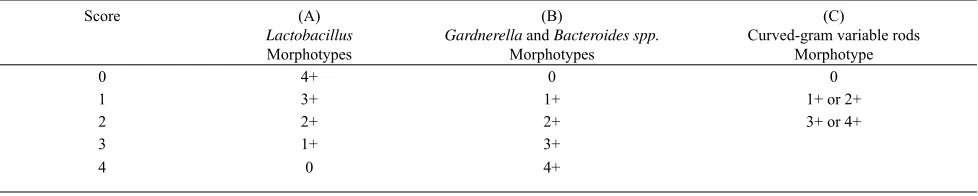
Gram-stained preparatory was assessed and scored based on the Nugent Criteria (Table 1)14
Nugent’s diagnostic criteria are based on combined score (A+B+C). The diagnosis is normal (score 0-3), indeterminate (score 4-6), and BV (score ≥ 7). In this study, BV categorized into two diagnoses: positive (score ≥ 7) and negative (score is normal or indeterminate).
Data analysis was done using SPSS 16. Chi square and Fischer exact test were used for bivariate analysis to know the difference of BV’s prevalence among each variable. Multivariate analysis was done using logistic regression to know some factors associated with BV.
RESULTS
Demographic characteristic
There were 492 women involved in this study. The average age were 30.9 + 0.27 years old, consisted of 15-25 years old (26,8%), 26 – 40 years old (59,1%), and > 40 years old (14%). Marital status of subjects were not married (16,9%), married (76.4%), and married more than once (6,7%). All subjects > 40 years old were married or married >1. Most subjects occupation was housewife (69.2%) and education level was high school (46.3%). BV was found in 151 women (30.7%). Among demographic characteristics, factors related to the prevalence of BV were age, education, and occupation (p <0.05). Marital status did not have a relationship with the prevalence of BV.
Score (A)
Lactobacillus
Morphotypes
(B)
Gardnerella and Bacteroides spp.
Morphotypes
(C)
Curved-gram variable rods Morphotype
0 4+ 0 0
1 3+ 1+ 1+ or 2+
2 2+ 2+ 3+ or 4+
3 1+ 3+
4 0 4+
Morphotype scoring is based on the number per fi eld of view. 0, no morphotypes present; 1+, <1 morphotype present; 2+, 1 to 4 morphotypes present; 3+, 5 to 30 morphotypes present; 4+, >30 morphotypes present
Medical characteristics
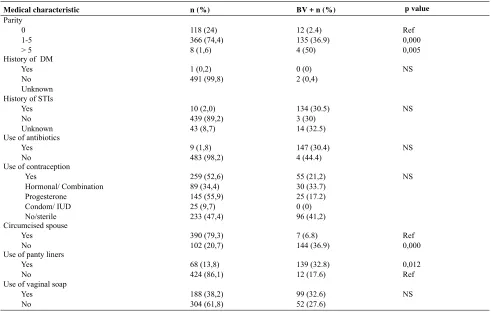
Women with parity > 5 were more prone to of BV compared to nullipara (50% vs 2.4%, p = 0.005) and parity 1-5 (36.9%, p = 0.000). The prevalence of BV was higher among women with uncircumcised spouse compared to women with circumcised spouse (36.9% vs 6.8%, p = 0.000). The prevalence of BV was also high among women using panty liners (p = 0.012) (Table 2). Despite its statistic signifi cance, it was found that the prevalence of BV was higher among women not using any contraception. History of diabetes mellitus (DM), sexual transmitted infections (STIs), use of antibiotics,
and use of vaginal soap had no signifi cant correlation with the incident BV.
Multivariate analysis
Age, education, occupation, parity, circumcised spouse and use of panty liners were included in multivariate analysis (Table 4). Based on the analysis, it is found that age above 40 years (OR = 3.15, p = 0.003) and uncircumcised spouse (OR = 6.25, p = 0.00) were the independent factor associated with BV. Other factors included in this multivariate analysis did not have signifi cant correlation to BV.
Demographic characteristics n(%) BV+ n(%)
p value
Age (years old) 15-25 26-40 ≥ 40
132 (26,8) 291 (59,1) 69 (14,0)
18 (13,6) 98 (33,7) 35 (50,7)
Ref 0,000 0,000 Marital status
Not married Married Married > 1
83 (16,9) 376 (76,4) 33 (6,7)
0 (0) 138 (36,7) 13 (39,4)
NS
Education level Elementary Junior high Senior high ≥ Senior high
75 (13,0) 74 (15,0) 228 (46,3) 126 (25,6)
23 (35,9) 26 (35,1) 79 (34,6) 23 (18,2)
0,008 0,008 0,001 Ref Occupation
Housewife Student Others
340 (69,1) 71(14,4) 81 (16,5)
94 (27,6) 20 (28,2) 37 (45,7)
0,007 0,027 Ref
Table 2. Demographic characteristics and prevalence of BV
Medical characteristic n (%) BV + n (%) p value Use of panty liners
Yes Use of vaginal soap
Yes
Table 3. Medical characteristics and prevalence of BV
Risk factor OR (95% CI) p value
Age (years old)
Uncircumcised spouse 6,25 (2,54-15,38) 0,000
Use of panty liner 0,97 (0,46-2,06) NS
Note Ref: reference NS: not signifi cant
DISCUSSION
Based on multivariate analysis, determinant risk factors for BV were age above 40 years old and with an uncircumcised spouse.
An Uncircumcised spouse was the most signifi cant independent risk factor for BV (OR = 6.25, 95% CI = 2,54-15,38). Circumcisions are related to the hygiene of penis which is associated with the transmission of infection. Because mucosal membrane of preputium is less keratinized than exposed skin, it is prone to trauma during intercourse and became a pathway for pathogens. The space between preputium and glans penis is a moist and warm environment conducive for discharge and pathogen deposit.15,16 Gray, et.al has reported that circumcised spouse reduced the risk of genital ulcers, Trichomonas, and BV in his partner. Yang and his colleagues also stated that circumcision reduces the risk of sexually transmitted infections including human immunodefi ciency virus (HIV), human papilloma virus (HPV), herpes simplex virus (HSV) type 2, and syphilis.17
Age above 40 years old was risk factor for BV (OR = 3.15, p = 0.003). It is associated with the perimenopausal hypoestrogenic condition at that age. Declining levels of estrogen causes elevated vaginal pH.18 This condition is not optimal for Lactobacillus sp growth as the dominant normal vaginal fl ora but very conducive for the growth of microorganisms causing BV.19 Research on women aged> 40 years conducted by Cauci et al found that perimenopausal women had higher BV prevalence than fertile women and post-menopause and that Lactobacillus sp level decreased with age.20
There is an interesting fi nding in the characteristics of contraceptive use. Despite its statistic signifi cance, women using contraception had lower risk for BV than women not using contraception or sterile. More detailed research is needed to identify contraception as risk factor for BV.
In conclusion, The prevalence of BV by Nugent criteria in this study was 30.7%. Factors associated with BV incidence were age, education, occupation, parity, uncircumcised spouse and use of panty liners. Based on the multivariate analysis, determinant risk factors for BV were age and uncircumcised spouse.
Acknowledgments
Authors thanks directors and staffs of RSU Karawang and Puskesmas Karawang, directors and staffs Klinik
Batalyon 201 Cijantung, and all parties who contributed to this research.
REFERENCES
1. Baisley K, Changalucha J, Weiss HA, Mugeye K, Everett D, Hambleton I, et al. Bacterial vaginosis in female facility workers in north-western Tanzania: prevalence and risk factors. Sex Transm Infect. 2009;85:370-5.
2. Tolosa JE, Chaithongwongwatthana S, Daly S, Maw WW, Gaitn H, Lumbiganon P, et al. The International Infections in Pregnancy (IIP) study: Variations in the prevalence of bacterial vaginosis and distribution of morphotypes in vaginal smears among pregnant women. American Journal of Obstetrics and Gynecology 2006;195:1198-204. 3. Yan DH, Lu Z, Su JR. Comparison of main lactobacillus species
between healthy women and women with bacterial vaginosis. Chin Med J (Engl). 2009;122:2748-51.
4. Thorsen P, Jensen IP, Jeune B, et al. Few microorganisms associated with bacterial vaginosis may constitute the pathologic core: a population-based microbiologic study among 3596 pregnant women. Am J Obstet Gynecol. 1998;178:580–7
5. Livengood CH. Bacterial vaginosis: an overview for 2009. Rev Obstet Gynecol. 2009;2:28-37.
6. Bhalla P, Chawla R, Garg S, Singh MM, Raina U, Bhalla R, et al. Prevalence of bacterial vaginosis among women in Delhi, India. Indian J Med Res. 2007;125:167-72.
7. Joesoef MR, Karundeng A, Runtupalit C, Moran JS, Lewis JS, Ryan CA. High rate of bacterial vaginosis among women with intrauterine devices in Manado, Indonesia. Contraception. 2001;64:169-72.
8. Klebanoff MA, Hillier SL, Nugent RP, MacPherson CA, Hauth JC, Carey JC, et al. Is bacterial vaginosis a stronger risk factor for preterm birth when it is diagnosed earlier in gestation? Am J Obstet Gynecol. 2005;192:470-7.
9. Myer L, Kuhn L, Stein ZA, Wright J, Denny L. Intravaginal practices, bacterial vaginosis, and women’s susceptibility to HIV infection: epidemiological evidence and biological mechanisms. The Lancet Infectious Diseases. 2005;5:786-94. 10. Peipert JF, Montagno AB, Cooper AS, Sung CJ. Bacterial
vaginosis as a risk factor for upper genital tract infection, Am J Obstet Gynecol. 1997;177:1184-7.
11. Harmanli OH, Cheng GY, Nyirjesy P, Chatwani A, Gaughan JP. Urinary tract infections in women with bacterial vaginosis. Obstetrics & Gynecology. 2000;95:710-2. 12. Patel V, Weiss HA, Kirkwood BR, Pednekar S, Nevrekar
P, Gupte S, et al. Common genital complaints in women: the contribution of psychosocial and infectious factors in a population-based cohort study in Goa, India. Int J Epidemiol. 2006;35:1478-85.
13. Rauh VA, Culhane JF, Hogan VK. Bacterial vaginosis : a public health problem for women. JAMWA. 2000;55: 220-4 14. Ledger WJ, Witkin SS. Diagnosis of Vulvovaginal Disease.
In: Vulvovaginal Infections. London: Manson Publishing Ltd. 2007:16-24.
circumcision interventions. Infectious Disease Clinics of North America. 2007;21:241-57.
16. Hankins C. Male circumcision: implications for women as sexual partners and parents. Reprod Health Matters. 2007; 15:62-7
17. Yang SS-D, Hsieh CH, Chang SJ. Effects of circumcision on urinary tract nfection and sexually transmitted disease. Tzu Chi Medical Journal. 2009;21:185-9.
18. Gorodeski GI, Hopfer U, Liu CC, Margles E. Estrogen acidifi es vaginal pH by up-regulation of proton secretion via the apical membrane of vaginal-ectocervical epithelial cells. Endocrinology. 2005;146:816-24.
19. Galhardo CL, Soares JM, Jr. Simoes RS, Haidar MA, Rodrigues de LG, Baracat EC. Estrogen effects on the vaginal pH, fl ora and cytology in late postmenopause after a long period without hormone therapy. Clin Exp Obstet Gynecol. 2006;33:85-9.