SEXISM AS REFLECTED IN NEW MOON FILM
a final project
submitted in partial fulfillment of the requirement
for the degree of Sarjana Sastra in English
by
Nur Baiti
2250406519
ENGLISH DEPARTMENT
FACULTY OF LANGUAGES AND ARTS
SEMARANG STATE UNIVERSITY
ii
APPROVAL
This final project was approved by the board of examination of the English Department of Faculty of Languages and Arts of Semarang State University on February 23, 2011.
Board of Examination
1. Chairman
Drs. Januarius Mujianto, M.Hum. NIP. 195312131983031002 2. Secretary
Dr. Dwi Anggani Linggar B, M.Pd. NIP. 195901141989012001 3. First Examiner
Drs. Amir Sisbiyanto, M.Hum NIP. 195407281983031002
4. Second Advisor as the Second Examiner
Drs. Ahmad Sofwan, Ph. D NIP. 196204271989011001 5. First Advisor as Third Examiner
Frimadhona Syafri, S.S., M.Hum NIP. 197210172002122002
Approved by
Dean of Faculty of Languages and Arts
iii
PERNYATAAN
Dengan ini saya:
Nama : NUR BAITI NIM : 2250406519
Prodi/ Jurusan : Sastra Inggris / Bahasa dan Sastra Inggris
Fakultas Bahasa dan Seni Universitas Negeri Semarang menyatakan dengan ini sesungguhnya bahwa skripsi / tugas akhir / final project yang berjudul:
SEXISM AS REFLECTED IN NEW MOON FILM
yang saya tulis dalam rangka memenuhi salah satu syarat memperoleh gelar sarjana ini benar-benar merupakan karya saya sendiri, yang saya hasilkan setelah melalui penelitian, bimbingan, diskusi, dan pemaparan / ujian. Semua kutipan baik langsung maupun tidak langsung, baik yang diperoleh dari sumber kepustakaan, wahana elektronik, maupun sumber lainnya, telah disertai keterangan mengenai identitas sumbernya dengan cara sebagaimana yang lazim dalam penulisan karya ilmiah. Dengan demikian, walaupun tim penguji dan pembimbing penulisan skripsi / tugas akhir / final project ini membubuhkan tanda tangan keabsahannya, seluruh karya ilmiah ini tetap menjadi tanggung jawab saya sendiri. Jika kemudian ditemukan pelanggaran terhadap konvensi tata penulisan ilmiah yang berlaku, saya bersedia menerima akibatnya. Demikian harap pernyataan ini dapat digunakan seperlunya.
Semarang, 23 Februari 2011
Yang membuat pernyataan,
iv
By sincerity, everything will run beautifully
This final project is dedicated to:
(1) My beloved parents, Supadi and Almh. Masri’ah (2) My dear brother (Hatta) and sisters (I’im and Zulmi) (3) My special friend M. Agus Alamsyah
v
ACKNOWLEDGEMENT
The first and foremost, I wish to take the opportunity to express my greatest gratitude to Allah SWT, God, The Almighty for the blessing, grace, love, and strength leading to the completion of this final project.
I extend my deepest gratitude and appreciation to my advisors, Frimadhona Syafri, S.S, M. Hum, as my first advisor, and Ahmad Sofwan, P.hD, as my second advisor, for the entire patience, valuable guidance, correction, advices, and supports in finishing this final project.
Furthermore, my special thanks are also forwarded to my beloved parents (Supadi and Almh. Masri’ah), my brother and my sisters, for their affection, encouragement, attention, and trust from the beginning to the finishing of my final project and to M. Agus Alamsyah for his motivation and care. Lots of love and thanks are also delivered to all my friends in Literature ’06 for friendship and beautiful moments, my mates (Nurjannah, Imas, Umi, Dini, Isna, Eva) for moments we share together, all my friends in Pon-Pes Al Asror (Fanni, Alfi, nisa’, Putri, Arim, Chuma, Rini) for sharing happiness and sadness, all my friends in Wong Kost for sharing experiences and joyful moments, all my friends that I cannot mention them here because of limited space.
Semarang, February 16, 2011
vi
ABSTRACT
Nur Baiti. 2010. Sexism as reflected in New Moon Film. Final Project, English Department, Faculty of Arts and Languages, Semarang State University. 1st advisor: Frimadhona Syafri, S.S, M. Hum. 2nd advisor: Ahmad Sofwan, P.hD.
Key Words: sexism, New Moon
The final project intends to analyze sexism found in New Moon film Written by Melissa Rosenberg Adapted from the Novel by Stephenie Meyer. The story expresses how sexism exist. That is woman belief that man superior to her but on the contrary she belief herself is less competent, or less valuable than man. It cause man has more power to woman, woman depend on man, and cannot life without him.
The object of this study is New Moon, a film. The method applied in this final project was qualitative. The data of the study were in the form of phrases, sentences and dialogues. The procedures of collecting the data included reading, identifying, inventorying, and then reporting the data.
There are some results found. First, man has power to woman, woman always depend on man, and woman need safe from man are expression of sexism. Besides that, emotional of woman is sexism that expressed in the film. Second, the causes are belief that woman less competent and inferior to man, in contrast man is superior to woman. The belief is trusted by both woman and man. Third, the effect of it is woman becomes after man leave her, woman cannot life without man (possessive) and she become illogical, she has no expectations or aspirations in life and she will do everything to get close to him.
vii
TABLE OF CONTENTS
Page
Acknowledgment ……….…...v
Abstract ...…..……….vi
Table of Contents...vii
List of Appendixes……. ………....x
Chapter I. INTRODUCTION 1.1 Background of the Study ……….………....……..1
1.2 Reason for Choosing the Topic.……….……..……...4
1.3 Statements of the Problem……….………..5
1.4 Objectives of the Study ……….….5
1.5 Significance of the Study ……….……….……….…5
1.6 Outline of the Report ……….….………...…...5
II. REVIEW OF RELATED LITERATURE 2.1 Review of Previous Study ………..7
2.2 Review of Theoretical Background ………...……….…8
2.2.1 Literature ………...8
2.2.2 Psychology of Literature ………...………12
2.2.3 Psychology ………14
2.2.4 Sexism ………...20
2.2.5 Psychology of Woman ………..26
2.2.6 Psychology of Man ………31
2.3 Framework of Analysis ………..………33
III. METHODS OF INVESTIGATION 3.1 Approach ……….………40
3.2 Object of the Study ….………..………..40
3.3 The Source of the Data……….……….….…….40
3.4 Types of the Data...………..41
3.5 Procedures of Collecting Data…………...……….41
viii
3.5.2 Script Reading ………42
3.5.3 Identifying ………..42
3.5.4 Classifying ………..43
3.5.5 Simplifying……….….43
3.5.6 Selecting……….….43
3.5.7 Reporting………...43
3.6 Technique of Data Analysis ………44
3.7 Synopsis of the Film ………....…...44
IV. RESULTS OF THE STUDY 4.1 Characteristic of the Main Character ………..………....…53
4.1.1 Bella Swam ………53
4.1.2 Edward Cullen ………...54
4.1.3 Jacob Black ………54
4.2 Sexism as Reflected in this Film ……….………...55
4.3 The factors Causing Sexism in the Film ………..………..….62
4.4 The Effect of Sexism for Woman in the Film ………...…..66
V. CONCLUSION AND SUGGESTIONS 5.1 Conclusion ………...74
5.2 Suggestion.………....75
References……….……….………....77
ix
LIST OF APPENDIXES
Appendix
1. Data Finding
1
CHAPTER I
INTRODUCTION
The first chapter presents introduction. It consists of six subchapters, they are background of the study, reason for choosing the topic, statement of the problem, objective of the study, significance of the study and finally outline of the study.
1.1
Background of the Study
Literature is creative activity, a work of art (Rene W and Austin W, 3: 1989). It means that literature is creative product of human being. The creativity comes from human idea, thought and experience. Everyone can do it every time and every where.
There are many kinds of literature. In a course Handout Introduction to literature, Rahayu say that in a Handbook of literature, Hollan and Harmon (1992) say that the traditional genre of literature include tragedy, comedy, epic, lyric and pastoral. However today, it includes novel, short story, essay, television play, and motion picture scenario (Rahayu, 2007: 36). These genres of literary works not only just can be enjoyed but also can be studied. For example by analyzing one of these literary works, we can take some messages of it. And also we get much knowledge from this study.
Film is produced by recording images from the world with cameras, or by creating images using animation techniques or special effect. Film is cultural artifacts created by specific cultures, which reflect those cultures. Film is considered to be an important art form, a source of popular entertainment, powerful method for educating, and indoctrinating citizens. The origin of the name film comes from the fact that photographic film has historically been the primary medium for recording and displaying motion picture.
Film has close relation to literature. Both are regarded as art and use language as the media. Film is an interesting literary work. It usually contains more massages than other literary works do. Film is generally shown in a long action that contains some elements and has a lot of ideas. By watching film, more experience can be taken. We can learn life without taking any risks, but their feeling feel like they were in real life. Those feeling will arise if we are really concerned about the film. Moreover, we have to watch it critically to get the message of the film.
As we know, there are only two sexes in this world, but there are many concepts of gender which reflect social ideas about masculinity and femininity. Some people see woman as weak, gentle and emotional creatures. More over, for the sexist people this might mean that men are overrun by woman. So in truth a woman is weak physically only because a man is in reality stronger. A woman is submissive only because a man in reality is more aggressive. A woman is emotional only because a man is less emotional a woman is dependent only because a man serves this dependency. A woman is indecisive only because a man is decisive in his decision.
We see how and in what way the world sees sexes, male and female. Wherever, male and female are very different. Weakness, submissiveness, emotion and dependency are some to mention many stereotypes that attributed to female. The belief about it still exists in our daily life. Many people still believe that women deserve just to stand behind men, and also there are many females that agree about it. Many women don’t want to do many things in front of men. They are believe to be powerless and inequity. They prefer to depend on their men (brother, husband, boyfriend, etc) than stand on their own in doing everything. The condition is very apprehensive.
power. Power is a measure of an entity's ability to control its environment, including the behavior of other entities. The person who can control other is the stronger person. That why we can say power to man to woman could be evidence the existence of sexism.
In reality, the kind of the woman thinking can be found in many walks of life. One of influences can be obtaining from many ways, for instance from literary works like novel, short story, film, poem, and so on. Film has very significant influence towards the movie goers. People seem to believe in everything shown in film. So, if false ideas are transmitted and readers don’t careful to filter them, these fallacies will drag people into misjudgment.
There are a lot of films that contains of the issues above. One of the films is New Moon. Hereby, I intend to show the power of man to woman as reflection of sexism by the characters on this interesting film.
1.2
Reasons for Choosing the Topic
1.3 Statement of the Problems
In order to focus the discussion on the topic, I put the following questions: 1. How is sexism as reflected in this film?
2. What are the factors causing sexism in this film?
3. What are the effects of sexism towards woman in the film?
1.4 Objective of the Study
There are some objectives of the study which I want to achieve by doing this research. This study is going to find out:
1. How sexism as reflected in this film 2. The factors that causing sexism in this film 3. The effects of sexism towards woman in the film.
1.5
Significance of the Study
The expected significances of the study are to help the reader know more about sexism. The result of the study will be used as a reference for developing literature at the English Department of Semarang Stated University. The last is to motivate the further study at English Literature of English Department’s Student.
1.6 Outline of the Report
7
CHAPTER II
REVIEW OF RELATED LITERATURE
The second chapter presents the theory underlying the topic of the study. This chapter consists of three subchapters. First, it talks about review of previous study. Second, it will discuss review of theoretical background. Third, it talks about framework of analysis.
2.1 Review of Previous Study
There have been many researches concerning with the analysis of film and sexism. They are as below:
also identified the type of sexual disorientation, and finds the effects for the main character. Tri (2009) also analyses film for her final project. She discusses American social class inequality as reflected in film Note Book. She tries to find out is there any social class inequality that reflected in the film. Then she reveals the causes, and describes the effect for the main character. She also finds the solution for the problems.
b) I found one study that analyze about sexism. That is sexism in English textbook Linked to the World 3 by Ima (2009). She describes a particular way which is used to convey sexist attitudes and values in the textbook. She also determines the position of the textbook from point of view of sexism.
2.2
Review of Theoretical background
2.2.1 Literature
Literature is one of the great creative and universal means of communicating the emotional, spiritual, or intellectual concern of mankind (the encyclopedia Americana, volume 17, 1997:559). It means literature expresses the writer’s thought, feeling and attitude toward her/his lives. So, literature has relation with human life. People can share their idea, emotion, and experience by literature.
nonfiction includes the essay, historical fiction, biography, autobiography, magazine, and account of travel.
According to Hornby (1995: 434), film is a story, etc cetera, recorded as a set of motion pictures to be shown on television or at cinema. Film is a term that encompasses individual motion picture, the field of film as an art form, and the motion picture industry. Film is produced by recording images from the world with cameras, or by creating images using animation techniques or special effect. Film is cultural artifacts created by specific cultures, which reflect those cultures. Film is considered to be an important art form, a source of popular entertainment, powerful method for educating, and indoctrinating citizens.
The origin of the name film comes from the fact that photographic film has historically been the primary medium for recording and displaying motion picture. Many other terms then exist for an individual motion picture, including picture, picture show, flick, and most commonly, movie. Then additional terms appear to name this kind of term for the field in general including the big screen, the silver screen, the cinema and the movies.
from the studio. Many production companies would travel to areas far from Hollywood to shoot their films.
Filmmaking also has basic elements that are inherent to the process. Those are:
1. Image
All filmmaking uses a light capture/recording device. It is then projected upon a screen. In theaters powerful lamps are used to project the image through a focusing lens. In television a vacuum tube projects lines of electrons upon a phosphor coated screen. Although the image is a recording of captured light the aesthetics of what we are viewing is still determined by the use of the basic elements and principles of static, fine art.
2. Time
Film had two types of time. The first is the actual length or duration of the film, for example, a run time of 90 minutes. The other type of time is called diegetic time, or time that is the result of the story or narrative. The story may span the a few minutes, a few hours, a few days, a few years or a lifetime although it may only take 90 minutes to tell the story through the film.
3. Motion
4. Sound
Sound is not essential to a motion picture however sound is so common in film that it is included as an essential element. Most films now include dialogue recorded on the sound stage, sound effects that are included during post production, music scores, narrations and voice over.
5. Lighting
When we record using photographic instruments we record light. We do not record objects, people, buildings or anything at all - we record light. Image is what the mind does to the light once it is recorded and played back. Cinematographers strive to have control over lighting conditions. The most experienced ones have full control over lighting and work with the director to create mood and effect as well as consistent continuity throughout the film.
6. Sequence
After filming is complete, the editing process begins. The editor and director together will decide the length and order of the shots and piece them together to create a sequence. The sequence tells the story using the visual language of film, or film syntax.
7. Composition
Therefore, film is one kind of literature because film also uses language to perform it. Like another form of art work, film or movie tries to describe the phenomena of human life including their aspects such as human characters, social problems, psychology, etc. structured in motion pictures with images, sound effects, and the like. Those aspects become the object of study to be analyzed and investigated to understand the meaning behind the images and pictures.
2.2.2 Psychology of Literature
Psychology of literature has four definitions as possible. First, study the author psychology as type or individual. Second, study creative process. Third, study the psychological type and law that applicated in literary work. And the fourth, study the impact to the reader (Wellek and Warren, 1977: 90). Psychology of literature explores its structure, function, and psychological value. Topics of discussion include symbolism, the purpose of storytelling, application of psychological theories and concepts, different literary genres, accuracy in the depiction of psychological variables and mental health professionals, how writing and reading reflect cognitive processes, and the therapeutic value of literature. Character analyses involve examination of personality, mental illness, developmental issues, conflicts, and motivation.
the other hand reader or consumer receive the literary works with their own psychology. Literature can called as psychological activity.
Some literary works can be analyzed through the psychological approach because it emphasizes on the past real of conscious human experience. Literary work is a psychological product and the author thinking that poured from subconscious situation to conscious situation. The author imagination proves how she / he describe the character of her/ his literary work.
One of elements of literary works is characters, and the characters build the story. The characters reflect some their characteristic, their attitude, background and the formation of their behavior. It can be learned and analyzed. So, the psychological approach applies psychological theories to explain the character’s personality in the story. Each character’s attitude and behavior could be referred to the psychology of human being. The human characteristic in psychology or in literature often shows a resemblance. Although literature is creative and imaginative thing, the authors often use law of psychology to bring to live the character.
2.2.3
Psychology
Psychology derived from two words: “psyche’ means soul and ‘logos” means science. Therefore, it means a science of soul or a science that study about the tendency of psychological (Dirgagunarso, 1978:9). Soul is interpreted as self, and then study connotes the study of the self. The self is the dynamic organism or living being that constantly affects and is being regarded affected by other selves. The characteristic of soul is immaterial. it caused before entering to ourselves, soul had been existing in sensory realm or said to be pre existential of soul. Soul has two places that are sensory place (sensation) and idea place (thinking).
Psychology is also defined as a science that studies the human behavior. It caused human souls as background of their behavior. It means psychology is the study of behavior that includes thought, feeling, dreams and anything a person does or experience. The term behavior signifies those activities of an organism living that can be observed by another person or tested by means of evaluating and experimental techniques.
According to Descartes as a master of philosophy of rationalism, behavior divided into two kinds, they are:
1. Rational behavior, it related to soul or be said to be unextended substance. It means that human being can arrange or revise their behavior.
Therefore, between soul and body have a significant relation which in happen of the behavior. Organ (senses, muscles, glands) is important to study behavior. Either the behavior that cannot be seen directly or can be seen directly. An example of the behavior that can be seen directly is like walking, talking, crying, etc, while the example of behavior that cannot be seen directly is thinking. Actually, thinking is implicit speech whereas tongue is move slowly while we think.
In studying psychology, also need to know some branches of it. There are a number of unique and distinctive branches of psychology. Each branch looks at questions and problems from a different perspective. While each branch has its own focus on psychological problems or concerns, all areas share a common goal of studying and explaining human thought and behavior. The following are some of the major branches of psychology within the field today.
1. Abnormal Psychology
Abnormal psychology is the area that looks at psychopathology and abnormal behavior. The term covers a broad range of disorders, from depression to obsession-compulsion to sexual deviation and many more. Counselors, clinical psychologists and psychotherapists often work directly in this field.
2. Behavioral Psychology
of the twentieth century, it became less prominent during the 1950s. However, behavioral techniques remain a mainstay in therapy, education and many other areas.
3. Biopsychology
The branch of psychology focused on the study of how the brain influences behavior is often known as biopsychology, although it has also been called physiological psychology, behavioral neuroscience and psychobiology.
4. Cognitive Psychology
Cognitive psychology is the branch of psychology that focuses on internal states, such as motivation, problem solving, decision-making, thinking and attention. This area of psychology has continued to grow since it emerged in the 1960s.
5. Comparative Psychology
Comparative psychology is the branch of psychology concerned with the study of animal behavior. The study of animal behavior can lead to a deeper and broader understanding of human psychology.
6. Developmental Psychology
Topics studied in this field include everything from prenatal development to Alzheimer's disease.
7. Educational Psychology
Educational psychology is the branch of psychology concerned with schools, teaching psychology, educational issues and student concerns. Educational psychologists often study how students learn or work directly with students, parents, teachers and administrators to improve student outcomes.
8. Experimental Psychology
Experimental psychology is the branch of psychology that utilizes scientific methods to research the brain and behavior. Many of these techniques are also used by other areas in psychology to conduct research on everything from childhood development to social issues.
9. Forensic Psychology
Forensic psychology is a specialty area that deals with issues related to psychology and the law. Forensic psychologists perform a wide variety of duties, including providing testimony in court cases, assessing children in suspected child abuse cases, preparing children to give testimony and evaluating the mental competence of criminal suspects.
10.Personality Psychology
in psychology have arisen from this field, including Freud's psychoanalytic theory of personality and Erikson's theory of psychosocial development. Besides these branches of psychology, it will need to be known about some theories of psychology. Much of what we know about human thought and behavior has emerged thanks to various psychology theories. Some theories of psychology, these are as follows:
1. Behavioral Theories
Behavioral psychology, also known as behaviorism, is a theory of learning based upon the idea that all behaviors are acquired through conditioning. Advocated by famous psychologists such as John B. Watson and B.F. Skinner, behavioral theories dominated psychology during the early half of the twentieth century. Today, behavioral techniques are still widely used in therapeutic settings to help clients learn new skills and behaviors.
2. Cognitive Theories
Cognitive theories of psychology are focused on internal states, such as motivation, problem solving, decision-making, thinking, and attention. 3. Developmental Theories
4. Humanist Theories
Humanistic psychology theories began to grow in popularity during the 1950s. While earlier theories often focused on abnormal behavior and psychological problems, humanist theories instead emphasized the basic goodness of human beings. Some of the major humanist theorists include Carl Rogers and Abraham Maslow.
5. Personality Theories
Almost every day we describe and assess the personalities of the people around us. Whether we realize it or not, these daily musings on how and why people behave as they do are similar to what personality psychologists do. Personality psychology looks at the patterns of thoughts, feelings, and behavior that make a person unique. Some of the best known theories in psychology are devoted to the subject of personality.
6. Social Psychology Theories
Social psychology is focused on helping us understand and explain social behavior. Social theories are generally centered on specific social phenomena, including group behavior, prosocial behavior, social influence, love and much more.
and are bound interesting in and what can be more attractive. It is also tantalizing science cause anything that too easy is not interesting.
Study psychology means trying to know a human. Know means can understand, means we can describe behavior and personality traits. Research in psychology seeks to understand and explain thought, emotion, and behavior. There are six basic of human emotion; they are love, joy, wonder, hate, desire, and sadness (Dirgagunarso, 1978:18). If humanity has advanced through its history, it has been trough the activity of human brain, which has brought material security and every aspect of culture. And if humanity has been placed in danger, it has been through the activity of the human brain, for human motivation, carefully thought out and justified by the brain greed, envy, rage, lust that produce the wars, violence, alienation, cruelties that other motivation, sympathy, love, desire, to give and build and create fight so endlessly.
In fine, psychology is a science that related to human soul. It includes human thinking, emotion, behavior, love, desire, sympathy, and so on. So, studying psychology is study of human being. Therefore, Psychology can be divided as behavior psychology, abnormal psychology, bio psychology, etc.
2.2.4 Sexism
There are several definitions about sexism. Sexism is the belief or attitude that one gender or sex is inferior to, less competent, or less valuable than the other. It can also refer to hatred of, or prejudice towards, either sex as a whole (see
relation to men, or of femininity in relation to women. Other opinion sexism is differential treatment of individuals based on their sex; subordination of women and assumption of the superiority of men solely on the basis of sex or gender. Sexism still exists nowadays, where the differences between male and female are believed. The view that men are stronger than female is a form of sexism. Female usually feel that she is a weak human, she needs some other human to save her especially male who believed more strong than her. So dependency of female to male can’t be inevitable.
Sexism view more negative values than positive ones, because in sexism use words discrimination, demeaning, ignoring, stereotyping and prejudice which are naturally negative in meaning. Sexism, or gender discrimination, is present everywhere, in every culture, in every country. The terms ‘sexism’ or ‘gender discrimination’ basically means the prejudicial treatment of a group or a person due to their gender or sex (Rita Putatunda, 2000)
For instances throughout history have been used to explain why many men believe that they should have more power than women. Even today, the problem of sexism exists in the workplace, in political matters, in the field of education, in sports, in families, and in religion. Sexism affects a variety of social institutions and it has continued to be growing problem for many generations.
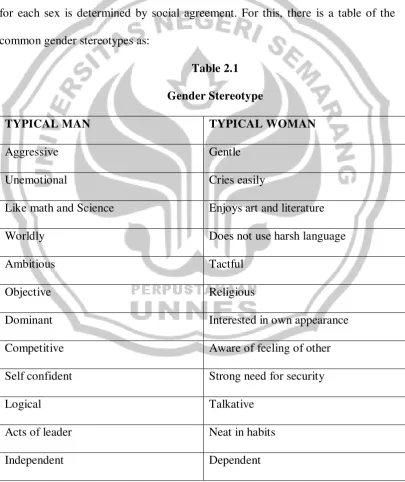
The condition involves a reinforcement of behavior and attitude on the basis of traditionally stereotypical roles people have in the society we live in. Stereotype is something that is confirming to a general pattern and lacking individual distinguishing marks on qualities, especially a standardized mental picture that is held in common by the members of a group and that represents an over simplified opinions, emotional attitudes or uncritical judgment. The behavior for each sex is determined by social agreement. For this, there is a table of the common gender stereotypes as:
Table 2.1
Gender Stereotype
TYPICAL MAN TYPICAL WOMAN
Aggressive Gentle
Unemotional Cries easily
Like math and Science Enjoys art and literature
Worldly Does not use harsh language
Ambitious Tactful Objective Religious
Dominant Interested in own appearance
Competitive Aware of feeling of other
Self confident Strong need for security
Logical Talkative
Acts of leader Neat in habits
Gender discrimination can involve a whole gamut of issues, from unequal pay to women being portrayed as sexual objects in the media to wives being beaten up by their spouses. While in theory gender discrimination can affect both men and women, however, it is women who have been at the receiving end through the ages and across cultures, since most cultures in the world are patriarchal, or male dominated. Men feel threatened if they are seen as weak in any aspect of their lives in which they are competing against a woman. Most men would hate to see a female beat them in the workplace or at sports. In my opinion, I believe that is the feeling of being humiliated by a "weaker" sex that bothers them. The responsibility for creating lasting change in the culturally- installed patriarchy is the work of men in our society. This important work of extending privilege, power, as influence to women as a group does not require the disadvantage of men.
Around the world, many women have internalized the sexist messages that are present in their societies and cultures. In many cultures women are socialized according to strong patriarchal values, they are brought up to take their state of subordination to men as normal. They feel that men are everything for them. They cannot life without men. The sexists are submissive to men. They would give up everything, friends, family and their very own life, for men. No women’s life should solely revolve around men. They always need of saving. The belief of their weakness which caused their dependence on men.
men existed as Gods. It happens in any places and situations. In our society is so concerned with political correctness and equal rights to women that it has almost completely forgotten about equal rights to men as well. The workplace is the area in which sexism is most commonly found. Sexism is in evidence in unfair recruitment practices, unequal pay, and intimidating behavior towards colleagues. Legislation is now in place in many countries that prohibits unfair treatment of staff on the grounds of their sex. Other example, in any language shows a society's attitude towards a person’s social status, sex and occupation. The way women are spoken about is much different than the way we would speak about men. For example, if women married she is referred to as Mrs. and if she isn't married she is called Miss. But whether a man is married or not he always carries the title Mr. Which doesn't allow us to know if a man is married or not.
We are both put here on this earth and we must find some way to live together peacefully. Both genders have to accept the fact that neither sex can exist without the other. It takes one biological man and one biological woman to create either sex, and that's just a fact that everyone has to live with.
Women tend to naturally set obstacles in their own way and it seems that the only ways to get a powerful, influential, prestigious job is to never have a baby and never get married. Which stereotypical thoughts like this are very unfair to women. The law is not much use for woman in power as there are so many males above them in any company. The usefulness of the law can be seen however in the fact of precedent where any previous case of a woman taking a company to court for sexual discrimination or equal pay and winning may be considered in a similar court case.
the very privileges they enjoy can only be looked upon as so many instances of his generosity to them.
Here I can say that sexism is a human point of view or human thinking about gender. Here they think that one of the genders is less than other. It is like less competence, less valuable, weaker, and so on, and it tended to female. The sexist thinks that male is more in everything.
2.2.5
Psychology of Woman
Women are genuinely complicated species as compared to the male species. Women are brimming with emotions all the time. They are caring and nurturing. They are seemingly less competent than the men when it comes to the physical aspects unless you are a woman wrestler or a martial art expert. Women’s psych looks also at unique aspects of women’s development- physical differences, pregnancy, victimization.
Mostly, woman is unable to get out of her subjectivity and personal approach to things, lacks understanding of masculine activities and qualities, and often does not even try to understand them. She loves man, but with a personal, possessive, jealous affection. But although she loves him, she neither understands nor appreciates his world, his interests, and his ideals. She is inclined to regard him as a savage who holds a delicate butterfly with a rough hand, who ruthlessly destroys perfumed and many-coloured flowers, as a naughty boy who is inclined to fight with others, as one who foolishly risks his life in darling enterprises, who plays with his complicated machines, and who neglects those who love him in order to chase after ancient ruins or rare manuscripts or to construct difficult and useless theories and systems.
The psychology of women is the study of behavior mediated by the variable of female sex. The sector of psychology of woman explores the wonderful female species. It includes all psychological issues pertaining to women and their experiences. It also studies the various experiences and stages the women go through in her life and in the outside world as well. Psychology of woman explores the female experience within the world. It looked at a survey of the psycho-biological, cultural, social and intellectual factors influencing the psychology of women.
others more aware of the problems of the female species in this big bad world of ours.
Basically, psychology of woman divided into seven sections, the three of them come from their brain physic (senses), logic, and emotion. The seven sections are:
1. Social programming
It is education, norms, the ways of thinking, mentalities, beliefs that are thought by parent in social environment to the female from their childhood in family, activity environment, school, individual experience and traumatic responsible in figuration of female.
2. Social pressure
It means pressure from environment and society. A lot of women fear to ill judged by their society and environment. Sometime, they are not being their selves in order to save their images and fear to ill judged by their environment. They also make decision that not they want because of pressure of their family and their friends.
3. Culture
4. Ego
It means women prestige. A lot of women look unfriendly but actually they are friendly women, and then they like to look after their selves although they are wrong, and they say that they like something but actually they do not like it. The all of thing are caused by ego.
5. Logic
It relates to reason and cause-effect also advantage-disadvantage to make relation with somebody. Social programming, social pressure, and culture are very influence women logical.
6. Physical
It includes what women listen and see. For example sound, appearance, face expression of somebody. Women can use their senses for it.
7. Emotion
It is important, emotion influence women behavior. The strong emotion makes women brave and strong. (Dana Subiyakto, 2007)
examining things in an unanalytical, diffuse, and inconclusive manner, with arguments that are often of a personal rather than objective character.
Women in the end of adolescent (18-21 years old) period are marked with physic maturity and sexual gland. In this period, the teenagers begin to feel stable. They realize their life goal and have conviction in choosing their pattern of life. They also find values of their new life, so it make they know their selves clearly. Because they focus at their selves, it makes them striven so they are sensitive in disappointment, do not like critic and feel loneliness. They feel that their environment do not understand them. The combination between loneliness and self esteem cause they are easy to angry, disappointed, depressed, and sensitive. The full and total comprehension cause the teenager women give what they give everything whom their love just for give evidence.
Meanwhile, in 20-30 years old (beginning of adult women) arise norms of the level ages. They make their own way of life. Their life depends on their choice. Success and felt are chose by them. In this period, they study to make important decision for their life.
2.2.6 Psychology of Man
Man is an adult male human being with qualities conventionally regarded as manly, such as strength, courage, etc. Man is and adult male with possesses a high degree the distinctive qualities of manhood.
Psychology of Men is the purpose of trying to understand men emphatically associated with the dark sides of this masculinity (Nauly, 2002:10). Means the studies address men who have sex with men. It includes behavior, characteristic, and other about man.
Most expression of sexual dimorphism in human are found in height, weight, and body structure, for example, men tend to be taller than women. Some example of male secondary sexual characteristics in humans, those acquired, as boys become men are:
a. More facial hair,
b. Larger hand and feet than women, c. Broader shoulder and chest, d. Heavier skull and bone structure, e. Greater muscle mass,
f. A prominent deeper voice.
It can be said that man has a power, strong and having the authority in front of woman.
Other characteristics of men are anti-femininity, restricted emotions (except anger), and a focus on success, power, achievement, toughness and aggression. So men is different to women physically and mentally. Other opinion about men describes seven areas of man in general culture:
a. Physical: virile, athletic, strong, brave,
b. Functional: provider for family, defender of family from physical traits, c. Sexual: aggressive, experience,
d. Emotional: unemotional, never crying,
e. Intellectual: logical, rational, objective, practical,
f. Interpersonal: leader, dominating, independent, free, demanding,
Other personal characteristic: oriented, ambitious, proud, egoistical, and competitive.
Sartono Kartodirjo explains that the dominance of men against women include the bio-social, social, cultural, political and religious. Men have an authoritarian nature (Mujianto, 2010:106). So, man can be said that they have power to woman by their authoritarian nature. The authoritarian nature makes him be of power to whom they think as inferior than him. For instance woman who believed as weak person.
2.3 Framework of Analysis
Power theory used on Michel Foucault’s opinion. He was a French historian and philosopher, associated with the structuralist and post-structuralist movements. He has had wide influence not only (or even primarily) in philosophy but also in a wide range of humanistic and social scientific disciplines. Michel Foucault wrote challengingly on psychiatry, medicine and the human sciences. One of his written is about power.
Foucault, as noted, was influenced by structuralist ideas, but because he did not adhere to them and preferred a combination of personal and structural considerations within a single explanation, he is considered a post-structuralist. Foucault is also considered a post-modernist. If modernity is connected with terms such as rationality, purpose, totality, synthesis and determinism, and postmodernism is an approach characterized by the opposed concepts irrationality, play, deconstruction, antithesis and non-determinism, then Foucault is indeed a post-modernist.
effect of power. Power must not be seen as a single individual dominating others or as one group or class dominating others. Foucault resists power from the perspective of a white male citizen of a colonizer country (who sees all power relations as largely equivalent, and stresses resistance but not social transformation). What characterizes power is its capacity to bring into play relations between individuals (or between groups). The term power implies that is exercised by certain persons over others.
To understand what power relations are about, perhaps we should investigate the forms of resistance and attempts made to dissociate these relations, for example opposition to the power of men over women, of parents over children, of psychiatry over the mentally ill, of medicine over the population, of administration over the ways people live. Form of power which makes individuals subjects. There are two meanings to the word subject: subject to someone else by control and dependence, and tied to his own identity by a conscience or self-knowledge (Clarke, 1982:1). Both meanings suggest a form of power which subjugates and makes subject to.
Power/knowledge, since it combines into a unified whole “the deployment of force and the establishment of truth.” It both elicits the truth of the subjects under examination (in fact it tells what a students know or what is the status of health of a patient), and at the same time controls their behavior (by forcing the student to study what is prescribed, or the patient to follow a certain treatment to be cured).
According to Foucault reduction of the instance of power to the image of the master is tied to another: the reduction of the procedures of power to the law of interdiction. The reduction to the law plays three main roles:
a) It allows a schema of power to be put forward which is homogenous at whatever level one place oneself and in whatever domain: family or state, relation of education or of production.
b) It allows power to be only ever thought in negative term: refusal, delimitation, obstruction, censure.
c) It allows the fundamental operation of power to be thought of as a speech act: uttering the law, discourse which forbids. The manifestation of power takes on the pure form of “thou shalt not”.
Power relations are dependent on culture, place and time, and hence Foucault deals with power discourse in contemporary Western society only, which he characterizes as follows:
in everyday life. Power occurs at sites of all kinds and sizes, including the most minute and most intimate, such as the human body.
b) Power relations are mobile, non-egalitarian and asymmetrical. We must not expect to find a stable logic in power, or a possibility of balance in its domain.
c) Since power is not a thing, is not control of a set of institutions, nor a concealed historical pattern, the aim of the researcher of power is to discover how it operates. To do this, one must isolate, identify and analyze the network of relations which creates political technologies. It is important to research the level of the micro-practices, from which one may learn how power operates in a social institution on the most routine everyday level.
d) From all the previous assumptions it follows that power is not limited to political institutions as it has been commonly thought. Power has a direct and creative role in social life. It is multi-directional, and operates from the top down and from the bottom up. Although power is at its peak when it is situated inside specific institutions such as schools, prisons or hospitals, we should be wary about identifying technologies of power with particular institutions, because power is neither a superstructure nor a quality of an institution.
advantages of efficient technologies of power in many productive domains—economic, industrial, and scientific.
f) Power is a general matrix of power relations in a given society at a given time. No-one is outside this matrix, and no-one is above it. The prisoners and the jailers are subject to the same procedures of discipline and surveillance practiced in the prison, and act within the actual limitations of the prison architecture. Even though all are trapped in the grid of the power relations, there also exist rule and domination: the jailers nevertheless have certain advantages according to the prison rules, as do those who are in charge of them and those who designed the prison.
g) Domination, then, is not the essence of power. Domination does exist, but power is exercised upon the rulers too and not only upon the ruled. For the bourgeoisie in 19th-century France to turn into a class it had to activate technologies of power upon its members. Technologies of confession, as well as surveillance over life, sexuality, and health, were implemented first of all upon the bourgeoisie itself. Bio-power served as a central strategy in the bourgeoisie’s self-creation. Only a century later would the same technologies be activated upon the French working class.
Foucault assumed that one can never be outside of power does not mean that one is in every way trapped. He suggested rather (but these are hypothesis to be explored):
a) That power is coextensive with the social body; there are not between the links of the its network, any golden sands of basic freedom,
b) That power relation are intermingled with other types of relations (of production, kinship, family, sexuality) where they play both a conditioning and a conditioned role,
c) That these relation don’t obey the unique form of interdiction and punishment, but they take the multiple form,
d) That their interweaving sketches on the general facts of domination, that this domination is organized in a more or less coherent and unitary strategy; that the dispersed, heteromorphous, and local procedures of power are readjusted, reinforced and transformed by these global strategies, and all this with numerous phenomena of inertia, dislocation and resistance; that one must not therefore accept a primary and massive fact of domination (a binary structure with on one side the dominating and the other the dominated) but rather the multiform production of relations of domination which are partially integratable into the strategies of the whole,
f) That there are no relations of power without resistance; that the latter are all the more real and effective to the extent that they are formed there were the relation of power are exercised; resistance to power doesn’t have to come from elsewhere in order to be real, nor is it trapped because it is the compatriot of power. It exist all the more insofar as it is there where power is; it is therefore, like power, multiple and integratable into global strategies.(Morris and Patton 1979: 55)
40
CHAPTER III
METHODS OF INVESTIGATION
Research method is a way in collecting and analyzing some data to find out the object problem of the study. It is for the sake of having systemically film analysis.
3.1 Approach
The study will use qualitative data by analyzing with psychological approach
3.2 Object of the Study
New Moon is a continuation of the Twilight sequel, which appointed from Stephanie Meyer's novel. Meanwhile, I take the film of it to be analyzed. This film tells about male and female (Bella and Edward) who fall in love. Because of the differences both them, that are Bella is human but Edward is vampire. From this film I will analyze their character.
3.3 Sources of the Data
theory of literature, psychology, sexism. The source of data will be taken from various kind of literary book. Some data from website that support the study will also be taken to complete the analysis.
3.4 Types of the Data
In this final project writing, I used the qualitative approach which means that the data were analyzed qualitatively. A qualitative data research does not focus on numerals or statistic but gives most attention to how deep the researcher’s knowledge is toward the interaction among concept which is being learnt.
The qualitative data needs a number of words, sentences, utterances, action, thought, feeling and dialogues, paragraphs and the explicit meanings of the characters. Thus, the data will be collected to support the study.
3.5 Procedures of Collecting Data
In gathering the data, I used DVD of New Moon which consists of the whole story. I also used the script got from the internet research to more understand its content. The data will be collected by having some procedures to do as follows:
3.5.1
Watching film
idea, especially the one which is related to this topic. This understanding is very important for the researcher in order to compose the topic according to the focus of the study.
3.5.2
Script Reading
The next step is the researcher search the script on the internet and read it many times. The purpose of this step is to give the researcher a closer look and deep understanding to the main idea of the work.
3.5.3
Identifying
The third step to do is identifying. In this study, identifying means the activity of separating between data and non-data by marking and underlining the suspected data in this film, then numbering them. The data that are related to the study will be collected to make the data identified clearer. Identifying the implicit and explicit meaning which had relation with the topic, I used several steps. They were:
a. Marking (underlining, bracketing) b. Numbering
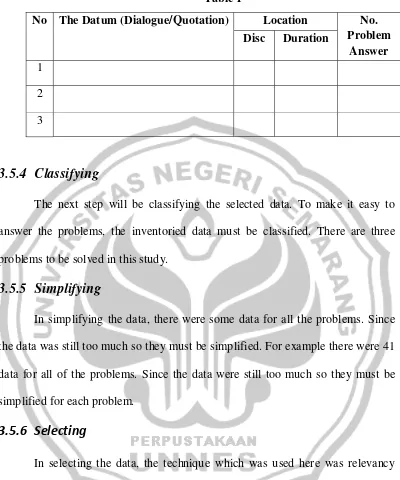
c. Inventorying
Table 1
No The Datum (Dialogue/Quotation) Location No. Problem
Answer Disc Duration
1
2
3
3.5.4
Classifying
The next step will be classifying the selected data. To make it easy to answer the problems, the inventoried data must be classified. There are three problems to be solved in this study.
3.5.5
Simplifying
In simplifying the data, there were some data for all the problems. Since the data was still too much so they must be simplified. For example there were 41 data for all of the problems. Since the data were still too much so they must be simplified for each problem.
3.5.6
Selecting
3.5.7
Reporting
The data which had been selected were reported in the appendix. If the readers want to see the overall, they can see Appendix I.
3.6 Technique of Data Analysis
This is a qualitative research with qualitative data in form of sentences, clauses, phrases, words. Then the analysis will be using the steps as follows; a. Exposing the data in order to reveal the problems.
b. Explaining the data, meaning that all the evidence found is explained clearly. c. Interpreting the data. I interpreted the identified conflicts contained in the film
by using psychoanalytical approach. Finally, I presented the analysis in the form of paragraph formulated in a statements discussion. To support my statements, I quoted some selected quotations related to the identified conflicts.
d. Summarizing
I make some conclusion in order to answer statements of the problems.
3.7 Synopsis of the Film
Film begin with a thick, yellow moon slowly transforms into the title New Moon. Bella is having a nightmare. Charlie, Bella's father, wakes her up from the nightmare. He wishes Bella a happy birthday.
parking lot she talks to her friends, Jessica, Mike, Angela, and Eric, all of who seem to know nothing of her birthday. Edward arrives then wishes her a happy birthday. Bella tells him she is not very happy about it. She's eighteen now, which is a year older than him. Then they go to class but suddenly Edward stops her because Jacob wants to see her, even though he hasn't arrived yet. Jacob gives Bella a gift.
In the hallway of the school the rest of the school-age Cullen clan arrive. Alice gives her a present and also invites Bella to a birthday party they're going to have for her that night.
Bella goes to the Cullens' house for a birthday party. Before the proceedings Edward and Bella stand before a painting of the Volturi, which includes Edward's vampiric father Carlisle Cullen. Then Edward tells her about it. Edward has broken the law by telling Bella, a human, too much. Edward also predicts that Victoria will come for him some day. Bella tells Edward that they would never have to think about this if he would turn her into a vampire. He says firmly that won't ever happen.
Afterward, Edward drives home with her in her truck. He talks about the welfare of Bella's soul. Bella argues that he can't always protect her. She will get ill, have an accident, and get old. Bella says she doesn't care about her soul.
The next day the Cullens are not at school. Edward comes over to Bella's house after school before she arrives. Bella arrives and Edward intercepts her before she gets to the house. He tells her they have to talk. After a walk some ways away on a trail in the forest, he stops and tells her that they are leaving Forks. Bella says that she'll have to prepare some excuse for Charlie but when she notices that Edward isn't picking up on the suggestion realizes he isn't talking about taking her with them. She requiring to follow him but Edward repels her. He can't stay with her anymore. He asks her to promise that she will not do anything reckless, for Charlie's sake, and in return he promises her she will never see him again. Bella runs after him and as it gets dark. Lost deep in the woods she trips and drops to the forest floor, depleted and deserted. She falls asleep sobbing. An enormous wolf watches her from a nearby rise. Charlie is looking for Bella, from the woods at the edge of the house a shirtless Sam Uley carries Bella in his arms. He hands her over to Charlie. She is safe now but still depressed and unable to see or contact Edward, Bella becomes despondent for many months. She screams at night, waking Charlie. Her wailing is so uncontrollable that Charlie confronts her. He suggests that she leave Forks. Finally, to appease her father and to stay in Forks she tells him she's arranged to go shopping with Jessica.
recognizes them as the same gang that Edward beat up when they menaced Bella during their pre-courtship. Seeing them she also recalls Edward's admonition not to do anything reckless and she even sees a ghostly visage of him. "Keep walking," he says, "this is dangerous." He then disappears. Excited, and wanting to have another visitation, she assumes that Edward will appear before her only if she's doing something that will endanger her. She comes up to one of the seedier bikers and asks for a ride. He lets her get on and speeds down the street. Again she sees the spectral Edward, warning her not to do what she's doing. She arrives back in one piece, much to the horror and disgust of Jessica, who states that she's either insane or suicidal and asks her if she's now become an adrenaline junkie.
Bella renews her friendship with Jacob. She brings him two dilapidated motorcycles, asking him to help her refurbish them. As they strip and reassemble the bikes the easy friendship between Bella and Jacob grows more substantial. When once the bikes are operational Bella and Jake takes them out. Bella drives recklessly, trying to conjure up Edward's spirit again.
if waiting for her to settle her hands on theirs. The violent conflict onscreen turns Mike's stomach, who leaves to presumably get sick. Outside, in the lobby Jacob tries to hold Bella's hand. She draws away. She's obviously conflicted. Mike arrives, stating that he needs to go home.
Charlie and Harry get ready to go fishing. Charlie is worried about leaving her alone, the finally decides to track down Jacob and confront him herself. When she arrives at Jacob's house he has indeed changed; he's cut his hair quite short and has a tattoo. He warns Bella away. Bella walks into a glade similar to the one from her early dream and discovers the vampire Laurent there. He too is looking for the Cullens and is equally surprised by her presence. He informs her he is doing the bidding of Victoria and wants to know where Edward is. Edward's ghostly presence appears, "Lie," he tells Bella. Bella believes she's going to die and simply says, 'I love you, Edward,' wanting these to be her last words. Before Laurent can strike, however, an enormous black wolf emerges. Several other wolves join him and they chase after Laurent.
That night, in her room, she looks down to see Jacob. He wants to explain to her what’s going on with him but he can't, he tells her. He begs her to remember the story he told her on the beach in LaPush.
Quileutes. She runs from Paul just as she sees Jacob emerge from the house. She tells him to run but Jacob instead leaps from the porch and hurdles over Bella, himself changing to a wolf in mid-air. The two wolves engage in a fierce fight, destroying a small rowboat in the process. Sam tells Jared and Embry to take her to his fiancée, Emily's house.
Bella and Jacob walk on the beach as Jacob explains what precipitated his change into being a werewolf. He also disabuses her of the notion that they're killing people. There's only one thing they do kill and that's vampires. She warns him of the strength and speed of vampires, not believing that anyone would be able to kill one. Back at the Swans, Bella warns Jacob again about Victoria's incredible speed.
the passenger side. Jacob pulls the door closed before she can. He smells a vampire nearby.
Bella sees the Cullens' car and heads towards the house. Once inside the house Alice appears. She is amazed to find Bella alive; she saw her leap to her death. Alice tells her that Edward has removed himself from them; he calls in only every few months. She also knows that Victoria has been around. As Alice is advising her that werewolves are not good company to keep Jacob appears. Alice gives them a moment alone. Bella and Jacob quarrel again in the kitchen. They are angered and attracted by the other. He crumples the phone in his hand. Alice bursts in as Edward now believes that Bella is dead. He's going to the Volturi to end his life too. Bella is incensed when she realizes that it was Edward on the phone and that Jacob didn't let her talk to him. She leaves with Alice.
Alice and Bella fly on Virgin America airlines to Italy. Meanwhile Edward has appeared before Caius, Marcus and Aro. They reject Edward's petition to end his life as they find his particular gifts too valuable to destroy.
him go. Edward professes his love for her. He was going to end his life because he couldn't live in a world where she didn't exist. Alice breaks in, hoping to avert a confrontation. It appears they will get away until a young vampire woman named Jane appears. Both Alice and Edward appear afraid of her. They comply and go with the Volturi, taking an elevator down to an underground complex.
Aro is genteel but menacing. Alec compliments his sister for being asked to fetch one and bringing back two and a half (referring to Bella as the half). Bella is obviously a problem. She knows too much about them. Aro takes Edward's hand. Aro's gift is that he can read peoples' minds with a mere touch. He's intrigued as Edward can't read Bella's mind. He sees Edward's longing for her and is amazed at how much Bella's blood appeals to him. Aro is impressed at Edward's self-control which Edward says is achieved not without some difficulty.
successfully prophesies to him that Bella will become a vampire; she's seen it in the future. "I'll change her myself," says Alice. "Your gifts will make an intriguing immortal," says Aro to Bella. As Bella, Edward, and Alice leave, however, Caius warns them to follow through on their promises as the Volturi do not give second chances. Bella looks behind her to see small children among the group. They hear the chamber door open and the screams begin.
The screams wake her from her sleep. She is back in her bedroom in Forks. Edward sits beside her on the bed. Edward says the only reason he'd left her before was to protect her and that it was the hardest thing he'd done in one hundred years. He's interrupted by the entrance of Charlie.
Bella apologizes for disappearing for three days. Charlie says she's grounded for the rest of her life, then leaves. Edward reappears and says that Charlie won't forgive him easily for abandoning Bella earlier. Bella says he won't be able to get rid of her easily once Alice changes her. Edward still rejects that notion, saying there are always ways to keep the Volturi from finding out. But Bella doesn't dare risk this and makes Edward bring her to the Cullen house.
Back at the Cullen's home Bella says "you all know what I want" and requests a vote. All of them say ‘yes’ except Rosalie. Edward looks as if he's been betrayed but Carlisle says Edward has chosen not to live without Bella, so Carlisle has no choice; he won't lose his son.
Jacob but wants to thank him first for protecting Bella when he didn't. Jacob agrees with Edward's point but also wants to stress a key point in the treaty. If any of the Cullens bite a human the truce is over. Bella says it's her decision. Jacob reminds her that, once she's a vampire he will have to help his tribe hunt her down; he won't have a choice. He advances and Edward pushes him back through the air. Jacob turns into a wolf before he hits the ground. They face each other, ready to fight. Bella reminds them that they can't hurt each other without hurting her. Realizing he's in a losing situation, Jacob bounds away.
54
CHAPTER IV
DATA ANALYSIS
This chapter is intended to give information to the readers about the film, New Moon. To make a simple and clear study, this chapter is divided into some sub chapter: characteristic of the main character, sexism that expressed in this film, the factors causing sexism as reflected in this film, the effects of sexism as reflected in this film.
4.1
Characteristics of the Main Characters
4.1.1 Bella Swan
Isabella Marie "Bella" Swan is the fictional protagonist of the New Moon film. This film is primarily narrated from Bella's point-of-view. Bella, in the film, is being very pale with brown hair, chocolate brown eyes, and a heart-shaped face. She is described as being clumsy and stubborn. In the film Bella is submissive to Edward, she also has no expectations or aspirations in life other than being with Edward. She is constantly confirming that she is not worried about dying, she would rather be dead than be without her boy friend. Bella is always in need of saving, either Jacob or Edward.
4.1.2
Edward Cullen
his 17-year-old body while dying of the Spanish influenza, when he was changed into a vampire by Dr. Carlisle Cullen. Physically, he described as being perfect and angular—high cheekbones, strong jawline, a straight nose, and full lips. His hair, which is always messy, retains the unusual bronze shade that he inherited in his human life from his biological mother. His eyes, once green, are now described as topaz. His appearance changes if he goes long without feeding: his eyes darken, becoming almost black, and purple bruises appear beneath his eyes. Edward has a slender but muscular body. He is charming, polite, determined, and very stubborn. He falls in love with Bella soon after she arrives in Forks. He is very protective over Bella and puts her safety, humanity and welfare before anything else. He often over-analyzes situations and has a tendency to overreact, especially in situations where Bella's safety is at risk.
4.1.3
Jacob Black
4.2 Sexism as Reflected in this Film
As stated in chapter II, sexism is the belief or attitude that one gender or
sex is inferior to, less competent, or less valuable than the other. Here, who usually stated as a weak human is woman, women are naturally the caregivers, nurturers, and less aggressive people because they are the mothers. She needs some other human to save her especially male who believed stronger than her. Men are the fighters, the protectors, and more aggressive people.
Because of his character, man has power to woman. He has authoritarian nature. He can use his it to woman who believed as weak person. As we know in Foucault theory, power is no longer the conventional power of institutions and leaders, but instead the capillary modes of power that controls individuals and their knowledge, the mechanism by which power reaches into to the very grain of individuals, touches their bodies and inserts itself into their actions and attitudes, their discourses, learning processes and everyday lives.
Here, as Foucault said that from all the previous assumptions it follows that power is not limited to political institutions as it has been commonly thought. Power has a direct and creative role in social life; I argue that sexism can be expressed by power of man to woman. Because the stronger person is has power over the inferior person. Based on New Moon film, there are some acts that show about it. Power that expressed in this film as quotation below:
(1) Edward :” I never existed, I promise”
Bella :” If this is about my soul, take it. I don't want without you” Edward :” It's not about your soul. You're just not good for me” Bella :” I'm not good enough for you?”
Edward :” Goodbye”
(00:23:47,680 --> 00:24:24,400)
The quotation tells how Edward says to Bella that he will leave Bella although she does not want it. Here, the man (Edward) uses his authority to woman (Bella). He dominates her in this decision. Whereas according to Foucault, power must not be seen as a single individual dominating others or as one group or class dominating others. Power doesn’t mean dominating other without think about who dominated. Is she agree or not about the decision. Power has to be goodness for whom in power. Like the dialogue below:
(2) Edward: “But if it's not too much to ask can you at least promise me something?
Don't do anything reckless.For Charlie's sake And I'll promise something to you in return.” (00:23:15,160 --> 00:23:34,720)
The quotation is command of Edward to Bella before he leaves her. He doesn’t want Bella do any reckless that will make Bella’s father worried about her. This command indicates that the power is for goodness. Man want woman to be a