CHAPTER IV
RESEARCH METHOD
4.1 Research Field
This research was in the field of genetics and ophthalmology.
4.2 Research Period and Location
This research had been done from July to December 2014 in Palembang
City, South Sumatera and Centre of Biomedical Research (CEBIOR) Faculty of
Medicine Diponegoro University, Semarang, Central Java, Indonesia.
4.3 Research Design
The design of this research was cross sectional study.
4.4 Material
4.4.1 Population
The population of this study was Indonesian people from South
Sumatera ethnic group.
4.4.2 Sampling
Samples were selected with random sampling method from
Muhammadiyah Palembang University students and staffs.
4.4.2.1 Subject Selection
Subject for this study had been going through history taking and limited
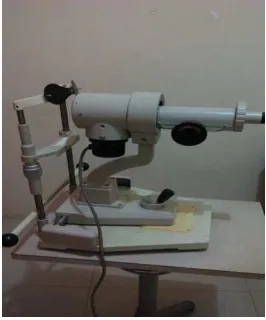
chart, subjective test with trial lens, and corneal curvature measurement with
manual keratometer (Takagi, Japan).
Figure 6. Manual keratometer Takagi, Japan Source: private documentation.
Inclusion criteria for case subject was:
1. Male and female from South Sumatera tribes with visual acuity <6/6
and gave positive response with spherical concave lens on both eyes.
2. Age on examination was 18-40 years old.
3. Subject was literate person.
Inclusion criteria for control subject was:
1. Male and female from South Sumatera tribes with visual acuity 6/6 and
gave negative response with spherical concave and convex lens on both
eyes.
2. Age on examination was 18-40 years old.
3. Subject was literate person.
2. Subject with myopia only on one eye.
3. Subject who had history of ophthalmic surgery.
4. Subject who had ophthalmic disease during subject recruitment such as
cataract, keratitis, conjunctivitis.
4.4.2.2 Sample Estimation
For cross sectional study, the formula to estimate the minimum sample
requirement was58:
n=(Zα)² pq d²
With:
n = minimum sample requirement
p = early-onset myopia prevalence in Palembang city, Indonesia (46.7%)9
q = 1-p
d = error limit or absolute precision (10%)
Zαover 2 for α5% = 1.96
From the formula above, the minimum sample requirement for this study was
96 subjects. Total 100 subjects were taken as sample for this study.
4.5 Research Method
4.5.1 Questionnaire Administration
All subjects in this study had answered the questionnaire which
sex, family history of myopia, near work activities, outdoor activity and
lighting.
4.5.2 SNP Location
Gene sequence reference was taken from the www.ncbi.nlm.nih.gov
with accession number NM_006206. This study was designed to investigates 7
SNPs near PDGFRA gene as the result of previous Genome Wide Association
Study in corneal curvature of Singaporean citizens.11
Table 3. Location of SNPs in PDGFRA gene11
SNP Location
variations could induced alternative splicing i.e exon skipping, alternative 3’
splice site activation, alternative 5’ splice site activation, intron retention,
mutually exclusive splicing.59
4.5.3 Primer design
Primers were designed using Primer3Plus software available online at
4.5.4 DNA Extraction
The subjects were asked to participate on this research by signing the
consent form and giving their DNA sample from buccal swab. DNA samples
were extracted using DNA extraction kit. The extraction process followed the
factory manual guide.
4.5.5 DNA Amplification
PDGFRA gene was amplified and analyzed using High Resolution
Melting Analysis (HRMA) technique using qPCR RotorGeneQ 5Plex HRM
(Qiagen, California, USA). Each well consisted of 10 μL of Type-It HRM
Master Mix (Qiagen, California, USA, Cat. No. 206542), 10 pmol/ μL forward
primer, 10 pmol/μLreverse primer, 10 ng DNA, and PCR-grade water adjusted
until 20 μL total volume in 0.2 μLPCR tube.
The curve analysis had been done using Rotor-Gene ScreenClust HRM
Software (Qiagen, California, USA). PCR product were confirmed by looking
at the data of fluorescent level against cycle. One sampel had been chosen
randomly from each difference graph and proceed to the sequencing process.
4.6 Operational Definition
1. PDGFRA gene polymorphism
Definition: Genetic variation which is caused by a change in one
basepair of SNP sequence in 5506457G>A,
55085620T>G, 55087581C>A, 55092626T>C,
55124460C>T, 55130154G>A, and 55134394G>A. The
with qPCR-HRMA and the aberrant graphs will be
proceed to sequencing process.
Scale: Nominal
Result: 1. Yes
` 2. No
2. Early-onset myopia
Definition: Nearsightedness occurs before 20 years old of age, on
both eyes.
Scale: Nominal
Result: 1. Yes
2. No
3. Sex
Definition: Physical appearance of female or male.
Scale: Nominal
Result: 1. Male
2. Female
4. Reading in dim light
Definition: Subjective estimation about quality of their room lighting
while reading. The estimation will be divided into dim
light and bright light.
Scale: Ordinal
5. Near work duration and frequency
Definition: Subjective estimation about duration and frequency of
doing near work. Near work in this study means reading,
watching television, using computer/tablet/smart phone.
Scale: Ordinal
Result: a. Duration of near work for pleasure
1. < 30 minutes per day
2. 30 minutes - 2 hours per day
3. >2 hours per day
b. Duration of near work for school
1. <8 hours per day
2. 8-13 hours per day
3. >13 hours per day
c. Frequency of near work for pleasure
1. 1-2 times per week
2. 3-5 times per week
3. ≥6 times per week
d. Frequency of near work for school
1. 1-2 times per week
2. 3-5 times per week
3. ≥6 times per week
Definition: Subjective estimation about duration and frequency of
doing outdoor activity. Outdoor activity in this study
means sport, physical exercise, play in the park.
Scale: Ordinal
Result: a. Outdoor activity duration
1. < 30 minutes per day
2. 30 minutes-2 hours per day
3. >2 hours per day
b. Outdoor activity frequency
1. Never
2. 1-2 times per week
3. ≥3 times per week
7. Parental history of myopia
Definition: History of biologic father and or biologic mother with
nearsightedness.
Scale: Nominal
Result: 1. Yes
2. No
8. Corneal curvature
Definition: The average of horizontal diameter and vertical diameter
radius of cornea (in mm ) for each eye. Corneal curvature
Random sampling
Visual examination with Snellen Chart
Visus 6/6 on both eyes Visus <6/6 on both eyes
Sperical lens +0.5 Pinhole test and -0.5 give blurred vision Subjective test
Normal eyes Spherical concave lens (+)
Questionnaire administration
Keratometry examination
DNA collection and extraction
qPCR-High Resolution Melting Analysis
Data analysis Result: 1. Steeper cornea (≤ 7.8 mm)
2. Flatter cornea (> 7.8 mm)
4.7 Data analysis
The data were analyzed by SPSS software version 17.0. The output data
from SPSS were:
a. Prevalence and distribution of PDGFRA gene polymorphism.
b. Prevalence risk for risk factors of early-onset myopia, corneal
curvature, and PDGFRAgene polymorphism.
4.9 Research Ethics
The study protocol was submitted to the ethical committee of Medical