Effects of Palm Biodiesel Blends on Fuel Consumption in Fire Tube
Boiler
Leily Nurul Komariah
1,a, Susila Arita
2,b, Novia
2,c,
Soni Solistia Wirawan
3,d,
and Muhammad Yazid
4,e * 1Post Graduate Program (PHd Candidate), Sriwijaya University, Palembang, Indonesia
2
Faculty of Engineering, Sriwijaya University, Inderalaya, Indonesia
3
Energy Technology Center (B2TE-BPPT), Serpong, Indonesia
4
Faculty of Agricultural , Sriwijaya University, Inderalaya, Indonesia
a
[email protected], [email protected], c [email protected],
d
[email protected], [email protected]
Keywords: fire tube boiler, fuel consumption, palm biodiesel, petrodiesel
Abstract. Biodiesel application in boiler is basicly potential due to the combustion system tends to be simpler than compression ignition as performed in diesel engine. The various tests on combustion facilities showed that the use of biodiesel will increase the fuel consumption. This study was conducted in a fire tube boiler, with heat input rate of 60.000 kCal/hr and 3 bars of pressure, using palm biodiesel. A series of test shown that the combustion behavior in boiler was strongly possible influenced by some changes in physical properties of the fuel. The blends was varied in 10, 20, 30, 50 and 100% of biodiesel in mixture with petrodiesel. The fuel consumption was likely similar or slightly lower than petrodiesel when the fuel used in lower blends (less than 20%). In higher blends, the fuel consumption was increased up to 17%. The rate of consumption was relatively lower at average 9,4% in half load mode of the boiler operation rather than full load.
Introduction
Boilers are essential in industrial, commercial, and institutional sectors and it comprises a significant component of energy consumption. Boilers use a heat source through the combustion of fuel to produce hot water or steam. One of the common fuels used in boilers is petroleum diesel, although the latter portion of its use continues to decline along with the depletion of oil reserves and its price fluctuations on the world market.
Biodiesel is an alternative fuel which has a great opportunity to replace petroleum diesel, because it has many properties in common with diesel oil. Mostly, biodiesel utilization in anykind of engines is mixed with petroleum diesel. Many studies showed that 20% or less of biodiesel blends with petroleum diesel is the optimum blend to gather better effect of emissions reduction and does not require any special adjustments on engine operating conditions or modifications to the engine and fuel lines as expressed by [2,6,10,18].
In terms of engine performance, one of the technical considerations that are affected due to the use of biodiesel is the specific fuel consumption. Various test results indicate that specific fuel consumption is affected by the heating value as determined by the physical properties of the fuel [4,10,16,18]. The studies showed that the source of raw material for biodiesel and its blends in petroleum diesel affects tihe properties of the fuel so that it will definitely affect the fuel consumption. Though admittedly, the use of biodiesel in diesel engines give some advantages in oil lubrication and emission reduction, but there are still doubts for boiler users, especially for commercial and industrial sectors, due to concerns about equipment compatibility, engine performance and product sustainability and cost. Due to the limited study of biodiesel effects on industrial/commercial boilers, it is important to study how the changing properties of palm biodiesel blends will affect particularly to the fuel consumption on the boiler.
Fuel Consumption in Diesel Engine and Boilers
Specific Fuel Consumption (SFC) is the amount of fuel that can be converted into mechanical energy by a machine. SFC in diesel engine is determined by the ability of the combustion process in the engine, which is chemically influenced by the amount of these physical properties of fuels, such as heating value and cetane number. The SFC increases with increase in percentage of biodiesel in the blends due to the lower heating value of biodiesel [11].
The SFC of biodiesel and its blends are slightly higher than that of diesel at high engine loads, and keep almost same at lower engine loads [7-8]. Nagaraju et al. (2008) reported the use of 20% soybean methyl ester mixed to 80% petroleum diesel oil (B20) on the High Speed Direct Injection (HSDI) diesel engine. They showed that the specific fuel consumption was higher than B0, it is attributed to the lower heating value of biodiesel and late release of energy in the expansion stroke [14]. Moreover, Xue et al. (2011) summarized that fuel increase of consumption when using biodiesel [10,11,16,18], but this trend will be weakened as the reduces proportion of biodiesel fuel in the blends.
The increase in biodiesel fuel consumption is mainly due to its low heating value, as well as its high density and high viscosity. The different feedstock of biodiesel with different heating value and carbon chain length, or different production processes and quality, also have an impact on engine economy [18]. Jaichandar et al. (2011) have concluded the specific fuel consumption when using a biodiesel fuel is expected to increase by around 14% when there is unchanged for a fixed engine operation mode [10]. The loss of heating value of biodiesel must be compensated for with higher fuel consumption. The same trend was shown by Avecedo et al. (2011), it showed that at the same engine speed, SFC values with biodiesel were 18% higher than petroleum diesel oil [1]. In the meantime Jagadish et al. (2011) have confirmed that higher quantities of blending leads to increase of in fuel consumption, but upercharging operation resulted in reduction in fuel consumption [9]. Wirawan et al. (2008) reported that power and torque for biodiesel blends was higher than pure biodiesel (B100) but lower than pure petrodiesel fuel (B0) [17]. Fuel viscosity has impacts on injection and combustion, which continue to affects a power loss of the engine [17,11]. The loss of power is related to fuel consumption [1,11,18].
Some tests of biodiesel application in industrial, commercial or institutional boiler are very limited. Miller (2008) was tested animal and soy-based biodiesel in fire tube boiler, they reported some significant reductions in emissions of pollutants, but they did not find a significant difference to the efficiency of the boilers, without giving detail informations about the effects on fuel consumption [12].
Materials and Methods
Biodiesel used in this study were transesterified palm oil and its blends with petroleum diesel oil No.2. The characterization of fuel performed to determine the physical properties of palm biodiesel and the blends in some variations of blending composition. Fuel properties are evaluated focused on the properties associated with the combustion performance and the hypothetical effects on fuel consumption, such as density, viscosity, calorific value, flash point and cetane number.
Fig. 1. Experimental Set Up
Results & Discussion
Fuel and Fuel Blends Characteristics.
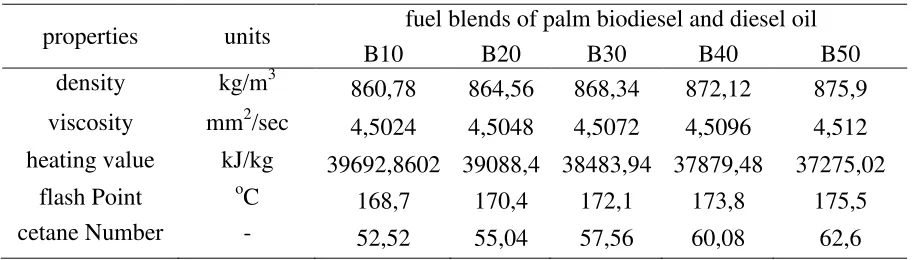
As a common results, the comparison of biofuels with diesel oil No. 2 displayed relatively similar trend, where the density of palm biodiesel is 7.58% higher than diesel oil, while the viscosity and the cetane number is 0.53% and 33.5 % higher than petroleum diesel, otherwise, the calorific value is 8.56% lower. The low heating value of biodiesel is normally less than mineral diesel due to the fuel-bound oxygen [4]. The difference in the physical properties of both fuel is due to the different chemical structure. Cetane number of biodiesel is higher than diesel oil and among other biodisel from different raw materials. It is probably caused by the longer carbon chain of palm oil and higher oxygen contents in the blends. The analysis of the physical properties of biodiesel and its blends tend to exhibit physical properties whose value changes linearly with the increase of biodiesel in the blend. Analysis of the physical properties are in shown in Table 3.
Table 3. The physical properties of Palm Biodiesel Blends
properties units fuel blends of palm biodiesel and diesel oil
B10 B20 B30 B40 B50
density kg/m3 860,78 864,56 868,34 872,12 875,9 viscosity mm2/sec 4,5024 4,5048 4,5072 4,5096 4,512 heating value kJ/kg 39692,8602 39088,4 38483,94 37879,48 37275,02
flash Point oC 168,7 170,4 172,1 173,8 175,5 cetane Number - 52,52 55,04 57,56 60,08 62,6
Effects on Fuel Consumption.
Fig. 2. Effects of combustion time on fuel consumption with various Biodiesel Blends in Boiler
In case of burning the lower blends (below 20%) of biodiesel, the fuel consumption was similar or slightly lower than petrodiesel. It is due to the optimal combustion behavior occurred, wherein the cetane number and higher heat of combustion parameters was compromized to the negative impacts of poor atomization due to higher viscosity and lower heating value of the fuel blends. The higher heat of combustion is influenced by the higher density of the fuel.
Fig. 3. Effects of Biodiesel Blend use in Firetube Boiler at half and full load
A variation of the boiler load was conducted by opening the steam control valve. The half load was set by adjusting the steam distribution valve, so that the steam production send to steam drum (in the plant) was lower than optimum conditions (full load). The effects of boiler load on the rate of fuel consumption are shown in Figure 3. In this study, at half load boiler operation, the fuel consumption rate was averagely 9.4% lower compared to at full load mode.
Meanwhile, when neat palm biodiesel used (B100) the fuel consumption rate in half load mode was decreased 8.16%. It is possibly affected by the less amount of water to be heated, so that the temperature gradient needed for heating the water in the cylinder was lower so that the supply of fuel required for combustion through pumping fuel into the burner automatically become fewer.
Conclusion
A series of test in the boiler with palm biodiesel as fuel showed that at lower biodiesel blends the fuel consumption was likely to be similar or lower than petrodiesel. However, for higher biodiesel blends, there was an increase in fuel consumption of up to 17%.
The variation of boiler operation mode, indicated that the rate of fuel consumption of palm biodiesel in boiler at half load mode was 9,4% lower than full load.
References
[1] H. Acevedo and J.Mantilla : Dyna Vol. 170, (2011), pp. 150-158.
[2] S. Arita, R. Sipahutar, L.N. Komariah, F.Hadiah, A.M. Jannah : Performance Check of Biodiesel Application on Boiler Used in Biodiesel Pilot Plant UNSRI, Proceeding of Sriwijaya International Seminar on Energy Science and Technology, (2010).
[3] D. Ariwibowo, T.K. Fadjar and T. Suryo : Proceeding of Seminar Nasional Sains dan Teknologi 2. Vol. 2. (2011).
[4] M. Boyd in The Autoignition Properties of Biodiesel Fuels, Short Progress Report Univeristy of Adelaide, (2007).
[5] M. Canakci, and J.H. Van Gerpen : American Society of Agricultural Engineers ASAE Vol 46(4), (2003), pp. 937-944.
[6] H. Dwipayana and Maryamah : Menentukan Kondisi Steady State Boiler berbahan bakar Campuran Biodiesel CPO dan Solar dengan Parameter Konsumsi Bahan Bakar dan Emisi Gas Buang. Tesis Magister Teknik Kimia. PPS UNSRI. (2009).
[7] A. Ghorbani, B. Bazooyar, A. Shariati, S.M. Jokar, H. Ajami and A. Naderi: Applied Energy Vol 88, (2011), pp. 4725-4732.
[8] S. Gowthaman, and K. Velmurugan : International Journal of Engineering Research, (2012), pp 1083-1089.
[9] D. Jagadish, P.R. Kumar, and K.M. Murty : International Journal of Energy and Environment, vol 2 Issue 5, (2011), pp. 899-908.
[10] S.Jaichandar, and K. Annamalai : Journal of Thermal Science and Technology, (2011), pp. 71-75.
[11] M.Lapuerta, O.Armas, and J.R.Fernandez : Progress in Energy Fuel and Combustion Science Vol.34, (2008), pp. 198-223
[12] A.C. Miller : Characterizing Emissions from the combustion of biofuels. (U.S. Environmental Protection Agency), (2008).
[13] M. Munawir Z : Indonesian Journal of Materials Science, (2006), pp. 135 – 139
[14] V. Nagaraju, N. Henein, A. Quarder, M.Wu, and W.Bryzik : Technical Paper Series, Detroit, Michigan: SAE International, (2008).
[15] K.Sivaramakrishnan, and P.Ravikumar : ARPN Journal of Engineering and Applied Sciences, February (2012). pp 205-211.
[16] K.Sivaramakrishnan : International Journal of Engineering Science and Technology (IJEST), November (2011), pp. 7981-7987.
[17] S.S.Wirawan, A.H. Tambunan, and M.Djamin, Engineering International CIGR EJournal, Vol X, (2008), pp. 1-13.