DESIGNING OF THE INTUITIVE MATERIAL
IN REAL ANALYSIS 1
Indaryanti and Purwoko
Department of Mathematics Education, Sriwijaya University
e-mail: [email protected]
Abstract
The objective of this research is to design the intuitive material draft of the course Real Analysis 1. The materials using intuitive are real number & its property, absolute value, upper & lower bound, sequences, series, function, derivative and integral. This material draft is important for the students of Mathematics Education Department in Faculty of Teacher Training and Education, Sriwijaya University; because it can give simplicity in understanding the materials. This article discusses the designing part of development research that is designing the materials. The materials were developed by using Dick & Carrey Model. This research was began by identifying instructional goals, conducting instructional analysis, analyzing learners & context, writing performance objectives, developing assessment instrument, developing instructional strategy, and developing & selecting instructional materials. In identification of instructional goals, the goal of the course Real Analysis 1 was analyzed. The goal was to give competency for students so that they would be able to analyze the real number and its property. There for the instructional was given deductively. However, it was hard for the students to understand the materials so, in this research, the instructional is the combination of inductively and deductively instructional. After that, performance objectives and assessment instrument were arranged. Then the instructional strategy was developed. To understand the materials, the teacher must explain the definition or theorem by using teacher’s and sudents’ intuition. The intuition is to react immediately based on students’ and teacher’s knowledge. Therefore, in this research, the intuitive materials are defined as knowledge owned by the teacher and students that can be used intuitively. The intuitive materials of the course Real Analysis were designed when teacher was explaining in the class the course of Real Analysis 1 materials by using intuition. All of the intuitive materials are written in a module. The module consists of introduction, the subject matter and the intuitive materials, examples, exercises, evaluation, feedback and conclusion. The intuitive materials were constructed well by the teacher and the students in the class. Nevertheless, the developing & selecting instructional materials part by the researcher was not well constructed. Hence, the problem in the designing the intuitive materials draft was in rewriting the teacher’s and students’ intuitive materials. The results of this research are the intuitive materials of the course Real Analysis 1. The materials are about proving steps of algebra operation, the number line, the Venn diagram, and sketching a graph using Microsoft Office Excel. The proving steps of the algebra operation are used to explain real number and its property. Meanwhile the number line is used to explain the absolute value. Next, the Venn diagram is used to explain sequences. And the last, the Microsoft Office Excel is used to describe sequences, series, convergence of sequences and series. This research has produced the draft of the intuitive materials for the course Real Analysis 1. The draft has been valid by materials, but not valid by constructing the instructional.
Key Words: Real Analysis 1, intuitive, materials, designing.
INTRODUCTION
words, it makes students can give logical reasons. In giving the reasons, they are trained to prove theorems by definitions, axioms and other theorems. This competence can be achieved by studying Real Analysis 1.
The Real Analyze materials are so abstract that students have difficulty in analyzing the materials. This is illustrated by the test results of the students in the odd semester of 2011/2012, there are still students who scored less than 70 or that category enough value. There are some problems that had by students; (1) they are less mastered prerequisite (Mansyur, 2008), (2) they do not know the problems or if they know the problems, they have difficulty in solving problems (Usodo, 2011), (3) they do not know in determining the beginning step (Muttaqin, 2010). More detail, revealing Indaryanti that the students have not been able to do a proof of contradiction and direct proof. They failed to make the argument in the proof.
These weaknesses become a basis for improving the students’s ability to analyze the materials. Inability of students in the use direct proof or proof of contradiction indicates that they do not understand about definitions, axioms and theorems. Based on the experience of teaching Real Analysis 1, they do not have meaningful of definitions, axioms and theorems, however it has terms explaining what it means. It is because they do not understand the terms contained in definition, and master prerequisite materials, so that they can analyze materials.
To handle the difficulties, there are few research have done. Susanti (2008) had developed Computer Aided Learning (CAL) for learning Real Analysis 1. Mansyur had researched using hierarchical approach (2008) and Iwan had researched using the M-APOS approach. These studies have yet to address student difficulties in understanding the definitions, and theorems. To overcome it, the intuitive materials are designed.
The intuitive materials are the materials that can be used to analyze definitions or theorems
Analysis 1. At Real Analysis 1, students are trained to reason with theorem proving based on definitions, axioms or theorems are known
In addition to completing the calculation, or mathematical reasoning is done with the proof. According to Farrell, et al. (2011), proving that either starts with a set of axioms and using the axioms toward the conclusion. The process of creating a presumption that is necessary for students to understand the problems they face, so that the allegations can be determined from the initial steps of a proof. Making allegations is a mental activity that is not included in the formal cognition, but the intuitive cognition or intuition.
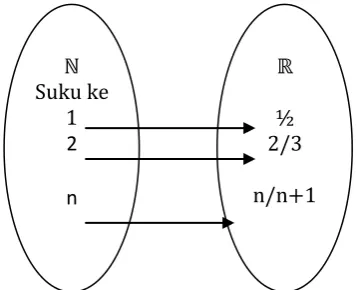
Intuition is that people have the ability to do something based on the existing knowledge on him at the time. For example, to understand definition of sequence in real numbers, students should pay attention to the concepts contained in the definition. Consider the following definition: a function from a subset of the natural numbers to the real numbers. There are some terms that are known or available to students as a function, subset, natural numbers and real numbers. The key word of this definition is function. They know what is function. Function is a mapping from domain natural number to range real number. It is illustrated by arrow diagram (figure 1).
Figure 1. Sketch of arrow diagram for sequence (n/(n+1)).
All of the terms in students are called the intuitive materials. The materials can be used intuitively. Intuitive mathematical material can be either construct a sentence with its own language, create charts, and graph (Indaryanti, 2013b). Moreover, it can also make a number line. At the time of making the graph can be created manually or using a software program excel.
The materials that are already present in the student and used to analyze or understand the material Real Analysis 1, without having to search information about the material being discussed is called the intuitive teaching materials. This material is collected in the form of what are termed draft intuitive teaching materials.
METHOD
The research method used is design research with Gravemeijer & Cobb model (2006). There are 3 phases: (1) preparing for experiment , (2) design experiment, and (3) restrospective analysis. In preparing for experiment, activities carried out are : analyze the learning objectives of Real analysis 1 to be achieved, determine and establish baseline conditions of the student, discuss the conjecture of
local instructional theory to be developed, determine the characteristics class and the teacher’s role, and establish a theoretical goals to be achieved through research.
This step is test whether the draft and local instructional theory works or not. Besides that, this
step is to test and develop local instructional theory that
have been developed as well as understand how the theory works for experiments took place.
Next step is restrospective analysis. The purpose of this phase is to analyze the data which has been obtained to support to see whether or not appropriate with the conjecture that has been designed.
The data collection technique used is walktrough.. Walktrouh technique is used to review the draft of intuitive materials. At this time observed is intuitive material that appears when lecturing implemented. From here held intuitive recording and preparation of the material being taught becomes intuitive draft instructional materials.
RESULT AND DISCUSSION
The Real Analysis 1 materials are presented in the lecture covers four topics that include: (1) Real Number, (2) Sequence, (3) Function, (4) Derevative and integral, and (5) Series.
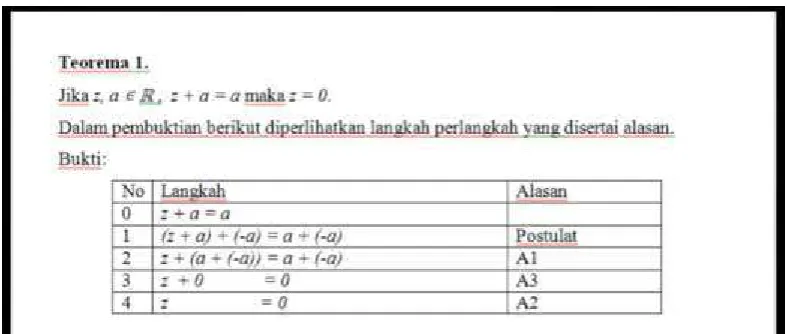
On the subject of Real Numbers field, the material used is intuitive steps theorem proving, as in Figure 1. This step is an intuitive instructional materials that help students to perform the analysis of the existing theorems on Real Analysis 1.
Figure 1. Steps of proving theorem
Figure 2. The number line that can help the students to understand the materials
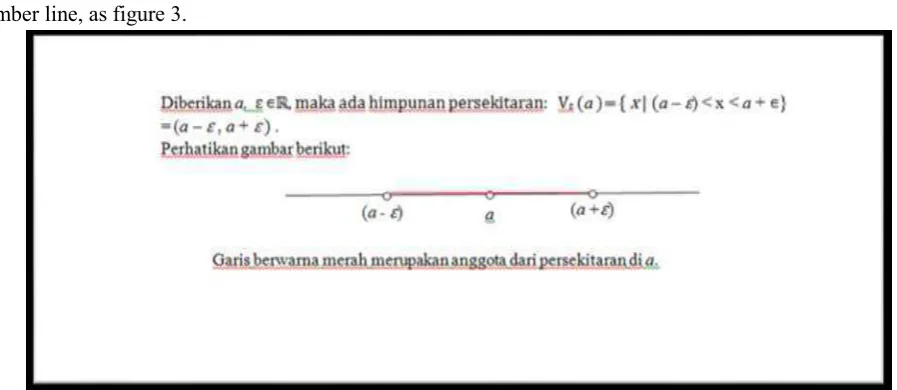
Further understanding of the absolute value of the material is used to explain neightborhood by a number line, as figure 3.
Figure 3. Number Line in the Nightborhood.
Figure 4. the arrow diagram in sequnces of Real Number.
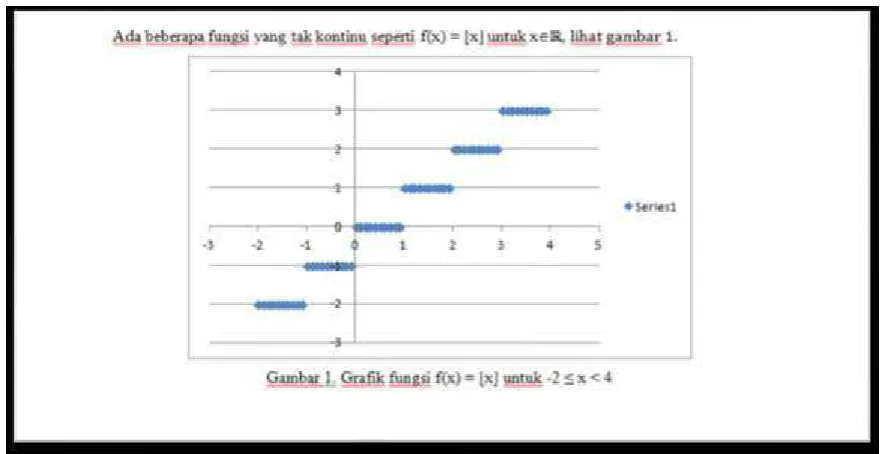
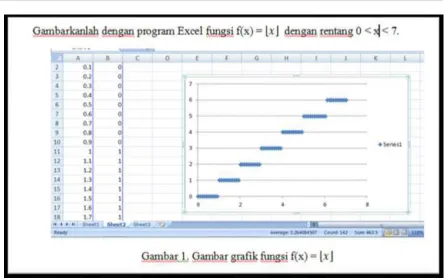
Discontinuous function can be understood by excel program, as figure 5. Besides that, it can be used to learn Riemann integral as figure 6.
Figure 6. Excel Program is used for Riemann Integral.
That's the intuitive material contained in intuitive teaching materials. Such material may be the concept of functions, graphs created using the excel program and arrows diagrams.
The intuitive material is very helpful to understand for students in the Real Analysis 1 material, it is reflected upon learning the sequences Real Numbers. At the time of not using materials intuitive, the student was not thought that the sequence is a function that links between the natural numbers to the said estate are related with certain relationships. Having given the question that led to the concept of function, then the students understand that the sequence is a function.
Likewise with concept of neighborhood, students are also confused by the concept of neighborhood. Once the image is given a number line, then the student can understand the concept of neighborhood.
In designing intuitive teaching materials, researchers have difficulties at the time of pouring the teaching materials in the form of writing. This happens because at the time it is easier to teach students herded toward the target concept, while at the time stated in the form of writing, there are things that are spoken, can not be recorded or stated in writing. Or in other words is not valid construct. As a result, the draft still needs to be intuitive material tested in the course and needs to be done visually and audio recorder. Thus the results of this recording can be contained in the written form.
CONCLUSION AND REMARK
The results were obtained intuitive teaching materials on the course Real Analysis 1. These teaching materials have content, or content may provide insight on the student to learn Real Analysis 1, but still needs to be tested in the course in order to obtain a valid teaching materials in the content, language and constructs.
CAHSEE. (2008). Mathematical Reasoning from the 2008 California High School Exit Examination (CAHSEE): Mathematics Study Guide. Published by the California Department of Education. http://www.cde.ca.gov/ta/tg/hs/mathguide.asp. kses 7 Februari 2013
Indaryanti. (2013a). Menumbuhkan Kemampuan Bernalar dengan Intuisi. Prosiding Seminar Nasional Pendidikan 2013, Membangun SDM Indonesia melalui Pendidikan yang Membebaskan. ISBN 978-602-17465-0-9. Palembang: Prodi Pendidikan Matematika FKIP Unsri.
Indaryanti. (2013b). Profil Mathematical Reasoning Mahasiswa Dalam Mempelajari Analisis Real 1. Draft Laporan Penelitian Dana DIA BERMUTU, 2012-2013. FKIP Unsri.
Mansyur, Abil. (2008). Pendekatan Hirarkis Belajar Matematika dan Pemecahan Masalah sebagai Upaya Mengatasi Kesulitan Belajar Mahasiswa pada Mata Kuliah Analisis Real 1. Jurnal Pendidikan MAtematika dan Sains.Vol 3(2) 2008. ISSN: 1907-7157. Page 113-117.
Mutaqin, Anwar. (2010). Mengapa Harus Mempelajari Analisis
Real?.http://anwarmutaqin.wordpress.com/2010/03/05/mengapa-harus-belajar-analisis-real/ Accessed 24-1-2013.
Riyanto, Zaki: 2011. Pengantar Analisis Real 1 (Introduction to Real Anlysis 1). Yogyakarta: Universitas Ahmad Dahlan.
Shodiq, F. (2004). ”Pemecahan Masalah, Penalaran dan Komunikasi”.
http://p4tkmatematika.org/downloads/sma/pemecahanmasalah.pdf. Accessed on March 19, 2010.
Susanti, Ely. (2008). Development Research: Studi Kasus pada Computer Aided Learnig. Jurnal Pendidikan Matematika. Hal. 1 – 16. Volume 2 No. 2, Juli- Desember 2008. Palembang: Program Studi Pendidikan Matematika Program Pascasarjana, Universitas Sriwijaya.
Ubaydilah, AN. 2010. Memahami Kerja Intuisi.
http://www.e-psikologi.com/epsi/artikel_detail.asp?id=624 diakses 24-1-2013.