* corresponding author: [email protected] or [email protected]
The effect povidone-iodine on the wound
healing process: A study on fibroblast
populated collagen lattice (FPCL) model
Retno Danarti1, Suswardana2, Arief Budiyanto1, Widodo Wirohadidjojo1
1Department of Dermatology and Venereology, Faculty of Medicine, Universitas Gadjah
Mada, Yogyakarta, Indonesia. 2dr. mintohardjo Navy Hospital, Jakarta
ABSTRACT
Povidone-iodine (PI) 10% solution is an effective antiseptic. However, it appears to be toxic to the cells involved in wound healing. The aim of this study is to evaluate the toxicity of PI on cultured human fibroblast using fibroblast populated collagen lattice (FPCL) model. The cultured human fibroblast was divided into 6 groups i.e. 5 groups were exposed by PI 1, 0.1, 0.01, 0.001 and 0.0001%, and 1 group was exposed by phosphate-buffered-saline (PBS). Twenty-four hours later, the media was washed using PBS. The size of the FPCL media on each group was observed over time by serial photographs, which then were measured by Image-J computer program. Exposure of 0.1, 0.01, 0.001 and 0.0001 PI caused an obvious reduction of fibroblast’s contraction capability on FPCL media, which described temporary fibroblast injury, that showing a concentration-dependent recovery phenomenon after 48th hour. Furthermore, 1% PI exposure
leads to a permanent fibroblast injury. In conclusion, PI exposure in concentration more than 0.1% has a permanent toxic effect on fibroblast that clearly observed using a simple FPCL model.
ABSTRAK
Larutan povidon iodida 10% adalah suatu antiseptik yang efektif. Namun demikian, larutan ini kemungkinan toksik terhadap sel yang terlibat dalam proses penyembuhan luka. Penelitian ini bertujuan untuk mengkaji toksisitas PI pada kultur fibroblas manusia menggunakan model fibroblast populated collagen lattice (FPCL). Kulture fibroblas manusia dibagi menjadi 6 kelompok yaitu 5 kelompok dipapar dengan larutan 1; 0,1; 0,01; 0,001; dan 0,0001 % PI dan 1 kelompok dipapar dengan salin dapar fosfat (PBS). Dua puluh empat jam kemudian, media dicuci dengan larutan PBS. Ukuran media FPCL pada masing-masing kelompok diamati dari waktu ke waktu dengan fotograf secara serial untuk kemudian diukur dengan program komputer Image-J. Paparan PI 0,1; 0,01; 0,001 dan 0,0001 menyebabkan penurunan nyata kemampuan kontraksi fibroblas pada media FPCL yang menggambarkan kerusakan fibroblas sementara. Kerusakan ini menunjukkan fenomena perbaikan yang tergantung konsentrasi setelah jam ke 48. Selanjutnya, paparan PI 1% menyebabkan kerusakan fibroblas secara permanen. Dapat disimpulkan, paparan PI pada konsentrasi lebih dari 0,1% menyebabkan efek toksik permanen pada fibroblas yang jelas teramati dengan model FPCL sederhana.
INTRODUCTION
Infection can slow down the wound-healing process. However, the infection can be effectively prevented using an antiseptics. Povidone-iodine (PI) is the most effective antiseptic to prevent infection. It has been widely used on 10% concentration.1,2 However,
either in vivo or in vitro studies indicated that the PI, in 10% concentration, is toxic to fibroblast.3-6
Fibroblast plays an important role on all phases of wound healing. Fibroblast plays either in inflammation, proliferation, re-epithelization or remodelling phase.7 However, it is mainly
responsible for collagen deposition.8 Fibroblast
availability can be measured in vitro by observing its function in making a contraction on a media.9
Fibroblast Populated Collagen Lattice Contraction (FPCL) media is a model that can be used to measure fibroblast contraction. Using this model, fibroblasts are 3-dimensionly arranged in collagen matrix and will contract all the way together with collagen fibres. Fibroblastic processes that include cell-proliferation, cell-to-cell contact and new collagen synthesis cause the contraction on FPCL media.10,11 The decreasing size of FPCL
media is a result of fibroblasts contraction activities. Therefore, it could represent fibroblast availability.9,12
Fibroblast Populated Collagen Lattice Contraction model has not been used for fibroblastic process measurement of PI-exposed fibroblast. We determined to study the capability of fibroblast to do extra-cellular matrix reorganization by periodical observation on
collagen lattice area exposed by various PI concentrations.
MATERIALS AND METHODS
It was an experimental, parallel-comparative, placebo (medium) controlled study. The study used cultured-fibroblast taken from healthy human skin and then cultivated in Dulbecco’s Modified Eagle’s Medium (DMEM) containing 10% fetal bovine serum, 0.1% fungizone and 0.2 % gentamicin. After divided into 6 groups, the cultured-fibroblast was taken into a 36 micro-well plate. Five groups were exposed by 1, 0.1, 0.01, 0.001 and 0.0001% PI for 24 hours, whereas 1 group was exposed with phosphate-buffered saline (PBS). Povidone-iodine used was taken from Betadineâ solution (Beta Mahakam, Indonesia), which was diluted, by PBS. After 24 hours of PI exposure, the media was washed using PBS. The size of the FPCL media on each group, as a representation of fibroblast contraction capability, was observed over time on 24th, 48th,
72nd and 96th hour time point by serial
photographs which then were measured by Image-J computer program as shown in FIGURE 1.
Kruskal-Wallis and Mann Whitney post hoc test were used to analyze the difference of lattice-contraction area between PI-exposed and non PI-exposed fibroblast culture area, while Friedman and Wilcoxon rank post hoc test were used to analyze lattice-contraction area difference observed on 24th, 48th, 72nd, 96th-hour
FIGURE 1. Contraction of lattice after 24, 48, 72, 96 hours exposure with PI
RESULTS
No significant difference was observed between lattice–contraction area of control group observed on 24th, 48th, 72nd and 96th-hour
after exposure with PI (Friedman test p=0.112; Wilcoxon rank post hoc test p=0.180 between all observed time). The results of
Kruskal-Wallis test of lattice contraction area (mean contraction area percentage between 0hr and on
each observed time-24th, 48th, 72nd and 96th
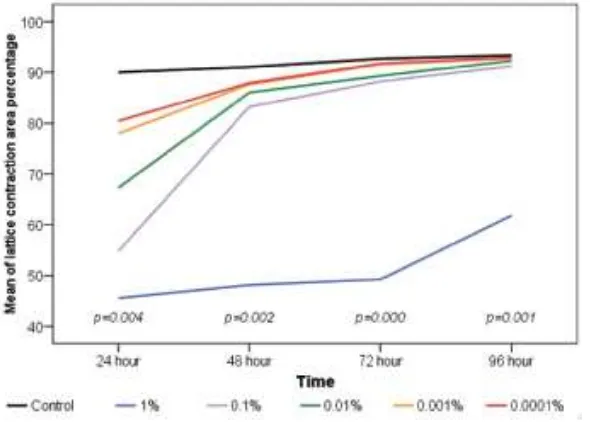
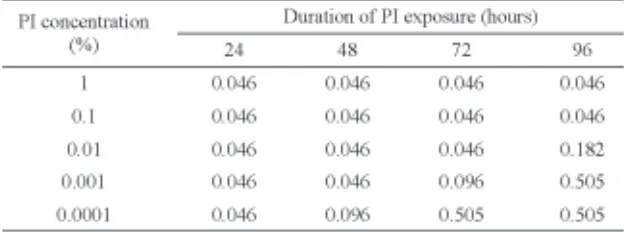
hour) are presented on FIGURE 2, while p value of its post hoc test (Mann-Whitney test) results are presented on TABLE 1.
TABLE 1. Post hoc test result (p value) of treatment group compared to control group
DISCUSSION
Povidone-iodine is a potent antiseptic, which widely used in 10% concentration. However, the use of PI as a toner, irrigator or wet dressing solution on an open wound is still a controversy.5In vitro study indicates that 10%
PI was toxic to cells which play an important role in wound healing process such as keratinocytes and fibroblasts.6 This study
observed the effect of various PI concentrations on human fibroblasts growth using FPCL media model. Using this model, fibroblast contraction on lattice media has been optimal after 24 hour; no more significant fibroblasts contraction difference between control group and 48th, 72nd,
or 96th groups (p=0.112).
Based on FIGURE 1 and TABLE 1, the study indicated that exposure to 0.1, 0.01, 0.001 and 0.0001 PI for 24 hours caused a temporary cells injury on fibroblast, which showing a recovery phenomenon after 48th hour. Therefore, the lattice contraction area of each treatment group has a similar size with the control group, after 96 hours observation. Over time observation showed that recovery phenomenon found in this study was a concentration dependent; therefore that the higher PI concentration exposed to fibroblasts, the longer time needed for a fibroblast recovery.
However, cells injury caused by 1% PI exposure in our study did not showed recovery phenomenon which could be a sign of fibroblast toxicity. Previous studies reported that PI in 10% concentration,6 2% concentration,14 1%
concentration,4 or even in 0.5% concentration,15
has a cytotoxic effect on fibroblast, polymorphonuclear cells and osteoblast. These findings were in accordance with our result, but using various PI low concentrations in our method, we could report that the safe PI concentration on fibroblast was less than 0.1% concentration. Moreover, compared to other complicated methods used in observing fibroblast cells injury/toxicity,4,13-15 our study
could show the toxicity of various PI concentrations on fibroblast using simple FPCL media as a model.
CONCLUSIONS
Povidone-iodine exposure in concentration more than 0.1% has a permanent toxic effect on fibroblast. Moreover, this phenomenon could be clearly observed using a simple FPCL model.
ACKNOWLEDGEMENTS
REFERENCES
1. Mayer DA. Povidone-iodine and wound healing: A critical review. Wounds 1993; 5:14-23. 2. Burks RI. Povidone-iodine solution in wound
treatment. Phys Ther 1998; 78(2):212-8. 3. Lineaweaver W, Howard R, Soucy D, McMorris
S, Freeman J, Crain C, et al. Topical antimicrobial
toxicity. Arch Surg 1985; 120(3):267-70. 4. Balin AK, Pratt L. Dilute povidone-iodine
solutions inhibit human skin fibroblast growth. Dermatol Surg 2002; 28(3):210-4.
5. Karukonda SR, Flynn TC, Boh EE, McBurney EI, Russo GG, Millikan LE. The effects of drugs on wound healing: part II. Specific classes of drugs and their effect on healing wounds. Int J Dermatol 2000; 39(5):321-33.
6. Lineaweaver W, McMorris S, Soucy D, Howard R. Cellular and bacterial toxicities of topical antimicrobials. Plast Reconstr Surg 1985; 75(3):394-6.
7. Singer AJ, Clark RA. Cutaneous wound healing. N Engl J Med 1999; 341(10):738-46.
8. Karukonda SR, Flynn TC, Boh EE, McBurney EI, Russo GG, Millikan LE. The effects of drugs on wound healing: part I. Int J Dermatol 2000; 39(4):250-7.
9. Dallon JC, Ehrlich HP. A review of fibroblast-populated collagen lattices. Wound Repair Regen 2008; 16(4):472-9.
10. Howling GI, Dettmar PW, Goddard PA, Hampson FC, Dornish M, Wood EJ. The effect of chitin and chitosan on fibroblast-populated collagen lattice contraction. Biotechnol Appl Biochem 2002; 36(Pt 3):247-53.
11. Ehrlich HP. The fibroblast-populated collagen lattice: A model of fibroblast collagen interactions in repair. Methods Mol Med 2003; 78:277-91. 12. Ehrlich HP, Wyler DJ. Fibroblast contraction of
collagen lattices in vitro: Inhibition by chronic inflammatory cell mediators. J Cell Physiol 1983; 116(3):345-51.
13. Zamora JL. Chemical and microbiologic characteristics and toxicity of povidone-iodine solutions. Am J Surg 1986; 151(3):400-6. 14. Rabenberg VS, Ingersoll CD,Sandrey MA, Johnson
MT. The bactericidal and cytotoxic effects of antimicrobial wound cleansers. J Athl Train 2002; 37(1):51-4.