KRISTIN DAVIS
College
Financing
How much you’ll
really have to pay—
and how to get
the money
n
Develop a winning investment plan
n
Qualify for more financial aid
n
Make the most of state savings plans
Kiplinger’s Practical Guide to Investing But Which Mutual Funds?
Making Money in Real Estate Buying & Selling a Home Retire Worry-Free
Retire & Thrive
Dollars & Sense for Kids Next Step: The Real World Home•ology
Taming the Paper Tiger at Home The Consumer’s Guide to Experts Know Your Legal Rights
KIPLINGER’S BUSINESS MANAGEMENT LIBRARY:
Business 2010
Customer Once, Client Forever Raising Capital
Taming the Paper Tiger at Work Cash Rules
Hunting Heads Parting Company
You Can’t Fire Me, I’m Your Father Fast-Track Business Growth
Kiplinger offers excerpts and tables of contents for all of our books on our Web site (www.kiplinger.com)
For information about volume discounts contact:
Cindy Greene
Kiplinger Books & Tapes 1729 H Street, N.W. Washington, DC 20006
e-mail: [email protected] 202-887-6431
KIPLINGER BOOKS Washington, DC
KRISTIN DAVIS
Senior Associate Editor
Kiplinger’s Personal Finance
magazine
Financing
College
How much you’ll
really have to pay—
1729 H Street, N.W. Washington, DC 20006
Library of Congress Cataloging-in-Publication Data
Davis, Kristin
Financing college / by Kristin Davis.--3rd ed. p. cm.
At head of title: Kiplinger’s. Includes index.
ISBN 0-938721-89-5 (pbk.)
1. Student aid--United States. 2. College costs--United States. 3. College
choice--United States. 4. Parents--United States--Finance, Personal. I. Title: Kiplinger’s financing college. II. Title.
LB2337.4 .D394 2001 378.3’0973--dc21
2001038033
© 2001 by The Kiplinger Washington Editors, Inc. All rights reserved. No part of this book may be reproduced or transmitted in any form or by any means, electronic or mechanical, including photocopying, recording or by an information storage and retrieval system, without the written permission of the Publisher, except where permitted by law.
This publication is intended to provide guidance in regard to the subject matter covered. It is sold with the understanding that the author and publisher are not herein engaged in rendering legal, accounting, tax or other professional services. If such services are required, professional assistance should be sought.
Third edition. Printed in the United States of America.
9 8 7 6 5 4 3 2 1
y education in college finance began with my own college years, when I pulled together financial aid, scholar-ships, loans and part-time work to cover the expense. It wasn’t a breeze, but it was a lot easier to get through on my own then than it is for students today. No longer can a 19-year-old easily qualify as an independent student (which meant more financial aid) just by moving away from home. And college costs have risen twice as fast as inflation—in the 18 years since my freshman year, the tuition alone at the private university I attended has risen from $7,000 to more than $22,000. To meet today’s high college costs, parents and students alike are chipping into the pot, from earnings, savings and future income (loans).
Even so, most of the things I did almost two decades ago to get through college are still core strate-gies today. More than ever, it pays to apply to schools with an eye on financial aid. It wasn’t a deliberate strat-egy, but the colleges I applied to included one where my grades and test scores put me toward the top of the class, statistically speaking, and I qualified for a gener-ous aid package there that included a merit award. Be-cause colleges strive to build a diverse freshman class, it probably also didn’t hurt that I was a Southerner apply-ing to a college that draws most of its student body from the Northeast. In my junior year, I lobbied for, and re-ceived, a bigger aid package for a semester of study in London, to cover the airfare and other extra expenses.
Then, as now, a little effort can turn up some scholarship money. In high school and college I
ap-M
Ackno
plied for several scholarships, and earned a total of $12,000 in awards, from a high school service club, my father’s employer, and a college journalism society I participated in.
And of course, loans and part-time employment are usually a given. To meet the gap between my aid package and scholarships and my total expenses, I took out loans and worked two days a week at various jobs during most of my college career. One of those jobs was a $4.50-an-hour internship at what was then Changing Timesmagazine. Now it’s called Kiplinger’s Per-sonal Finance magazine, and I never imagined I’d be one of its writers, or spend 15 years here.
As a journalist at Kiplinger’s, I’ve covered college issues for 12 years. But this book wouldn’t be possible without the valuable contributions of many other peo-ple, chiefly the dozens of financial-aid officers, financial planners, college administrators and public-informa-tion officers, admissions counselors, parents of college students and employees of the College Board, who re-sponded generously to requests for interviews and in-formation. Working on the staff of a top-flight personal-finance magazine also lets me tap the exper-tise of a group of dedicated writers and editors, who are always generous with their time and their help and whose knowledge is reflected in these pages. To all of them, a sincere thank-you.
I’m also grateful for the keen eyes and persistence of Kim Walker Klarman, Adrienne Langley, Maureen McHugh, and Jenny Cliff O’Donnell, who fact-checked the original manuscript, and for Cindy Greene’s valu-able help in updating this edition. Rosemary Neff, the first edition’s copy editor, gracefully smoothed out the original manuscript’s rough edges. Allison Leopold copyedited and proofread this edition, and Heather Waugh designed it. Thanks also to David Harrison, Kiplinger’s director of books, for getting this project off the ground.
superla-tive brainstorming partner, sounding board and coach, and this book is far better for her probing ques-tions and alertness to detail. I also couldn’t ask for a better friend.
I owe a huge debt of gratitude to my husband, Michael, for his extraordinary patience and support.
I dedicate this book to the memory of my father, John M. Willenbrink, who always inspired me to take on challenges and supplied unwavering encouragement.
CHAPTER 1:
Affording the Gold-Plated Diploma 1
Smelling Salts for Sticker Shock • Consider the Averages • The College-Cost Spiral Is Slowing • Financial Aid Will Cut Your Cost • Tax Credits Will Help, Too • No Need to Save It All in Advance • A College Planning Timeline • The Bottom Line • A College-Cost Sampler
CHAPTER 2:
The $64,000 Question: How Much to Save? 23 Setting Realistic Savings Goals • Another Way to Set Your
Goal • How Much You Need to Save: The Short Range, The Long Range • How Much Can You Spare? • Tightening Your Belt • A Budget-Cutting Worksheet • Smart Saving Tricks • Where Should You Save? • Saving for College or Retirement?
CHAPTER 3:
Where to Keep Your College Money 47
Using the Time You Have • The Safest Safe Havens • A Small Step Up the Risk Ladder • Long-Term Investments • Putting It All Together: A Shortcut • A Portfolio of Mutual Funds • State-Sponsored College-Savings Plans • College Savings Plans and Prepaid Tuition Plans by State • How to Choose an Adviser
CHAPTER 4:
Winning the College Aid Game 99
Cost Equals Your Contribution • What the Variables Are • How They Decide What You Can Afford • Timing Taxes and Aid Forms • The Financial-Aid Years • Estimate Your
Expected Family Contribution Early • Uncle Sam’s Math: The Federal Methodology • If You’ll Have Two Kids in College at Once • For Divorced Parents • Figuring Your Expected Family Contribution • Let Your Computer Help
CHAPTER 5:
How the Schools Build Your Aid Package 127 The Usual Process • How and Why Schools Adjust the
Federal Formula • Preferential Packaging • Mind the Gap • No Need-Based Aid? Target a “Discount” • If You Can’t Negotiate, Appeal
CHAPTER 6:
Increasing Your Eligibility for Aid 155 Accelerate or Defer Income • Should You Shift Assets? •
How About Reducing Assets? • What About Giving Money to Your Parents? • Most Debt Doesn’t Count • Can You Save Too Much? • What About a Parent in School? • Completing the Free Application for Federal Student Aid • Preparing the PROFILE • After Freshman Year • Hire a College-Aid Helper? Study First
CHAPTER 7:
The Financial Side of Choosing a College 187 Step One: Complete a Need Analysis • Step Two: A Financial
Checkup • Weighing the Options • Public Versus Private • Honors Colleges • Good Values in Specific Fields • Go International? • Select a School With Aid in Mind • College Resources on the Internet • The Cost of Getting Into College
CHAPTER 8:
The Great Scholarship Quest 209
The Scholarship Mirage • Who Should Seek Scholarships? • Where to Look? • Tips for Scholarship Seekers • Scholarships of Broad Interest • After High School
CHAPTER 9:
Borrowing Power 231
Stafford Student Loans • Perkins Loans • PLUS Loans • Private Loans • Are You Creditworthy? • The High Cost of Stretching Out Your Payments • Borrowing From Yourself • Student Loan “Relief”
CHAPTER 10:
Other Ways and Means 267
Cost-Conscious Ways to Get a Degree • Innovative Ways to Pay the Bill for College • Student Jobs
CHAPTER 11:
Collegiate Cash Flow 285
ust a generation ago, college education was still a somewhat elitist experience, an optional path to success enjoyed by a small minority of Ameri-cans. Scholarship money and loans were nar-rowly available. Many of America’s top colleges weren’t even open to women, female enrollment in professional post-graduate programs was small, and racial minorities constituted a tiny fraction of enroll-ment in all of higher education.
Of course, a generation or two ago, millions of Americans did just fine without going to college. Young men and women with only a high school diploma— which back then typically symbolized true mastery of fundamental skills like literacy and basic math—walked into good-paying factory, clerical and sales jobs, and they advanced just fine through diligence and on-the-job learning.
My, how times have changed. Today the high school diploma, once a badge of honor for many Americans, doesn’t open many doors. Due to declining academic standards and “courtesy promotions” of fail-ing, over-aged students, the high school diploma has been debased to a point of near uselessness as an indi-cator of job-related academic skills. That’s why acade-mic testing of job applicants is booming, as is remedial education for college freshmen. Now there are heart-ening signs that public secondary education is on the mend, but it still has a long way to go.
At the same time, the job skills required by the new world economy are constantly increasing. Computer literacy is a must for all workers. Today’s farmers, and factory and office workers, must be able to operate
Intr
oduction
computer-controlled devices with sophisticated gauges, monitors, and print-outs. That’s why we’re beginning to find college-educated men and women on assembly lines, behind the wheels of tractors and combines in the field, and repairing cars and trucks with all the lat-est computer technology.
These skills can be obtained today without going to college, as America begins to get serious about transforming secondary vocational education into high-tech programs of learning and apprenticeships for manufacturing.
But more and more, we are turning to our colleges to prepare America’s youth for success in a rapidly changing global economy. And colleges are respond-ing, by overhauling their curricula, expanding enroll-ment, opening adult-learning branches, offering online-degree programs, and better matching their programs to the needs of local employers. This trend is especially evident among the nation’s community col-leges, which have become a bridge between the less-valuable high school diploma and the stiffening skill demands of the workplace.
For most young Americans today, college is no longer a luxury, an option that might help them get a better job. It is vital path to career success. Sure, we all know a young French lit or sociology major who can’t find a decent-paying job, but the lifetime earnings ad-vantage for college graduates over high school grads is still dramatically wide and growing. A college degree is the currency of the realm in the job market, the basic credential that employers want to see. And it’s fast be-coming so basic a commodity that employers are now looking for post-graduate study to set one applicant apart from the others. But you probably know most of this already, which is why you’re looking at this book for some help on how to afford this basic but valuable commodity called “college.”
the new wrinkles in college finance, including tax-free 529 plans (state-sponsored college-savings plans) and changes made by the 2001 tax law, including improve-ments in Education IRAs, expanded tax deductions for college and improved deductions for student-loan interest.
Before you get into the meat of the subject, how-ever, I’d like to offer a few thoughts on the college-selection process. As you enter the fray, please keep in mind the following points.
Good schools, and good values, abound. Excellence in higher education is much more broadly distributed in America than many people realize. There are vastly more fine colleges than can fit on the “most-selective” lists in popular guidebooks. Arguably, how your child takes advantage of good teaching and good campus re-sources is more important than where he or she goes to college.
Some of the academically solid but little-known col-leges, public and private, are a better financial value than the expensive, high-prestige institutions. In a new trend towards chic thriftiness, it’s not unusual to see an applicant turn down an acceptance from a famous col-lege to attend a less-known one that will cost them-selves and their parents a lot less money.
Schools are working to attract the best. Competi-tion among colleges to lure the very top students is cre-ating some excellent scholarship opportunities for relatively affluent parents who would typically qualify for little or no financial aid. “Merit” scholarships, as well as low-tuition honors programs, are proliferating at colleges seeking to strengthen their student bodies academically. Even very prestigious colleges quietly vie for the best students by trying to match or top another college’s financial-aid offer (a practice most colleges will deny ever doing).
out-standing in all fields. Likewise, some obscure colleges have superb departments in unusual fields of study, and if your child wants to pursue a career in one of those fields, this should matter more than the overall reputation of the college.
Majors do determine job prospects. There is a strong connection between what youths study in col-lege and the career choices they will have when they graduate. It’s fine to major in political science, anthro-pology, journalism or music history, so long as they don’t expect to find a lot of job opportunities in those fields when they graduate. But job offers will be plenti-ful and high-paying in science, engineering and other technical fields.
Demographics play a big role in the college selection and financing game. Beginning in the early 1980s and extending into the early ’90s, America experienced a great surge in births, as the women of the enormous post-war baby boom cohort (1946–1964) finally got around to having the babies many of them had put off in their early career days. On top of that, America ex-perienced in the ’80s a wave of immigration unparal-leled since the turn of the century.
As this “baby boom echo” generation and young immigrants finished high school and applied to college in the late ’90s, colleges felt a surge of applicants. The best-known colleges saw the greatest increases in appli-cations. And the admissions pressure hasn’t abated yet. This makes it all the more important that parents help their children identify colleges that will be a good fit— in atmosphere, size, location, and especially field of study—regardless of the prestige of the institution.
new course of study. In tomorrow’s world, education will be continuous, not something one does for just four or six years of college between the ages of 18 and the mid 20s. Adult classes and online “distance learn-ing” programs will continue to boom.
At the Kiplinger organization, we’ve been writing about the college-finance process since the founding of our personal-finance magazine in 1947, because it’s vi-tally important to American families. When we sur-veyed the field of recent books on this subject, we found a group of books that focus on long-range plan-ning for college expenses — basically, investment guides—and another group of books that took aim at short-run tasks, such as applying for loans, scholar-ships, college jobs, and so on.
Kristin Davis’s book is unusual in combining both focuses in one comprehensive guide. It’s written with unusual clarity and occasional dashes of wit to lighten a very serious subject. We hope that you find it a useful ally in the daunting challenge ahead of you. Our best wishes to you and your college-bound youngsters.
Editor in Chief
Chapter 1
hat are two of the scariest words you can pronounce to the parents of a teenager? College tuition. With the same $140,000-plus that some par-ents will pay to put a student through one of the country’s most selective private colleges, you could buy a 50-foot sailboat, a pair of Mercedes-Benzes, or a vacation house at the shore. As one college-aid adviser quips: “Think of paying for college as buying an intellectual home for your child.”
The purpose of this book isn’t to scare you. It is true that by the time children reach their teen years, most parents have only a token amount saved toward the college bills. But it’s also true that parents who want to finance their kids’ college education—even at the country’s priciest schools—usually find a way. And you can, too. Even if your kids are in high school and you don’t yet have the first dollar saved, this book will show you how to marshal your resources—making the most of your own cash flow and assets, getting as much as you can in financial aid, scholarships and low-cost loans, and taking advantage of cost-cutting tips that will hold down the amount you have to finance.
You’re far better off, of course, if you’re starting while your kids are in elementary school or even younger. The sacrifices you make now to put away a lit-tle each month toward college bills will pay off in more options, less debt and less worry as the college years approach. This book will help you figure out how much to save, whose name to save it in and where to invest it—now and as the tuition bills get closer.
Affording
the Gold-Plated
Diploma
Smelling Salts for Sticker Shock
F
irst, let’s get a grip on costs. They’re growing moreslowly than in the past, which is good news. And, more important, most parents don’t drop six fig-ures per diploma.
Consider the Averages
The news media like to emphasize the dramatic. That’s why, in stories about college costs, you’ll usually read about the cost of sending a child to Harvard, Yale, Princeton, Stanford and other elite schools. In 2001, the full sticker price at those schools topped $36,000 a year. But the average tab at a four-year pri-vate school was just under $25,000 in the 2000–01 academic year, according to the annual survey of col-leges conducted by the College Board, a nonprofit as-sociation of colleges, universities and educational organizations. (Average costs for the 2001–02 academ-ic year weren’t yet available when this book went to press.) That figure includes not just tuition and fees but also room and board, books, travel costs for two or three trips home, and personal expenses—toothpaste, laundry soap and the like, and undoubtedly some late-night pizza. (Often in discussions of college costs you’ll see just the tuition—or tuition plus room and board— quoted, but it’s the total bill you have to
fi-AVERAGE COLLEGE COSTS FOR THE 2000–01 ACADEMIC YEAR
These average costs of public and private four-year schools nationwide reflect a survey of 1,666 institutions by the College Board. The room-and-board figures assume the stu-dent lives on campus; costs for stustu-dents who live at home are normally less. A student’s
actual expenses for books and supplies, transportation, and personal expenses will vary, of course, but these are the amounts college financial-aid officers, when compiling financial-aid packages, assume students on their campuses will spend.
Tuition Books Room Transpor- Personal Total Type of school and fees and supplies and board tation expenses expenses
nance. Fortunately, when figuring your need for assis-tance, most financial-aid officers include those less-obvious costs, as we discuss in Chapter 4.)
At four-year public colleges, the total cost for in-state students was less than half as much—$11,500 on average. That’s just a shade over $48,000 in total for a Class of 2004 graduate, assuming the cost goes up a bit each year. And some of those public schools are among the nation’s finest, as shown in the box below.
The College-Cost Spiral Is Slowing
You can probably count on college costs rising at a less-torrid pace in the early 2000s. Through the early 1990s, college costs soared, rising far faster than infla-tion. You can blame the baby-bust generation, at least in part. As the smaller-than-normal cohort of Ameri-cans born between 1965 and 1977 began to move through their college years, empty seats in the class-room meant fewer revenues for colleges, which still had to maintain libraries, equip computer labs and pay tenured faculty. Now, that demographic trend has
THE TOP TEN BEST VALUES IN 2000–01
The schools that follow were named the top ten “best values” by Kiplinger’s Personal Finance
magazine in 2000 (cost is for the 2000–01 academic year).
Cost for Cost for in-state out-of-state
Schools (in order of best value) students students
shifted. The “echo boom” generation, children of post-war baby-boom parents, are overfilling classrooms and lecture halls. It doesn’t cost the colleges much more to fill those additional seats, so the extra revenue should help keep tuition costs in check. The 1990s stock mar-ket boom has also swelled college endowments (more-recent market dips notwithstanding), which eases the pressure for big tuition hikes.
At the same time, the damage has been done. Par-ents are blanching at the $36,000-a-year price tag at many private schools. Colleges have responded with pledges to hold tuition increases to the rate of inflation, which has hovered around 3% in recent years, or to “inflation plus two” percentage points, compared with an average of about five points over inflation during most of the 1980s and early 1990s. “Every college
pres-HOW COSTS HAVE RISEN
This graph shows the average annual increase in tuition and fees at four-year colleges, public and private, since the 1987–88 academic year, compared with the consumer price index rate of inflation. (Inflation rates are for the calendar year ending during the given academic year.)
2% 4% 6% 8% 10%
12% CPI*
Private
Public
2000-01 1999-00 1998-99 1997-98 1996-97 1995-96 1994-95 1993-94 1992-93 1991-92 1990-91 1989-90 1988-89 1987-88
ident I know is working hard to pull annual tuition in-creases below the rate of increase in the consumer price index” to respond to parents’ and students’ growing resistance to soaring prices, says David War-ren, president of the National Association of Indepen-dent Colleges and Universities. Some examples:
■Rice University, in Houston, guarantees that tuition
hikes after freshman year will be no higher than the national consumer price index (CPI) rate of inflation.
■The University of Rochester, a private school in Rochester, N.Y., gives state residents a $5,000 discount on tuition.
■Queens College,in Charlotte, N.C., cut its tuition price
from $12,980 to $9,410 for the 1998–99 academic year.
■Bennington College,in Vermont, increased tuition by
only 2.3% altogether over the five years ended in 1999–2000.
■Wells College,in Aurora, N.Y., cut tuition and fees by 30% in 1999–2000, from $17,540 to $12,300.
■Williams College,in Williamstown, Mass., froze tuition and fees for 2000–01.
■Lebanon Valley College, in Pennsylvania, offers grants of up to 50% of tuition costs to incoming freshmen who graduated in the top 30% of their high school class.
You won’t find breaks like that at high-demand schools like Harvard or Yale, but a number of lesser-known schools have made attention-grabbing price cuts or special offers to compete for students.
So what rate of increase should you use for plan-ning purposes? If you’re facing college bills within the next six or seven years, try 5%, rather than the 6% or 7% that some financial planners and mutual fund worksheets suggest when calculating how much you need to save toward college bills. The worksheets tend to look backward, at historical rates of increase and those rates aren’t likely to hold up in the next decade or so. The table below shows what a year of college at today’s costs will look like in the future
So what rate
of increase
should you
use for
planning
purposes?
If you’re
using a 5% college-cost inflation rate.
Financial Aid Will Cut Your Cost
Even at slower rates of growth than in the past, the numbers are likely to be unsettling. But remember that the figures cited earlier in this chapter reflect to-morrow’s inflated dollars (which your income will also likely reflect), as well as the full sticker price, including living expenses, as we mentioned earlier. The wel-come news is that most parents don’t pay the full tab. More than half receive a financial-aid package that is, in effect, a tuition discount based on their ability to pay. How much help might that bring? At the Massa-chusetts Institute of Technology, for example, the av-erage need-based financial-aid package in 2001–02
WHAT COLLEGE WILL COST
This table will help you figure out the total cost of college, given projected increases of 5% annually during the college years.
If your child begins school in two years, for instance, add the annual cost of years two through five to get an estimate of the four-year cost. If she is an infant, add years 18 through 21.
Use the $36,000 starting point if you have your eye on an elite private
institu-tion, the $11,000 starting point for in-state costs at public schools, and the $25,000 starting point if you’re not sure.
If you’re starting early, bear in mind that the further out you go, the tougher it is to predict how quickly college costs will rise. As the years pass, you’ll want to look into how much college costs are really rising and adjust your planning accordingly.
Today 1 Year 2 Years 3 Years 4 Years 5 Years 6 Years 7 Years
$36,000 $37,800 $39,690 $41,675 $43,759 $45,947 $48,244 $50,656 25,000 26,250 27,563 28,941 30,388 31,907 33,502 35,177 11,000 11,550 12,128 12,734 13,371 14,040 14,742 15,479
Today 8 Years 9 Years 10 Years 11 Years 12 Years 13 Years 14 Years
36,000 53,189 55,848 58,640 61,572 64,651 67,884 71,278 25,000 36,936 38,783 40,722 42,758 44,896 47,141 49,498 11,000 16,253 17,066 17,919 18,815 19,756 20,744 21,781
Today 15 Years 16 Years 17 Years 18 Years 19 Years 20 Years 21 Years
was $24,600, of which $19,000 was a need-based grant (that is, free money).
The amount of aid you receive will depend pre-dominantly on your family’s income. A typical family of four with one child in college and $50,000 in income would almost certainly qualify for a fat aid package to offset a $36,000-plus college tab—
even with significant assets, like $150,000 in home equity and $50,000 in stocks or mutual funds. Even a family earning $125,000 in income might qualify for some aid, and al-most certainly would if two or more family members attended expensive colleges at the same time. In fact, be-cause some pricey schools have plen-ty of aid money to give out, families applying to them sometimes qualify for generous aid packages that bring the real cost below what they’d pay at a public university.
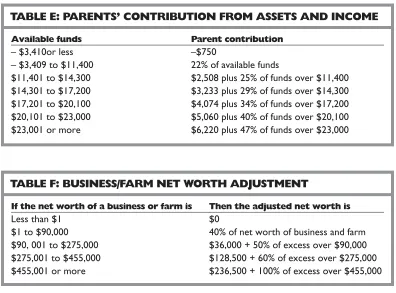
Chapter 4 will help you pinpoint how much schools will expect you to contribute to college costs be-fore qualifying for any aid—your expected family con-tribution. That’s the best indicator of how much college will really cost—no matter what the official sticker price at the school your child attends.
Tax Credits Will Help, Too
Thanks to tax legislation passed in 1997 and 2001, many families will also get a boost from tax credits and tax deductions for higher-education expenses.
THE HOPE SCHOLARSHIP CREDIT. During the first two
years of college, parents (or students, if they’re pay-ing the bills themselves) can qualify for a “Hope Scholarship,” which is an annual tax credit equal to 100% of the first $1,000 you pay in tuition and fees and 50% of the second $1,000—for a total credit of up to $1,500 per student each calendar year. You’re fully eligible for the credit if you’re a married couple
COLLEGE EDUCATION PAYS
A COLLEGE PLANNING TIMELINE
You can use this timeline to identify where you should be in the process of preparing to send your child to college. Each section identifies the appropriate steps by season and the chapters of this book that will help you take them.
If you’re starting late, remember that the timeline is an ideal to shoot for. So don’t be too discouraged if most of it has already passed you by. If it’s the beginning of senior year, for instance, and you’re just starting to look at colleges, just recognize that you have a lot of work to cram into the next few months. You may have missed the chance to arrange your finances for maximum eligibility for financial aid, but getting the aid applica-tion forms in on time (usually in January to March of the senior year) is far more impor-tant. Similarly, if you haven’t managed to set aside money in a college fund, remember that every little bit helps no matter how late you start—and be aware that you will probably need to rely more heavily on your current income and loans to meet the bills.
Preschool
Start a savings plan for college. If you set aside even a small sum each month, the amounts you accumulate over the years will go a long way toward meeting the college bills. For help deciding how much to save and whether to keep the money in your own name or your child’s, see Chapter 2.Because you have years before you need the money, you can take some risk and shoot for high returns in stocks and stock mutual funds; see Chapter 3.
Elementary School
Although you may need to aim for a higher monthly savings contribution than a parent who started sooner, you’re still in good shape.See Chapters 2and 3for guidance on how much to save and where to invest it.
Junior High
With about five years before you’ll write your first tuition check, you should take less risk with money you save from now on. See Chapter 3.
High School
Freshman year
Complete a “need analysis” to get a rough idea of whether you’re likely to qualify for financial aid. See Chapter 4.
If you’ve accumulated savings, begin shifting your money from riskier invest-ments, like stocks and stock mutual funds, to safer investments, like bonds and money-market accounts. See Chapter 3.
Encourage your child to take challeng-ing courses in high school so he or she will be a more attractive college applicant, which not only helps a student get into school but may also lead to more financial aid. See Chapter 6.
Likewise, encourage your child to engage in extracurricular activities, which will help with admissions and may lead to scholarships. See Chapter 8.
Sophomore year
Repeat the need analysis in Chapter 4.
how it’s likely to affect your eligibility for financial aid.
Consider using some of the aid-boosting strategies in Chapter 6to increase your eligibility.
Encourage your child to begin browsing college-selection books to get an idea of what schools he or she might want to apply to. See Chapter 7on selecting a college.
Take a practice round of the PSAT (a shorter version of the College Board’s SAT) or PLAN (a shorter version of the ACT, another national exam for college entrance).
Junior year—Fall
When colleges evaluate your income and assets to determine whether you’re eligible for financial aid, the first year they examine is the one starting halfway through your child’s junior year. So you have until the end of that calendar year to make adjust-ments to your finances that might boost your eligibility for aid. See Chapter 6.
Advise your child to talk with a high school guidance counselor about colleges that might be a good fit. See Chapter 7.
Take the PSAT or PLAN. This time it counts. Students with very high PSAT scores can qualify for National Merit Scholarships.
Strong students should consider taking advanced placement courses, which are usually offered beginning in the junior year. These help students’ admissions chances at selective schools and may also earn your child credits toward his or her college
degree. They might even save you money by shortening his or her time on campus.
See Chapter 10.
Junior year—Spring
Make a preliminary list of prospective col-leges by consulting guidebooks and talking to teachers and counselors.See Chapter 7.
Begin working campus visits into your family travel plans. You can visit in the sum-mer, too, but a visit while a regular semes-ter is in session will probably be more informative and revealing. See Chapter 7.
Begin browsing scholarship guides at the library or scholarship databases on the Internet or in the high school guidance office. See Chapter 8.
Take the SAT or ACT.
Summer after the junior year
Narrow the list of prospective colleges and request applications, catalogs and financial-aid information. Ask about special intern-ship or co-op programs, innovative tuition-payment plans, advanced-placement credits and other alternatives that might influence your choice of school.See Chapter 10.
Senior year—Fall Continue campus visits.
Register to receive the application mate-rials for the PROFILE financial-aid form. See Chapter 4.
Apply for scholarships now and in the spring. See Chapter 8.
Begin working on college applications and essays.
filing jointly and earn up to $80,000 in adjusted gross income or if you’re single and earn up to $40,000. The credit begins shrinking at higher income levels, and disappears completely at $100,000 for couples and $50,000 for singles.
Unlike a tax deduction, which reduces your taxable income, a tax credit reduces your actual tax bill dollar for dollar. So a $1,500 tax credit means you’ll have an extra $1,500 you can send to your child’s college rather than to Uncle Sam. Another plus: A family with two or more students in the first two years of college at the same time can take advantage of multiple Hope Schol-arships. So if you have twins, for instance, you could receive tax credits worth $3,000 in their freshman year and another $3,000 in their sophomore year.
THE LIFETIME LEARNING CREDIT. In the third year of college and beyond, students or their parents can take a “Lifetime Learning” tax credit that is currently worth up to $1,000 for each year of postsecondary study— which includes graduate or professional school or even A COLLEGE PLANNING TIMELINE continued
Retake the SAT or ACT if you want a shot at improving your scores.
Senior Year—Spring
College applications are typically due in January, and financial-aid forms are due in February or March (although the earlier you file them after January 1, the better). Then you’ll endure the wait for accep-tances and financial-aid offers.
Compare the aid packages you receive to determine how much each school will actually cost you out of pocket. If you want to appeal your aid package or try to get one school to match the offer from another, now is the time. See Chapter 5.
Summer after graduation
Apply for student loans. See Chapter 9.
Prepare your child to handle his or her own finances. See Chapter 11.
And beyond
“adult education” classes to brush up on job skills. Your credit equals 20% of the first $5,000 in tuition and fees paid in a calendar year; after 2002, the credit increases to 20% of the first $10,000 a year (a credit of $2,000). The Lifetime Learning credit is subject to the same in-come restrictions as the Hope Scholarship, so if you earn more than $80,000 to $100,000 as a couple or more than $40,000 to $50,000 singly, the credit will be phased out. While a family paying two or more tuition bills at once can take multiple Hope Scholarships, you’re limit-ed to one Lifetime Learning crlimit-edit per taxpayer per year, no matter how many family members are in school. However, you can take a Lifetime Learning credit in the same year you claim one or more Hope Scholarships.
TAX CREDIT EXAMPLES. The total amount of tax credits
a typical student can earn is more than you may think because four academic years spans five calendar years.
For example, a student who began freshman year in 1998 (the first year Hope Scholarships were avail-able) and who will graduate in 2002 will, over the span of her undergraduate career, have been eligible for up to $6,000 in tax credits from Uncle Sam, as shown here:
The government’s subsidy gets even more gener-ous for students beginning college in the fall of 2001 and beyond. Those students will be eligible for a Life-time Learning credit of up to $2,000 in each of the last three calendar years of their undergraduate career (or more, if it takes longer to graduate), which brings the potential tax credits up to $9,000 for students in the class of 2005 and beyond who earn a degree in four years. Here’s how it works:
The total
amount of
tax credits
a typical
student can
earn is more
than you may
think because
four academic
years spans
five calendar
years.
Freshman fall, 1998 $1,500 Hope Scholarship Freshman spring–sophomore fall, 1999 $1,500 Hope Scholarship Sophomore spring–junior fall, 2000 $1,000 Lifetime Learning credit Junior spring–senior fall, 2001 $1,000 Lifetime Learning credit Senior spring, 2002 $1,000 Lifetime Learning credit
If you’ll have two students going through college si-multaneously, you won’t receive twice the amount of tax credits, because only one student in a taxpaying house-hold can take the Lifetime Learning credit each year:
But with two children going through college three or more years apart, a family will be able to take up to $9,000 in tax credits for each child entering college in 2001 and beyond (not that you can do much about the timing now!):
Freshman fall, 2001 $1,500 Hope Scholarship Freshman spring–sophomore fall, 2002 $1,500 Hope Scholarship Sophomore spring–junior fall, 2003 $2,000 Lifetime Learning credit Junior spring–senior fall, 2004 $2,000 Lifetime Learning credit Senior spring, 2005 $2,000 Lifetime Learning credit
Total $9,000 in tax credits
Freshman fall, 2001 $3,000 (2 Hope Scholarships) Freshman spring–sophomore fall, 2002 $3,000 (2 Hope Scholarships) Sophomore spring–junior fall, 2003 $2,000 (1 Lifetime Learning credit) Junior spring–senior fall, 2004 $2,000 (1 Lifetime Learning credit) Senior spring, 2005 $2,000 (1 Lifetime Learning credit)
Total $12,000 in tax credits
Freshman fall for student #1, 2001 $1,500 Hope Scholarship Freshman spring–sophomore fall #1, 2002 $1,500 Hope Scholarship Sophomore spring–junior fall #1, 2003 $2,000 Lifetime Learning credit Junior spring–senior fall #1 and freshman $3,500 (1 Lifetime credit + 1 Hope)
fall for student #2, 2004
Senior spring #1 and freshman spring– $3,500 (1 Lifetime credit + 1 Hope) sophomore fall #2, 2005
Sophomore spring–junior fall #2, 2006 $2,000 Lifetime Learning credit Junior spring–senior fall #2, 2007 $2,000 Lifetime Learning credit Senior spring #2, 2008 $2,000 Lifetime Learning credit
MORE RULES. All of the above examples assume you meet the income requirements and that you’re spend-ing enough on tuition and fees to earn the maximum credit each year.
To earn the full Hope Scholarship, you need to spend
$2,000 on tuition and fees, after any grants or scholar-ships are taken into account. Room and board and other related expenses don’t count toward the credit.
To receive the full $1,000 Lifetime Learning credit, you will have to spend $5,000 or more in tuition and fees through 2002. Beginning in 2003 and beyond, you will earn the full $2,000 Lifetime credit if you spend $10,000 or more on tuition and fees.
Beginning in 2002, the amount of the Hope Scholarship (but not the Lifetime Learning credit) will be indexed for inflation, along with the income limits for eligibility for both credits, so the figures shown in the above examples may change. To be eli-gible for the Hope credit, a student must be enrolled at least half time. This is true of the Lifetime Learn-ing credit, too, unless you are takLearn-ing a course to im-prove job skills.
TAX DEDUCTIONS FOR HIGHER EDUCATION EXPENSES.
Tax legislation that passed in 2001 created an added, but temporary, tax break for college expenses that will benefit some parents. Beginning in 2002, parents can take a tax deduction for up to $3,000 of college costs, regardless of whether they itemize. The top write-off rises to $4,000 in 2004 and 2005, and then disappears. To qualify for the top write-off, your adjusted gross in-come must be below $65,000 on a single return or $130,000 on a joint return. In 2004 and 2005, taxpay-ers with higher incomes—but still below $80,000 on single returns and $160,000 on joint ones—can qualify for a $2,000 write-off.
You can’t claim a Hope or Lifetime Learning tax credit in the same year and for the same student for
Beginning in
2002, parents
can take a
tax deduction
for up to
whom you claim this deduction. And, in most cases, those tax credits will be more valuable than a tax de-duction. But since the income limits for the credits are lower than for the deduction, some taxpayers who are locked out of the credits will get this write-off.
No Need to Save It All in Advance
What you’re left to pay still won’t be chicken feed— even if your true cost is less than you imagined. Un-less your child wins a free ride or a generous grandparent comes to the rescue, the college bills will still be substantial. But you don’t have to save the full amount in advance. Financial-aid officers like to say that a family’s contribution to college costs gets paid in the past, present and future—meaning from your savings, your income during the college years, and loans you pay off later. Just as you probably wouldn’t try to save the entire cost of a home or a car before you buy it, you needn’t be ready to write a check for four years of educational expenses as your child be-gins freshman year.
SAVINGS. Whether you’re doing it or not, you probably know that the best course is to save early and often. The bigger the “down payment” you save ahead of time, the less painful the payments will be during and after the college years. But even with just a year or two to go until the first tuition bill, there’s time to accumu-late some cash to soften the blow. Find a way to put $200 a month into a savings or money-market account earning 5% during your child’s junior and senior high school years, for instance, and you’ll have made a $5,000 dent in the challenge ahead.
See Chapter 2 to get a handle on how much you need to save and in whose name to keep it, as well as how to squeeze a little more college money out of the family budget. Chapter 3 will help you choose an ap-propriate investment haven for your college savings.
Also remember that a good portion of a financial-aid package is likely to consist of loans rather than grants or scholarships. So each dollar that you save
Even with
now is probably one you or your child won’t have to borrow—and pay interest on—later.
Saving doesn’t make you a chump, by the way. Some parents have the frustrating suspicion that while they’re pinching pennies to save toward the equivalent of two Mercedes in the driveway, the neighbors who save nothing and actually drive a Mercedes are getting away with something—because with less savings they’ll qualify for more financial aid. Don’t worry. If you’re saving now, you’re going to be far better off than your profligate neighbors.
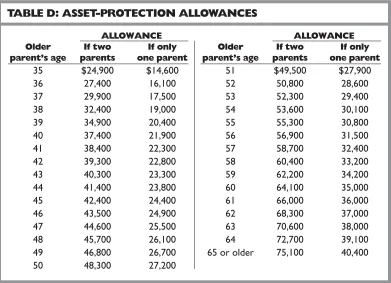
If the savings you put away now reduce your financial-aid package at all, it will be by a small amount. The calculations that determine how much you can afford to contribute to college costs don’t even consider a portion of your savings and other assets (up to $75,100, depending on your age and marital sta-tus), and even resources above that amount are tapped at no more than 5.6% per year. So, you are hardly penalized at all for being a good saver.
And because you saved ahead of time, you’ll wind up borrowing less than your neighbors to meet the portion of college costs that isn’t covered by financial aid. They’ll be envying you when they’re still paying off college bills years and years after graduation day.
CASH FLOW. This is the painful, belt-tightening part. As a parent, you already know all about sacrifice. Maybe you will drive the old car a couple of extra years, skip a vacation, or strike shrimp and steak off the family gro-cery list for a while.
While your child is away at school, there will be one less mouth to feed at home, and you can probably count on fewer outlays for such expenses as sports equipment or flute lessons. Put another way, some of the board and personal costs that are rolled into the college bills are expenses you’re already carrying. So it should be possible to squeeze some additional money out of the family budget to put toward college costs. In Chapter 11, you’ll find tips for keeping those “inci-dental” costs down, from trimming the phone bill to
finding a student-friendly bank account.
If you save regularly for retirement, perhaps via payroll deductions to your 401(k) plan, you might choose to put that on hold for a few years and divert cash to college bills. (Balancing the two goals, of course, can make for some tough decisions. See Chap-ter 2 for some guidance.)
The other alternative is to find ways to boost your income. Some parents even pick up a second job—or turn a hobby into an income-producing sideline busi-ness. Karen and Ross Kleinman of Potomac, Md., for instance, turned a dog-breeding hobby into an active business to generate extra cash toward the college costs of their three children. One Minnesota family took a job cleaning their church to help put their son through business school.
Your kids are another resource. It’s not unreason-able to expect them to chip in toward their own col-lege bills. A student working full-time during the summer and semester break and/or part-time during the school year can earn perhaps $6,000 in a year. Yes, a lot of that will probably get spent on day-to-day liv-ing costs, but it’s that much less sneaker and sweatshirt money you will have to come up with. (Chapter 2 dis-cusses how your child’s income will be figured into the financial-aid formula; see pages 36–39.)
LOANS.Most students also pick up some of the tab in
the form of student loans, which they pay off after graduation. A typical student can borrow as much as $17,125 over four years, sometimes with no interest on the loan during the college years. When that’s not enough, you can usually get a so-called “parent loan” to cover the balance. Federal loan programs now let you borrow up to the full cost of college, at rates that are reasonable if you don’t succumb to the temptation to stretch payments out over decades. It may be even cheaper to borrow against your own assets, such as a retirement account, home equity or cash value in a life insurance policy. (Chapter 9 will help you sort out the choices and keep a lid on interest costs.)
Your kids
are another
resource.
It’s not
unreasonable
to expect
them to chip
in toward
their own
college bills.
COLLEGE-COST SAMPLER, 2000–2001
This sampler isn’t meant to be all-inclusive, but it will give you an idea of how college costs vary at schools in every state. For the most current information about the schools that are listed here—and those
that aren’t—contact the school directly or consult a guidebook such as the College Costs & Financial Aid Handbook($21.95), the source for the figures below, which is published annually by the College Board.
Alabama Auburn U.
(Auburn) $3,154/$9,150 $4,640 $744 $900 $1,516 $ 10,954/$16,950 U. of Alabama 3,014/8,162 4,200 634 700 1,690 10,238/15,386
Alaska
Alaska Pacific U. $10,480 $5,090 $350 $1,000 $1,500 $18,420 U. of Alaska
(Fairbanks) 3,420/7,380 4,610 324 650 260 9,264/13,224
Arizona
Arizona State U. $2,344/$9,728 $4,880 NA $700 $2,575 $10,499/$17,883 U. of Arizona 2,348/9,728 5,548 500 700 1,870 10,966/18,346
Arkansas
Lyon College $10,955 $4,930 $500 $500 $1,000 $17,885 U. of Arkansas
(Fayetteville) 3,872/8,850 4,358 1,100 800 1,100 11,230/16,208
California
Stanford U. $24,441 $8,030 NA $1,044 $1,584 $35,099 U. of California
(Berkeley) 4,047/14,221 7,788 442 854 1,436 14,567/24,741
Colorado
Colorado College $22,800 $5,808 $492 $680 $1,048 $30,828 U. of Colorado
(Boulder) 3,223/15,832 5,538 1,215 720 1,935 12,631/25,240
Connecticut
U. of Connecticut $5,596/$13,056 $6,062 $725 $725 $1,700 $14,808/$22,268 Yale U. 25,220 7,660 500 720 1,570 35,670
Delaware
Delaware State U. $3,470/$7,400 $5,710 NA NA NA $9,180/$13,110 U. of Delaware 5,004/13,260 5,312 NA 800 1,500 12,616/20,872
Tuition and Total costs
State and fees (in state/ Room & Transpor- Books & Personal (in state/ school out of state) board tation supplies expenses out of state)
COLLEGE-COST SAMPLER, 2000–2001 continued
Tuition and Total costs
State and fees (in state/ Room & Transpor- Books & Personal (in state/ school out of state) board tation supplies expenses out of state)
District of Columbia
Georgetown U. $24,168 $9,123 $410 $870 $970 $35,541 U. of the District
of Columbia 2,070/4,440 NA NA 800 NA 2,870/5,240
Florida
Stetson U. $18,385 $6,070 $660 $600 $960 $26,675 U. of Florida 2,256/8,542 5,440 310 700 2,370 11,076/17,362
Georgia
Emory U. $24,532 $7,868 $600 $700 $700 $34,400 U. of Georgia 3,276/10,024 5,080 NA 610 1,682 10,648/17,396
Hawaii
Hawaii Pacific U. $8,920 $7,950 $1,000 $1,000 $500 $19,370 U. of Hawaii
(Manoa) 3,157/9,504 5,297 225 925 1,120 10,724/17,071
Idaho
Boise State U. $2,451/$8,451 $3,690 $1,000 $700 $1,960 $9,801/$15,801 U. of Idaho 2,476/8,476 4,238 936 1,024 1,890 10,564/16,564
Illinois
Northwestern U. $24,648 $7,471 $510 $1,128 $1,380 $35,137 U. of Illinois
(Urbana-Champaign) 4,752/11,172 5,844 430 700 1,600 13,326/19,746
Indiana Indiana U.
(Bloomington) $4,362/$12,958 $6,399 $410 $600 $1,528 $13,299/$21,895 U. of Notre Dame 23,357 5,920 500 800 900 31,477
Iowa
Grinnell College $20,500 $5,820 $500 $400 $400 $27,620 Iowa State U. 3,204/10,668 4,432 400 684 2,200 10,920/18,384
Kansas
Kansas State U. $2,781/$9,035 $4,090 NA $650 $900 $8,421/$14,675 U. of Kansas
Tuition and Total costs State and fees (in state/ Room & Transpor- Books & Personal (in state/ school out of state) board tation supplies expenses out of state)
Kentucky
U. of Kentucky $3,446/9,330 $3,782 $530 $450 $980 $9,188/15,072 U. of Louisville 3,448/9,448 3,500 1,176 684 2,004 10,812/16,812
Louisiana Louisiana State U.
and A&M $3,395/$7,851 $4,270 $487 $702 1,852 $10,706/$15,162 Tulane U. 25,480 6,908 NA 1,000 800 34,188
Maine
Bowdoin College $25,890 $6,760 NA $800 $1,100 $34,550 U. of Maine
(Orono) 4,829/11,520 5,360 500 700 1,100 12,489/19,180
Maryland
Johns Hopkins U. $25,430 $8,185 $600 $800 $800 $35,815 U. of Maryland
(College Park) 5,136/11,704 6,076 599 702 1,768 14,281/20,849
Massachusetts Harvard and
Radcliffe Colleges $25,128 $7,982 NA $800 $2,290 $36,200 U. of Massachusetts
(Amherst) 5,212/13,465 4,895 400 500 1,000 12,007/20,260
Michigan
Michigan State U. $5,210/$12,233 $4,692 $296 $716 $1,184 $12,098/$19,121 U. of Michigan
(Ann Arbor) 6,513/20,138 5,780 NA 700 1,944 14,937/28,562
Minnesota
Carleton College $24,390 $4,950 $325 $600 $600 $30,865 U. of Minnesota
(Twin Cities) 4,879/12,988 4,914 NA 729 1,443 11,965/20,074
Mississippi
U. of Mississippi $3,153/7,106 $3,930 $650 $700 $1,500 $9,933/13,886 U. of Southern
Mississippi 2,970/6,898 3,770 380 700 1,740 9,560/13,488
Missouri U. of Missouri
(Columbia) $4,726/$12,273 $4,585 NA $810 $2,320 $12,441/$19,988 Washington U. 24,745 7,724 NA 860 1,741 35,070
COLLEGE-COST SAMPLER, 2000–2001 continued
Tuition and Total costs
State and fees (in state/ Room & Transpor- Books & Personal (in state/ school out of state) board tation supplies expenses out of state)
Montana
Montana State U. $3,052/$7,301 $4,000 NA $800 $2,200 $10,052/$14,301 U. of Montana
(Missoula) 2,600/5,256 4,680 NA 624 2,500 10,404/13,060
Nebraska
Creighton U. $14,910 $5,782 $550 $850 $1,375 $23,467 U. of Nebraska
(Lincoln) 3,450/7,515 4,310 576 660 1,744 10,740/14,805
Nevada
Sierra Nevada College $11,400 $7,150 $1,000 NA $1,200 $20,750 U. of Nevada
(Las Vegas) 2,386/9,200 5,694 380 700 1,230 10,390/17,204
New Hampshire
Dartmouth College $25,763 $7,557 NA $810 $1,191 $35,321 U. of New
Hampshire 7,395/14,840 5,154 275 800 2,000 15,624/23,069
New Jersey
Princeton U. $25,430 $7,206 $450 $790 $1,719 $35,595 Rutgers at New
Brunswick 5,220/10,178 NA NA 700 NA 5,920/10,878
New Mexico
New Mexico State $2,790/$9,162 $3,700 $1,168 $634 $3,180 $11,472/$17,844 U. of New Mexico 2,795/10,012 4,870 NA 624 NA 8,289/15,506
New York
Columbia U. $25,922 $7,966 NA $800 $1,060 $35,748 State U. of New York
(Binghamton) 4,463/8,300 5,772 250 750 NA 11,235/15,072
North Carolina
Duke U. $25,630 $7,387 $600 $740 $1,320 $35,677 U. of North Carolina
(Chapel Hill) 2,768/11,026 5,770 500 700 1,157 10,895/19,153
North Dakota
Tuition and Total costs State and fees (in state/ Room & Transpor- Books & Personal (in state/ school out of state) board tation supplies expenses out of state)
Ohio
Oberlin College $25,355 $6,364 NA $575 $525 $32,819 Ohio State U.
(Columbus) 4,383/12,732 5,807 $180 696 232 11,298/19,647
Oklahoma
U. of Oklahoma $2,491/5,910 $4,610 $873 $846 $2,688 $11,508/14,927 U. of Tulsa 13,810 4,810 1,000 1,200 1,360 22,180
Oregon
Linfield College $18,600 $5,470 $200 $600 $1,100 $25,970 U. of Oregon
(Eugene) 3,819/12,714 5,715 NA 675 1,975 12,184/21,079
Pennsylvania Penn State
(University Park) $6,756/$14,088 $5,380 $378 $656 $2,016 $15,186/$22,518 U. of Pennsylvania 25,170 7,826 NA NA NA 32,996
Rhode Island
Brown U. $26,374 $7,346 NA $888 $1,192 $35,800 U. of Rhode Island 5,154/11,906 6,646 NA 600 1,594 13,994/20,746
South Carolina
Clemson U. $3,590/$9,584 $4,548 $2,040 $712 $1,518 $12,408/$18,402 U. of South Carolina
(Columbia) 3,918/10,054 4,167 994 544 2,514 12,137/18,273
South Dakota
Augustana College $14,754 $4,260 $200 $600 $800 $20,614 South Dakota State U. 3,365/5,765 3,155 NA 600 NA 7,120/9,520
Tennessee U. of Tennessee
(Knoxville) $3,362/$9,366 $4,190 $2,494 $998 $2002 $13,046/$19,050 Vanderbilt U. 24,700 8,328 NA NA 1,040 34,068
Texas
Rice U. $16,445 $6,850 $300 $600 $1,550 $25,745 Texas A&M
(College Station) 3,374/8,850 5,164 522 788 1,494 11,342/16,818
The Bottom Line
Y
es, a college education costs a lot of money today. But don’t be cowed by the six-figure amounts you see in the headlines. Let them spur you to action—using the time you have left between now and freshman orientation, whether one year or 18, to fig-ure out how much college will really cost and map out a plan for reaching your goals for your child’s college education. (Chapter 7 will help you get a handle on what those goals really are.)COLLEGE-COST SAMPLER, 2000–2001 continued
Utah
Brigham Young U. $2,830 $4,454 $1,300 $1,050 $1,470 $11,104 U. of Utah 2,897/8,302 4,890 756 1,086 3,051 12,680/18,085
Vermont
Middlebury College $32,765 NA NA $550 $1,000 $34,315 U. of Vermont 8,268/19,236 6,038 NA 628 997 15,931/26,899
Virginia
U. of Virginia $4,335/16,295 $4,767 NA $800 $1,300 $11,202/23,162 Washington & Lee U. 17,965 5,690 NA 900 1,345 25,900
Washington
U. of Puget Sound $21,425 $5,510 $500 $750 $1,300 $29,485 Washington State U.3,790/10,544 5,086 1,165 678 1,879 12,598/19,352
West Virginia West Virginia U.
(Morgantown) $2,836/8,362 $5,152 $1,175 $630 $900 $10,693/16,219 West Virginia
Wesleyan College 18,050 4,350 750 600 1,500 25,250
Wisconsin
Lawrence U. $21,855 $4,791 $300 $450 $900 $28,296 U. of Wisconsin
(Madison) 3,788/13,688 5,470 340 660 1,550 11,808/21,708
Wyoming
U. of Wyoming $2,575/$7,284 $4,568 $587 $680 $1,650 $10,060/$14,769
Tuition and Total costs
Chapter 2
ow much money do you need to shovel into the college fund? A lot, but not as much as mutual fund companies and brokerages would have you believe. The worksheets they give customers to help them compute how much to invest tend to employ the big scare, which goes like this: Take today’s sticker price at one of the country’s costliest universities, inflate it at 7% per year (the rate of tuition inflation several years ago), and conclude that parents of a newborn must save more than $500,000—or about $900 a month—over 18 years to pay four years’ college costs out of their own pockets the day the child sets foot on campus. For par-ents of junior-high studpar-ents the prognosis is even worse—on the order of $2,400 a month to come up with a cash-on-the-barrelhead payment to the bursar at Ivy League U.
“Avoid those dumb charts,” says Philip Johnson, a Clifton Park, N.Y., financial planner who specializes in college planning. As explained in Chapter 1, col-lege costs aren’t going to rise as fast in the next decade as they did in the early 1990s. As we’ve also explained, most parents won’t pay the full sticker price, and you don’t need to save in advance every penny of what you will spend. In this chapter, we’ll help you get a handle on how much you really need to be saving toward college costs. We’ll also provide some guidance on how to squeeze more cash out of your budget to put into savings and how to decide whether to keep those savings in your own name or in your child’s name.
The $64,000
Question: How
Much to Save?
Setting Realistic Savings Goals
T
here’s no right answer to the how much to savequestion. “It’s a personal goal that you need to set—and no one is going to hold you to it,” says Johnson. Still, it can be a useful exercise to crunch some numbers. Working backward from the “dumb worksheet” approach, we’ll start with assumptions that produce impossibly huge numbers and then show you how changing the assumptions can transform the ridiculous into a manageable goal.
BAD ASSUMPTION #1: YOU NEED TO SAVE IT ALL UP FRONT. Imagine that your sixth-grader will attend one of the most expensive universities in the country and that you’ll foot the whole bill. In that case, the goal would be $218,000 (roughly what four years at Harvard will cost for the class of 2012, who begin their freshman year in 2008, assuming 5% annual inflation of tuition). If you’re starting from scratch and earn a 7% return on your investments, you’d need to put away a gasp-induc-ing $1,787 per month.
But as you know, you wouldn’t need to hand over the whole $218,000 the day your scholar reports for freshman orientation. By assuming you’ll keep up the contributions during your child’s undergraduate years, you’d cut the tab to $1,095 per month. If you already have a $10,000 head start, the savings goal would be reduced to $986 a month.
BAD ASSUMPTION #2: YOU’LL PAY 100% OF THE SCHOOL’S STICKER PRICE.That’s still an impossibility for most family budgets. But remember, you’re proba-bly not going to have to pay the entire tab yourself. After all, financial aid, student loans, a summer job, a scholarship or grant, and/or a grandparent’s largesse will probably trim the final bill.
■Aiming to amass 75% of the total expensefrom scratch requires an $821 monthly savings contribution, or $712 if you already have $10,000 put away.
■Aiming to foot half the bill brings those numbers down to $547 and $439, respectively.
Changing your
assumptions
can transform
the ridiculous
into a
■Saving even a quarter of the totalcould be enough if it seems likely that you’ll get significant financial aid. That’s $273 a month from scratch, or $165 with $10,000 already in the bank.
QUESTIONABLE ASSUMPTION #3: YOU’RE AIMING FOR HARVARD. Let’s assume instead that your goal is an average-priced private college, which will probably cost closer to $152,000 than $218,000 by the time your sixth-grader is ready to go.
■Shooting for 75% of that costmeans you would need to save $572 a month from scratch, or $464 with a $10,000 head start.
■To save 50% of the cost, your monthly savings goal would be $381, or $273 with $10,000 already saved.
■And to save 25%,your goal is $190 a month, or $82 a month with $10,000 in the kitty.
REASONABLE POSSIBILITY: YOU’RE SAVING FOR A PUB-LIC COLLEGE. How about saving for a public college, where the total bill will probably be about $67,000 over four years?
■If you aim to save the whole amount,your goal is $336 from scratch, or $228 with $10,000 already saved.
■Aim for 75%,and you’d want to save $252 a month from scratch, or $144 a month with $10,000 saved.
■Shoot for 50%, and the numbers are $168 and $60, respectively.
Another Way to Set Your Goal
A
n even more precise approach is to start thenumber crunching with your “expected family contribution” (Chapter 4 will show you how) rather than with any school’s sticker price. Your ex-pected contribution is the amount of money colleges will expect you to come up with out-of-pocket before qualifying for any financial aid, so using that number as a starting savings goal is more realistic than looking at the full sticker price. If you determine from the worksheet in Chapter 4 that you would be expected to contribute $7,000 a year to college costs today, for ex-ample, then use that figure as your starting point and multiply it by four to represent the cost of four years of school. Even if you can’t quite match the savings goal that emerges from the calculations in this chapter, you’ll have a handle on the amount that you’ll proba-bly be expected to pay and just how far your efforts will take you toward it.
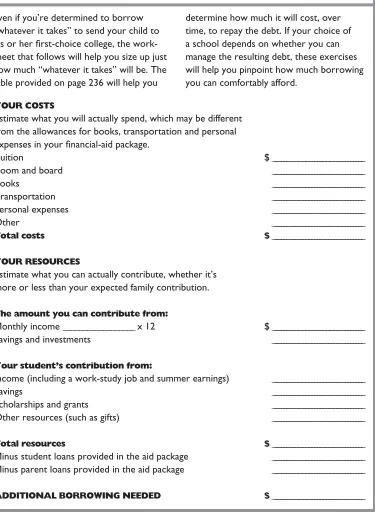
The worksheets on the following pages will help you determine what you should save monthly. Use the “short-form” version if college is five or fewer years away, and the “long-form” version if college is more than five years off.
How Much Can You Spare?
N
o matter how much you estimate your contri-bution to college costs should be, you need to decide how much you can afford or are willing to save toward college, versus competing goals such as saving for retirement. And you probably already have a feel for how much you can squeeze out of your pay-check each month or each week to funnel into a college fund. Jim Stoever, a computer programmer who lives in Brick, N.J., says his savings plan for his son’s college education started with, “Okay, I think we can do $100 a month, and if that’s too much we’ll knock it back.” Then it became just another bill to pay, “and we just did it.” Later, he bumped up his monthly mutual fund contribution by $50 when he got a raise. That’s theYou need to
decide how
much you
can afford or
are willing to
save toward
college, versus
competing
goals such
as saving for
retirement.
HOW MUCH YOU NEED TO SAVE: THE SHORT RANGE
This worksheet is for families with a child in the eighth grade or older. The first two columns show the monthly savings necessary over nine years to pay full price at an average private or public college; the third column shows the amount needed to come up with an expected family contribution of $7,000, an example of the minimum out-of-pocket a school might expect. The last column lets you figure out what you should save monthly in the years left until your child graduates from college. (The payments in the last four
years represent a contribution from cash flow toward college costs, rather than actual savings.)
This worksheet assumes that the return you earn on your investments will just about match the rate of increase in college costs. In other words, the 5% or so that college costs will go up each year will about match the 5% or so you can earn in a money-market mutual fund or certificate of deposit. That’s a reasonable assumption for parents with five years or fewer until the first tuition bill.
A. Cost of college OR
Expected Family Contribution
The average annual cost for tuition, room and board, and other costs at public schools in 2000–01 is about $11,000; at private schools, it’s $25,000.
B. Total cost
Multiply the result in Step A by 4.
C. Savings goal
Multiply the result in Step B by the percentage of the cost you wish to save (for example, 60%).
D. Existing savings
Subtract the amount of your existing sav-ings for college from the result in Step C.
E. What you should save annually
Divide the result in Step D by the num-ber of years until college graduation.
F. What you should save monthly
Divide the result in Step E by 12.
Example: Example: Example: Your Private Public Expected Family’s College College Contribution Numbers
$25,000 $11,000 $7,000 $ ________________ x 4 x 4 x 4 x ________________ 100,000 44,000 28,000 ____________
x 60% x 60% x 60% x ________% 60,000 26,400 16,800 _________
– 3,000 – 3,000 –3,000 – _________ 57,000 23,400 13,800 _________
÷ 9 ÷ 9 ÷ 9 ÷ _________ 6,333 2,600 1,533 _________