Article http://ijfac.unsri.ac.id
DOI: 1024845/ijfac.v3.i3.83 83
Article Info
Received 3 September 2018 Receive in revised 14 September 2018
Accepted 30 September 2018 Available online 10 October 2018
Purification of Crude Glycerol from Biodiesel By-product by Adsorption
using Bentonite
Erniati Anzar1*, M. Syahirman Yusi2, Yohandri Bow3
1Applied Master of Renewable Energy Engineering, Politeknik Negeri Sriwijaya, Palembang 30139, Indonesia 2Business Administration Department, Politeknik Negeri Sriwijaya, Palembang 30139, Indonesia
3Chemical Engineering Department, Energy Engineering Study Program, Politeknik Negeri Sriwijaya Palembang 30139, Indonesia
*Corresponding Author: [email protected]
Abstract
The production of glycerol from biodiesel by-product that was obtained from waste cooking oil has low purity. This crude glycerol contains impurities such as methanol, catalyst, soap and water. Analysis result shows that crude glycerol contains 67.7% water, 16.7% ash with density 1.1217 g/mL. The impurities were able to be adsorbed using bentonite which was activated in sulphuric acids 1.5 M and characterized by SEM-EDX. The purified glycerol after being treated with bentonite at 60 C for 75 minutes was fulfilled The SNI 06-1564-1995 requirement i.e. 89.5% glycerol, 4.3% water, 3.6% ash and density 1.2212 g/mL.From the experiment can be concluded the activated bentonite showed a capacity in adsorbing and removing impurities in waste cooking oil. Keywords: Waste cooking oil, Crude glycerol, H2SO4, Bentonite, Adsorption
Abstrak (Indonesian)
Produksi Gliserol dari hasil samping pembuatan biodiesel yang berasal dari bahan baku minyak goreng bekas (minyak jelantah) mempunyai kemurnian yang masih sangat rendah. Karena gliserol kasar ini mengandung senyawa pengotor. Senyawa pengotor yang terdapat dalam crude glycerol antara lain gliserol, metanol, katalis, sabun, dan air. Kadar crude glycerol didapatkan 67,7%, kadar air 38,6%, kadar abu 16,7% dan massa jenis 1,1217 g/mL. Senyawa pengotor dapat diadsorpsi dengan menggunakan bentonit yang sudah diaktivasi. Aktivasi bentonit menggunakan asam sulfat 1,5M dan dikarakterisasi dengan Scanning Electron Microscopy Energy Dispersive X-ray (SEM EDX). Kadar gliserol kondisi optimum setelah diadsorpsi dengan bentonit yang telah diaktivasi yaitu pada pemanasan 60oC, waktu kontak adsorpsi 75 menit memenuhi syarat mutu SNI 06-1564-1995 kadar gliserol 89,5%, kadar air 4.3%, massa jenis 1,2212 (gr/mL) dan kadar abu 3,6%. Dari experimen dapat disimpulkan bahwa bentonit aktif memiliki kapasitas penyerapan dan penghilangan pengotor dari minyak goreng bekas.
Kata Kunci: Minyak Jelantah, Crude Glycerol, H2SO4, Bentonit, Adsorpsi
INTRODUCTION
Crude glycerol, a by-product of biodiesel manufacture, isproduced by approximately 10-20% (v/v). This by-product still contains impurities such as methanol, soap, residual catalyst, fatty acids and water [1]. The use of glycerol is in the pharmaceutical, cosmetics and petrochemical industries and has a high selling value. Trans esterificationprocess is one of several methods to produce biodiesel usually accompany
with by-product such as low-quality glycerol which roughly 10-20% of product total volume [2].
DOI: 1024845/ijfac.v3.i3.83 84 purified product contained approximately 90%
of glycerol [3].
Biodiesel by-product which contained 50% glycerol has the potential to be reused through physical and chemical treatment by adding such as HCl, NaOH, H3PO4 and KOH. Acids addition
will convert soap mixture into free fatty acids (FFA) and salt. Free fatty acids is insoluble in glycerol hence it will forms a separate layer above glycerol while salt will precipitated in the bottom part. Residual reactant i.e. methanol and water will form soluble mixture with glycerol. Methanol can be separated from mixture by evaporation method with approximately 85% purity and can be increased to 99% by further method of purification [4].
The process of making biodiesel from used cooking oil can be done by laboratory scale by heating, giving a basic catalyst, methanol solvent and separating biodiesel with a separate funnel. Crude glycerol as much as 300 g was added with 85% H3PO4 solution to reach the pH of ± 2.5
solution. After that, let stand for ± 24 hours until the solution forms 3 phases. The top layer is free fatty acid, the middle layer is glycerol, and the lowest layer is inorganic salt. After separation, the filtrate (crude glycerol) is separated from salt deposits by filtering using a vacuum pump [5].
There are several available methods of biodiesel production by using membrane including membrane reactor. Membrane reactor combined simultaneously the reaction process and product separation process to ensure continues of stirring reactants mixture and mass transfer process between insoluble phases. Membrane reactor can also separateunreacted feed and resulting product continuously which then shifted reaction equilibrium towards product side and increased its results. [6-10].
Another method for biodiesel production is using ultrasound wave and were reported by several authors. Ultrasound reactor was used to produced biodiesel firstly reported by Hielscher Ultrasonic GmbH in 2000 by using ultrasound processor which operates at frequency range 18 to 20 kHz [11].
From each method of making biodiesel has glycerol by products in different amounts and colors of glycerol. Separation of glycerol from
the byproducts of biodiesel can also be carried out by adding phosphoric acid followed by the addition of activated carbon to attract residual dirt and color. Finally, a rotary evaporator is used to draw water [12].
Previously, researcher reported crude glycerol was purified using natural zeolite from Lampung [12]. To obtain glycerol purification by means of adsorption, adsorbents must be chosen which have strong absorption properties such as bentonite. Several factors that influence the adsorption process are concentration, surface area, temperature, particle size, pH, contact time. The choice of Bentonite as an adsorbent is very appropriate because bentonite has a layered structure with the ability to swell and have cations that can be exchanged. To increase the absorption capacity of bentonite, activation must be carried out by heating and acidification. The bentonite size used in this research is 60 mesh. Washing and soaking with distilled water and sulfuric acid. Drying in the oven and drying on the furnace. To determine the final results of glycerol purification, glycerol levels, moisture content, ash content and viscosity were measured.
MATERIALS AND METHODS Materials
Crude glycerol was provided from biodiesel production unit by-product which processed through electrolysis method. The biodiesel was produced using feed from waste cooking oil. Other chemicals used in this research were bentonite, distilled water, periodate acids (HIO42H2O), sodium thiosulphate
DOI: 1024845/ijfac.v3.i3.83 85 SEM-EDX to see the morphology of the surface
and composition of the bentonite.
Characterization of Crude Glycerol
Crude glycerol obtained from biodiesel by-product was heated and stirred by using magnetic stirrer followed by H2SO4 1.19 M
addition drop wise until the pH is 6. Heating temperature was maintained at 60 C. After pH reached 6, crude glycerol was cooled and left for 30 minutes. The precipitate formed is separated from the filtrate (crude glycerol) using vacuum pump. The filtrate was analyzed for its physical and chemical properties including: density using pycnometer, water content, ash content, total glycerol content [13].
Glycerol produced at optimum treatment was subjected to analysis [14]. Crude glycerol was added with sulphuric acids (acidification) to convert soap into free fatty acids and water. H+
ion will protonate soap to produce free fatty acids which then formed separated layer in upper part due to the difference in density and polarity compare to glycerol [15]. The SO42- excess from
sulphuric acids was reacted with potasium ion from soap in glycerol to form insoluble K2SO4
which precipitated at the bottom [16]. The addition of sulphuric acids turn crude glycerol to form three separated layers i.e. free fatty acids layer at the upper part, glycerol layer at the midle and inorganic salt at the bottom. However, in this work we found out that the reaction produced only two layers i.e. lower layer contain free fatty acids and upper layer contain glycerol. The upper layer was further analysis for its physical and chemical properties.
The Purification of Crude Glycerol using Bentonite
Glycerol as a by-product of biodesel manufacture using waste cooking oil as feed was separated in an equipment using electrolysis method. 100 g of crude glycerol was added into 12 g bentonite and stirred in various time i.e. 30, 45, 60, 75 and 90 minutes at 30C and then left for 24 hours. The filtrate was collected using vacuum filtration. The procedure was repeated using various bentonite concentration i.e. 3%, 6%, 9%, 12% and 15% based on crude glycerol
weight. Another procedure was conducted to obtain optimum temperature (30, 40, 50, 60 and 70C). In this step, crude glycerol was adsorbed using 60 mesh bentonite at optimum temperature, duration and concentration previously obtained.
RESULT AND DISCUSSION
Characterization of Activated Bentonite
Bentonite activation was conducted as follows, 10 g of bentonite was dispersed into 100 mL of H2SO4 0.6 M, HCl 0.5 M and HNO3
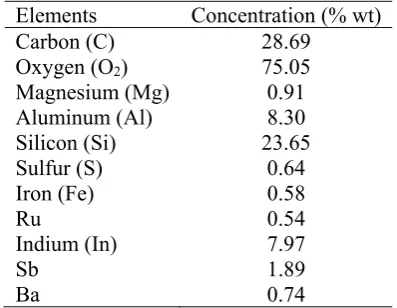
0.1 M each was refluxed and stirred for 3 hours at 70 C. The mixtures were cooled, filtered and washed to remove ions of residual acids. Acids activated bentonite was dried in an oven at 100-110 C for 3 hours. The dried bentonite was grinded and sieve to obtain size of 60 mesh (0.2 mm). The composition of bentonite is displayed in Table 1.
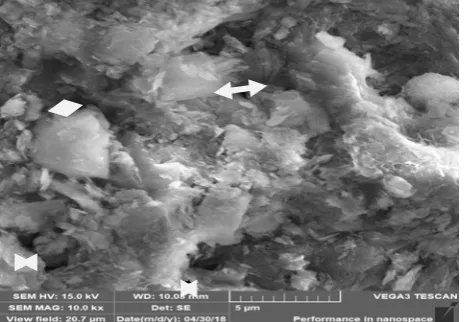
Table 1. The composition of activated bentonit result by optimum treatmentusing SEM-EDX. images (Figure 1 and 2) show at wide ratio 10.03 mm and 9.80 mm it appears high concentration of carbon at 28.69% and low concentration of iron at 0.58% while Ru element could be coming from interference of X-ray dispersive occurred. From this result one can expected the adsorption process can optimally occured.
DOI: 1024845/ijfac.v3.i3.83 86 potasium salt from residual catalyst produced
during transesterification process. Salt content was affected by pH of chemical treatment on the crude glycerol. The higher pH of solution will increase catalyst’s salt solubility which enhance salt content in the glycerol.
Figure 1. SEM Image of activated bentonite wd: 10.03 mm, SEM mag 10.0 kx, view field 20.7µm
Figure 2.SEM image of activated bentonite wd: 9.80 mm, SEM mag 10.1 kx, view field 20.6µm
On contrary, low pH decrease catalyst’s salt solubility hence reduce salt content of glycerol [18]. The glycerol obtained in this report is 67.7%. No sugar content was detected indicates by the colour of glycerol whis is not brownish. The analysis result of crude glycerol confirmed it comprise of 67.7% glycerol, 38.6% water, 16.73% ashand 1.1217 % salt as shown onTable 2.
Table 2. The composition of crude glycerol Component Percentage (% wt) Glycerol 67.7
Water 38.6
Ash 16.73
Salt 1.1217
The Effect of Temperature in Glycerol Content At 60 C, glycerol content reached 87.4%. the increase of temperature is proportional to the amount of adsorption. Kinetic energy of moleculewas increased at elevated temperature hence the adsorbent was able to adsorb more impurity into its pore. This optimum condition was carried out in 12% bentonite, particle size 60 mesh (0.2 mm) and adsorption duration 75 min.
The increase of glycerol content was no longer observed once the optimum temperature was exceeded as represented in Figure 3. At 70C, the content of glycerol was decreased to 68.6%. The formation of flocs of impurity has saturated and its began to dissolve into the mixture. Temperature above 60 C also increase the vapor pressure of glycerol which also contribute to its content decrease.
Figure 3 displays the increase of glycerol content as function of temperature but start to decrease at 80 C. The point of curve decline marks the optimum temperature of adsorption.
Figure 3. The effect of temperature to the glycerol content
The Effect of Adsorption Time to The Glycerol Content
The variation of adsorption time was conducted by holding other variables i.e. at 60 C, 12% bentonite concentration and particle
0 25 50 75 100
0 25 50 75
Glycer
ol
content
(%
)
DOI: 1024845/ijfac.v3.i3.83 87 size of 60 mesh. The result of adsorption at
various adsorption time is displayed on Figure 4. Figure 4 exhibits the increase of glycerol content reaches maximum after75 minutes adsorption time with glycerol content 88.7%. Longer adsorption time i.e. 90 minutesresult in decrease of the glycerol as the temperature has reach beyond optimum time.
Figure 4. The effect of adsorption time to the glycerol content
The Effect of Bentonite Concentration to The Glycerol Content
At maximum bentonite concentration (15%), the glycerol content was detected decreased to 77.5%. The larger amount of adsorbent added caused more adsorbate and adsorbent molecules to interact in an adsorption process. Impurities such as free fatty acids, methyl esters, water and potassium become more being adsorbed. The glycerol content at thiscircumstance was preferred at 12% bentonite concentration compare to 15%. The existence of 3 polar functional groups (-OH) within glycerol possibly responsible to the chemical interaction between glycerol and adsorbent surface. This interaction caused the glycerol content being adsorbed and decrease its concentration during adsorption process. The result of bentonite concentration effect is shown on Figure 5.
Initially, glycerol content increased by increase of bentonite from 3 to 12 g. At bentonite 12 g, the glycerol content reaches its optimum concentration by 89.5%. At higher bentonite addition i.e. 15 g, the glycerol content shows a decrease to 77.5%.
Figure 5. The Effect of bentonite concentration to the glycerol content
CONCLUSION
The result indicated that optimum condition of adsorption using bentonite on crude glycerol purification is 75 minutes, 12% bentonite concentration, 60 C and bentonite particle size of 60 mesh (0.2 mm). The grade of glycerol obtained was fulfil the requirement of quality standard which proves the successful of organic impurity adsorption other than glycerol wanted. The method employed was able to acquire at optimum condition 89.5% glycerol, 4.3% water content, 1.2212 g/mL density and 3.6% ash content. The activated bentonite showed capacity in adsorbing and removing impurities within glycerol such as free fatty acids, methyl ester, water and potassium. The heat treatment on bentonite increased its Si/Al ratio which makes adsorption more efficient hence increase the glycerol yields.
REFERENCES
[1] Kovaks A. 2011. Aspect of refining biodiesel byproduct glycerin. J. of
Petroleum and Coal.1. pp. 91-97.
[2] Darnoko, D and Cheryan, M, 2000, “Kinetics of Palm Oil Transesterification in a Batch Reactor”, J. Am.Oil Chem.Soc., 77,
pp. 1263-1267.
DOI: 1024845/ijfac.v3.i3.83 88 [4] Jon Van Gerpen and Gerhard Knothe. 2005.
Biodiesel Production. The Biodiesel Handbook, USA
[5] Manosak, R., Limpattayanate, S & Hunsom, M. 2010. Sequential refining of crude glycerol derived from waste used oil methyl ester plant via a combination process of chemical and adsorption, Fuel
Process.Technol. 104, pp 92-99
[6] Cao P., Dube´ M.A., dan Tremblay A.Y., (2008), “Methanol recycling in the production of biodiesel in a membrane reactor”, Fuel, 87, pp 825–833.
[7] Dube´ M.A., Tremblay A.Y., dan Liu J., (2007), “Biodiesel Production Using a Membrane Reactor”, Bioresource
Technology, 98, pp 639–647.
[8] Dube´ M.A., Tremblay A.Y., dan Cao P., (2006), “A Novel Membrane Reactor for the Continuous Production of Biodiesel”, Department of Chemical Engineering, University of Ottawa, Canada.
[9] Cao P., Tremblay A.Y., dan Dube M.A., (2009), “Kinetics of Canola Oil Transesterification in a Membrane Reactor”,
Ind. Eng. Chem. Res., Vol. 48, No. 5. pp
2533–2541.
[10] Cao P., Tremblay A.Y., Dube´ M.A., and Morse K., (2007), “Effect of membrane pore size on the performance of a membrane reactor for biodiesel production”, Ind. Eng.
Chem. Res., 46, pp 52–58.
[11] Rmachandran K, Suganya N, Gandhi NN, Renganathan S. 2013. Recent developments for biodiesel production by ultrasonic assist transesterification using different heterogenous catalyst: A review. Renew.
Sustain. Energy Rev. 22: pp 410-418.
[12] Aziz I, Las T, Shabrina A. 2014. Pemurnian crude glycerol dengan cara pengasaman dan adsorpsi menggunakan zeolit alam Lampung. Chem. Prog. 7: pp.
66-73.
[13] Anonym. 1995. Official Methods of Analysis of The Association of Analytical Chemists. Washington D.C.
[14] SNI 06-1564-1995. Gliserol Kasar. Jakarta: Badan Standarisasi Nasional.
[15] Hunsom, M & Autthanit, C. 2013. Adsorptive purification of crude glycerol by sewage sludge derived activated carbon prepared by chemical activation with H3PO4, K2CrO3 and KOH. Chem. Eng.
Journal. 229, pp 334-343.
[16] Kongjao, S., Damronglered, S. & Hunsom, M. 2010. Purification of crude glycerol derived from waste used oil methyl ester plant. Chem. Eng. Journal. 27, pp. 944-949.
[17] The Soap and Detergent Association. 1980. Glycerin: An Overview. New York.