Page | 1 The Problems and Solutions in Teaching Practice for Preservice-Teacher Students
By Jejen Musfah
lecturer at FITK UIN Syarif Hidayatullah Jakarta email: [email protected]
Presented at ICEM, Syahida Inn, 29-31 Oct 2014, UIN Jakarta
Abstract
Numerous studies on teaching practice of the pre-service teachers indicated that the majority
of the pre-service teachers have passed the teaching practice with good grade, but their
teaching competence was not adequate. This study aims at firstly, identifying and mapping
the problems overcome by pre-service teachers in some faculties of teaching. Secondly,
formulating the solutions for those problems. This study employs literature research where
the data was collected through written resources. Qualitative analysis was utilized to analyze
the data. The resources were taken from 9 study results of teaching practice at 5 faculties of
teaching and evaluation results of pre-service teachers’ observation of FITK UIN Syarif
Hidayatullah Jakarta.
Key Words: teaching practice, teaching competence, pre-service teachers
Theoretical frameworks
There are some factors for preparing competent teachers. In addition to input quality
of the teacher students, the quality of teaching and learning in the faculties of teaching as well
as the quality of teaching practice program contribute significantly in preparing competent
teachers. On the national perspective, the government has been formulated four types of teacher’s competence as mentioned in the Description of Government Ordinance No. 19 year 2005 about the National Standard of Education, covering: pedagogical competence, personal
competence, social competence, and professional competence.
Musfah (2012: 27) mentioned that, “A competence relates to the adaptation ability
towards the new working environment, where one can carry out their duties satisfactorily based on their possessed ability”. This is in line with what Debling (1995: 80) posed that, “Competence is a broad concept which embodies the ability to transfer skills and knowledge to new situations within the occupational area”.
Competence is closely associated to the standard. Someone is considered as
Page | 2 standard constructed by the institution or by government. Wolf (1995: 40) ads, “Competence
is the ability to perform: in this case, to perform at the standards expected of employees”.
Firstly, pedagogical competence is the ability to manage the pupils (BSNP, 2006: 88). Lang and Evans (2006: 1) mention about the criteria of an effective teacher, “A good speaker who understands their pupils very well, appreciates the difference, and utilizes some
variations in their teaching and learning activities. His class is exciting and challenging, the assessment is conducted fairly since there are various way to show the students’ comprehension about what they have learned.”
Horowitz, et al. (in Darling-Hammond in Bransford, 2005: 88) in Educating Teachers
for Developmentally Appropriate Practice, explained about the criteria of a good and effective teacher, that is: a teacher who can demonstrate the subject they are teaching and
assist the pupils to comprehend and utilize the new knowledge and skills.
Secondly, personal competence is “the personal traits which are: a) firm, b) stable, c) mature, d) wise, e) dignified, f) well-behaved, g) exemplary for the pupils and the society, h)
self-controlled, and i) sustainably self-improved” (BSNP, 2006: 88). Additionally, Musfah (2012: 43) mentions, “The essence of learning is a behavior change. A teacher will be able to change the students’ behavior only if he himself has succeeded being a good human.”
Thirdly, social competence is an ability of a teacher to be a part of a society in: 1)
communicating orally and writtenly, b) using information and communication technology
properly, c) interacting with the pupils, fellow teachers, academic staffs, and parents, d)
interacting with the surrounding society in courtesy (BSNP, 2006: 88).
A teacher, like the other people, is social creature who lives side by side with the other
humans. Teachers are expected to give a good model by performing their rights and
obligations as part of the surrounding community. Teachers should have a high social sense,
should be sociable and helpful. They should not be the individuals who are persevered and
ignorance to the surrounded society (Musfah, 2012: 52).
Musfah states (2012: 54), “The teachers’ duty is to teach the knowledge to the students.
Teachers should not only master the materials they are teaching, but also comprehend them
intensively and extensively. Therefore, the students should always learn to deepen their knowledge related to their subject of study.”
Fourthly, professional competence is an ability to master the teaching materials
intensively and extensively which consist of: a) concept, structure, and method of science,
technology, and art which are coherent to the subject of study, b) teaching materials in school
Page | 3 daily life, and e) the professional competition in the global context by preserving national
values and culture (BSNP, 2006: 88). Boix-Mansilla and Gardner explained, “A teacher
should apprehend the science, purpose, method, and the forms of materials he is teaching.”
(Darling-Hammond and Bransford, 2005: 387).
Curriculums of teacher faculties are developed to prepare future teachers who possess
at least those aforementioned competences. Despite various models of teaching, each faculty
of teaching obliges its students to have teaching practice at schools. Teaching practice is
conducted at the last year of study by the assumption that the pre-service teachers have
already mastered the teaching theories and have passed micro teaching.
Teaching practice is a compulsory program for the students in order to equip them with
skills for being professional teachers. The model of teaching practice varies from one
teaching faculty to the others, either by the duration or by the scope. By duration, there are
teaching practices which occur for four months or two months at schools. By the scope,
teaching practices consist of classroom teaching only and the integrated one (classroom
teaching and school administration). The latter model is applied by FITK UIN Jakarta with
the term “Praktik Profesi Keguruan Terpadu (PPKT)”. Similarly, FITK UIN Yogyakarta employs teaching practice model with the term “PPL I and PPL-KKN Intergratif” which focuses on promoting the students’ competence in developing teaching materials and teaching practice in classroom.
The students’ passing rate of teaching practice which is nearly 100% (Solihatun, 2012; Ilmi, 2013) has not yet adequately indicated a good teaching competence. The
effectiveness of teaching practice, after all, can not be determined by the score of teaching
practice examination nor the number of the graduates. Instead, the success of teaching
practice is reflected by the process at classroom and school level. Score of teaching practice
as a subject is often determined by the consideration of teacher tutors and the supervisors thus
an objective and reliable standard is hard to determined.
As pre-service teachers, students are demanded to have skills of analyzing standard of
competence/ basic competence, syllabus, lesson plan, and minimum passing standard. In
addition to the mastery of the theory, these skills need 2 to 3 times real practice, under the
supervision of expert lecturers.
The effectiveness of a teaching practice program is greatly affected by the student,
supervisor, teacher tutor, students’ characteristics, and school facilities (Solihatun, 2012).
Furthermore, the quality of the study program and the quality of teaching and learning at the
Page | 4 Based on the related research results on teaching practice and based on the
self-experience of author as a supervisor, below are the problems emerged during teaching
practice which should be taken as consideration for the teacher faculty.
Students’ Competence
Students’ pre competence in developing the set of teaching and learning affects significantly to their performa in the classroom. This competence was gained during their
study in the faculty. Therefore, the quality of study program and faculty as well as the students’ intelligence are the prerequisite for building students’ competence. However, Solihatun (2012) and Sukoco (2013) found that pre-service teachers are incompetence in
comprehending the subjects based on syllabus. Based on Tim Revisi PPKT (2010: 2) report,
it is mentioned that “The low rate of students’ professional competence of FITK indicates the lack of experience exposure equipped for them”. It is also caused by “the teaching method applied during the teaching practice did not use active learning. The lack of teaching experience impedes the students in handling the problems related to the teaching activities” (Huda: 2011).
Sukoco (2013) finds out that pre-service teachers’ professional competence serves the lowest among the other three competences. Based on the survey of students’ perspective, it is concluded that the pre-service PE (Physical Education) teachers are: 77% pedagogic, 81%
personal, 69% social, and 60% professional. In SMPN 5 Malang, the competences of
pre-service PE (Physical Exercise) teachers are: 69% pedagogic, 74% personal, 66% social, and
57% professional. Similarly, in SMPN 9 Malang, the preservice teachers’ competence are:
83% pedagogic, 84% personal, 74% social, and 67% professional. SMPN 5, SMPN 9, SMPN
19 for the pegagogical aspects are 70%, 83%, 78%, personal: 74%, 84%, 83%, social: 57%,
64%, 57%, and professional: 49%, 57%, 49%”.
One interesting finding is found in Izzah’s (2009) study which summarizes that “Most
of the Mathematics pre-service teachers have already been able to open the lesson well, but
are failed in delivering the teaching objectives. In the main activities, most of the students
have already mastered the questioning skills, giving reinforcements, and class managements.
And, in the closing activities, the students have succeeded in concluding the lesson by
making a summary with the students and giving follow-ups. Some students are able to
Page | 5 not conducted continously, consistently, systematic and well-planned due to the limited duration of the teaching practice program”.
On the other hand, Maharani (2006) points out that the pre-service PE teachers of
State University of Malang year 2006-2007 has shown an overall good work during the
teaching practice, but still needs improvement in the lesson closing technique. A small
number of pre-service teachers linguistically ready for international based schools due to the
English proficiency. As a result, these teachers are projected for average-quality schools.
From the explanation above, it can be concluded that the weaknesses of pre-service
teachers are: subject mastery, teaching method, media of teaching and learning, lesson
opening technique and lesson closing technique.
Pre-service teachers’ commitment
Some pre-service teachers do not take maximum advantage of teaching practice
program as a chance to learn directly and contextually from the school teachers. They tend to
be passive at school while waiting the command from the teacher tutors. Ideally, they should
pose questions and consider the school teachers as the informants who share about the art of
teaching, theoretically and practically. The prompt presence of the pre-service teachers at
school is also an indicator of their commitment to the teaching practice program. Small
number of students use excuses to skip from schools which thus show their incommitment.
The Supervisors’ Competence
The competence of supervisors in guiding and helping the pre-service teachers
contributes profoundly to the effectiveness of teaching practice program (Khumaidi, 2012).
However, the intensity of consultation and visitation to schools varies one another. The obstacle was not necessarily on the lack of supervisors’ competence, but on the time availability of the supervisors. Therefore, it needs not only the commitment of the pre-service
teachers but also the commitment of the supervisors to visit regularly their supervisees at
Page | 6 Teacher Tutor
Teacher tutors who are the school teachers supporting the pre-service teachers in their
daily teaching activities, play an important role in succeeding a teaching practice program
(Khumaidi, 2012). These tutors are assigned by the schools to guide the pre-service teachers
to master the tools and equipment in teaching and learning. The communication between the
tutors and the pre-service teachers should be mutual and productive. As senior teachers,
tutors are expected to share their best practice to their fellows related to the lesson planning,
teaching method, and classroom management. This is very crucial since pre-service teachers
have collected a lot of theories of teaching methods which are usually tested in ideal
classroom. When faced to the real context, they need to make adjustment to solve emerged
problems in the classroom. The problem is, not all the tutors are open to their juniors as some
of them feel that the pre-service teachers are an additional duty for them.
Students’ Characteristics
Students’ learning motivation is influenced greatly by who teach them in the
classroom. When taught by their class teachers, they show great enthusiasm. But when they are taught by the practicant, they show discomfortness and laziness. This kind of “shocking” situation is not always handled well by the pre-service teachers.
Surely, students’ characters are varied in every school. Some students appreciate the presence of practicant teachers, but some are not. Huda (2011) mentions that there was a “lack of students’ respect towards the practicant teachers during their teaching practice, an under-estimation of the subject of study, and also sleep during the teaching and learning activities.”
School Environment and Facilities
Not all of the schools where teaching practices are conducted are the fully-equipped
schools. Some are furnished with full facilities, but most of schools are not. Most of
pre-service teachers conduct their practice at average-facility schools even poorly-equipped
schools. The poor condition or the absence of school facilities hinder the smooth activity of
teaching practice. Some technical equipment, such as: infocus projector, library, or speakers
for language practice, when they are absent, it will affect negatively to the planning and
Page | 7 The Curriculum of Teacher Faculties
Curriculum of teacher faculties should emphasize on not only the theories of
education, but also on the practical implication (Safita, 2012). Some competences such as:
analyzing standard competence/ basic competence, developing syllabus, writing lesson plan,
and defining the minimum passing grade are essential to be underlined on the curriculum of
the faculties. Media of Teaching subject, for instant, should be dominantly focusing on practice instead of theories. Microteaching should also be used effectively as the simulation
of the real teaching context where theories of teaching is used properly.
Microteaching as a practical subject of study is aimed at adapting the practicants to
the step-by-step of teaching and learning. By this mean, practicants are expected to conduct
the lesson systematically and smoothly-flowing, from the opening stage to the closing stage.
It is proven that the practicants who perform well on micro teaching, achieve better result in
teaching practice. In terms of grade, those who succeed in micro teaching gain better score
than those who do not practice on microteaching. Despite that hypothesis, there is no proven
correlation between microteaching activity to the success of teaching practice program as
what has been studied by Riyadi (2006) in Tarbiyah program STAIN Pekalongan.
Besides microteaching, faculties should also provide teaching practice programs with
various approaches and methods, such as lesson-study based learning. Lesson study is a
model of supervision to the teachers through collaborative and continous learning based on
the collegiality principals and mutual learning to build a learning community (Susilo, in
Rokhmawati, 2011).
Faculties should also provide an assistency program for preparing the students to
teaching practice program as what has been initiated by Engineering Faculty, State University
of Malang. Arsan (2007) points out that this assistency program is effective for preparing the
students in their teaching practice program, with 64,6% effective and 31,8% effective
enough. Teaching activity is 48,1% effective and 41,3% effective enough. Additionally, the
assessment stage is considered 56,6% effective while 37,4% effective enough.
These research results suggest that the lecturers of teacher faculties should improve
their teaching and learning quality by equpping the students (future pre-service teachers) both
Page | 8 School Response
The presence of practicants at schools does not always get positive welcome from the
schools. Most schools accept and welcome the practicants well, and just a small number of
students who do not. There are various responses of the school, such as: accepting practicants
in both semester (odd and even semester), only accepting in certain semester (odd semester
only/ even semester only), or even declining totally.
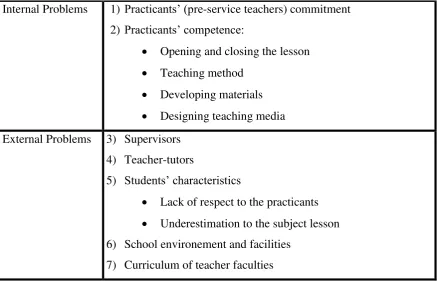
From the mentioned explanation, it can be summarized that the problems urged in
teaching practice (PPL) are:
Table 1.
Internal and external problems affecting the effectiveness of teaching practice program
Internal Problems 1) Practicants’ (pre-service teachers) commitment
2) Practicants’ competence:
Opening and closing the lesson Teaching method
Developing materials Designing teaching media
External Problems 3) Supervisors
4) Teacher-tutors
5) Students’ characteristics
Lack of respect to the practicants Underestimation to the subject lesson
6) School environement and facilities
7) Curriculum of teacher faculties
Solution
From these seven problems, it is formulated some solutions and recommendations. First, problem of practicants’ commitment can be overcome by a good monitoring system conducted by supervisors and teacher-tutors. All of these parties should have a control book
that records the presence and the progress of the practicants. When an indication of
Page | 9 Second, problem of practicants’ competence should be dealed with the faculty by evaluating and reviewing the lecturers’ performance. The results of review and evaluation
should be followed up by improvement actions, such as: training for lecturers, providing a
superior learning facilities, such as libraries and micro-teaching laboratory.
Third, problem of supervisors and teacher-tutors. They should be evaluated through
an evaluation meeting during teaching practice continuum. The meeting is to bolden the
commitment of supervisors and teacher-tutors in guiding and supervising the practicants. Fourth, students’ characters. It is the obligations of school principals and the teachers to approach the students to be respectful to the practicants and to follow the teaching and
learning activity actively and attentively.
Fifth, school quality. If it is possible, school should comply some criterias of a good
school which has qualified curriculum, qualified teachers, and enough facilities. By this
means, practicants can learn a lot about the best practice and the ideas in teaching and
learning. They can learn from the good teachers about how to vary the teaching activities,
how to manage difficult students, and such. Additionally, they can also learn from the
academic staff on how to manage the administration stuff in supporting the teaching and
learning. They also learn from the school environment on how to create condusive
atmosphere for students to learn comfortably.
Sixth, teacher faculties should change the selection system for recruiting the new
students. For instance, conducting an in-depth interview to explore the interest and the basic
competence of teacher candidate related to teaching profession. Without passion in teaching,
it is impossible to have qualified teachers who teach by heart. In FITK UIN Syarif
Hidayatullah Jakarta for instance, this mode of recruitment does not exist. Preparing
professional teachers is not enough by completing 7 semesters of learning and 1 semester of
conducting teaching practice. Instead, it is the input quality of the students that decide. Table
2 describes the concept of developing future professional teachers.
Finally, teaching practice itself cannot effectively influence significantly in making
the professional teachers. Professional teachers are created from the tightly selected
candidates who are screened by their interest, passion, academic competence, and basic
teaching knowledge. Curriculum of teacher’s faculty should not only focuses on the learning,
but also to the improvement of language proficiency, writing skill, and researching skill.
Page | 10 Table 2. Concept Framework of Preparing Professional Teacher Candidates
The implementation of teaching practice (PPL) still requires some improvements,
ranging from curriculum LPTKs, lecturers, teachers, students, and schools. LPTK
cooperation with the school is not only limited to sending students to the school, but also to
answer the problems which have emerged during the PPL. PPL effectiveness is highly
dependent on the competence of the practicants, practicants’ commitment, tutors and
supervisors, as well as the school quality. Student competence is highly dependent on the
Page | 11 References
Arsan, H.W. (2007). “Efektivitas Program Asistensi dalam Menyiapkan Mahasiswa
Melaksanakan Praktik Pengalaman Lapangan (PPL) Program Studi Pendidikan Teknik Mesin Universitas Negeri Malang.”Skripsi. Jurusan Pendidikan Teknik Mesin Fakultas Teknik Universitas Negeri Malang.
Darling-Hammond, L. dan Bransford, J. (Eds). (2005). Preparing Teacher for A Changing World: What Teacher Should Learn and Be Able To Do. San Francisco: Jossey-Bass. Debling, G. “The Employment Department/Training Agency Standards Program and NVQs: Implications for Education”, dalam Burke, J.W. (Ed.). (1995). Competency Based Education and Training. London-New York-Philadelphia: The Falmer Press. H. 77-94.
Horowitz, et al. “Educating Teachers for Developmentally Appropriate Practice,” dalam Darling-Hammond, L. dan Bransford, J. (Eds). (2005). Preparing Teacher for A Changing World: What Teacher Should Learn and Be Able To Do. San Francisco: Jossey-Bass. H. 88-125.
Huda, S. (2011). “Problematika Mahasiswa UIN Sunan Kalijaga Yogyakarta Jurusan PBA
dalam Praktik Pembelajaran Bahasa Arab di MAN Yogyakarta I Tahun Ajaran 2009-2010.”Skripsi. UIN Sunan Kalijaga Yogyakarta.
Ilmi, H. (2013). “Efektifitas PPL-KKN Integratif dalam Pembentukan Calon Guru bahasa Arab Profesional di MTsN Piyungan Bantul Yogyakarta.” Skripsi. Yogyakarta: Jurusan Pendidikan bahasa Arab Fakultas Tarbiyah dan Keguruan UIN Sunan
Kalijaga.
Izzah, N. (2009). “Analisis Kemampuan Mengajar Mahasiswa Program Studi Pendidikan Matematika Fakultas Keguruan dan Ilmu Pendidikan Universitas Sebelas Maret pada Pelaksanaan Program Pengalaman Lapangan (PPL) Tahun Akademik 2009/2010.” Skripsi. Fakultas Keguruan dan Ilmu Pendidikan. Universitas Sebelas Maret Surakarta.
Khumaidi, A. (2012). “Pengaruh Peran Dosen Pembimbing Lapangan dan Peran Guru
Pamong Terhadap Prestasi Mahasiswa PPL (Studi Kasus Pada Mahasiswa Program
Studi Pendidikan Ekonomi Fakultas Ekonomi Universitas Negeri Malang Angkatan 2008).” Skripsi. Jurusan Pendidikan Ekonomi Fakultas Ekonomi Universitas Negeri Malang.
Page | 12 Maharani, D.A. (2006). “Kinerja guru PPL Pendidikan Jasmani Semester Ganjil Tahun
2006-2007Mahasiswa Jurusan Ilmu Keolahragaan Universitas Negeri Malang.” Skripsi. Jurusan Ilmu Keolahragaan Fakultas Ilmu Pendidikan, Universitas Negeri Malang.
Musfah, J. (2012). Peningkatan Kompetensi Guru Melalui Pelatihan dan Sumber Belajar. Jakarta: Prenada. Cetakan Kedua.
Nugraha, S.A. (2013). “Penguasaan Kompetensi Pedagogik Mahasiswa Calon Guru Dalam
Pelaksanaan Program Pengalaman Lapangan (PPL) : Studi Deskriptif pada
Mahasiswa Jurusan Kurikulum dan Teknologi Pendidikan Konsentrasi Pendidikan
Guru TIK.”Skripsi. Universitas Pendidikan Indonesia.
Riyadi, S. (2006). “Studi korelasi antara kegiatan mikroteaching dengan keberhasilan praktik mengajar (PPL) Mahasiswa Jurusan Tarbiyah STAIN Pekalongan.” Skripsi. STAIN Pekalongan.
Rokhmawati, A. (2011). “Implementasi Praktik Pengalaman Lapangan (PPL) Berbasis
Lesson Study untuk Meningkatkan Keterampilan Mahasiswa Pendidikan Biologi
FMIPA UM dalam Memanfaatkan Media Pembelajaran dan Hasil Belajar Biologi Siswa SMA Negeri 9 Malang.” S-1 Thesis. Program Studi Pendidikan Biologi, Jurusan Biologi, Universitas Negeri Malang.
Safita, R. Pelatihan Keterampilan Mengembangan Media Pembelajaran Biologi oleh Mahasiswa Tadris Biologi Fakultas Tarbiyah IAIN STS Jambi (Studi Kasus Mata Kuliah Media Pembelajaran Biologi) - http://www.iainjambi.ac.id/e-journal - Vol 3 2012 .
Solihatun, S. (2012). “Profesionalitas Mahasiswa dalam Pelaksanaan PPL Jurusan Tarbiyah STAIN Pekalongan Angkatan 2007.”S-1Thesis. STAIN Pekalongan.
Tim Revisi Panduan PPKT. (2010). Panduan Praktik Profesi Keguruan Terpadu (PPTK). Jakarta: Laboratorium Fakultas Ilmu Tarbiyah dan Keguruan UIN Syarif Hidayatullah
Jakarta. 3rd Edition.