IJPSR (2015), Vol. 6, Issue 9 (Research Article)
Received on 05 March, 2015; received in revised form, 02 June, 2015; accepted, 30 June, 2015; published 01 September, 2015
FORMULATION DEVELOPMENT AND EVALUATION OF FENOFIBRATE AND
ROSUVASTATIN IN COMBINATION TABLETS AND RELEASE RATE IMPROVEMENT
Priyanka Sarkar*,Shaila Eamen, Md. Biplob Hossen and Md. Golam Mucktady
Department of Pharmacy, Primeasia University, Banani, Dhaka-1213, Bangladesh
ABSTRACT: The work was aimed to develop an immediate release tablet formulation of Fenofibrate and Rosuvastatin in combination for better treatment as well as management of hypercholesterolemia and prevention of cardiovascular diseases. The target was also set to improve the dissolution profile of poorly soluble Fenofibrate. For manufacturing these immediate release combined formulation tablets, Hot-Melt Technology was used which helped in enhancing dissolution profile and moreover, here amino acids are used in conjunction with other excipients. In the developed formulation, the amino acids imparted its action as excipient by helping in the solubilization process which facilitated the release rate of Fenofibrate. The formulated tables were then investigated for hardness test, friability test, weight uniformity and dissolution test. The results showed that all tablets met the expected requirements for these tests and the release rate of fenofibrate also got improved giving an excellent dissolution profile for both fenofibrate and rosuvastatin.
INTRODUCTION: Fenofibrate is one of the most commonly prescribed fibrate class of drug that has been used since 1975 and has a well known
efficacy and tolerability profile. Fenofibrate is
mainly used for primary hypercholesterolemia or mixed dyslipidemia. It works by reducing low-density lipoprotein (LDL), very low low-density lipoprotein (VLDL) and triglycerides levels as well as increasing high-density lipoprotein (HDL) levels.1-4
It appears to decrease the risk of cardiovascular
disease and possibly diabetic retinopathy in
diabetes mellitus patients.5
QUICK RESPONSE CODE
DOI:
10.13040/IJPSR.0975-8232.6(9).4075-79
Article can be accessed online on:
www.ijpsr.com
DOI link: http://dx.doi.org/10.13040/IJPSR.0975-8232.6(9).4075-79
FIG. 1: STRUCTURE OF FENOFIBRATE
Chemically Fenofibrate is
1-methylethyl-2-[4-(4-chlorobenzoyl)phenoxy]-2-methyl propanoate
molecular formula C20H21ClO4.
It is white crystalline powder stable under normal condition having molecular weight 360.83 and
melting point 80-850C.6
Keywords:
Fenofibrate, Rosuvastatin, Release Rate, Amino acids, Hot Melt Technology
Correspondence to Author: Priyanka Sarkar
Lecturer, Department of Pharmacy Primeasia University, 9, HBR Tower, Banani, Dhaka1213, Bangladesh.
Rosuvastatin belongs to a group of drugs called HMG CoA reductase inhibitors. Rosuvastatin reduces triglycerides and low-density lipoprotein in blood by inhibiting HMG-CoA reductase while increasing the levels of "good" cholesterol or high-density lipoprotein (HDL). It is used along with
exercises, supportive diet and weight-loss
supplements to treat high cholesterol and related conditions, and to prevent cardiovascular disease.
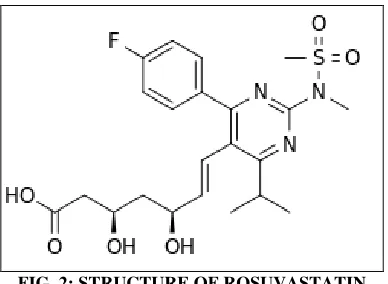
FIG. 2: STRUCTURE OF ROSUVASTATIN
Chemically Rosuvastatin is (3R,5S,6E)-7-[4-(4- fluorophenyl)-2-(N-methylmethanesulfonamido)-6-
(propan-2-yl)pyrimidin-5-yl]-3,5-dihydroxyhept-6-enoic acid and molecular formula
C44H54CaF2N6O12S2. It is white to off white
crystalline powder having molecular weight
1001.14 and melting point 1220C.7
Fenofibrate has the disadvantage of being poorly soluble in an aqueous medium which led to its having an insufficient dissolution profile. This in turn gives poor bioavailability following oral administration. Fenofibrate in combination with amino acids overcome this poor solubility and increases dissolution profile.
MATERIALS AND FORMULATION:
A combination of Fenofibrate and Rosuvastatin Calcium along with two amino acids is developed
using Fenofibrate, Rosuvastatin Calcium,
Microcrystalline Cellulose, Magnesium Stearate, Sodium Lauryl Sulfate, Cross Carmellose Sodium, Guar Gum, Poly Ethylene Glycol (PEG-1500), arginine, isoleucine.
A mixture of Fenofibrate, Rosuvastatin Calcium and polyethylene glycol 1500 (PEG) were physically mixed and then heated at 125°c until the
mixture was completely melted to clear liquid.
Table 1 showed all the ingredients and amounts of actives and excipients used in formulation.
The hot melt liquid was stirred gently for 1 minute and then removed from the heated water bath. The mixture was allowed to cool at room temperature. Within few minutes, the mixture was Solidified. After that it was pulverized and sieved through a #14 mesh sieve (US standard mesh).
TABLE 1: THE INGREDIENTS AND AMOUNTS OF ACTIVE AND EXCIPIENTS USED IN FORMULATION
Sl Ingredients Amounts
1. Fenofibrate 160 mg
2. Rosuvastatin calcium 10 mg 3. Microcrystalline cellulose 25 mg 4. Magnesium stearate 2 mg 5. Sodium lauryl sulfate 10 mg 6. Cross carmellose sodium 7 mg
7. Guar gum 10 mg
8. Poly ethylene glycol (PEG-1500) 15 mg
9. Arginine 2 mg
10. Isoleucine 2 mg
Manufacturing of Tablet:
Sieved powders were then mixed with other excipients and blended. Using Dry granulation method the blends were compressed into tablets.
Machine Name : Xinyuan Pharmaceutical
Machinary Co. Ltd. : Shanghai, Chaina ZP 35 E
Compression Force : 80 KN (Rotary tablet Press)
Tablet Dia : 9mm
RESULTS AND DISCUSSION: Hardness Test:
The testing involved subjecting the tablets to an increasing load until the tablets break or fracture. The force was applied along the radial axis of the tablets.
Table 2 showed all test results of tablet hardness we found that the hardness for all of the tables exceed the minimum force that is 40N. So the hardness for all newly formulated tablets met the requirement.
Friability Test:
Apparatus, India). The chamber was rotated for 100 times were removed. The loose dusts were cleared and the tablets were weighed again..
Percentages of Friability of the tablets were found out by the following formula:
Percentage Friability = W1– W2/W1 × 100
Where,
W1 = weight of tablets before testing
W2 = weight of tablets after testing
W1 = 246.7 + 249.5 + 246.4 + 248.1 + 248.9 +
250.2 + 248.7 + 250.2 + 245.8 + 243.0 = 2477
Weight of tablets after testing:
W2 = 245.9 + 248.3 + 245.6 + 245.7 + 248.0 +
244.9 + 242 + 239.5 + 248.8 + 248.9 = 2457.6
Percentage Friability = {(2477.5 - 2457.6) / 2477.5} × 100 % = 0.8032 %
For most products, the maximum weight loss of not
more than 1% is acceptable,8 so all of our tablets
met the requirement as we found the average percentage of friability 0.08032.
TABLE 2: THE TEST RESULTS OF TABLET HARDNESS
Tablets Serial No.
Hardness N
1 54
2 49
3 56
4 59
5 60
6 59
7 58
8 60
9 61
10 59
11 55
12 56
13 52
14 55
15 59
16 65
17 56
18 53
19 55
20 58
Weight uniformity test: Randomly 20 tablets were selected and individual weight of each tablet is taken. The average weight was then calculated and each individual weight was compared to the average weight.
Weight of 20 tablets:
X1, X2, X3, ………… X20
1st Tablet: 248 mg, 2nd Tablet: 247 mg, 3rd Tablet:
256 mg, 4th Tablet: 255 mg, 5th Tablet: 250 mg,
6th Tablet: 249 mg, 7th Tablet: 249 mg, 8th Tablet:
252 mg, 9th Tablet: 252 mg, 10th Tablet: 249 mg,
11th Tablet: 249 mg, 12th Tablet: 253 mg, 13th
Tablet: 250 mg, 14th Tablet: 247 mg, 15th Tablet:
258 mg, 16th Tablet: 256 mg, 17th Tablet: 248 mg,
18th Tablet: 244 mg, 19th Tablet: 243 mg, 20th
Tablet: 244 mg
The average weight of tablets = Total weight of tablets / Number of tablets So, the average weight of tablets, X = Total weight of tablets / Number of tablets = (248 + 247 + 256 + 255 + 250 + 250 + 249 + 249 + 252 + 249 + 249 + 253 + 250 + 247 + 258 + 256 + 248 + 244 + 243 + 244) mg / 20 = 249.85 mg
According to British Pharmacopoeia, not more than two of the individual weights deviate from the average
weight by more than ± 7.5%.8 So, all tablets met the B.P.
requirement.
Dissolution Study:
Dissolution medium: 0.375% sodium lauryl sulphate solution (SLS)
USP Apparatus: #2 (Veego Dissolution test apparatus, India)
Rpm: 100
Run Time: 45 minutes
vessels were withdrawn. The solution was then filtered and the filtrate was collected.
Preparation of standard solution: 21.1 mg of Then 5 ml of this solution was taken in another 100
ml volumetric flask and then diluted to 100ml by 0.375% sodium lauryl sulphate solution. Similarly, 17 mg of Fenofibrate standard was taken in a 100ml volumetric flask. Then 60 ml of 0.375% sodium lauryl sulphate solution was added to dissolve. Finally quantity sufficient 0.375% sodium lauryl sulphate solution was added to make 100ml. We calculated the % dissolution of Fenofibrate at 235nm by using the following equation:
We calculated the % dissolution of Rosuvastatin at 286 nm by using the following equation:
According to USP, In case of immediate/conventional-Release Drug Products, for six tablets, each unit is not less than 75%. So, all of our tablets meet the USP requirements of immediate-release tablets.
CONCLUSION: The formulation for combination tablet of Fenofibrate and Rosuvastatin was developed. Here, isoleucine and arginine worked as solubility enhancers, significantly increasing the release rate of Fenofibrate. All results implied that using hot-melt technology and amino acids as excipients significantly improved the dissolution profile.
REFERENCES:
1. Bruckert E, Labreuche J, Deplanque D, Touboul PJ, Amarenco P. Fibrates effect on cardiovascular risk is greater in patients with high triglyceride levels or atherogenic dyslipidemia profile: a systematic review and
meta-analysis. J Cardiovasc Pharmacol 2011; 57(2):267-72.
2. Lee M, Saver JL, Towfighi A, Chow J, Ovbiageli B. Efficacy of fibrates for cardiovascular risk reduction in persons with atherogenic dyslipidemia: a meta-analysis. Atherosclerosis 2011; 217(2):492-8.
3. Tenenbaum A, Medvedovsky D, Fisman EZ, Bubyr L, Matetzky S, Tanne D, et al. Cardiovascular events in patients received combined fibrate/statin treatment versus statin monotherapy: acute coronary syndrome Israeli surveys data. PLoS ONE 2012; 7(4):e35298-7.
4. Accord Study Group. Effects of combination lipid therapy in type 2 diabetes mellitus. N Engl J Med 2010; 362(17):1562-74.
5. Hermans MP. Impact of fenofibrate on type 2 diabetes patients with features of the metabolic syndrome: subgroup analysis from FIELD. Curr Cardiol Rev2010; 6(2):1128.
6. http://chemicalland21.com/bioscience/bp/FENOFIBRATE .htm
7. http://www.emedicinehealth.com/drug-rosuvastatin/article_em.htm
8. British Pharmacopeia. The Pharmaceutical Press, Her
Majesty’s Stationery Office, London. 1998; Vol. I. pp. 379, 969, 1242.
All © 2013 are reserved by International Journal of Pharmaceutical Sciences and Research. This Journal licensed under a Creative Commons Attribution-NonCommercial-ShareAlike 3.0 Unported License. This article can be downloaded to ANDROID OS based mobile. Scan QR Code using Code/Bar Scanner from your mobile. (Scanners are available on Google Playstore)
How to cite this article: