STUDY ON BIOETHANOL PRODUCTION USING RED SEAWEED
Eucheuma cottonii
FROM BONTANG SEA WATER
Krishna Purnawan Candra 1, Sarwono 2, Sarinah 2
1
Department of Agricultural Product Technology, Faculty of Agriculture , Mulawarman University, Jalan Tanah Grogot, Kampus Gunung Kelua, Samarinda -75119, Indonesia
2
Department of Aquaculture, Faculty of Fisheries and Marine Science, Mulawarman University, Jalan Kerayan, Kampus Gunung Kelua, Samarinda - 75119, Indonesia
Received : March, 22, 2011 ; Accepted : August, 8, 2011
ABSTRACT
The increasing of energy demand for public transport and a rise of oil prices lead to intense of using green fuel for sustainable future. Red-seaweed polysaccharide consists of carrageenan can be used for production of bio-etahanol, as it supplies monosacharides. In this study, the possibility of bioethanol production using red-seaweed as raw material was examined. The purpose of this research was to determine the method of bioethanol production using red-seaweed. Two separate anaerobic fermentation following acid hydrolysis, each by different type of yeast, bread yeast (Saccharomyces cereviceae) and tapai yeast were conducted in
this study. Acid hydrolysis for 2 h using H2SO4 of 5% at 100 oC of 100 g seaweed gel derived from 25 g of
red-seaweed showed an optimal hydrolysis process yielded sugar content of 15.8 mg mL-1. Tapai yeast was
not suitable for fermentation of red-seaweed hydrolysate, while Saccharomyces cereviceae gave an alcohol content of fermentate of 4.6% after 5-6 days of fermentation at room temperature.
Keywords: Red seaweed, Eucheuma cottonii, acid hydrolysis, bioethanol, Saccharomyces
cereviceae, bread yeast, tapai yeast.
Corresponding : Telp: +62-541-749352; Fax +62-541-738341; email : [email protected]
I
NTRODUCTION
The issue of renewable and eco-friendly energy resources combined with the high oil prices lead to the increasing of production of bioethanol every year (John et al., 2011). On the other hand, growth in the human population, pollution, overexploitation of land and lack of fresh water in the future will encourage use of seaweed (Jensen, 1993, Goh and Lee, 2010). Adam et al. (2009) compiled the huge potential of macroalgae compare to crops (wheat, maize, sugar beet, and sugar cane) by about 4-23 times for bioethanol production.
Indonesia with the longest seashore in the world has a huge potential in producing of seaweed. Using of seaweed as bioenergy source will be very important in the future including in Indonesia, because the use of bioethanol (E100) as energy source in transportation, industrial, and commercial is gradually planned to 15% to
national energy demand in January 2025 (Ditjen Minyak dan Gas Bumi Kementerian Energi dan Sumber Daya Mineral, 2010).
Utilization of seaweed as bioenergy source could be combined paralel with food industry as nowadays many reports showed that floating residue or by-product of seaweed processing for food can be converted to bioethanol (Ge et al., 2010), however this efforts still need more innovation before it goes commercially (Waltz, 2009). Different types of seaweed will produce different yield of bioethanol (Lee et al., 2009), and different locations (seawater nutrition) and seasons will give different growth (Kotiya et al., 2011).
Eucheuma cottonii is now
Kappaphycus alvarezii is still commercially
red-seaweed is the main red-seaweed cultured in Bontang seawater. Its production continued to increase, from 1.82 million tones in 2003 to 181.5 million tones in 2007 (Dinas Kelautan dan Perikanan Kota Bontang, 2007). The usage of the seaweed is very broad, it is used in food, pharmaceuticals, cosmetics industries (Hurtado and Agbayani, 2000) and recently it promises an important role in bioenergy sources (John et al., 2011, Harun et al., 2009, Yoon et al., 2010a, Lee et al., 2009, Wi et al., 2009, Horn et al., 2000, Kim et al., 2011). Because of the huge potential production of this seaweed in Bontang seawater, it is interesting to explore the possibilities to provide benefit from seaweed. As seaweed is composed by carbohydrate of more than 62% (Anggadireja et al., 2008), in this research we explored the this report, we determine the optimal condition for hydrolysis of Eucheuma cottonii, a red-seaweed from Bontang seawater, and the fermentation condition of the hydrolysate.
M
ATERIALS
A
ND
M
ETHODS
Eucheuma cottonii red-seaweed was delivered from Bontang seawater at Bontang Kuala Sub-regency, Bontang city. H2SO4, NaOH, Na2CO3,
rochelle salt, NaHCO3, Na2SO4, CuSO4.5H2O,
Na2HAsO4.7H2O NH4Mo, were purchaced from
Merck and Riedel-Haen. Bread yeast (Saccharomyces cereviceae) was purchased from local market (“Haan” brand), while
“tapai” yeast were purchased from local market in Bogor, West Java.
Collection and preparation of seaweed
Seaweed was collected from seaweed collector at Bontang Kuala Subdistrict of Bontang City, East Kalimantan Province, Indonesia. The harvested seaweed was sun dried and packed in plastic. The dried seaweed transported to Laboratory in Samarinda, then was stored at room temperature before use.
Gel preparation
Dry seaweed of 100 g was placed in water of 300 mL for 2 h to develop, followed by boiling at 80 oC until gel was formed and then cooled at room temperature. From this treatment, the weight of gel produced was about 400 g. The gel produced was then cutted and weighed for 100 g to be applied for acid hydrolysis.
Acid hydrolysis
25 mL of 5% H2SO4 (sulfuric acid) were poured
into a bottle glass containing 100 g seaweed gel, which was designed with reflux and boiled using stirrer hotplate for 30 to 120 minutes. The hydrolysis time was measured after the acid boiled. The hydrolysis temperature was maintained at 100 oC. The solution was then adjusted to pH 5 by adding dropwise of 0.1 M NaOH. Reducing sugar was measured from the hydrolysate using Nelson Somogyi method (Sudarmadji et al., 1984).
Fermentation
(hydrolysis time) i.e. 30, 60, 90, and 120 min. Fermentation of hydrolysate was performed with 4 levels of treatment (fermentation time). Each experiment was repeated for 3 times. Data were analyzed using ANOVA (F test) and continued by least significant difference (=5%). In fermentation step, two types yeast (bread yeast/Saccharomyces cereviceae and
“tapai” yeast ) were studied.
R
ESULTS
A
ND
D
ISCUSSION
Gel Preparation
Gel preparation for Eucheuma cottonii needs a portion of three times water of seaceds weight as reported by Syamsuar (2006) for general seaweed. In this experiment, we showed that the gel was not formed completely when less than 300 mL of water was used. On the other hand the gel was too soft when the water was added more than 300 mL. From 100 g of
Eucheuma cottonii, appoxincetely 400 g of seaweed gel was performed by adding 300 mL of water and boiled at 80 oC for 2 h.
Hydrolysis of Seaweed Gel
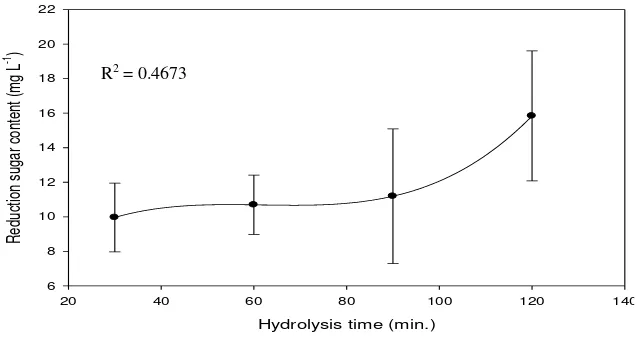
Acid hydrolysis of 100 g gel corresponded to 25 g of Eucheuma cottonii using 25 mL of sulfuric acid of 5% at 100 oC for 2 h gave reducing sugar in hydrolysate of about 16 mg mL-1 or the yield of sugar was 16 mg g-1 of dry seaweed. Hydrolysis time gave significant effect on sugar content of hydrolysate (Table 1.). The trend of the data following regression analysis (Fig. 1.) showing that the hydrolysis condition can be developed i.e. by extending the hydrolysis time or increasing the concentration of sulfuric acid, as well as increasing the hydrolysis temperature, as reported by Yoon et al. (2010). Rachmania et al. (2009) reported that temperature used in acid hydrolysis using sulfuric acid is 125-214 oC, and Sudjatmiko (2008) using sulfuric acid by concentration of 7%. Sulfuric acid is the best catalyst for hydrolyzing compare to that of nitric acid and chloric acid as reported by Surraya et al. (2008)
for starch from canna (“ganyong” in
Indonesian).
Table 1. Influence of fermentation time on alcohol content of fermentate
Hydrolysis time (min.) Reduction sugar content in hydrolysate (mg L-1)
30 (10.0 ± 2.0) a
60 (10.7 ± 1.7) a
90 (11.2 ± 3.9) a
120 (15.8 ± 3.8) b
Note: Data from three replications. The sugar reduction content followed by same character
showed no significant difference by least significant difference test at of 5%.
Fig. 1. Influence of hydrolysis time on reduction sugar content of seaweed hydrolysate by acid hydrolysis using 5% of sulfuric acid
Hydrolysis time (min.)
20 40 60 80 100 120 140
R
educt
ion
sug
ar cont
ent
(m
g
L
-1 )
6 8 10 12 14 16 18 20 22
Combination of chemical and enzymatic hydrolysis method of seaweed has been reported by Ge et al. (2010). Using seaweed waste, which are rich in cellulose (30%) and bit of cellobiose (2.2%), they reported that about 277.5 mg g-1 of glucose could be reached using method of enzymatic hydrolysis following mild acid pre-treatment using sulfuric acid (0.1% w/v, 121 oC, 1.0 h). Wi et al. (2009) also reported that pre-treatment using chloride will transform lignin to soluble compound without any significant loss of carbohydrate, and it could increased glucose yield up to 70% with contrast of only 5% was obtained from non pre-treatment samples of seaweed Ceylon mass (Gelidium amansii).
Fermentation
Seaweed hydrolisate (sugar concentration of 15.8 mg mL-1) produced by acid hydrolysis
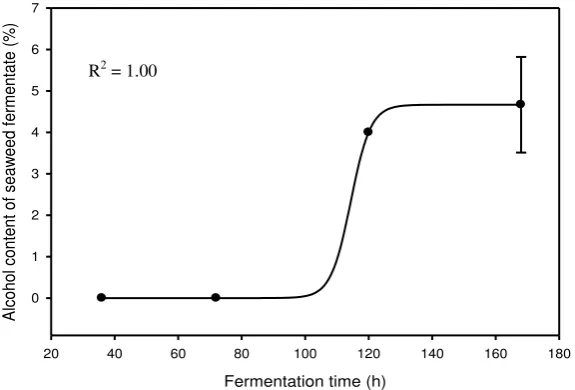
using 5% sulfuric acid at 100 oC for 2 h was used as raw material for fermentation process. The seaweed hydrolysate from 100 g of seaweed gel (25 g of seaweed) yielded alcohol maximal of about 4.6% in fermentate using bread yeast as fermentation agent (Table 2.). Regression analysis of the data of alcohol content in fermentate shows that for 100 g of seaweed, time fermentation to produce alcohol is around 130-140 h or about 5-6 days (Fig. 2). Time fermentation gave significant effect on alcohol content of fermentate using bread yeast. However, the yield was still low compare to work of Ge et al. (2010), which could get about 41.2% (corresponds to 80% of theoritical yield) of ethanol from seaweed waste hydrolysate fermentation using Saccharomyces cereviceae
as bio-agent. In this experiment we showed that tapai yeast was not suitable for bio-ethanol fermentation of seaweed hydrolysate.
Table 2. Influence of fermentation time on alcohol content of fermentate
Fermentation time (h) Alcohol content in fermentate (%)
36 (0.0 ± 0.0) a
72 (0.0 ± 0.0) a
120 (4.0 ± 0.0) b
168 (4.6 ± 0.0) b
Note:
Data from three replications. The alcohol content followed by same charactershowed no significant difference by least significant difference test at of 5%
Fig. 2. Influence of fermentation time on alcohol content of fermentate of seaweed hydrolysate by acid hydrolysis using 5% sulfuric acid
Fermentation time (h)
20 40 60 80 100 120 140 160 180
Alc
oho
l co
ntent
of
s
eaw
eed
f
er
m
entate
(%
)
0 1 2 3 4 5 6 7
In preliminary experiment we have showed that ”tapai” yeast we used is appropriate for “tapai” fermentation (Indonesian traditional fermented food from cassava). Azmi et al., (2010) has reported that tapai yeast is the best biological agents among three yeast of Saccharomyces cereviceae,
Candida tropicalis, and “tapai” yeast, which recombinant bio-agent or simultaneous saccharification and fermentation (SSF). Bioethanol production from seaweed (Laminaria japonica) was demonstrated by Kim et al. (2011) using ethanogenic recombinant Escherichia coli KO11 with ethanol production of 0.4 g ethanol per g of carbohydrate, while SSF method was reported by Choi et al., (2009) using cassava as carbohydrate source and Saccharomyces cereviceae as bio-agent could yield alcohol of 90.7%.
C
ONCLUSION
Acid hydrolysis for 2 h using H2SO4 of 5% at
100 oC of seaweed gel derived from 100 g of red seaweed (Eucheuma cottonii) yielded sugar content of about 15.8 mg mL-1 in hydrolysate.
“Tapai” yeast was not suitable for bioethanol fermentation of seaweed hydrolysate, while bread yeast (Saccharomyces cereviceae) gave an alcohol content of fermentate of about 4.6% after 5-6 days (130-140 h) of fermentation at room temperature.
R
EFERENCES
Adam J.M., J.A. Gallagher, and I.S. Donnison. 2009. Fermentation study on Saccharina latissima for bioethanol production considering variable pre-treatment. J. Appl. Phycol. 21: 569-574.
Anggadireja J.T., A. Zatnika, H. Purwanto, and S. Istiani. 2008. Rumput Laut. Penebar Swadaya, Jakarta. (in Indonesian)
Azmi A.S., G.C. Ngoh, M. Mel, and M. Hasan. 2010. Ragi Tapai and Saccharomyces
cerevisiae as Potential Coculture in Viscous Fermentation Medium for Ethanol Production. AJB. African. J. Biotechnol. 9: (42): 7122-7127.
Choi G-W., H-W. Kang, and S-K.Moon. 2009. Repeated-batch fermentation using flocculent hybrid, Saccharomyces cereviceae CHFY0321 for efficient production of bioethanol. Appl Microbiol Biotechnol 84: 261-269.
Dinas Kelautan dan Perikanan Kota Bontang. 2007. Buku Saku Statistik, Potensi Rumput Laut Kota Bontang. Dinas Kelautan dan Perikanan Kota Bontang, Bontang. (in Indonesian )
Ditjen Minyak dan Gas Bumi Kementerian Energi dan Sumber Daya Mineral. 2010. Blue Print 2006-2025, Pengembangan Bahan Bakar Nabati untuk Percepatan Pengurangan Kemiskinan dan Pengangguran. 2 ed. Ditjen Minyak dan saccharafication techniques of seaweed wastes for the transformation of ethanol.
Renew Energy. 36(1):84-89.
Goh C.S. and K.T. Lee. 2011. A visionary and conceptual macroalgae-based third-generation bioethanol (TGB) biorefinery in Sabah, Malaysia as an underlay for renewable and sustainable development.
Renew Sustain Energy Rev 14: 842-848.
Harun R., M.K. Danquah, and G.M. Forde. 2009. Microalgal biomass as fermentation feedstock for bioethanol production. J. Chem. Technol. Biotechnol. 85: 199-203.
Horn S.J., I.M. Aasen, and K.Østgaard. 2000. Ethanol production from seaweed extract.
Hurtado A.Q. and R.F. Agbayani. 2000. The Farming of the Seaweed Kappaphycus. Aquaculture Extension Manual No.32. SEAFDEC, Tigbauan, Iloilo, Philippines.
Jensen A. 1993. Present and future needs for algae and algal products. Hydrobiologia
260/261: 15-13.
John R.P., G.S. Anisha, K.M. Namoothiri, and A. Pandey. 2011. Micro and macroalgal biomass: A renewable source for bioethanol. Bioresource Technol 102: 186-193.
Kim N-J, H. Li, K. Jung, H.N. Chang, and P.C. Lee. 2011. Ethanol production from marine algal hydrolysate using
Escherichia coli KO11. Bioresource Technol 102: 7466-7469.
Kotiya A.S., B. Gunalan, H.V. Parmar, M. Jaikumar, D. Tushar, B. Solanski Jitesh, and N.P. Makwana. 2011. Growth comparison of the seweed Kappaphycus alvarezii in nine different ciastal areas of Gujarat coat, India. Advances in Applied Science Research 2: 99-106.
Lee S-M., H. Kim, H-Y. Cho, H. Joo, and J-H. Lee. 2009. Production of bio-ethanol from brwon algae by physicochemical hydrolysis. J Korean Ind Eng Chem 20: 517-521.
Rachmania O, A. Krishnanta, and G. Ricardo. 2009. Acid hydrolysis pretreatment of bagasse lignocellulosic Material for bioethanol production. Paper on Seminar
Nasional Teknik Kimia “Kejuangan”,
Yogyakarta, 28 January 2009. (in Indonesian )
Syamsuar. 2006. Karakteristik Karagenan Rumput Laut Eucheuma cottonii pada Umur Panen, Konsentrasi KOH dan Lama Ekstraksi. Master Thesis. School of
Graduate Program, Bogor Agricultural University, Bogor. (in Indonesian)
Sudarmadji S., B. Haryono, and Suhardi. 1984. Prosedur Analisa untuk Bahan Makanan dan Pertanian. Liberty, Yogyakarta. (in Indonesian)
Sudjatmiko, H. 2008. Pengaruh Alkali Pretreatment pada Pemanfaatan Limbah Kulit Nanas untuk Pembuatan Bioetanol, Tugas Akhir Teknik Kimia, Politeknik Negeri Samarinda, Samarinda. (in Indonesian)
Surraya L., S. Eka, and S. Dede. 2008. Konversi Pati Ganyong (Canna edulis
Ker.) menjadi Bioetanol Melalui Hidrolisis Asam dan Fermentasi. Jurnal Biodiversitas 9(2): 112-116. (in Indonesian)
Waltz E. 2009. Biotech’s green gold? Nat Biotechnol 27: 15-18.
Wi S.G., H.J. Kim, S.A. Mahadevan, D-J. Yang, and H-J.Bae. 2009. The potential value of seaweed Ceylon moss (Gellidium amansii) as an alternative bioenergy rersource. Bioresource Technol 100: 6658-6660.
Yoon J.J., Y.J. Kim, S.H. Kim, H.J. Ryu, J.Y. Choi, G.S. Kim, and M.K. Shin. 2010a. Production of polysccharides and corresponding sugars from red seaweed.
Advanced Material Research 93/94: 463-466.